MCP (Model Context Protocol) is an open standard that connects AI applications to tools, data, and business systems in 1 common way. On 12 November 2026, the current version is 2026-07-28, and the next version is scheduled for 30 March 2027.
This article is about the Model Context ProtocolMCPA standard that lets an AI program use your tools and data under clear permissions.Open the glossary for AI. The abbreviation MCP has other meanings, for example the Microsoft Certified Professional certification. This page does not discuss those meanings.
What does MCP mean, and who manages it?
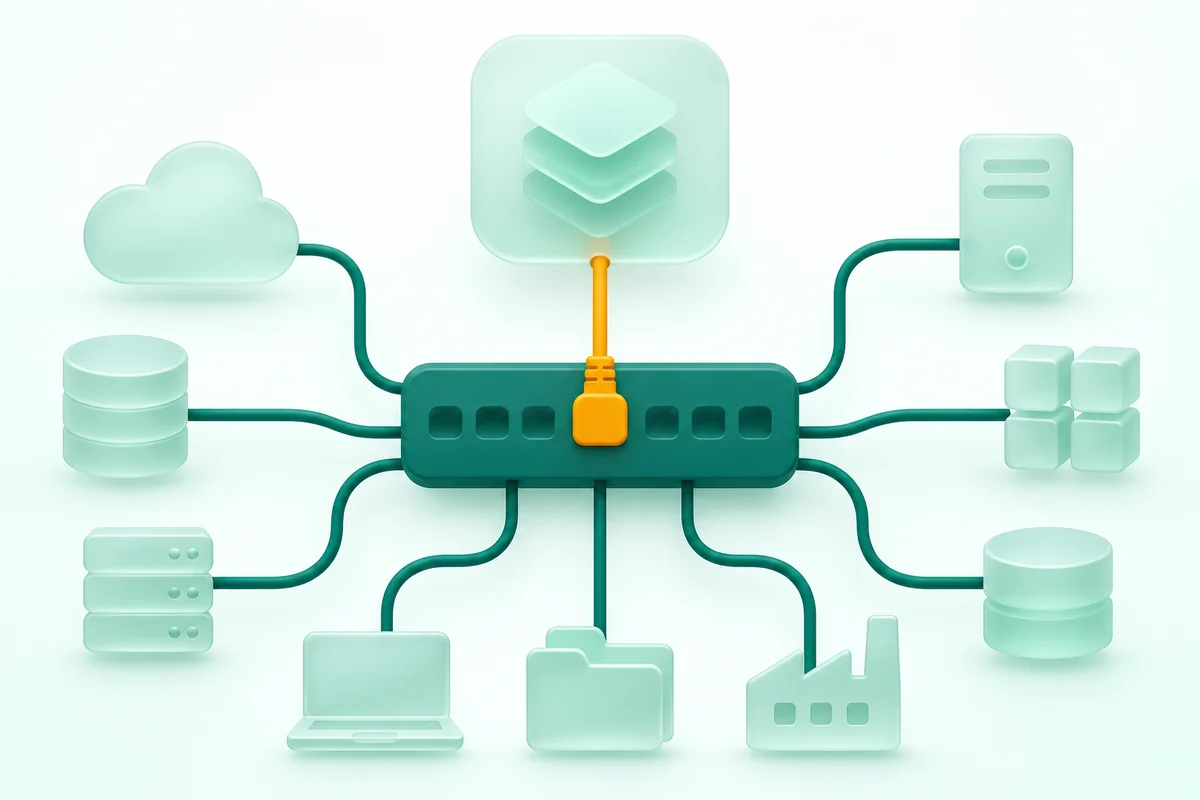
MCP is a protocol that controls how an AI application requests data and runs actions in another system. Without MCP, each AI application needs its own integration for each system. With MCP, many AI applications that support the protocol can use 1 MCP server.
Anthropic released MCP in November 2024 with specification version 2024-11-05. On 9 December 2025, Anthropic gave MCP to the Agentic AI Foundation, a directed fund under the Linux Foundation. The MCP maintainer team did not change.
The use of MCP increased quickly. On 9 December 2025, the official MCP blog reported more than 97 million SDK downloads each month and 10,000 active servers. On 28 July 2026, the official MCP blog reported close to 500 million downloads each month across the Tier 1 SDKs. The TypeScript SDK and the Python SDK each passed 1 billion total downloads.
For a shorter explanation for business owners, read What Is MCP: An Explanation for Business Owners.
How does MCP work?
MCP works with 3 roles: the host, the MCP client, and the MCP server. The host is the application that you use, for example ClaudeClaude ProThe paid subscription for the Claude AI assistant from Anthropic. It unlocks connectors to outside tools.Open the glossary or ChatGPT. The MCP client is inside the host and talks to 1 MCP server.
| Role | Example | Task |
|---|---|---|
| Host | Claude, ChatGPT, Cursor, VS Code | Receives your instruction and shows the answer of the model. |
| MCP client | A component inside the host | Sends requests to 1 MCP server and brings the results back. |
| MCP server | Stock server, CRM server, Google Drive server | Gives access to 1 system through tools, resources, and prompts. |
An MCP server gives 3 types of features. A tool runs an action, for example "create an invoice". A resource gives data to read, for example the content of a file. A prompt gives a ready-to-use instruction template.
A typical request follows these steps:
- You write an instruction in the host, for example "check the stock of 250 g coffee".
- The model selects a tool from the tool list of the MCP server.
- The host can ask for your approval before the tool runs. The approval rules are different in each host.
- The MCP client sends the request to the MCP server.
- The MCP server runs the tool on your system and sends the result back.
- The model writes the answer from that result.
For each role in detail, read How MCP Works: Host, Client, and Server. For a comparison with a normal APIAPIThe official door 2 systems use to exchange data, without anybody copying it by hand.Open the glossary, a plugin, and RAG, read MCP vs API vs Plugin vs RAG.
What changed in MCP version 2026-07-28?
Version 2026-07-28 changes MCP from a stateful protocol to a stateless request/response protocol. This version became final on 28 July 2026.
| Change | Content | Effect for MCP server owners |
|---|---|---|
| No handshake and no session | The initialize/initialized exchange and the Mcp-Session-Id header are retired (SEP-2575). Each request carries the protocol version, the client identity, and the client capabilities. | A server that keeps state for each session must migrate. |
| Optional discovery | The server/discover method gives the server capabilities when the client asks for them. | A client can read the capabilities before the first request. |
| Routing with headers | The method name and the tool name are in the Mcp-Method and Mcp-Name headers. | A gateway can route requests and check permissions from the headers. |
| Cacheable list results | List responses carry cache hints and a fixed order. | A client can keep the tool catalog for a longer time. |
| Extension framework | Tasks, MCP Apps, and Enterprise-Managed Authorization are extensions. | New features arrive as optional extensions. |
| Stricter authorization | RFC 9207 issuer validation. A move from Dynamic Client Registration to client metadata documents. | Check the OAuth flow of your remote MCP server. |
| Deprecated | Roots, Sampling, Logging, and the legacy HTTP+SSE transport. | These features continue to work for a minimum of 12 months. Do not use them in a new server. |
The transition window is important for your budget. Deprecated features continue to work until at least July 2027, so you have time to plan the migration. For the history of the 5 MCP versions since 2024, read 5 MCP Versions from 2024 to 2026 (in Indonesian).
What is new in MCP in November 2026?
The MCP project published 3 official updates in the last 2 weeks: a new Tier 1 SDK, a draft file extension, and a fixed release schedule.
- 30 October 2026: the Ruby SDK became Tier 1. There are now 6 Tier 1 SDKs: TypeScript, Python, C#, Go, Rust, and Ruby. A Tier 1 SDK supports a new specification version on its release date. Source: MCP blog, 30 October 2026.
- 10 November 2026: a draft extension for file uploads and downloads. The extension name is io.modelcontextprotocol/files, and it works with revision 2026-07-28 and later. It is experimental and has no reference implementation yet. The team plans a stable version before the end of 2026. Source: MCP blog, 10 November 2026.
- 11 November 2026: a release every 6 months. New specifications release on the last Tuesday of March and September. The next version, 2027-03-30, is scheduled for 30 March 2027. Existing clients and servers do not need a change because of this announcement. Source: MCP blog, 11 November 2026.
With this schedule, you can plan an MCP server review 2 times each year, on the release dates.

Which AI applications support MCP?
ChatGPT, Claude, Cursor, Gemini, Microsoft Copilot, and Visual Studio Code support MCP as clients, according to the official MCP blog on 9 December 2025.
The support is not the same in each application. The transport, the OAuth sign-in, and the approval method are different. For a comparison of 10 clients on 13 September 2026, read MCP Clients 2026: Claude, ChatGPT, Gemini, OpenClaw, and Hermes Agent. Guides for each product:
How do you start to use MCP?
Select 1 of 3 paths, based on your requirement and the skills of your team.
| Path | Good for | First step | Main risk |
|---|---|---|---|
| 1. Use a ready connector | Teams without a developer | Turn on an official connector in Claude or ChatGPT, for example Google Drive. | The connector reads data with the permissions of your account. |
| 2. Install a local MCP server | Developers and tests | Run an open source MCP server through stdio, then connect it to Claude Code or Cursor. | A local server runs with the access rights of your laptop. |
| 3. Build your own MCP server | Businesses with an ERPERPOne system that keeps the sales, purchasing, stock, and finance of a company in one set of data.AI-native ERP build, a database, or an internal application | Write the first 3 tools, the access rights, and the audit log before you write code. | Tools that change data need approval and access limits. |
For path 3, read MCP for small businesses: the first 3 tools, the checklist before you build an MCP server, and the cost to build an MCP server.
On each path, apply 3 security rules: give the minimum access, require approval for tools that change data, and keep an audit log. For the details, read MCP Server Security: Access Rights, Approval, and Audit Log.
Map of MCP articles on Rama Digital
We wrote 18 MCP articles, and this list helps you select the next article to read.
Basics
- What Is MCP: An Explanation for Business Owners
- How MCP Works: Host, Client, and Server
- MCP vs API vs Plugin vs RAG
- 5 MCP Versions from 2024 to 2026 (in Indonesian)
For businesses
- Benefits of MCP for companies
- MCP server examples for businesses
- MCP for small businesses: the first 3 tools
- The cost to build an MCP server
For developers
- Checklist before you build an MCP server
- MCP server hosting: Cloudflare Workers, VPS, or stdio
- MCP server security
- MCP Python SDK 2.3.0
- MCP TypeScript SDK 2.3.0
For each application
Questions and answers
Is MCP the same as an API?
No. An API is a door to 1 system, in the format of that system. MCP is a standard format on top of APIs, so many AI applications can use 1 MCP server.
Do old MCP servers continue to work after version 2026-07-28?
Yes, when the client and the server agree on the old version, because the protocol version is negotiated. Deprecated features continue to work for a minimum of 12 months. A server that wants version 2026-07-28 and uses Mcp-Session-Id must migrate.
When does the next MCP version release?
Version 2027-03-30 is scheduled for 30 March 2027. From this cycle, MCP releases a specification 2 times each year, on the last Tuesday of March and September.
Does Anthropic still own MCP?
No. Since 9 December 2025, MCP is part of the AgenticAgenticA way of working where an AI agent performs the routine steps and a person checks and approves the result.Open the glossary AI Foundation, a directed fund under the Linux Foundation. Anthropic continues to help develop MCP, and the maintainer team did not change.
Is MCP safe for business data?
MCP does not make data safe by itself. Safety depends on the access rights of the MCP server, approval for tools that change data, and the audit log. Version 2026-07-28 adds OAuth issuer validation (RFC 9207) for remote servers.
Next step
If you have an MCP server, check its protocol version and SDK version this week. Record the deprecated features that you still use, then plan the migration before July 2027. If you do not have an MCP server, start with a list of the first 3 tools and their access rights.
Do you need an MCP server for an ERP, a database, or an internal application? See the scope and the price on MCP Server Development Service.
Sources
- Model Context Protocol: Versioning, read on 12 November 2026.
- The 2026-07-28 Specification, 28 July 2026.
- MCP joins the Agentic AI Foundation, 9 December 2025.
- The Official Ruby SDK for MCP Reaches Tier 1, 30 October 2026.
- Exploring File Uploads and Downloads in MCP, 10 November 2026.
- A More Predictable Release Cycle for MCP, 11 November 2026.