Direct answer: MCPMCPA standard that lets an AI program use your tools and data under clear permissions.Open the glossary for a small business starts with 1 source system and 3 read tools. The 3 tools: check stock or price, find customer history, and a daily sales recap. All 3 answer the questions the owner asks every day without changing data. Write tools, such as an invoice draft or a WhatsApp reply, come in phase 2 with human approval. The Starter package at IDR 2,500,000 covers 1 MCP server, 1 source system, and up to 3 read tools in 3–5 working days.
Main condition: this pattern holds when business data lives in 1 place a program can read. Examples: a spreadsheet, a POS app with export or an APIAPIThe official door 2 systems use to exchange data, without anybody copying it by hand.Open the glossary, or a WhatsApp CRM with an API. Limit: this article promises no revenue increase and does not replace the POS app. Hosting, model API cost, and AI client subscriptions are paid separately. Customer data remains subject to Law 27/2022 (the PDP Law).
We wrote this guide on 13 September 2026 from the official MCP specification, the Claude, OpenClaw, and Cloudflare Workers documentation, and the PDP Law. Prices are as of 13 September 2026; the schedule starts once access to the source system is complete. The example in this article uses dummy data; the shop, customer, and product names are not real.
The problem: the owner asks, staff open 3 apps
A business owner asks the same questions every day. They ask: how much stock is left, what a price is, what a returning customer last bought, and yesterday's total sales. The answers sit scattered across a spreadsheet, a POS app, and WhatsApp chat.
Staff open 3 apps for 1 answer, then type the result back to the owner. A plain AI chat with no connection can only answer from text someone pastes in; it cannot read a spreadsheet or a POS app directly. The official documentation says MCP is a standard way to connect AI applications to external systems, like a USB-C port for AI. Model Context Protocol (MCP) connects existing systems to an AI agentAI agentAn AI program that performs work steps by itself, for example reading a message, drafting a reply, and recording the result.Open the glossary through 1 small server, with no rebuild of that system. The basics are in What Is MCP (Model Context Protocol)?.
Why start with read tools, not write tools
The MCP specification marks a read tool with the readOnlyHint annotation. A tool with this flag does not change data on the source system. Source: the official Model Context Protocol schema.
A write tool, such as an invoice draft or an automatic WhatsApp reply, must pass through a human who can deny the call. For a small business, that human is the owner, tapping approve or deny each time. Sources: the MCP tools specification and OWASP LLM06 on excessive agency.
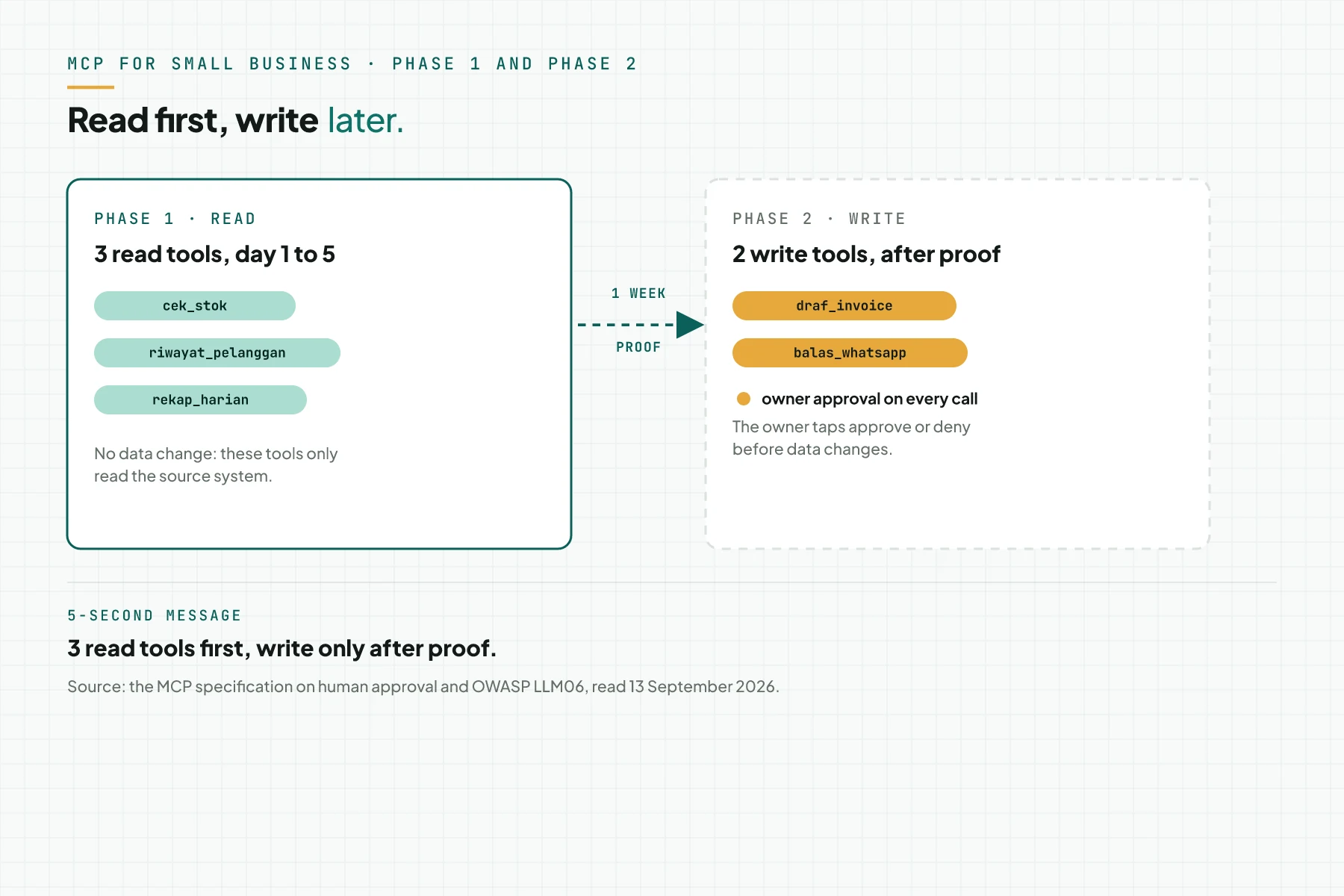
Reading first proves the benefit within 1 week with no risk of changed data. The owner sees the 3 read tools answer daily questions, then adds write tools once the result earns trust.
Tool 1: check stock or price
Source system: a stock spreadsheet or a POS app with export. Tool argument: a product name or code. Result: quantity, price, and the last update date.
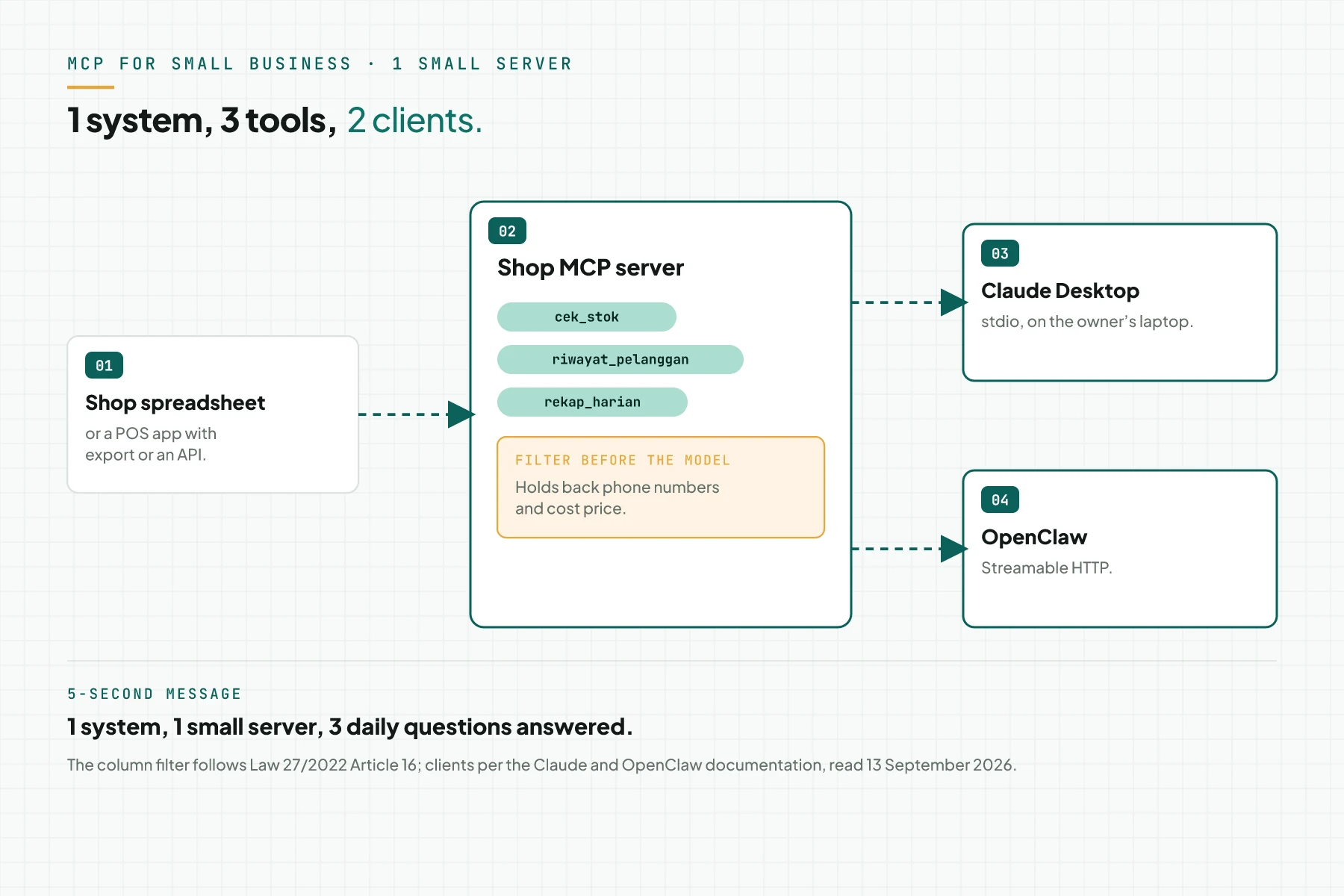
Filter: hide the cost price when staff use the tool, not the owner. Test cases: a product that exists, a product that does not, and 2 similar product names. For a missing product, the tool returns isError: true so the model can fix the input instead of guessing an answer. Source: the MCP tools specification.
Tool 2: find customer history
Source system: a WhatsApp CRM or a customer sheet. Tool argument: a customer name or code. Result: the last 5 transactions and the customer's status.
The phone number and address are filtered before the result reaches the AI model. The business owner remains the Data Controller under the PDP Law, and the tool shows only the data someone needs to see. Source: Law No. 27 of 2022 on Personal Data Protection. Test case: 2 customers with the same name.
Tool 3: daily sales recap
Source system: a sales sheet or a POS export. Tool argument: 1 date or 1 date range. Result: total sales, the transaction count, and the top 3 products.
Design a concise result. Claude's tool result limit is about 150,000 characters, source: the Claude connector documentation. A monthly recap stays far below that limit. The tool must not send every raw row to the model. Summarise it into a total and a top list first.
Table: 3 tools, source system, question answered, risk
The table below lists the 3 phase 1 read tools, then 1 phase 2 write-tool row for contrast.
| Tool | Source system | Question answered | Filtered column | Risk if wrong | Phase |
|---|---|---|---|---|---|
| cek_stok / cek_harga | A stock spreadsheet or POS app | "How much stock is X?" "What is the price of Y?" | cost price (when staff use it) | A stale answer if the sheet is not updated | 1 (Starter) |
| riwayat_pelanggan | A WhatsApp CRM or customer sheet | "What did customer A last buy?" | phone, address | Same name mixed up; personal data reaches the model | 1 (Starter) |
| rekap_harian | A sales sheet or POS export | "Yesterday's sales? Top 3 products?" | none | Result too long if every row is sent | 1 (Starter) |
| draf_invoice / balas_whatsapp | POS app or WhatsApp CRM | "Draft an invoice for A" | per template | Sent to the wrong customer; owner approval required | 2 (IDR 600,000 per tool, or Standard) |
AI clients a small business can use
Claude (claude.ai, Claude Desktop, mobile) supports remote MCP custom connectors. The Free plan is limited to 1 connector; Pro and Max allow more. Source: the Claude custom connector guide. Claude Desktop also runs a local server through its configuration file (stdio), with no hosting cost. Source: the MCP server build documentation.
ChatGPT connects to a remote server through Developer mode in Settings, by entering the server URL; it does not run a local server. Source: the OpenAI MCP documentation.
OpenClaw connects with the openclaw mcp add command. The OpenClaw tool policy still applies to MCP tools, so connecting a server does not bypass the rules already set. Source: the OpenClaw MCP documentation. What OpenClaw is and why it matters for business operations (in Indonesian) covers this client in more detail.
MCP clients follow different protocol revisions. The owner does not need to know the revision details; pick a client that supports the latest revision. The technical detail is in the 5 MCP versions article (in Indonesian).
A small business has 2 hosting choices. The first is a local stdio server on the owner's laptop with no hosting cost. The second is Cloudflare Workers, with a Free plan of 100,000 requests per day. Source: Cloudflare Workers pricing.
Cost: the Starter package at IDR 2,500,000
The Starter package at IDR 2,500,000 is fixed and takes 3–5 working days. It covers: 1 MCP server, 1 source system, up to 3 read tools, stdio or Streamable HTTP, 1 API key, a test with 1 AI client, and documentation plus an SOP. Full package coverage is on the MCP Server Development Service page.
Phase 2 adds a write tool with owner approval at IDR 600,000 per tool. Hosting and basic monitoring cost IDR 900,000. A business with larger needs can move up to the Standard package at IDR 6,500,000.
Paid separately: hosting (Cloudflare Workers or a VPS), model API cost, source system licenses, and monthly maintenance (the OS Care Retainer). The full formula and the 3-package comparison are in MCP server development cost.
Example: a shop's first week with 3 tools
The simulation below uses dummy data from 1 bakery with 3 read tools connected to Claude Desktop.
| Day | Input (owner's question) | Recorded (in the MCP server) | Output (the answer shown) |
|---|---|---|---|
| Monday | "How much flour is in stock?" | cek_stok {product: "flour"}; 2 matching rows; result with the update date | "Cakra flour 12 kg, Segitiga flour 8 kg, as of Monday 08:00." |
| Tuesday | "What did Mrs. Rina last order?" | riwayat_pelanggan {name: "Rina"}; 2 customers named Rina; phone filtered | "There are 2 customers named Rina: R-014 (Bogor) and R-102 (Depok). Which one?" |
| Wednesday | "Yesterday's sales?" | rekap_harian {date: "2026-06-23"}; 37 transactions | "IDR 4,120,000 from 37 transactions. Top: brownies, pandan cake, pull-apart bread." |
| Thursday | "Draft an invoice for R-014." | No write tool exists; the model does not call a tool | "This server only reads. Create the invoice in the POS app, or add a write tool in phase 2." |
| Friday | "Which products have stock under 5?" | cek_stok {threshold: 5}; 4 products | "4 products under 5: yeast, chocolate bar, condensed milk, cupcake liners. No cost price." |
Note: the shop, customer, and product names, and the numbers in the table, are dummy data. A customer code replaces the phone number in every answer.
Owner checklist before you order
- Pick 1 source system where the data is most complete. Owner: the business owner. Evidence: the file or app name.
- Write down the 3 questions asked most often last week. Owner: the business owner. Evidence: a note of the 3 questions.
- Clean up the columns: 1 product code per row, 1 customer code per person. Owner: the admin. Evidence: a sheet with no duplicate rows.
- Mark the columns that must not leave the system: phone, address, cost price. Owner: the business owner. Evidence: a column list.
- Pick 1 AI client you already use: Claude, ChatGPT, or OpenClaw. Owner: the business owner. Evidence: the client name and plan.
- Stop criterion: if those 3 questions come up fewer than 3 times a week, wait and clean up the data first.
Frequently asked questions
How much does an MCP server cost for a small business? The Starter package at IDR 2,500,000 covers 1 source system and up to 3 read tools, done in 3–5 working days. Hosting, model API cost, and AI client subscriptions are paid separately.
Do I have to replace my spreadsheet with a database? No. A spreadsheet can serve as the source system as long as its columns stay clean, for example 1 product code per row. Move to a database later if duplicate rows start to confuse the tool's answers.
Which AI client is the cheapest to start with? Claude Free allows 1 custom connector, and a local stdio server in Claude Desktop needs no hosting cost. AI client plan prices are not covered here; check each client's own page.
Is customer data safe? The tool filters the phone number and address before the result reaches the AI model. The business owner remains the Data Controller under the PDP Law.
When can I add write tools? After the 3 read tools run in daily use for 1–2 weeks, and the owner is ready to approve every write action. A write tool costs IDR 600,000 per tool, or upgrade to the Standard package.
Next step
3 read tools prove the benefit of MCP within 1 week with no change to business data. This article promises no revenue increase; the result depends on clean data and questions people actually ask often. Other systems you can turn into MCP tools are in 10 MCP server examples for business. If your team is ready to order the Starter package, Send your brief. If you want to ask first, Book a free consultation.
Sources
- MCP: Getting Started, official documentation
- MCP: official schema and tool annotations
- MCP: Tools specification
- OWASP: LLM06:2025 Excessive Agency
- Law No. 27 of 2022 on Personal Data Protection
- Claude: Building custom connectors
- Claude: Getting started with custom connectors using remote MCP
- MCP: Build an MCP server
- OpenAI: Model Context Protocol (MCP)
- OpenClaw: MCP tools
- Cloudflare Workers: Pricing