Direct answer: MCPMCPA standard that lets an AI program use your tools and data under clear permissions.Open the glossary gives a company 7 benefits. First, 1 connection for many AI clients. Second, source systems stay as they are. Third, access rights per tool and scope. Fourth, human approval for write actions. Fifth, an audit log per call. Sixth, small testable tools. Seventh, freedom to switch models without rewriting the integration. Each benefit has evidence you can ask a vendor for: the tool list, the consent prompt, and audit log rows.
Main condition: these benefits appear when a tool is designed for 1 user goal, not as a wrapper of the whole APIAPIThe official door 2 systems use to exchange data, without anybody copying it by hand.Open the glossary, and the host in use shows a consent prompt. Limit: MCP does not guarantee a business result, does not replace your SOPs, and does not remove the duties in Indonesia's Law 27/2022. We do not write a savings figure, because no source opens one; we write the evidence to ask for, not a promise.
We wrote this article on 13 September 2026 from the MCP specification 2026-07-28, the Claude, ChatGPT, OpenClaw, and Hermes AgentAI agentAn AI program that performs work steps by itself, for example reading a message, drafting a reply, and recording the result.Open the glossary client docs, and Law 27/2022. Every tool example and data point in this article is a labelled dummy simulation, not customer data.
The problem: company AI stops at the chat window
Many teams use AI through a plain chat window. Staff copy data from an ERP, a spreadsheet, or a CRM into that window, then paste the answer into a report. That answer cannot be checked back against the source data, because the AI never touches the real system.
Each department then orders its own integration from the IT team. The result: access rights differ by system, and there is no uniform log for audit. the Model Context Protocol (MCP) closes this gap with 1 standard way to connect AI to systems that already exist. The full definition is in our article on what MCP is; this article focuses on its benefits for 7 company areas.
Benefit 1: 1 connection for many AI clients (IT)
MCP uses 1 message standard between the host, the client, and the server. The official site uses the USB-C analogy: 1 standard plug for AI applications (the official MCP site, read 13 September 2026). The detail of these 3 roles is in our article on how MCP works; here, 1 point matters: 1 MCP server can serve any client that supports the protocol.
4 major clients already support MCP. Claude accepts remote MCP custom connectors on plans from Free to Enterprise (the Claude Help Centre). ChatGPT connects a remote MCP server through Developer mode; the API path uses the Responses API (the OpenAI developer docs). OpenClaw connects with the openclaw mcp add command (the OpenClaw docs), and Hermes Agent 0.20.3 (in Indonesian) ships a built-in MCP client (the Hermes Agent docs).
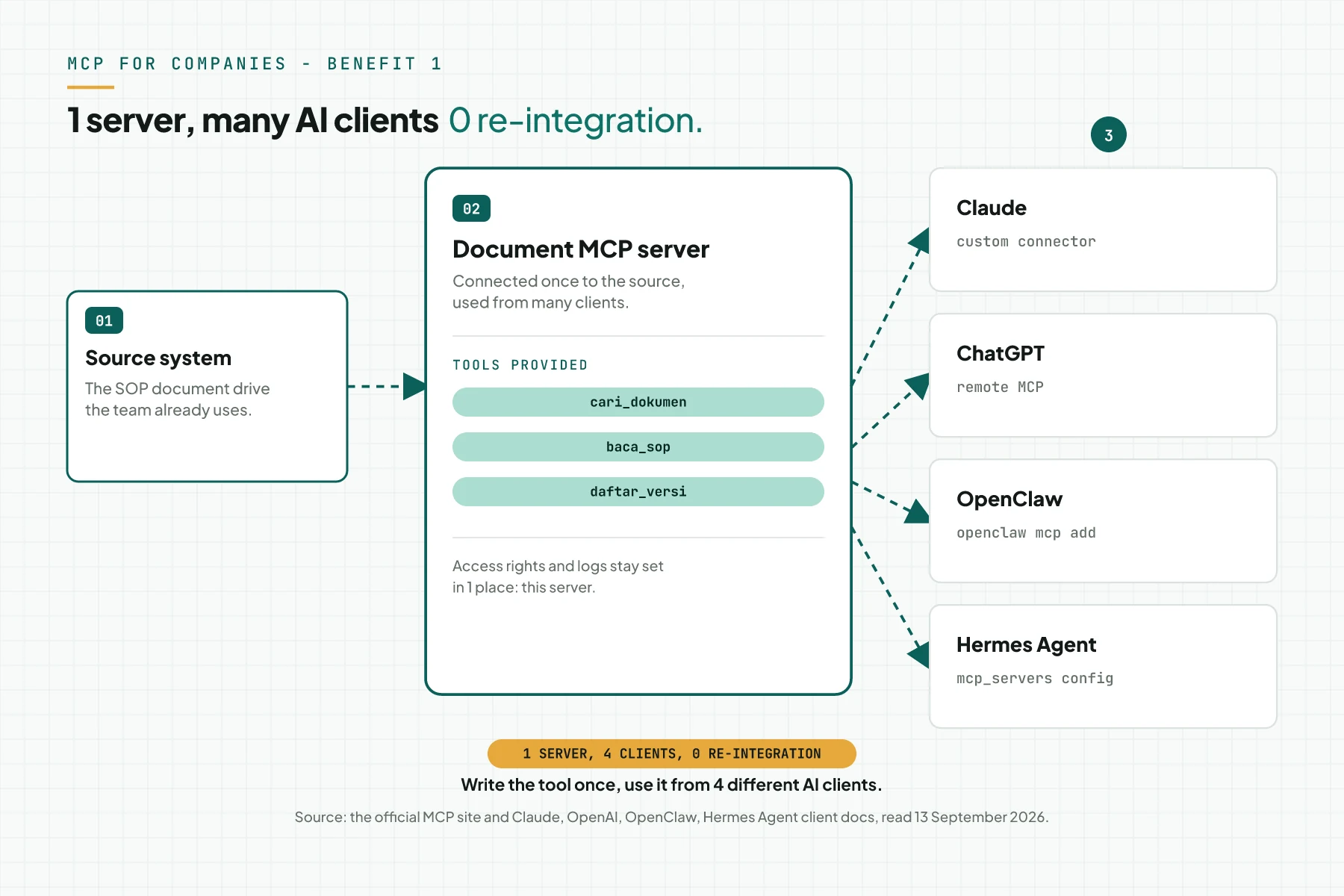
Example (dummy data): the cari_dokumen_sop tool on 1 document server is used from Claude by the legal team and from OpenClaw by operations, with no separate integration written for each.
Benefit 2: source systems stay (operations)
An MCP server connects to data and tools that already exist; the source system does not need to change or migrate (the MCP specification 2026-07-28). Cloudflare's guidance: build tools per user goal, do not wrap the whole API schemaSchemaExtra description inside page code that tells a search engine what the page is, for example an article, a service, or a question and answer.Open the glossary as 1 large tool (the Cloudflare agents guide).
Example (dummy data): the cek_stok_gudang tool reads an ERP the company has used for 8 years. The MCP server only adds 1 tool layer on top of that ERP; the old data and process still run as before. The pattern for connecting old systems without a rebuild is in our article on connecting legacy systems to an AI agent.
Our MCP server development service follows the same pattern: a new server goes in, the old system keeps running.
Benefit 3: access rights per tool and scope (finance)
The MCP specification calls for least privilege: the server names the minimum scope it needs, and the client asks for more only when it must (the MCP authorization specification). Every tool also carries the readOnlyHint and destructiveHint annotations, so the client knows which tools only read and which change data (the MCP tool schema on GitHub).
Example (dummy data): the invoice_list tool uses a read-only scope; the invoice_cancel tool uses a separate write scope. Staff who only need to view invoices cannot cancel them, because the 2 actions use different scopes.
Benefit 4: human approval for write actions (sales and CS)
The MCP specification requires the host to ask for explicit consent before it runs a tool, and there should always be a human in the loop who can deny it (the MCP specification, the MCP tools specification). OWASP names the same root causes under risk LLM06: excessive function, permission, and autonomy; the mitigation is human approval for high-impact actions (OWASP GenAI Security, LLM06).
The setup differs by client. ChatGPT uses a require_approval setting per tool (the OpenAI developer docs); OpenClaw applies the same tool policy to MCP tools and built-in tools (the OpenClaw docs).
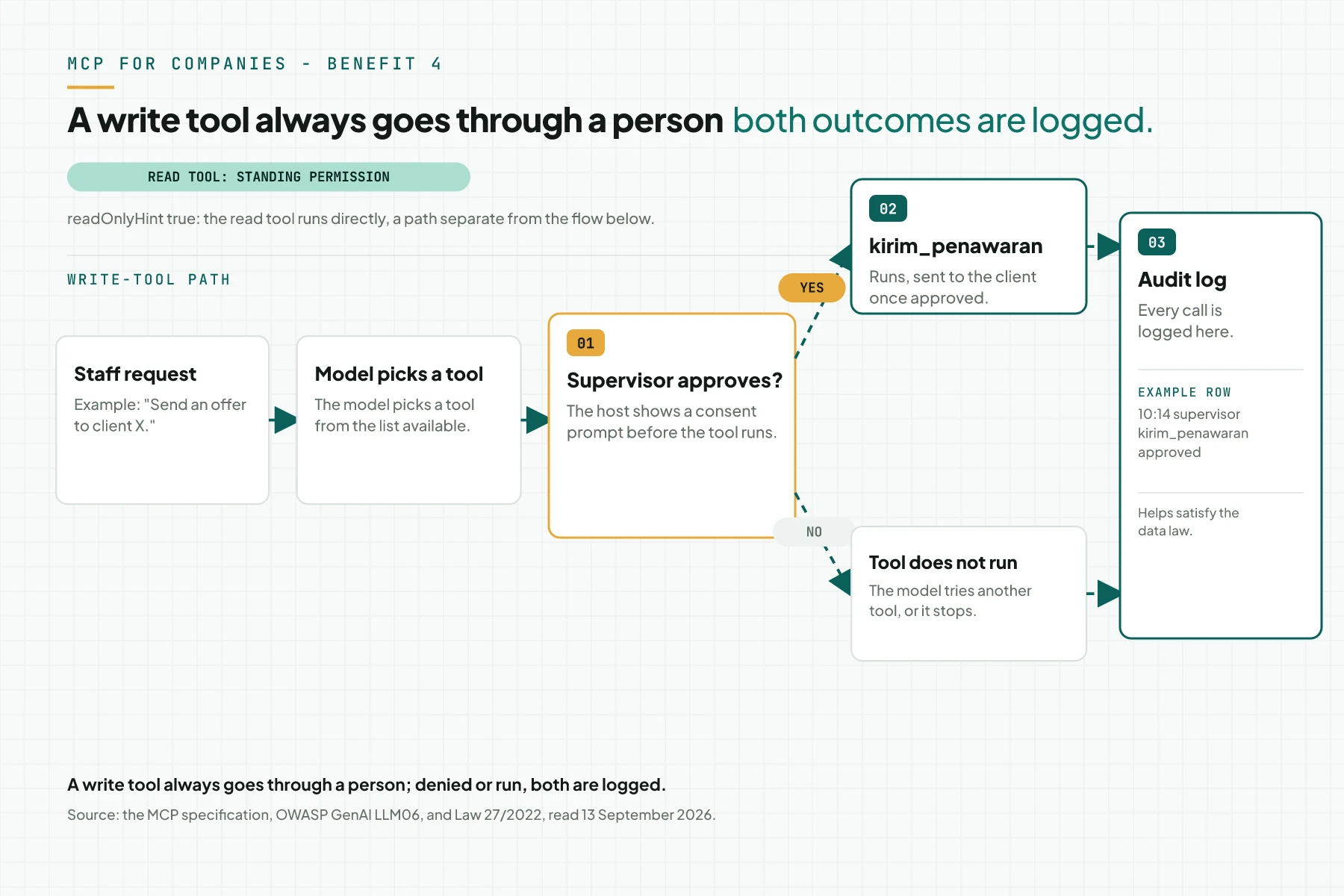
Example (dummy data): the kirim_penawaran tool only runs once a sales supervisor approves its content. A team that already uses this approval pattern is in our OpenClaw use case for marketing, sales, and admin teams (in Indonesian).
Benefit 5: an audit log per call (compliance and the PDP Law)
The MCP specification advises the client to log tool use for audit (the MCP tools specification, security section). Article 46 of Indonesia's Law 27/2022 requires a Controller to notify the data subject and the authority within 3 x 24 hours after a data protection failure, naming the data exposed and when and how it happened (Law 27/2022). An MCP audit log helps answer that "when and how" part; the other duties in Articles 35 to 39, such as supervising every party that processes the data, still stand outside this log.
Example log row (dummy data): the call time, the actor, the tool name, arguments with no personal data, and the result. The technical detail on approval, audit logs, and OAuth 2.1 is in our article on MCP server security; this article stops at the benefit for a company.
Benefit 6: small tools are easy to test (IT and QA)
An MCP design principle: a server must be easy to build and compose, and must not read the whole user conversation (the MCP architecture page). A tool result also carries an isError flag, so a tool failure can be tested apart from a protocol failure (the MCP tools specification).
Example (dummy data): the cek_stok tool is tested with 3 cases: an SKU that exists, one that does not, and an empty SKU. On our own systems, every commercial and scheduling MCP tool carries a contract test before we use it; we do not write the test count here, because it changes with every release.
Benefit 7: freedom to switch models and vendors (management)
MCP sits under Model Context Protocol, a Series of LF Projects, LLC. Governance membership belongs to individuals, not to a company seat (the MCP community governance page). There are 10 official SDKs across 3 support tiers, so a team can write a server in TypeScript, Python, Go, or another language (the list of official MCP SDKs).
Because the server and the model are 2 separate things, a company stays free to switch models or clients without rewriting the server. Example (dummy data): the same MCP server serves Claude this month, then OpenClaw next month, with no change to the server itself.
Table: 7 benefits, department, example tool, evidence to ask for
The table below summarises the 7 benefits above. The evidence column names a real artefact you can ask a vendor for before you sign a contract, not a promised result.
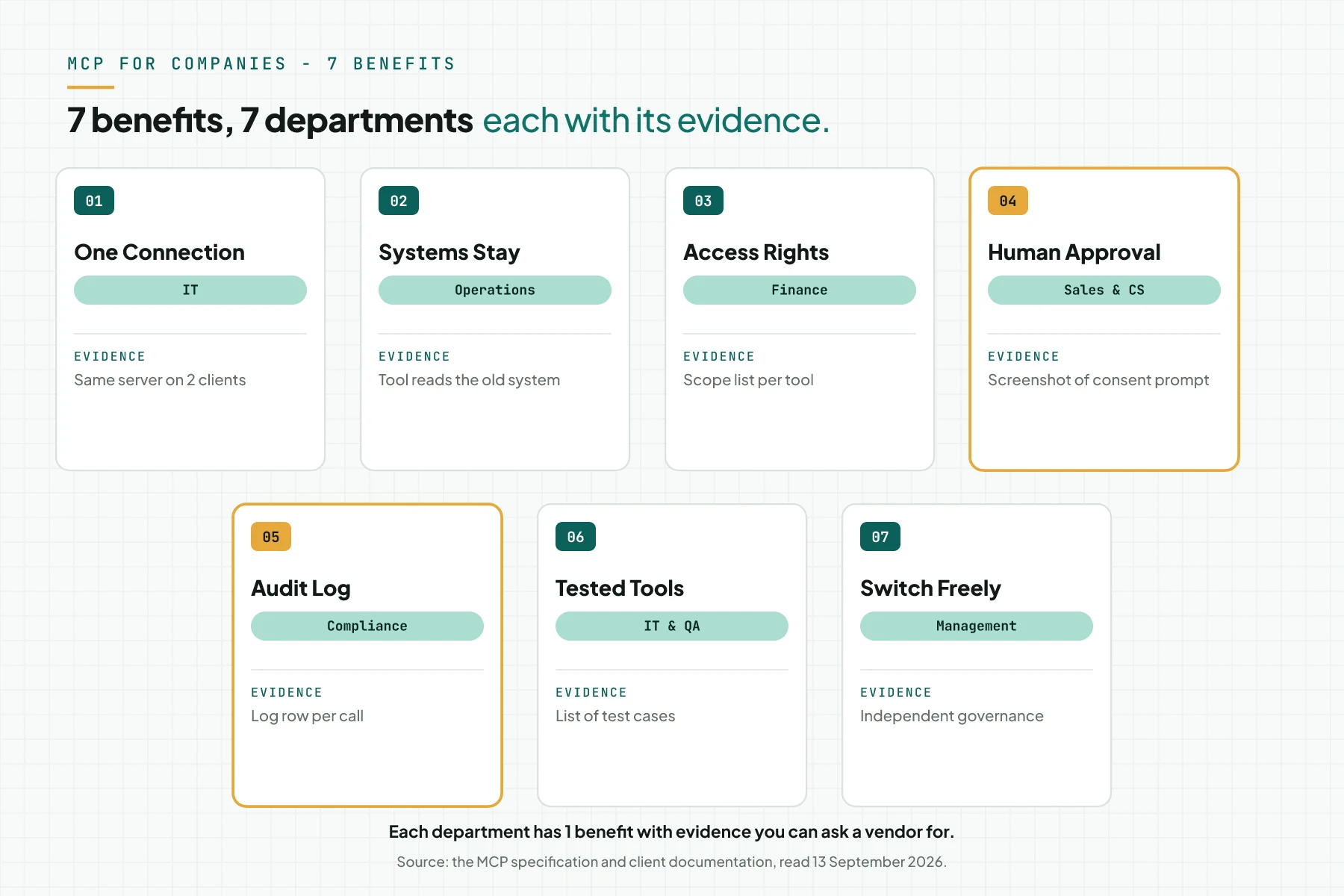
| # | Benefit | Department | Example tool (dummy data) | Evidence to ask for |
|---|---|---|---|---|
| 1 | 1 connection for many AI clients | IT | cari_dokumen_sop | The same server shows up on 2 clients |
| 2 | Source systems stay | Operations | cek_stok_gudang | The tool reads the existing ERP, no migration |
| 3 | Access rights per tool and scope | Finance | invoice_list (read), invoice_cancel (write) | The scope and annotation list per tool |
| 4 | Human approval for write actions | Sales and CS | kirim_penawaran | A screenshot of the consent prompt |
| 5 | An audit log per call | Compliance | Every tool | Log rows: time, actor, tool, result |
| 6 | Small tools are easy to test | IT and QA | cek_stok with 3 cases | The test case list per tool |
| 7 | Freedom to switch models and vendors | Management | Same server, different clients | LF Projects governance; 10 SDKs |
Example: 1 week in finance with 2 tools
The simulation below uses dummy data. It shows how approval and the audit log work over 1 week in finance, with 2 tools: invoice_jatuh_tempo (read) and draf_pengingat (write, with approval).
| Input (staff request) | Recorded (server and audit log) | Output (what happens) |
|---|---|---|
| Monday: "Which invoices are due this week?" | invoice_jatuh_tempo {week: "2026-W15"}; 7 invoices; read logged | A list of 7 invoices with amounts, no customer personal data |
| Tuesday: "Draft a reminder for the first 3 invoices." | draf_pengingat {ids: [...]}; status "awaiting approval"; pending write logged | 3 drafts appear to the finance supervisor |
| Tuesday: the supervisor approves 2, denies 1 | 2 drafts sent through the company email system; 1 denied with the reason "customer already paid" | Audit log: 2 rows "approved", 1 row "denied", actor supervisor |
| Friday: an internal auditor asks for a trail | Export the week W15 audit log | A who-when-what table with no email content |
The week name, the invoice count, and the denial reason in this table are dummy data. No customer name is used.
Checklist to hold a vendor to the benefits
Use these 7 items before you sign a contract for MCP server development.
- Ask for the tool list with read and write annotations before you sign. Owner: head of IT. Evidence: the tool list document.
- Ask for a screenshot of the consent prompt on the client your team uses. Owner: the using department's head. Evidence: 1 image per write tool.
- Ask for 5 example audit log rows from a test with dummy data. Owner: compliance. Evidence: the log export file.
- Confirm the tool reads an existing system, not a manual copy. Owner: operations. Evidence: the source system name per tool.
- Confirm personal data columns are filtered in the tool, per Article 16 of Law 27/2022. Owner: the data lead. Evidence: the list of dropped columns.
- Test the same server from 2 different AI clients. Owner: IT. Evidence: 2 screenshots.
- Stop criterion: if the vendor cannot show a consent prompt for a write tool, do not proceed.
Frequently asked questions
Does MCP reduce integration cost? It cuts the number of integrations you write, because 1 server can serve many clients. We do not write a savings figure, because it depends on the systems you already run.
Which department should start first? Start with a department that asks 1 system the same question often and only needs a read tool. Read the first 3 MCP tools for small business for an example order.
Does human approval slow work down? The MCP specification asks for user consent before every tool call; a host such as Claude lets you keep a standing permission for a trusted read tool. OWASP requires human approval for high-impact actions.
Does an MCP audit log satisfy the PDP Law? It helps answer the when-and-how part of Article 46. Other duties, such as the legal basis for processing and supervision of a processor, still stand outside this log.
Can 1 MCP server serve Claude and OpenClaw at the same time? Yes, over Streamable HTTP. Each client opens its own connection to the same server, with no change to the server.
Next step
These benefits appear when a tool is designed for 1 user goal and the host shows a consent prompt; MCP does not guarantee a business result and does not replace your SOPs. For example servers per system, read 10 MCP server examples for business. To work out the cost, read MCP server development cost. If your team is ready to install an MCP server for a system you already run, Send your brief to us. If you want to ask first, Book a free consultation.
Sources
- MCP: Introduction, official MCP site
- MCP: Specification 2026-07-28
- MCP: Architecture
- MCP: Server Tools
- MCP: Authorization
- MCP: tool schema on GitHub
- Claude Help Centre: Custom Connectors
- OpenAI Developers: MCP
- OpenClaw Docs: MCP
- Hermes Agent Docs: MCP
- Cloudflare Agents: Model Context Protocol
- OWASP GenAI Security: LLM06
- Indonesia's Law 27/2022
- MCP Community Governance
- MCP SDK