Direct answer: Series A funding is the first priced equity round led by a venture capital (VC) investor. The investor buys Series A preferred stock at an agreed valuation and generally targets about 20% ownership. The round follows proof of initial repeatable revenue, usually 18-24 months after seed. The US/global median is an $80 million valuation on a $14.4 million round (Carta, 10 July 2026).
Main condition: this applies to a limited company startup that sells new shares to a VC investor. Market numbers come from US/global, Southeast Asia, and Indonesia sources opened on 14 September 2026. Limit: Rama Digital is not a financial, legal, or tax adviser. This article explains the mechanism and the calculation, not a funding promise or a result. A licensed legal and financial adviser must review every funding decision and agreement.
We read Y Combinator, NVCA, Carta, Cento Ventures, and peraturan.bpk.go.id pages on 14 September 2026. The example numbers in this article are a dummy simulation, not real client data.
- Series A is sold as preferred stock ("Series A Preferred Stock") in the YC and NVCA templates; the lead generally wants 20% (YC).
- US/global median: an $80 million valuation, a $14.4 million round, 18% dilution (Carta, 10 July 2026, software companies, over 1,000 rounds).
- Southeast Asia: median Series A pre-money is $20.0 million and round size $4.0 million in 2024; Indonesia: pre-money $23 million (Cento, 19 September 2025).
- The median seed-to-Series A gap was 616 days, about 20 months, in Q2 2025 (Carta). Only about 17% of the 2022 seed cohort reached Series A within 24 months.
- In Indonesia, preferred share rights must be written as a share class in the articles of association (Law 40/2007 Article 53).
Series A funding is the first priced equity round with a VC lead
Venture rounds usually run from seed, then Series A, Series B, and Series C, until an acquisition or an IPO. No round is required; some companies start directly with Series A (YC). Series A matters because it is the first point where a share price sets the valuation.
Series A is sold as preferred stock in both the Y Combinator and NVCA templates (YC, a standard and clean Series A term sheet; NVCA, 2020 Model Term Sheet). A seed round usually uses a SAFE with no share price, and can close within weeks. Cento defines Series A as the stage where the product is built and proven through initial repeatable revenue (Cento).
The Series A lead generally wants about 20% ownership, but pricing still follows each side's leverage (YC). A lead is the first and largest investor in a round, and it brings other investors in. A and B rounds typically raise $10 million to $50 million, take months to close, and carry legal fees in the hundreds of thousands (YC).
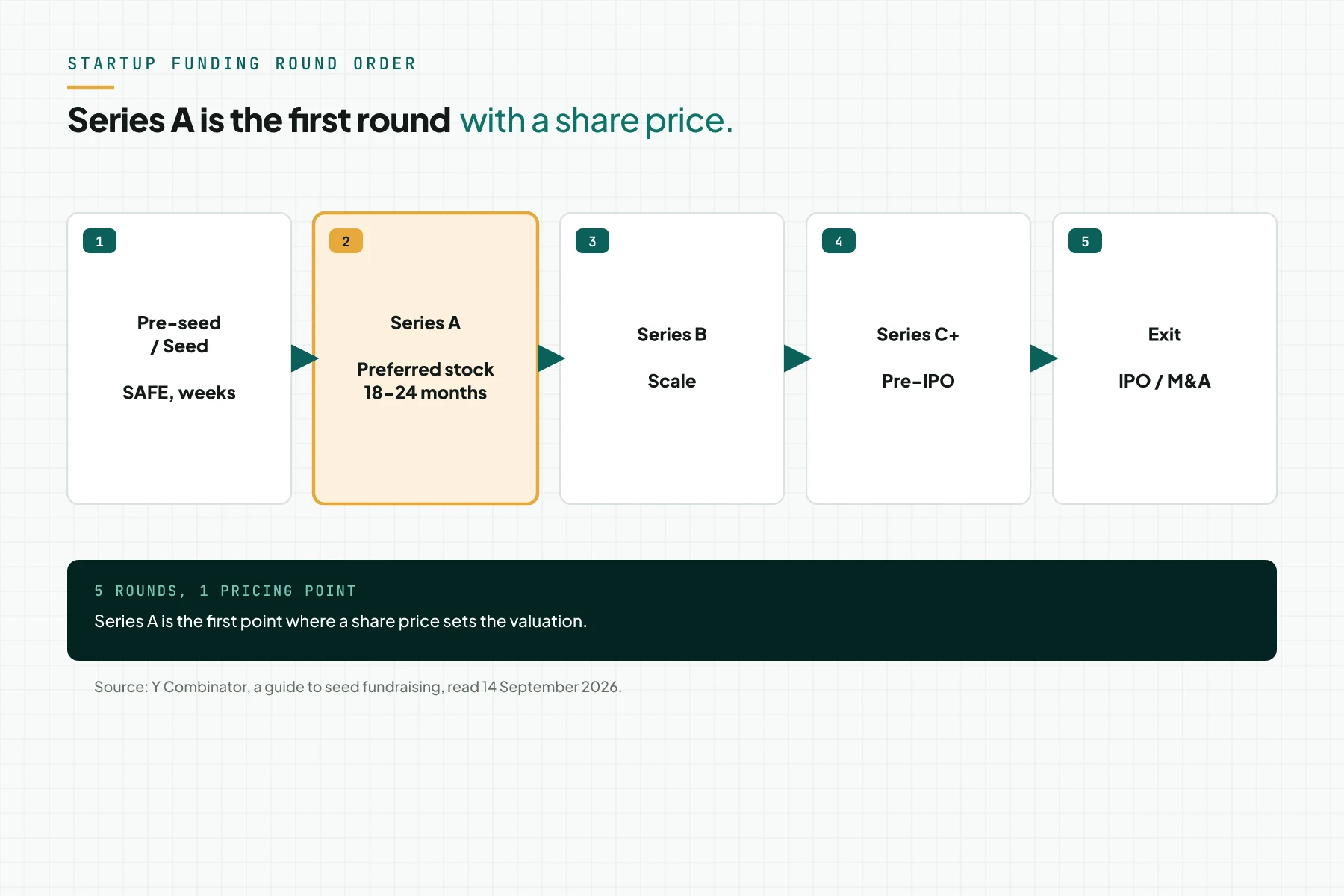
Read startup funding stages from pre-seed to Series C for every stage in detail, from pre-seed to exit. Read how to calculate Series A valuation and dilution for the pre-money and post-money formulas behind it.
What goes wrong when founders misread Series A
In a normal year, 25-30% of seed startups reach Series A within 24 months (Carta). The 2022 seed cohort reached that mark only about 17% of the time. A founder who raises too early often faces repeated rejection.
The wait keeps growing: the median seed-to-Series A gap reached 616 days, about 20 months, in Q2 2025 (Carta). Series A deal count in the US fell 18%, and cash raised fell 23%, over the same period. Investor ARR expectations have risen, but this stays an opinion, not a rule: Fiat Ventures cites a $5 million to $10 million range.
In Indonesia, private funding value fell from $9.1 billion in 2021 to $0.4 billion in 2024, and $0.1 billion in the first half of 2025 (Google, Temasek, Bain). Bridge financing and venture debt helped many companies avoid a down round, so recorded valuations look stable (Cento). A longer wait also pushes a startup closer to its cash-flow trough; read what a J-curve is for this general pattern.
Read ICP, wedge market, SOM, and how investors read them (Indonesian source) for how an investor reads market size before a term sheet.
Who Series A investors are and where their money comes from
A venture firm forms a limited partnership: the investor becomes a limited partner (LP), and the firm becomes the general partner (NVCA). LP examples include pension funds, insurance companies, family offices, and foundations. A fund agreement usually lasts 10 years with an extension option.
Money is drawn from an LP through a capital call each time an investment is made. A venture fund usually reserves 3 to 4 times the first investment for a follow-on round (NVCA). A VC works with the founder for 3 to 8 years before a payoff arrives through an acquisition or an IPO.
A management fee usually runs 2% to 2.5% of committed capital per year (AngelList). Carried interest, the firm's share of profit, is usually 20% after the LP's principal returns. Read the private equity and venture capital J-curve for why a venture fund needs an exit inside its fund life.
An angel invests their own money, usually $25,000 to $100,000 per company, and decides faster than a VC (YC). A corporate VC pursues a strategic goal, while an institutional VC pursues a financial return.
Series A funding size: the US, Southeast Asia, and Indonesia
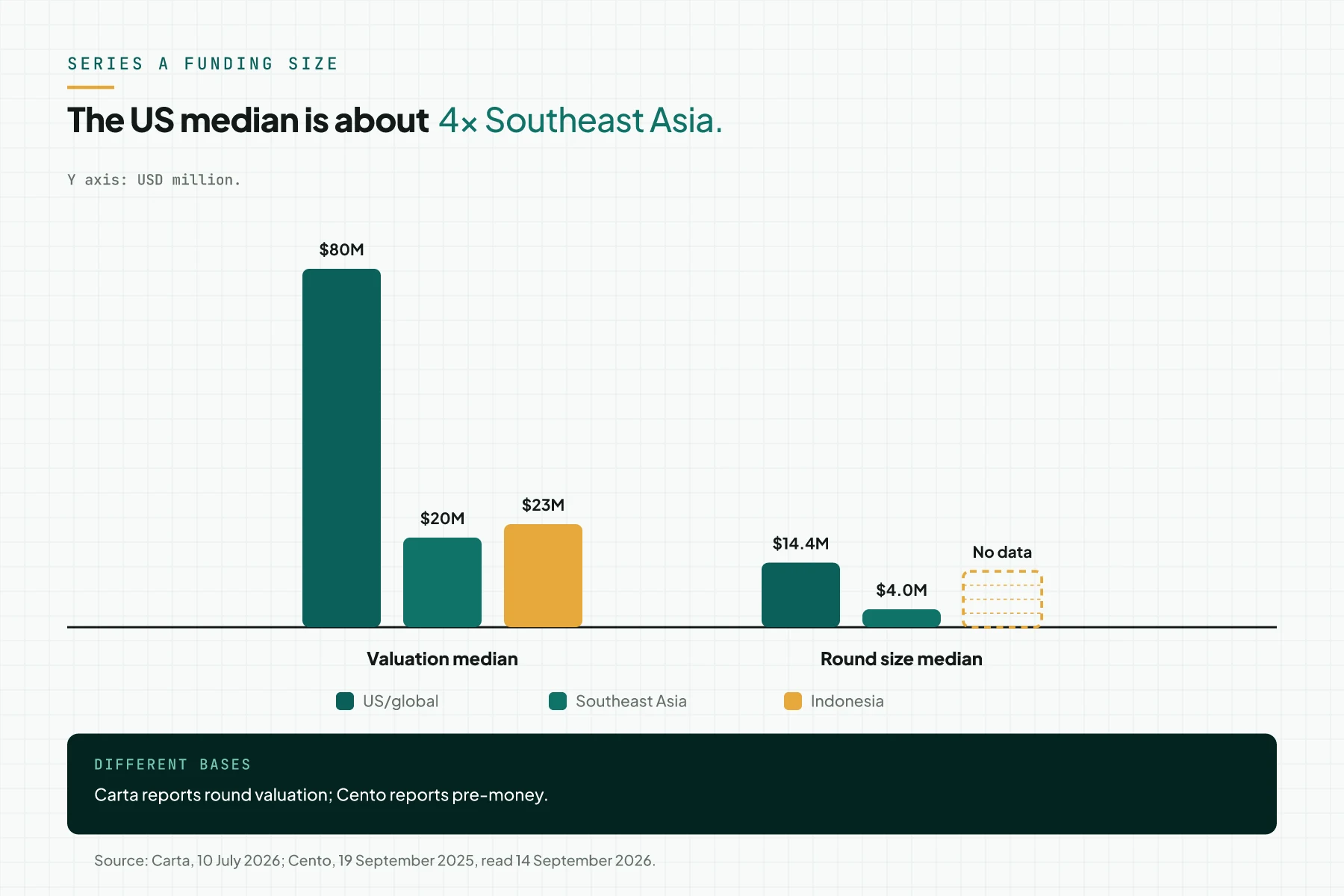
Series A numbers differ sharply by region, and so does the underlying basis. Carta reports round valuation in the US and globally; Cento reports pre-money valuation in Southeast Asia and Indonesia. Table 1 compares the 3-region median on sources opened on 14 September 2026.
| Measure | US/global (Carta) | Southeast Asia (Cento) | Indonesia (Cento, Bain) | Basis note |
|---|---|---|---|---|
| Series A median valuation | $80 million (10 July 2026, software, over 1,000 rounds) | $20.0 million pre-money (2024); $19.0 million (2023); $25.0 million (2022) | $23 million pre-money (2024); $24 million (2023); $44 million (2022) | Carta reports round valuation; Cento reports pre-money |
| Series A median round size | $14.4 million (10 July 2026) | $4.0 million (2024); $4.0 million (2023); $5.0 million (2022) | No open figure; 2024 private funding was $0.4 billion across 73 deals (Bain) | The Indonesia figure is total market value, not a round median |
| Series A median dilution | 18% (10 July 2026); historically 19-20% | Not reported | Not reported | The 18% median is not a fixed rule; every deal differs (Carta). |
| Seed-to-Series A gap | Median 616 days, about 20 months (Q2 2025) | Not reported | Not reported | YC benchmark is 18-24 months |
| Market direction | Series A deal count -18% YoY and cash -23% in Q2 2025; 2025 total $119.5 billion on Carta | Digital economy private funding about $8 billion, up 15% in 2025; early stage keeps shrinking | H1 2025 about $0.1 billion, 20 deals; less than a fair share since H2 2023 | Each region uses a different basis and year; do not compare directly. |
A median only marks the middle of a wide range; every deal still differs. No open source gives an Indonesian Series A round size or dilution median for 2025 or 2026; the latest Indonesian figure is 2024 Cento data.
Series A requirements investors look for
An investor reads evidence, not a promise. These 4 things usually come first.
- Initial repeatable revenue, read as a 4-6 month trend from accounting software as the source of financial numbers (Indonesian source), not a cumulative number (YC).
- Capital efficiency: a burn multiple near 2x is reasonable, and 3x or higher is a warning sign (Sacks).
- Market size calculated bottom-up: the number of prospective customers times the value of each one (YC). Read the Series A metrics investors read for all 8 metric formulas.
- A ready team and data room; a data room finished before the term sheet can cut the closing time by up to a week (YC).
Read the startup cash-flow J-curve: trough, runway, and turning point for how to calculate runway and the cash trough before you start this process.
How to raise Series A funding: 6 stages
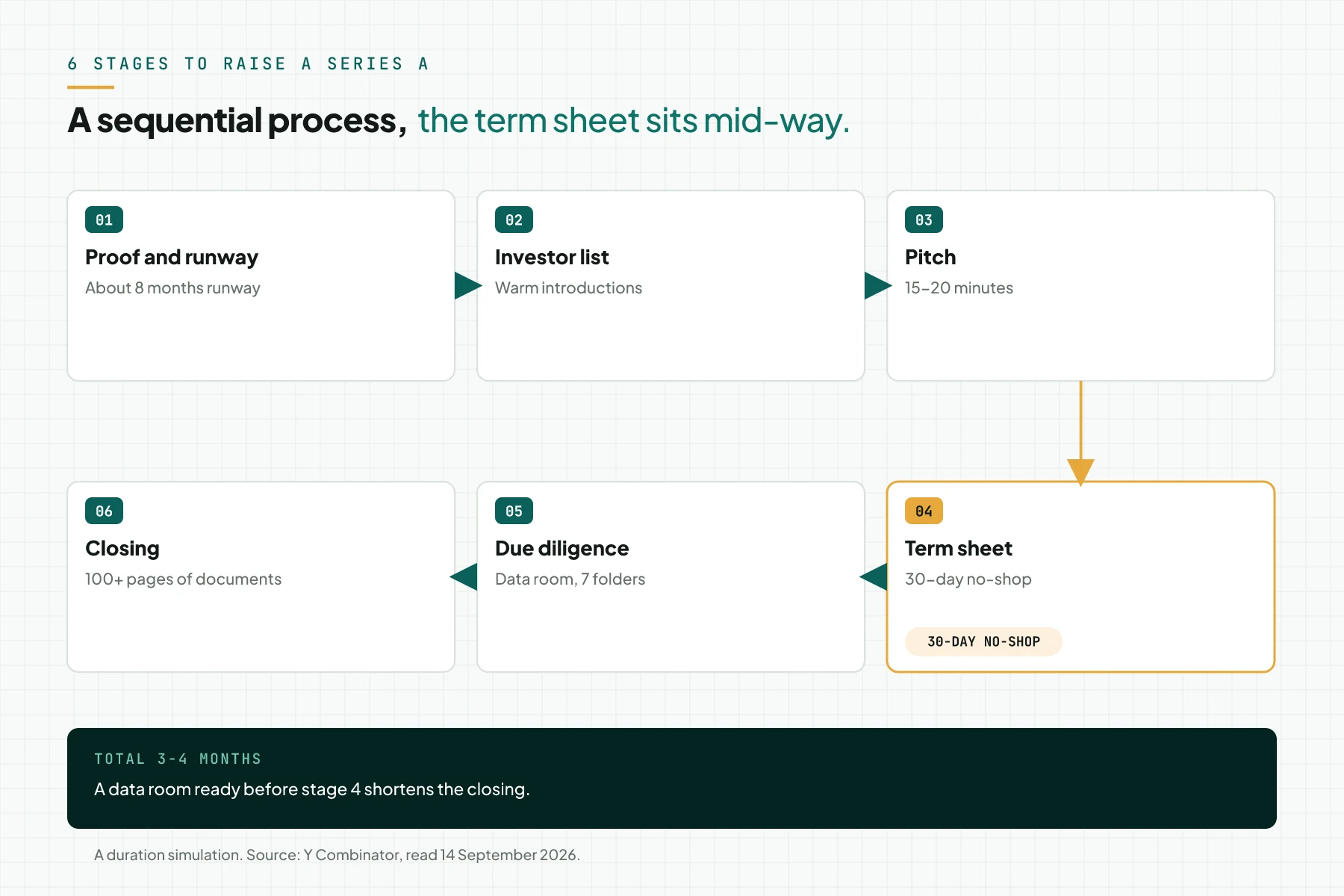
A Series A process runs through 6 sequential stages, from initial proof to closing. The term sheet only appears mid-way, at stage 4.
Stage 1: Prepare proof and runway
YC advises starting the raise with about 8 months of runway left (YC). One round usually lasts 18 to 24 months before the next one is needed.
Stage 2: Build the investor list
The main way to meet a VC is a warm introduction, and a founder may meet dozens of investors (YC). Avoid listing a Series A fund among existing investors unless it is set to lead this round.
Stage 3: Pitch investors
A pitch runs 15 to 20 minutes to open a 40 to 45 minute discussion (YC). Most first pitches now happen over video, with 1 person presenting. Read how to prepare a Series A pitch deck and data room for the full slide order.
Stage 4: Receive and negotiate the term sheet
Only the no-shop clause is legally binding; the rest of the term sheet is a non-binding summary (YC). The no-shop in the YC template runs 30 days. Read 12 Series A term sheet terms for the 12 terms a founder must understand before signing.
Stage 5: Complete due diligence
The YC data room holds 7 document groups, from corporate records to past disputes (YC). A data room ready before the term sheet cuts the closing time by up to a week.
Stage 6: Sign the definitive documents and close
Definitive documents come from the term sheet and usually run over 100 pages (YC). The company pays the lead investor's legal fees, capped at $30,000 in the YC template. Series A terms set the precedent for the next round.
Series A for an Indonesian PT: share classes, PMA, and crowdfunding
Law 40/2007 Article 53 requires the articles of association to set 1 or more share classes (Law 40/2007). Shares in 1 class carry equal rights, for example a prior dividend right or a prior claim on liquidation proceeds. Series A preferred stock must be written as this class in the articles.
Article 43 requires new shares to be offered first to existing shareholders proportionally, within 14 days (Law 40/2007). A capital increase needs approval at a general meeting of shareholders (GMS).
A foreign investor enters through a foreign investment limited company (PT PMA), a PT under Indonesian law and domiciled in Indonesia (Investment Ministry/BKPM Regulation 5/2025). A PMA's investment value must exceed Rp10 billion excluding land and buildings, with paid-up capital of at least Rp2.5 billion. This rule revoked BKPM Regulation 4/2021 as of 2 October 2025.
A smaller alternative is securities crowdfunding under POJK 17/2025, in force since 25 July 2025 (POJK 17/2025). An issuer may raise up to Rp10 billion in 12 months through an OJK-licensed operator. The older rule, POJK 57/2020, has been revoked and no longer applies.
Y Combinator provides a SAFE version for Singapore companies, with advice to consult local legal counsel (YC Safe documents).
Alternatives to Series A funding: venture debt, revenue-based financing, and bootstrapping
Equity is not the only way to add capital. Read the difference between a revenue model and a business model for the recurring revenue model that decides how well each alternative below fits.
| Instrument | Dilution | Cost | When it fits | Source |
|---|---|---|---|---|
| Venture debt | Smaller than equity | Interest, an origination fee, and warrants | Adds 3-9 months of capital, closed alongside an equity round | SVB |
| Revenue-based financing | No dilution | A percentage of monthly revenue | Recurring revenue is already stable | Capchase |
| Bootstrapping | No dilution | Your own cash, no investor | The startup need not grow as fast as a VC-backed one | YC |
Rama Digital recommendation: consider venture debt or revenue-based financing when you need extra capital without opening a new round, provided recurring revenue is already stable.
When a new round fails, a founder turns to crowdfunding, a SAFE bridge from an angel syndicate or family office, or shuts the company down (Carta). Non-dilutive debt lets a hardware founder build first, before raising equity.
Dummy simulation: PT Simulasi runs a 16-week Series A process
This dummy simulation shows a Series A process at PT Simulasi, a fictional company, from 5 October 2026 to 25 January 2027, or 16 weeks. The rupiah and dollar figures in this table are dummy data, not real client data.
| Week | Date | Input (team action) | Recorded (evidence) | Output |
|---|---|---|---|---|
| 1-2 | 5-16 Oct 2026 | Calculate runway (Rp5.4 billion cash, Rp600 million monthly net burn, equals 9 months); export 6 months of MRR; clean up the cap table | Dated cash table; accounting software export; fully diluted cap table | Decision to start, since 9 months of runway beats the YC advice of about 8 months |
| 3-4 | 19-30 Oct 2026 | Build a list of 40 Series A VCs; ask for 12 warm introductions; draft a 12-slide deck v1 | Investor spreadsheet; deck v1 | 12 introductions sent; 8 meetings booked |
| 5-8 | 2-27 Nov 2026 | 24 pitch meetings over video, 1 presenter; fill the 7-folder data room | Meeting notes; data room index | 5 follow-up meetings; 2 partner meetings |
| 9-10 | 30 Nov-11 Dec 2026 | Receive 1 term sheet: a $4 million round at a $20 million post-money, 1x non-participating, a 2-1 board; review it with legal counsel | Signed term sheet; a 30-day no-shop starting 11 Dec | Term sheet accepted, with its terms on record |
| 11-14 | 14 Dec 2026-8 Jan 2027 | Financial and legal due diligence from the data room; a GMS amends the articles for the preferred share class | Investor questions answered; GMS deed | 0 material findings; definitive documents drafted |
| 15-16 | 11-25 Jan 2027 | Sign the definitive documents; funds arrive in the company account | Transfer proof; new cap table | Cash grows by $4 million at a $20 million post-money, equal to 20% new ownership |
Note: the rupiah and dollar figures are dummy data; do not convert the exchange rate. Read how to calculate Series A valuation and dilution for the full formula behind the 20% figure in this table.
Checklist before you open a Series A process
- The last 6 months of recurring revenue are shown by month from accounting software (finance; a dated monthly export).
- Runway is calculated at about 8 months or more when the process starts, per YC advice (founder; a 12-month cash table).
- The fully diluted cap table is clean, with SAFEs, issued options, and promised options (founder; a dated cap table file).
- The articles of association hold a share class, or a GMS amendment agenda is ready (legal adviser; notary minutes).
- A list of 30-50 active Series A VCs exists, with a warm introduction path (founder; investor spreadsheet).
- A 10-15 slide deck and a 7-folder data room are ready before the term sheet (founder and operations; data room link).
- Stop criterion (Rama Digital recommendation): stop the process if the first 20 meetings produce 0 follow-up meetings, or runway falls under 6 months. Move to a bridge plan or cost cuts.
FAQ on Series A funding
What is Series A funding? Series A funding is the first priced equity round. A VC investor buys preferred stock, and the lead generally wants 20% ownership. The US/global median is an $80 million valuation on a $14.4 million round (Carta, 10 July 2026).
What is the difference between Series A and seed? Seed uses SAFEs, raises $500,000 to a few million dollars, and can close within weeks. Series A sells priced preferred stock, takes months to close, and carries higher legal fees.
How large is a Series A round? The US/global median is $14.4 million (Carta, 2026). The Southeast Asia median is $4.0 million (Cento, 2024). No open Indonesian median exists yet; every deal differs.
What percentage of shares is sold at Series A? Series A median dilution was 18% in 2026; the historical range is 19-20%. The lead investor generally wants about 20% ownership. An option pool adds further dilution for existing holders; read how to calculate Series A valuation and dilution for the full formula.
When is a startup ready for Series A? The product must show proof through initial repeatable revenue. YC recommends reading a 4-6 month trend, not an annual number. The usual benchmark is 18-24 months after seed; a $5-10 million ARR figure is only an investor opinion, not a fixed rule.
Can an Indonesian startup receive Series A from a foreign VC? Yes, through a foreign investment limited company (PT PMA). PMA rules require an investment value above Rp10 billion excluding land and buildings. Paid-up capital must be at least Rp2.5 billion, and the articles of association must state the share class.
Next step
The limit here stays the same. Rama Digital is not a financial, legal, or tax adviser, and the numbers in this article are no promise of a result. If your team needs a problem map before you raise, use the AI Diagnostic service. 1 session gives a bottleneck map and a written first step. To ask a question first, book a 30-minute session.
Sources
- Y Combinator: A guide to seed fundraising
- Y Combinator: Series A Term Sheet (template)
- Y Combinator: A standard and clean Series A term sheet
- Y Combinator: Series A diligence checklist
- Y Combinator: How to build a great Series A pitch and deck
- Y Combinator: How startup fundraising works
- Y Combinator: How much should you spend after fundraising
- Y Combinator: Safe documents
- NVCA: 2020 Model Term Sheet
- NVCA: What is Venture Capital?
- Carta: VC Startup Fundraising Benchmarks From 1000 Rounds (10 July 2026)
- Carta: The new state of Series A fundraising (19 September 2025)
- Carta: Graduation rate from seed to Series A (5 February 2025)
- Carta: Rising round sizes and record-breaking valuations
- Cento Ventures: Southeast Asia Tech Investment 2023-2024
- Google, Temasek, Bain: e-Conomy SEA 2025, Indonesia report
- Law 40/2007 on Limited Companies (JDIH BPK)
- Investment Ministry/BKPM Regulation No. 5 of 2025 (JDIH BPK)
- POJK No. 17 of 2025 on securities crowdfunding (JDIH BPK)
- Silicon Valley Bank: What is venture debt?
- Capchase: What is Revenue Based Financing
- AngelList Education Center: Venture Capital Fee Economics
- David Sacks: The Burn Multiple