Direct answer: A Series A pitch deck holds 10–15 slides outside the appendix, 1 point per slide. It runs 15–20 minutes and opens a 40–45 minute discussion (YC). First write 10–15 narrative bullets, each backed by data, then turn 1 bullet into 1 slide. Prepare a 7-folder data room before the term sheet; it cuts the closing by up to 1 week (YC). The 7 steps below use a 6-week schedule with dummy data.
Main condition: this applies to a startup raising a Series A round from VC investors. The slide order follows YC and Sequoia, and the data room checklist follows YC; Indonesian PT documents follow Law 40/2007. Limit: Rama Digital is not a financial, legal, or tax adviser. This article explains the mechanism and the calculation, not a funding promise or a result. A licensed legal and financial adviser must review every funding decision, valuation, and agreement. A tidy deck and data room do not guarantee a term sheet, and the numbers in the 6-week schedule are a simulation. The 409A note in the YC checklist is US context; for an Indonesian PT, close pending option grants and GMS approvals with a notary.
We read pages from YC, Sequoia, Cooley GO, NVCA, Carta, and Law 40/2007 on 14 September 2026. The example numbers in this article are a dummy simulation, not customer data.
30-second summary:
- A 15–20 minute pitch opens a 40–45 minute discussion; 10–15 slides outside the appendix; 1 point per slide (YC).
- YC deck order: title, traction teaser, problem, solution, in-depth traction, market, competition, vision, team, use of funds, appendix.
- YC data room in 7 groups: corporate records, business plan and financials, intellectual property, securities issuances, material agreements, disputes, employees.
- A data room ready before the term sheet cuts the closing by up to 1 week. A Series A closing can take more than 1 month (YC).
- The use-of-funds slide states the amount, allocation, and the 18–24 month milestone; market size is calculated bottom-up (YC).
Series A pitch deck and data room: 2 documents, 1 story
A Series A pitch deck is a 15–20 minute presentation that opens an investor discussion (YC, how to build a great Series A pitch and deck). It holds 10–15 slides outside the appendix, 1 point per slide; Sequoia uses a different order, and Table 1 compares the two (Sequoia, Writing a Business Plan).
The data room holds the evidence behind the deck, in 7 YC groups. Ready before the term sheet, it cuts the closing by up to 1 week (YC Series A diligence checklist).
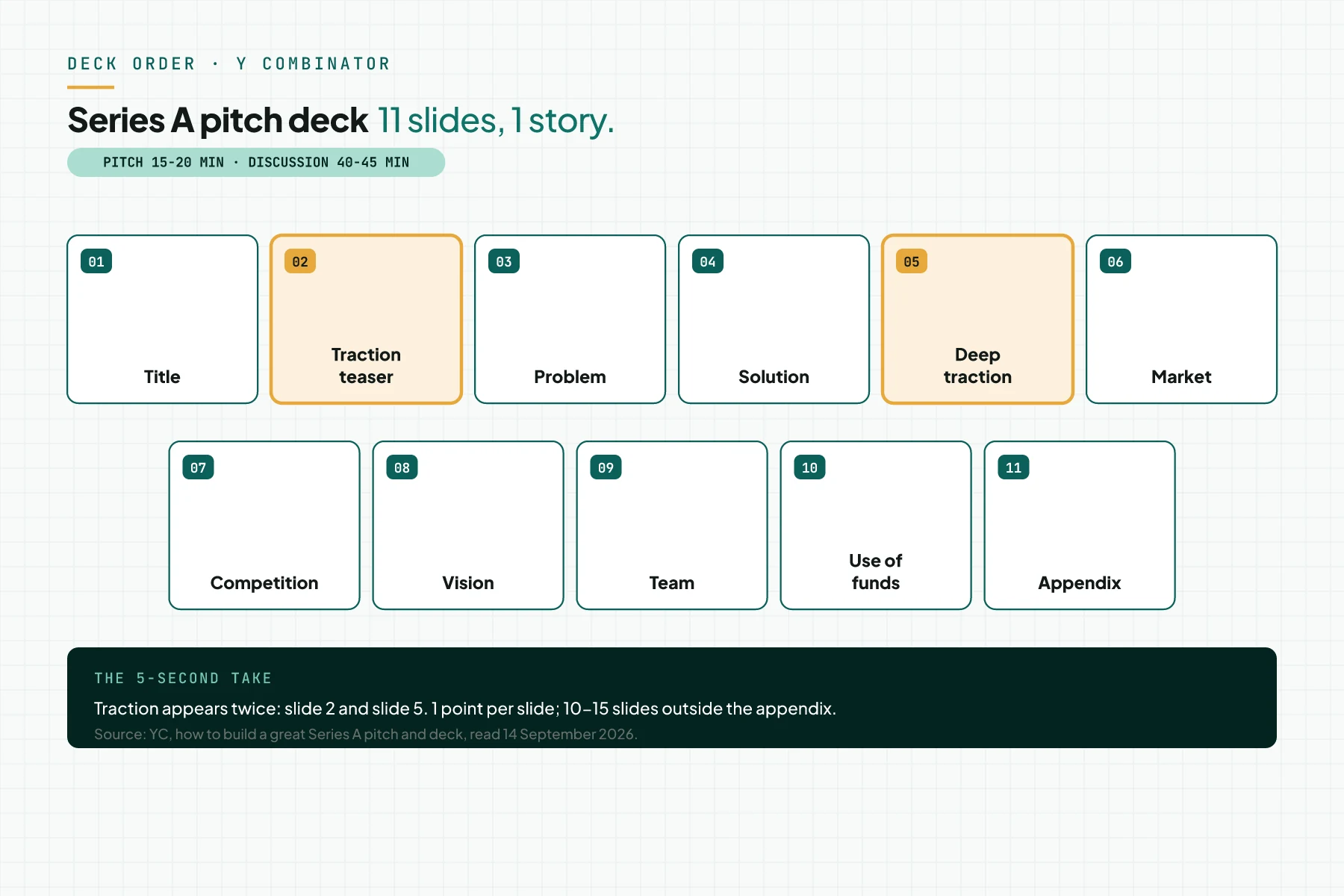
Start from the narrative, not the slides: write 10–15 story bullets, each backed by 1 number and 1 source, then turn each into 1 slide (YC, how to build a great Series A pitch and deck).
Read what Series A funding is and the Series A metrics investors read.
The problem: a 30-slide deck, an empty data room, a late closing
A Series A round takes months and hundreds of thousands in legal fees, US/global data (YC, how startup fundraising works). The median seed-to-Series A gap reached 616 days, US/global data (Carta, Series A fundraising Q2 2025).
Closing can exceed 1 month without a ready data room (YC Series A diligence checklist). A cumulative-number traction slide hides the trend, so investors miss real momentum (YC, how to build a great Series A pitch and deck). Listing a Series A fund as an existing investor invites 1 question, too: is that fund leading this round.
A pending equity grant delays the process (close GMS approvals first), and material agreements often scatter across folders (Step 5 lists them).
Read accounting software as the source of financial numbers (Indonesian source) for the monthly report source.
Slide order table: YC vs Sequoia and the supporting data room folder
Table 1 maps each YC slide to its Sequoia equivalent, supporting data, and proving folder.
| Order | YC slide | Sequoia equivalent | Supporting data | Data room folder |
|---|---|---|---|---|
| 1 | Title | Company purpose (1 sentence) | Name, tagline, date | 1 Corporate |
| 2 | Traction teaser | — | 1 monthly chart, 4-6 months | 2 Financials |
| 3 | Problem | Problem | Evidence from ICP interviews | 2 Financials |
| 4 | Solution | Solution; why now | Demo, product screenshots | 3 Intellectual property |
| 5 | Deep traction | Financials | MRR, NRR, burn multiple, runway | 2 Financials |
| 6 | Market | Market potential | Bottom-up: prospects x value per customer; SOM | 2 Financials |
| 7 | Competition | Competition | A dated competitor fact table | 2 Financials |
| 8 | Vision | 5-year vision | 18-24 month milestones and beyond | 2 Financials |
| 9 | Team | Team | Roles, track record, open seats | 7 Employees |
| 10 | Use of funds | Business model; financials | Amount, allocation, capital to the turning point | 2 Financials; 4 Securities |
| 11 | Appendix | — | Metric detail, cohorts, large contracts | 5 Material agreements; 6 Disputes |
Prerequisites before you start
Prepare these 6 things first.
- The 8 metrics from the Series A metrics investors read in a 6-month table, exported from the accounting software.
- The fully diluted cap table from how to calculate Series A valuation and dilution.
- The ICP, wedge market, and SOM documents. Read ICP, wedge market, SOM, and how investors read them (Indonesian source) and TAM, SAM, and SOM: meaning, formulas, and examples (Indonesian source).
- PT corporate documents: the deed, current articles, shareholder register, and GMS minutes (Law 40/2007 on Limited Liability Companies).
- 1 data room tool with an access log, 1 owner per folder, 1 test identity.
- 1 empty narrative document and 1 16:9 deck template.
Step 1: Write 10–15 narrative bullets, each backed by data
Open 1 empty narrative document. Write 10–15 story bullets; each carries 1 claim, 1 number, and 1 internal source (YC, how to build a great Series A pitch and deck).
Write the traction bullets with monthly data, not cumulative numbers, which hide the real trend.
Evidence: no bullet lacks a number, and every traction bullet points to a finance-folder data row.
Step 2: Arrange 10–15 slides in the YC order
Open the 16:9 deck template. Turn each bullet into 1 slide, in order: title, traction teaser, problem, solution, in-depth traction, market, competition, vision, team, use of funds, appendix (YC, how to build a great Series A pitch and deck).
Write 1 point per slide, and keep metric detail, cohorts, and large contracts for the appendix, so the deck stays at 15 slides or fewer. Use the Sequoia order from Table 1 if an investor asks for it (Sequoia, Writing a Business Plan).
Evidence: count the slides, and move slide 16 onward into the appendix.
Step 3: Fill the traction slides with a 4–6 month monthly trend
Open the traction teaser slide and the deep traction slide. Fill both with a 4–6 month monthly chart: MRR or customers, net new ARR, cohort retention, burn multiple, and runway (YC, how to build a great Series A pitch and deck). Read the Series A metrics investors read for the formulas.
Growing 25% a month off a $200k base is easy; sustaining it at $1M is what impresses an investor (YC, how to build a great Series A pitch and deck).
Pull the numbers from the accounting software, not manual notes (read accounting software as the source of financial numbers (Indonesian source)). Add the funnel from prospect to paying customer too.
Evidence: every number has 1 source table in the finance folder.
Step 4: Calculate the bottom-up market and an 18–24 month use of funds
Open the market and use-of-funds slides. Calculate the market bottom-up: prospects times value per prospect (YC, how to build a great Series A pitch and deck). Read ICP, wedge market, SOM, and how investors read them (Indonesian source) and sensitivity analysis and validation of TAM, SAM, SOM (Indonesian source).
Write use of funds with 3 elements: the amount, allocation, and the 18–24 month milestone it buys (YC, how to build a great Series A pitch and deck). A round lasts 18–24 months on average, and YC suggests raising at about 8 months of runway (YC, how much should you spend after fundraising).
The amount asked covers the cash need to the turning point plus a buffer (read the startup cash-flow J-curve: trough, runway, and turning point).
Evidence: the market number matches your SOM, and use of funds sums to the round.
Step 5: Build the 7-folder data room before the term sheet
Open a data room tool, and build 7 folders per YC: corporate, financials, IP, securities, material agreements, disputes, employees (YC Series A diligence checklist).
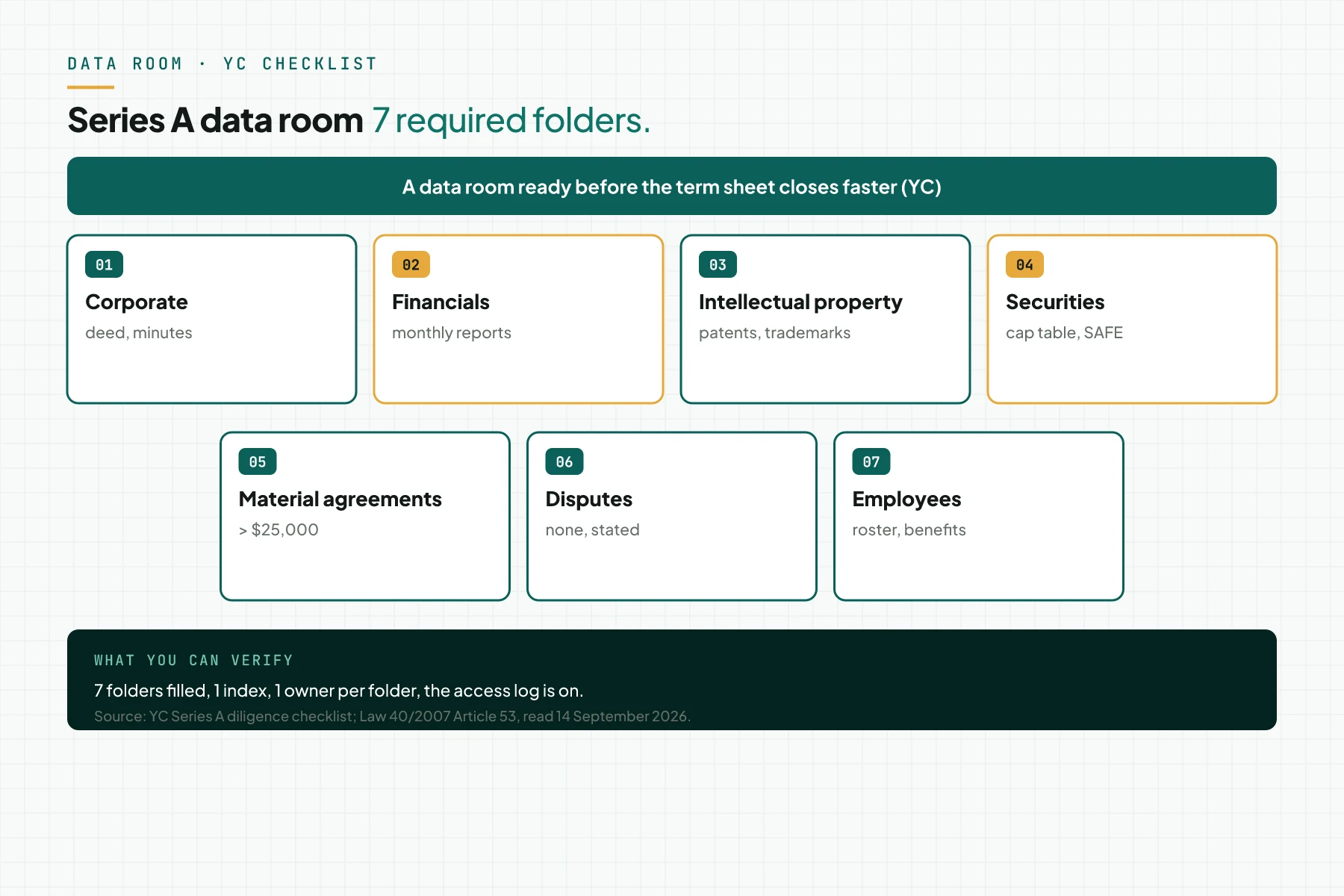
Material agreements mean contracts above $25,000, leases, debt, IP licences, insurance, and NDAs (YC Series A diligence checklist). For an Indonesian PT, corporate holds the deed, articles with share classes, and GMS minutes for a capital increase (Law 40/2007 Articles 41, 42, and 53).
Securities holds SAFEs, convertible notes, and the shareholder register. Read 12 Series A term sheet terms: NVCA also names due diligence as a closing condition (NVCA, 2020 Model Term Sheet).
Evidence: 1 index per folder names an owner and date, a test identity opens every folder, and the access log is on.
Step 6: Tidy the cap table and pending equity grants
Open the securities folder and the cap table file. A cap table tells who owns what, and must stay detailed and accurate (Cooley GO, cap table). List every SAFE and promised option on it, and read how to calculate Series A valuation and dilution for its dilution.
Close pending equity grants first. US practice treats a term sheet as changing the 409A valuation, so a PT should close pending GMS approvals and deeds early (YC Series A diligence checklist). Do not list a fund as an existing investor without stating its role (YC, how to build a great Series A pitch and deck).
Evidence: the cap table totals 100%, and the pro forma sits in a file labelled a simulation.
Step 7: Practice the 20-20-20 pitch and appoint 1 presenter
Schedule a practice session, 20-20-20: 20 minutes to pitch, 20 for discussion, 20 for feedback (YC, how to build a great Series A pitch and deck). Set aside 1–2 hours a day to refine the deck, and appoint 1 presenter, since most pitches now run over video.
Record every session, and note the questions that stay unanswered.
Evidence: 3 recorded sessions exist, the final deck holds 15 slides at most, and the question list names each evidence location.
Dummy simulation: PT Simulasi's 6-week preparation schedule
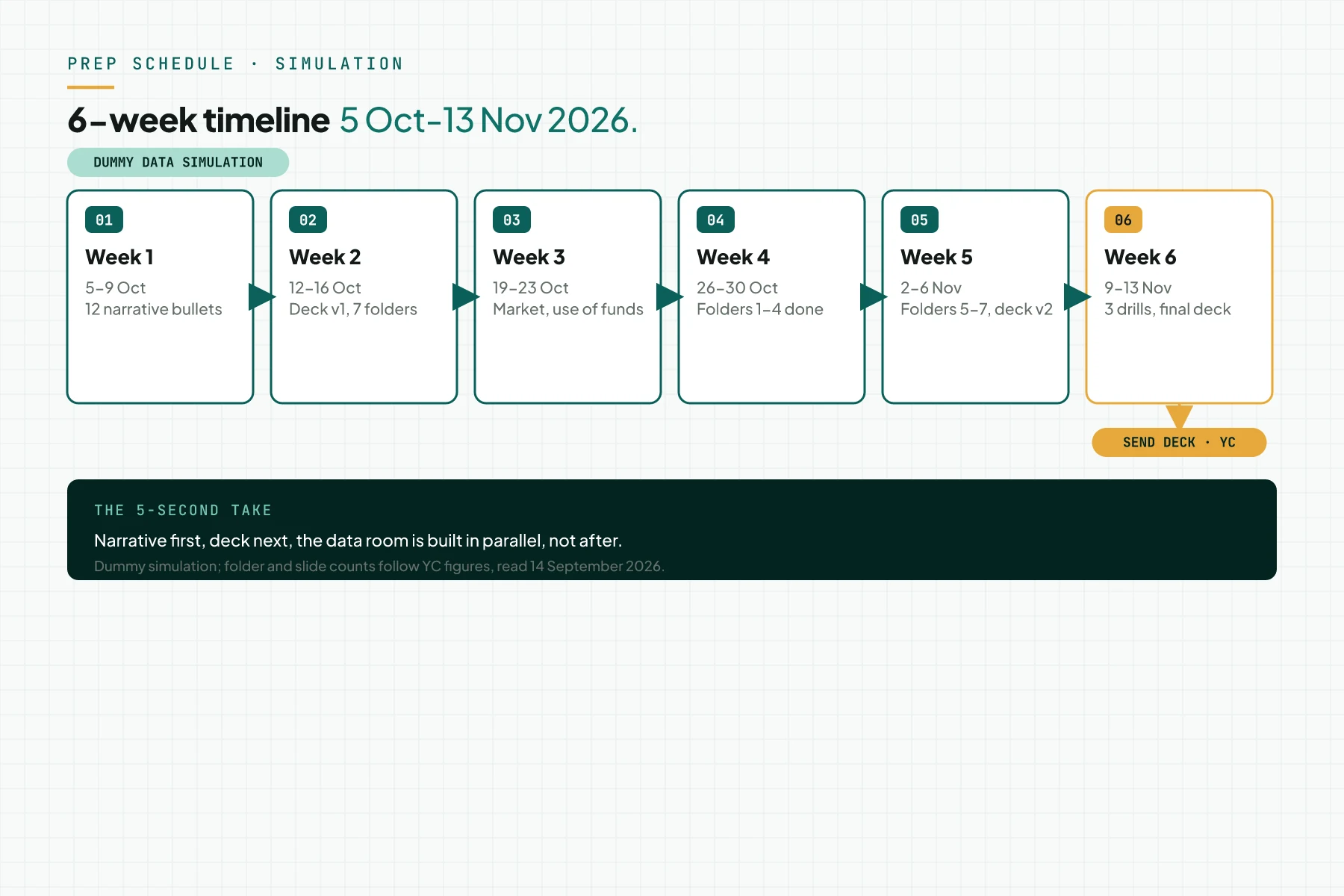
Table 2 is a dummy simulation for PT Simulasi, week 1-6, 5 October-13 November 2026.
| Week | Date | Input (activity) | Recorded (evidence) | Output |
|---|---|---|---|---|
| 1 | 5-9 Oct 2026 | Write 12 bullets; export 6 months of MRR, cohorts, cash | Narrative v1; 3 export files | 12 bullets, numbered and sourced |
| 2 | 12-16 Oct 2026 | Deck v1, 12 slides, YC order; build 7 folders and an index | Deck v1; a folder index | 12 slides; 7 named empty folders |
| 3 | 19-23 Oct 2026 | Bottom-up market from the SOM; a Rp 60 billion (dummy) use of funds, 20 months; a pro forma cap table | Spreadsheet with assumptions; cap table labelled a simulation | Slides 6 and 10 filled |
| 4 | 26-30 Oct 2026 | Fill folders 1-4: deed, articles, GMS minutes, reports, IP, cap table, SAFEs | Upload log; test opens 4 folders | Folders 1-4 complete |
| 5 | 2-6 Nov 2026 | Fill folders 5-7: contracts above $25,000, leases, NDAs, disputes (none), roster; deck v2 | Upload log; deck v2 | Folders 5-7 complete; 7 of 7 |
| 6 | 9-13 Nov 2026 | 3 recorded 20-20-20 drills; 1 presenter; final deck | 3 recordings; 25 questions with evidence locations | Final deck, 13 slides plus appendix |
The rupiah figures are dummy; do not convert them. Slide, folder, and practice counts follow YC.
Series A checklist: deck and data room
- 10–15 narrative bullets are written, each numbered and sourced (founder; the narrative document).
- 10–15 slides outside the appendix, 1 point per slide, in YC order (founder; a versioned PDF).
- Traction slides use a 4–6 month chart from the accounting software, not a cumulative number (finance; the export).
- The bottom-up market size and the 18–24 month use of funds sum to the round amount (founder and finance; a spreadsheet).
- 7 folders hold an index, owner, date, and access log (operations; the data room index).
- The fully diluted cap table carries a date; pending grants and GMS approvals close (finance and legal; the cap table).
- 3 recorded 20-20-20 drills; 1 presenter named; a question list names each evidence location (founder; the recordings).
- Stop criterion: do not send the deck while 1 of 7 folders stays empty. The traction slide must not stay cumulative, and the cap table must reach 100%.
FAQ on Series A pitch decks and data rooms
How many slides should a Series A pitch deck have? 10–15 slides outside the appendix, 1 point per slide, for a pitch that opens a 40–45 minute discussion (YC).
What is the slide order of a Series A pitch deck? YC's order runs title through appendix, with traction featured twice (see the summary above); Sequoia adds why now and a business model.
What is a startup data room and what goes in it? It holds 7 YC document groups (see the summary above); an Indonesian PT adds the deed, articles, and GMS minutes.
When must the Series A data room be ready? Before the term sheet: this cuts the closing by up to 1 week, since closing without one can exceed 1 month (YC).
How does a Series A deck differ from a seed deck? A Series A deck buys proof: traction appears twice, with a monthly trend, while a seed deck leans on team and idea (YC benchmarks Series A about 18–24 months after seed).
Next step
A tidy deck and data room speed up the process, but do not guarantee a term sheet; a licensed adviser must still review every decision. A data room is a document system with sourced access, versions, and search.
If your team wants its sources tidied before due diligence, use the Company Document Systems service. It maps sources, access, and versions, priced in a quote after a 1-business-day review. Do not send us document content or credentials.
To ask a question first, book a 30-minute session.
Sources
- Y Combinator: How to build a great Series A pitch and deck
- Y Combinator: Series A diligence checklist
- Sequoia Capital: Writing a Business Plan
- Y Combinator: How startup fundraising works
- Carta: 'Quantity is down, and quality is up': the new state of Series A fundraising
- Cooley GO: Cap table
- NVCA: 2020 Model Term Sheet
- Law No. 40 of 2007 on Limited Liability Companies (peraturan.bpk.go.id)
- Y Combinator: How much should you spend after fundraising