Direct answer: A Series A valuation comes from 2 agreed numbers: the pre-money and the investment. Post-money = pre-money + investment. Price per share = pre-money divided by the fully diluted share count before the round, including the option pool the investor requires. Investor ownership = investment divided by post-money. Founder dilution exceeds the investor's percentage, because the new pool and the SAFE conversionConversionThe action you count as a result, for example a paid order, a sign-up, or a chat that becomes a qualified buyer.Open the glossary enter the pre-money.
Main condition: These formulas apply to a priced round with preferred stock and YC-style post-money SAFEs. Sources: Cooley GO, the YC Post-Money Safe User Guide (version 1.2, February 2023), and the YC and NVCA 2020 term sheet templates. Limit: Rama Digital is not a financial, legal, or tax adviser; this article explains the mechanism, not a funding promise or a result. A licensed legal and financial adviser must review every funding decision, valuation, and agreement. Convertible notes with interest and anti-dilution in a down round are not calculated here; read 12 Series A term sheet terms for anti-dilution. For an Indonesian PT, share classes and pre-emptive rights follow Law 40/2007 and the articles of association.
We read Cooley GO, the YC Post-Money Safe User Guide, the YC and NVCA term sheet templates, and Carta data on 14 September 2026. Every example number here is a dummy simulation in USD, not customer data.
- Post-money = pre-money + investment; investor ownership = investment divided by post-money (Cooley, YC).
- YC example: $1M at a $5M pre-money with 10 million shares gives a $0.50 price, 2 million new shares, and 16.7% dilution, not 20%.
- Investors usually require the full post-closing pool percentage inside pre-closing capitalization, so the pool dilutes only existing holders (Cooley).
- Cooley example: a $15M pre-money with a 20% pool leaves common stock at 67.05%; a $12M pre-money with a 15% pool leaves 70.28%.
- Post-money SAFE ownership = investment divided by cap. SAFEs do not dilute each other, but Series A money and the new pool dilute them (YC Safe User Guide).
Series A valuation: pre-money, post-money, and price per share
Pre-money is the company's value before the investment. Post-money is the value after it. Pre-money plus investment equals post-money, with few exceptions (Cooley GO on pre-money; post-money).
YC's example: a $1,000,000 investment at a $5,000,000 pre-money with 10,000,000 shares gives a $0.50 price per share. The round issues 2,000,000 new shares. Post-money becomes $6,000,000, and founder dilution is 16.7%, not 20% (YC seed guide).
Fully diluted means every issued share, plus warrants, options, and convertible securities. A cap table answers who owns what, and how much (Cooley GO on the cap table).
Read what Series A funding is for Series A context and startup funding stages from pre-seed to Series C for cumulative dilution across funding stages.
The problem: 20% on the term sheet is not 20% founder dilution
Dilution means an ownership percentage falls because new shares exist. 1% becomes 0.5% when the share count doubles (Cooley GO on dilution).
Investors price the pre-money from market size and growth metrics. Read the Series A metrics investors read and TAM, SAM, and SOM: meaning, formulas, and examples (Indonesian source) for both. Read ICP, wedge market, SOM, and how investors read them (Indonesian source) for how investors read them.
The option pool shuffle names this tactic: the pool is a percentage of post-money, but it sits inside the pre-money. So it dilutes only existing holders, not the new investor (Cooley GO on negotiating the option pool).
Investors often call a 20% pool standard, yet a 12-18 month option grant budget often needs only 10% (Cooley GO). Step 7 tests the effect with numbers.
A SAFE is also diluted by Series A money and the new pool. YC's example: a 15% SAFE, a 25% investor, and a 10% pool give 39.41% total dilution, with a 4.41% pro rata share (the YC Post-Money Safe User Guide).
Read 12 Series A term sheet terms for other term sheet language, such as liquidation preference and anti-dilution.
Instrument comparison: post-money SAFE, convertible note, and priced round
A startup raises a Series A through 3 instruments. Table 1 compares pricing timing, caps, discounts, interest, maturity, and ownership.
| Instrument | When the price is set | Cap and discount | Interest and maturity | How ownership is calculated |
|---|---|---|---|---|
| Post-money SAFE (YC) | Next priced round; converts automatically. | Cap = highest valuation; a discount prices lower. | No interest, no maturity date. | Investment divided by the post-money cap. |
| Convertible note | Next equity round; loan becomes equity. | Cap and/or discount; cap = maximum effective valuation. | Carries interest and a maturity date. | Principal plus interest, at the lower of discount or cap. |
| Priced round (Series A) | At closing; price agreed directly. | No cap; negotiated directly. | None; preferred stock carries other rights. | Investment divided by post-money. |
Table sources: YC Safe documents, the YC Post-Money Safe User Guide, and Cooley GO on convertible notes. Also see: the YC seed guide and the NVCA term sheet template.
Prerequisites before you calculate
Prepare these 5 things before you start.
- A dated, fully diluted cap table: founder shares, issued options, promised options, and the unissued pool.
- A list of every SAFE: amount, post-money cap, discount, and any pro rata side letter.
- The term sheet numbers: the fully diluted pre-money, the investment amount, and the post-closing pool percentage.
- 1 spreadsheet with columns for holder, shares before, shares after, percentage, and dilution.
- 1 decision owner and 1 legal adviser to review the final result.
Step 1: Set the pre-money, the investment, and the post-money
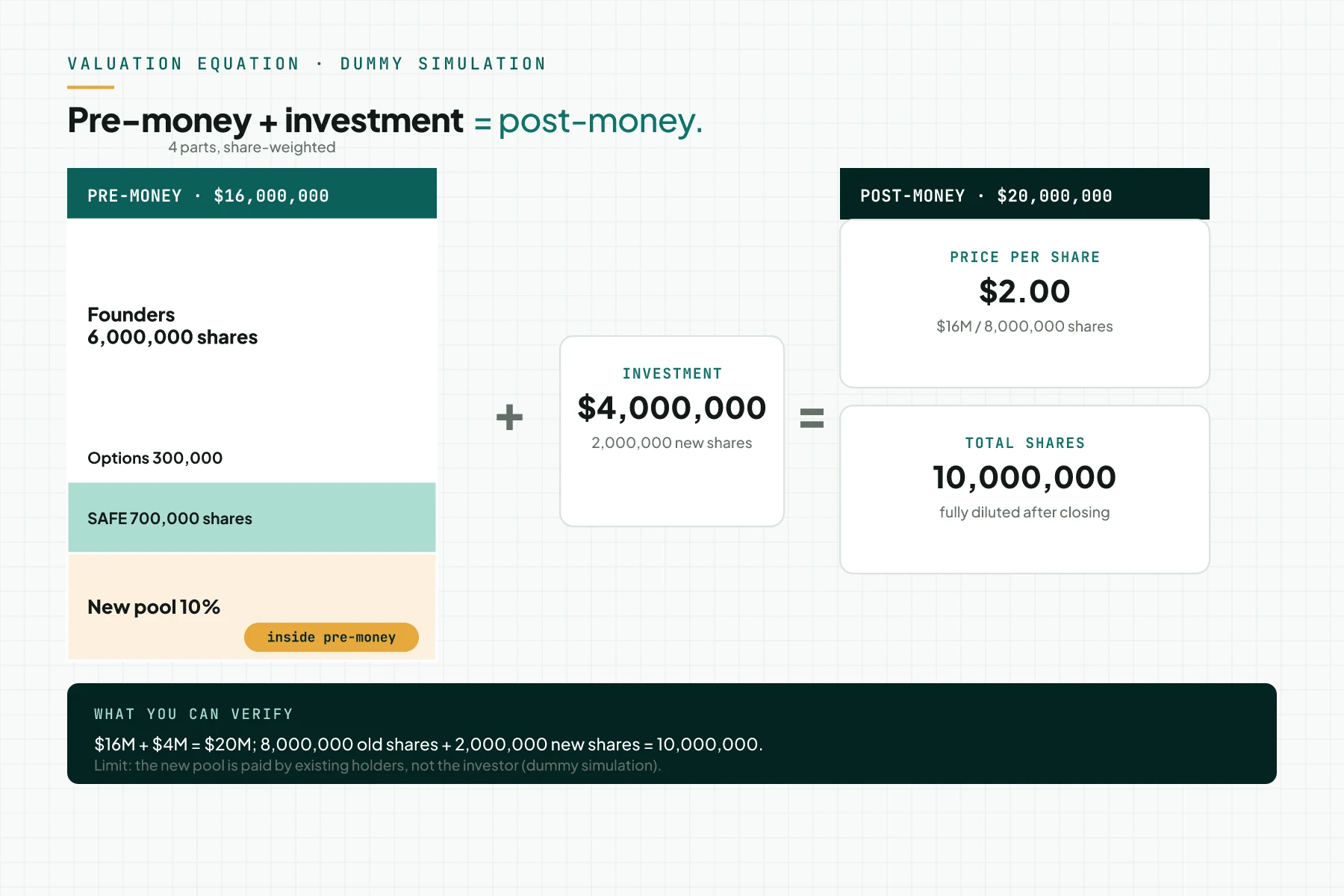
Open the valuation line on the term sheet, usually bold on the first page. Fill in the simulation: a $16,000,000 pre-money and a $4,000,000 investment.
Post-money = pre-money + investment = $20,000,000. Investor ownership = $4,000,000 divided by $20,000,000 = 20%.
Evidence: the term sheet's post-money must equal pre-money plus investment; question the investor if it does not.
This $4,000,000 follows the cash need up to the turning point; read the startup cash-flow J-curve: trough, runway, and turning point for that calculation.
Source: Cooley GO on pre-money and post-money; the YC Post-Money Safe User Guide.
Step 2: Build the fully diluted capitalization before the round
Open the cap table as it stands before this round. Fill in the simulation: founders hold 6,000,000 common shares, and issued options total 300,000 shares.
Total shares before the round = 6,300,000. Founders hold 95.24%, and issued options hold 4.76%.
YC's Company Capitalization holds outstanding shares, options, promised options, and the unissued pool, without this round's new pool.
Evidence: match the share count to the incorporation documents and shareholder register, with a dated option grant.
Source: the YC Post-Money Safe User Guide; Cooley GO on the cap table.
Step 3: Convert the post-money SAFE into shares
Open the SAFE document, at the Post-Money Valuation Cap line. Fill in the simulation: a $1,000,000 SAFE with a $10,000,000 cap.
SAFE ownership = $1,000,000 divided by $10,000,000 = 10% of Company Capitalization once the SAFE is included.
SAFE shares = 10% of 6,300,000 plus the SAFE shares, solving to 700,000. Company Capitalization becomes 7,000,000; SAFE price = $10,000,000 divided by 7,000,000 = $1.4286.
YC's rule: a SAFE uses the new investor's price if the round's pre-money sits below the cap, or the round price less any discount (the YC Post-Money Safe User Guide).
Evidence: 700,000 divided by 7,000,000 = 10.00%. Other SAFEs do not dilute this one.
Source: the YC Post-Money Safe User Guide; the YC Safe documents page.
Step 4: Add the new option pool to the pre-money
Find the term sheet line on the option pool, usually a stated percentage of post-closing fully diluted capitalization (YC example). Fill in the simulation: a 10% post-closing pool.
Total post-money fully diluted shares = 7,000,000 divided by 1 minus the 10% pool and 20% investor share = 10,000,000. The new pool = 1,000,000 shares.
Fully diluted pre-money capitalization = 7,000,000 plus 1,000,000 = 8,000,000 shares.
This pool sits inside the pre-money, so it dilutes only existing holders. Ask for a pool sized to a 12-18 month grant budget, not a standard number (Cooley GO on negotiating the option pool).
Evidence: 1,000,000 divided by 10,000,000 = 10% of the post-closing capitalization.
Source: the NVCA term sheet template; Cooley GO on the option pool.
Step 5: Calculate the price per share and the investor's new shares
Divide the pre-money by the fully diluted pre-money capitalization from Step 4. The result: $16,000,000 divided by 8,000,000 = $2.00 per share.
The investor's new shares = $4,000,000 divided by $2.00 = 2,000,000 shares, or 20% of 10,000,000 total shares.
Compare this with the $1.4286 SAFE price from Step 3. That price sits below $2.00, so the SAFE still converts at its own price and gets 700,000 shares.
Evidence: 2,000,000 times $2.00 = $4,000,000. 10,000,000 times $2.00 = $20,000,000, matching the post-money.
Source: the YC seed guide; the YC Post-Money Safe User Guide.
Step 6: Build the post-Series A cap table and each holder's dilution
Gather every number from Steps 1 through 5 into 1 cap table. Fill in: 6,000,000 founder shares, 300,000 options, 700,000 SAFE, a 1,000,000 new pool, and 2,000,000 investor shares, of 10,000,000 total.
Final percentages: founders 60.00%, options 3.00%, the SAFE 7.00%, the new pool 10.00%, and the investor 20.00%.
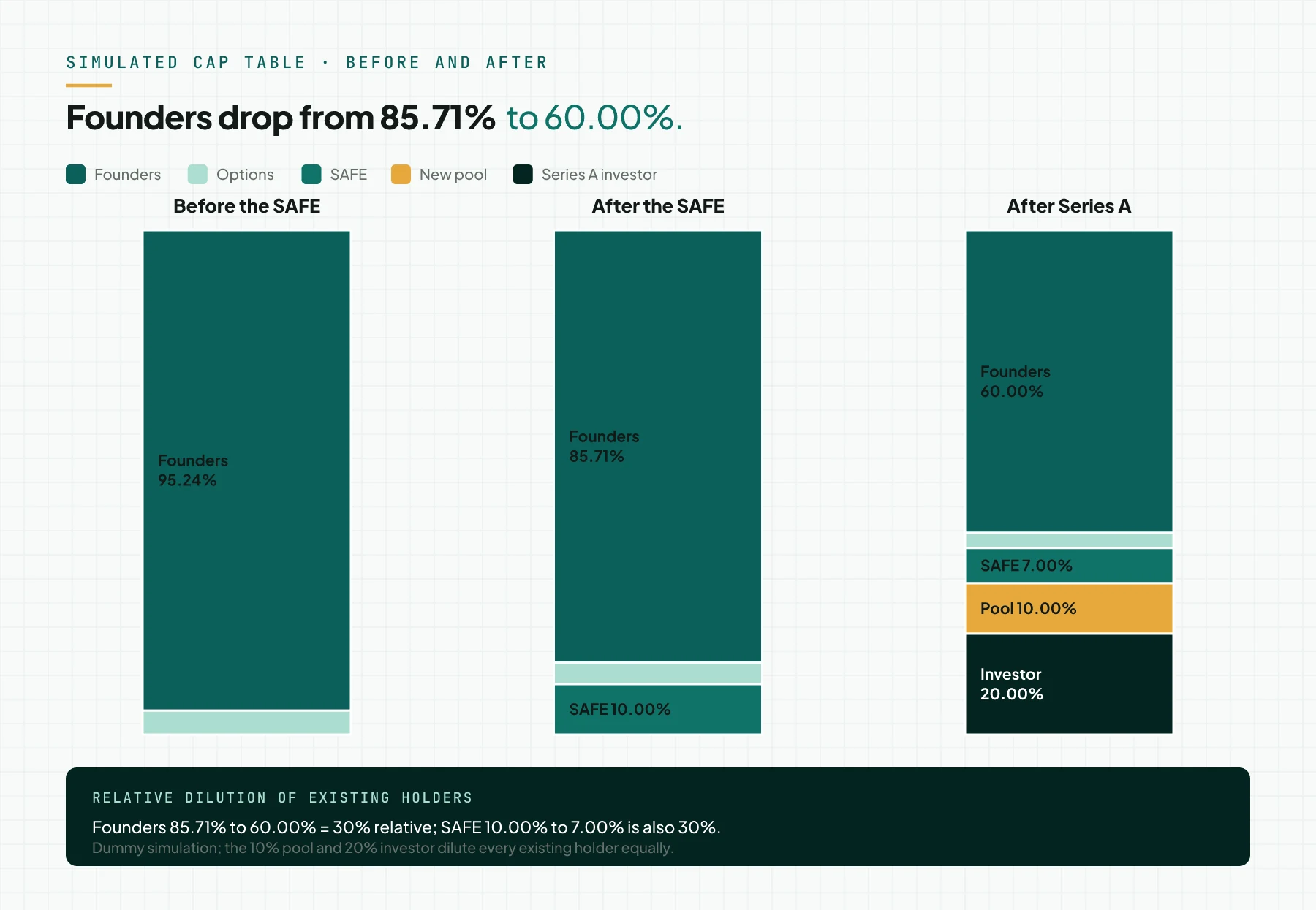
Evidence: every percentage must total 100%. Match this result against the investor's pro forma cap table.
Source: the YC Post-Money Safe User Guide; Cooley GO on dilution.
Step 7: Test the option pool and pre-money sensitivity
Change 2 numbers, the pool and the pre-money, then recalculate founder ownership. Quick formula: ownership after equals ownership before, times 1 minus the pool percent and the investor percent.
Table 2 tests 5 scenarios with a fixed $4,000,000 investment.
| Scenario | Founder ownership |
|---|---|
| 10% pool, $20,000,000 pre-money | 62.86% |
| 10% pool, $16,000,000 pre-money (base case) | 60.00% |
| 15% pool, $16,000,000 pre-money | 55.71% |
| 10% pool, $12,000,000 pre-money | 55.71% |
| 20% pool, $16,000,000 pre-money | 51.43% |
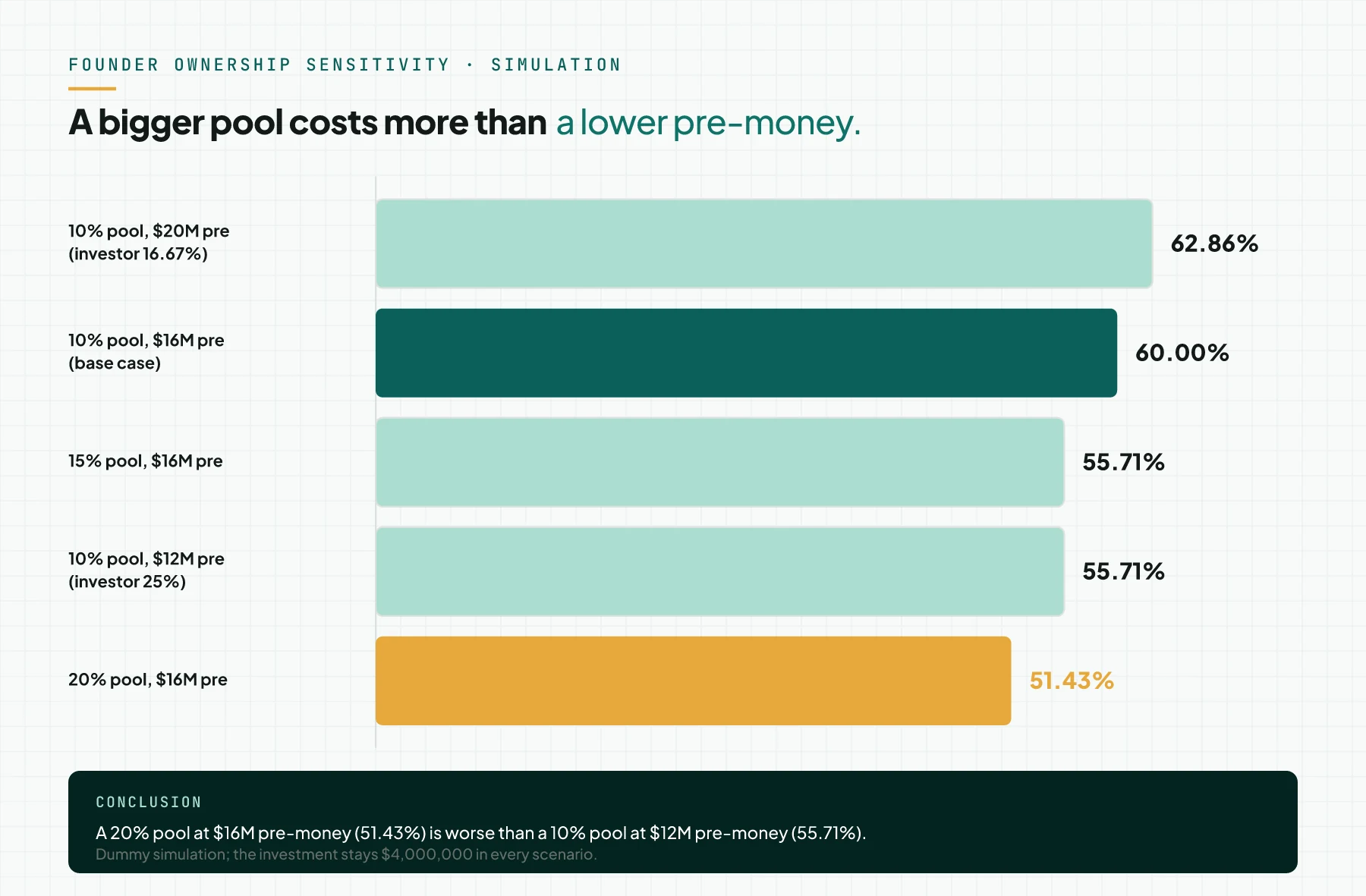
Evidence: calculate all 5 scenarios in a spreadsheet before you pick the number you sign.
Source: Cooley GO on negotiating the option pool; the YC Post-Money Safe User Guide.
Dummy simulation: the PT Simulasi cap table before and after Series A
PT Simulasi signed its SAFE in March 2025, its term sheet on 6 October 2026, and closed on 1 December 2026. Table 3 records each holder's shares and percentage at 3 points in time.
| Holder | Before the SAFE | After the SAFE | After Series A | Relative dilution |
|---|---|---|---|---|
| Founders (common stock) | 6,000,000; 95.24% | 6,000,000; 85.71% | 6,000,000; 60.00% | 30.0% |
| Issued employee options | 300,000; 4.76% | 300,000; 4.29% | 300,000; 3.00% | 30.0% |
| SAFE, $1,000,000 at a $10,000,000 cap | — | 700,000; 10.00% | 700,000; 7.00% | 30.0% |
| New option pool (10% post-closing) | — | — | 1,000,000; 10.00% | new |
| Series A investor | — | — | 2,000,000; 20.00% | new |
| Total | 6,300,000; 100% | 7,000,000; 100% | 10,000,000; 100% | — |
Input: a $16,000,000 fully diluted pre-money and a $4,000,000 investment, with a 10% post-closing pool. Also: a $1,000,000 SAFE at a $10,000,000 cap, 6,000,000 founder shares, and 300,000 issued options.
Recorded by the system: Company Capitalization 7,000,000 shares and SAFE price $1.4286. Also: fully diluted pre-money 8,000,000 shares, price per share $2.00, investor shares 2,000,000, new pool 1,000,000.
Output: a $20,000,000 post-money; see the table above for each holder's final percentage.
Label: dummy simulation in USD. Do not convert these numbers into rupiah, because the instruments and contracts are denominated in dollars.
Checklist before you agree the valuation numbers
- Today's fully diluted cap table is dated: founder shares, issued options, promised options, and the unissued pool (founder; the cap table file).
- Every SAFE and convertible note is listed: amount, cap, discount, interest, and any pro rata side letter (finance; document copies).
- The term sheet is read for 2 numbers: the fully diluted pre-money and the post-closing pool percentage (founder; the signed term sheet).
- These 7 steps are replicated in a spreadsheet, matching the investor's pro forma cap table (finance; a spreadsheet labelled simulation, then actual).
- 10%, 15%, and 20% pool scenarios, at 2 different pre-money levels, are simulated before negotiation (finance; the sensitivity table).
- The articles of association hold the preferred share class and an AGM agenda item for the capital increase (legal adviser; notary notes).
- Stop criterion: stop the negotiation if the spreadsheet result differs by more than 0.5 percentage points from the investor's pro forma. Resume only after the gap is explained in writing and a legal adviser reviews it.
FAQ on Series A valuation
How do you calculate a Series A valuation from pre-money and post-money? Post-money = pre-money + investment. Investor ownership = investment divided by post-money. Example: $16,000,000 + $4,000,000 = $20,000,000, and the investor holds 20%.
Does a 20% investor mean founders are diluted 20%? No. The new pool and SAFE conversion enter the pre-money, so founders fall further. In this simulation, founders drop from 85.71% to 60.00%, a 30% relative fall.
Why does the option pool go into the pre-money? Investors usually require the post-closing pool inside pre-closing capitalization, so it dilutes only existing holders, not the new investor.
How does a post-money SAFE convert at Series A? SAFE ownership = investment divided by the cap. SAFE price = the cap divided by Company Capitalization. If the round's pre-money sits below the cap, the SAFE uses the round price.
What Series A dilution is reasonable? The Series A median dilution is 18% on AS/global data (Carta, 10 July 2026). Historical figures run 19-20% plus the pool, and each deal differs.
Do these formulas apply to an Indonesian PT? The arithmetic stays the same. Preferred share rights must appear as a share class under Law 40/2007 Article 53, and the pre-emptive right runs 14 days under Article 43.
Next step
Rama Digital is not a financial, legal, or tax adviser. This article explains the mechanism and the calculation, not a funding promise or a result. A licensed legal and financial adviser must review the valuation numbers before you sign.
If your team wants to check its own term sheet numbers, use the AI Diagnostic service. This 60-90 minute session gives a bottleneck map, AI opportunities, and a written first step, for Rp 1,500,000. To ask a question first, book a 30-minute session.
Sources
- Cooley GO: Pre-Money Valuation
- Cooley GO: Post-Money Valuation
- Cooley GO: Dilution
- Cooley GO: Negotiating the Option Pool
- Cooley GO: Option Pool (glossary)
- Cooley GO: Cap Table
- Cooley GO: Convertible Note
- Y Combinator: A Guide to Seed Fundraising
- Y Combinator: Series A Term Sheet Template
- Y Combinator: Safe Documents
- Y Combinator: Post-Money Safe User Guide (v1.2, February 2023)
- NVCA: 2020 Model Term Sheet
- Carta: VC Startup Fundraising Benchmarks From 1,000 Rounds
- Law No. 40 of 2007 on Limited Liability Companies