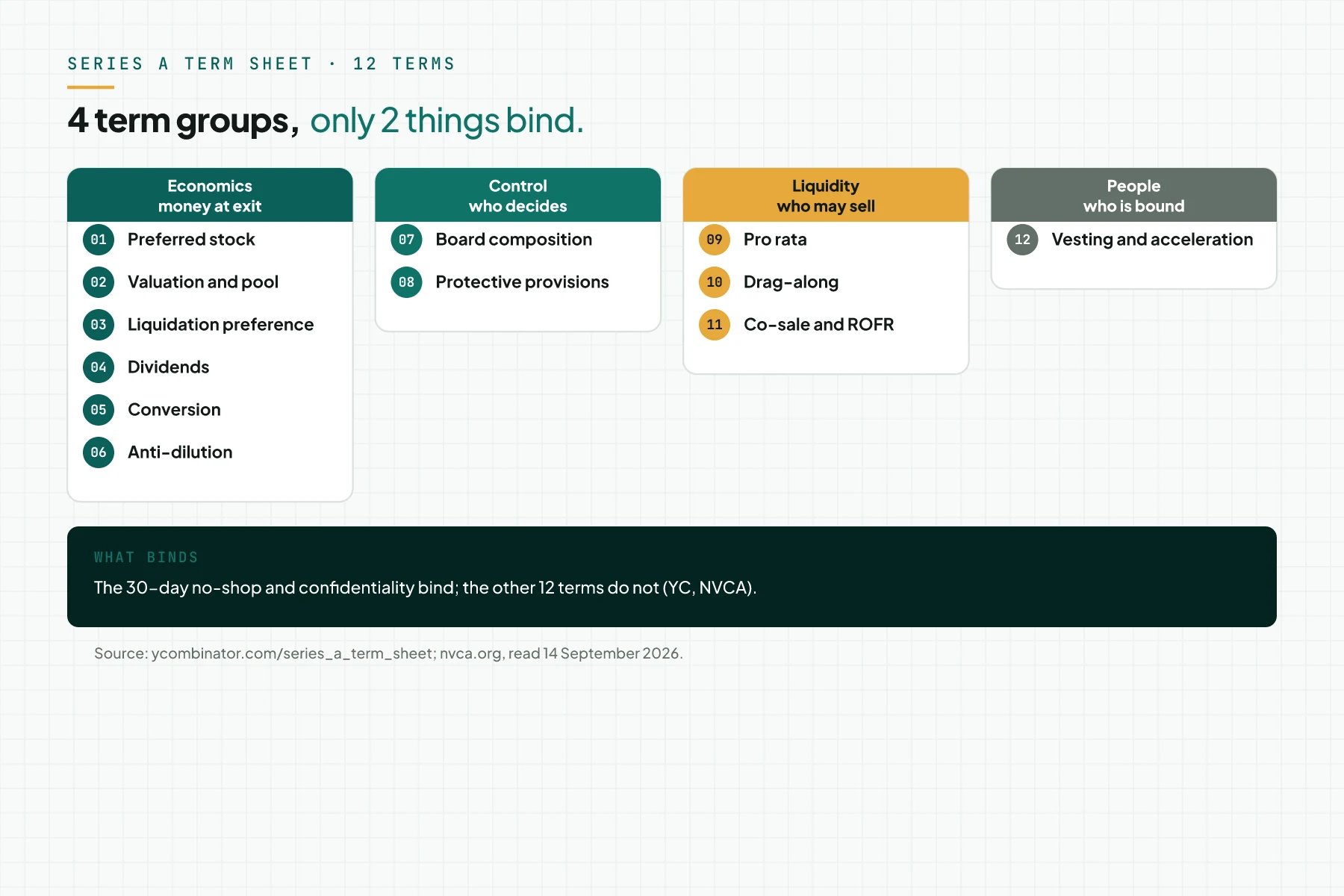
Direct answer: A Series A term sheet is a summary of investment terms that is mostly non-binding; only the no-shop and confidentiality bind (YC, NVCA). Its 12 core terms fall into 4 groups: economics, control, liquidity, and people. The YC template uses 1x non-participating and a 2-1 founder board; terms beyond that are "dirty" and set the precedent for later rounds.
Main condition: this applies to a Series A term sheet on the YC or NVCA pattern, common US practice. A "standard" position is template content, not a legal obligation. Limit: Rama Digital is not a financial, legal, or tax adviser; this article explains the mechanism, not a funding promise. The valuation, pool, and dilution formulas are not repeated here; read how to calculate Series A valuation and dilution.
We read YC, NVCA, Cooley GO, and Carta on 14 September 2026; Law 40/2007 was read the same date and remains in force. The example numbers here are a dummy simulation, not real data.
- YC template: 1x non-participating preference, 6% non-cumulative dividends if declared, a 3-seat board with founders 2-1.
- The 30-day no-shop binds; lead legal fees are capped at $30,000.
- YC's "dirty" terms: a preference above 1x, participating preferred, cumulative dividends, and warrant coverage.
- NVCA anti-dilution: CP2 = CP1 × (A + B) / (A + C); full ratchet is far less common in the US.
- A 2-2-1 board is the most common loss of control; employee vesting usually runs 4 years with a 1-year cliff.
Series A term sheet: what binds and what does not
A Series A term sheet is a short document listing investment terms; most of it does not bind legally (YC, Series A term sheet).
NVCA carves out 2 exceptions: no-shop and confidentiality bind even after financing falls through (NVCA, 2020 Model Term Sheet). In Delaware, "nonbinding" does not always release a party from its duties, as a 2013 case found (NVCA, 2020 Model Term Sheet).
A definitive document can run past 100 pages and sets the precedent for the next round (YC). NVCA updated its model documents 3 times in 2025-2026 (NVCA).
Read what Series A funding is for the 6-stage funding process. Read also how to prepare a Series A pitch deck and data room, which speeds up closing.
The problem: "dirty" terms that only bite at exit or when control is lost
Founders often sign without checking the 12 terms behind a term sheet. Some, which YC calls "dirty," bite only once the company sells or control is lost.
YC lists 4 dirty terms: a preference above 1x, participating preferred, cumulative dividends, and warrant coverage (YC). Participating is a "double-dip," taking the principal and still sharing the rest.
Founders usually lose control through a 2-2-1 board plus an approval clause over budget, executives, and pivots (YC). Carta notes preferences sit near multi-year lows, US/global data (Carta, State of Private Markets Q1 2026).
Investors already tested the ICP and market size before the term sheet stage. Read what an ICP is and why it matters more than a large market (Indonesian source) so a pivot does not become a veto reason. Read also ICP, wedge market, SOM, and how investors read them (Indonesian source).
Economics group: preferred stock, valuation, liquidation preference, dividends, conversion, anti-dilution
The economics group decides the money each party receives at exit.
1. Preferred stock and pricing
A Series A investor buys preferred stock, which carries rights common stock lacks: a liquidation preference, dividends first, a board seat, and veto rights (Cooley GO, preferred stock glossary).
2. Valuation and the option pool
The valuation, pool, and dilution formulas are fully worked out in how to calculate Series A valuation and dilution. This article does not repeat them.
3. Liquidation preference
A liquidation preference pays the investor first at exit. Non-participating pays the preference or the as-converted share, whichever is larger, while participating pays both and is far less common (Cooley GO, liquidation preference).
The YC template uses 1x non-participating, treating a sale as a liquidation (YC). NVCA offers 3 alternatives (NVCA).
4. Dividends
The YC template uses a 6% non-cumulative dividend, paid only if declared (YC); a cumulative dividend is "dirty".
5. Conversion
Preferred stock converts to common at the holder's choice, or automatically at an IPO; the starting ratio is 1:1 (YC).
6. Anti-dilution
NVCA's broad-based weighted average: CP2 = CP1 × (A + B) / (A + C) (NVCA). A = pre-issuance as-converted shares; B = money in divided by CP1; C = new shares. Full ratchet divides the old price by the new price and ignores the amount raised; it is far less common in the US (Cooley GO).
Control group: board composition and protective provisions
7. Board composition
The YC template sets 3 board seats: the lead names 1, the common majority 2; founders usually hold both, a 2-1 result (YC).
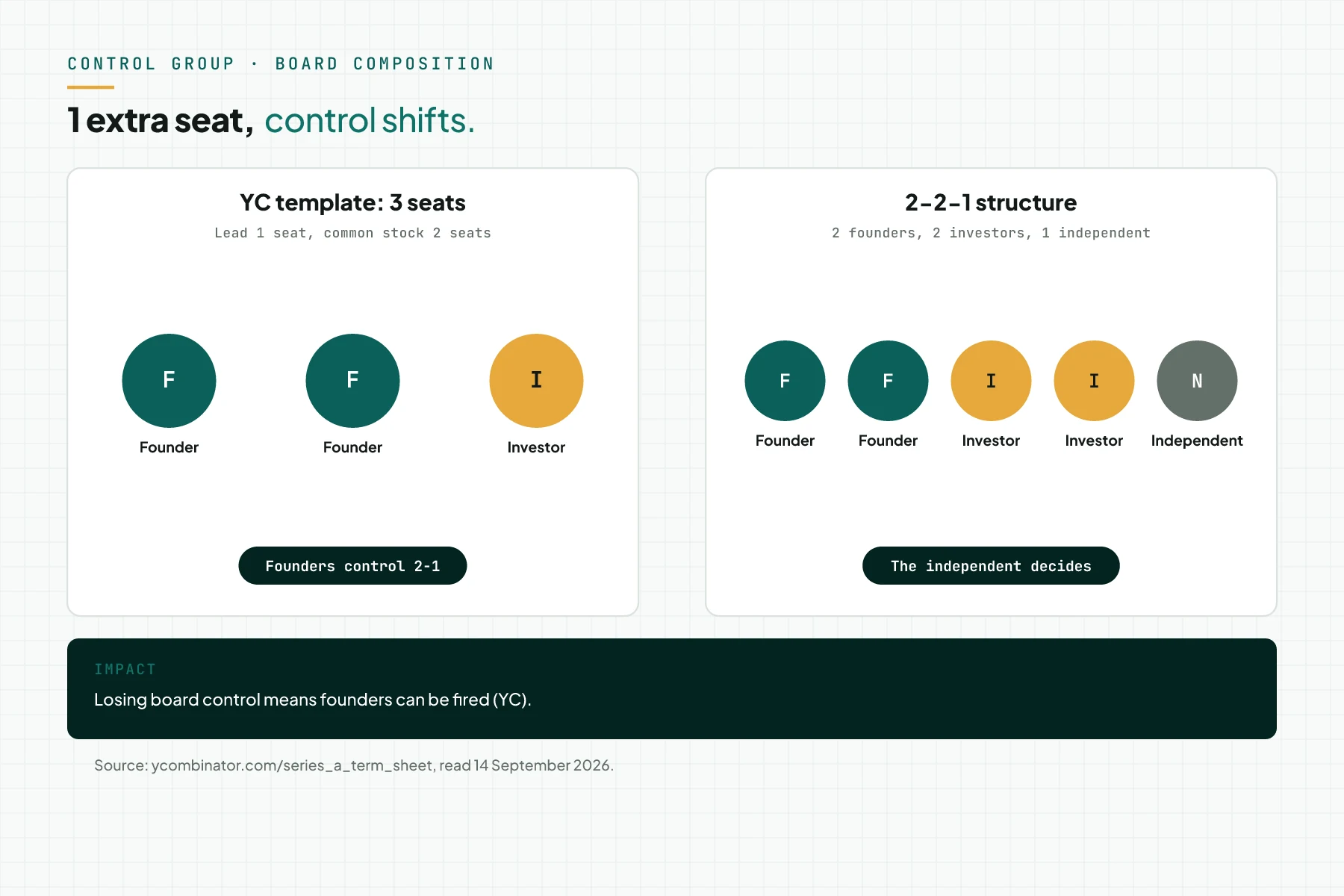
A 2-2-1 board is the most common loss of control, sometimes ending in a firing (YC). NVCA adds a CEO and an independent director as a counterweight (NVCA).
8. Protective provisions
Protective provisions require majority preferred consent for key decisions: preferred rights, senior stock, buybacks, dividends, board size, and liquidation (YC). The 2 most impactful vetoes are financing and a sale (YC). NVCA adds consent for loans, executives, and the core business (NVCA).
Liquidity group: pro rata, drag-along, co-sale, and the right of first refusal
9. Pro rata and pay-to-play
A pro rata right keeps an ownership percentage in the next round (YC). NVCA grants it to a Major Investor, including when oversubscribed; pay-to-play converts a skipped investor to common stock (NVCA).
10. Drag-along
The YC template requires founders, investors, and 1%+ holders to join a board- and common-approved sale (YC). Cooley calls this a majority "dragging" the minority in; NVCA limits liability to each pro rata share (Cooley GO, drag-along rights).
11. Co-sale and the right of first refusal
A right of first refusal (ROFR) lets the company buy first, then the investor; NVCA's "take-me-along" co-sale lets 1%+ holders join a sale (NVCA). YC includes a similar right, plus quarterly information rights (YC).
See the private equity and venture capital J-curve for why investors ask for these.
People and process group: vesting, acceleration, no-shop, and fees
12. Vesting and acceleration
The YC template gives employees 4-year monthly vesting with a 1-year cliff, founders negotiated separately (YC); NVCA uses 25% at year 1, then 36 months (NVCA).
Single-trigger acceleration needs only a sale; double-trigger needs a sale plus termination without cause, and is more common (Cooley GO, acceleration).
On the YC template only the 30-day no-shop binds (YC); NVCA adds confidentiality as binding (NVCA). The company caps the lead's legal fees at $30,000 (YC).
12 Series A term sheet terms: YC position, NVCA position, and red flags
The table lists the YC and NVCA 2020 positions and a sourced red flag per term; NVCA cells keep the template's own [__] where blank.
| # | Term | YC position | NVCA position | Red flag (sourced) |
|---|---|---|---|---|
| 1 | Preferred stock | Series A Preferred Stock | Series A Preferred Stock | No share class in the articles of association (Law 40/2007 Art. 53) |
| 2 | Valuation and pool | Post-money, includes pool [__]% post-closing | Pre-money fully diluted, includes [__]% post-money pool | A large pre-money pool dilutes existing holders (see how to calculate Series A valuation and dilution) |
| 3 | Liquidation preference | 1x non-participating; a sale counts as a liquidation | [__]x non-participating, full participating, or a [__]x cap | Above 1x or participating is "dirty" |
| 4 | Dividends | 6% non-cumulative, if the board declares it | Template offers a choice; not used here | A cumulative dividend is "dirty" |
| 5 | ConversionConversionThe action you count as a result, for example a paid order, a sign-up, or a chat that becomes a qualified buyer.Open the glossary | To common stock; automatic at IPO; ratio 1:1 | Ratio adjusts for anti-dilution | Ratio shifts after a down round (row 6) |
| 6 | Anti-dilution | Standard broad-based weighted average | CP2 = CP1 × (A + B) / (A + C) | Full ratchet is far less common in the US |
| 7 | Board composition | 3 seats: lead 1, common 2; founders 2-1 | Lead, other investor, common, CEO, [__] independent | A 2-2-1 board is the most common loss of control |
| 8 | Protective provisions | Majority preferred consent: rights, shares, buybacks, dividends, board, liquidation | Adds tokens/crypto, debt above $[__], subsidiaries | An operating veto (budget, executives, pivot) |
| 9 | Pro rata, pay-to-play | Pro rata right for preferred holders | Major Investor; pay-to-play converts to common | Limited to a Major Investor; a PT's 14-day right is already law |
| 10 | Drag-along | Founders, investors, 1%+ join a board-approved sale | Several liability, limited to each pro rata share | No common majority consent needed |
| 11 | Co-sale, ROFR | First refusal and co-sale over founder stock | ROFR company first; "take-me-along" co-sale 1%+ | No sourced red flag; check the 1% threshold |
| 12 | Vesting, acceleration | 4-year monthly, 1-year cliff; founders negotiated | 25% at year 1, then 36 months; buyback [__]% | Double-trigger is more common; re-vesting with no credit |
Dummy simulation: a $30 million exit with 3 liquidation preference types and 1 down round
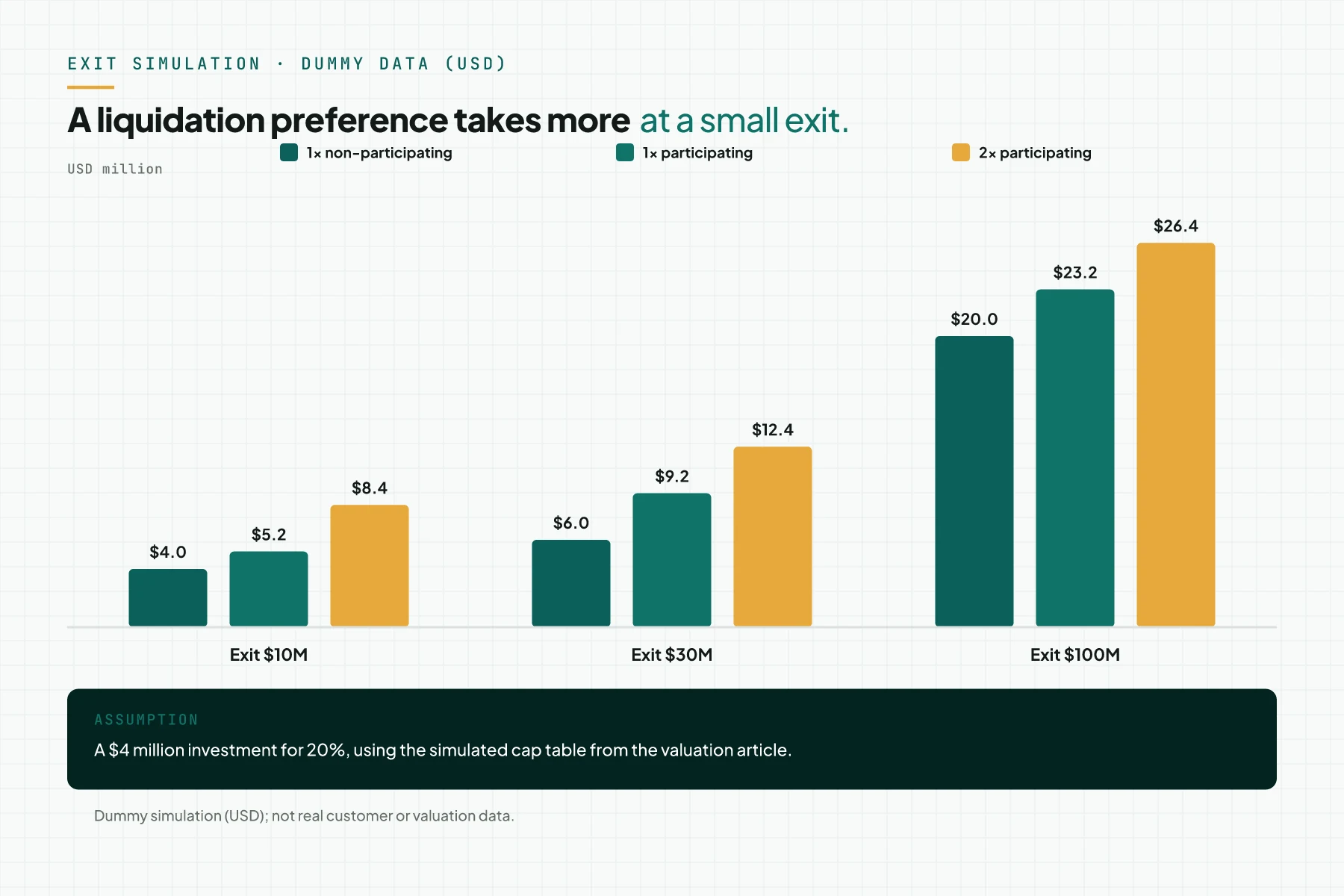
This simulation uses the cap table from how to calculate Series A valuation and dilution. The investor puts in $4 million for 20%, 2,000,000 shares at $2.00. The table calculates the investor share at 3 exit values, 3 preference types, and 1 down round with 3 anti-dilution methods. It is a dummy simulation (USD) computed 14 September 2026.
| Scenario | Input | Recorded (formula) | Investor output | Common holder output |
|---|---|---|---|---|
| $10M exit, 1x non-participating | $4 million invested; 20% | max(4; 20% × 10) | $4.0 million | $6.0 million |
| $10M exit, 1x participating | same | 4 + 20% × (10 − 4) | $5.2 million | $4.8 million |
| $10M exit, 2x participating | same | 8 + 20% × (10 − 8) | $8.4 million | $1.6 million |
| $30M exit, 1x non-participating | same | max(4; 20% × 30) | $6.0 million | $24.0 million |
| $30M exit, 1x participating | same | 4 + 20% × 26 | $9.2 million | $20.8 million |
| $30M exit, 2x participating | same | 8 + 20% × 22 | $12.4 million | $17.6 million |
| $100M exit, 1x non-participating | same | max(4; 20% × 100) | $20.0 million | $80.0 million |
| $100M exit, 1x participating | same | 4 + 20% × 96 | $23.2 million | $76.8 million |
| $100M exit, 2x participating | same | 8 + 20% × 92 | $26.4 million | $73.6 million |
| Down round, weighted average | CP1 $2.00; new round $2 million at $1.00; A 10,000,000; B 1,000,000; C 2,000,000 | CP2 = 2.00 × (10 + 1) / (10 + 2) = $1.8333; ratio 1.0909 | Series A 2,000,000 preferred becomes 2,181,818 common shares | Founders 6,000,000 / 12,181,818 = 49.25% |
| Down round, full ratchet | same | CP2 = $1.00; ratio 2.0 | Series A becomes 4,000,000 common shares | Founders 6,000,000 / 14,000,000 = 42.86% |
Conclusion: "dirty" terms take a far larger share at a small exit. The down round holds founder ownership at 49.25% (weighted average) or 42.86% (full ratchet), against 50.00% with no anti-dilution. Assumption: only Series A carries anti-dilution rights here. Converted SAFEs are treated like any other common holder, and these dummy numbers should not convert to another currency.
A Series A term sheet for an Indonesian PT: share classes and pre-emptive rights
For an Indonesian PT, an investor's preferred rights must be written into the articles of association as a share class, not only the term sheet (Law 40/2007 on Limited Liability Companies). The law allows share classes with different rights: dividends first, residual liquidation proceeds first, the right to nominate directors, and voting or non-voting shares. Common stock must still exist and carry voting rights, dividends, and residual proceeds (Law 40/2007 Article 53).
Pro rata is set by law: new shares go first to existing holders in proportion, over a 14-day window (Law 40/2007 Article 43). An exception applies to employees and convertible securities approved by the shareholder meeting, which also approves a capital increase (Law 40/2007 Articles 41-42).
Foreign investors use the PT PMA structure (read what Series A funding is); a licensed adviser must review the term sheet and the articles of association before signing.
Checklist before you sign a term sheet
- Read the term sheet twice, for economics and for control, with notes per term (founder; a 12-line note file).
- Check the preference is 1x, non-participating, no cumulative dividend; simulate 3 exit values (finance; the simulation table).
- Check anti-dilution is weighted average, not full ratchet; copy the clause verbatim (founder; the clause quote).
- Count the board seats; accept a 2-2-1 board only with a written reason (founder; seat table).
- Compare protective provisions with the YC list; log every operating veto (founder, legal adviser; difference list).
- Negotiate founder vesting with service credit and double-trigger acceleration (founder; final clause).
- Log the binding clauses on a calendar: the no-shop deadline, the fee cap, the expiry date (founder; calendar entry).
- Stop criterion: do not sign before a licensed adviser reviews the term sheet and the articles support the share class. Ask for a change first if any preference exceeds 1x without a written reason.
FAQ on Series A term sheets
Is a Series A term sheet legally binding? Mostly not; only no-shop and confidentiality bind, though Delaware can imply a duty to negotiate in good faith.
What is a 1x non-participating liquidation preference? The investor takes the 1x principal or the as-converted share, whichever is larger; the $30M exit simulation gives $6.0 million.
What are weighted average and full ratchet anti-dilution? Weighted average uses CP2 = CP1 × (A + B) / (A + C); full ratchet ignores the round size and is far less common.
What are protective provisions? A list of decisions needing majority preferred consent; the 2 most impactful vetoes are financing and a sale.
How many board seats are reasonable at Series A? The YC template gives 3 seats with founders holding 2-1; a 2-2-1 board is the most common loss of control.
Must founders re-vest at Series A? The YC template leaves founder vesting negotiated separately; ask for service credit and double-trigger acceleration.
Next step
Rama Digital is not a financial, legal, or tax adviser; this section does not replace a licensed adviser's review before signing. If your team wants to map its own term sheet and cap table, use the AI Diagnostic service. 1 session gives a bottleneck map and a written first step. To ask a question first, book a 30-minute session.
Sources
- Y Combinator: Series A term sheet
- Y Combinator: a standard and clean Series A term sheet
- NVCA: 2020 Model Term Sheet
- NVCA: model legal documents
- Cooley GO: preferred stock glossary
- Cooley GO: liquidation preference glossary
- Cooley GO: full ratchet glossary
- Cooley GO: broad-based weighted average anti-dilution glossary
- Cooley GO: acceleration glossary
- Cooley GO: drag-along rights glossary
- Carta: State of Private Markets Q1 2026
- Law 40/2007 on Limited Liability Companies