Direct answer: Revenue model vs business model: the difference is scope. A business model describes how 1 business creates, delivers, and captures value in 9 blocks. A revenue model fills only 1 block, Revenue Streams: how the business charges customers. The 8 types are subscription, usage fee, commission, licence, advertising, freemium, retainer, and project. Set the business model first, then test 2–3 revenue models with numbers.
Main condition: this applies to product, service, and platform businesses that charge customers directly, using the Strategyzer Business Model Canvas. Limit: this article gives no real market numbers and promises no result. Tax, accounting, payment gateway rules, non-profits, and third-party payers are out of scope.
We read the Strategyzer canvas page, 6 Wikipedia pages, and the open part of 2 HBR articles on 13 September 2026. The example numbers are dummy, not customer data.
Revenue model vs business model: "subscription" is only how you charge
A founder often answers an investor with 1 sentence: our business model is subscription. Revenue model vs business model disappears in that answer. That names only how you charge. It does not name the customer, the value, or the channel.
Early literature reinforced this habit: labels like "bricks-and-mortar" or "e-broker" described only 1 aspect, usually the revenue model, not the whole business model (Wikipedia, Business model).
The term "business model" has been used loosely since the dot-com era. Magretta opens her article with that critique: a buzzword that justified half-baked plans (Magretta, HBR May 2002). Ovans notes that business thinkers use the concept in many different ways, which can skew its definition (Ovans, HBR 2015).
The result: a business plan gets a price but no clear buyer. A large market number looks convincing on paper, while the money that actually arrives goes uncounted. We cover this in a large TAM is not a large business (Indonesian source).
Business model: 9 blocks that depend on each other
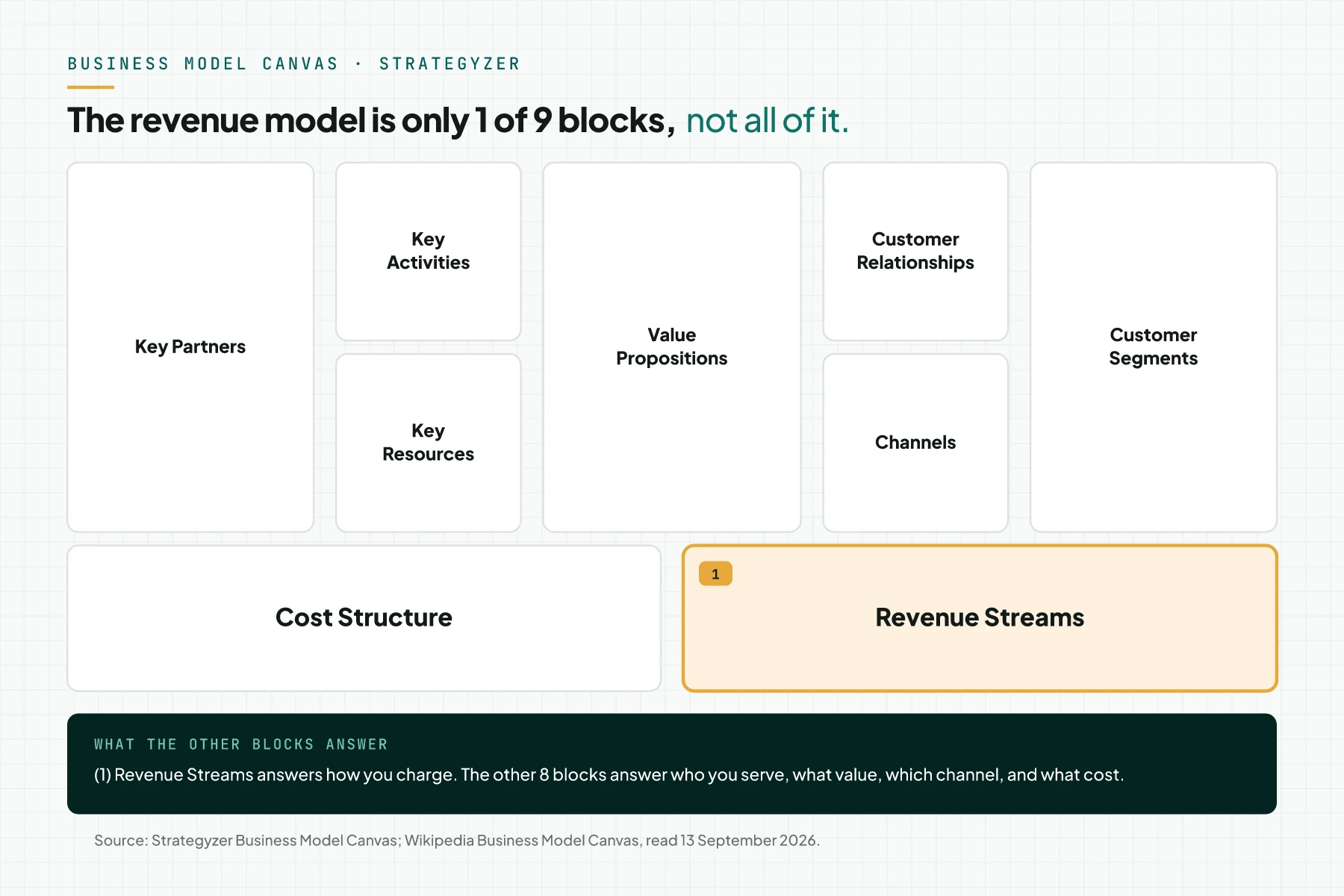
A business model describes how 1 business creates, delivers, and captures value on 1 canvas (Strategyzer, Business Model Canvas; Wikipedia, Business model). This canvas holds 9 interdependent blocks, shown below.
Right side: the market you serve
Customer Segments, Customer Relationships, and Channels name who you serve, how you keep them, and how value reaches them (Strategyzer).
Centre: the value you offer
Value Propositions names the problem you solve or the need you meet for each segment (Strategyzer).
Left side: what serving the market needs
Key Activities, Key Resources, and Key Partners name the work, assets, and partnerships that bring value to market (Strategyzer).
Bottom: cost and revenue
Cost Structure and Revenue Streams record spending and income, and hold only when the 7 blocks above are right (Strategyzer). Each canvas covers 1 business model: moving 1 segment shifts the channels, activities, and cost too.
The Revenue Streams block lists how a company earns from each segment: asset sale, usage fee, subscription, renting, licensing, or advertising (Wikipedia, Business Model Canvas). A revenue model is this block's content, only 1 of 9.
Revenue model: 8 types and a comparison table
A revenue model is a framework for generating income: the source you pursue, the value you offer, the price, and who pays. It is a component of the business model, not a replacement (Wikipedia, Revenue model).
A revenue stream is money from 1 source; a revenue model is how the business generates that stream (Wikipedia, Revenue model). Table 1 compares 8 types; named examples come from open sources, others use a generic category.
| Type | When it fits | Risk | Example |
|---|---|---|---|
| Subscription | Customers use the product continuously and get value every period. | Churn; customers pay without use, then cancel. | Subscription media (Netflix per Wikipedia); SaaS point-of-sale app. |
| Usage fee | Usage rises and falls; customers refuse a monthly commitment. | Revenue follows the season and is hard to forecast. | Pay-as-you-go airtime; delivery (UPS per Wikipedia); APIAPIThe official door 2 systems use to exchange data, without anybody copying it by hand.Open the glossary per call. |
| Commission (take rate) | The business matches 2 parties and takes a cut of the transaction. | GMV is not revenue; competitors push the take rate down. | Marketplace; property broker. |
| Licence | Intellectual property exists that others can use without buying it. | Piracy; long deals; no repeat fee on a permanent licence. | Software licence per server; content licence. |
| Advertising | A large free audience exists, and advertisers pay to reach it. | Depends on ad platforms; ads hurt the user experience. | Online media; search engine (Google per Wikipedia). |
| Freemium | Free users cost little to serve, and premium features are clear. | Low conversionConversionThe action you count as a result, for example a paid order, a sign-up, or a chat that becomes a qualified buyer.Open the glossary; free users absorb server and support cost. | Lite productivity app with paid features. |
| Retainer | Recurring service with capacity reserved each month. | Scope creep; unused hours; customers feel they pay for nothing. | Law firm; monthly ad agency; consultant. |
| Project | Bounded work with a fixed result and price. | Revenue stops after handover; a wrong estimate eats the margin. | Website build; system installation; construction. |
Sources: Wikipedia, Revenue model, Wikipedia, Business Model Canvas, Wikipedia, Retainer agreement, and Wikipedia, Fixed-price contract. Subscription risk: from inertia, some customers keep paying for a subscription they no longer value (Wikipedia, Subscription business model). When they notice, they cancel. That is churn.
How they relate: 1 business model, 2–3 revenue models
1 business model can use 2–3 revenue models at once, for example a subscription plus a one-time onboarding fee.
Changing the revenue model does not always change the business model. The segment, value, and channel can stay the same. Check Customer Relationships and Cost Structure after a change (Strategyzer).
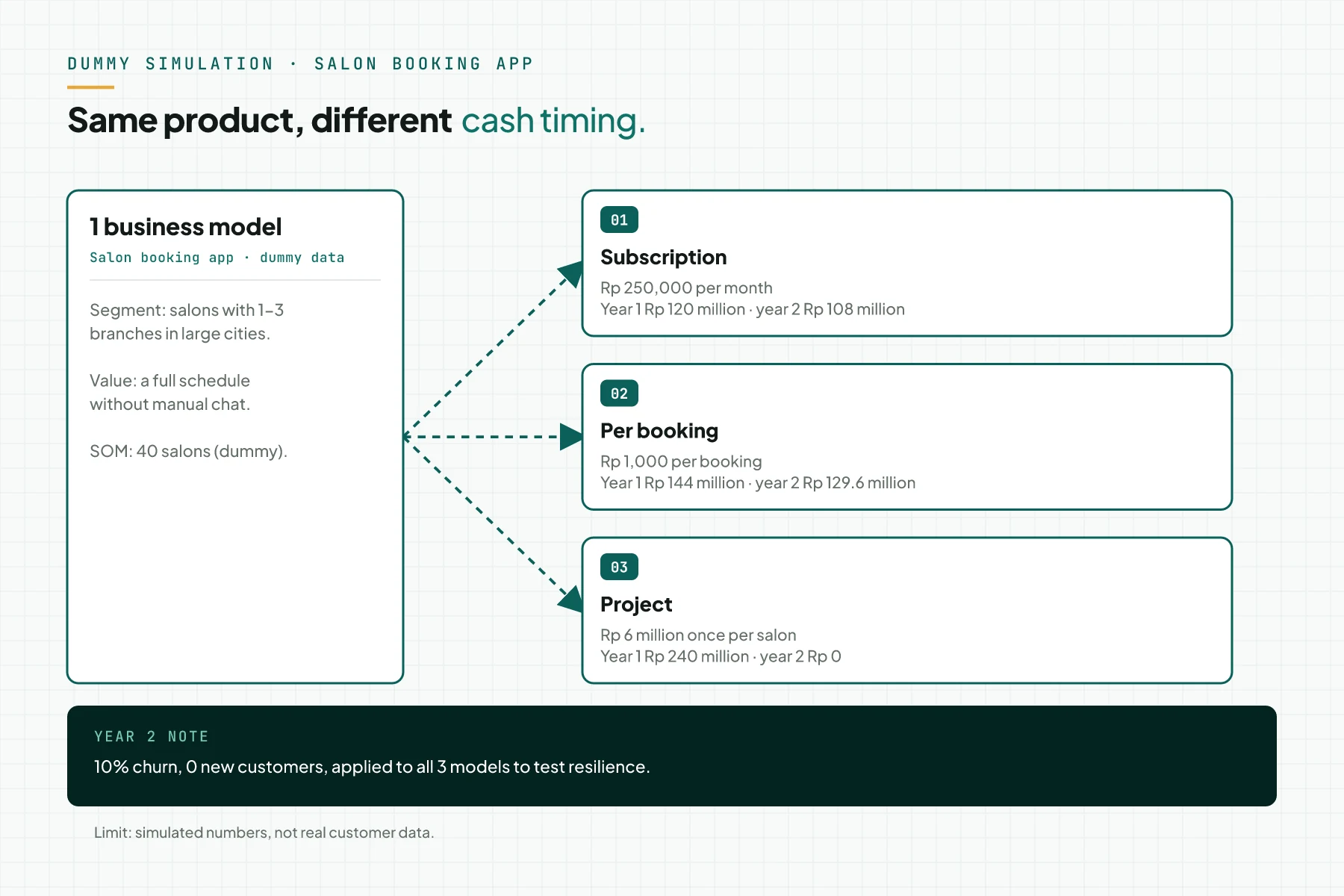
The same revenue model on 2 different business models gives different results, since the cost to serve differs. The simulation below prices 1 dummy salon booking app with 3 revenue models.
Simulation with dummy data: 1 product, 3 revenue models
Simulation assumptions (dummy data):
- Segment: salons with 1–3 branches.
- Value: a full schedule without manual chat.
- Population: 40 active salons (dummy) in year 1, at 300 bookings per salon monthly.
- Cost to serve: Rp 60,000 per salon monthly, all 3 models.
- Period: year 1 = October 2026–September 2027; year 2 = October 2027–September 2028.
Year 2 applies 10% churn and 0 new customers, to test resilience.
| Revenue model | Input (price × unit) | Recorded by the system | Year 1 output | Year 2 output (36 salons, 0 new) | Gross marginGross marginThe share of the selling price left after the cost of goods, written as a percentage.Open the glossary |
|---|---|---|---|---|---|
| Subscription | Rp 250,000 per salon per month × 40 salons × 12 months | 480 monthly invoices | Rp 120,000,000 | Rp 108,000,000 | 76% (250,000 − 60,000) / 250,000 |
| Per booking | Rp 1,000 per booking × 300 bookings × 40 salons × 12 months | 144,000 bookings, billed monthly | Rp 144,000,000 | Rp 129,600,000 | 80% (300,000 − 60,000) / 300,000 per salon per month |
| Project | Rp 6,000,000 once per salon × 40 salons | 40 one-time invoices | Rp 240,000,000 | Rp 0; cost to serve 36 salons stays Rp 25,920,000 | 88% in year 1; negative in year 2 |
Sensitivity: a 30% volume drop (210 per month) gives per booking Rp 100,800,000 in year 1, while subscription stays at Rp 120,000,000.
The business model does not change across these 3 rows. What changes is the cash timing, the number you watch, and the year 2 risk.
The link to TAM, SAM, SOM, ICP, and the wedge market
The base formula: revenue = SOM × price per unit × frequency per year. The revenue model sets the last 2 factors; SOM comes from team capacity. Above: 40 × Rp 250,000 × 12 months (subscription), 40 × Rp 1,000 × 3,600 bookings (per booking), and 40 × Rp 6,000,000 × 1 time (project). Read TAM, SAM, and SOM explained (Indonesian source) for unit economics and TAM SAM SOM formulas by business model (Indonesian source) for formulas by type.
Rama Digital recommendation: test the payment method per segment, because 1 segment usually picks 1 method. Example from the dummy simulation: a small salon owner may refuse a one-time Rp 6 million fee, but accept Rp 250,000 per month. Read what an ICP is (Indonesian source) and ICP, wedge market, SOM, and how investors read them (Indonesian source) to filter this kind of segment.
Start with 1 revenue model in 1 niche, and add a second once it pays regularly. Read the wedge market (Indonesian source) for the order. Then read from TAM, SAM, SOM to a Meta Ads budget to turn SOM into an ad budget limit.
Prerequisites before you choose a revenue model
Prepare these 6 things first.
- An empty Strategyzer canvas template, or 1 sheet of paper with 9 boxes.
- A list of 10 ICP customers or prospects, with contacts and who approves payment.
- Cost to serve 1 customer monthly: server, support, and shipping, for gross margin.
- 1 spreadsheet with columns for units, price, frequency, cost to serve, margin, and year 1-2 revenue.
- 1 invoicing tool that can issue a recurring, per-event, or one-time bill.
- 1 decision owner and 1 decision date.
Step 1: Fill the 9-block canvas on 1 page
Open the Strategyzer template, or prepare 1 blank sheet. Fill 8 blocks with 1–3 short sentences, and leave Revenue Streams empty.
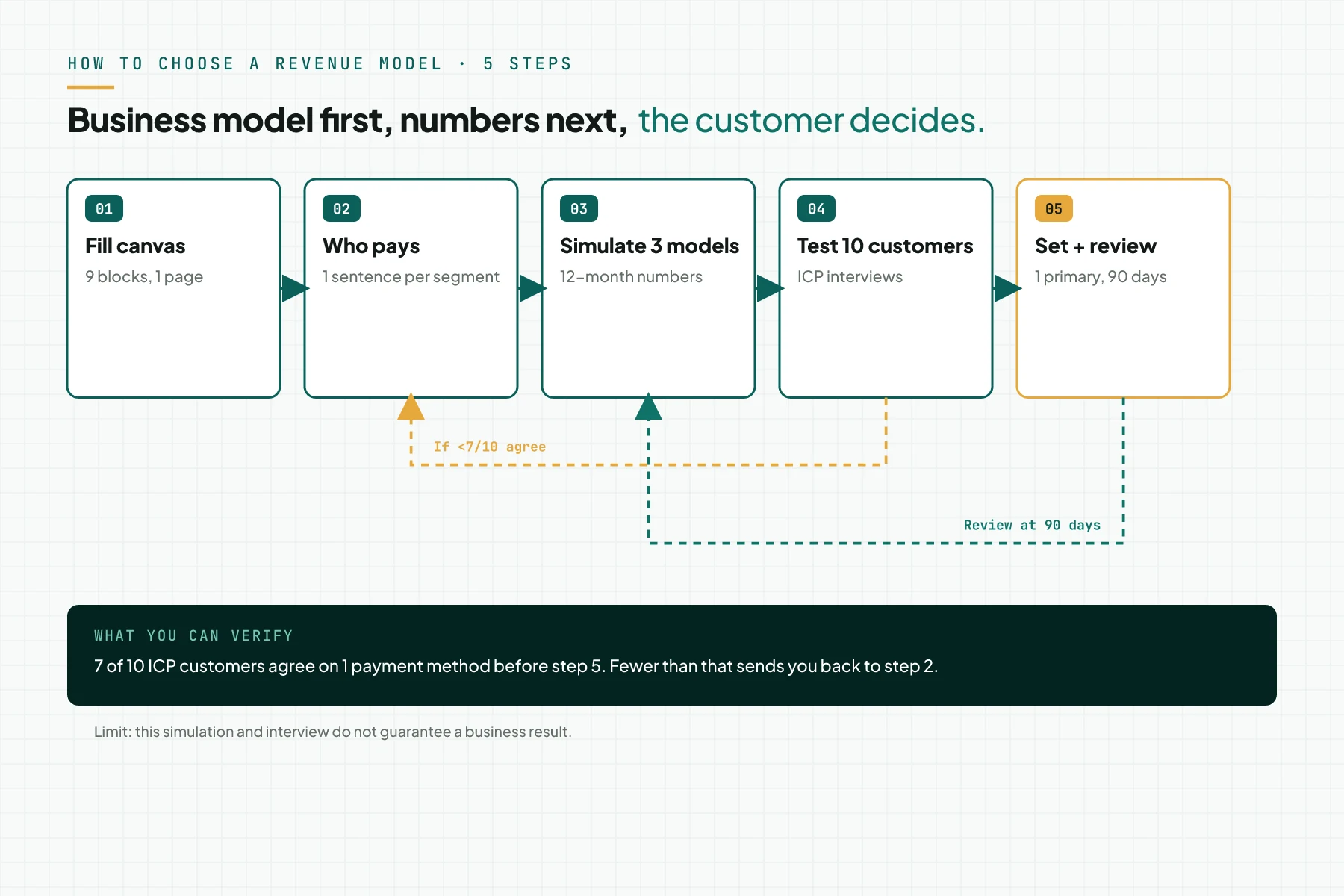
1 canvas applies to 1 business model, not the whole company (Strategyzer). Evidence: every block is filled, the canvas carries a date and version, and 1 primary segment is named.
Step 2: Write who pays for what, and when
Open the Revenue Streams block. Write 1 sentence per segment with this pattern: [segment] pays [value] at [price] every [period or event]. For 2 different payers, for example a free user and an advertiser, write 2 sentences.
Evidence: each sentence names the payer, the value, the price, and the timing. The first 3 come from the revenue model definition (Wikipedia, Revenue model). We add timing, because a bill needs a period or an event. A sentence without timing is not finished.
Step 3: Simulate 3 revenue models with 12-month numbers
Open the spreadsheet from the prerequisites. Build 1 row per model, with input, recorded, and year 1-2 output columns, using churn and 0 new customers.
Use customer units from SOM, not from TAM. Calculate gross margin per model with the same cost to serve. Evidence: the 3 rows give a different year 2 number; a match means a missing frequency assumption.
Step 4: Test with 10 ICP customers
Interview 10 customers or prospects from the list for 15 minutes by phone or WhatsApp. Ask 3 fixed questions: preferred payment method, the price that feels fair, and who approves payment.
Record the answers as given, with a date, and do not offer a discount.
Evidence: if 7 of 10 choose the same method, it becomes the leading candidate; if not, return to step 2. Read what an ICP is (Indonesian source) and ICP, wedge market, SOM, and how investors read them (Indonesian source) to filter interviewees.
Step 5: Set 1 primary model, 1 secondary model, and a review date
Write 1 dated decision document: the primary model, at most 1 secondary model, the number you watch, and a 90-day review date.
The number you watch differs per model:
- Subscription: monthly churn.
- Usage fee: volume per customer.
- Commission: take rate and GMV.
- Project: new project pipeline.
- Retainer: hours used.
A large year 1 cash intake is not ROI; calculate profit after every cost.
Evidence: the invoicing tool issues 1 test bill matching the model. Read accounting software (Indonesian source) for this. Source: Strategyzer; re-version the canvas as evidence arrives.
Checklist before you set the revenue model
- The 9-block canvas is filled on 1 page (founder; dated, versioned canvas file).
- The "who pays, how much, when" sentence is written per segment (founder; in Revenue Streams).
- 3 revenue models are simulated over 12 months with input, recorded, and output columns (finance; spreadsheet labelled dummy data).
- Gross margin is calculated per model with the same cost to serve (finance; 3 figures).
- 10 ICP interviews on how customers pay are done (sales; dated interview notes).
- 1 primary model and at most 1 secondary model are set with a 90-day review date (founder; decision document).
- The invoicing tool issues 1 dummy bill in the chosen model (operations; test invoice PDF).
- Stop criterion: 2 of 3 models fail to cover the cost to serve, or fewer than 7 of 10 accept any payment method. Change the segment or value, not the price.
FAQ on revenue models and business models
Is a revenue model the same as a business model? No. A revenue model fills 1 block, Revenue Streams, of 9. A business model also answers the customer, the value, the channel, and the cost (Wikipedia, Revenue model; Strategyzer).
Can 1 business use more than 1 revenue model? Yes. 2–3 models often run together, like a subscription plus a one-time fee. Name 1 primary model so the number you watch stays clear.
Does changing the revenue model change the business model? Not always. The segment, value, and channel can stay the same. Check Customer Relationships and Cost Structure.
Which revenue model fits a service business? Project fits bounded work, retainer fits monthly capacity, and subscription fits a repeat service; team hours cap it. Read TAM SAM SOM formulas by business model (Indonesian source) for service SOM.
How does the revenue model affect TAM, SAM, and SOM? The customer count (SOM) stays the same; price and frequency change, so SOM in currency shifts. Dummy case: 40 salons give Rp 120 million with subscription, Rp 144 million with per booking.
What is the difference between a revenue stream and a revenue model? A revenue stream is money from 1 source, like a subscription fee. A revenue model is how the business generates it: the source, value, price, and payer (Wikipedia, Revenue model).
Next step
The dummy simulation here does not replace your own customer data. If your team wants to test a revenue model with its own numbers, use the AI Diagnostic service. 1 session gives a bottleneck map and a written first step. To ask a question first, book a 30-minute session.
Sources
- Strategyzer: Business Model Canvas
- Wikipedia: Business Model Canvas
- Wikipedia: Revenue model
- Wikipedia: Business model
- Harvard Business Review: Why Business Models Matter (Magretta, 2002)
- Harvard Business Review: What Is a Business Model? (Ovans, 2015)
- Wikipedia: Subscription business model
- Wikipedia: Retainer agreement
- Wikipedia: Fixed-price contract