Direct answer: Citrix published CVE-2026-120868, a memory overflow with a score of 9.3 in NetScaler ADC and NetScaler Gateway. The flaw affects all configurations, including the default configuration, and works with no login. Today, check the version of each unit, then move to 14.1-73.57 or 13.1-64.39.
The same bulletin lists 27 more CVEs. The highest score is 9.5 for CVE-2026-107412 on Gateway and AAA. A second bulletin closes CVE-2026-120869, a login bypass in NetScaler Console. Console moves to 14.1-74.34.
Main condition: On 16 November 2026, Citrix reports no exploitation, and CISA KEV does not list these CVEs. Limit: The bulletins give no workaround. This article contains no packet content, payload, or attack chain. We use only the official Citrix summary.
We read bulletin CTX697305, bulletin CTX697320, the 3 CVE records, CISA KEV, and CERT-EU advisory 2026-020 on 16 November 2026, from 06.34 to 06.53 WIB. We ran the scripts in steps 1, 2, and 5 in a podman container with the official Debian image and dummy NetScaler files. NetScaler has no container image, so we did not test a real unit.
Important limit: The CLI output and log formats in this article are Rama Digital estimates. We mark each estimate with the label "Rama Digital analysis". Compare them with the output of your unit before you trust the scripts.
Problem: the front door of office apps has a flaw in the data path
NetScaler ADC spreads traffic across application servers. NetScaler Gateway opens SSL VPN and Citrix Virtual Apps access for staff outside the office. Many banks, hospitals, and companies put these units directly on the internet.
CVE-2026-120868 is in Packet Processing, the part that handles each incoming packet. So the flaw needs no special feature. A unit with the default configuration is also affected.
Rama Digital analysis: devices at the network edge are often the first target, because they face the internet and hold login sessions. The same pattern is in the Ivanti Connect Secure VPN chain and the SonicWall SSL VPN flaw CVE-2026-19868.
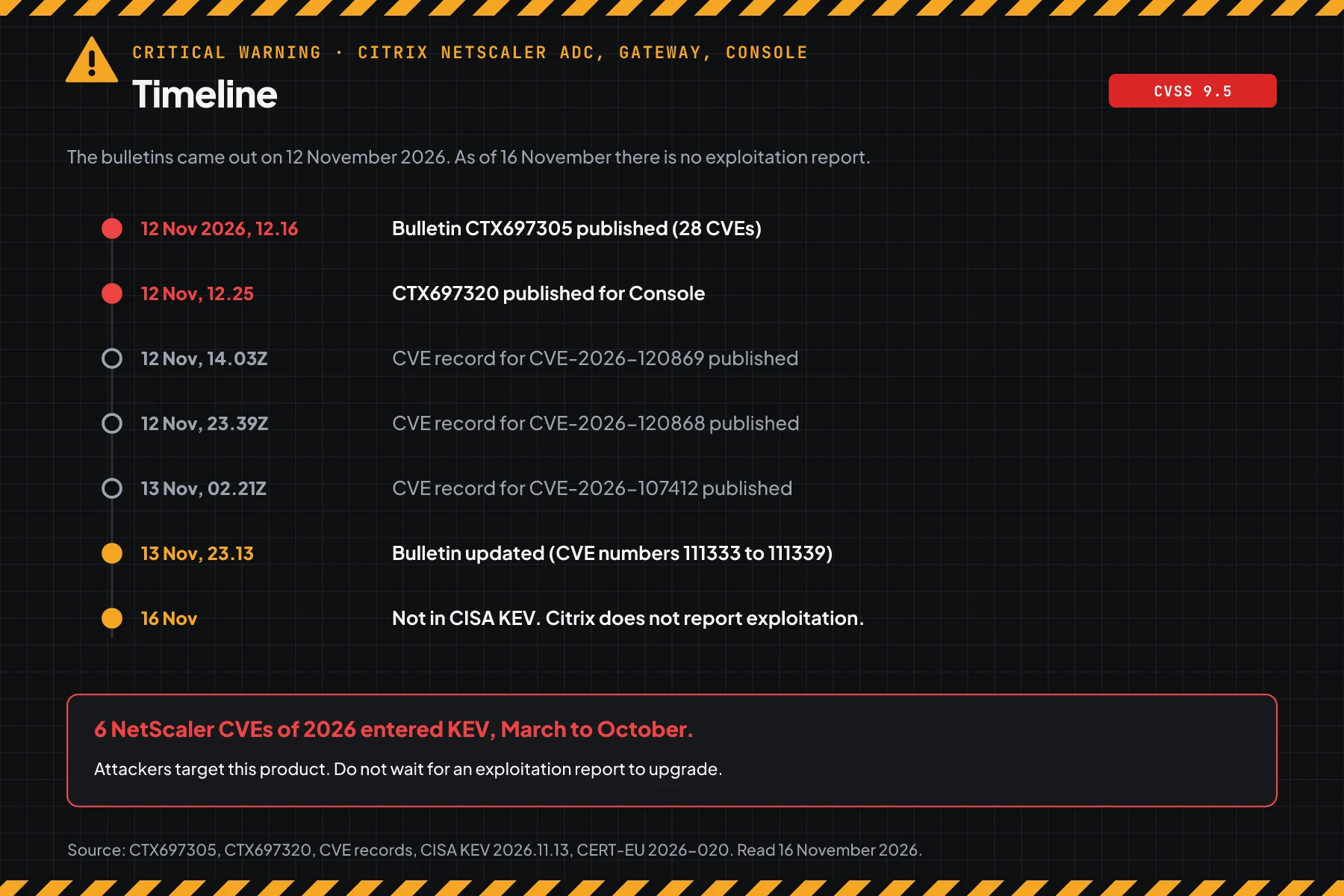
Citrix published CTX697305 and CTX697320 on 12 November 2026. The CVE records came out on 12 and 13 November 2026. Citrix updated CTX697305 on 13 November to change the numbers CVE-2026-111333 to CVE-2026-111339.
How it works: 1 flaw on every unit, 27 flaws that depend on features
This section uses the official Citrix summary. Its purpose is to help you pick the right step, not to explain an attack.
Summary from Citrix
Per bulletin CTX697305, CVE-2026-120868 is CWE-119 in Packet Processing. The Citrix text: "Memory overflow in Packet Processing can lead to unpredictable or erroneous behavior or Denial of Service." The precondition: all NetScaler ADC and Gateway units, including the default configuration.
Citrix writes the effect as unpredictable behavior or DoS. The CVSS 4.0 vector in the CVE-2026-120868 record gives high values for confidentiality, integrity, and availability, with no login and no user action. We add no claim beyond those 2 facts.
Per the CVE-2026-107412 record, CVE-2026-107412 is multiple memory overflows with a score of 9.5. It applies when the unit is a Gateway (SSL VPN, ICA Proxy, CVPN, or RDP Proxy) or an AAA vserver. The bulletin gives the patterns add vpn vserver .* and add authentication vserver .* to find that setup in ns.conf.
Per bulletin CTX697320, CVE-2026-120869 is CWE-287 in NetScaler Console. The official text: "An unauthenticated attacker can bypass authentication controls to access restricted resources on the Citrix NetScaler Console appliance". Console manages many NetScaler units from 1 place.
3 main CVEs, 2 bulletins
This table sums up the 3 CVEs with the highest scores. The safe versions in the next table close all CVEs in the same bulletin.
| CVE | Bulletin | Flaw type | CVSS 4.0 | Precondition |
|---|---|---|---|---|
| CVE-2026-120868 | CTX697305 | Memory overflow in Packet Processing (CWE-119) | 9.3 | All ADC and Gateway units, including the default configuration. No login. |
| CVE-2026-107412 | CTX697305 | Multiple memory overflows (CWE-119) | 9.5 | Gateway (SSL VPN, ICA Proxy, CVPN, RDP Proxy) or an AAA vserver. |
| CVE-2026-120869 | CTX697320 | Login bypass in Console (CWE-287) | 9.4 in the bulletin, 9.3 in the CVE record | An attacker with no login who can reach the Console IP. |
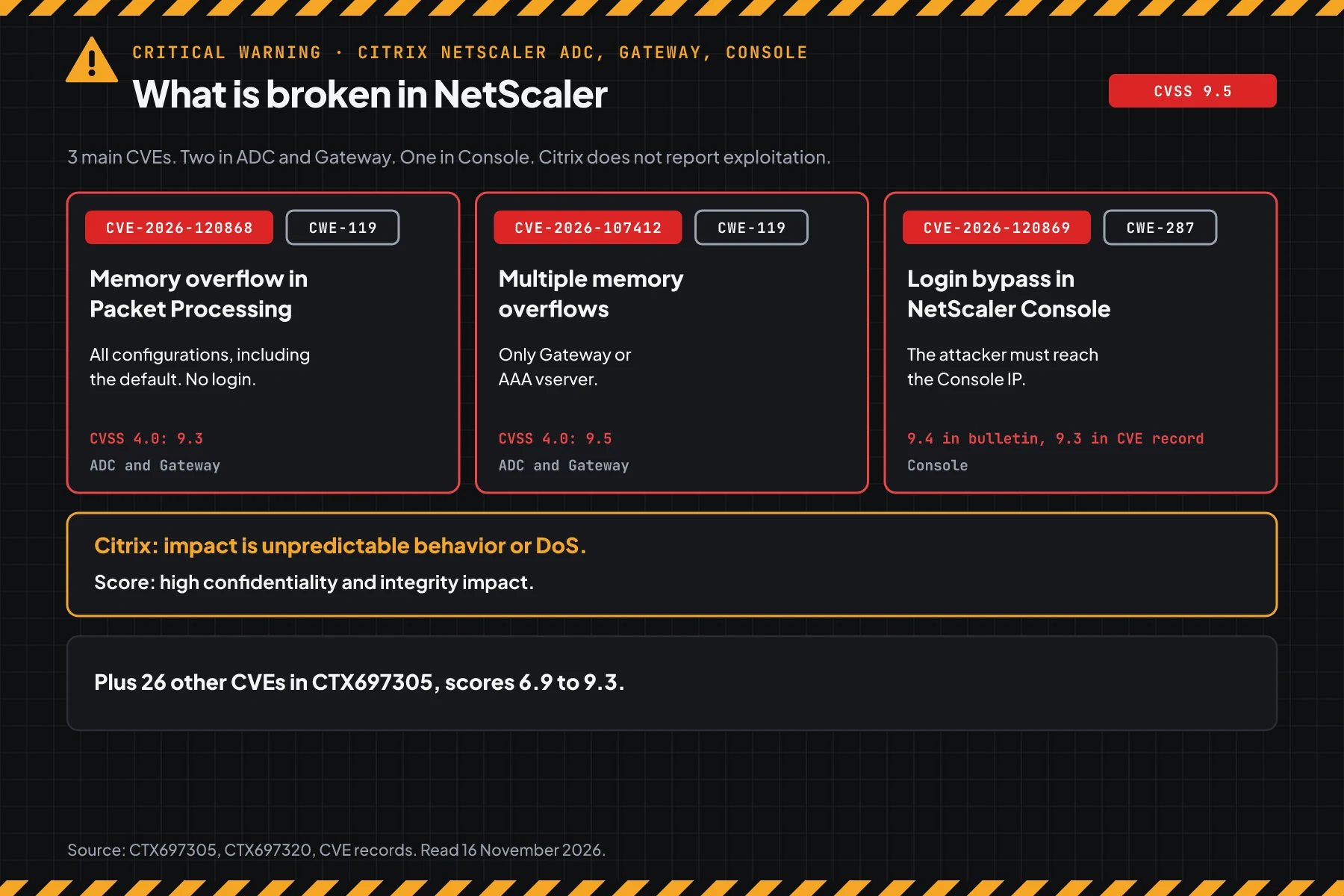
Difference between sources: bulletin CTX697320 gives CVE-2026-120869 a score of 9.4 with an adjacent network vector (AV:A). The CVE-2026-120869 record gives 9.3 with a network vector (AV:N). We use the bulletin precondition: the attacker must reach the Console IP.
26 more CVEs in CTX697305
Each other CVE has a feature precondition. Examples: SMPP, DNS with recursion or DNS over HTTPS, RTSP, SAML, Email OTP, EPA, LDAP, HTTP/2, GSLB, and HTTP_QUIC. Their scores are 6.9 to 9.3. The script in step 2 looks for the pattern of each feature in ns.conf.
One CVE needs special care. Per the bulletin, CVE-2026-111338 can write login data to /var/log/httperror.log. Rama Digital analysis: check who can read that file after the upgrade.
Exploitation status on 16 November 2026
Neither bulletin states an exploitation status. CISA KEV version 2026.11.13 lists no NetScaler CVE from November. Per CERT-EU advisory 2026-020, Citrix reports no exploitation, and there is no confirmed public proof of concept.
watchTowr, one of the reporters, wrote on its official account that CVE-2026-120868 affects the default configuration. Other reporters per the bulletin: Michael Tucker, the JPMorgan Chase XOR team, CapitalOne, and AI-assisted analysis by Cloud Software Group.
Rama Digital analysis: 6 NetScaler CVEs from 2026 entered CISA KEV between March and October. Attackers target this product. Condition: the unit faces the internet and has no upgrade. Limit: that fact does not prove attacks on these new CVEs.
Who is most at risk
Every unit below the safe version needs the upgrade. The order in this table helps you pick which unit to do first.
| Unit condition | Risk | Reason |
|---|---|---|
| Gateway or AAA vserver open to the internet | Highest | Hit by CVE-2026-120868, CVE-2026-107412, and other CVEs with a Gateway precondition |
| Other ADC that takes internet traffic | High | CVE-2026-120868 affects the default configuration |
| Console with a reachable IP | High | CVE-2026-120869 opens a login bypass |
| Unit on branch 13.0, 12.1, or older | High | Rama Digital analysis: the bulletin does not list these branches, so there is no fix build |
| Unit uses a feature from the list of 26 more CVEs | Check | Run step 2 to see the matching CVEs |
| ADC on the internal network only | Lower | An attacker needs network access first. Still upgrade. |
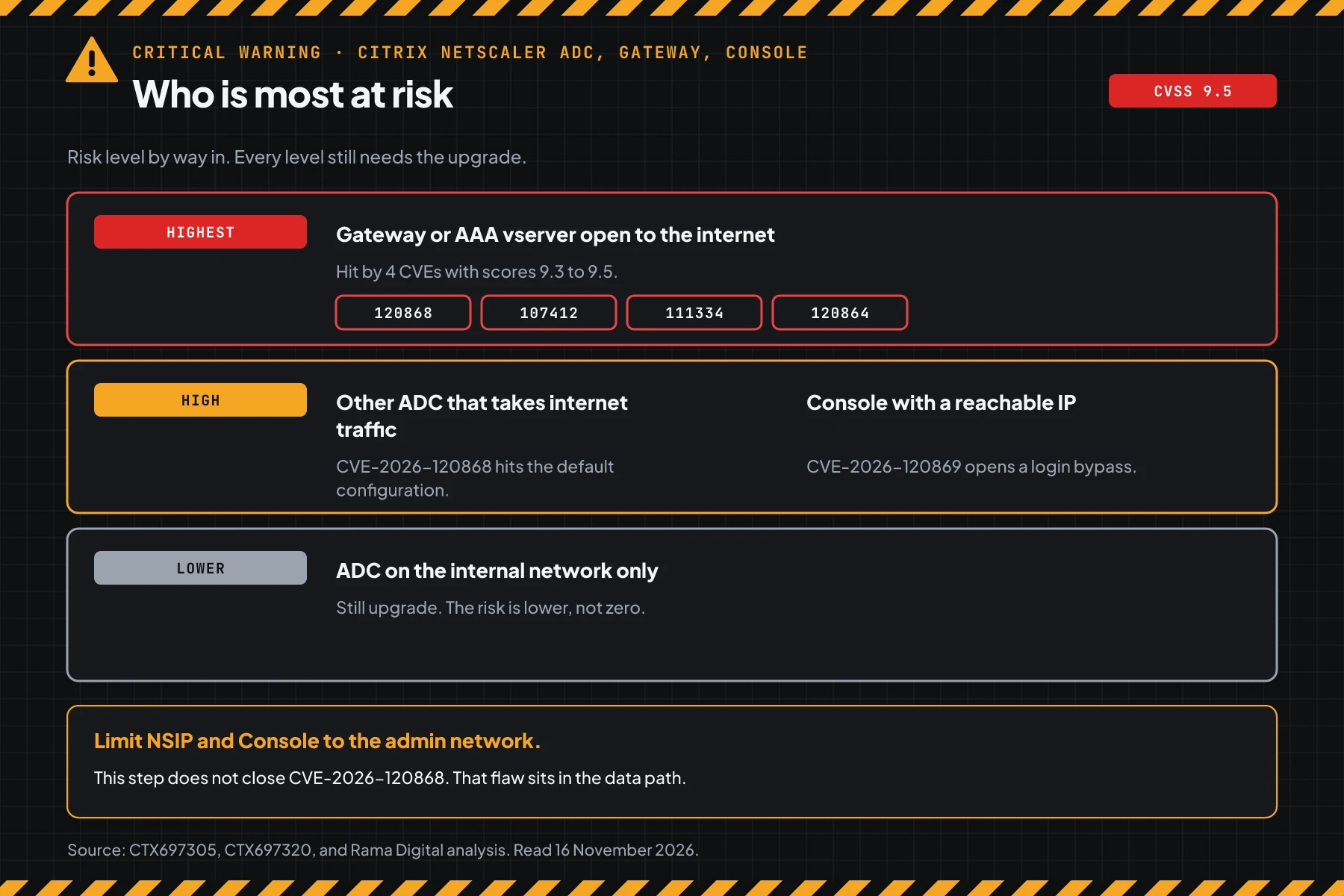
The bulletins apply only to NetScaler that you manage yourself. Cloud Software Group upgrades the cloud services that Citrix manages. Secure Private Access Hybrid uses your own NetScaler instances, so those instances also need the upgrade.
Vulnerable and safe versions
Match the branch, type, and build of your unit with this table. A safe version covers that build and newer builds on the same branch.
| Product | Vulnerable | Upgrade to | Source |
|---|---|---|---|
| ADC and Gateway 14.1 | before 14.1-73.57 | 14.1-73.57 | CTX697305 |
| ADC and Gateway 13.1 | before 13.1-64.39 | 13.1-64.39 | CTX697305 |
| ADC 14.1-FIPS | before 14.1-73.58 FIPS | 14.1-73.58 FIPS | CTX697305 |
| ADC 13.1-FIPS and 13.1-NDcPP | before 13.1-37.293 | 13.1-37.293 | CTX697305 |
| Console 14.1 | before 14.1-74.34 | 14.1-74.34 | CTX697320 |
| Secure Private Access Hybrid | NetScaler instances affected | the builds above | CTX697305 |
| 13.0, 12.1, and older branches | not listed | migrate to 14.1-73.57 | Rama Digital analysis |
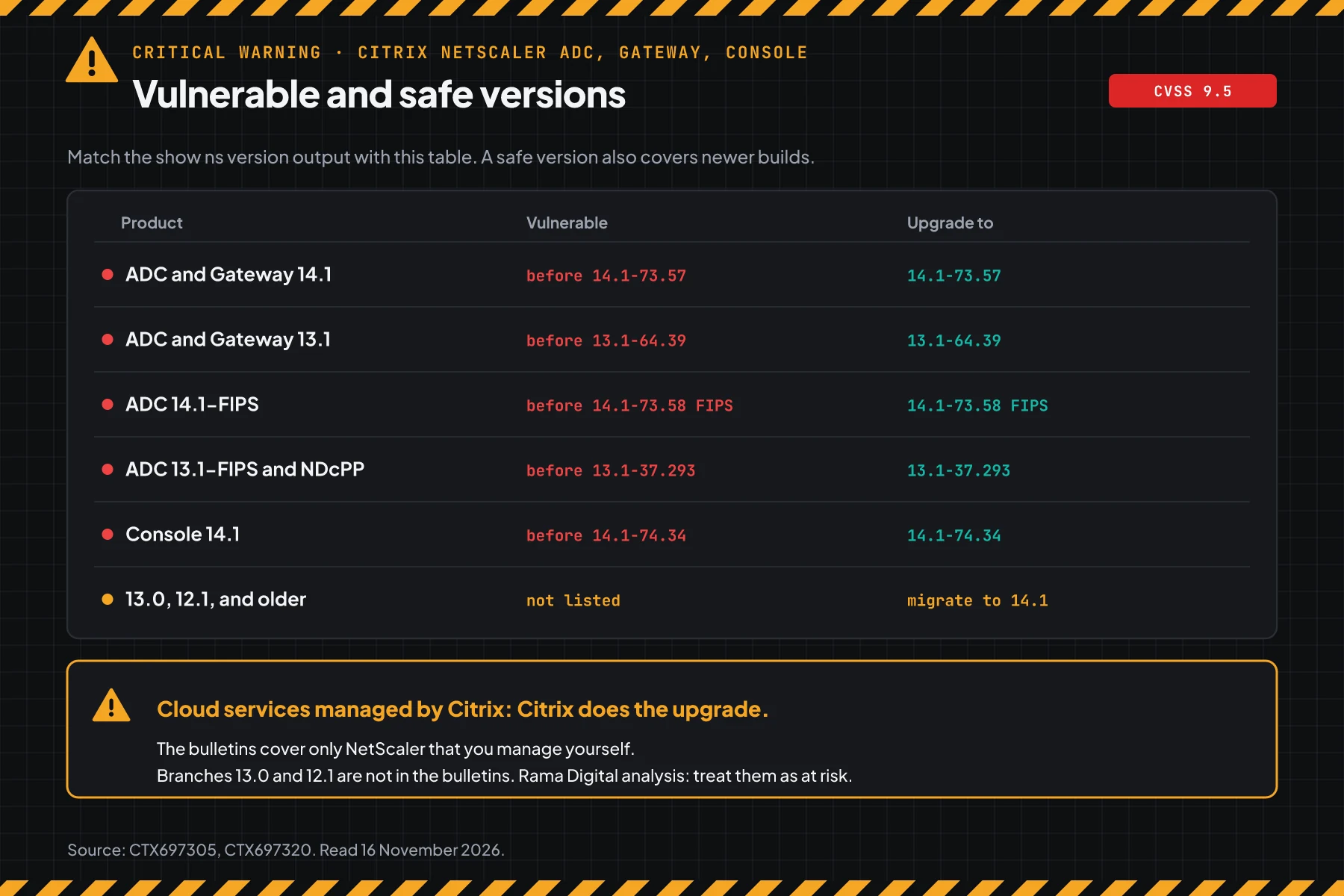
The command show ns version prints a line such as "NetScaler NS14.1: Build 73.50.nc". The branch is 14.1, and the build is 73.50. Compare the build as 2 numbers: 73.57 is newer than 73.6, because 57 is larger than 6.
FIPS and NDcPP note: FIPS and NDcPP units have their own builds. A 14.1-FIPS unit moves to 14.1-73.58 FIPS. 13.1-FIPS and 13.1-NDcPP units move to 13.1-37.293. Do not install a normal build on a FIPS unit.
Before you start
- An nsroot or full admin account on each ADC, Gateway, and Console unit, including the second HA unit and DR units.
- An account on the Citrix download portal to get the firmware build.
- A maintenance window. The unit restarts during the upgrade, so VPN and app sessions can drop for a short time.
- Access to the firewall in front of the unit, to check who can reach the NSIP and Console.
- A list of valid admin accounts and trusted admin IPs. Step 5 needs this list.
Step 1: Check the version of each unit
In the NetScaler CLI, run this command on each unit, including the second HA unit:
show ns versionSample output with dummy data. Rama Digital analysis: we wrote the shape of this line from an estimate, not from a real unit.
	NetScaler NS14.1: Build 73.50.nc, Date: Oct 30 2026, 10:12:44   (64-bit)
 Done
For many units, save this script as check-version-netscaler.sh. The script compares the version with the bulletin table and prints the target version. The script does not contact NetScaler.
#!/usr/bin/env bash
# Check the version of Citrix NetScaler ADC, Gateway, and Console against 2 Citrix bulletins of 12 November 2026:
# CTX697305 (ADC and Gateway, CVE-2026-120868 and 27 other CVEs) and CTX697320 (Console, CVE-2026-120869).
# The script reads text only and does not contact NetScaler or Console.
# Use: bash check-version-netscaler.sh devices.txt   (1 device per line: name, version, then the word FIPS, NDcPP, or CONSOLE if it applies, for example "adc-01 14.1-73.50")
#   or: bash check-version-netscaler.sh "adc-01 14.1-73.50" "console-01 14.1-74.20 CONSOLE"
#   or: bash check-version-netscaler.sh --version version.txt   (a copy of the CLI output of "show ns version")
# Version forms that it reads: 14.1-73.50, NS14.1: Build 73.50.nc, and 14.1 build 73.50.
# With no word FIPS, NDcPP, or CONSOLE, the script assumes a normal ADC or Gateway.
# The script only reads files. It does not change, delete, or send anything.
set -u
vuln=0; migrate=0; safe=0; other=0; has_old=0; has_high=0

# Remove control characters and limit the length, so file content cannot change the terminal display.
clean() { tr -cd '[:print:]\n' | cut -c1-110; }

header() { printf '%-13s %-8s %-12s %-11s %-10s %s\n' "DEVICE" "TYPE" "VERSION" "STATUS" "BULLETIN" "TARGET"; }

# $1 name, $2 type, $3 major, $4 minor, $5 build, $6 sub-build. The build is compared as 2 integers.
rate() {
  local name="$1" type="$2" ma=$((10#$3)) mi=$((10#$4)) b1=$((10#$5)) b2=$((10#$6))
  local key=$((ma * 100 + mi)) cur=$((b1 * 1000000 + b2)) bul="CTX697305" mode="cmp" t1=0 t2=0 tl="" st="" target="-"
  case "$type" in
    CONSOLE)
      bul="CTX697320"
      if (( key > 1401 )); then mode="high"
      elif (( key == 1401 )); then t1=74; t2=34; tl="14.1-74.34"
      else mode="migrate"; tl="14.1-74.34"; fi ;;
    FIPS)
      if (( key > 1401 )); then mode="high"
      elif (( key == 1401 )); then t1=73; t2=58; tl="14.1-73.58 FIPS"
      elif (( key == 1301 )); then t1=37; t2=293; tl="13.1-37.293"
      else mode="migrate"; tl="14.1-73.58 FIPS"; fi ;;
    NDCPP)
      if (( key > 1401 )); then mode="high"
      elif (( key == 1401 )); then t1=73; t2=57; tl="14.1-73.57"
      elif (( key == 1301 )); then t1=37; t2=293; tl="13.1-37.293"
      else mode="migrate"; tl="14.1-73.57"; fi ;;
    *)
      if (( key > 1401 )); then mode="high"
      elif (( key == 1401 )); then t1=73; t2=57; tl="14.1-73.57"
      elif (( key == 1301 )); then t1=64; t2=39; tl="13.1-64.39"
      else mode="migrate"; tl="14.1-73.57"; fi ;;
  esac
  case "$mode" in
    high) st="?"; target="check against the bulletin"; bul="-"; other=$((other + 1)); has_high=1 ;;
    migrate) st="MIGRATE"; target="$tl"; migrate=$((migrate + 1)); has_old=1 ;;
    *)
      if (( cur < t1 * 1000000 + t2 )); then st="VULNERABLE"; target="$tl"; vuln=$((vuln + 1))
      else st="SAFE"; safe=$((safe + 1)); fi ;;
  esac
  printf '%-13s %-8s %-12s %-11s %-10s %s\n' "$name" "$type" "$ma.$mi-$b1.$b2" "$st" "$bul" "$target"
}

# Read 1 line: name, version, then the word FIPS, NDcPP, or CONSOLE if it applies.
row() {
  local text low pre name type w word="" m0 ma mi b1 b2
  local re='([0-9]+)\.([0-9]+)(-|(-[a-z]+)?:?[[:space:]]*build[[:space:]]+)([0-9]+)\.([0-9]+)'
  [[ $1 =~ ^[[:space:]]*# ]] && return 0
  text=$(printf '%s' "$1" | tr -cd '[:alnum:] .,:()_-' | cut -c1-110)
  [[ -z ${text// /} ]] && return 0
  low=$(printf '%s' "$text" | tr '[:upper:]' '[:lower:]')
  if [[ $low =~ $re ]]; then
    m0="${BASH_REMATCH[0]}"; ma="${BASH_REMATCH[1]}"; mi="${BASH_REMATCH[2]}"; b1="${BASH_REMATCH[5]}"; b2="${BASH_REMATCH[6]}"
    pre=${low%%"$m0"*}; name=${text:0:${#pre}}
    type="ADC"
    [[ $low =~ (^|[^a-z0-9])fips([^a-z0-9]|$) ]] && type="FIPS"
    [[ $low =~ (^|[^a-z0-9])ndcpp([^a-z0-9]|$) ]] && type="NDCPP"
    [[ $low =~ (^|[^a-z0-9])console([^a-z0-9]|$) ]] && type="CONSOLE"
    for w in $name; do
      case "$(printf '%s' "$w" | tr '[:upper:]' '[:lower:]')" in
        netscaler|ns|fips|ndcpp|console|adc|gateway) ;;
        *) word="$word $w" ;;
      esac
    done
    name=$(printf '%s' "$word" | sed -E 's/ +/ /g; s/^ //; s/ $//' | cut -c1-13)
    rate "${name:--}" "$type" "$ma" "$mi" "$b1" "$b2"
  else
    printf '%-13s %-8s %-12s %s\n' "$(printf '%s' "$text" | cut -c1-13)" "-" "-" "UNKNOWN, version not readable"
    other=$((other + 1))
  fi
}

summary() {
  echo "Summary: $vuln VULNERABLE, $migrate MIGRATE, $safe SAFE, $other other."
  echo "The bulletin gives no workaround. The only fix is an upgrade to the build in the TARGET column."
  (( has_old )) && echo "MIGRATE: the bulletin does not list this branch and gives no fix build. Treat it as at risk and migrate to 14.1."
  (( has_high )) && echo "?: a branch above 14.1 is not in the bulletin. Check the newest Citrix bulletin."
  return 0
}

if [ "${1:-}" = "--version" ]; then
  f="${2:-}"
  if [ -z "$f" ] || [ ! -r "$f" ] || [ ! -f "$f" ]; then
    echo "CANNOT CONFIRM: file $(printf '%s' "$f" | clean) is not readable."; exit 2
  fi
  v=$(tr -d '\r' < "$f" | grep -m1 -E 'NS[0-9]+\.[0-9]+[^ ]*: Build' | clean | sed -E 's/^[[:space:]]+//')
  if [ -z "$v" ]; then echo "CANNOT CONFIRM: the file has no NetScaler NSxx.x: Build line."; exit 2; fi
  echo "$v"
  header
  row "(from file) $v"
  summary
  exit 0
fi

header
if (( $# == 1 )) && [ -f "$1" ]; then
  if [ ! -r "$1" ]; then echo "CANNOT CONFIRM: the file is not readable."; exit 2; fi
  while IFS= read -r x || [ -n "$x" ]; do row "$x"; done < "$1"
elif (( $# == 1 )) && [[ $1 != *[[:space:]]* ]]; then
  echo "CANNOT CONFIRM: file $(printf '%s' "$1" | clean) does not exist."; exit 2
elif (( $# > 0 )); then
  for x in "$@"; do row "$x"; done
else
  while IFS= read -r x || [ -n "$x" ]; do row "$x"; done
fi
summary
Write 1 unit per line: name, version, then the word FIPS, NDcPP, or CONSOLE when needed. Sample file with dummy data:
# name version type (dummy data)
adc-jkt-01 14.1-73.50
adc-sby-01 14.1-73.57
gw-dr-01 NS13.1: Build 64.35.nc
adc-bdg-01 13.1 build 64.41
adc-lama-01 12.1-55.300
adc-fp-01 14.1-73.50 FIPS
adc-nd-01 13.1-37.250 NDcPP
adc-fp-02 13.1-37.293 FIPS
console-01 14.1-74.20 CONSOLE
# 1 unit per line: name, the version from show ns version, then FIPS, NDcPP, or CONSOLE when needed
nano devices.txt
bash check-version-netscaler.sh devices.txt
# Or use a copy of the show ns version output
bash check-version-netscaler.sh --version version-netscaler.txt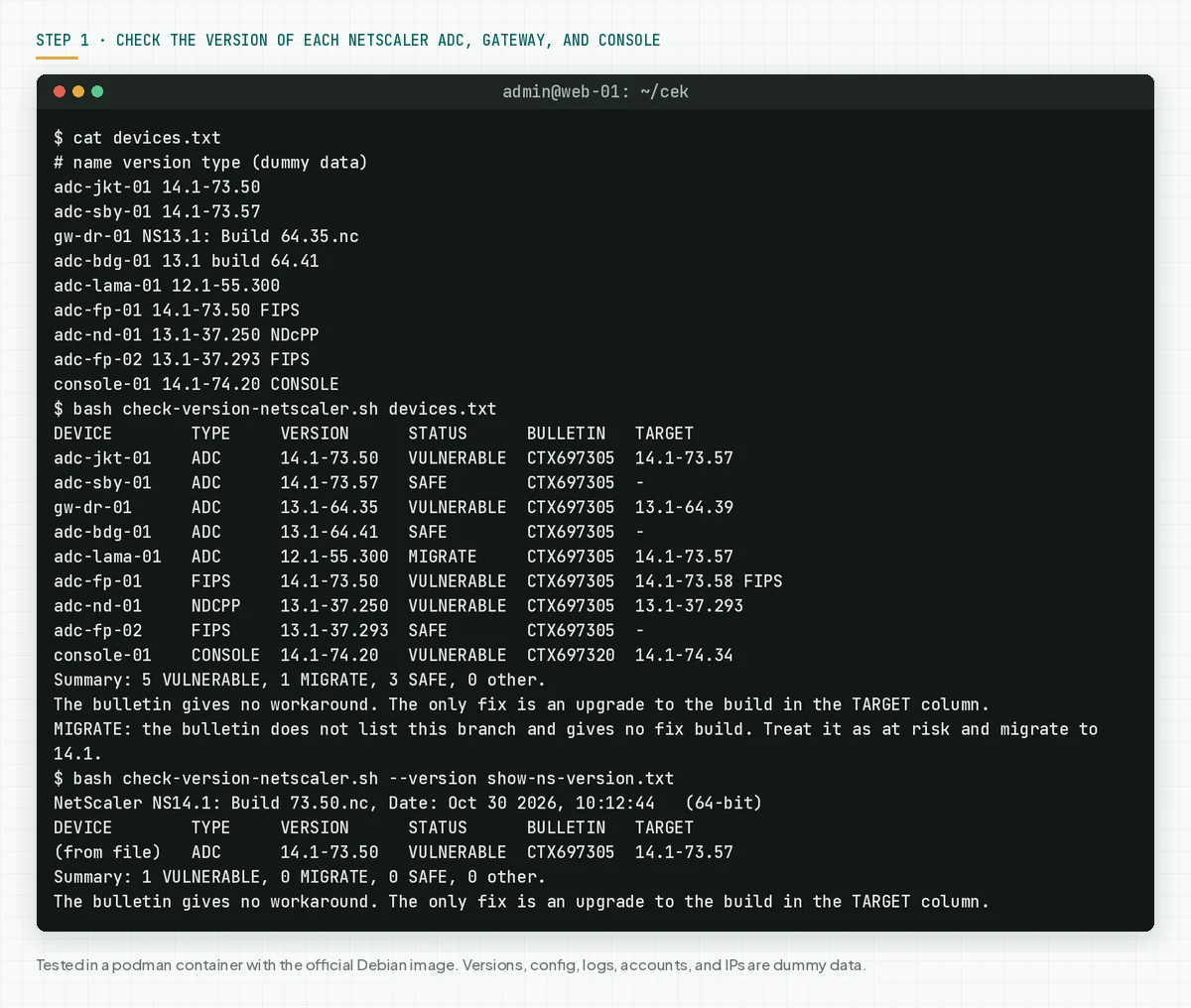
Check the result: "VULNERABLE" means the unit needs steps 2 to 4 today. "MIGRATE" means the unit is on a branch with no fix build. "SAFE" means the build closes the flaws, but still run step 5. "UNKNOWN" means the script cannot read the version. When in doubt, treat the unit as vulnerable.
We tested edge cases: an unreadable line, a missing file, a file with no read permission, and a branch above 14.1. The script gives the correct result or exits with code 2.
Step 2: Check the features that match a precondition
This step shows which CVEs can reach your unit. CVE-2026-120868 always applies, so this step does not replace the upgrade.
2a. Save a copy of the configuration
Run this command in the CLI, then save the output as ns.conf on a laptop:
show ns runningConfig
# or copy the file /nsconfig/ns.conf
The bulletin uses patterns from ns.conf for each CVE. Examples: add vpn vserver .* for Gateway, add authentication samlAction for SAML, and -http2 ENABLED for HTTP/2.
2b. Run the feature check script
Save this script as check-features-netscaler.sh. The script only reads the file. It prints the matching CVEs, with the line number as evidence.
#!/usr/bin/env bash
# Check which NetScaler features meet the CVE preconditions in bulletin CTX697305 (ADC and Gateway).
# The script reads a copy of the configuration and matches the ns.conf patterns from the bulletin. It does not contact NetScaler.
# Use: bash check-features-netscaler.sh ns.conf
#   ns.conf   a copy of the CLI output of "show ns runningConfig" or the file /nsconfig/ns.conf
# The script prints only AFFECTED rows. CVE-2026-120868 is always AFFECTED: the bulletin says all ADC and Gateway, including the default configuration.
# The script does not test BGP (CVE-2026-120866) or the management plane (CVE-2026-120863) from the file. Check both on the unit.
# The configuration format in the test is approximate and was not matched to a real unit.
# The script only reads files. It does not change, delete, or send anything.
set -u
export LC_ALL=C
clean() { tr -cd '[:print:]\n' | cut -c1-110; }

if (( $# != 1 )) || [[ $1 == -* ]]; then echo "Use: bash check-features-netscaler.sh ns.conf"; exit 2; fi
f="$1"
if [ ! -e "$f" ]; then echo "CANNOT CONFIRM: file $(printf '%s' "$f" | clean) does not exist."; exit 2; fi
if [ ! -f "$f" ] || [ ! -r "$f" ]; then echo "CANNOT CONFIRM: file $(printf '%s' "$f" | clean) is not readable."; exit 2; fi

conf=$(tr -d '\r' < "$f" | tr -cd '[:print:]\t\n' | tr '\t' ' ')
P='^[[:space:]]*(add|set)[[:space:]]+'
W='[[:space:]]+'
if ! printf '%s\n' "$conf" | grep -q -i -E "$P"; then
  echo "CANNOT CONFIRM: the file has no add or set lines. Is it a copy of ns.conf?"; exit 2
fi

GW="${P}(vpn${W}vserver|authentication${W}vserver)${W}"
HDX="${P}cr${W}vserver${W}.*${W}HDX([[:space:]]|\$)"
EPA="${P}[a-z]+${W}(epaAction|preauthenticationpolicy)"
SMPP="${P}(lb|cs)${W}vserver${W}[^[:space:]]+${W}SMPP([[:space:]]|\$)"
REC1="${P}dns${W}parameter${W}.*-recursion${W}ENABLED"
REC2="${P}dns${W}profile${W}.*-recursiveResolution${W}ENABLED"
DNSV="${P}(lb|cs)${W}vserver${W}[^[:space:]]+${W}(DNS|DNS_TCP|DOT)([[:space:]]|\$)"
DOH="${P}.*-dnsOverHttps${W}ENABLED"
PUSH="${P}lb${W}vserver${W}[^[:space:]]+${W}PUSH([[:space:]]|\$)"
RTSP="${P}(lb${W}vserver${W}[^[:space:]]+${W}RTSP([[:space:]]|\$)|.*-rtspalg${W}ENABLED)"
SAML="${P}authentication${W}samlAction"
WEBA="${P}authentication${W}webAuthAction"
MAIL="${P}authentication${W}emailAction"
KBA="${P}authentication${W}ldapAction${W}.*-KBAttribute"
CERT="${P}authentication${W}certAction"
H2="${P}.*-http2${W}ENABLED"
B64="${P}.*B64DECODE"
FW="${P}appfw${W}profile"
DIA="${P}lb${W}vserver${W}[^[:space:]]+${W}(DIAMETER|SIP_TCP|MQTT|RADIUS)([[:space:]]|\$)"
GSLB="${P}.*(-metricExchange${W}ENABLED|-automaticConfigSync${W}ENABLED|STATICPROXIMITY|MATCHES_LOCATION)"
SIP="${P}.*(-sipalg${W}ENABLED|-dnsanswerSecLogging${W}ENABLED)"
QUIC="${P}(lb|cs)${W}vserver${W}[^[:space:]]+${W}HTTP_QUIC([[:space:]]|\$)"
ECH="${P}.*(-encryptedClientHello${W}ENABLED|hsmKey)"

hits=0; misses=0; hit=""
find_line() { hit=$(printf '%s\n' "$conf" | grep -n -i -m1 -E "$1"); [ -n "$hit" ]; }
show() {
  local n="${hit%%:*}" t="${hit#*:}"
  t=$(printf '%s' "$t" | sed -E 's/^[[:space:]]+//')
  (( ${#t} > 60 )) && t="${t:0:60}..."
  printf '%-16s %-9s %s\n' "CVE-2026-$1" "AFFECTED" "line $n: $t"
  hits=$((hits + 1))
}
test_cve() { if find_line "$2"; then show "$1"; else misses=$((misses + 1)); fi; }

printf '%-16s %-9s %s\n' "CVE" "STATUS" "EVIDENCE"
printf '%-16s %-9s %s\n' "CVE-2026-120868" "AFFECTED" "all ADC and Gateway, including the default configuration"
hits=1
test_cve 107407 "$SMPP"
if find_line "($REC1)|($REC2)"; then
  rec="$hit"
  if find_line "($DNSV)|($DOH)"; then hit="$rec"; show 107408; else misses=$((misses + 1)); fi
else misses=$((misses + 1)); fi
test_cve 107409 "$DOH"
test_cve 107410 "$PUSH"
test_cve 107411 "$RTSP"
test_cve 107412 "$GW"
test_cve 107413 "$SAML"
test_cve 107414 "$WEBA"
test_cve 107415 "$MAIL"
test_cve 111333 "$GW"
test_cve 111334 "$EPA"
test_cve 111336 "$H2"
test_cve 111337 "($B64)|($FW)"
test_cve 111339 "$FW"
test_cve 111340 "($KBA)|($MAIL)"
test_cve 111341 "$CERT"
test_cve 111342 "$GW"
test_cve 120860 "$DIA"
test_cve 120861 "$GSLB"
test_cve 120862 "$SIP"
test_cve 120864 "($GW)|($HDX)"
test_cve 120865 "$QUIC"
test_cve 120867 "$ECH"

s="s"; (( misses == 1 )) && s=""
echo "No match in this file: $misses CVE$s."
echo "Not tested from the file: CVE-2026-120866 (BGP). Check on the unit: show router dynamicRouting."
echo "Not tested from the file: CVE-2026-120863. Check whether an untrusted network can reach the NSIP."
s="s"; (( hits == 1 )) && s=""
echo "Summary: $hits CVE$s meet the preconditions. The upgrade is still required: CVE-2026-120868 affects every configuration."
bash check-features-netscaler.sh ns.conf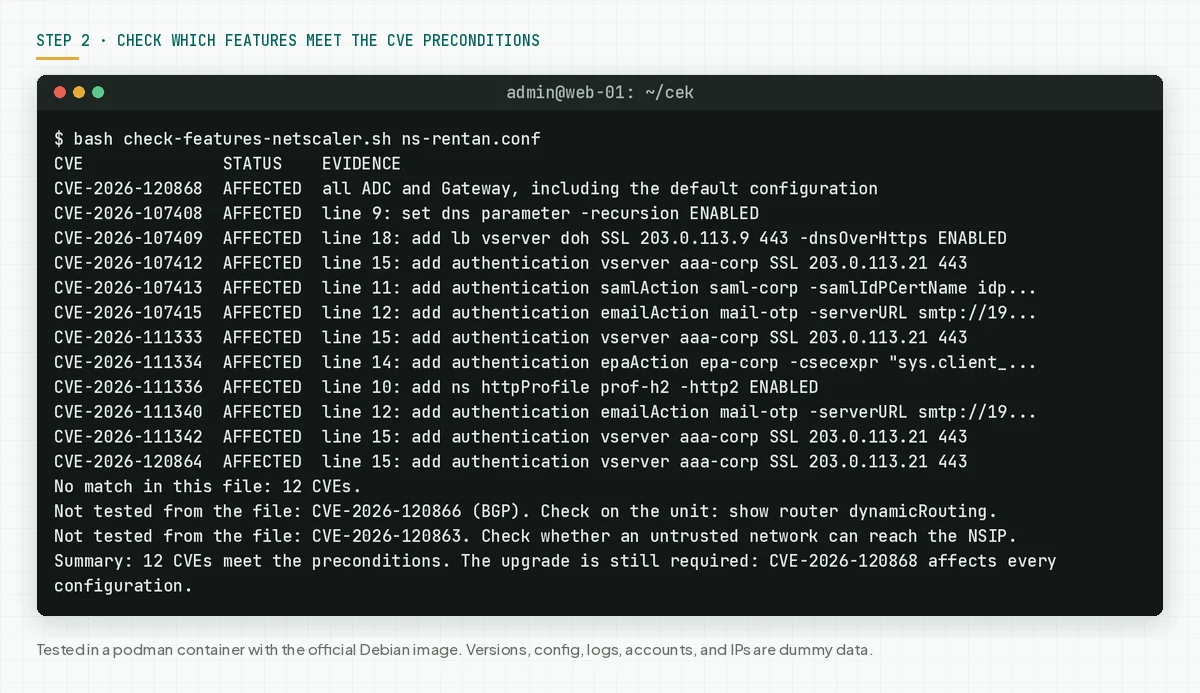
2c. Test from outside your network
From a mobile network or a server outside your network, test the NSIP and Console addresses that you own:
nc -vz <nsip-address> 443
nc -vz <console-address> 443
The result "succeeded" means the internet can reach that address. Test only IP addresses that you own.
Check the result: You have a list of matching CVEs for each unit, and an outside test result for the NSIP and Console. The script does not check BGP (CVE-2026-120866) or the management plane (CVE-2026-120863). For BGP, run show router dynamicRouting.
Step 3: Back up, then upgrade to a safe build
Only a build from Citrix closes the flaws. The bulletins give no workaround.
- Save
ns.conf, certificates, and SSL keys on a laptop or another place outside the unit. For a VM, make a snapshot. - Download the build for your model and type (normal, FIPS, or NDcPP) from the Citrix download portal.
- Check the HA pair with the command
show ha node. - For HA, follow the HA upgrade order in the Citrix documents. Rama Digital analysis: upgrade the secondary unit first, then fail over, then upgrade the old primary unit.
- Install the build, then wait for the unit to restart.
- Run
show ns versionagain, then runcheck-version-netscaler.shwith the new version. - Upgrade Console to 14.1-74.34 with the same steps.
Rama Digital analysis: we do not list the upgrade menus, because we did not test a real unit. Follow the Citrix guide for your model and version.
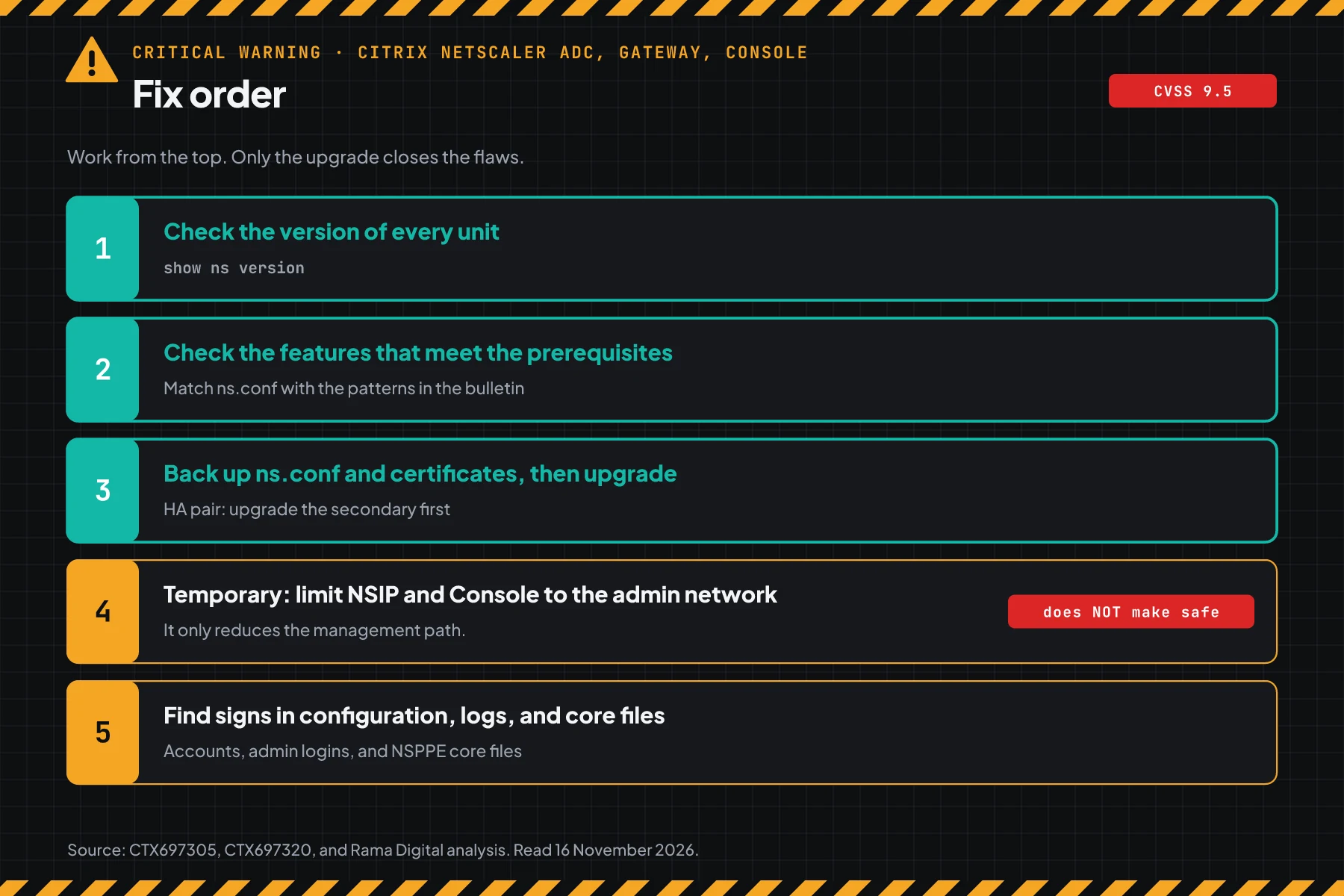
Check the result: the script prints "SAFE" on each ADC, Gateway, and Console unit. A unit on branch 13.0 or 12.1 needs a migration plan to 14.1.
Step 4: Temporary mitigation, does NOT make the unit safe
This step reduces the attack chance on the management path, but it does NOT make the unit safe. CVE-2026-120868 is in the data path, so only the upgrade closes the flaw.
4a. Limit the NSIP to the admin network
Rama Digital analysis: allow NSIP access only from the admin network or an admin VPN, on the firewall in front of the unit. Condition: the internet reached the NSIP in step 2c. Limit: this step does not close the flaw on the VIP addresses that take user traffic.
4b. Close Console access from the internet
Bulletin CTX697320 states that the attacker must reach the Console IP. Rama Digital analysis: allow Console access only from the admin network until Console is on 14.1-74.34. Limit: this step does not close the flaw in Console.
Check the result: a mobile network cannot reach the NSIP and Console, and admins can still log in from the admin network.
Step 5: Find signs of an attack
The upgrade closes the flaws, but it does not remove accounts, sessions, or settings that an attacker left. So look for those traces before and after the upgrade.
Rama Digital analysis: Citrix has not released IOCs. So the script looks for common traces: unknown system accounts, admin logins from unknown IPs, many failed logins from 1 IP, and NSPPE core files. An NSPPE core file appears when the packet engine crashes. A crash can come from a memory overflow attempt, or from another problem.
Prepare 3 files on a laptop: ns.conf from step 2, a copy of /var/log/ns.log, and the list of /var/core. Run these commands in the CLI and save the output:
shell ls -l /var/core
shell ls -l /var/log/ns.log*
Save this script as check-signs-netscaler.sh. The script only reads files. It does not change, delete, or send anything.
#!/usr/bin/env bash
# Find signs of attack on NetScaler after CVE-2026-120868 and CVE-2026-107412 (bulletins CTX697305 and CTX697320).
# Citrix did not publish IOCs. These checks are Rama Digital analysis. The log format in this script is approximate
# and was not matched to a real unit: unknown system accounts, admin logins from unknown IPs,
# many failed logins from 1 IP, and packet engine core files (NSPPE).
# Use on a laptop: bash check-signs-netscaler.sh --config ns.conf --log ns.log --core core.txt
#   ns.conf    a copy of /nsconfig/ns.conf or the output of "show ns runningConfig"
#   ns.log     the /var/log/ns.log log from the unit (.gz also works)
#   core.txt   a copy of the output of "ls -l /var/core"
#   KNOWN_ADMINS="nsroot adm-rina"   admin accounts that you know. nsroot is the default admin
#   KNOWN_IPS="198.51.100.10 198.51.100."   admin IPs that you trust. A final dot means 1 /24 block
# The script only reads files. It does not change, delete, or send anything.
set -u
export LC_ALL=C
ADMIN="${KNOWN_ADMINS:-}"; IPS="${KNOWN_IPS:-}"; LOG=""; CFG=""; CORE=""
while (( $# > 0 )); do
  case "$1" in
    --config) CFG="${2:-}"; shift 2 || shift ;;
    --log) LOG="${2:-}"; shift 2 || shift ;;
    --core) CORE="${2:-}"; shift 2 || shift ;;
    *) echo "Use: bash check-signs-netscaler.sh --config ns.conf --log ns.log --core core.txt"; exit 2 ;;
  esac
done
findings=0; doubt=0
# Remove control characters and cut long lines, so file content cannot change the terminal display.
clean() { tr -cd '[:print:]\n' | cut -c1-110; }
in_list() { [[ " $2 " == *" $1 "* ]]; }
ip_known() { local s; for s in $IPS; do
  if [[ $s == *. ]]; then [[ $1 == "$s"* ]] && return 0; else [[ $1 == "$s" ]] && return 0; fi; done; return 1; }
unsure() { echo "CANNOT CONFIRM: $1"; doubt=$((doubt + 1)); }
# Check 1 input file. Return 0 if it is readable. Otherwise print the reason with unsure.
can_read() {
  if [ ! -e "$1" ]; then unsure "file $(printf '%s' "$1" | clean) does not exist."; return 1; fi
  if [ ! -f "$1" ] || [ ! -r "$1" ]; then unsure "file $(printf '%s' "$1" | clean) is not readable."; return 1; fi
  return 0
}

echo "== 1. System accounts in the config"
cfg_ok=0
if [ -z "$CFG" ]; then unsure "no --config. Save a copy of ns.conf, then run again."
elif can_read "$CFG"; then
  if tr -d '\r' < "$CFG" | grep -q -i -E '^[[:space:]]*(add|set|bind|enable)[[:space:]]'; then cfg_ok=1
  else unsure "file $(printf '%s' "$CFG" | clean) has no add or set lines. Is it a copy of ns.conf?"; fi
fi
if (( cfg_ok )); then
  accounts=$(tr -d '\r' < "$CFG" | grep -i -E '^[[:space:]]*add[[:space:]]+system[[:space:]]+user[[:space:]]+' \
    | sed -E 's/^[[:space:]]*add[[:space:]]+system[[:space:]]+user[[:space:]]+"?([^" ]+).*/\1/I' \
    | tr -cd '[:alnum:]._@\n-' | sort -u)
  echo "nsroot  default admin"
  if [ -z "$accounts" ]; then echo "No other account in the config."
  else
    while IFS= read -r a; do
      if [ -z "$ADMIN" ]; then echo "$a"
      elif in_list "$a" "nsroot $ADMIN"; then echo "$a  known"
      else echo "CHECK: account $a is not in KNOWN_ADMINS"; findings=$((findings + 1)); fi
    done <<< "$accounts"
    [ -z "$ADMIN" ] && echo "Note: set KNOWN_ADMINS so the script can compare."
  fi
fi

echo "== 2. Admin logins from ns.log"
if [ -z "$LOG" ]; then unsure "no --log. Copy /var/log/ns.log, then run again."
elif can_read "$LOG"; then
  case "$LOG" in *.gz) read_log() { gzip -dc "$LOG" 2>/dev/null; } ;; *) read_log() { cat "$LOG"; } ;; esac
  logins=$(read_log | tr -d '\r' | grep 'CMD_EXECUTED' | grep 'Command "login' \
    | sed -nE 's/.*User ([^ ]+) - Remote_ip ([^ ]+) - Command "login[^"]*" - Status "([A-Za-z]*).*/\1 \2 \3/p' \
    | tr -cd '[:alnum:] .:@_\n-' | cut -c1-80)
  if [ -z "$logins" ]; then unsure "the log has no admin login lines (CMD_EXECUTED with Command \"login)."
  else
    ok=$(printf '%s\n' "$logins" | awk '$3 == "Success" { print $1, $2 }')
    echo "Successful logins by account and IP:"
    if [ -n "$ok" ]; then printf '%s\n' "$ok" | sort | uniq -c | sort -k1,1nr -k2 | head -n 10; else echo "  none"; fi
    if [ -z "$IPS" ]; then echo "Note: set KNOWN_IPS so the script can flag unknown IPs."
    elif [ -n "$ok" ]; then
      while read -r u ip; do
        ip_known "$ip" && continue
        echo "CHECK: $u logged in from $ip, this IP is not in KNOWN_IPS"; findings=$((findings + 1))
      done < <(printf '%s\n' "$ok" | sort -u)
    fi
    if [ -n "$ADMIN" ] && [ -n "$ok" ]; then
      while read -r u; do
        in_list "$u" "nsroot $ADMIN" || { echo "CHECK: successful login by account $u that is not in KNOWN_ADMINS"; findings=$((findings + 1)); }
      done < <(printf '%s\n' "$ok" | awk '{ print $1 }' | sort -u)
    fi
    failed=$(printf '%s\n' "$logins" | awk '$3 != "Success"' | grep -c .)
    echo "Failed logins: $failed."
    while read -r n ip; do
      (( n >= 5 )) && { echo "CHECK: $n failed logins from $ip (5 or more from 1 IP)"; findings=$((findings + 1)); }
    done < <(printf '%s\n' "$logins" | awk '$3 != "Success" { print $2 }' | sort | uniq -c | sort -k1,1nr -k2)
  fi
fi

echo "== 3. Packet engine core files"
if [ -z "$CORE" ]; then unsure "no --core. Save the output of ls -l /var/core, then run again."
elif can_read "$CORE"; then
  if [ ! -s "$CORE" ]; then unsure "file $(printf '%s' "$CORE" | clean) is empty. Save the output of ls -l /var/core."
  else
    cores=$(tr -d '\r' < "$CORE" | grep 'NSPPE-' | tr -cd '[:print:]\n' | cut -c1-90)
    if [ -z "$cores" ]; then echo "No NSPPE file."
    else
      while IFS= read -r l; do
        echo "CHECK: core NSPPE: $l"
        echo "  packet engine crash; check the date; a crash can come from a memory overflow attempt"
        findings=$((findings + 1))
      done <<< "$cores"
    fi
  fi
fi

if (( findings > 0 )); then
  echo "Result: FINDINGS ($findings). Check each CHECK line. A line that you do not know: treat it as an incident."
  (( doubt > 0 )) && echo "Also: CANNOT CONFIRM in $doubt part(s)."
elif (( doubt > 0 )); then
  echo "Result: CANNOT CONFIRM ($doubt parts). Complete the input, then run again."
else
  echo "Result: no findings. A clean result does not prove the unit is clean."
fi
The first 3 lines of a sample ns.log with dummy data:
Nov 13 08:02:11 <local0.info> 203.0.113.5 11/13/2026:08:02:11 GMT adc-jkt-01 0-PPE-0 : default GUI CMD_EXECUTED 1001 0 : User nsroot - Remote_ip 198.51.100.10 - Command "login login" - Status "Success"
Nov 13 08:40:30 <local0.info> 203.0.113.5 11/13/2026:08:40:30 GMT adc-jkt-01 0-PPE-0 : default GUI CMD_EXECUTED 1002 0 : User nsroot - Remote_ip 198.51.100.10 - Command "show ns version" - Status "Success"
Nov 13 09:15:40 <local0.info> 203.0.113.5 11/13/2026:09:15:40 GMT adc-jkt-01 0-PPE-0 : default SSH CMD_EXECUTED 1003 0 : User adm-rina - Remote_ip 198.51.100.11 - Command "login login" - Status "Success"
# On a laptop, in the folder where you keep the script, the log, and the config copy
KNOWN_ADMINS="nsroot adm-rina" KNOWN_IPS="198.51.100.10 198.51.100.11" bash check-signs-netscaler.sh --config ns.conf --log ns.log --core core.txt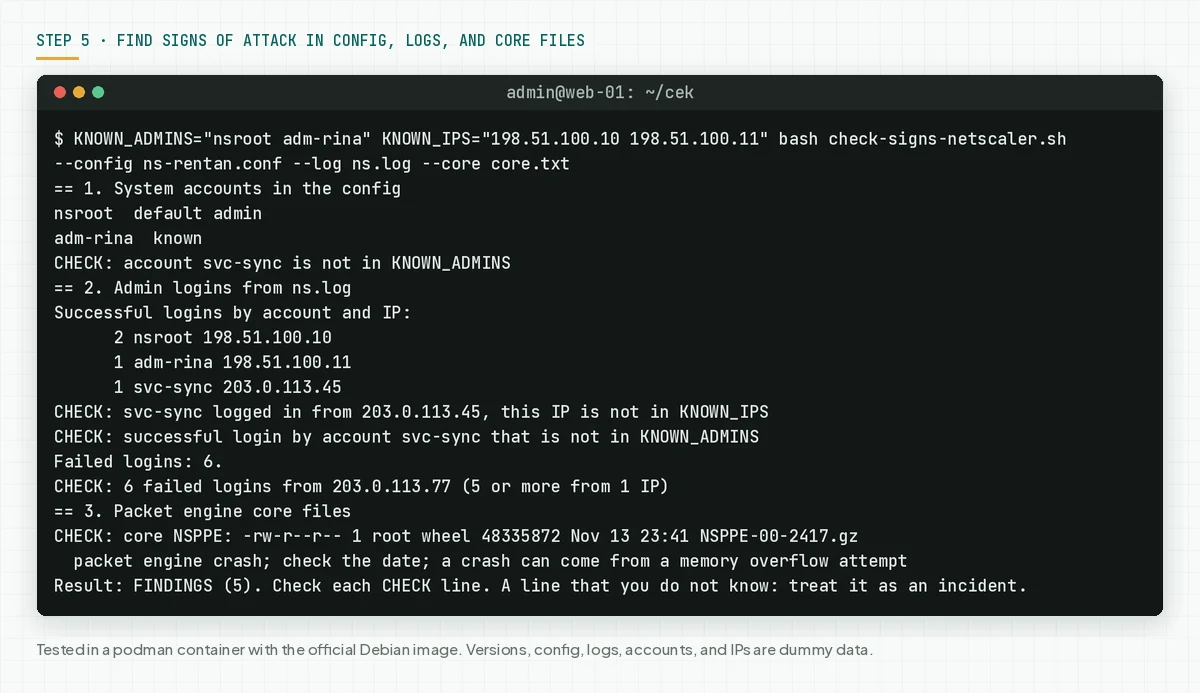
Script limits: Rama Digital analysis: we wrote the line patterns CMD_EXECUTED, Remote_ip, and Status "Success" from an estimate, not from a real unit. The script reads .gz files. It prints "CANNOT CONFIRM" when a file is missing.
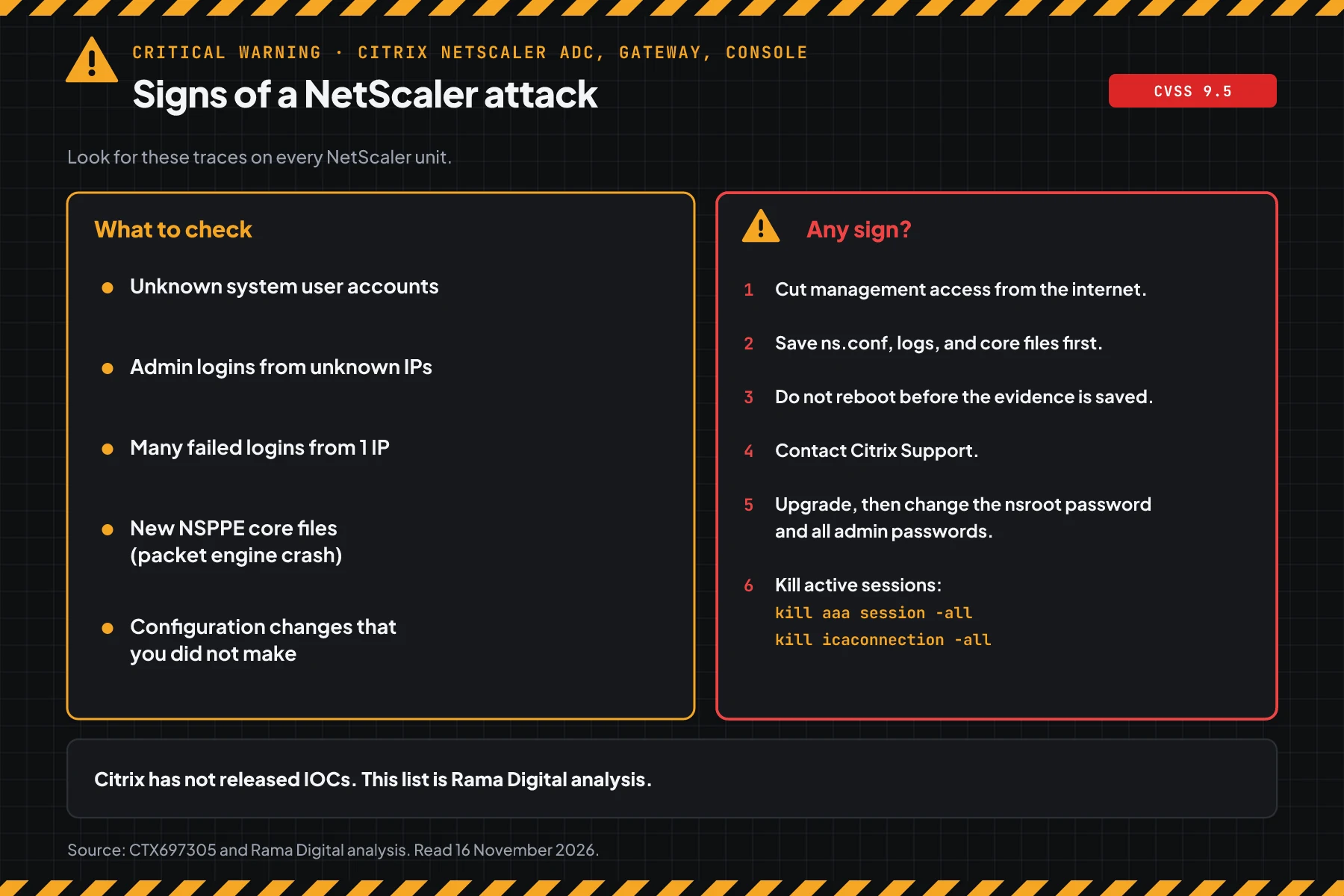
Check the result: "no findings" means the script found no sign. A clean result does not prove a clean unit. "FINDINGS" means check each CHECK line, then follow this order for any line that you do not know:
- Cut NSIP and Console access from the internet with step 4.
- Save
ns.conf, the logs, and core files first, before you change anything. - Do not reboot the unit before the evidence is saved.
- Contact Citrix Support with that evidence.
- Upgrade, then change the passwords of nsroot and all admins.
- Rama Digital analysis: end active sessions after the upgrade, so old sessions do not stay valid.
kill aaa session -all
kill icaconnection -all
When personal data leaks through this unit, Indonesian Law 27/2022 on Personal Data Protection requires a written notice within 3 times 24 hours. A similar edge device case is the Check Point flaw CVE-2026-123039.
Example: 1 night of response for 4 units
This simulation uses dummy data. The unit names, times, and results are not customer data.
| Time (WIB) | Dummy unit | What we checked | Result | Action |
|---|---|---|---|---|
| 19.00 | gw-jkt-01 (14.1-73.50, Gateway) | Steps 1 and 2 | VULNERABLE, the Gateway and SAML preconditions match | Upgrade to 14.1-73.57 tonight |
| 19.20 | adc-mdn-01 (13.1-62.23) | Step 1 | VULNERABLE, only CVE-2026-120868 and HTTP/2 | Upgrade to 13.1-64.39 after gw-jkt-01 |
| 19.40 | console-01 (14.1-71.40) | Steps 1 and 2c | VULNERABLE, the internet reaches Console | Step 4b, then upgrade to 14.1-74.34 |
| 20.10 | gw-jkt-01 | Step 5 | Unknown account svc-sync, a login from 203.0.113.45, 1 NSPPE core file | Cut access, save evidence, contact Citrix Support |
The lesson from this simulation: do the Gateway unit first, because it has the most CVEs. The upgrade does not remove the svc-sync account, so step 5 stays necessary.
Who does the work
The network team usually owns NetScaler. The application team must know the upgrade schedule, because user sessions drop. The head of IT decides the maintenance window and the migration plan for old branches.
Rama Digital advice: do not open the NSIP and Console to the internet. Use an admin VPN or an admin network. A similar lesson is in the FortiManager flaw CVE-2026-126170.
Checklist for today
- List all ADC, Gateway, and Console units, including the second HA unit and DR units. Owner: IT team. Proof: a list of names, types, and versions.
- Check the version with step 1. Owner: network admin. Proof: script output.
- Check features and outside access with step 2. Owner: network admin. Proof: script output and the outside test result.
- Back up, then upgrade to 14.1-73.57, 13.1-64.39, a FIPS build, or Console 14.1-74.34. Owner: network admin. Proof: script output after the upgrade.
- Limit the NSIP and Console to the admin network. Owner: network admin. Proof: the firewall rule and the outside test result.
- Find signs with step 5. Owner: network admin. Proof: script output, logs, and the core list.
- Schedule a migration for each unit on 13.0 or 12.1. Owner: head of IT. Proof: a written migration date.
Questions and answers
We do not use Gateway. Are we still affected?
Yes. Per bulletin CTX697305, CVE-2026-120868 affects all NetScaler ADC and Gateway units, including the default configuration. The upgrade is still necessary.
Does CVE-2026-120868 let an attacker run code?
Citrix writes the effect as unpredictable behavior or DoS. The CVSS score gives high values for confidentiality and integrity. We make no other claim.
There are no attack reports yet. Why must I upgrade today?
The scores are 9.3 and 9.5, the main flaw works with no login, and the bulletins are public since 12 November 2026. Six other NetScaler CVEs from 2026 are already in CISA KEV.
Our unit runs 13.0. What must we do?
The bulletin does not list branch 13.0. Rama Digital analysis: this branch gets no fix build, so treat it as at risk and migrate to 14.1-73.57.
We use NetScaler that Citrix manages in the cloud. Must we act?
Per the bulletin, Cloud Software Group upgrades the cloud services that Citrix manages. Your own NetScaler instances, including those for Secure Private Access Hybrid, still need the upgrade.
Is a limit on the NSIP enough until the upgrade?
No. That step only reduces the management path. CVE-2026-120868 is in the data path, so the VIP addresses stay open until the upgrade.
Does the upgrade remove the attacker's access?
The upgrade closes the flaws. It does not remove the accounts, sessions, or settings that an attacker made. Run step 5, then change the passwords of all admins.
Next step
The limits that still apply: step 4 does not make the unit safe, and an upgrade does not clean a unit that was taken over. When your unit shows a sign in step 5, or you need help with an audit and recovery, use Vibe Code Rescue. For 1 urgent issue today, book a 30-minute session.
Sources
- bulletin CTX697305: summary, CWE, score, preconditions and
ns.confpatterns, vulnerable versions, safe versions, and reporters, 12 November 2026, updated 13 November 2026. - bulletin CTX697320: CVE-2026-120869, score 9.4, vulnerable and safe Console versions, 12 November 2026.
- The CVE-2026-120868 record, CVE-2026-107412 record, and CVE-2026-120869 record: CNA description, CVSS 4.0 vector, and publish times of 12 and 13 November 2026.
- CISA KEV: lists no NetScaler CVE from November on 16 November 2026.
- CERT-EU advisory 2026-020: exploitation status and proof of concept.
- Indonesian Law 27/2022 on Personal Data Protection: the duty to report a personal data leak.