Direct answer: Fortinet published 4 critical flaws in FortiManager and FortiAnalyzer: CVE-2026-126170 (score 9.8), CVE-2026-126262 (9.3), CVE-2026-126261 (9.0), and CVE-2026-126229 (9.1). The first 3 flaws work with no login. Today, check the version and the product, move to 7.6.8, 7.4.12, or 7.2.13, then close ports 514 and 541 from the internet.
Branch 8.0 has a special rule. Version 8.0.2 closes 3 flaws, but the fix for CVE-2026-126170 is in 8.0.3 and is not released on 15 November 2026. Until 8.0.3 comes out, set rpc-permit none in each admin profile. Branch 7.0 has no fix and must migrate.
Main condition: On 15 November 2026, all advisories write Known Exploited: No, and CISA KEV does not list any of the 4 CVEs. Limit: This article has no request content, no payload, and no attack sequence. We only use the official Fortinet summary.
We read advisory FG-IR-26-219, advisory FG-IR-26-276, advisory FG-IR-26-275, advisory FG-IR-26-244, the 4 CVE records, and CISA KEV on 15 November 2026, from 06.35 to 07.10 WIB. We ran the scripts of steps 1 and 5 in a podman container with the official Debian image and dummy FortiManager files. FortiManager has no container image, so we did not test a real unit.
Important limit: The CLI output and log formats in this article are Rama Digital estimates. We mark each estimate with the label "Rama Digital analysis". Compare them with the output of your own unit before you rely on the scripts.
The problem: the control center of FortiGate faces the network
FortiManager manages the configuration of many FortiGate units from 1 place. FortiAnalyzer stores the logs and reports of those FortiGate units. Companies with many branches often use both. The unit comes as an appliance, a VM, and a cloud service.
Because its job is to manage network devices, 1 FortiManager unit that is taken over can be a way into many FortiGate units. Rama Digital analysis: this danger is real if an attacker can change FortiGate configuration through that unit. Limit: Fortinet does not write that effect, and we did not test a real unit.
The same pattern shows in the FortiMail flaw CVE-2026-126147. Fortinet published the FortiMail flaws on the same advisory date, 10 November 2026.
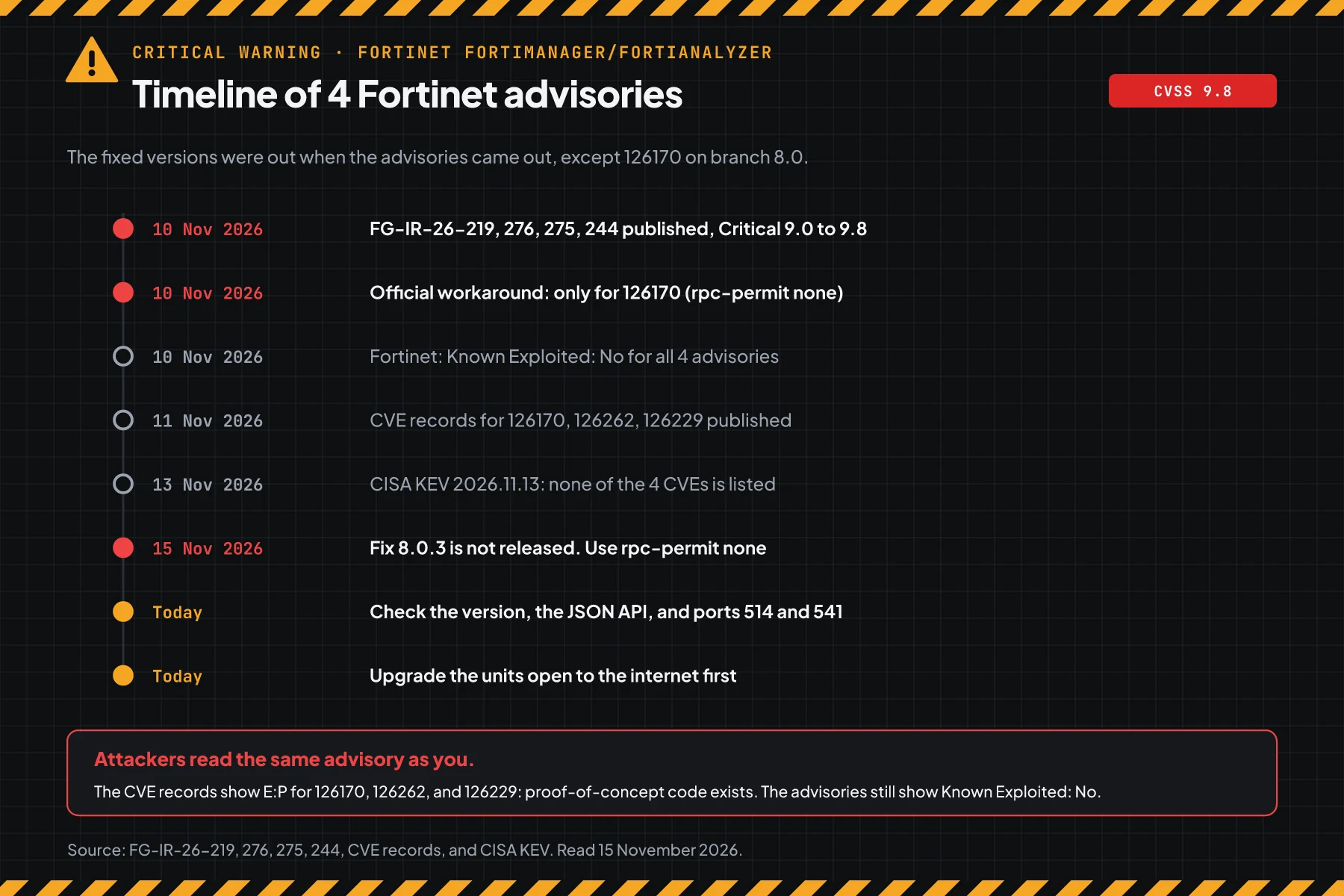
Fortinet published all 4 advisories on 10 November 2026. The CVE records came out on 10 and 11 November 2026. Only advisory 219 (CVE-2026-126170) has a workaround.
How it works: 3 flaws before login, 1 flaw after login
Three flaws work before login, so a strong password and 2FA do not guard the unit from those flaws. The fourth flaw needs an admin account.
This section uses the official Fortinet summary. Its purpose is to help you choose the correct steps, not to explain an attack.
Summary from Fortinet
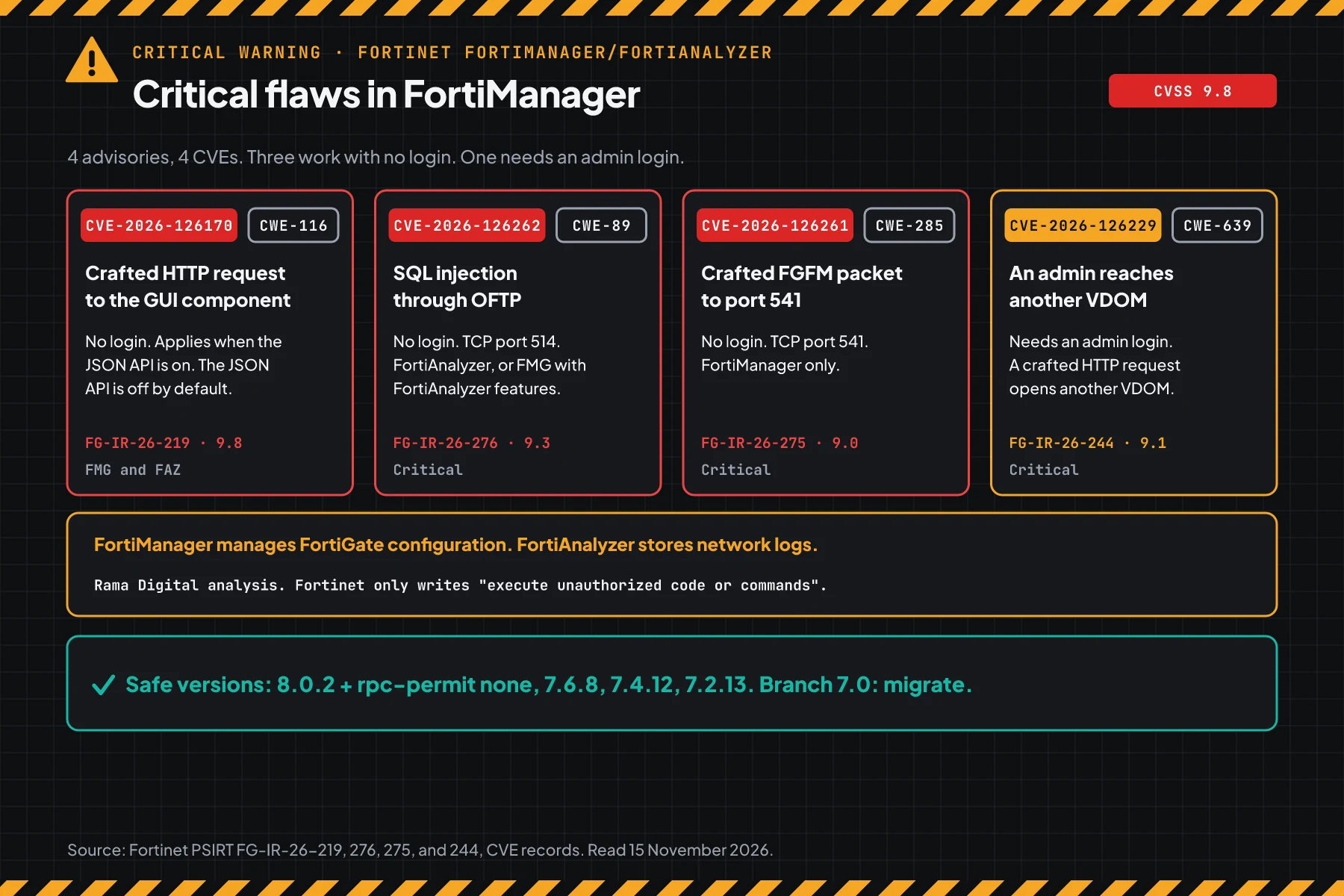
According to advisory FG-IR-26-219, CVE-2026-126170 is a CWE-116 flaw in the GUI component, through the JSON APIAPIThe official door 2 systems use to exchange data, without anybody copying it by hand.Open the glossary. It "may allow an unauthenticated attacker to execute unauthorized code or commands via a specially crafted HTTP request". The flaw applies only when the JSON API is on. Fortinet writes that the JSON API is off by default.
According to advisory FG-IR-26-276, CVE-2026-126262 is a SQL injection flaw (CWE-89) in the OFTP service, which uses TCP port 514. An attacker with no login who can reach that port can run code or commands through crafted OFTP packets. The flaw affects FortiAnalyzer, or FortiManager with the FortiAnalyzer features on.
According to advisory FG-IR-26-275, CVE-2026-126261 is a CWE-285 flaw in the FGFM service, which uses TCP port 541. FGFM is the protocol that connects FortiGate to FortiManager. An attacker with no login who can reach that port can run code or commands through crafted FGFM packets. The flaw affects FortiManager only.
According to advisory FG-IR-26-244, CVE-2026-126229 is a CWE-639 flaw. An admin who is already logged in can reach another VDOM through a crafted HTTP request. A VDOM is a separate configuration space. The score of 9.1 includes the admin privilege condition.
4 CVEs, 4 advisories, 1 upgrade
Each CVE has its own advisory. Versions 7.6.8, 7.4.12, and 7.2.13 close all 4. Branch 8.0 needs 8.0.2 for 3 flaws, and 8.0.3 for CVE-2026-126170.
| CVE | Advisory | Flaw type | Fortinet CVSS 3.1 | Effect |
|---|---|---|---|---|
| CVE-2026-126170 | FG-IR-26-219 | GUI component and JSON API (CWE-116) | 9.8 Critical | No login. Applies when the JSON API is on. Run code or commands through a crafted HTTP request. |
| CVE-2026-126262 | FG-IR-26-276 | SQL injection through OFTP, TCP port 514 (CWE-89) | 9.3 Critical | No login. Run code or commands through crafted OFTP packets. FortiAnalyzer, or FortiManager with FortiAnalyzer features. |
| CVE-2026-126261 | FG-IR-26-275 | FGFM packets to TCP port 541 (CWE-285) | 9.0 Critical | No login. Run code or commands through crafted FGFM packets. FortiManager only. |
| CVE-2026-126229 | FG-IR-26-244 | Access to another VDOM (CWE-639) | 9.1 Critical | Needs an admin login. A crafted HTTP request opens another VDOM. |
Other items in the same family: advisory FG-IR-26-219 also lists FortiAnalyzer-BigData 7.6.0 to 7.6.2 (fix 7.6.3 is not released) and FortiSASE-Sovereign. This article does not cover those two further.
Exploitation status on 15 November 2026
All advisories write Known Exploited: No and Virtual Patch: No. CISA KEV version 2026.11.13 does not list any of the 4 CVEs. The CVSS vectors in the CVE-2026-126170 record, the CVE-2026-126262 record, and the CVE-2026-126229 record have E:P. This means that, per the CNA, proof-of-concept code exists. The vector in the CVE-2026-126261 record has E:U.
The CVE-2026-126170 record has a CISA ADP assessment: Exploitation none, Automatable yes, Technical Impact total. Automatable yes means an attack can run automatically. Fortinet names the Fortinet Product Security team as the reporter, with the help of the frontier AI model ClaudeClaude ProThe paid subscription for the Claude AI assistant from Anthropic. It unlocks connectors to outside tools.Open the glossary Mythos.
Rama Digital analysis: another Fortinet flaw went into CISA KEV this year, so attackers aim at Fortinet products. Condition: the unit is open to the internet and is not upgraded. Limit: that fact does not prove attacks on these 4 new CVEs.
Who is most at risk
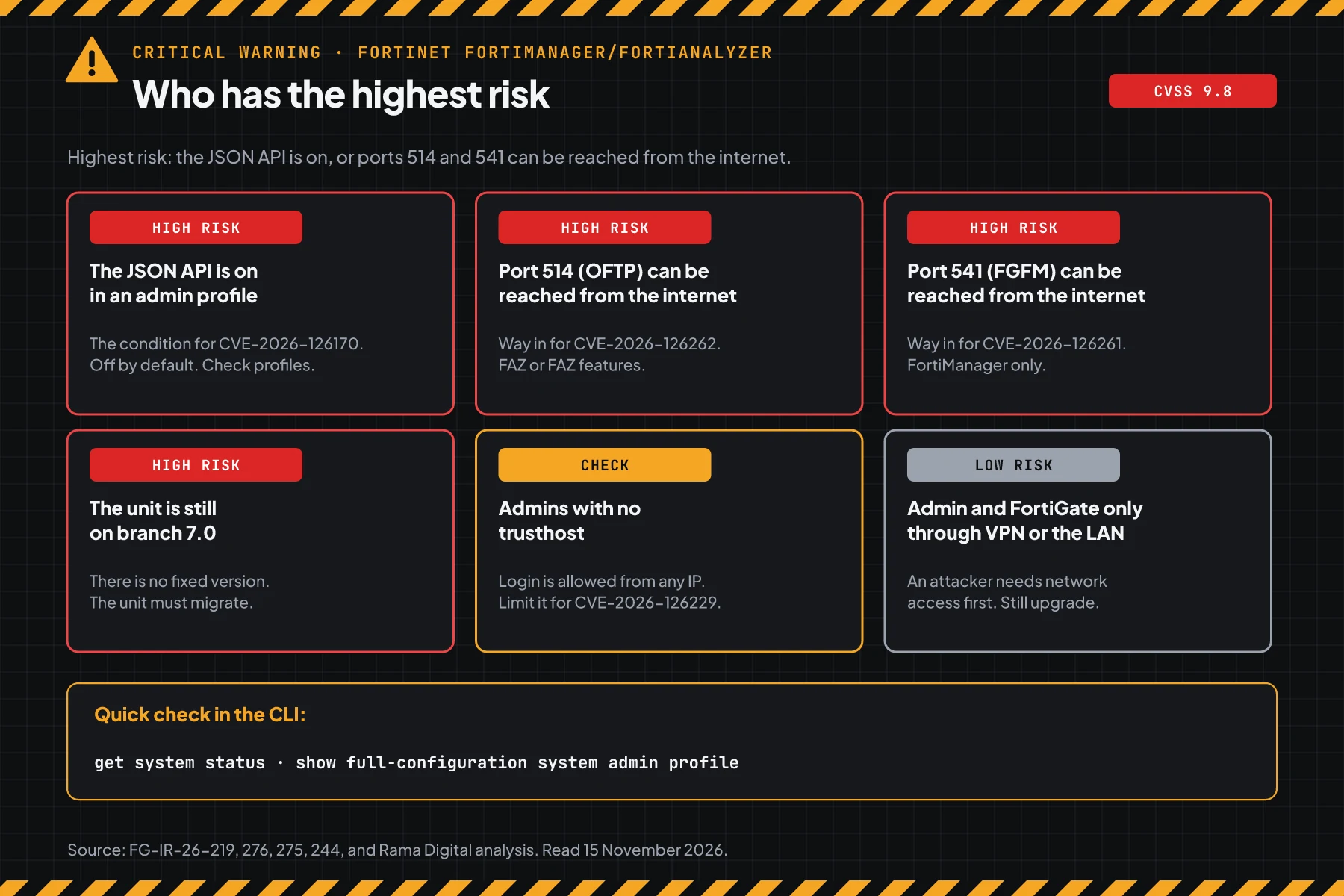
Units that open port 514 or 541 to the internet, or that turn on the JSON API, and did not upgrade are most at risk.
This table sums up the 4 advisories and our analysis.
| Unit condition | Risk | Reason |
|---|---|---|
| The JSON API is on in an admin profile | High | The condition for CVE-2026-126170. Fortinet writes that the JSON API is off by default |
| Port 514 (OFTP) can be reached from the internet | High | The way in for CVE-2026-126262. FortiAnalyzer, or FortiManager with FortiAnalyzer features |
| Port 541 (FGFM) can be reached from the internet | High | The way in for CVE-2026-126261. FortiManager only |
| The unit is still on branch 7.0 | High | There is no fixed version. The unit must migrate |
| Admins with no trusthost | Check | Rama Digital analysis: an admin account can log in from any IP, and CVE-2026-126229 needs an admin account |
| Admin and FortiGate only through VPN or the LAN | Low | An attacker needs network access first. Still upgrade. |
Rama Digital analysis: if branch FortiGate units send logs or register to the central unit through the internet, port 514 or 541 is often open. Condition: the central unit has a public IP address. Limit: we do not know your network, so check it yourself in step 2. The pattern of edge devices as the first target also shows in the SonicWall SSL VPN flaw CVE-2026-19868.
Vulnerable and safe versions
The version rules are the same for FortiManager and FortiAnalyzer. Match the branch and version of your unit with this table.
| Branch | CVE-2026-126170 | CVE-2026-126262 | CVE-2026-126261 (FMG only) | CVE-2026-126229 | Upgrade to |
|---|---|---|---|---|---|
| 8.0 | 8.0.0 to 8.0.2: vulnerable. Fix 8.0.3 is not released | FAZ 8.0.0 to 8.0.1, FMG 8.0.0: vulnerable | 8.0.0: vulnerable | 8.0.0 to 8.0.1: vulnerable | 8.0.2, then rpc-permit none until 8.0.3 |
| 7.6 | 7.6.0 to 7.6.7: vulnerable | 7.6.0 to 7.6.7: vulnerable | 7.6.0 to 7.6.7: vulnerable | 7.6.0 to 7.6.7: vulnerable | 7.6.8 |
| 7.4 | Not affected | 7.4.0 to 7.4.11: vulnerable | 7.4.0 to 7.4.5: vulnerable | 7.4.0 to 7.4.11: vulnerable | 7.4.12 |
| 7.2 | Not affected | 7.2.0 to 7.2.12: vulnerable | 7.2.0 to 7.2.8: vulnerable | 7.2.0 to 7.2.12: vulnerable | 7.2.13 |
| 7.0 | Not listed | Not listed | Not listed | All versions: vulnerable | Migrate to a branch with a fix |
| Cloud version | 7.6.0 to 7.6.7 and 8.0.1 to 8.0.2 | Not listed | Not listed | 7.0 to 8.0.1 | 7.6.8, or 8.0.3 when released |
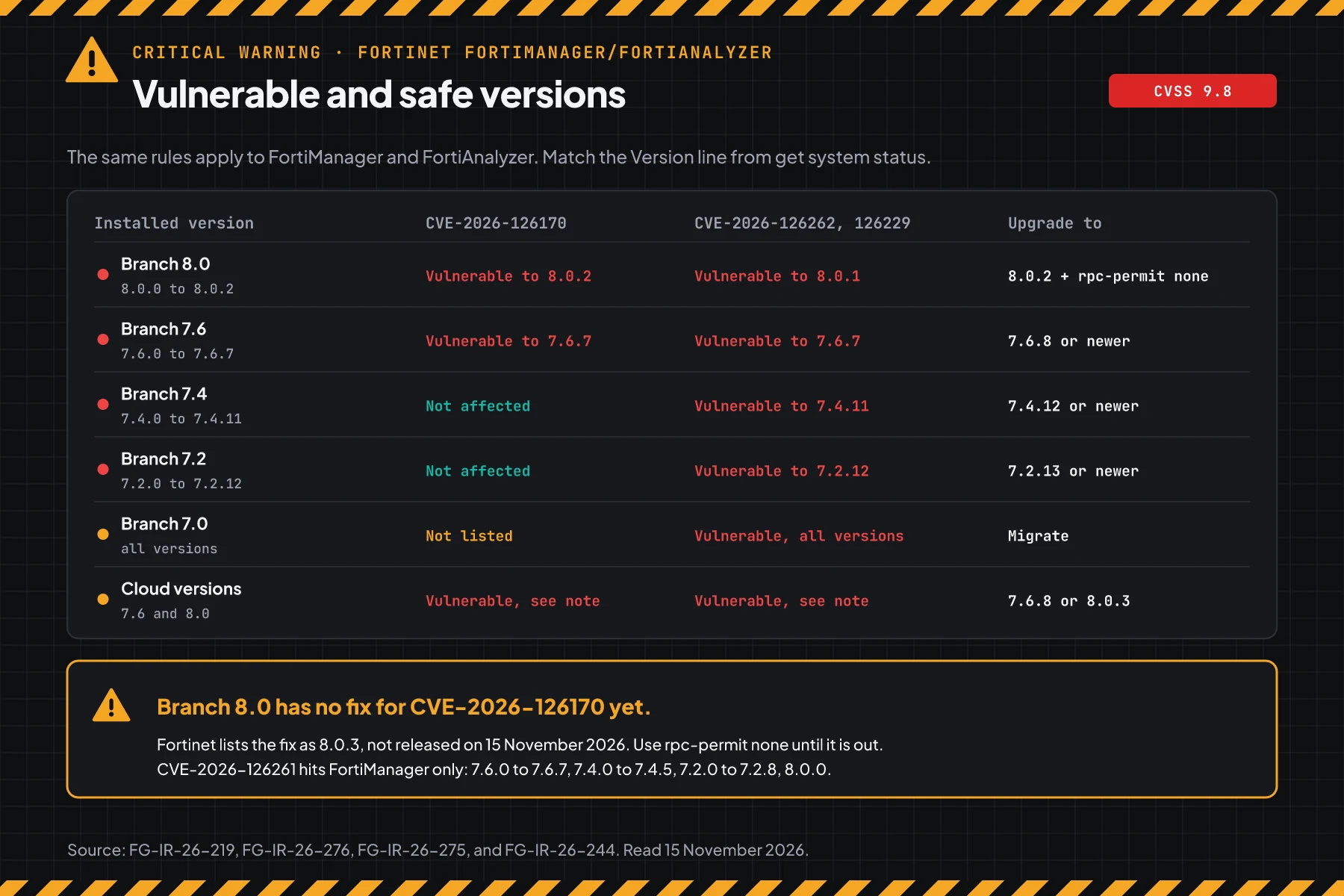
The table data comes from the 4 advisories. The command get system status shows a Version line, for example "v7.6.5-build3653". The number after the letter v is the version that you match.
Note on branch 8.0: Version 8.0.1 closes CVE-2026-126262 and CVE-2026-126261. Version 8.0.2 also closes CVE-2026-126229. CVE-2026-126170 has a fix only in 8.0.3, and that version is not released on 15 November 2026. So an 8.0.2 unit stays vulnerable to CVE-2026-126170 until you apply the workaround.
Note on CVE-2026-126261: This flaw affects FortiManager only. The versions are 8.0.0, 7.6.0 to 7.6.7, 7.4.0 to 7.4.5, and 7.2.0 to 7.2.8. The script in step 1 writes N/A for FortiAnalyzer.
Note on Cloud versions: advisory FG-IR-26-219 lists Cloud versions 7.6.0 to 7.6.7 and 8.0.1 to 8.0.2, with the fix in 7.6.8 or 8.0.3. We did not find a statement that Fortinet already fixed the Cloud service for you. Check the version of your service, then ask Fortinet. The script does not cover Cloud versions.
Before you start
- An admin account with full rights for each FortiManager and FortiAnalyzer unit, including the second HA unit and spare units.
- Access to Fortinet Technical Support to download the firmware image.
- A maintenance window. The unit restarts during the upgrade, so FortiGate units cannot be managed or send logs for a short time.
- Access to the firewall in front of the unit, to check the rules that open ports 514 and 541.
- A list of the valid admin accounts, the trusted admin IPs, the names of the ports that connect to the internet, and the names of the valid FortiGate units. Step 5 needs this list.
Step 1: Check the version and product of each unit
In the CLI, run this command on each unit:
get system statusThe command prints the Platform Type, Version, and Hostname lines. Rama Digital analysis: we wrote the shape of these lines from an estimate, not from a real unit. A sample output with dummy data:
Platform Type          : FMG-VM64
Version                : v7.6.5-build3653 250115 (GA.F)
Serial Number          : FMG-VMxxxxxxxxxxxx
Hostname               : fmg-jkt-01
Admin Domain Configuration : Disabled
HA Mode                : Stand Alone
For many units, save this script as check-version-fortimanager.sh. The script compares the version with the advisory table for 4 CVEs and prints the target version. The script does not contact FortiManager or FortiAnalyzer.
#!/usr/bin/env bash
# Check FortiManager and FortiAnalyzer versions against 4 Fortinet advisories of 10 November 2026:
# FG-IR-26-219 (CVE-2026-126170), FG-IR-26-276 (CVE-2026-126262), FG-IR-26-275 (CVE-2026-126261), FG-IR-26-244 (CVE-2026-126229).
# The script reads text only and does not contact FortiManager or FortiAnalyzer.
# Use: bash check-version-fortimanager.sh devices.txt   (1 device per line: name, product FMG or FAZ, then version, for example "fmg-01 FMG 7.6.5")
#   or: bash check-version-fortimanager.sh "fmg-01 FMG 7.6.5" "faz-01 FAZ v7.4.9,build2500"
#   or: bash check-version-fortimanager.sh --status status.txt   (a copy of the CLI output of "get system status")
# No product written: the script reads the name (fmg or faz), then assumes FortiManager and adds a * mark.
# FortiManager Cloud and FortiAnalyzer Cloud are not covered. Read the table in the article.
set -u
vuln=0; migrate=0; safe=0; other=0; has_old=0; has_faz_check=0; has_80=0; has_guess=0

# Remove control characters and limit the length, so file content cannot change the terminal display.
clean() { tr -cd '[:print:]\n' | cut -c1-110; }

header() { printf '%-13s %-5s %-8s %-10s %-17s %-10s %-10s %s\n' "DEVICE" "PROD" "VERSION" "126170" "126262" "126261" "126229" "TARGET"; }

# $1 name, $2 product (FMG or FAZ), $3 guess mark, $4 major, $5 minor, $6 patch
rate() {
  local name="$1" prod="$2" guess="$3" ma=$((10#$4)) mi=$((10#$5)) pa=$((10#$6))
  local s70="N/A" s62="N/A" s61="N/A" s29="N/A" target="-" class="safe" hit62
  [ "$prod" = "FMG" ] && hit62="CHECK FAZ FEATURE" || hit62="VULNERABLE"
  case "$ma.$mi" in
    8.0)
      (( pa < 3 )) && s70="VULNERABLE" || s70="SAFE"
      if [ "$prod" = "FMG" ]; then
        (( pa < 1 )) && s62="$hit62" || s62="SAFE"
        (( pa < 1 )) && s61="VULNERABLE" || s61="SAFE"
      else
        (( pa < 2 )) && s62="$hit62" || s62="SAFE"
      fi
      (( pa < 2 )) && s29="VULNERABLE" || s29="SAFE"
      if (( pa < 2 )); then target="8.0.2 + rpc-permit none"
      elif (( pa == 2 )); then target="rpc-permit none, wait 8.0.3"; fi
      has_80=1 ;;
    7.6)
      (( pa < 8 )) && s70="VULNERABLE" || s70="SAFE"
      (( pa < 8 )) && s62="$hit62" || s62="SAFE"
      if [ "$prod" = "FMG" ]; then (( pa < 8 )) && s61="VULNERABLE" || s61="SAFE"; fi
      (( pa < 8 )) && s29="VULNERABLE" || s29="SAFE"
      (( pa < 8 )) && target="7.6.8" ;;
    7.4)
      (( pa < 12 )) && s62="$hit62" || s62="SAFE"
      if [ "$prod" = "FMG" ]; then (( pa < 6 )) && s61="VULNERABLE" || s61="SAFE"; fi
      (( pa < 12 )) && s29="VULNERABLE" || s29="SAFE"
      (( pa < 12 )) && target="7.4.12" ;;
    7.2)
      (( pa < 13 )) && s62="$hit62" || s62="SAFE"
      if [ "$prod" = "FMG" ]; then (( pa < 9 )) && s61="VULNERABLE" || s61="SAFE"; fi
      (( pa < 13 )) && s29="VULNERABLE" || s29="SAFE"
      (( pa < 13 )) && target="7.2.13" ;;
    7.0)
      s70="N/A *"; s62="N/A *"; [ "$prod" = "FMG" ] && s61="N/A *"
      s29="VULNERABLE"; target="MIGRATE"; class="migrate"; has_old=1 ;;
    *)
      if (( ma < 7 )); then
        s70="N/A *"; s62="N/A *"; [ "$prod" = "FMG" ] && s61="N/A *"; s29="N/A *"
        target="MIGRATE"; class="migrate"; has_old=1
      else
        s70="?"; s62="?"; s61="?"; s29="?"; target="compare with advisory"; class="other"
      fi ;;
  esac
  if [ "$class" = "safe" ]; then
    case "$s70 $s62 $s61 $s29" in *VULNERABLE*|*CHECK*) class="vuln" ;; esac
  fi
  case "$class" in
    vuln) vuln=$((vuln + 1)) ;;
    migrate) migrate=$((migrate + 1)) ;;
    safe) safe=$((safe + 1)) ;;
    *) other=$((other + 1)) ;;
  esac
  case "$s62" in "CHECK FAZ FEATURE") has_faz_check=1 ;; esac
  [ -n "$guess" ] && has_guess=1
  printf '%-13s %-5s %-8s %-10s %-17s %-10s %-10s %s\n' "$name" "$prod$guess" "$ma.$mi.$pa" "$s70" "$s62" "$s61" "$s29" "$target"
}

# Read 1 line: name, product (FMG or FAZ), then a version such as "7.6.5", "v7.6.5,build3600", or the CLI "Version:" line.
line() {
  local text name low prod guess="" w words=""
  [[ $1 =~ ^[[:space:]]*# ]] && return 0
  text=$(printf '%s' "$1" | tr -cd '[:alnum:] .,:()_-' | cut -c1-110)
  [[ -z ${text// /} ]] && return 0
  if [[ $text =~ (^|[[:space:]v])([0-9]+)\.([0-9]+)\.([0-9]+) ]]; then
    local ma="${BASH_REMATCH[2]}" mi="${BASH_REMATCH[3]}" pa="${BASH_REMATCH[4]}"
    name=${text%%"${BASH_REMATCH[0]}"*}
    low=$(printf '%s' "$text" | tr '[:upper:]' '[:lower:]')
    local fmg=0 faz=0
    [[ $low =~ (^|[^a-z0-9])(fmg|fortimanager)([^a-z0-9]|$) ]] && fmg=1
    [[ $low =~ (^|[^a-z0-9])(faz|fortianalyzer)([^a-z0-9]|$) ]] && faz=1
    if (( fmg && faz )); then
      printf '%-13s %-5s %-8s %s\n' "$(printf '%s' "$name" | cut -c1-13)" "-" "$ma.$mi.$pa" "UNKNOWN, product is ambiguous (FMG and FAZ)"
      other=$((other + 1)); return 0
    elif (( fmg )); then prod="FMG"
    elif (( faz )); then prod="FAZ"
    else prod="FMG"; guess="*"; fi
    for w in $name; do
      case "$(printf '%s' "$w" | tr '[:upper:]' '[:lower:]')" in
        version:|fmg|faz|fortimanager*|fortianalyzer*) ;;
        *) words="$words $w" ;;
      esac
    done
    name=$(printf '%s' "$words" | sed -E 's/ +/ /g; s/^ //; s/ $//' | cut -c1-13)
    rate "${name:--}" "$prod" "$guess" "$ma" "$mi" "$pa"
  else
    printf '%-13s %-5s %-8s %s\n' "$(printf '%s' "$text" | cut -c1-13)" "-" "-" "UNKNOWN, version not readable"
    other=$((other + 1))
  fi
}

summary() {
  echo "Summary: $vuln VULNERABLE, $migrate MIGRATE, $safe SAFE, $other other."
  echo "N/A: not affected, or not applicable to that product."
  (( has_faz_check )) && echo "CHECK FAZ FEATURE: CVE-2026-126262 hits FortiManager only if the FortiAnalyzer features are on. Check that setting. If unsure, treat as vulnerable."
  (( has_80 )) && echo "Branch 8.0: the fix for CVE-2026-126170 (8.0.3) is not released. Use rpc-permit none until 8.0.3."
  (( has_old )) && echo "MIGRATE: this branch has no fix. N/A * means not listed in the advisory, so treat it as at risk."
  (( has_guess )) && echo "FMG*: no product written, assumed FortiManager. Write FMG or FAZ on the line."
  return 0
}

if [ "${1:-}" = "--status" ]; then
  f="${2:-}"
  if [ -z "$f" ] || [ ! -r "$f" ]; then
    echo "CANNOT CONFIRM: file $(printf '%s' "$f" | clean) is not readable."; exit 2
  fi
  v=$(grep -m1 -E '^Version[[:space:]]*:' "$f" | clean)
  h=$(grep -m1 -E '^Hostname[[:space:]]*:' "$f" | sed -E 's/^Hostname[[:space:]]*:[[:space:]]*//' | tr -cd '[:alnum:]._-' | cut -c1-13)
  if [ -z "$v" ]; then echo "CANNOT CONFIRM: the file has no Version: line."; exit 2; fi
  echo "$v"
  header
  line "${h:--} $(printf '%s' "$v" | sed -E 's/^Version[[:space:]]*:[[:space:]]*//')"
  summary
  exit 0
fi

header
if (( $# == 1 )) && [ -f "$1" ]; then
  if [ ! -r "$1" ]; then echo "CANNOT CONFIRM: the file is not readable."; exit 2; fi
  while IFS= read -r x || [ -n "$x" ]; do line "$x"; done < "$1"
elif (( $# == 1 )) && [[ $1 != *[[:space:]]* ]]; then
  echo "CANNOT CONFIRM: file $(printf '%s' "$1" | clean) does not exist."; exit 2
elif (( $# > 0 )); then
  for x in "$@"; do line "$x"; done
else
  while IFS= read -r x || [ -n "$x" ]; do line "$x"; done
fi
summary
Write 1 unit per line: the name, the product FMG or FAZ, then the version. A sample file with dummy data:
# name product version (dummy data)
fmg-jkt-01 FMG 7.6.5
faz-jkt-01 FAZ v7.6.7,build3700
fmg-sby-01 FMG 7.4.8
faz-sby-01 FAZ 7.4.12
fmg-bdg-01 FMG 7.2.9
fmg-dr-01 FMG 8.0.1
fmg-old FMG 7.0.6
faz-80 FAZ 8.0.2
fmg-new FMG 7.6.8
# 1 unit per line: name, product FMG or FAZ, then the version from get system status
nano devices.txt
bash check-version-fortimanager.sh devices.txt
# Or pass them as arguments
bash check-version-fortimanager.sh "fmg-jkt-01 FMG 7.6.5" "faz-sby-01 FAZ v7.4.12,build2500"
# Or use a copy of the CLI output of get system status
bash check-version-fortimanager.sh --status status-fortimanager.txt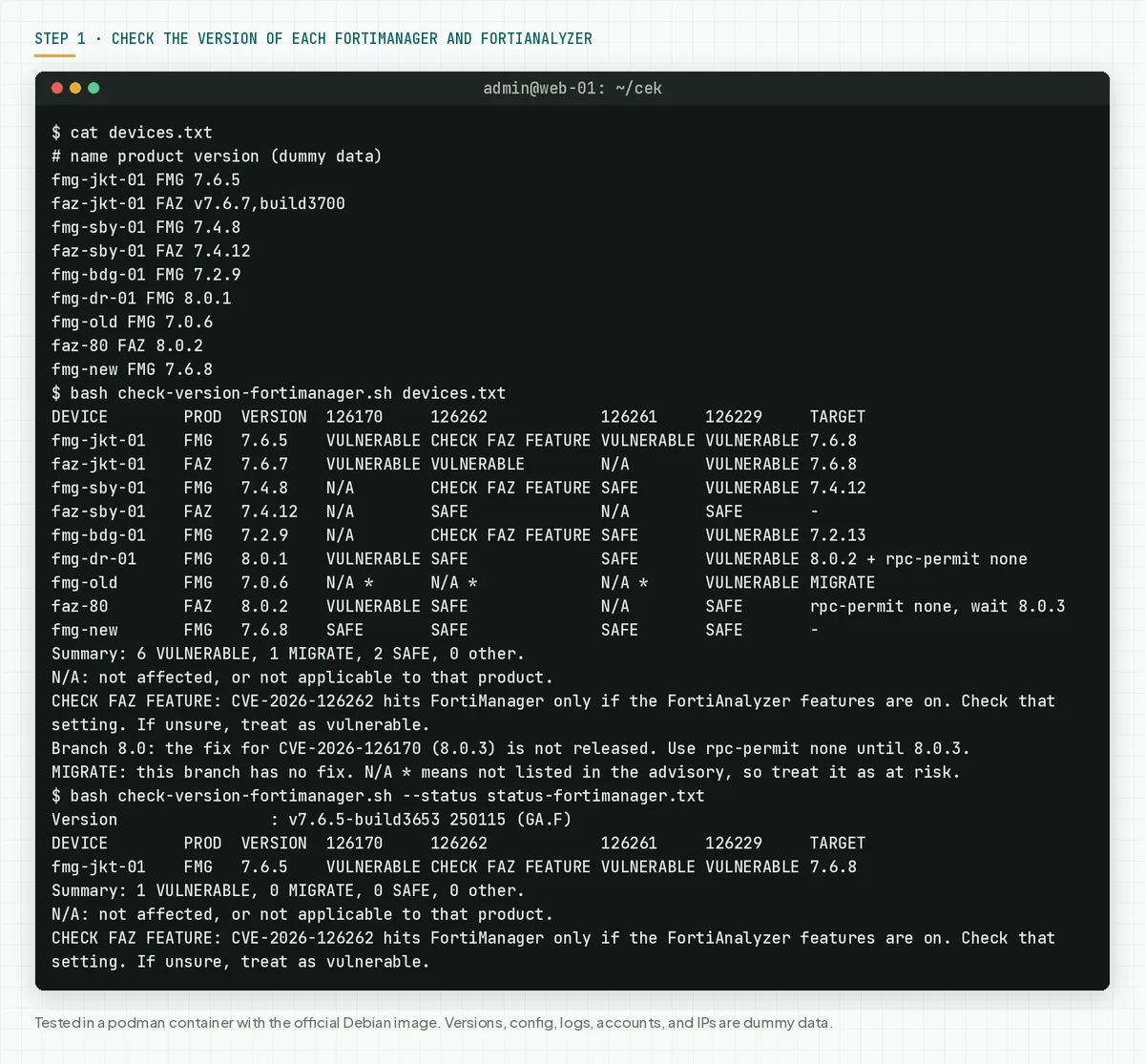
Check the result: "VULNERABLE" means the unit needs steps 2 to 4 today. "MIGRATE" means the unit is on branch 7.0 with no fix. "SAFE" means the version closes the flaws, but still run step 5. "CHECK FAZ FEATURE" means FortiManager is hit by CVE-2026-126262 only if the FortiAnalyzer features are on, so check that setting. If unsure, treat it as vulnerable.
If you do not write the product, the script reads the unit name, then assumes FortiManager and adds a * mark. The script rejects a line that holds both FMG and FAZ. We tested edge cases: a version such as 7.6.06, a version 8.1.0 that is not in the table, a missing file, and unreadable text. The script gives the correct result or exits with code 2.
Step 2: Check the JSON API and ports 514 and 541
This step shows which flaws can be reached on your unit. Do 3 checks.
2a. Check the admin profiles and the JSON API
Run this command in the CLI, then look for the rpc-permit line in each profile:
show full-configuration system admin profileAdvisory 219 uses rpc-permit none as the workaround. Rama Digital analysis: we read a rpc-permit value other than none as a sign that the JSON API is on for that profile. Limit: we did not test the meaning of that value on a real unit. If unsure, ask Fortinet Support.
2b. Check the open ports on the interfaces
Run this command in the CLI, then look for the allowaccess line in each interface:
show full-configuration system interfaceRama Digital analysis: we read the tokens fgfm and oftp as permission for port 541 and port 514. Write down the interfaces that connect to the internet. The script in step 5 reads this list.
2c. Test from outside your network
The interface rules are not the whole picture, because the firewall in front of the unit also decides. From a mobile network or a server outside your network, test the public IP address of your own unit:
nc -vz <public-ip-address> 514
nc -vz <public-ip-address> 541
A result of "succeeded" means the port can be reached from the internet. Test only IP addresses that you own.
Check the result: you have a list of profiles with rpc-permit, a list of interfaces with fgfm or oftp, and the outside port test result for each unit.
Step 3: Back up, then upgrade to 7.6.8, 7.4.12, or 7.2.13
Only Fortinet firmware closes the flaws. Branch 8.0 moves to 8.0.2 now, then to 8.0.3 when it is released.
- Make a configuration backup and, for a VM, a snapshot before the upgrade. Keep the files on a laptop or in another place outside the unit.
- Download the firmware image for your model from Fortinet Technical Support. Check the image hash before you use it.
- Read the upgrade path in the Release Notes of the target version. An old unit usually cannot jump straight to the newest version.
- For HA, follow the HA upgrade order in the Fortinet document for your version.
- Install the firmware, then wait for the unit to restart.
- Run
get system statusagain, then runcheck-version-fortimanager.shwith the new version.
Rama Digital analysis: we do not write the backup and upgrade menus, because we did not test a real unit. Follow the Fortinet guide for your model and version.
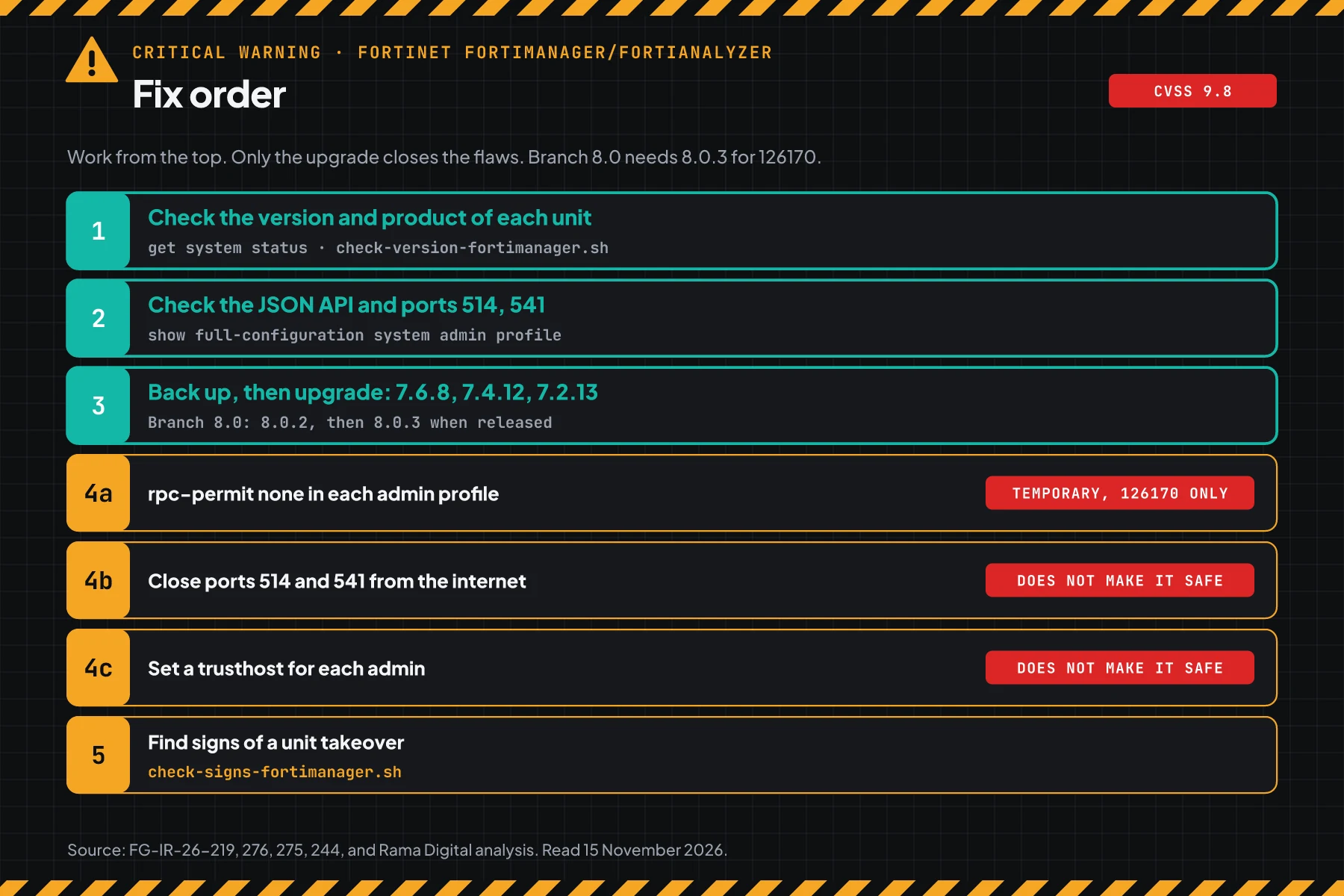
Check the result: the script prints "SAFE" on each unit, except 8.0.2 units. An 8.0.2 unit still prints "VULNERABLE" for CVE-2026-126170 until 8.0.3 is released. For that unit, go to step 4a.
Step 4: Temporary mitigation that does not make it safe
These steps lower the chance of an attack, but they do not make the unit safe. Only an upgrade closes the flaws.
4a. rpc-permit none in each admin profile (official workaround)
Advisory 219 gives this workaround for CVE-2026-126170. Run it in the CLI for each admin profile:
config system admin profile
    edit <profile name>
        set rpc-permit none
end
This command lowers CVE-2026-126170 only. It does not lower the 3 other CVEs. Rama Digital analysis: other scripts or systems that use the JSON API can stop working. Test on 1 profile first, and tell the owner of those systems.
4b. Close ports 514 and 541 from the internet
Advisories 276, 275, and 244 have no workaround. Rama Digital analysis: close ports 514 and 541 from the internet at the firewall in front of the unit, then allow only the FortiGate addresses that you know, or a VPN path. Condition: the unit receives logs or manages FortiGate units through the internet. Limit: a valid FortiGate must still reach those ports, so test 1 FortiGate first.
If you choose to change the interface, edit the allowaccess line in config system interface. Rama Digital analysis: remove the tokens fgfm and oftp from the internet interface. Limit: we did not test this command on a real unit.
4c. Set a trusthost for each admin
CVE-2026-126229 needs an admin account. Limit where an admin account can log in from:
config system admin user
    edit <admin name>
        set trusthost1 <ip> <netmask>
    next
end
Rama Digital analysis: the value 0.0.0.0 0.0.0.0 means any IP. Fill in the address or subnet of your admin. Limit: a trusthost does not make the unit safe from the 3 flaws before login.
Check the result: ports 514 and 541 do not open from a mobile network, each profile uses rpc-permit none or you know the reason, and each admin has a trusthost.
Step 5: Find signs of a takeover
The upgrade closes the flaws, but it does not remove the accounts, settings, or access that an attacker left. So look for those traces after the upgrade.
Rama Digital analysis: Fortinet has not published IOCs, and an attack before login may leave no login log. That is why the script looks for traces after an attack: unknown admins, profiles with the JSON API on, access on internet ports, unknown registered devices, and admin logins from unknown IPs.
Get 2 files on a laptop. First, the admin event log from Log View or the CLI. Logs that you send to another server do not show on the unit. Second, a config copy: run these commands in the CLI and save the output:
show full-configuration system admin user
show full-configuration system admin profile
show full-configuration system interface
show full-configuration dvmdb device
Save this script as check-signs-fortimanager.sh. The script only reads files. It does not change, delete, or send anything.
#!/usr/bin/env bash
# Find signs of attack on FortiManager or FortiAnalyzer after CVE-2026-126170, CVE-2026-126262, CVE-2026-126261 and CVE-2026-126229
# (FG-IR-26-219, FG-IR-26-276, FG-IR-26-275, FG-IR-26-244).
# Fortinet has not published IOCs. These checks are Rama Digital analysis and were not tested on real units:
# unknown admin accounts, admin profiles with the JSON API on (rpc-permit), access on internet ports,
# unknown registered devices, and admin logins from unknown IPs.
# Use on a laptop: bash check-signs-fortimanager.sh --log event.log --config config.txt
#   event.log   admin event log from Log View or the CLI (.gz also works)
#   config.txt  copy of the CLI output: show full-configuration system admin user, system admin profile, system interface, dvmdb device
#   KNOWN_ADMINS="admin noc-rina"   admin accounts that you know
#   KNOWN_IPS="198.51.100.10 198.51.100."   admin IPs that you trust. A final dot means 1 /24 block
#   INTERNET_PORTS="port1"        ports that connect to the internet
#   KNOWN_DEVICES="fgt-jkt-01 fgt-sby-01"   names of FortiGate devices that you know
# The script only reads files. It does not change, delete, or send anything.
set -u
ADMIN="${KNOWN_ADMINS:-}"; IPS="${KNOWN_IPS:-}"; PORTS="${INTERNET_PORTS:-}"; DEVS="${KNOWN_DEVICES:-}"; LOG=""; CFG=""
while (( $# > 0 )); do
  case "$1" in
    --log) LOG="${2:-}"; shift 2 || shift ;;
    --config) CFG="${2:-}"; shift 2 || shift ;;
    *) echo "Use: bash check-signs-fortimanager.sh --log event.log --config config.txt"; exit 2 ;;
  esac
done
findings=0; doubt=0
# Remove control characters and cut long lines, so file content cannot change the terminal display.
clean() { tr -cd '[:print:]\n' | cut -c1-110; }
in_list() { [[ " $2 " == *" $1 "* ]]; }
ip_known() { local s; for s in $IPS; do
  if [[ $s == *. ]]; then [[ $1 == "$s"* ]] && return 0; else [[ $1 == "$s" ]] && return 0; fi; done; return 1; }
unsure() { echo "CANNOT CONFIRM: $1"; doubt=$((doubt + 1)); }

# Turn config text into lines: path, entry name, key, value.
parse() {
  tr -d '\r' < "$1" | awk '
    { sub(/^[ \t]+/, ""); sub(/[ \t]+$/, "") }
    /^config / { d++; p[d] = substr($0, 8); e[d] = ""; next }
    /^edit / { v = substr($0, 6); gsub(/"/, "", v); e[d] = v; print path() "\t" v "\t_edit\t"; next }
    /^next$/ { e[d] = ""; next }
    /^end$/ { if (d > 0) d--; next }
    /^set / { v = ""; for (i = 3; i <= NF; i++) v = v (i > 3 ? " " : "") $i; gsub(/"/, "", v)
              print path() "\t" e[d] "\t" $2 "\t" v }
    function path(  s, i) { s = p[1]; for (i = 2; i <= d; i++) s = s "/" p[i]; return s }' \
  | tr -cd '[:alnum:][:space:]._/:@,-' | cut -c1-200
}

echo "== 1. Admin accounts in the config"
cfg_ok=0
if [ -z "$CFG" ]; then unsure "no --config. Save the show full-configuration output, then run again."
elif [ ! -r "$CFG" ]; then unsure "file $(printf '%s' "$CFG" | clean) is not readable."
else cfg_ok=1; data=$(parse "$CFG"); fi
if (( cfg_ok )); then
  accounts=$(printf '%s\n' "$data" | awk -F'\t' '$1 == "system admin user" && $3 == "_edit" { print $2 }' | sort -u)
  if [ -z "$accounts" ]; then unsure "block config system admin user is not in the file."
  else
    while IFS= read -r a; do
      th=$(printf '%s\n' "$data" | awk -F'\t' -v a="$a" '$1 == "system admin user" && $2 == a && $3 == "trusthost1" { print $4 }' | head -n 1)
      if [ -z "$ADMIN" ]; then echo "$a"
      elif in_list "$a" "$ADMIN"; then echo "$a  known"
      else echo "CHECK: account $a is not in KNOWN_ADMINS"; findings=$((findings + 1)); fi
      [[ -z $th || $th == 0.0.0.0* ]] && echo "  note: $a has no trusthost, login is allowed from any IP"
    done <<< "$accounts"
    [ -z "$ADMIN" ] && echo "Note: set KNOWN_ADMINS so the script can compare."
  fi
fi

echo "== 2. Admin profiles with the JSON API on"
if (( cfg_ok )); then
  profs=$(printf '%s\n' "$data" | awk -F'\t' '$1 == "system admin profile" && $3 == "_edit" { print $2 }' | sort -u)
  if [ -z "$profs" ]; then unsure "block config system admin profile is not in the file."
  else
    while IFS= read -r pr; do
      rp=$(printf '%s\n' "$data" | awk -F'\t' -v a="$pr" '$1 == "system admin profile" && $2 == a && $3 == "rpc-permit" { print $4 }' | head -n 1)
      if [ -z "$rp" ]; then unsure "profile $pr has no rpc-permit line. Use show full-configuration."
      elif [ "$rp" = "none" ]; then echo "$pr: rpc-permit none"
      else echo "CHECK: profile $pr uses rpc-permit $rp, the JSON API is on for this profile"; findings=$((findings + 1)); fi
    done <<< "$profs"
  fi
fi

echo "== 3. Access on internet ports"
if (( cfg_ok )); then
  if [ -z "$PORTS" ]; then unsure "INTERNET_PORTS is empty. Set the names of ports that connect to the internet."
  else
    for pt in $PORTS; do
      found=$(printf '%s\n' "$data" | awk -F'\t' -v p="$pt" '$1 == "system interface" && $2 == p { print "yes"; exit }')
      if [ -z "$found" ]; then unsure "port $pt is not in the block config system interface."; continue; fi
      acc=$(printf '%s\n' "$data" | awk -F'\t' -v p="$pt" '$1 == "system interface" && $2 == p && $3 == "allowaccess" { print $4 }' | head -n 1)
      bad=""; for t in $acc; do case "$t" in http|https|ssh|telnet|webservice|fgfm|oftp) bad="$bad $t" ;; esac; done
      if [ -n "$bad" ]; then echo "CHECK: $pt (internet) allows:$bad"; findings=$((findings + 1))
      else echo "$pt (internet): no HTTP, HTTPS, SSH, TELNET, webservice, FGFM, or OFTP"; fi
    done
  fi
fi

echo "== 4. Registered devices"
if (( cfg_ok )); then
  devs=$(printf '%s\n' "$data" | awk -F'\t' '$1 == "dvmdb device" && $3 == "_edit" { print $2 }' | sort -u)
  if [ -z "$devs" ]; then unsure "block config dvmdb device is not in the file."
  elif [ -z "$DEVS" ]; then
    echo "Registered: $(printf '%s' "$devs" | tr '\n' ' ' | sed 's/ $//')"
    echo "Note: set KNOWN_DEVICES so the script can flag unknown devices."
  else
    while IFS= read -r d; do
      if in_list "$d" "$DEVS"; then echo "$d  known"
      else echo "CHECK: device $d is registered but is not in KNOWN_DEVICES"; findings=$((findings + 1)); fi
    done <<< "$devs"
  fi
fi

echo "== 5. Admin logins from the event log"
if [ -z "$LOG" ]; then unsure "no --log. Download the event log, then run again."
elif [ ! -r "$LOG" ]; then unsure "file $(printf '%s' "$LOG" | clean) is not readable."
else
  case "$LOG" in *.gz) rd() { gzip -dc "$LOG" 2>/dev/null; } ;; *) rd() { cat "$LOG"; } ;; esac
  logins=$(rd | tr -d '\r' | grep 'type=event' | grep 'subtype=system' | grep 'action=login' \
    | sed -nE 's/.*user="?([^" ]*)"? .*ui="?[^ (]*\(([^)]*)\).*status="?([^" ]*).*/\1 \2 \3/p' \
    | tr -cd '[:alnum:] .:@_\n-' | cut -c1-80)
  if [ -z "$logins" ]; then unsure "the log has no admin login lines (type=event subtype=system action=login)."
  else
    ok=$(printf '%s\n' "$logins" | awk '$3 == "success" { print $1, $2 }')
    echo "Successful logins by account and IP:"
    if [ -n "$ok" ]; then printf '%s\n' "$ok" | sort | uniq -c | sort -rn | head -n 10; else echo "  none"; fi
    if [ -z "$IPS" ]; then echo "Note: set KNOWN_IPS so the script can flag unknown IPs."
    elif [ -n "$ok" ]; then
      while read -r u ip; do
        ip_known "$ip" && continue
        echo "CHECK: $u logged in from $ip, this IP is not in KNOWN_IPS"; findings=$((findings + 1))
      done < <(printf '%s\n' "$ok" | sort -u)
    fi
    if [ -n "$ADMIN" ] && [ -n "$ok" ]; then
      while read -r u; do
        in_list "$u" "$ADMIN" || { echo "CHECK: successful login by account $u that is not in KNOWN_ADMINS"; findings=$((findings + 1)); }
      done < <(printf '%s\n' "$ok" | awk '{ print $1 }' | sort -u)
    fi
    failed=$(printf '%s\n' "$logins" | awk '$3 != "success"' | grep -c .)
    echo "Failed logins: $failed."
  fi
fi

if (( findings > 0 )); then
  echo "Result: FINDINGS ($findings). Check each CHECK line. A line that you do not know: treat it as an incident."
  (( doubt > 0 )) && echo "Also: CANNOT CONFIRM in $doubt part(s)."
elif (( doubt > 0 )); then
  echo "Result: CANNOT CONFIRM ($doubt parts). Complete the input, then run again."
else
  echo "Result: no findings. A clean result does not prove the unit is clean."
fi
The first 3 lines of a sample event log with dummy data:
date=2026-11-11 time=08:02:11 log_id=0100032001 type=event subtype=system pri=information user=admin ui=GUI(198.51.100.10) action=login status=success reason=none msg="Administrator admin logged in successfully from GUI(198.51.100.10)"
date=2026-11-11 time=09:15:40 log_id=0100032001 type=event subtype=system pri=information user=noc-rina ui=ssh(198.51.100.11) action=login status=success reason=none msg="Administrator noc-rina logged in successfully from ssh(198.51.100.11)"
date=2026-11-11 time=09:20:02 log_id=0100032002 type=event subtype=system pri=information user=noc-rina ui=ssh(198.51.100.11) action=update status=success reason=none msg="dummy config change"
# On a laptop, in the folder where you keep the script, the log, and the config copy
KNOWN_ADMINS="admin noc-rina" KNOWN_IPS="198.51.100.10 198.51.100.11" INTERNET_PORTS="port1" KNOWN_DEVICES="fgt-jkt-01 fgt-sby-01" bash check-signs-fortimanager.sh --log event-fortimanager.log --config config-fortimanager.txt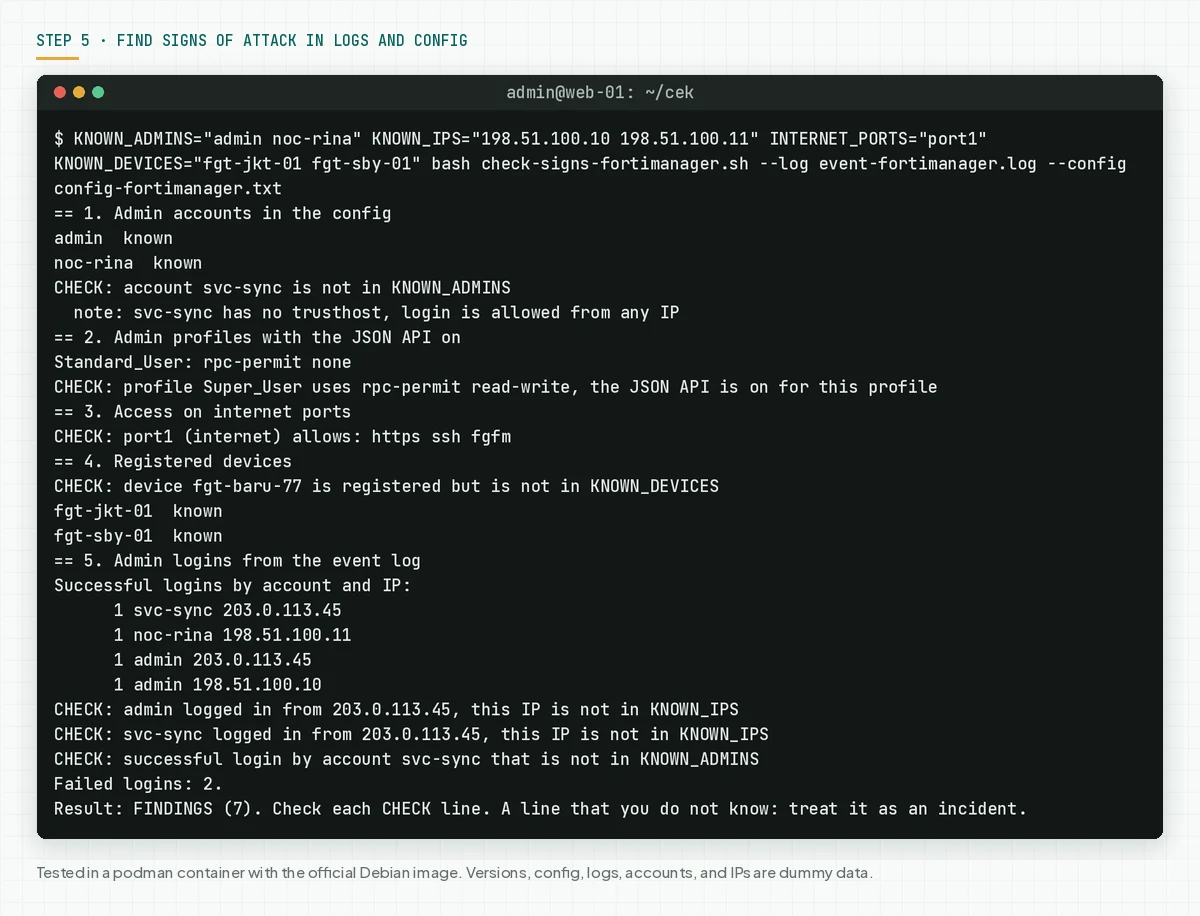
Script limits: Rama Digital analysis: we wrote the patterns type=event subtype=system, action=login, and status=success from an estimate, not from a real unit. The config formats trusthost1, rpc-permit, allowaccess, and dvmdb device are also estimates. The script reads .gz files, and does not read CSV exports. The script prints "CANNOT CONFIRM" if a log or config part is missing.
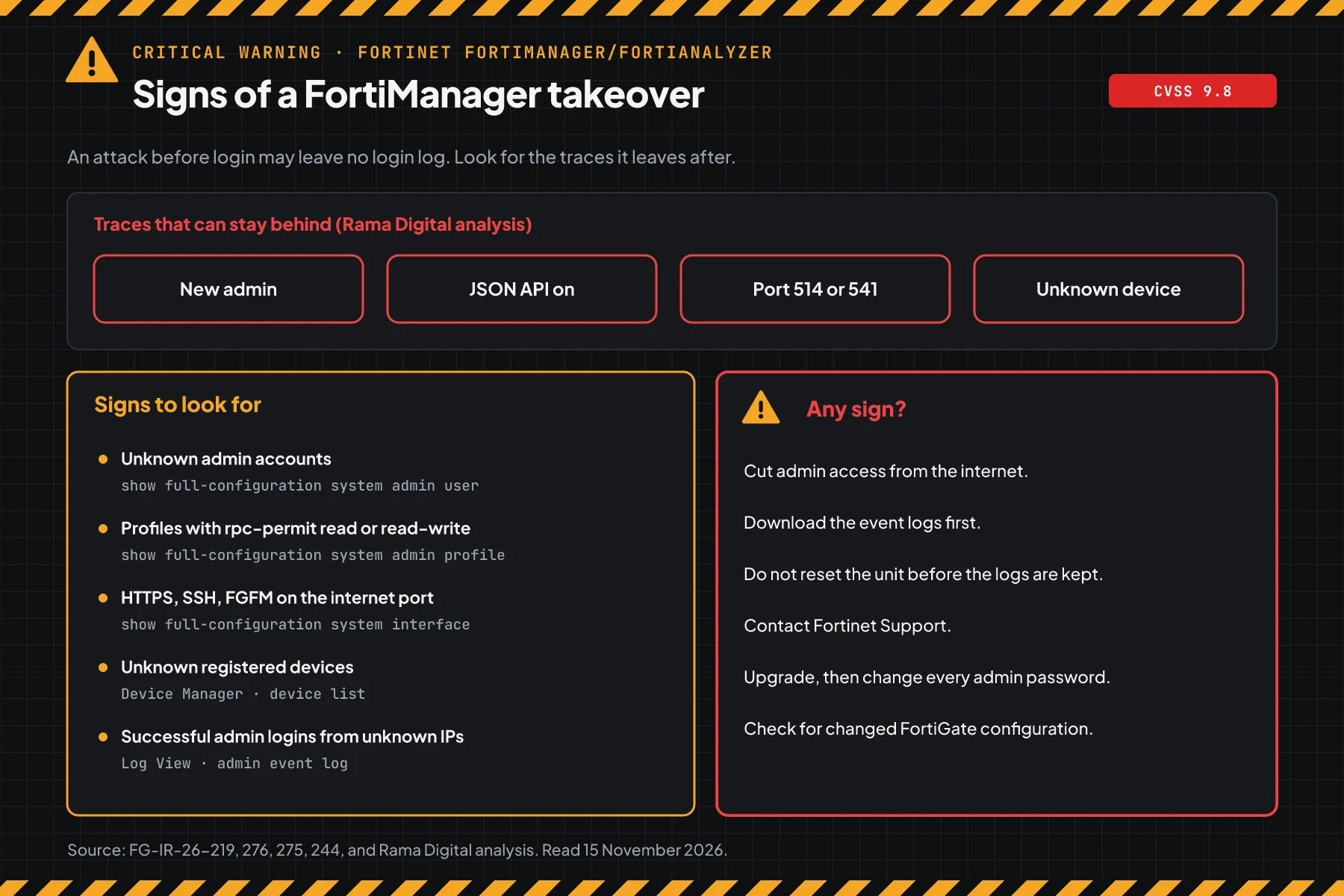
Check the result: "no findings" means the script found no signs. A clean result does not prove that the unit is clean. "FINDINGS" means check each CHECK line, then follow this order for each line that you do not know:
- Cut admin access and ports 514 and 541 from the internet with step 4.
- Download the event log first, before you change anything.
- Do not reset the unit or delete unknown accounts before the logs are kept.
- Contact Fortinet Support with those logs.
- Upgrade, then change the passwords of all admins.
- Rama Digital analysis: check for changed FortiGate configuration, because FortiManager can change it.
If personal data leaked through this unit, Indonesian Law 27/2022 on Personal Data Protection requires written notice no later than 3 times 24 hours. Also read the Ivanti Connect Secure VPN chain.
Example: 1 response evening for 4 units
This simulation uses dummy data. The unit names, times, and results are not customer data.
| Time (WIB) | Dummy unit | Check | Result | Action |
|---|---|---|---|---|
| 19:00 | fmg-jkt-01 (7.6.5, port1 with fgfm) | Steps 1 and 2 | VULNERABLE for CVE-2026-126170, 126261, and 126229 | Step 4b tonight, upgrade to 7.6.8 after the backup |
| 19:20 | fmg-sby-01 (7.4.8) | Step 1 | CHECK FAZ FEATURE for 126262, VULNERABLE for 126229 | Check the FortiAnalyzer features, upgrade to 7.4.12 |
| 20:00 | fmg-jkt-01 | Step 5 | svc-sync with no trusthost, login from 203.0.113.45, unknown device fgt-baru-77 | Cut access, keep the logs, contact Fortinet Support |
| 21:00 | fmg-dr-01 (8.0.1) and fmg-lama (7.0.6) | Step 1 | 8.0.1: VULNERABLE. 7.0.6: MIGRATE | 8.0.2 with rpc-permit none. Schedule the 7.0.6 migration |
Lesson from the simulation: a unit with a vulnerable version and an open port 541 needs action first. fmg-jkt-01 uses a strong admin password, but step 5 still found an account and a device that nobody knew.
Who installs the patch
The patch duty changes with the management model, so this table helps you know who acts today.
| Management model | Patch owner | What you do |
|---|---|---|
| Appliance or VM, managed by your own IT team | Your IT team | Steps 1 to 5 |
| Managed by an IT vendor or MSP | The partner, per the contract | Ask for written version proof and the step 5 result |
| VM on a public cloud | Your IT team, not the cloud provider | Steps 1 to 5, plus the security group rules for ports 514 and 541 |
| FortiManager Cloud or FortiAnalyzer Cloud | Check with Fortinet | Check the service version, then ask Fortinet for a written answer |
Rama Digital advice: do not open ports 514 and 541 to the internet. Allow only the FortiGate addresses that you know, or use a VPN. A similar lesson is in the Ivanti Connect Secure VPN chain.
Checklist for today
- List all FortiManager and FortiAnalyzer units, including the second HA unit and spare units. Owner: IT team. Proof: a list of names, products, and versions.
- Check the version with step 1. Owner: network admin. Proof: script output.
- Check the JSON API and ports 514 and 541 with step 2. Owner: network admin. Proof: the outside port test result.
- Back up, then upgrade to 7.6.8, 7.4.12, or 7.2.13. Owner: network admin. Proof: script output after the upgrade.
- Set rpc-permit none on branch 8.0 units and close ports 514 and 541. Owner: network admin. Proof: the profile configuration and the port test result.
- Find signs with step 5. Owner: network admin. Proof: script output and the event log.
- Schedule a migration for each branch 7.0 unit. Owner: head of IT. Proof: a written migration date.
Questions and answers
Our unit runs 8.0.2. Why does the script still say vulnerable?
Version 8.0.2 closes CVE-2026-126262, 126261, and 126229. CVE-2026-126170 has a fix only in 8.0.3, and that version is not released on 15 November 2026. Set rpc-permit none until 8.0.3 comes out.
Our JSON API is off. Are we safe?
Safe from CVE-2026-126170 only, per advisory 219. The 3 other CVEs do not need the JSON API. Still upgrade and close ports 514 and 541.
We use FortiManager Cloud or FortiAnalyzer Cloud. Must we act?
Check first. Advisory 219 lists Cloud versions 7.6.0 to 7.6.7 and 8.0.1 to 8.0.2, with the fix in 7.6.8 or 8.0.3. We did not find a statement that Fortinet already fixed it for you. Ask Fortinet.
There are no attack reports yet. Why must I upgrade today?
The score is 9.8, and 3 flaws work with no login. Three CVE records have E:P, so per the CNA proof-of-concept code exists. The CISA ADP assessment writes Automatable yes. The advisories are public since 10 November 2026.
Does closing ports 514 and 541 cut off FortiGate?
It can. A valid FortiGate uses those ports to send logs or to connect to FortiManager. Allow the FortiGate addresses that you know, or use a VPN, then test 1 FortiGate first.
Does rpc-permit none stop our automation?
It can. Rama Digital analysis: scripts or systems that use the JSON API can stop working. Test on 1 profile first, and tell the owner of those systems.
Does the upgrade remove the attacker's access?
The upgrade closes the flaws. It does not remove the admins, settings, or devices that an attacker made. Run step 5, then change the passwords of all admins.
Next step
The limits that still apply: the step 4 mitigation does not make the unit safe, and an upgrade does not clean a unit that was taken over. When your unit shows a sign in step 5, or you need help with an audit and recovery, use Vibe Code Rescue. For 1 urgent issue today, book a 30-minute session.
Sources
- advisory FG-IR-26-219, advisory FG-IR-26-276, advisory FG-IR-26-275, and advisory FG-IR-26-244: summary, CWE, score, affected versions, safe versions, workaround, Known Exploited, and reporters, 10 November 2026.
- CVE-2026-126170 record, CVE-2026-126262 record, CVE-2026-126261 record, and CVE-2026-126229 record: CNA description, CWE, the E:U and E:P vectors, the CISA ADP assessment, and the publish times of 10 and 11 November 2026.
- CISA KEV: does not list the 4 CVEs on 15 November 2026.
- Indonesian Law 27/2022 on Personal Data Protection: the duty to report a personal data leak.