Direct answer: from 1 October 2026, every WhatsApp business number gets 1,000 free service messages per month for all of its customers. Service message 1,001 onward costs Rp356.65 per message for an Indonesian recipient. Utility templates that you send inside the 24 hour window also cost Rp356.65 per message, with no free tier.
Main condition: this applies to the WhatsApp Business Platform with +62 recipients, through a BSP (Business Solution Provider) or a direct Cloud APIAPIThe official door 2 systems use to exchange data, without anybody copying it by hand.Open the glossary integration. Limit: the normal WhatsApp Business app is not affected. Messages in the free 72 hour window from Click to WhatsApp ads stay Rp0, and this calculation holds no BSP fees and no tax.
We wrote this guide on 23 September 2026 and updated the numbers on 24 September 2026. Our sources: the Meta pricing document (10 September 2026), the IDR rate card from 1 October 2026, and 7 days of our number data. Tokens, account IDs, and customer numbers do not show in the images.
Why the WhatsApp API bill can rise in October
Until 30 September 2026, Meta does not charge for replies from support staff or a chatbot in the 24 hour window. Meta stopped charging service messages on 1 November 2024, and stopped charging utility templates in the 24 hour window on 1 July 2025. Source: the Meta Upcoming pricing updates page, updated 25 August 2026.
Many teams count only marketing template costs, because that is the only large paid line. From 1 October, every chat reply counts after the free tier of the number runs out. Teams that reply with many short messages will see the fastest rise.
On our number, 1,940 of 2,721 delivered messages in 7 days were service messages. All of them are still Rp0 in September. This guide focuses on the calculation; the other 2 articles in this series answer which messages are charged and how to cut the cost.
How Meta calculates message costs from 1 October 2026
Meta charges delivered messages, not conversations
Since 1 July 2025, Meta charges per message, not per conversation. Meta charges only business messages with the delivered status, not messages that were only sent.
The rate follows the message category and the country calling code of the recipient. Source: Pricing on the WhatsApp Business Platform, updated 10 September 2026.
Messages from customers to the business are never charged. So the cost comes only from messages that your business sends, from staff, a chatbot, or an automatic system.
Service messages: 1,000 free per business number, then Rp356.65
A service message is a non-template message that you send in the 24 hour window, for example text, an image, or a document. This window opens and starts again each time the customer sends a message. Source: the Meta customer service window document.
Meta writes 4 free tier rules in the Service rates part of the Updates to rate cards section:
- Every business number gets 1 shared free tier: 1,000 delivered service messages per month.
- 1:1 messages and group messages use the same tier. 1 group send uses 1 unit per recipient who receives it.
- Unused units do not roll over. The tier starts again each month for each number.
- After the tier runs out, Meta charges each service message at the service rate of the recipient market.
The business number is the WhatsApp number that sends the message, not the customer number. Every customer that you reply to from 1 number shares 1 tier, so more customers do not add to the tier.
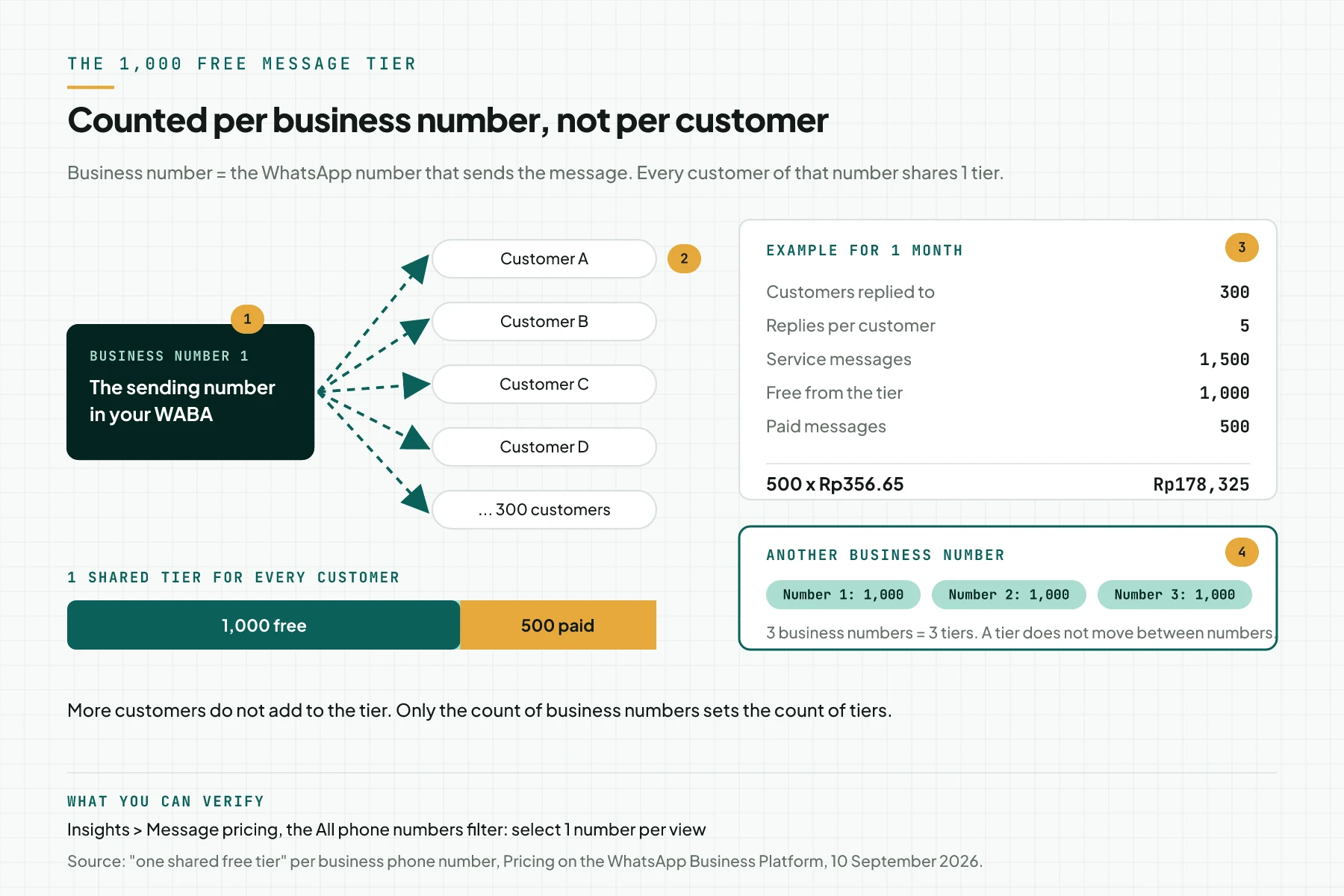
The service rate equals the utility and authentication rate in every market. Meta gives no volume tiers for service messages. Source: the Service messages part of the Upcoming pricing updates page.
Utility templates in the 24 hour window: no free tier
A utility template is a transaction template, for example an order confirmation, a delivery status, or a payment reminder. Until 30 September, utility templates that you send in the 24 hour window are free. From 1 October, every utility template in that window is charged from the first message.
The 1,000 free tier applies only to service messages, not to utility templates. Utility keeps its volume tiers, but the first tier in Indonesia starts at message 750,001 per month.
The 72 hour FEP window stays free
The FEP (free entry point) window opens when a customer writes from a Click to WhatsApp ad or a Facebook Page button. The customer must use the Android or iOS app.
When you reply within 24 hours, every business message is free for 72 hours, templates too. Source: the Free entry point windows section.
The Meta documents do not say if messages in the FEP window use the 1,000 free tier. So our worked numbers below use 2 scenarios.
With no payment method, replies stop after message 1,000
When your WABAWABAAn official WhatsApp account for a business. It sends messages through a program, not through a phone app.Open the glossary (WhatsApp Business Account) has no payment method, Meta still delivers service messages inside the free tier. After the tier runs out, Meta does not deliver more service messages. Source: the Service rates part of the Updates to rate cards section.
The diagram below puts all of these rules into 1 formula per business number.
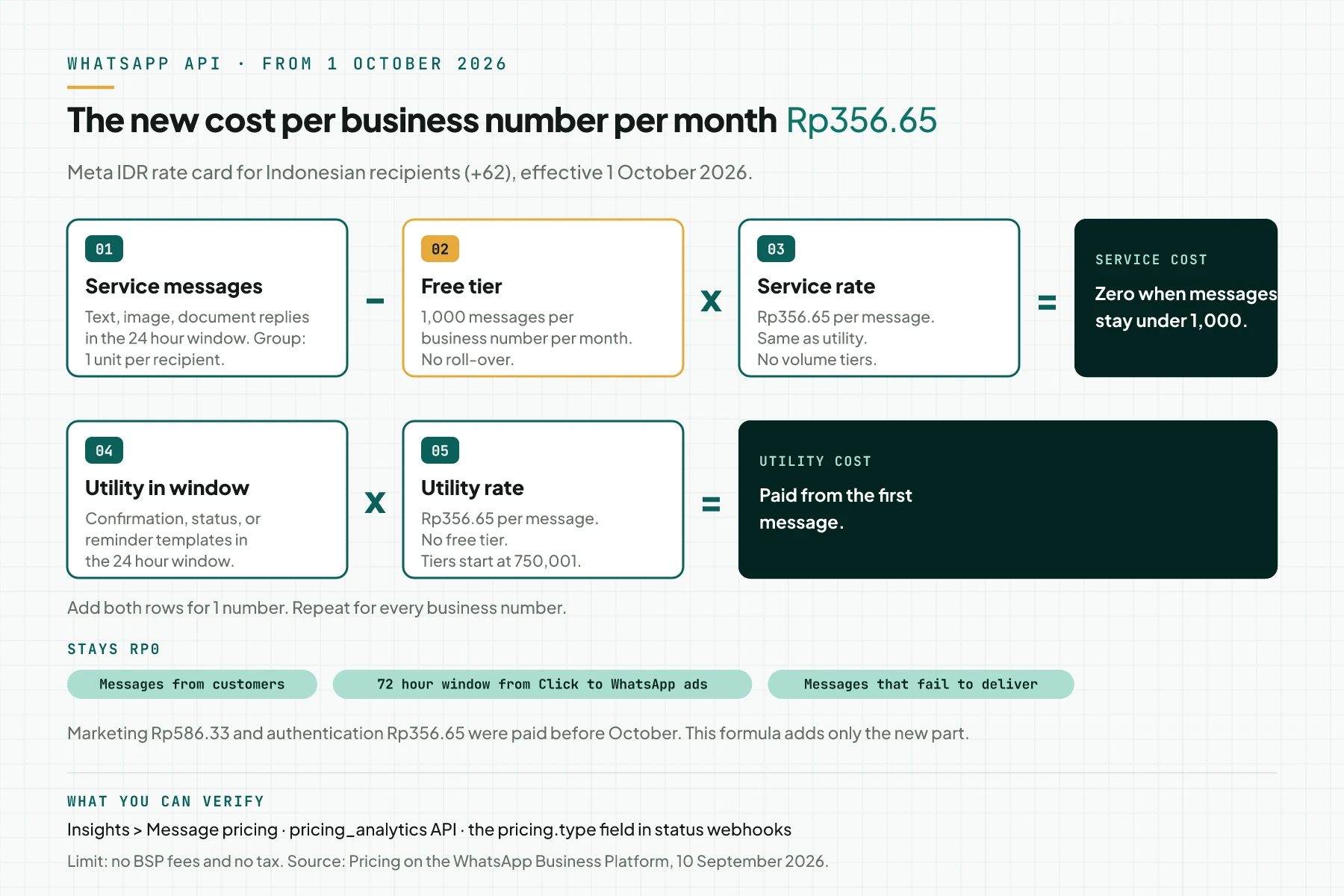
The formula: new cost per business number = service messages above 1,000 x Rp356.65 + utility templates in the 24 hour window x Rp356.65. Marketing and authentication do not change, so add those old costs separately.
WhatsApp API rates for Indonesia from 1 October 2026
This table uses the Meta IDR rate card effective 1 October 2026, row Indonesia. We read the numbers from the official file on 24 September 2026. The Indonesian rates equal the rate card of 1 July 2026; the new item is the Service column.
| Category | Rate per delivered message | Until 30 September 2026 | From 1 October 2026 | Volume tiers |
|---|---|---|---|---|
| Marketing | Rp586.33 | Paid | Paid, no change | None |
| Utility outside the 24 hour window | Rp356.65 | Paid | Paid, no change | From message 750,001 |
| Utility inside the 24 hour window | Rp356.65 | Free | Paid from the first message | From message 750,001 |
| Authentication | Rp356.65 | Paid | Paid, no change | From message 750,001 |
| Authentication-International | Rp1,940.13 | Paid when it applies | Paid when it applies | From message 750,001 |
| Service | Rp356.65 | Free | Free for 1,000 per business number per month, then paid | None |
| Every message in the 72 hour FEP window | Rp0 | Free | Free | Not counted |
Table sources: Rate cards effective October 1, 2026 (IDR rates and IDR volume tiers) and the Volume tiers section. Volume tiers count per business portfolio, per market, and per category. The next Indonesian utility tiers: 750,001 to 4,000,000 messages at Rp338.82, then 4,000,001 to 25,000,000 messages at Rp320.99.
The rate follows the country of the recipient number, not the country of the business. A message to a Malaysian number, for example, uses the Malaysia row. Rate changes start at 00:00 in the time zone of your WABA.
Prerequisites
- Access to WhatsApp Manager for your WABA, with a role that can open Insights.
- The list of business numbers in the WABA, because the 1,000 free tier applies per business number.
- Access to Billing Hub, or a contact at the BSP that manages your bill.
- For the API steps: a system user token with access to the WABA, and the WABA ID.
- A terminal with
curlandjq, when you want daily data. - 1 worksheet to record the numbers per business number per month.
Step 1: Open Message pricing in WhatsApp Manager
Open WhatsApp Manager › Account tools › Insights, then click the Message pricing tab. Select the number in the All phone numbers filter, then select the date range. The free tier applies per business number, so read 1 number per view.
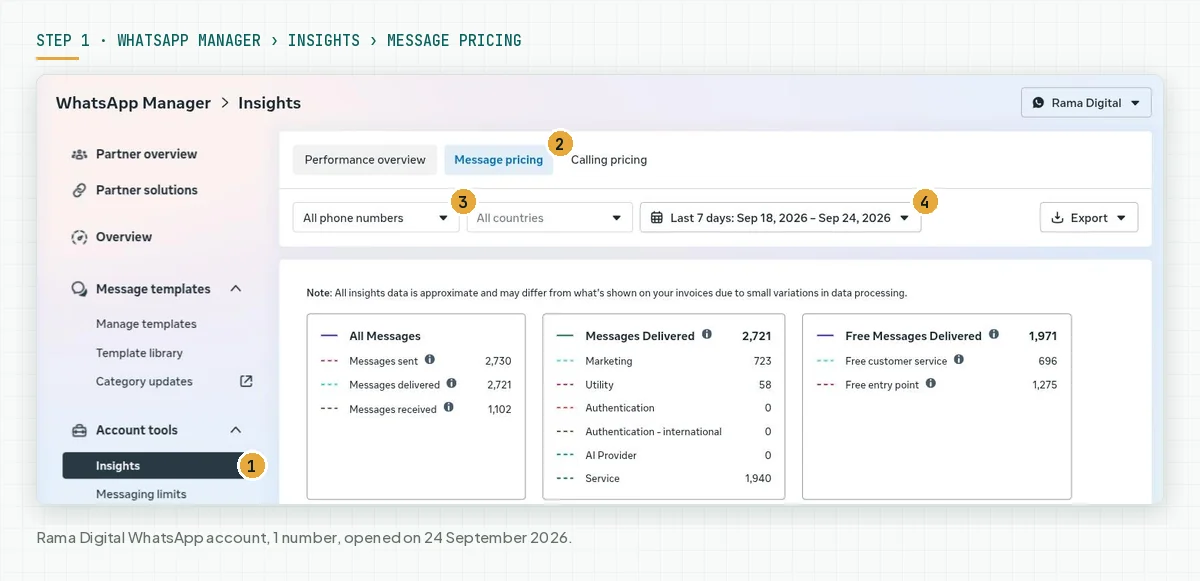
Check the result: the page shows the All Messages, Messages Delivered, and Free Messages Delivered cards. Meta writes that Insights data is approximate and can differ a little from the invoice.
Step 2: Read the Service, Utility, and free message numbers
On the Messages Delivered card, read the Service and Utility rows. On the Free Messages Delivered card, read Free customer service and Free entry point. Those 2 free rows separate the messages that become paid from the messages that stay free.
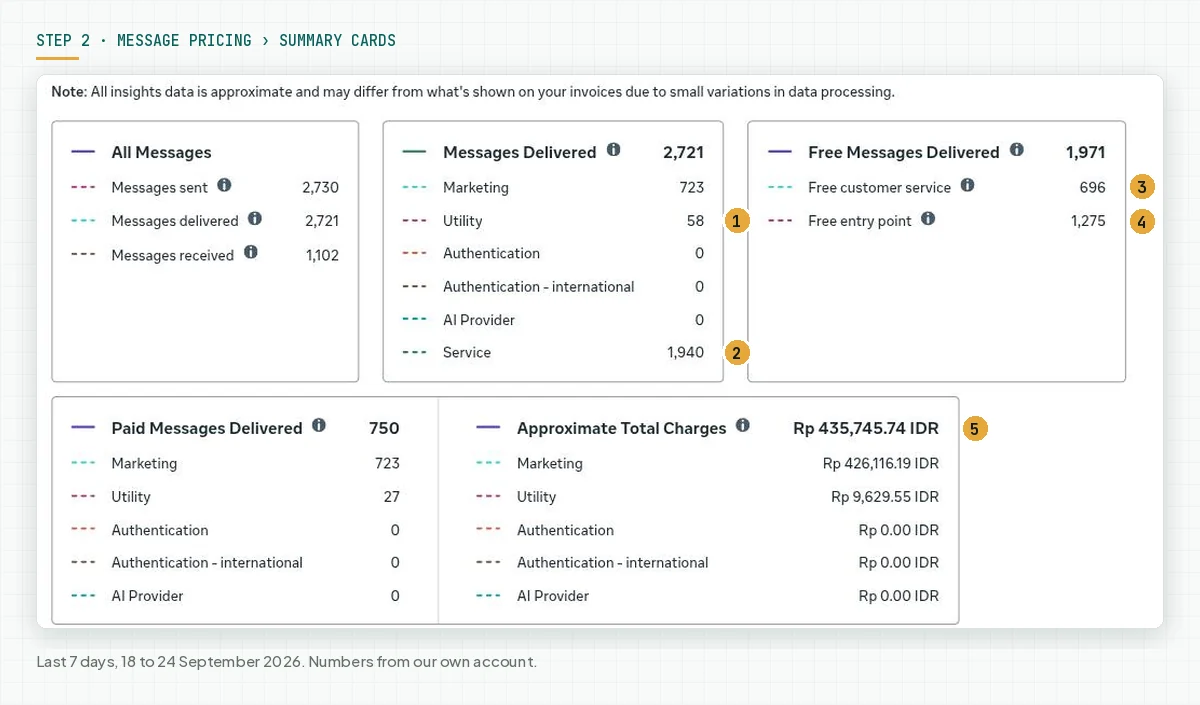
In our test, the range 18 to 24 September 2026 showed 1,940 service messages and 58 utility messages. The Free customer service tooltip says that this number holds service and utility messages in the 24 hour window. It also says "This metric is in development".
Check the rate with your own numbers. In our account, 27 paid utility messages x Rp356.65 = Rp9,629.55, equal to the Utility number on the Approximate Total Charges card.
Step 3 (optional): Pull daily numbers with pricing_analytics
When you need numbers per day or per business number, call the pricing_analytics field in the Graph API. Send GET /<WABA_ID> with start, end, granularity(DAILY), and the PRICING_CATEGORY and PRICING_TYPE dimensions. Source: the Meta Pricing analytics document.
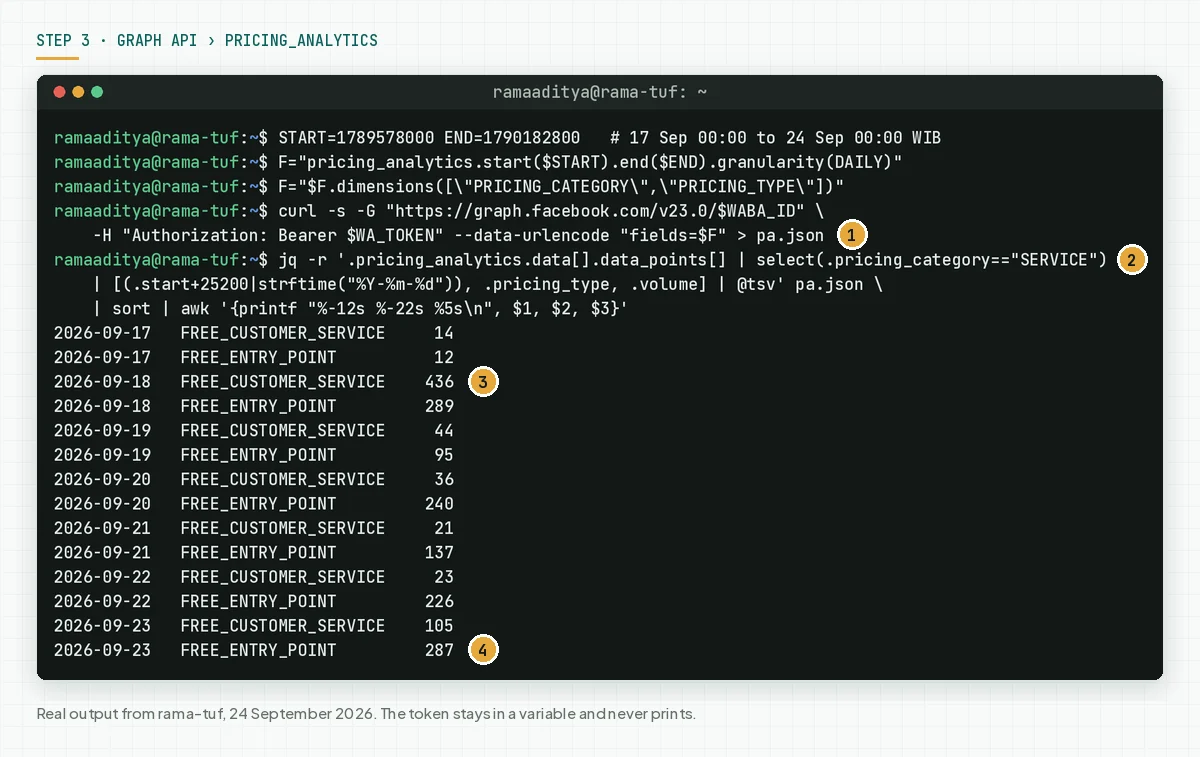
Fill start and end with UNIX timestamps. In the jq filter, we add 25200 seconds to start, so the dates show in WIB. The token stays in a variable and does not print on the screen.
Check the result: every row has a date, a pricing type, and a message count. When the answer is empty, check the token permission and the date range.
Step 4 (optional): Add up by pricing type to separate the FEP window
Group the data by category and pricing type, then add up the volume column. The result gives the 3 numbers for the formula: service messages in each window, and utility messages in the 24 hour window.
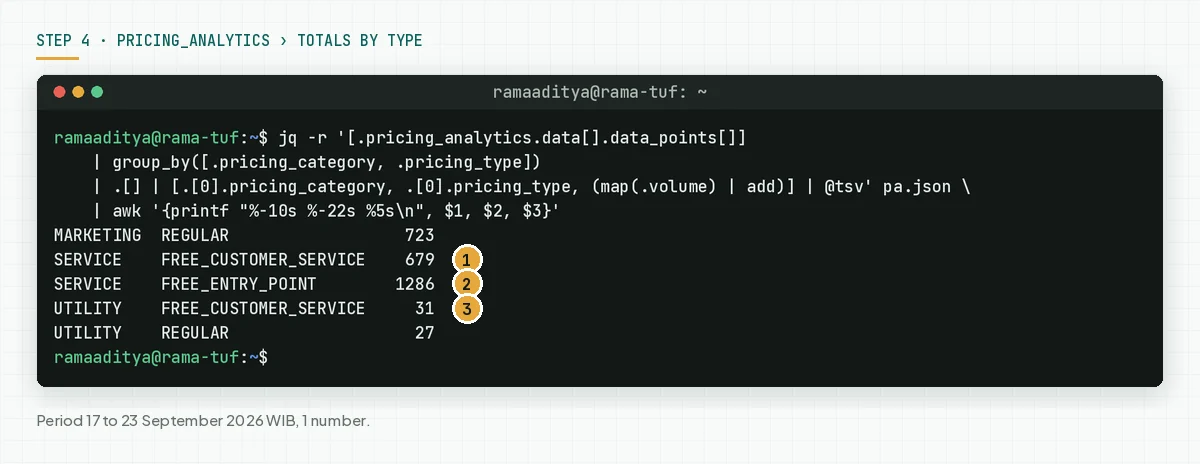
According to the Meta document, the FREE_CUSTOMER_SERVICE type holds only service messages inside the free tier from 1 October. Messages above the tier move to the REGULAR type, and REGULAR holds no messages from the FEP window. Source: the PRICING_TYPES list in the Pricing analytics document.
Step 5: Calculate the cost per business number with the formula
Put the 3 numbers from step 2 or step 4 into the formula. When your data covers less than 1 month, multiply by 30 divided by the number of data days. Calculate 2 scenarios, because the Meta documents do not state how FEP messages count against the free tier.
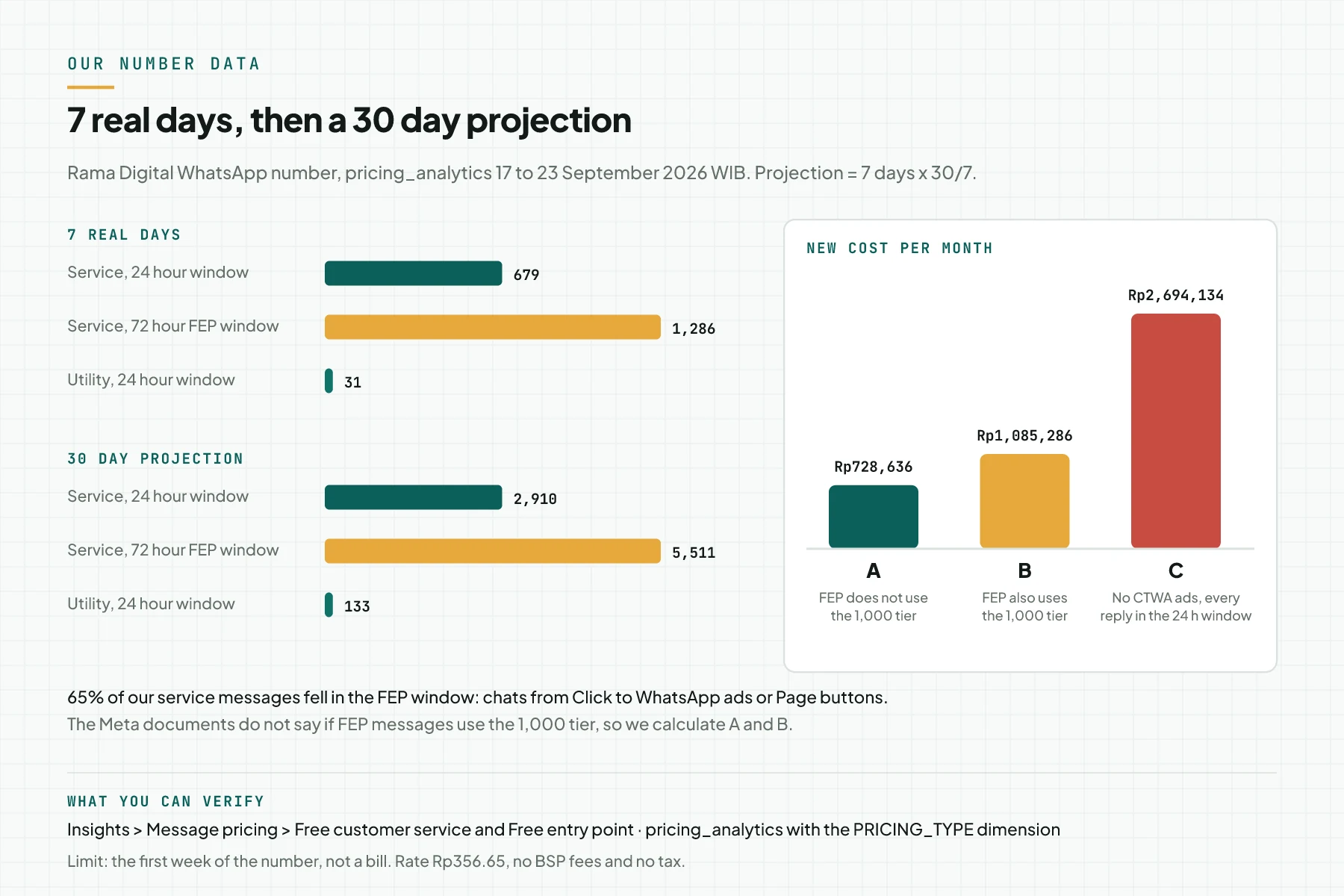
| Item (our number, 30 day projection) | Scenario A: FEP does not use the tier | Scenario B: FEP uses the tier |
|---|---|---|
| Service messages in the 24 hour window | 2,910 | 2,910 |
| Minus the free tier | 1,000 | 0, because FEP messages used the tier |
| Paid service messages | 1,910 x Rp356.65 = Rp681,201.50 | 2,910 x Rp356.65 = Rp1,037,851.50 |
| Utility in the 24 hour window | 133 x Rp356.65 = Rp47,434.45 | 133 x Rp356.65 = Rp47,434.45 |
| New cost per month | Rp728,635.95 | Rp1,085,285.95 |
On our number, 1,286 of 1,965 service messages in 7 days fell in the FEP window, which is 65%. With no chats from ads, those messages would fall in the 24 hour window. The new cost would then rise to Rp2,694,134.10 per month.
Step 6: Check the volume tiers for utility templates
Open WhatsApp Manager › Overview › Messaging tiers. Select Indonesia as the Market, then open the Category list. The list holds only Authentication and Utility, because service messages have no tiers.
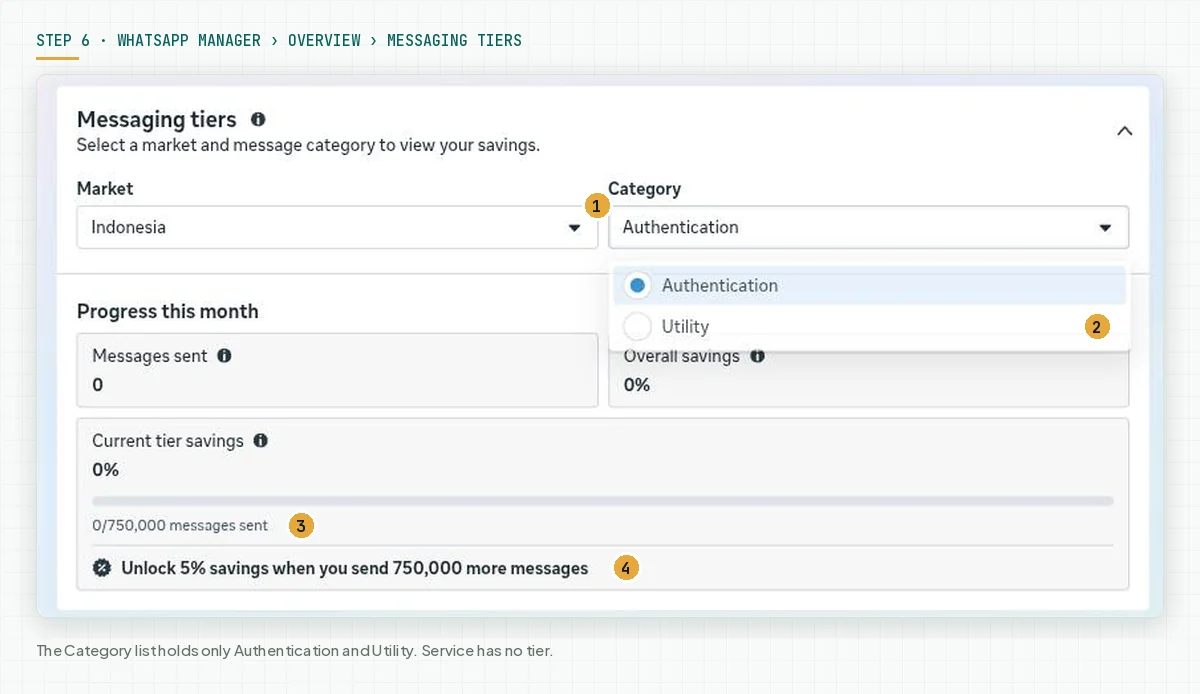
When your utility volume is far below 750,000 per month, use the full rate of Rp356.65. Only paid messages count toward the tiers. Source: the Tiering accrual part of the Meta pricing document.
Step 7: Make sure a payment method is active before 30 September 2026
Open Billing Hub › Payment methods in Meta Business SuiteBusiness ManagerThe place where Meta holds your business ad assets: ad accounts, Pages, pixels, and people access.Open the glossary, then make sure your WABA has an active payment method. When a BSP bills you, ask if your WABA uses BSP credits. Meta asks for the payment method by 30 September 2026 at the latest.
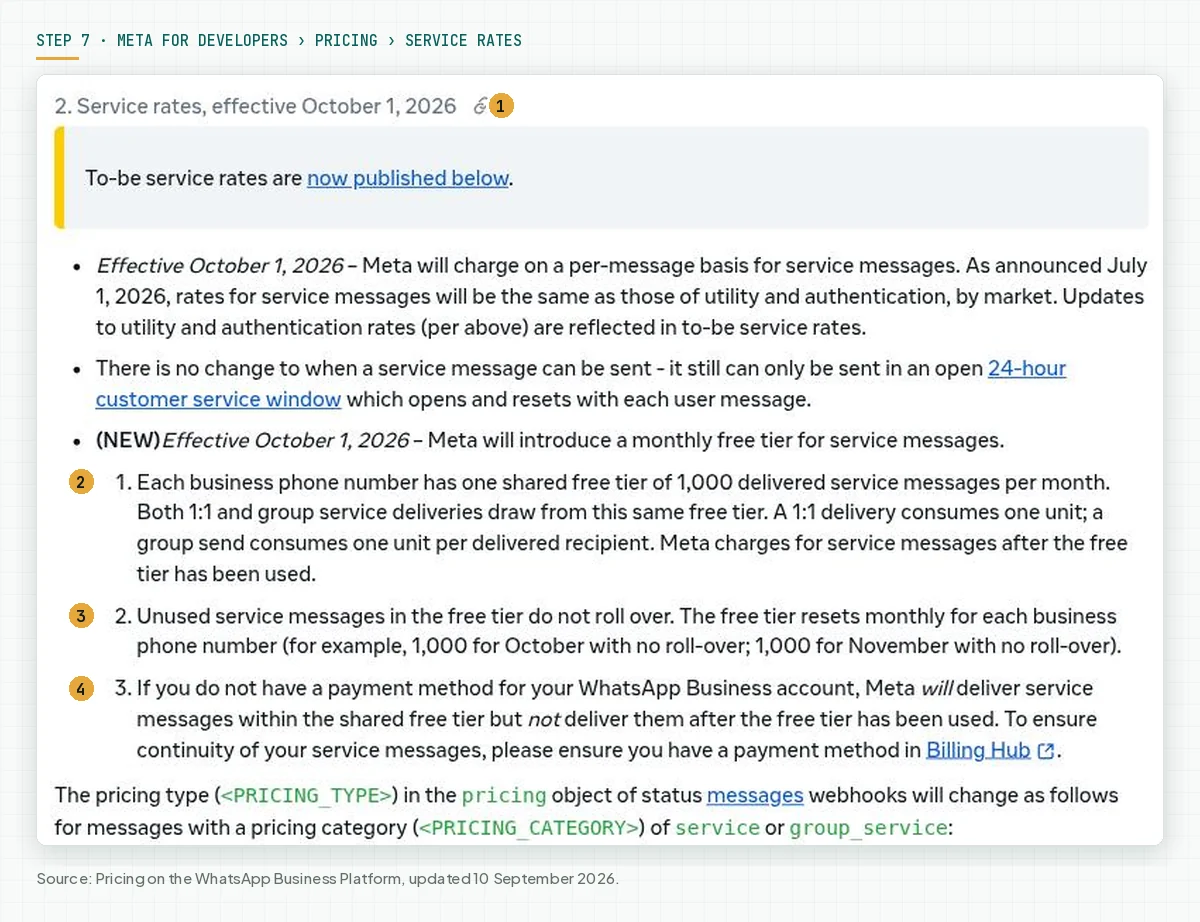
In our test, Billing Hub asked for a new identity check with a passkey. We did not enter that page, so the image above comes from the Meta document, not from our account. Source: Pricing on the WhatsApp Business Platform, updated 10 September 2026.
Check the result: the payment method shows on the correct WABA. Keep a screenshot with no card number.
Step 8: Set an alarm when service messages get close to 1,000
Count the delivered statuses with category service for each number since day 1. Send a warning when the count reaches 800. From 1 October, the pricing.type field changes from free_customer_service to regular after the tier of the number runs out.
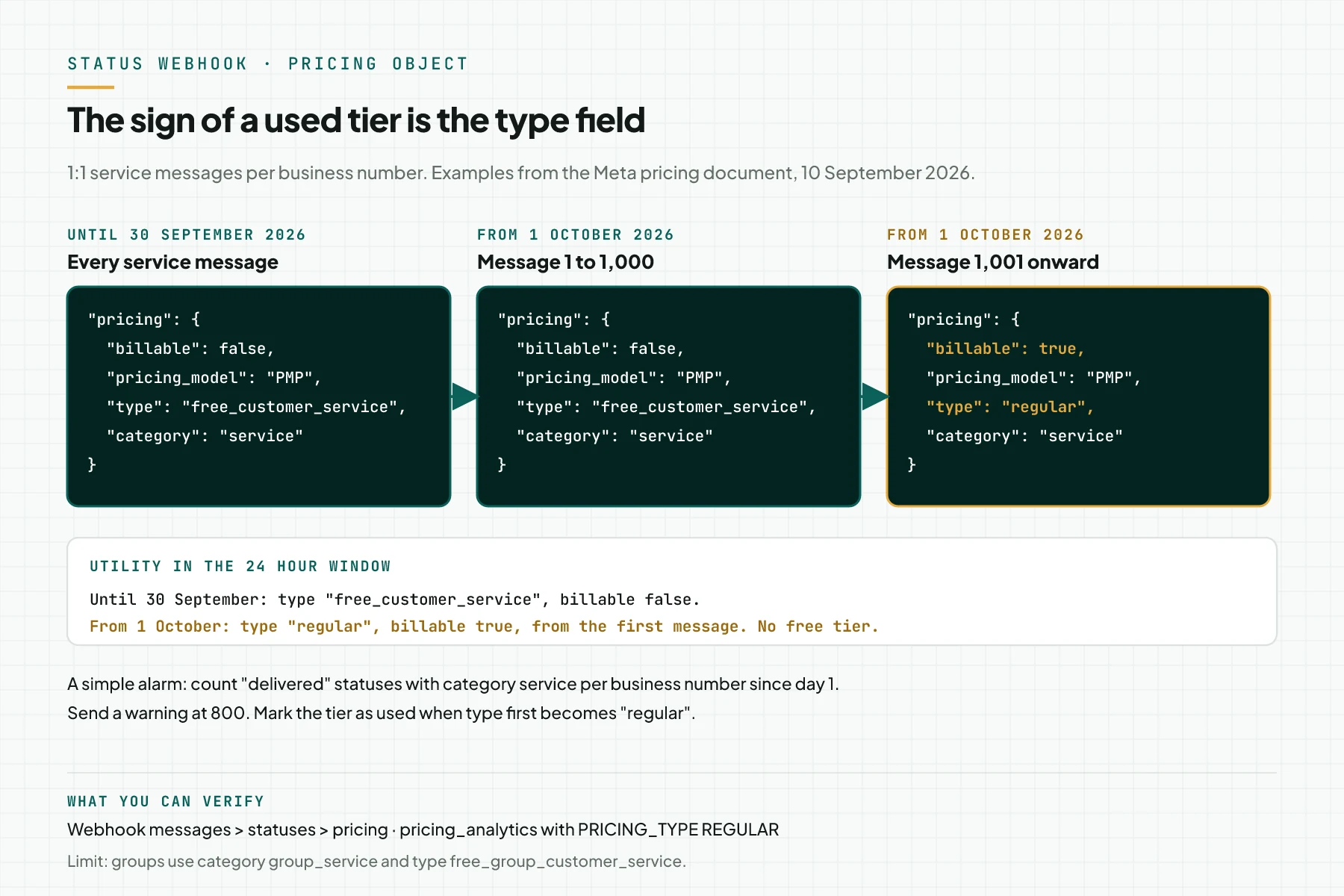
This alarm gives time to check automatic messages, chatbot limits, and the payment method. Source of the object structure: the Service rates and Utility rates parts of the Meta pricing document.
Worked example: 1 online shop with 1 number in October 2026
The table below is a simulation with dummy data, not customer data. The shop sends 130 service messages per day in the 24 hour window, and 50 utility templates per day in the same window. No chats come from Click to WhatsApp ads.
| Date | What happens | What the system records | Cumulative new cost |
|---|---|---|---|
| 1 October 2026 | The tier of the number starts at 0 | 130 service messages free_customer_service, 50 utility regular | Rp17,832.50 |
| 7 October 2026 | Service message 910; the 800 alarm fires | A warning goes to the admin | Rp124,827.50 |
| 8 October 2026 | Service message 1,000 is delivered | Message 1,001 starts to record type regular | Rp156,926 |
| 31 October 2026 | Total 4,030 service messages and 1,550 utility | 3,030 regular service messages | Rp1,633,457 |
| 1 November 2026 | The tier starts again at 0; unused units do not roll over | free_customer_service again | Rp0 for the new month |
In this simulation, the new cost for October is Rp1,080,649.50 from service messages and Rp552,807.50 from utility. Utility adds 34% of the new cost, although it is only 28% of the messages. The reason: utility has no free tier.
The second table compares 3 business profiles with dummy data. The numbers show only the new cost; the old marketing cost is not included.
| Profile (dummy) | Service messages per month | Utility in the 24 hour window | New cost per month |
|---|---|---|---|
| Small business, 1 number | 600 | 100 | Rp35,665 |
| Online shop, 1 number | 4,000 | 1,500 | Rp1,604,925 |
| Support team, 3 numbers x 10,000 | 30,000 | 6,000 | Rp11,769,450 |
Checklist before 1 October 2026
- The WABA owner records every business number. Evidence: the number list from WhatsApp Manager › Phone numbers.
- The admin reads Service, Utility, Free customer service, and Free entry point per business number for the last 7 days. Evidence: a Message pricing screenshot.
- Finance calculates scenarios A and B per business number at Rp356.65. Evidence: a worksheet with the data date.
- Finance makes sure a payment method is active in Billing Hub or at the BSP. Evidence: a screenshot with no card number.
- A developer adds a counter of delivered service statuses per business number. Evidence: an alarm log at 800 on test data.
- The support team removes automatic messages that are not needed, for example a double greeting. Evidence: a list of automatic messages before and after.
- Marketing records the share of chats from Click to WhatsApp ads. Evidence: the Free entry point number per week.
- Stop criterion: when scenario B per business number stays below 5% of the revenue from WhatsApp chats, keep a monthly check and do not change the chat flow.
Other numbers online and how to check them
On 24 September 2026, we read the Google results for "harga whatsapp api 1 oktober 2026". Some claims do not match the Meta documents. This table compares those claims with the source, with no site names.
| Claim online | Meta document | How to check |
|---|---|---|
| The 1,000 tier applies per business account | The tier applies per business number | Service rates part, point 1 |
| The 1,000 tier applies per customer | Every customer of 1 business number shares 1 tier | Service rates part, point 1 |
| The rate is Rp376 per message | IDR rate card, Indonesia: Rp356.65 | Download the IDR rates effective 1 October 2026; ask the BSP for the basis of other numbers |
| October changes pricing from per conversation to per message | Per message pricing started on 1 July 2025 | The Pricing page, Cloud API part |
| The first 1,000 conversations are free | An old per conversation rule; now 1,000 service messages per business number | The WhatsApp Business FAQ still holds the old text |
The last claim comes from the WhatsApp Business FAQ page, which on 24 September 2026 still said "the first 1,000 conversations per month are free". The same page says that partners can charge additional fees, so a BSP number can differ from the rate card.
Rama Digital recommendation: use Insights for monthly numbers per business number, and use pricing_analytics when you need a daily alarm or a report per team. Use the BSP dashboard when the BSP bills through its credits, because Meta returns no COST for a WABA that shares a partner credit line. Source: the METRIC_TYPES part of the Pricing analytics document.
Frequently asked questions
Does the 1,000 free tier apply per account, per business number, or per customer? Per business number, which is the number that sends the message. Every customer of 1 number shares 1 tier. When 1 WABA has 3 numbers, each number has its own tier of 1,000.
How much does a WhatsApp API chat reply cost for an Indonesian recipient? Rp356.65 per delivered service message, after 1,000 free messages per business number per month. This number comes from the Meta IDR rate card effective 1 October 2026, with no BSP fees and no tax.
Do messages from customers count? No. Meta charges only messages from the business to the customer, and only delivered ones. Incoming messages do not use the tier and cost nothing.
Do replies within 72 hours after a Click to WhatsApp ad click stay free? Yes. The FEP window does not change on 1 October. Every business message in that window is Rp0, except the token cost of Meta Business AgentAI agentAn AI program that performs work steps by itself, for example reading a message, drafting a reply, and recording the result.Open the glossary.
What happens when the WABA has no payment method? Meta still delivers service messages until the 1,000 tier runs out. After that, Meta does not deliver more service messages until a payment method is available.
Does the normal WhatsApp Business app become paid? No. This change applies to the WhatsApp Business Platform. The WhatsApp Business FAQ says that the WhatsApp Business app is free to download and free to use.
Next step
Limits that still apply: Insights numbers are approximate, the tier status of FEP messages is not written, and a BSP invoice can hold other fees. When you want to know if a message is charged, read the answers for 12 WhatsApp API message cases. When the scenario B cost looks large, continue to the 7 steps to cut WhatsApp API costs.
When you want WhatsApp, the CRM, and the cost count to run in 1 system, see OS Module: CRM. To talk about the numbers of your own number first, book a 30 minute Initial Consultation.
Sources
- Meta for Developers: Pricing on the WhatsApp Business Platform, updated 10 September 2026.
- Meta for Developers: Updates to rate cards and Rate cards effective October 1, 2026.
- Meta for Developers: Upcoming pricing updates for Meta Business Agent, service and utility messages, updated 25 August 2026.
- Meta for Developers: Free entry point windows.
- Meta for Developers: Rate cards and volume tiers.
- Meta for Developers: Pricing analytics.
- Meta for Developers: Customer service windows.
- WhatsApp Business: Frequently Asked Questions, read on 24 September 2026.