Direct answer: Solomon's paradox is the tendency to reason more wisely about other people's problems than about your own. Grossmann and Kross (2014) tested this pattern with 693 people in 3 experiments. The gap closed when people thought about their own problem from a third-person view, for example with their own name. For a solo founder, this means: write your decision as the case of another founder, then give advice to that founder.
Main condition: This method applies to decisions that touch your own interests, for example price, hiring, a pivot, or stopping. Limit: The original experiments used personal relationship conflicts, not business decisions. Later studies found a smaller effect. The method improves the quality of your reasoning, but it does not guarantee a correct decision.
We opened 10 sources on 27 October 2026. We read the full text of Grossmann and Kross (2014) through the proof copy on the Waterloo lab site, the full text of Moser et al. (2017) and Xu et al. (2022), and the accepted manuscript on PsyArXiv for Grossmann et al. (2021). For the other sources, we read the abstract on PubMed or the publisher page. The founder named Dina in this article uses dummy data, not client data.
The problem: solo founders give advice that they do not take
Think of a fellow founder who asks you: "My material cost rose almost 15%. Should I raise my price?" You answer in 2 minutes. Calculate the break-even point, test the new price for 4 weeks, then measure orders.
Then the same problem appears in your own business. You delay the decision for weeks. You fear that customers will leave, and the fear feels like data.
Grossmann and Kross (2014) gave this pattern a name: Solomon's paradox. People reason more wisely about other people's social problems than about their own. A founder with a co-founder has 1 person who can ask questions back. A solo founder does not have that person.
The number of solo founders is rising. According to the Carta Solo Founders Report 2025, the share of new US startups with 1 founder rose from 23.7% in 2019 to 36.3% in the first half of 2025. The data comes from US companies on Carta. We found no equal data for Indonesia.
This paradox is close to another bias that we covered before. the sunk cost fallacy keeps you in a project because of the money you already spent. Both biases are easier to see in another person's business.
How it works: why advice for others is wiser
This section has 3 questions. What did the researchers measure? What happens when people take distance? Why does distance help?
1. What wise reasoning means
Grossmann and Kross (2014) use the term wise reasoning. It has 4 signs: you admit the limits of your own knowledge, you search for a compromise, you consider other people's views, and you see many ways an event can unfold.
Participants rated the first 3 signs on a scale of 1 to 7. For the fourth sign, judges who did not know the group of each participant counted the outcomes that the participant wrote. An earlier study, Kross and Grossmann (2012), had found that distance from the self increases intellectual humility and dialectical thinking.
2. Experiment 1: your own problem against a friend's problem
Study 1 included 104 University of Michigan students who had a partner. 51 participants imagined that their partner was unfaithful. The other 53 imagined that the partner of their closest friend was unfaithful.
The "friend" group scored higher on wise reasoning. The effect size was ηp² = .25. This means that the group difference explains 25% of the variation in scores.
3. Experiments 2 and 3: your own name closes the gap
Study 2 included 120 students with the same scenario. The researchers added 1 variable: viewpoint. The first-person groups used "I" and "me" as much as possible. The third-person groups used their own name and "she" or "he".
The "own problem in first person" group scored lower than the other 3 groups. The "own problem in third person" group showed no real difference from the 2 "friend's problem" groups. The authors write that self-distancing removed the gap.
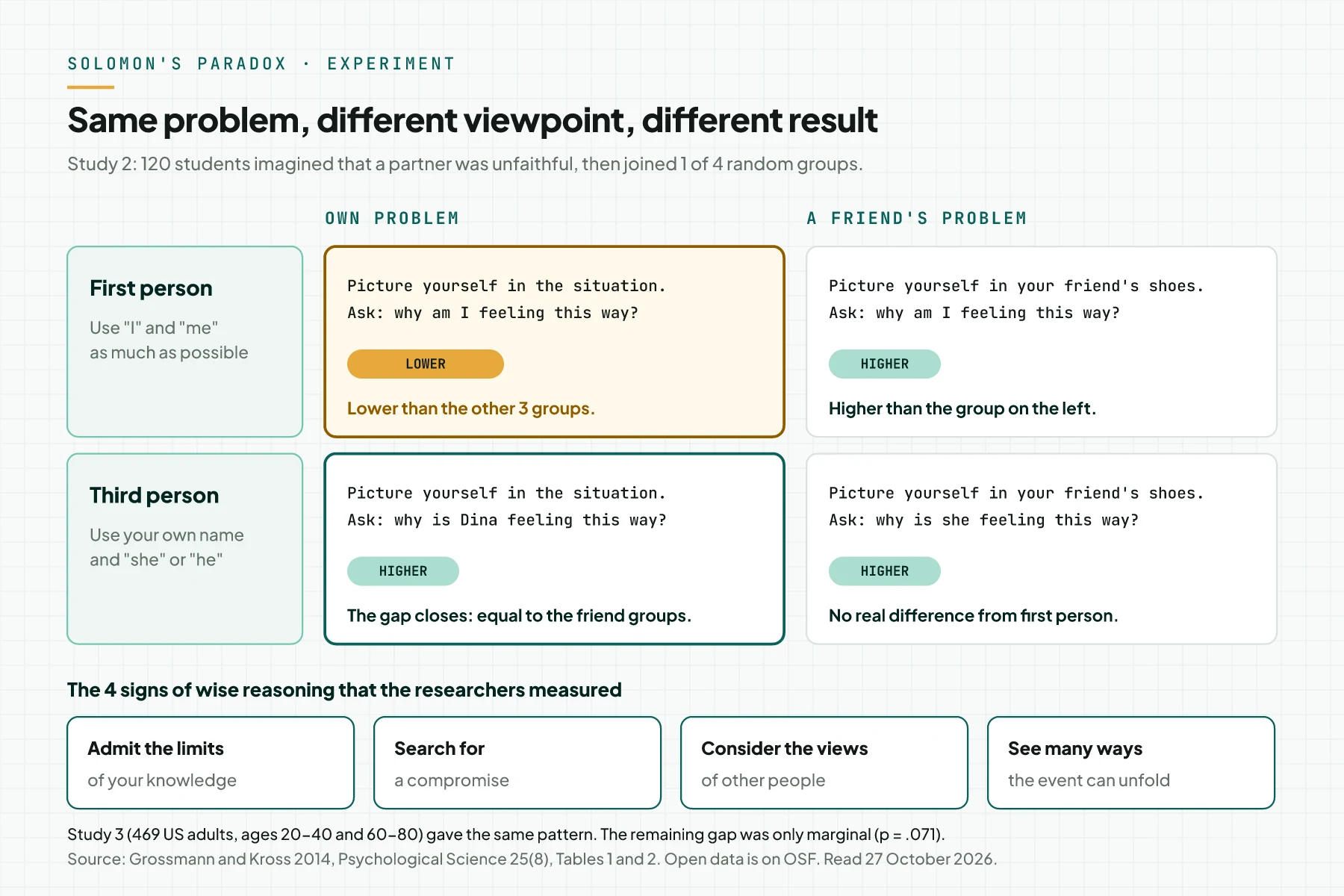
Study 3 tested 469 US adults through a crowdsourcing site: 267 people aged 20 to 40 and 202 people aged 60 to 80. The scenario was a betrayal by a friend or a family member. The same pattern appeared, but a marginal gap stayed for the third-person group (p = .071).
A meta-analysis of Studies 2 and 3 gave d = 0.15 with p = .80. So participants who took distance from their own problem were statistically equal to participants who reasoned about another person's problem.
4. Age does not remove the paradox
Study 3 also tested the saying "with age comes wisdom". People aged 60 to 80 showed the same gap as people aged 20 to 40. The authors suggest a new version of the saying: with age comes wisdom about the dilemmas of strangers.
Both age groups also gained the same benefit from self-distancing. So experience helps you advise other founders, but experience does not automatically help your own decisions.
5. Why distance helps
Kross et al. (2014) ran 7 studies with 585 participants. Participants who used their own name or a pronoun other than "I" during reflection took more distance. Outside judges rated their first impressionsImpressionThe number of times your ad or page appeared on a screen. An impression is not a person and not a search.Open the glossary and speeches as better. These participants also saw a stressful task as a challenge, not as a threat.
Moser et al. (2017) tested the method with brain measures. In 29 participants, an ERPERPOne system that keeps the sales, purchasing, stock, and finance of a company in one set of data.AI-native ERP build signal of emotional reaction fell within the first second when they used their own name. A signal of cognitive control effort did not rise. In 50 fMRI participants, activity in the medial prefrontal cortex fell. This area is linked with thinking about the self. Distress fell from 3.82 to 3.24 on a scale of 1 to 5.
Webster et al. (2022) repeated the ERP study with 67 participants. The main result appeared again. The authors call distanced self-talk a relatively effortless way to regulate emotion.
Xu, Zhang, and Wang (2022) looked for another path with 399 participants. When participants thought about their own conflict, positive affect and self-transcendence fell. These 2 factors explained part of the gap in wise reasoning.
So distance works through 2 paths. Emotion falls faster, and your attention widens from "I" to the larger situation.
6. Distance in time also helps
Bruehlman-Senecal and Ayduk (2015) ran 7 studies on distance in time. Participants who looked at a recent problem from a distant-future view felt less distress. The path: they focused more on the temporary nature of the problem.
7. Limits of the evidence
We found no study that tests Solomon's paradox on the business decisions of founders. All studies above used personal conflicts, unpleasant images, bad memories, or social stress such as a speech.
The effect is also smaller in other studies. Huynh et al. (2017) tested 623 participants and found the same paradox. According to the Xu et al. (2022) summary, the effect size in the Huynh study was between ηp² .01 and .05, and the Xu study found ηp² .03. The original studies found .05 to .25.
Xu et al. give 2 reasons. The new studies used a scale of 19 to 21 items, not 4 to 7 items. The new studies also measured how useful participants found wise strategies, not whether participants used them.
Xu et al. also name 1 confound. In studies that use real events, you know more details about your own conflict than about a friend's conflict. This difference in information can also explain part of the paradox.
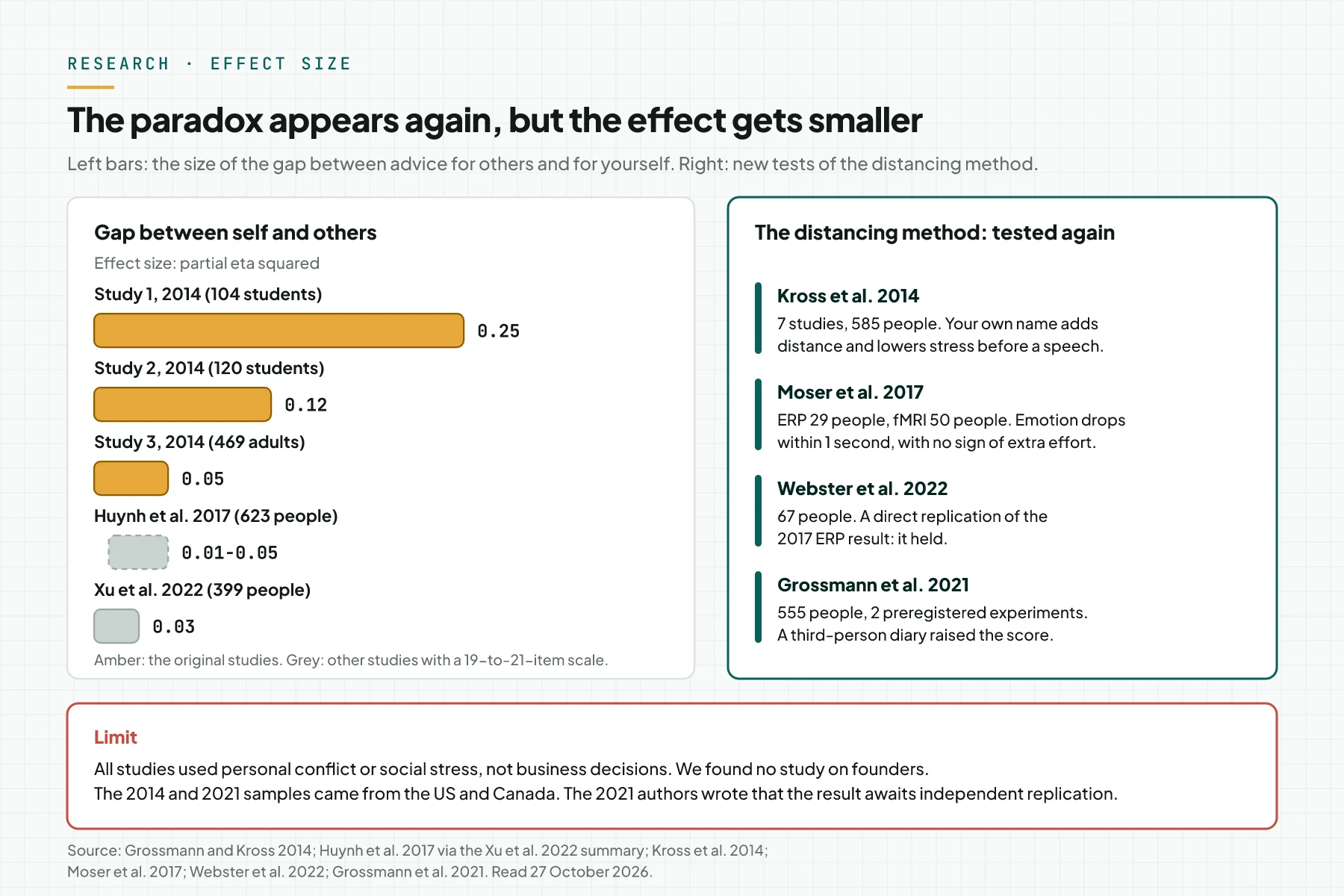
The authors of Grossmann et al. (2021) wrote 3 notes in their manuscript. Their samples came from English-speaking North America. The effects were small to moderate. The robustness of the result awaits independent replication.
Rama Digital recommendation: use this method as a low-cost thinking habit, not as proof that your decision is correct. Still test each decision with numbers and a stop line.
Compared: 4 ways to take distance from your own decision
The research above gives 4 practical methods. The table separates the method, the time, the evidence, and the type of decision that fits.
| Method | What you do | Time | Evidence | Fits |
|---|---|---|---|---|
| Your own name and "she" or "he" | Write it, or say it silently: "Why does Dina hesitate?" | 1 to 5 minutes | Grossmann and Kross (2014), Kross et al. (2014), Moser et al. (2017) | Decisions with strong emotion |
| Advice for another founder | Write your problem as a question from a friend, then answer it. | 10 minutes | Grossmann and Kross (2014), the "friend's problem" groups | Price, hiring, and pivots |
| Distance in time | Ask: how will Dina see this problem 1 year from now? | 2 minutes | Bruehlman-Senecal and Ayduk (2015) | Problems that feel urgent |
| Third-person diary | Write the main event of the day with your own name. | 10 minutes a day, 1 to 4 weeks | Grossmann et al. (2021) | A long-term habit |
Methods 1, 2, and 4 have direct tests for wise reasoning. Method 3 has tests for distress, not for wise reasoning. The 5 steps below combine all 4 methods.
Before you start: prepare 5 things
- 1 decision that you have delayed for more than 2 weeks.
- The base numbers of that decision, for example price, cost, order count, or salary.
- 1 empty document or note.
- 15 minutes with no notifications.
- 1 outside person with no stake, for example a fellow founder or a mentor (optional).
Grossmann and Kross (2014) write that an advisor with a personal stake can also be biased. So choose an outside person who does not gain or lose from your decision.
Step 1: Write your decision as the case of another founder
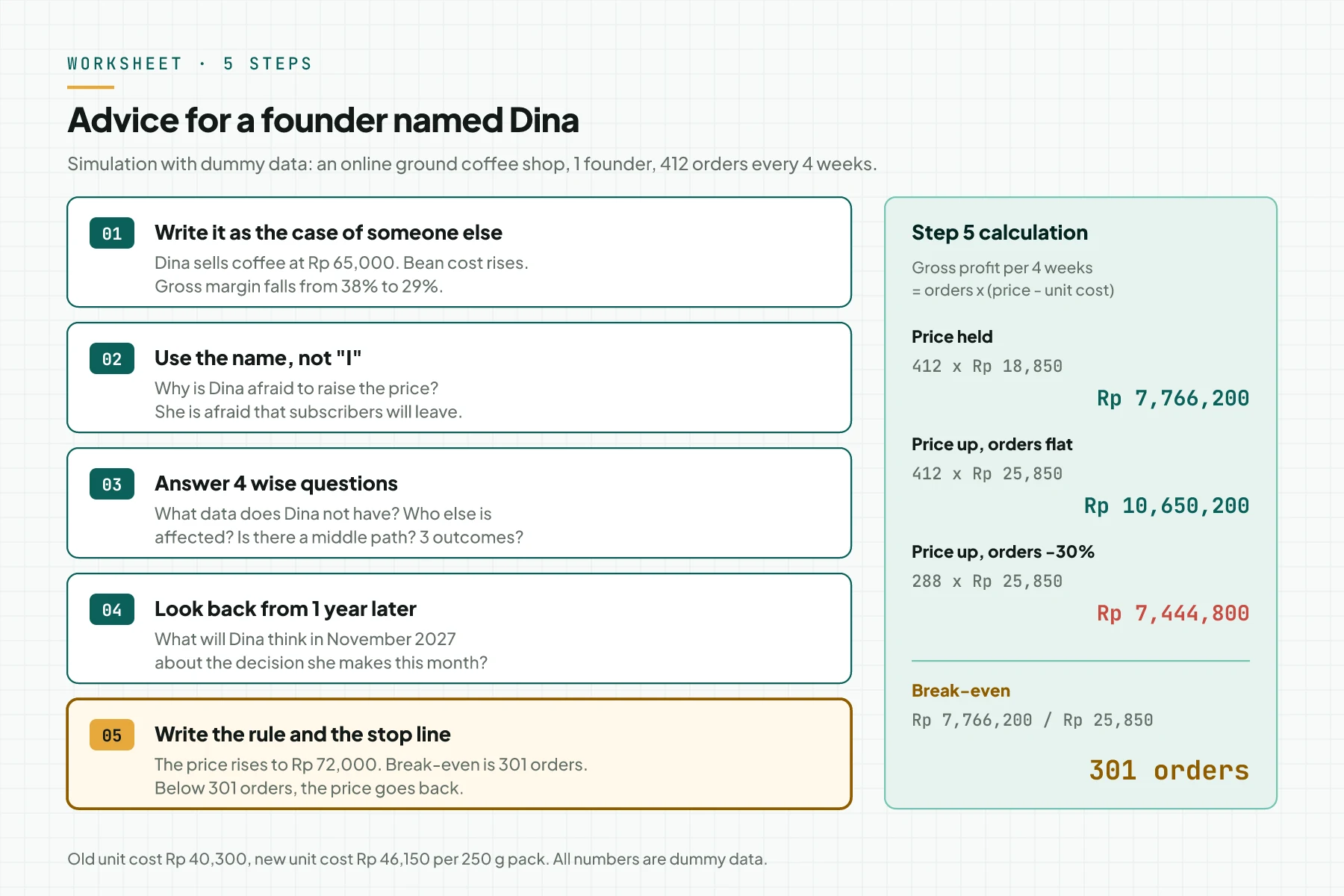
Open an empty note. Write the title "The case of a founder named [your name]". Describe the situation in 3 to 5 sentences with numbers: price, cost, orders, cash, and deadline.
This copies the "friend's problem" groups in Grossmann and Kross (2014). Those groups reasoned with higher scores. Check: the case has at least 3 numbers, 1 deadline, and at least 2 options.
Step 2: Replace "I" with your name
Rewrite the paragraph about your feelings with your own name and "she" or "he". Example: "Why is Dina afraid to raise the price? She is afraid that subscribers will leave." You can also say it silently.
This instruction is the same as the instruction for the third-person groups in Study 2: use your own name as much as possible. All studies in this article used English. Check: the paragraph does not contain the word "I".
Step 3: Answer the 4 wise reasoning questions
Answer these 4 questions for the founder in your case. Each question comes from 1 sign of wise reasoning in Table 1 of Grossmann and Kross (2014).
- Limits of knowledge: what data does she not have yet? How can she get it within 7 days?
- Other people's views: who else is affected? Write at least 3 parties, for example customers, staff, suppliers, or family.
- Compromise: what is the middle path between her 2 main options?
- Possible outcomes: write 3 outcomes that can occur, good, average, and bad, with numbers.
Question 4 matters for founders. Outcomes with numbers turn a fear into a comparison that you can calculate. Check: each question has at least 1 written answer, and question 4 has 3 outcomes with numbers.
Step 4: Look at the decision from 1 year later
Ask: "How will [your name] see this decision 1 year from now?" Bruehlman-Senecal and Ayduk (2015) found that a distant-future view lowers distress, because people focus more on the temporary nature of the problem.
Xu et al. (2022) found that lower positive affect explains part of the less wise reasoning. So lower distress can help step 3. Rama Digital recommendation: use a distance of 1 year for price and hiring decisions, and 3 years for a pivot or for stopping. Check: you wrote 1 sentence about how that founder sees the decision 1 year from now.
Step 5: Write the decision rule and the stop line
Write the decision as a rule that you can check: the action, the start date, the number that you monitor, and the stop line. Write the stop line before you see the result. This is the same principle as the stop line in the article on the sunk cost fallacy.
Then make steps 1 to 4 a habit. Grossmann et al. (2021) asked participants to keep a third-person diary for 4 weeks in the first study and 1 week in the second study. The wise reasoning scores of that group rose compared with the scores before the training. Rama Digital recommendation: write for 10 minutes each workday for 4 weeks, then repeat steps 1 to 5 for each large decision. Check: the rule has 1 number to monitor, 1 check date, and 1 stop line.
Simulation: Dina and the price of ground coffee
This example uses dummy data. Dina is the solo founder of an online ground coffee shop. She sells 412 packs of 250 g every 4 weeks at Rp 65,000. The unit cost (cost of goods sold) per pack rises from Rp 40,300 to Rp 46,150, so the gross marginGross marginThe share of the selling price left after the cost of goods, written as a percentage.Open the glossary falls from 38% to 29%.
The first table compares 2 drafts that Dina writes about the same problem.
| Sign of wise reasoning | Draft with "I" (3 Nov) | Draft with "Dina" (4 Nov) |
|---|---|---|
| Limits of knowledge | "Customers will leave for sure." No question about data. | How many customers buy because of price? What do 3 competitors charge? |
| Other people's views | Only Dina. | Subscribers, resellers, and the bean supplier. |
| Compromise | None. | Tell subscribers 7 days before the price rises. |
| Possible outcomes | 1 outcome: customers leave. | 3 outcomes: orders stay flat, fall 10%, or fall 30%. |
The second table calculates the 3 outcomes from the second draft, plus the old price for comparison. Gross profit equals orders x (price minus unit cost).
| Outcome | Orders per 4 weeks | Gross profit per pack | Gross profit per 4 weeks |
|---|---|---|---|
| Price held at Rp 65,000 | 412 | Rp 18,850 | Rp 7,766,200 |
| Price Rp 72,000, orders flat | 412 | Rp 25,850 | Rp 10,650,200 |
| Price Rp 72,000, orders down 10% | 371 | Rp 25,850 | Rp 9,590,350 |
| Price Rp 72,000, orders down 30% | 288 | Rp 25,850 | Rp 7,444,800 |
The break-even point of the new price is Rp 7,766,200 divided by Rp 25,850, which is 301 orders. So orders can fall from 412 to 301, or 26.9%, before the new price gives less gross profit than the old price.
| Date (simulation) | Event | What is recorded | Decision |
|---|---|---|---|
| 3 Nov | Dina reads the monthly report and writes a draft with "I". | Gross margin 29%. 1 option: hold the price. | No decision yet. |
| 4 Nov | Dina does steps 1 to 3. | 3 options, 3 affected parties, and 3 outcomes with numbers. | Check customer data. |
| 5 Nov | Dina sends 1 question to 20 subscribers and records the prices of 3 competitors. | 14 of 20 people answer. 3 people name price as the main reason they buy. | Go on to steps 4 and 5. |
| 6 Nov | Dina writes the rule and sends a message to subscribers. | The price rises to Rp 72,000 from 13 Nov. Stop line: below 301 orders per 4 weeks. | Apply the rule. |
| 11 Dec | Dina checks the 4-week result. | 389 orders, down 5.6%. Gross profit Rp 10,055,650. | Keep the price. Check again after 4 more weeks. |
In this simulation, gross profit rises from Rp 7,766,200 to Rp 10,055,650 per 4 weeks. These numbers are an example, and your business result can differ. The important part is the order: Dina wrote the stop line on 6 Nov, before the result came in.
Checklist before your next large decision
- Write the decision as the case of another founder with at least 3 numbers. Owner: you. Evidence: a dated note.
- Rewrite the feelings paragraph with your own name. Owner: you. Evidence: a paragraph with no "I".
- Answer the 4 wise reasoning questions. Owner: you. Evidence: 4 answers and 3 outcomes with numbers.
- Collect 1 piece of missing data within 7 days. Owner: you. Evidence: survey results, sales data, or competitor prices.
- Ask 1 outside person with no stake to read your case. Owner: a fellow founder or a mentor. Evidence: written comments.
- Write the decision rule with 1 number to monitor and 1 check date. Owner: you. Evidence: a dated rule.
- Stop or reverse the decision when the monitored number crosses the stop line that you wrote before the result. Owner: you. Evidence: a dated decision note.
When to use this method alone, and when to ask an outside person
Use this method alone for decisions that you can reverse within 4 weeks, for example price, packages, or work schedules. The worst loss is limited, and the number to monitor is clear.
Ask an outside person for decisions that are hard to reverse: a permanent hire, a pivot, a loan, or closing the business. Distancing reduces bias, but it does not add data or experience. For heavy mental strain, ask a psychologist for help.
A solo founder also has no backup when ill. The article on presenteeism covers the cost of working while ill and how to measure it.
Frequently asked questions
What is Solomon's paradox? Solomon's paradox is the tendency to reason more wisely about other people's problems than about your own. Grossmann and Kross (2014) gave it this name after they tested 693 people in 3 experiments.
Where does the name Solomon's paradox come from? Grossmann and Kross (2014) use the story of King Solomon in the Hebrew tradition as a metaphor. According to the authors, he was famous for wise advice but showed less wisdom in his own life decisions. The name is a metaphor, not a historical finding.
What is self-distancing? Self-distancing is a way to take distance from yourself when you think about a problem. Examples: use your own name and "she" or "he", write advice for another person, or look at the problem from 1 year later.
Do I have to speak out loud? No. Moser et al. (2017) studied silent third-person self-talk. You can also write it in a note, as the diary participants in Grossmann et al. (2021) did.
Are senior founders safe from this paradox? Not necessarily. In Study 3 of Grossmann and Kross (2014), people aged 60 to 80 showed the same gap as people aged 20 to 40. Self-distancing helped both age groups.
Does this method replace a co-founder or a mentor? No. The method improves your reasoning, but it does not add data, experience, or a network. Use it before you meet a mentor, so that the discussion uses numbers.
Next step
The limit still applies: this research used personal conflicts, and the effect is smaller in later studies. If you want an outside view of where your business is stuck, use AI Diagnostic. The session takes 60 to 90 minutes and gives you a written problem map and a first step. Book a 30-minute session if you want to discuss 1 decision with us first.
Sources
- Grossmann and Kross (2014). "Exploring Solomon's Paradox: Self-Distancing Eliminates the Self-Other Asymmetry in Wise Reasoning About Close Relationships in Younger and Older Adults", Psychological Science 25(8), pp. 1571 to 1580. 3 experiments, 693 participants. We read the full text through the proof copy on the Waterloo lab site.
- Kross and Grossmann (2012). "Boosting wisdom: Distance from the self enhances wise reasoning, attitudes, and behavior", Journal of Experimental Psychology: General 141(1), pp. 43 to 48. We read the abstract.
- Kross et al. (2014). "Self-talk as a regulatory mechanism: How you do it matters", Journal of Personality and Social Psychology 106(2), pp. 304 to 324. 7 studies, 585 participants. We read the abstract.
- Moser et al. (2017). "Third-person self-talk facilitates emotion regulation without engaging cognitive control", Scientific Reports 7, 4519. ERP 29 participants, fMRI 50 participants. We read the full text.
- Webster et al. (2022). "An event-related potential investigation of distanced self-talk: Replication and comparison to detached reappraisal", International Journal of Psychophysiology 177, pp. 122 to 132. 67 participants. We read the abstract.
- Huynh et al. (2017). "The Wisdom in Virtue: Pursuit of Virtue Predicts Wise Reasoning About Personal Conflicts", Psychological Science 28(12), pp. 1848 to 1856. 623 participants. We read the abstract.
- Xu, Zhang, and Wang (2022). "The Psychological Mechanisms Underlying Solomon's Paradox: Impact of Mood and Self-Transcendence", Frontiers in Psychology 13, 901012. 399 participants. We read the full text.
- Grossmann et al. (2021). "Training for Wisdom: The Distanced-Self-Reflection Diary Method", Psychological Science 32(3), pp. 381 to 394. 2 preregistered experiments, 555 participants. We read the accepted manuscript on PsyArXiv.
- Bruehlman-Senecal and Ayduk (2015). "This too shall pass: Temporal distance and the regulation of emotional distress", Journal of Personality and Social Psychology 108(2), pp. 356 to 375. We read the abstract.
- the Carta Solo Founders Report 2025, Carta Insights, 9 December 2025. Share of new US startups with 1 founder: 23.7% in 2019 and 36.3% in the first half of 2025.
We opened all sources on 27 October 2026.