The Anthropic IPO prospectus has 2 numbers that seem to disagree. Opus 5.5 cut customer cost per task by about 40%, but existing customers pay about 9 times their bill of 1 year earlier.
Both numbers are in the final prospectus that Anthropic filed with the SEC on 19 November 2026. Anthropic set the share price at $83 on 18 November, the Anthropic IPO pricing announcement shows. On the first day on Nasdaq, the ANT shares opened at $111.50 and closed at $97.17, up 17%, AP reports.
This article does not discuss the share price. It takes apart the 9 times number, because a small team that uses AI can see the same pattern in its own bill.
The 900% number compares the bill of the same customers with 1 year earlier
Net Revenue Retention (NRR) of about 900% means existing Anthropic customers pay about 9 times their bill for the same 3 months last year.
The prospectus gives the definition. Anthropic takes all customers who paid at least $1 in the base period, the 3 months that end 1 year before the measurement date. Then Anthropic divides the revenue from those customers in the last 3 months by their revenue in the base period.
Pro, Max, and Ultra subscribers are not in the calculation, because their subscription price is fixed. The prospectus says that the number includes customers who spend more, customers who spend less, and customers who stopped. The measurement date is 30 September 2026.
Worked example, not customer data: a company paid Rp10 million in July-September 2025. If that company pays Rp90 million in July-September 2026, its NRR is 900%. The Anthropic number is the result for the full group of existing customers.
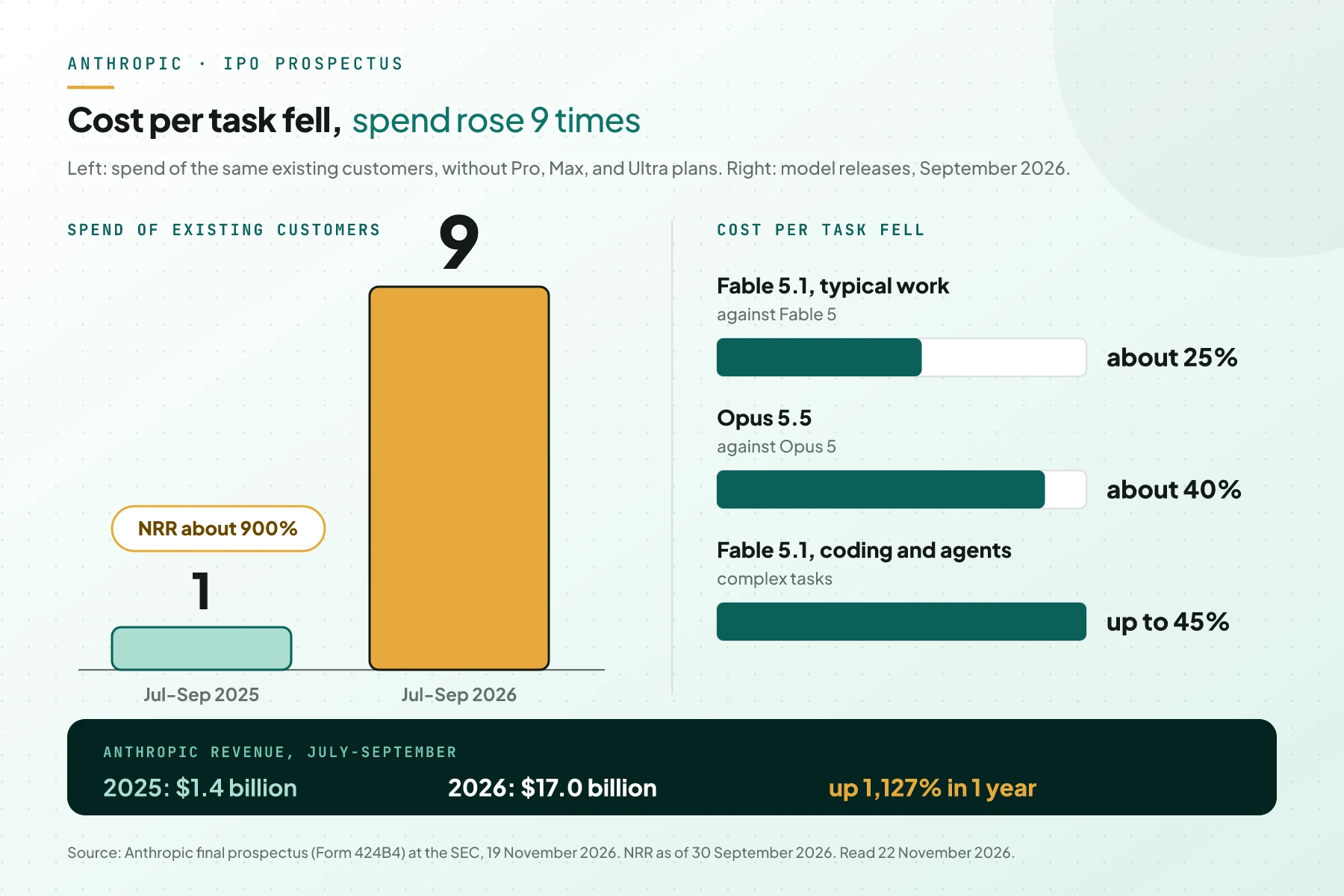
Total revenue also increased fast. Anthropic recorded $17.0 billion in July-September 2026, up 1,127% from $1.4 billion in the same period of 2025.
The number of customers who paid at least $100,000 in 12 months grew from more than 950 to more than 11,900. Anthropic measured the 2 numbers on 30 September 2025 and 30 September 2026.
Cost per task fell, then customers gave Claude more tasks
Two new models in September 2026 cut cost per task by 25% to 45%, and the prospectus says that lower costs drive more usage.
| Model, September 2026 | Compared with | Decrease in cost per task |
|---|---|---|
| Fable 5.1, typical work | Fable 5 | about 25% |
| Fable 5.1, complex coding and agentAI agentAn AI program that performs work steps by itself, for example reading a message, drafting a reply, and recording the result.Open the glossary tasks | Fable 5 | up to 45% |
| Opus 5.5 | Opus 5 | about 40% |
Anthropic writes that each decrease combines a lower price and a more efficient model. The part of each depends on the task. So the price list per token shows only a part of the decrease.
The prospectus gives 1 example from the past. Opus 4.5 launched in November 2025 with a lower price and a lower cost per task than Opus 4.1. Quarter-over-quarter revenue growth then went from 48% in October-December 2025 to 132% in January-March 2026.
Anthropic writes that several factors caused that increase, including new products and wider customer adoption. So the lower price is not the only cause. But the direction is clear: a better price and better capability open new uses.
This pattern is important because 79% of Anthropic revenue in January-September 2026, or $26.3 billion, came from usage. Anthropic measures usage in tokens, with a different price for each model. The bill increases each time a customer runs more tasks.
One agent user can spend 20 times the bill of a colleague
ClaudeClaude ProThe paid subscription for the Claude AI assistant from Anthropic. It unlocks connectors to outside tools.Open the glossary Enterprise users without Claude Code averaged below $75 a month, and the top 5% of Claude Code users spent about 20 times that.
That number comes from July-September 2026. At the Bank Indonesia JISDOR rate of 20 November 2026, Rp18,278 per US dollar, $75 is Rp1,370,850. Because the average is below $75, 20 times that is below about $1,500, or Rp27,417,000 per person per month.
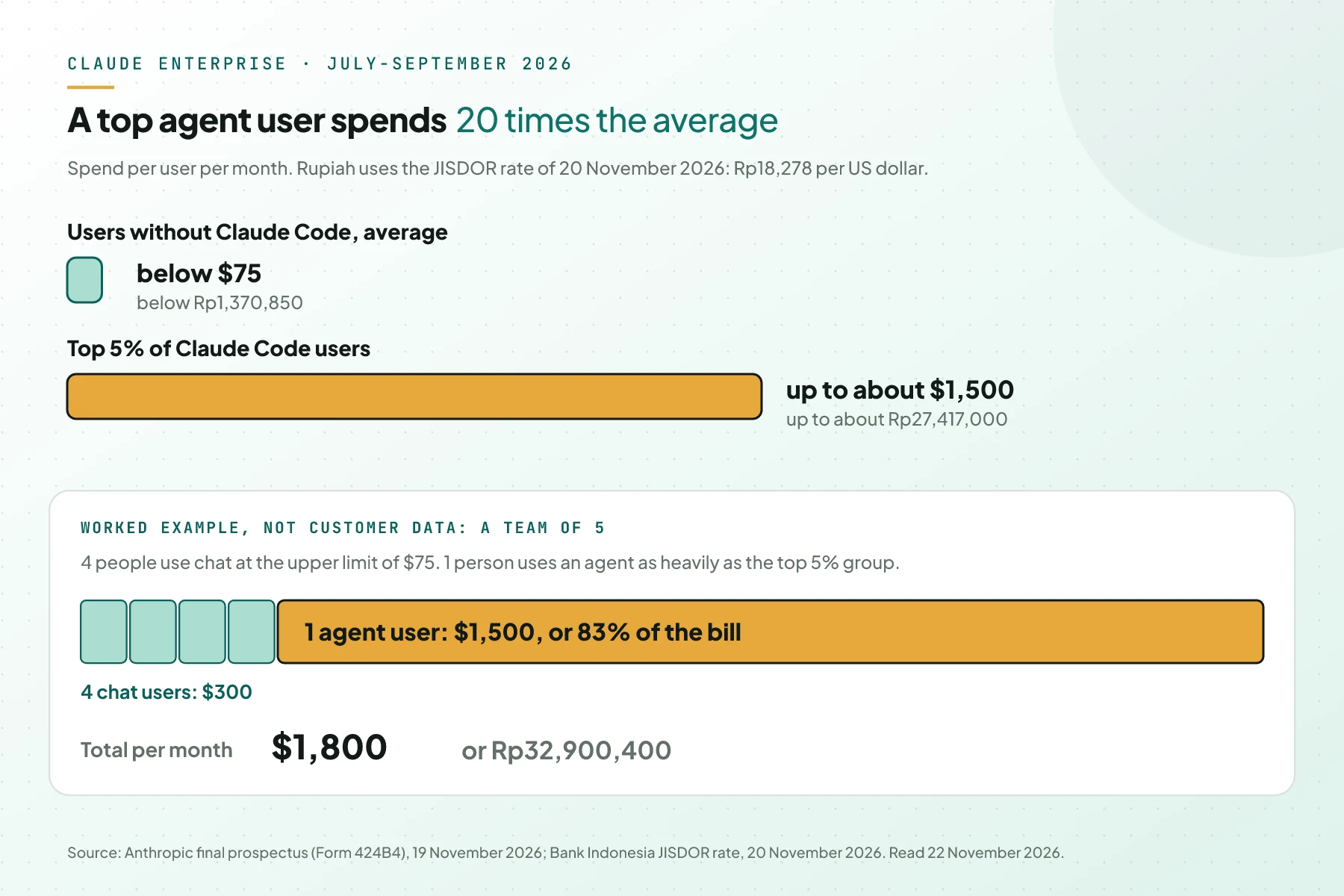
The worked example in the image uses a team of 5. Four people use chat at the upper limit of $75, and 1 person uses an agent as heavily as the top 5% group. The total bill is $1,800, or Rp32,900,400, and 83% comes from that 1 person.
The 83% share stays the same if the chat average is lower than $75, because the ratio is 20 to 4. One person alone can change the shape of your team bill.
The prospectus does not give the number of people in that 5% group, or the type of their tasks. This number also comes from Claude Enterprise, not from a small team plan. Use it as a scale, not as a forecast of your bill.
A higher bill is not always bad news
Anthropic says that business customers get a strong return on investmentROIProfit minus all costs, divided by all costs. ROI counts profit, while ROAS counts gross revenue.Open the glossary from Claude, but that view comes from the seller, not from a customer audit.
The prospectus says that agent workflows can increase the revenue and the efficiency of customers. The prospectus does not give a return figure for each customer. A bill that is 9 times larger makes sense only if the value of the work also rises and stays above the cost.
Anthropic also gives warnings to possible investors. The company does not expect revenue to continue to grow at the same rate, and the recent growth can show an early stage of adoption. The 5 largest customers gave about 25% of revenue in January-September 2026, and customers can reduce their spend at any time.
The finances of Anthropic are also heavy. The net loss for January-September 2026 was $104.0 billion, and $94.3 billion of it came from changes in fair value. Anthropic has spend commitments of about $900.9 billion, almost all for compute and infrastructure.
The IPO gave Anthropic about $91.6 billion after the underwriters used their full option, the IPO closing announcement of 20 November 2026 shows. Rich Lesser, global chair of Boston Consulting Group, told AP that the market value of AI companies will go up and down for many years. In his view, the exact path is hard to predict.
The price per task can also go up. Google raises the Gemini 4 Carbon price from 1 December 2026, as our article on the Gemini 4 Carbon price increase shows. So monitor the bill of each provider, not only the general price trend.
AI use in Indonesia is still shallow, and the prospectus gives no Indonesia number
The Anthropic prospectus has no customer or revenue number for Indonesia, so the 9 times pattern is not proven for businesses here.
The Indonesia numbers come from a different report. The e-Conomy SEA 2026 report for Indonesia shows that Indonesia has 43% of AI users in 6 Southeast Asian countries, but only 37% of tokens. On average, 1 user in Indonesia uses 8.5 million tokens.
The same report shows that 54% of the working population in Indonesia uses GenAI. So many people already use AI, but their use is still shallow. We discussed those numbers in the article on Indonesia as the largest but shallowest AI user base.
When that use becomes deeper, bills can follow the Anthropic pattern. The prospectus says that Anthropic sells in US dollars, euros, and British pounds, so the rupiah rate also sets your bill. JISDOR moved from Rp18,218 on 13 November to Rp18,278 on 20 November 2026.
Calculate the 900% number of your team this week
Take your AI bill for the last 3 months, then compare it with the same 3 months last year, as Anthropic does for NRR.
- Open the billing page of each AI service that your team pays for. Record the total for the last 3 months for each service.
- Record the total for the same 3 months last year. If your team did not use AI then, use the first 3 months of use.
- Divide the number from step 1 by the number from step 2. A result of 1.5 means that the bill rose 50%.
- Divide the bill by person or by workflow. Find the person or workflow that uses more than half of the bill.
If the result of step 3 is above 2 and the team output did not increase, set a monthly spend limit in each service. If 1 agent workflow uses more than half of the bill, calculate its cost per completed task. Compare that cost with the cost of the work hours of the person who did the task before.
A limit per task is more useful than a limit per person, because an agent works outside office hours. We described how to monitor agents for a small team in the article on AI agent controls from Microsoft Ignite 2026.
Limits of the data in this prospectus
Almost all numbers in this article come from Anthropic, in a document that Anthropic wrote to sell shares.
- The 900% NRR includes only customers who already paid in July-September 2025. New customers of this year are not in it.
- The prospectus does not divide NRR by customer size. Large customers can pull the group number up.
- The spend per user numbers come from Claude Enterprise, not from the APIAPIThe official door 2 systems use to exchange data, without anybody copying it by hand.Open the glossary or a team plan.
- The decrease in cost per task is an Anthropic number. We did not test it.
- The prospectus has no Indonesia numbers.
So the 2 numbers at the start do not disagree. Cost per task fell, then customers gave Claude many more tasks. The question for your team is what your own 900% number is, and if your output rose too.
Questions and answers
What does the Anthropic NRR of 900% mean?
Existing Anthropic customers pay about 9 times their bill for the same period 1 year earlier. This number, as of 30 September 2026, does not include Pro, Max, and Ultra plans.
Does a lower cost per task make the AI bill smaller?
Not always. Opus 5.5 cut cost per task by about 40%, but the prospectus says that customers usually increase their use after the cost per task falls.
How do I calculate the AI bill growth of my team?
Divide your total AI bill for the last 3 months by the total for the same 3 months last year. A result of 9 means that the bill is 9 times larger.
Is this article advice to buy Anthropic shares?
No. This article is about AI bills for businesses. We do not give investment advice or share price opinions.
If you want us to map your AI bill and set cost limits per task, open the Rama Digital AI process automation service.