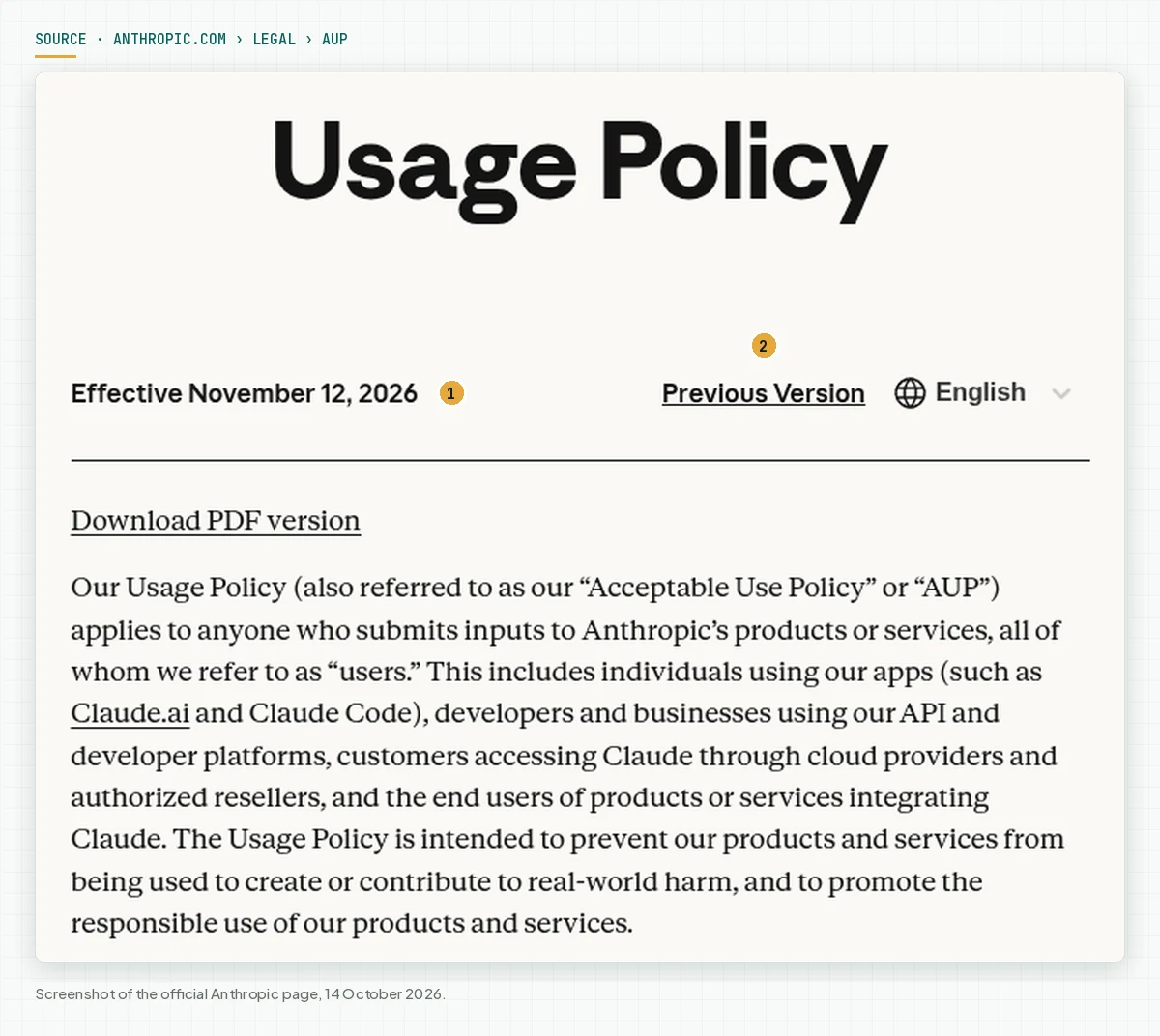
Direct answer: Anthropic published a new Usage Policy on 8 October 2026, and it applies on 12 November 2026. It replaces the 15 September 2025 version. For a business, the 4 most important changes are a new section on deceptive campaigns, a list of 11 high-risk areas, the chatbot disclosure rule, and a ban on unauthorized resale of ClaudeClaude ProThe paid subscription for the Claude AI assistant from Anthropic. It unlocks connectors to outside tools.Open the glossary access.
Main condition: The policy applies to everyone who submits input to Anthropic products, including end users of products that use Claude. So a WhatsApp chatbot that calls Claude through the APIAPIThe official door 2 systems use to exchange data, without anybody copying it by hand.Open the glossary is in scope. Limit: This article reads the policy text. It is not legal advice, and it does not guess how Anthropic will judge your case.
We read the Usage Policy page, the archived 15 September 2025 version, and the 8 October 2026 announcement on 14 October 2026. We compared both versions line by line with a script, then counted sections and items. The shop in the simulation uses dummy data, not client data.
The problem: Claude runs in many places, and few people read the rules
In many businesses, Claude is not only 1 browser tab. Claude answers WhatsApp chats, writes content, summarizes applicant CVs, or runs agents that open other systems. Each of those places carries a different risk.
The problem starts when a product owner treats the Usage Policy as Anthropic's job only. The new text says the opposite: users are responsible for the agents they build or deploy, including actions through tools, browsers, and connected systems.
The result can be a warning, throttling, a limit, a suspension, or a termination of access. If your sales chatbot stops in the middle of an ad campaign, the loss is not only technical. Teams that already track AI use, as in the Claude text watermark and the EU AI Act, adapt faster because their inventory exists.
How it works: three layers of rules
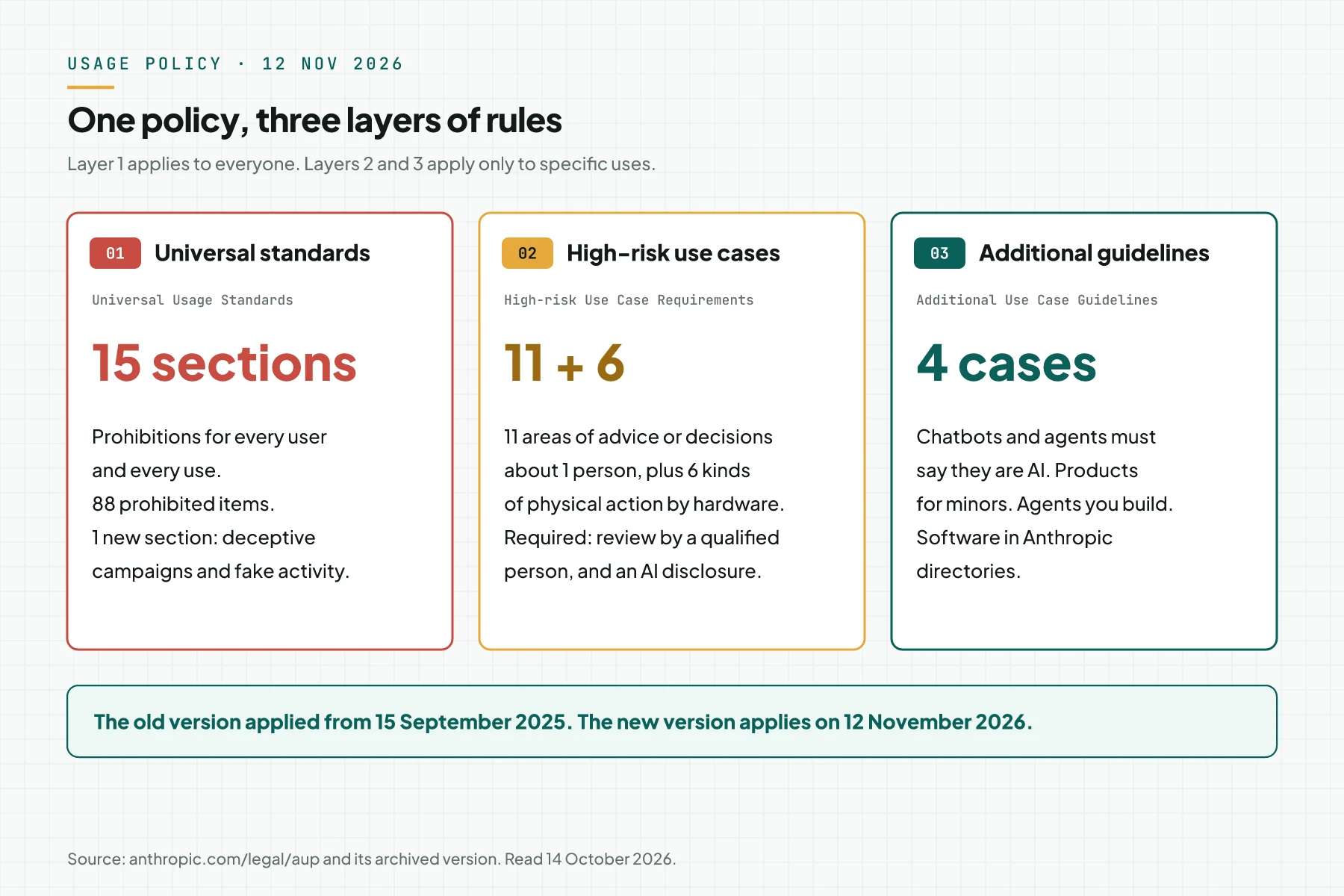
The new Usage Policy splits its rules into 3 layers. Layer 1 applies to everyone. Layers 2 and 3 apply only to specific uses.
Layer 1: Universal Usage Standards
This layer holds 15 prohibited sections with 88 items, by our count. The 15 September 2025 version held 14 sections and 82 items. The sections closest to daily business work are:
- Deceptive campaigns and artificial activity (new section).
- Fraudulent, abusive, and predatory practices, including spam and phishing.
- Privacy and identity rights, including profiles of people sold without their awareness.
- Platform abuse, including resale of access and multiple accounts to avoid detection.
- Disinformation, including impersonation of real people or organizations.
Layer 2: High-risk Use Case Requirements
This layer applies when a Claude output becomes advice or a decision about 1 person in 11 areas. The areas are legal, medical, finance, credit, insurance, housing, employment, education and credentials, healthcare access, public benefits, and legal status.
For those areas, Anthropic requires 2 controls. First, a qualified person reviews the output and has the authority to change it before it is delivered or used. Second, the person who receives the advice or decision is told that AI was used.
This layer also adds 6 kinds of physical action, for example a robot or vehicle that moves through shared space. For physical actions, a person must be able to stop the equipment at any time, and the equipment must hold a safe state when the connection to Claude is lost.
Layer 3: Additional Use Case Guidelines
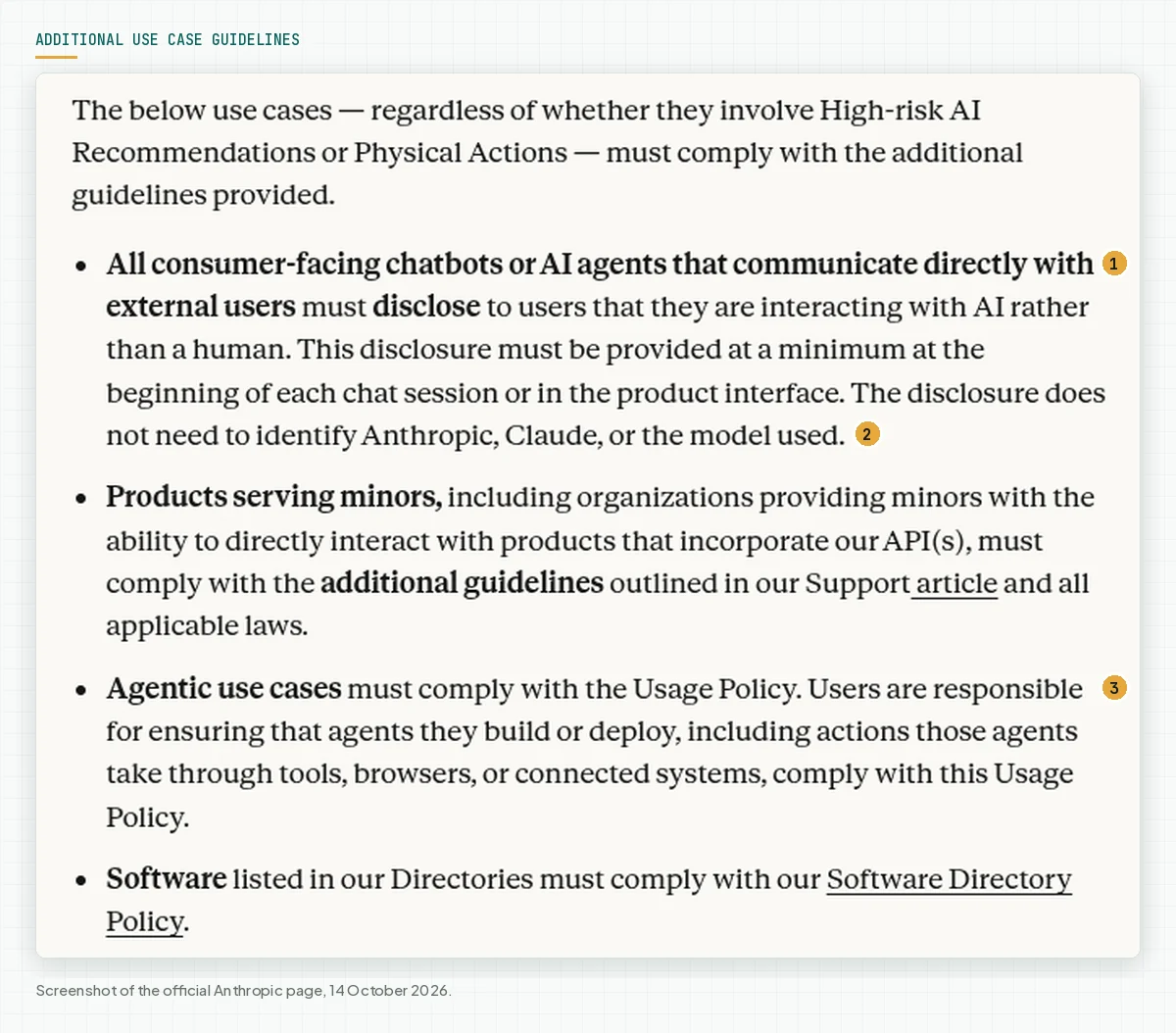
This layer applies to 4 cases, with or without high risk. The cases are chatbots and agents that talk directly to external users, products for people under 18, agenticAgenticA way of working where an AI agent performs the routine steps and a person checks and approves the result.Open the glossary use, and software in Anthropic directories.
Enforcement: from a warning to a termination
The Anthropic Safeguards Team uses detection and monitoring. If they suspect a violation, they can warn you, throttle, limit, suspend, or terminate access. The new text also says that a block from real-time safeguards is not by itself a violation.
What changed from the 15 September 2025 version
Anthropic writes that most changes are clarifications. The table below holds only the changes you can read directly in the text of both versions.
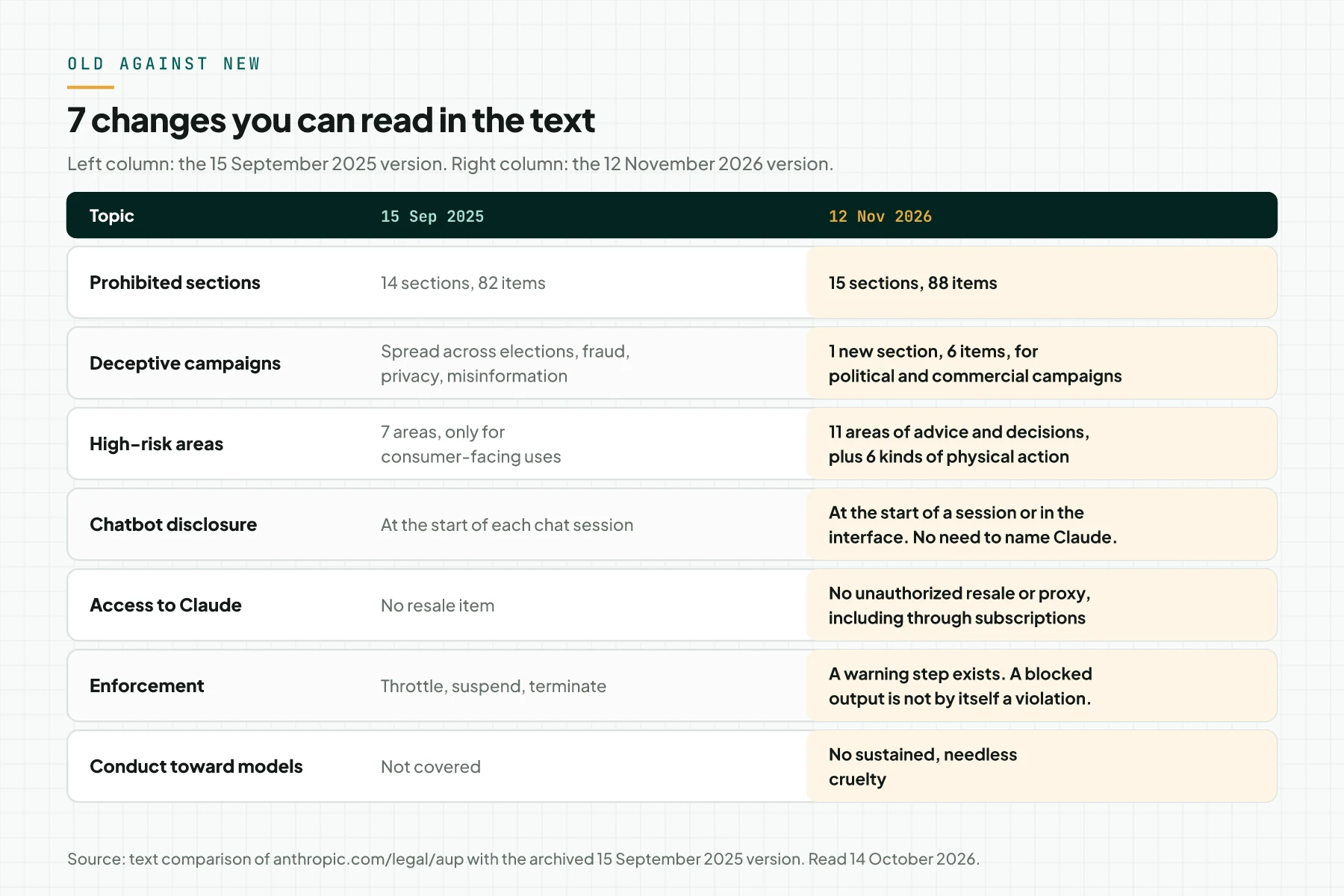
| Topic | 15 September 2025 | 12 November 2026 |
|---|---|---|
| Deceptive campaigns | Spread across the elections, fraud, privacy, and misinformation sections | 1 new section with 6 items, for political and commercial campaigns |
| Fake reviews | An item in the fraud section | An example in the deceptive campaigns section, next to sockpuppets and astroturfing |
| Search engine and AI answers | Not named | No seeding of answer sources with content of false origin |
| High-risk areas | 7 areas for consumer-facing uses, including media and journalism | 11 areas, with a list of what is covered and what is excluded |
| Chatbot disclosure | At the start of each chat session | At the start of each session or in the product interface, with no need to name Claude |
| Access to Claude | No resale item | No unauthorized resale or proxy, including through consumer subscriptions |
| Payment | Not named | No stolen payment methods, and no payment evasion |
| Directories | MCPMCPA standard that lets an AI program use your tools and data under clear permissions.Open the glossary servers in the Connector Directory | All software in Anthropic directories |
| Conduct toward models | Not covered | No sustained, needless cruelty |
The 8 October 2026 announcement adds 2 notes. First, Anthropic writes that the high-risk requirements did not change; the section was rewritten to make the covered list clearer. Second, the blanket ban on personalized political campaign targeting is gone, but deceptive targeting stays prohibited under other sections.
The ban on cruelty toward models applies only to extreme cases. Anthropic writes that ordinary frustration, pushback, dark creative themes, and model testing are not included.
Prerequisites
- A list of products and workflows that use Claude, including through cloud providers or third-party apps.
- Access to the chatbot system prompt and its first-message template.
- 1 named owner for each workflow that sends output to customers.
- Account data: the Claude plan, the account owner, the payment method, and who uses the account.
- 1 person from legal or compliance to read the final result.
Step 1: Map every place where Claude runs
Make 1 table with columns for product, channel, who sees the output, and whether the output leaves the company. Include Claude.ai, Claude Code, the API, Claude through cloud providers, and apps that use Claude behind the scenes. The first paragraph of the Usage Policy page names all of those paths.
Verify: every chatbot, agentAI agentAn AI program that performs work steps by itself, for example reading a message, drafting a reply, and recording the result.Open the glossary, and automation has 1 row and 1 owner. If a workflow has no owner, you cannot check the other steps.
Step 2: Add an AI disclosure to chatbots and agents
Every chatbot or agent that talks directly to external users must tell them they are talking to AI. The disclosure must appear at the start of each chat session or in the product interface. You do not need to name Anthropic, Claude, or the model.
A sample opening line: "Hi, I am the AI assistant of Sample Shop. Type ADMIN to talk to our team." A persona name can stay, as long as the bot does not claim to be human. In the disinformation section, the new text bans making people believe they talk to a human when they do not.
Verify: open a new session from a number that never chatted before, then read the first bot message. For WhatsApp, also check the opening template and the follow-up messages. The guide on the AI WhatsApp chatbot for closing shows how to write an opening that still sells.
Step 3: Flag outputs in the high-risk areas
For each row of the Step 1 table, answer the 3 questions in the next diagram. Answer from left to right, and stop at the first NO.
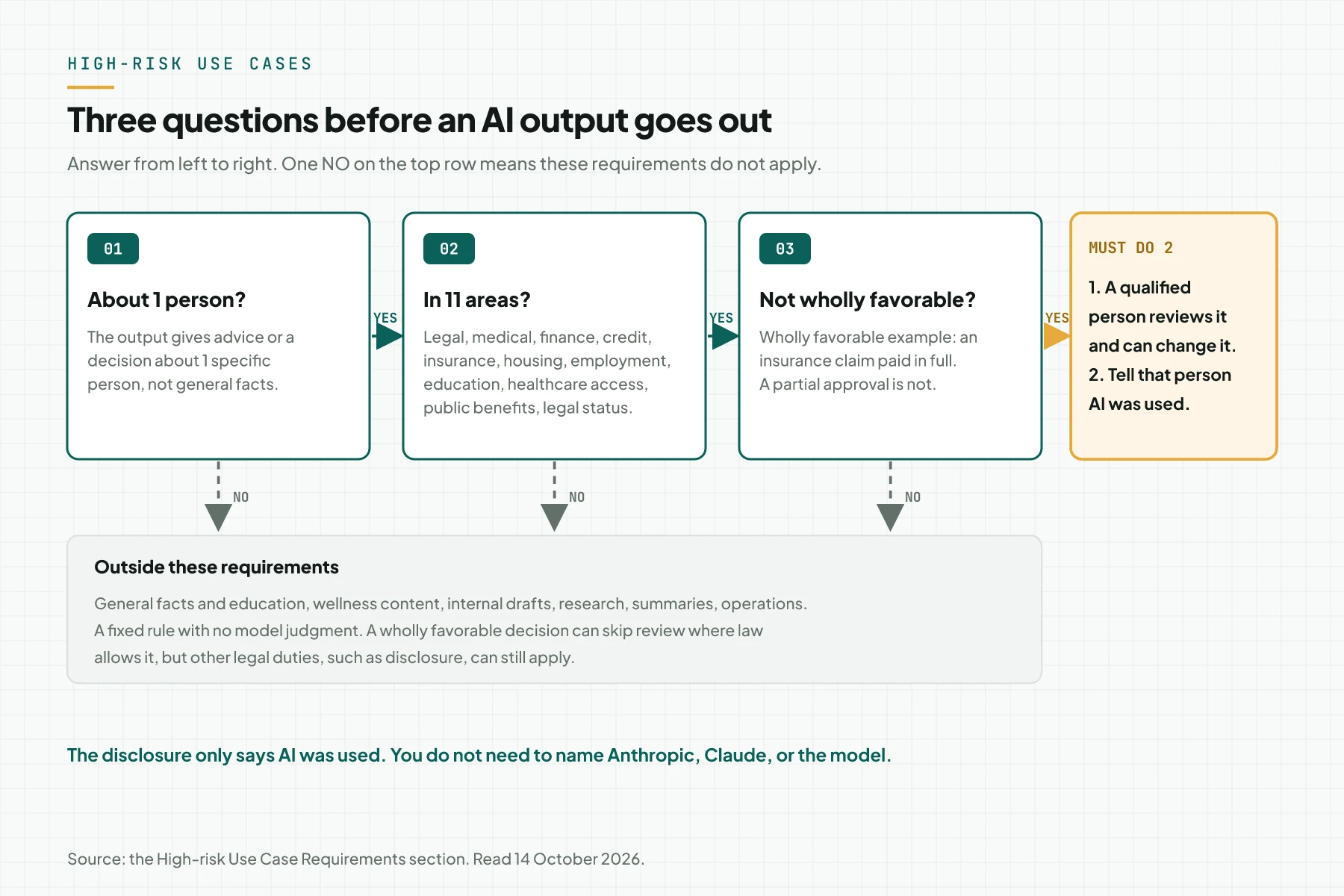
Examples inside the scope: a bot that approves or denies an installment plan, AI that screens and ranks applicant CVs, and a bot that reads 1 patient's lab results. Personal tax advice, such as what to report on a person's tax return, is in the finance area.
Examples outside the scope: a bot that explains how installments work in general, an internal draft for the credit team, and a bot that carries out a decision a person already made. Verify: every row has the status "high-risk" or "outside", with a 1-sentence reason.
Step 4: Name a qualified person and write the disclosure
For each high-risk workflow, write the name of the person who reviews the output. The AUP defines a qualified person as someone with training or experience in that field, and a license where law requires one. That person must be able to change the output, and stays responsible for the result.
Then write a disclosure sentence for the affected person, for example: "This recommendation was prepared with AI help and reviewed by our credit staff." A wholly favorable decision, such as an insurance claim paid in full, can skip review where law allows it. A partial approval does not count.
Verify: keep a log with the reviewer name, the review time, and the changes made. Without a log, you cannot show that the review happened before the output went out.
Step 5: Check content, review, and AI answer practices
The new section Do Not Engage in Deceptive Campaigns or Artificial Activity applies to political and commercial campaigns. It bans fake accounts, fake reviews, bots that claim to be human, hidden sponsorship, and fake site networks. It also bans selling a service or tool for any of those.
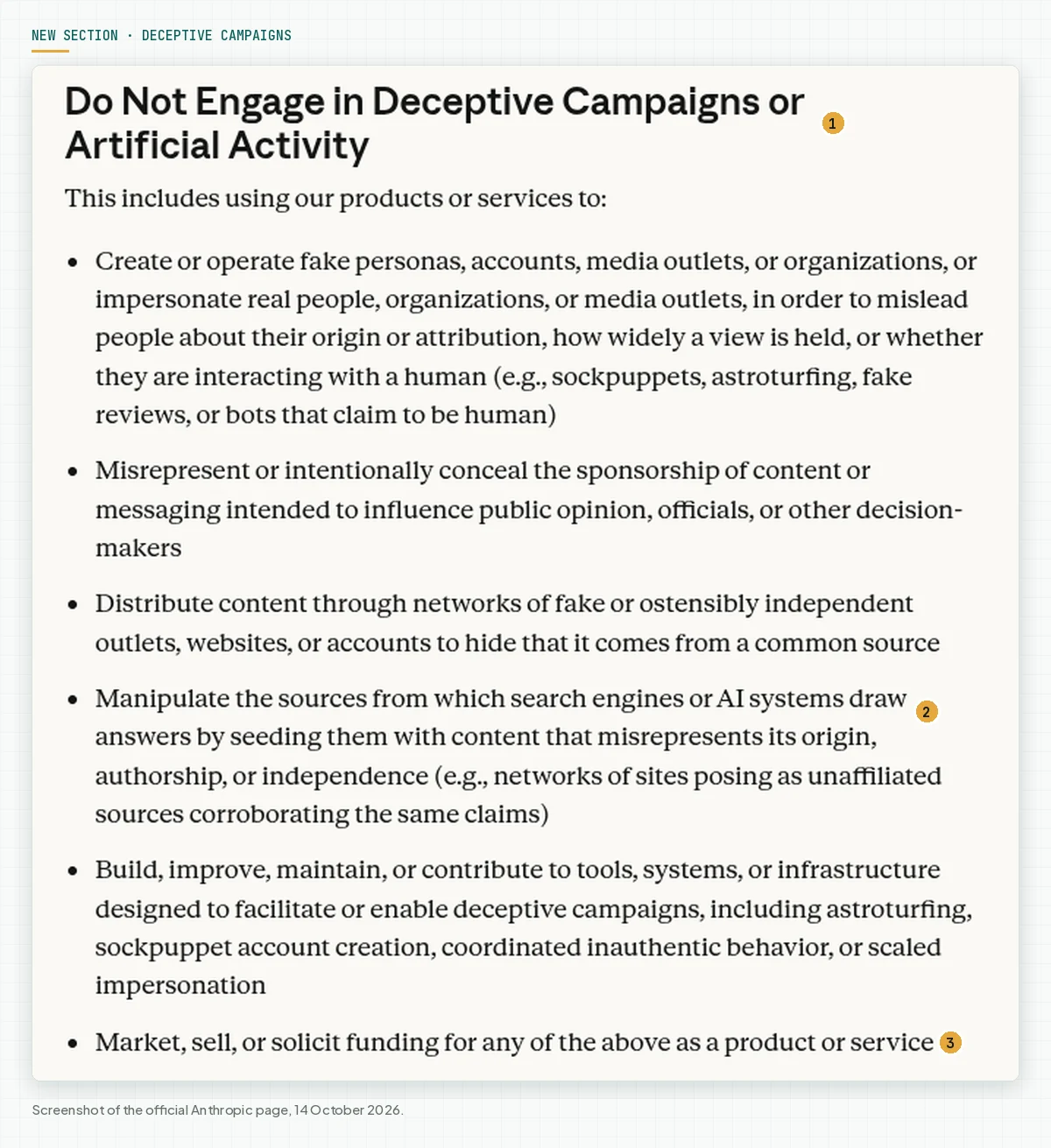
The newest item for SEOSEOThe work of making your page easy to find and easy to choose in search results, without paying for ads.Open the glossary teams bans manipulating the sources of search engine or AI answers. An example is a network of sites that pose as independent and confirm the same claims. A brand article with a clear author and sources is not in this item.
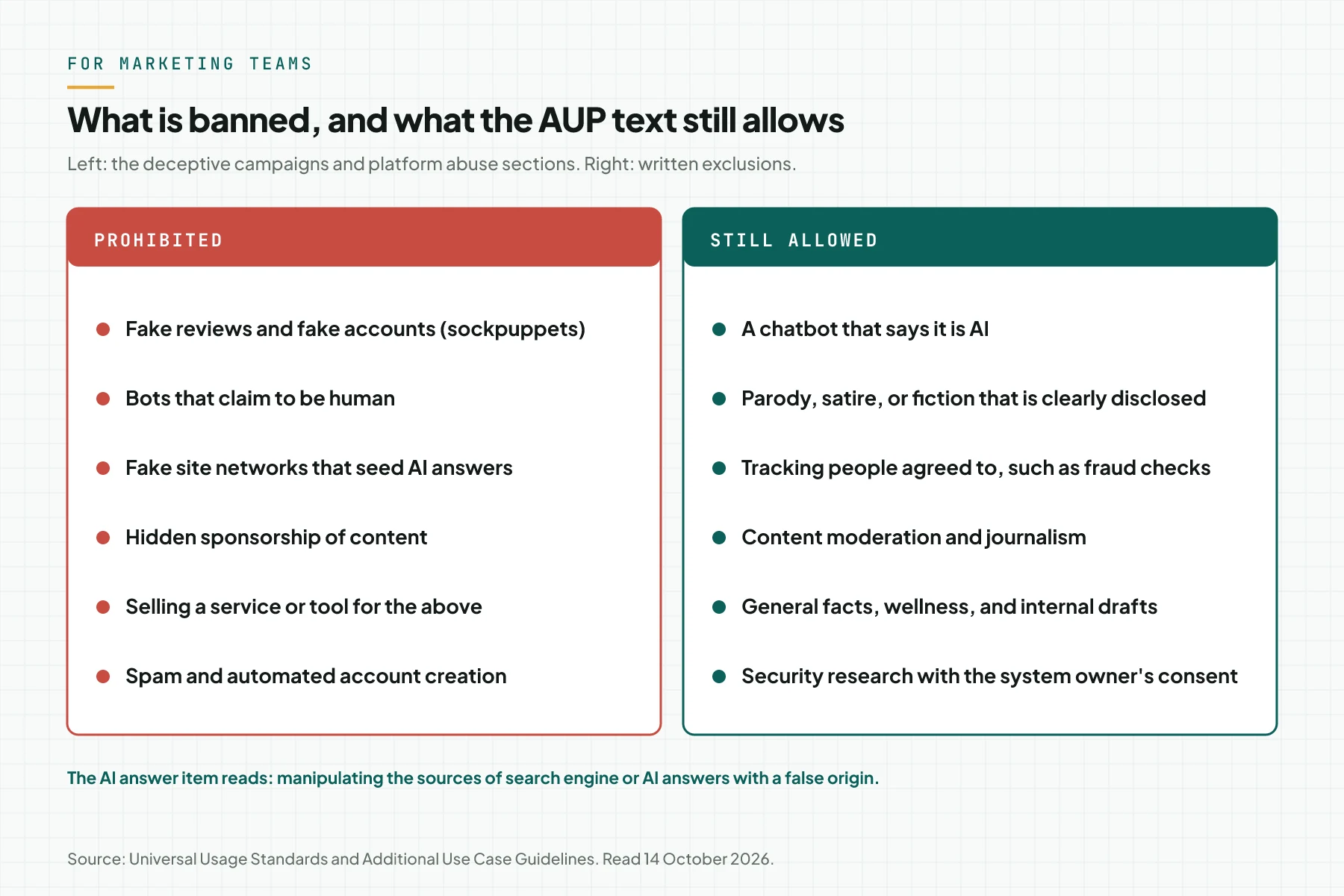
Verify: search for tasks that ask Claude to write reviews in a customer's name, comments from many accounts, or articles for sites that hide their owner. Remove those tasks from the SOP and from saved prompts.
Step 6: Check how your team accesses Claude
The platform abuse section now bans resale, proxy, or access through unauthorized means. The text names services that route requests through consumer subscriptions, or that misrepresent the product or client in use. It also bans stolen payment methods and multiple accounts used to avoid detection or a ban.
Rama Digital recommendation: if your team buys Claude access from a third-party seller, move to a team plan, the API, or an official cloud provider in the company name. The condition: your team uses Claude for client work or customer data.
Also check the supported countries list. Indonesia was on that list on 14 October 2026. Anthropic also writes that companies majority-owned by parties in unsupported regions stay prohibited. Verify: every account has a company owner, a company payment method, and a user list.
Step 7: Write limits for every agent
The new text says users are responsible for the agents they build or deploy, including actions through tools, browsers, and connected systems. So an agent that sends messages, fills forms, or creates accounts carries the same Usage Policy risk as a person who does it.
Write for each agent: the tools it can use, the actions that need approval, and the logs you keep. Verify: during a test, 1 outbound action, such as sending a message, does not run without approval.
If an agent controls physical equipment, read the High-risk Physical Actions part. The equipment must stop or hold a safe state when the supervising person stops it, or when the connection to Claude is lost.
Worked example: an electronics shop with a chatbot and installments
A simulation with dummy data. Sample Shop in Surabaya uses Claude for a WhatsApp chatbot, content, and installment checks. The team reviews 5 findings before 12 November 2026.
| Date | Finding | AUP part | Action |
|---|---|---|---|
| 20 Oct 2026 | Bot "Rina" greets users with no AI mention | Additional guidelines, chatbots | Add "AI assistant" to the first message |
| 21 Oct 2026 | Bot approves a 12-month installment plan | High-risk, credit | Credit staff review it, then the customer is told AI was used |
| 22 Oct 2026 | Bot explains installment terms in general | Exclusion, general facts | No review needed |
| 23 Oct 2026 | Content team asks for 40 reviews from "customers" | Deceptive campaigns | Remove the task, ask real buyers for reviews |
| 24 Oct 2026 | 3 staff share 1 account bought from an access seller | Platform abuse | Move to a team plan in the company name |
Simulation result: 4 of 5 findings need a change, and 1 finding is outside the requirements. The same pattern works for other businesses: check the first bot message, the decision flows, the content tasks, then the accounts.
Checklist for your team
- Map every Claude use. Owner: head of operations. Evidence: a table with 1 owner per row.
- Add an AI disclosure to the first message of every chatbot. Owner: chatbot owner. Evidence: a screenshot of a new session.
- Flag workflows in the 11 high-risk areas. Owner: product owner. Evidence: a status and a 1-sentence reason per workflow.
- Name a qualified reviewer for every high-risk workflow. Owner: head of the related division. Evidence: a log of name, time, and changes.
- Remove fake review, fake account, and fake site network tasks. Owner: head of marketing. Evidence: revised SOPs and prompts.
- Move Claude access to official company accounts. Owner: finance and IT. Evidence: a list of accounts, owners, and payment methods.
- Write tools, approvals, and logs for every agent. Owner: technical team. Evidence: 1 test action held without approval.
- Stop criterion: do not launch a feature that sends high-risk output before a named reviewer and the disclosure are live.
What did not change, and what still needs a lawyer
The core bans stay the same: weapons, child exploitation, malware, fraud, and surveillance without consent. Anthropic also writes that weapons and surveillance enforcement did not change in practice; the text is only clearer. Security research on your own systems, or with the owner's authorization, stays allowed.
The high-risk requirements do not replace local law. If Indonesian law, for example the Personal Data Protection Law, adds duties, follow the stricter rule. For AI content labels in the European Union, also read the Claude text watermark and the EU AI Act.
Frequently asked questions
When does the new Anthropic Usage Policy apply? The new version applies on 12 November 2026. Anthropic announced it on 8 October 2026. Until that date, the 15 September 2025 version stays the reference.
Must my WhatsApp chatbot name Claude? No. The chatbot must tell users they are talking to AI, at the start of each session or in the product interface. The text says you do not need to name Anthropic, Claude, or the model.
Can I still make marketing content with Claude? Yes, as long as the content does not deceive people about its origin, author, or sponsor. The bans cover fake reviews, fake accounts, hidden sponsorship, and fake site networks that seed search engine or AI answers.
Must every finance use have a human review? No. Review is required when the output becomes advice or a decision about 1 person, such as approving credit. General explanations, internal drafts, and operations that decide nothing about 1 person are outside the requirements.
What happens when a Claude output is blocked? The new text says a block from real-time safeguards is not by itself a violation. For cyber security or life sciences work, Anthropic runs verification programs for access with adjusted safeguards.
Does swearing at Claude in frustration break the rules? No. Anthropic writes that the cruelty ban covers only extreme cases that repeat with no purpose. Ordinary frustration, pushback, dark creative themes, and model testing are not included.
Next step
The limit stays the same: this article reads the policy text, and the reading of your own case still needs a legal adviser. If you want to map every Claude use, review flow, and chatbot disclosure in 1 document, the AI Consulting Services for Business service can help. Start when you book a 30-minute initial consultation.
Sources
- Anthropic Usage Policy, effective 12 November 2026. Read 14 October 2026.
- Anthropic Usage Policy, 15 September 2025 version (archive). Read 14 October 2026.
- Anthropic, 2026 Usage Policy update, 8 October 2026. Read 14 October 2026.
- Anthropic, supported countries. Read 14 October 2026.