Direct answer: From 30 September 2026, Anthropic adds its EU AI Act text watermark to output from ClaudeClaude ProThe paid subscription for the Claude AI assistant from Anthropic. It unlocks connectors to outside tools.Open the glossary Fable 5, Claude Sonnet 5, and Claude Opus 4.8. The watermark is a statistical pattern in word choice. Price, latency, token count, and the request and response format stay the same, so your code needs no change. What you must check is your own label duty when your content is used in the European Union (EU).
Main condition: the watermark applies to output from these 3 models on every platform and in every country, including Indonesia, because Anthropic adds it at the model layer. Limit: the watermark only shows that Claude was likely involved. It does not prove who the author is, and this article is not legal advice.
We wrote this article from the Anthropic email to customers dated 24 September 2026, the Claude Help Center, the Anthropic technical article, the text of Article 50 of the EU AI Act, and European Commission pages. We read all sources on 24 September 2026. The worked example in this article uses dummy data.
What Anthropic announced on 24 September 2026
The Anthropic email to customers, 24 September 2026, contains 5 main facts:
- The watermark starts on 30 September 2026 for Claude Fable 5, Claude Sonnet 5, and Claude Opus 4.8 on the Claude Platform.
- The rollout on Amazon Bedrock, Google Cloud, and Microsoft Foundry can take a few more days.
- It is the same watermark that Claude Fable 5.1, Claude Opus 5.5, and Claude Opus 5 already carry.
- New models released after 2 August 2026 carry the watermark from launch, starting with Claude Fable 5.1. Claude Opus 5 was the first earlier model, on 14 September 2026.
- Customers do not need to take any action.
The model table in the Claude Help Center article "How Claude marks AI-generated content" on 24 September 2026 matches the email. Full text watermarks are active on Fable 5.1, Mythos 5.1, Opus 5.5, and Opus 5. On Opus 5, cloud partners get the watermark step by step from 14 September 2026, in full within 1 week. 10 other models add only Content Credentials (C2PA) to files so far.
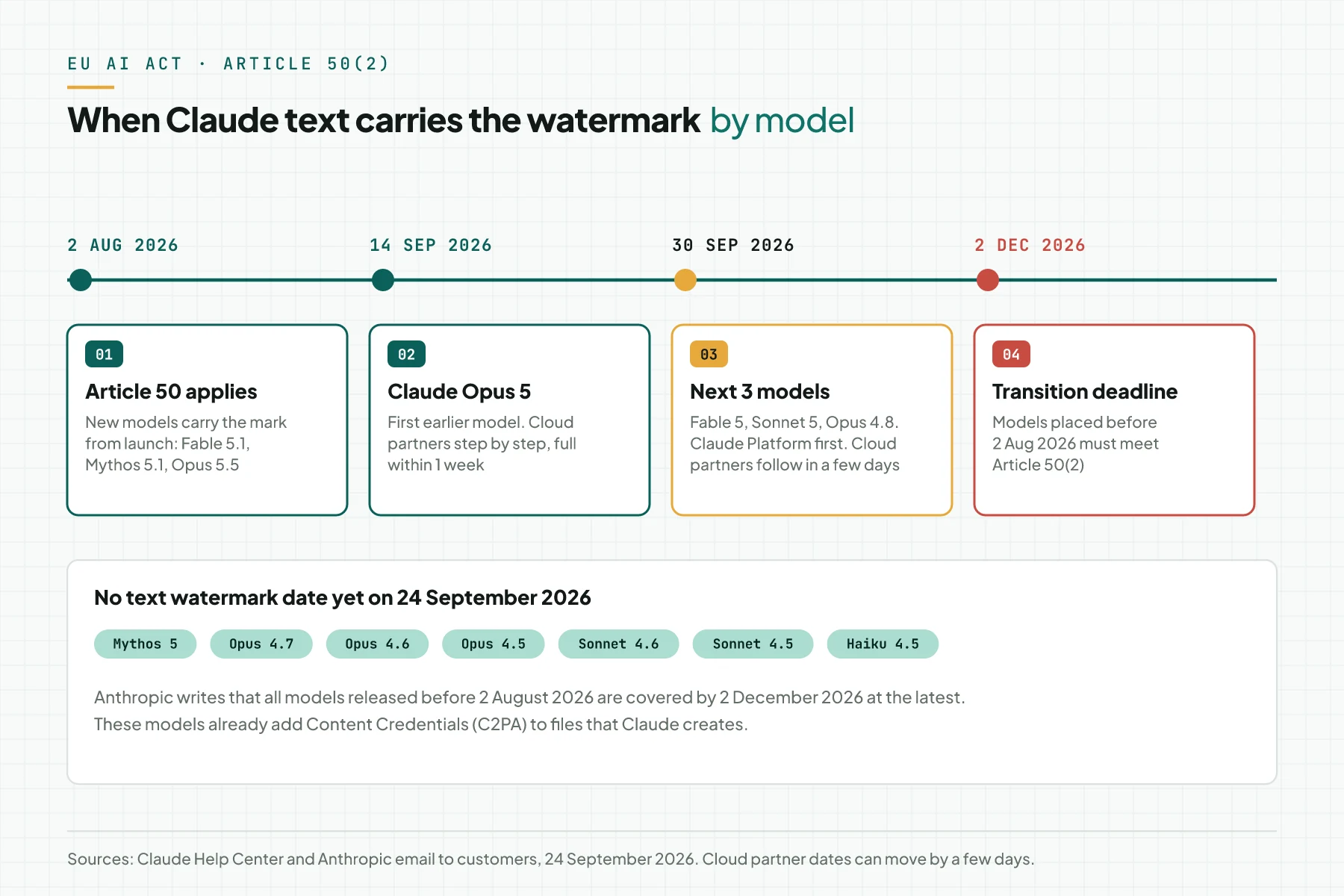
What the timeline tells you: if your team uses an older model, such as Sonnet 4.6 or Haiku 4.5, the text watermark arrives by 2 December 2026 at the latest. Anthropic writes that all models released before 2 August 2026 are covered by that date. We cover the price and migration of the newest model in our Claude Opus 5.5 release notes.
The problems your team can face
Many teams read the word "watermark" and fear that their content will look AI-made. Readers cannot see this watermark. Detection needs the Anthropic key, and the detection APIAPIThe official door 2 systems use to exchange data, without anybody copying it by hand.Open the glossary is still a private preview for specific organizations.
The real risk is in the other direction. Teams think the Anthropic watermark meets every EU AI Act duty. The watermark is the duty of the model provider. The label on published content is the duty of the publisher, and that duty stays.
The third risk is "anti-detection" tools that rewrite text. These tools add cost and work, but they do not change your label duty. Step 5 below explains why.
How the Claude text watermark works
Word choice with a different source of randomness
A language model picks 1 word at a time. Often several words are equally good, for example "overcast" or "grey", and a random number picks one of them. With the watermark, a secret key and the few words before it become the source of that random number.
The result still looks random to a reader. A key holder can check whether the sequence of word choices matches the key. Anthropic calls its method a version of the SynthID-Text approach from Google DeepMind, published in Nature in 2024. Source: Anthropic article "How Claude's text watermark works", 14 August 2026, updated 1 September 2026.
What does not change
According to the Anthropic email and the same article, the watermark adds no hidden characters and no tokens. It does not change price, latency, or the request and response format. It also holds no information about the user, the organization, or the conversation.
Where the watermark signal is weak
Anthropic lists 5 limits. Short text gives a weak signal. Factual answers give few word choices. Code carries almost no watermark, except in comments. Light proofreading changes only a few words. A full rewrite removes the watermark, while a translation by Claude still carries it.
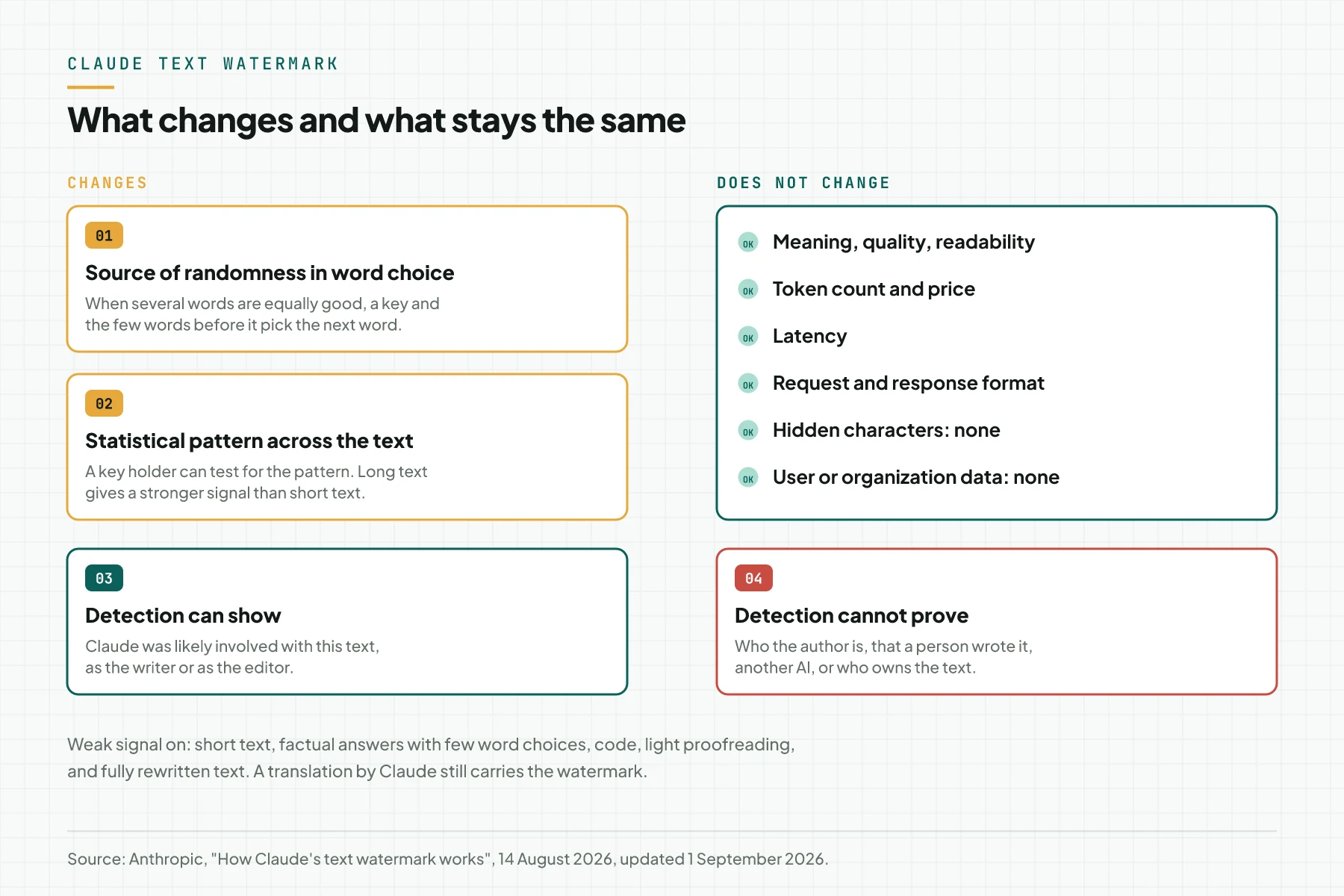
The diagram shows the key decision for technical teams: nothing changes in the API integration. For content teams, a detection result only says "Claude was likely involved". It does not say who the author is or who owns the text.
The text watermark is not the same as Content Credentials (C2PA)
For files such as PNG and JPEG, Claude adds signed metadata with the C2PA standard. You can check such a file with the free Claude Content Checker. The metadata can disappear after a format conversionConversionThe action you count as a result, for example a paid order, a sign-up, or a chat that becomes a qualified buyer.Open the glossary, a re-save, or a screenshot, according to the Claude Help Center.
| Item | Claude text watermark | Content Credentials (C2PA) | Third-party AI detector |
|---|---|---|---|
| Where the mark lives | Inside the word choices | In the file metadata | No mark. The tool guesses from writing style |
| Who can check | Key holders. The detection API is a private preview | Anyone with a C2PA tool or Claude Content Checker | Customers of that tool |
| Survives | Copy and paste, light edits | Copying the whole file | Depends on the tool model |
| Lost through | A full rewrite, short text | Format conversion, re-save, screenshot | Not applicable |
| What it proves | Claude was likely involved | Claude made or processed the file | An estimate, not proof |
Table sources: the Claude Help Center and the Anthropic article, read on 24 September 2026. Anthropic says third-party detectors use a different method because their providers do not hold the Anthropic key.
What the EU AI Act says about watermarks and labels
Article 50 of Regulation (EU) 2024/1689 (EU AI Act) applies from 2 August 2026. Article 50(2) requires providers of generative AI systems to mark output in a machine-readable format. It does not set a specific technique, according to the European Commission FAQ on Article 50, updated 24 July 2026.
Systems already on the market before 2 August 2026 have until 2 December 2026 for this marking duty. That transition comes from Regulation (EU) 2026/1744 (Digital Omnibus on AI), in force since 27 July 2026. This is the December deadline that the Anthropic email mentions.
Article 50(4) covers the party that publishes content, called the deployer. A deployer must disclose deepfakes. A deployer must also disclose AI-generated text that is published to inform the public on matters of public interest. The exception: the text went through human review or editorial control, and a person or entity holds editorial responsibility.
The Commission FAQ also states 2 facts that matter for businesses outside the EU. Providers outside the EU fall under these rules when the output of their system is used in the EU. Fines for breaking Article 50 can reach 15 million euros or 3% of global annual turnover.
The final Code of Practice on Transparency of AI-generated Content was published on 10 June 2026. About 190 organizations signed it by the end of July 2026, including Anthropic. The Commission also provides a set of icons that deployers can use as labels.
Prerequisites
- Read access to the code, configuration, or workflows that call Claude.
- Access to usage reports in the Claude Console or at your cloud partner.
- A list of the clients, markets, and channels where your content is published.
- 1 person who holds editorial responsibility for published content.
- 1 published piece of Claude-made content, to test the review flow.
Step 1: List the Claude models you call
Search your repositories and configuration for model names. Example command: grep -rnE "fable-5|sonnet-5|opus-4-8|opus-5" .. Compare the result with the usage report in the Claude Console or at your cloud partner.
Write 1 row for each model: model name, platform, and the watermark date from the timeline above. Remember that Bedrock, Google Cloud, and Microsoft Foundry can follow a few days after 30 September 2026. If you are still choosing a model, read our comparison of GPT-6 Sol, GPT-6 Luna, and Claude Opus 5.5.
Verify: every model in the code appears in the list, and no model in the list is missing from the code.
Step 2: Check whether your output is used in the EU
Mark every channel that reaches people in the EU. Examples are an agency client in Germany, newsletter readers in the Netherlands, or a chatbot on an English website with visitors from the EU. Article 2(1)(c) of the EU AI Act covers deployers outside the EU when the AI output is used in the EU.
Output used only in Indonesia does not fall under Article 50. The watermark is still in that output, because Anthropic applies it globally.
Verify: every channel has a column "used in the EU: yes or no", with the name of the channel owner.
Step 3: Decide which content needs a label
Use the 4 questions in the diagram below for every type of content used in the EU. Start at question 1, then follow the YES or NO answer.
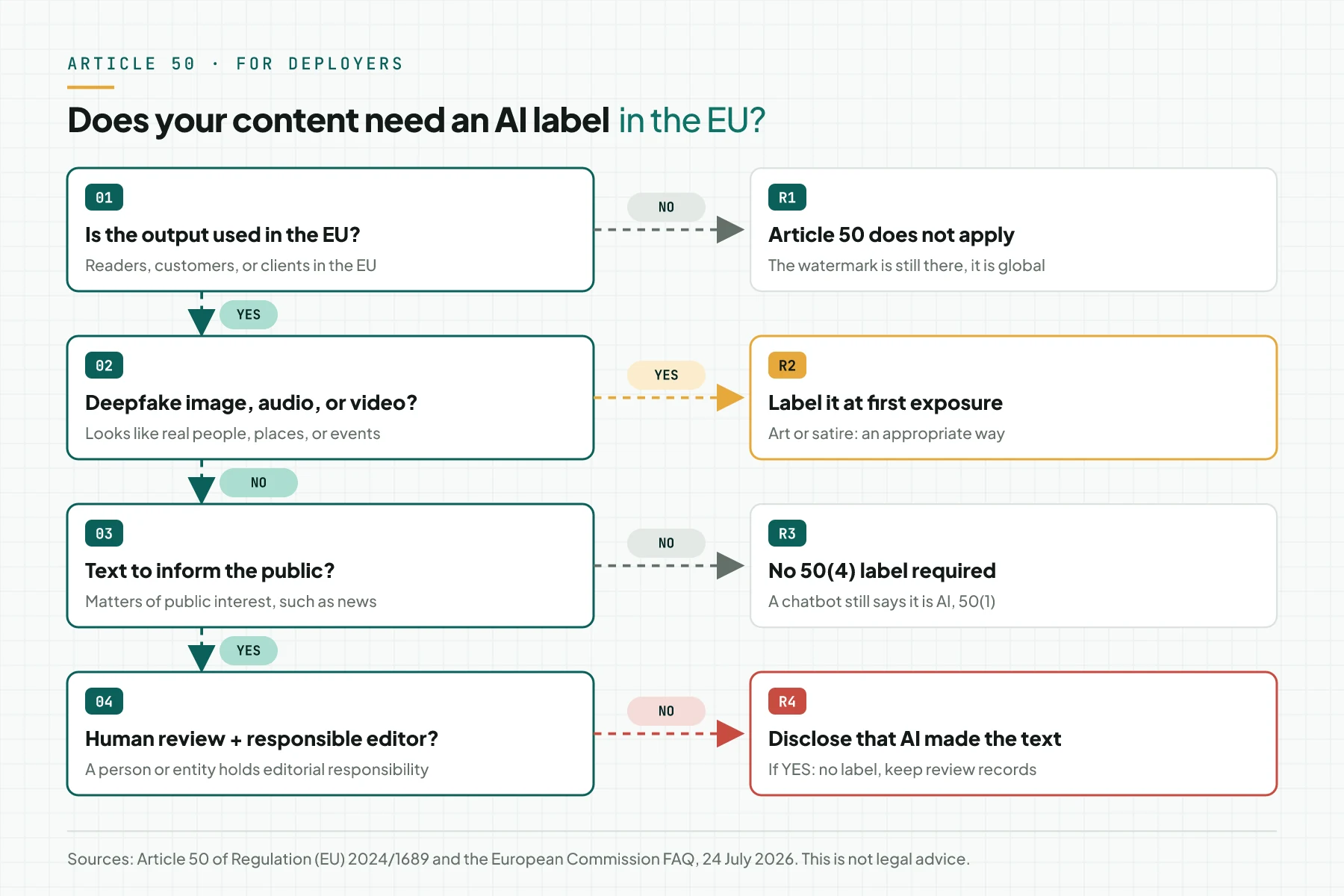
Article 50(4) names text that informs the public on matters of public interest, such as news. It does not name product ads specifically. Ask a legal adviser when your content sits on the border.
For a chatbot that serves people in the EU, Article 50(1) asks that people know they talk to an AI, unless this is already obvious. Verify: every content type has a written result from R1 to R4.
Step 4: Keep human review records
The Article 50(4) exception needs human review and editorial responsibility. The Commission FAQ explains that human review means a deliberate check by people with relevant expertise. Editorial control means a party with the authority to approve, change, or reject the content.
For every published piece, record 5 items: the model used, the reviewer name, the review date, the parts that changed, and the name of the person with editorial responsibility. Keep the record in a system your team already uses, such as document history or a ticket.
Verify: pick 1 article published this week. You must be able to show the 5 records within 5 minutes.
Step 5: Do not rely on "anti-detection" rewrites
Anthropic writes that light editing probably does not remove the watermark, while a full rewrite does. But the Article 50(4) label duty depends on the content type and the review process. It does not depend on whether a watermark is present.
The watermark also holds none of your data, so there is no privacy reason to remove it. Rama Digital recommendation: spend editor time on real review and review records, not on tools that promise "undetectable" text. This recommendation holds when your content is published under your business name.
Verify: your content SOP has no "remove AI traces" step as a condition to publish.
Step 6 (optional): Request access to the watermark detection API
The Claude watermark detection API is still a private preview. According to the Claude Help Center, access is for organizations eligible under EU law, such as regulators, law enforcement, media, fact-checkers, independent researchers, educational organizations, and EU civil society groups. Enterprises that must verify watermarks for their own compliance can also request access.
Fill in the access form from that Help Center page if your organization is in one of these groups. For image files, use the Claude Content Checker, which is open to everyone.
Verify: record the form submission date and the name of the access owner in your team.
Worked example: a Jakarta agency with a client in Germany
This example is a simulation with dummy data. "Example Agency" in Jakarta writes a city news newsletter for "Example Client GmbH" in Germany. The agency uses Claude Sonnet 5 on the Claude Platform.
| Date | Event | What is recorded | Decision |
|---|---|---|---|
| 29 Sep 2026 | The team lists models and channels | Sonnet 5, Claude Platform, EU newsletter | This channel goes to Step 3 |
| 1 Oct 2026 | Claude writes a 900-word draft on city parking rules | Model, date, and prompt stored in a ticket | The draft carries the watermark, because it was made after 30 September |
| 1 Oct 2026 | The agency editor checks facts and changes 30% of the sentences | Editor name, 45 minutes, list of changes | Human review is recorded |
| 2 Oct 2026 | The client editor-in-chief approves | Name of the person with editorial responsibility and the approval | Question 3: YES. Question 4: YES |
| 2 Oct 2026 | The newsletter is published | Published link and the 5 review records | No Article 50(4) label is required. The watermark stays and causes no conflict |
In the same simulation, the agency also writes product descriptions for an Indonesian marketplace with the same model. That output is not used in the EU, so the result is R1. The watermark is still there, but there is no Article 50 label duty.
Checklist for your team
- List the Claude models and their platforms. Owner: lead developer. Evidence: model list with watermark dates.
- Mark the channels used in the EU. Owner: account manager. Evidence: channel list with an EU column.
- Give every EU content type a result from R1 to R4. Owner: head of content. Evidence: decision table.
- Add a label to content with result R2 or R4. Owner: editor. Evidence: screenshot of the label on the published page.
- Keep the 5 review records for every published piece. Owner: editor. Evidence: ticket or document history.
- Remove any "remove AI traces" step from the SOP. Owner: head of content. Evidence: new SOP version.
- Review the model list again on 2 December 2026. Owner: lead developer. Stop criterion: do not publish R4 content in the EU without a label or review records.
How Claude compares with other providers
Anthropic writes that other major model providers signed the same Code of Practice and will add their own watermarks. This table holds facts from each provider page on 24 September 2026.
| Item | Anthropic (Claude) | Google (Gemini) | OpenAI |
|---|---|---|---|
| Text watermark | Active on 4 models, 3 more from 30 September 2026 | SynthID active on text in the Gemini app and web | The help page states a goal to extend provenance signals to text. We found no date |
| Text method | A version of SynthID-Text | SynthID-Text, open source in Hugging Face Transformers v4.46.0 and later | No text method announced on that page |
| Detection tool | Detection API, private preview | SynthID Detector portal for early testers. The page names image, video, and audio | Not named for text |
| Mark on files | C2PA on PNG and JPEG | SynthID on media | C2PA and SynthID on media |
Sources: Claude Help Center, Google DeepMind SynthID page, SynthID Text developer docs, and OpenAI provenance help page. Rama Digital recommendation: choose a model by task, cost, and quality, not to avoid a watermark. The Article 50(4) label rules stay the same for content from any provider.
Frequently asked questions
Does the Claude watermark add cost or slow down the API? No. The Anthropic email dated 24 September 2026 states that the watermark adds no characters or tokens, and does not change price, latency, or the request and response format.
Does the watermark contain data about me or my organization? No. Anthropic writes that the watermark and its key hold no information about the user, the organization, or the conversations with Claude.
Can readers see the watermark in my text? No. The pattern is not visible. Detection needs the Anthropic key, and the detection API is still a private preview for eligible organizations.
Must I label all content that Claude writes? No. The Article 50(4) label applies to deepfakes and public-information text used in the EU without human review and editorial responsibility. The watermark is the duty of Anthropic.
Does the watermark disappear after I edit the text? Partly. Light editing probably does not remove it. A full rewrite removes it. Short text gives a weak signal from the start.
Does the EU AI Act apply to a business in Indonesia? Only when the AI output is used in the EU. Article 2 of the EU AI Act covers providers and deployers outside the EU in that case. Output used only in Indonesia does not fall under Article 50.
Next step
The watermark does not change your API integration. The label duty and the review records stay with your team, and the legal reading of your case needs a legal adviser. If you want to map your AI use, your EU channels, and your team review flow, the AI Consulting Services for Business service can help. Start with a 30-minute initial consultation.
Sources
- Anthropic email to customers, "Watermarking begins September 30, 2026", 24 September 2026 (not public).
- Claude Help Center: How Claude marks AI-generated content
- Anthropic: How Claude's text watermark works
- Claude Content Checker
- EUR-Lex: Regulation (EU) 2024/1689 (EU AI Act)
- EUR-Lex: Regulation (EU) 2026/1744 (Digital Omnibus on AI)
- European Commission: Transparency obligations under Article 50 of the AI Act
- European Commission: Code of Practice on Transparency of AI-generated Content
- Google DeepMind: SynthID
- Google AI for Developers: SynthID Text
- OpenAI Help Center: Provenance signals in OpenAI-generated content