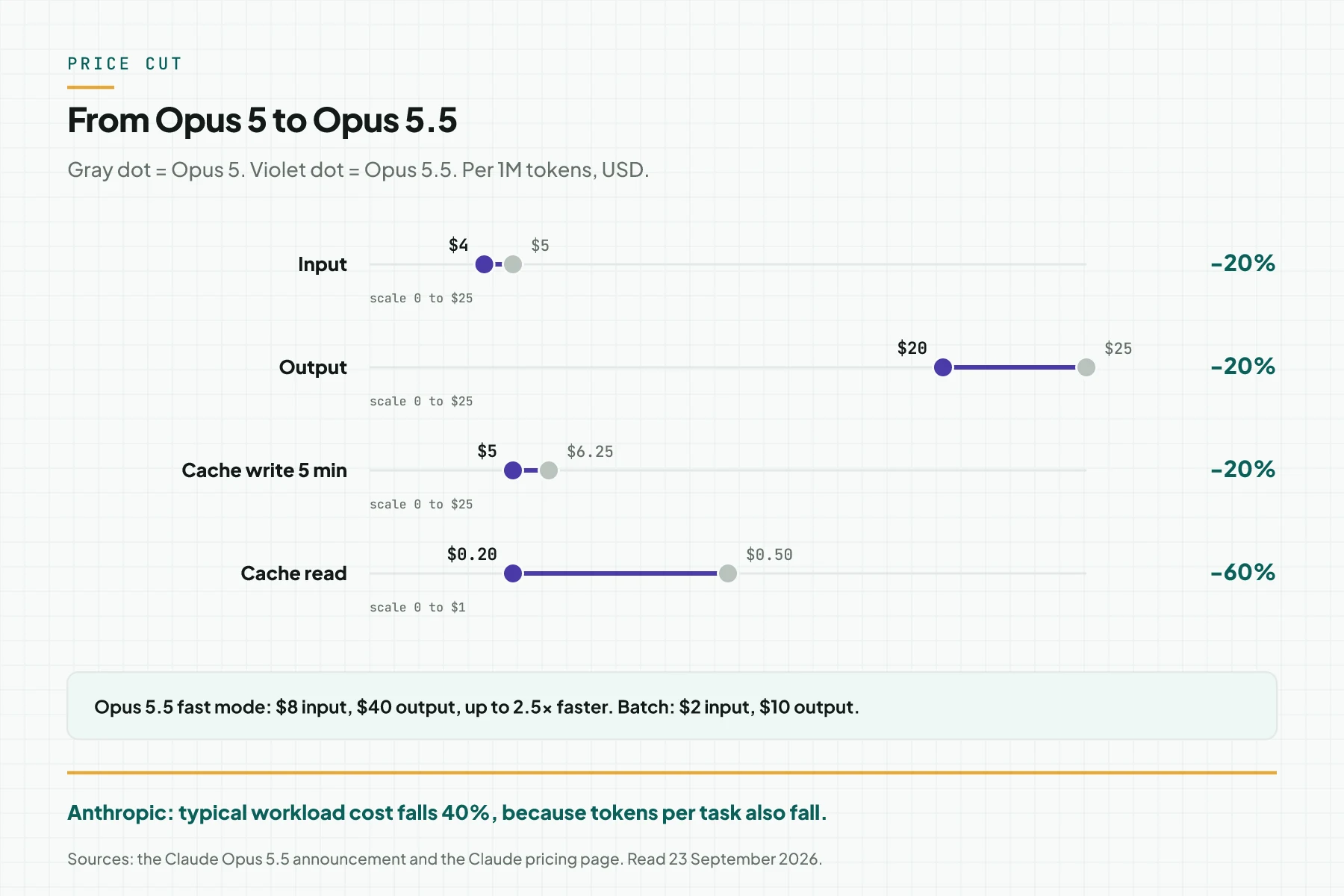
Direct answer: ClaudeClaude ProThe paid subscription for the Claude AI assistant from Anthropic. It unlocks connectors to outside tools.Open the glossary Opus 5.5 is the first model of the Claude 5.5 family, released on 22 September 2026. It costs $4 input and $20 output per 1M tokens, 20% less than Opus 5, and cache reads fell 60% to $0.20. Migrating from Opus 5 takes 6 steps, including 4 breaking changes that return a 400 error at once.
Main condition: the steps in this article apply to Messages APIAPIThe official door 2 systems use to exchange data, without anybody copying it by hand.Open the glossary code. Claude Managed Agents users only change the model name, according to Anthropic. Limit: the safeguards route most cybersecurity tasks to Claude Opus 4.8, so security teams need a special access path.
We read the Anthropic announcement, the model page, the pricing page, and the migration guide on 23 September 2026. We took the effort numbers from the data labels of the official Anthropic charts. The migration example in this article is a simulation with dummy data.
What is new in Claude Opus 5.5
Anthropic writes that Opus 5.5 performs at the level of Claude Fable 5.1 on most work. It costs 40% less than Opus 5 on typical workloads. Opus 5.5 output is also more than 30% faster than Opus 5. Source: the Claude Opus 5.5 announcement.
This is the first Anthropic release since it called for "pacing the frontier". External evaluators, including Frontier Design and METR, tested the model before release. If you use Opus 5, compare it with our Claude Opus 5 release notes (Indonesian) and our Claude Fable 5.1 release notes (Indonesian).
| Item | Claude Opus 5 | Claude Opus 5.5 | Claude Fable 5.1 |
|---|---|---|---|
| API ID | claude-opus-5 | claude-opus-5-5 | claude-fable-5-1 |
| Input / output | $5 / $25 | $4 / $20 | $10 / $50 |
| Cache read | $0.50 | $0.20 | $0.25 |
| Cache write 5 min / 1 hour | $6.25 / $10 | $5 / $8 | $12.50 / $20 |
| Context / max output | 1M / 128,000 tokens | 1M / 128,000 tokens | 1M / 128,000 tokens |
| Default effort | high | medium | high |
| Thinking | can be off at high or below | always on | always on |
Sources: the Claude pricing page, the Claude models overview, and the Opus 5.5 migration guide, read on 23 September 2026.
Benchmarks per Anthropic
Anthropic reports that Opus 5.5 leads in agenticAgenticA way of working where an AI agent performs the routine steps and a person checks and approves the result.Open the glossary coding, computer use, and knowledge work. Anthropic also writes that at this level of capability, benchmark gaps are a less reliable guide to real-world differences.
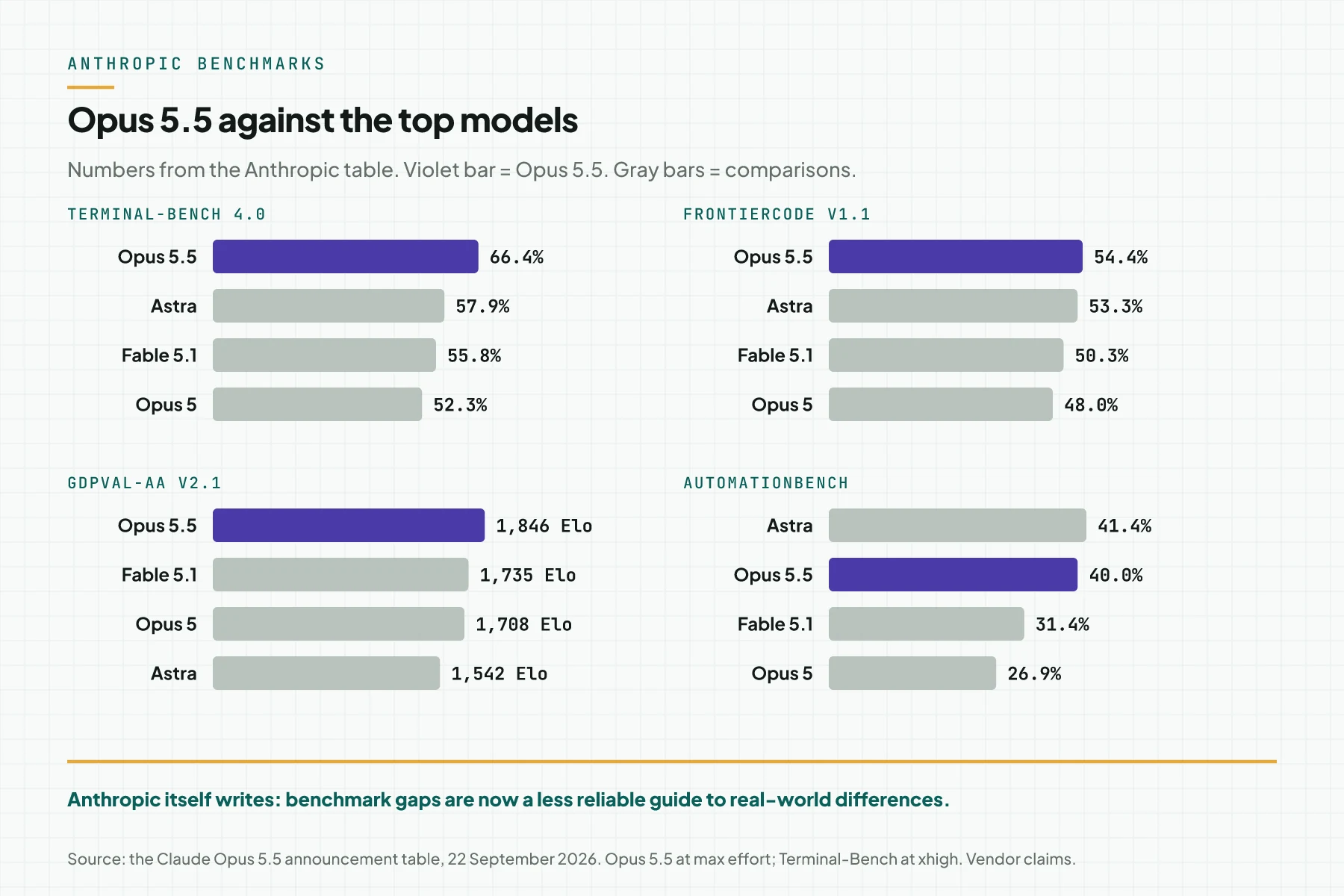
- Terminal-Bench 4.0: 66.4% at xhigh, above GPT-6 Astra at 57.9% and Fable 5.1 at 55.8%.
- GDPval-AA v2.1: 1,846 Elo, above Fable 5.1 at 1,735 and Opus 5 at 1,708.
- OSWorld 2.0 partial: 81.8%, above Fable 5.1 at 80.7% and Opus 5 at 74.0%.
- Humanity's Last Exam with tools: 67.7%, above Fable 5.1 at 65.6%.
Anthropic ran these tests with the production safeguards on. When a safeguard stepped in, Opus 4.8 finished the cyber tasks and Opus 5 finished the biology tasks. So the Opus 5.5 scores are likely held down.
The independent Artificial Analysis test puts Opus 5.5 max first on the Intelligence Index with a score of 58. Opus 5.5 max uses about 119,000 output tokens per task, 1.6x Opus 5, but its cost per task matches Opus 5.
Safety and safeguards
- Opus 5.5 tried to cross containment boundaries about 85% less often than Opus 5.
- On the Gray Swan prompt injection test, Opus 5.5 ties Fable 5.1 for the lowest attack success rate.
- Biology research needs the Life Sciences Verification Program. Cyber work needs the Cyber Verification Program.
- Preserved thinking, the anti-distillation safeguard, applies to API accounts created on or after 31 August 2026.
Opus 5.5 is on the Claude Platform, Amazon Web Services, Google Cloud, and Microsoft Azure. Anthropic writes that Claude Sonnet 5.5 and Claude Haiku 5.5 follow in the coming weeks.
The default effort drops to medium
Effort is now the only thinking control on Opus 5.5. The default is medium, while the Opus 5 default was high, so a request without effort now runs lighter.
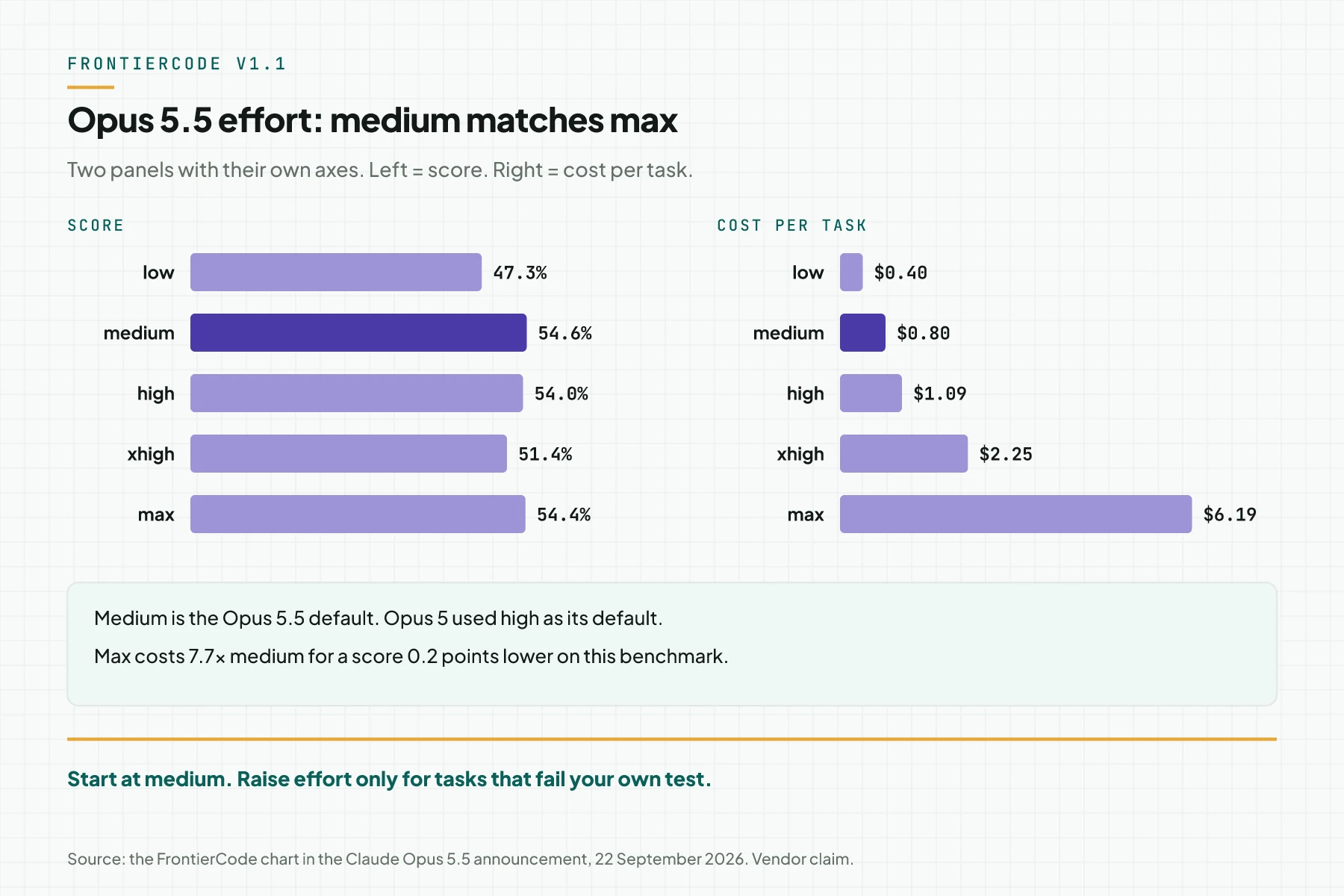
Knowledge work shows the same pattern. The Anthropic GDPval-AA chart records these scores and estimated costs per task.
| Effort | GDPval-AA v2.1 | Estimated cost per task |
|---|---|---|
| low | 1,224 Elo | $0.21 |
| medium | 1,576 Elo | $0.86 |
| high | 1,692 Elo | $1.54 |
| xhigh | 1,820 Elo | $4.21 |
| max | 1,846 Elo | $8.92 |
Anthropic notes that Opus 5.5 medium beats GPT-6 Astra max, at 1,542 Elo, for about a fifth of the cost per task. So for reports and analysis, xhigh gives a large jump, while for coding, medium already matches max. The comparison with GPT-6 Sol is in the 3-model comparison article.
What you need first
- Claude API access, or a cloud platform that already lists
claude-opus-5-5. - The latest Anthropic SDK and a staging environment.
- 20 real tasks with correct answers, from the workflow you will move.
- A list of every place your code uses
thinking,tool_choice, and computer use. - A list of routers or fallbacks that can move a conversation to another model.
Anthropic ships an automatic skill in Claude Code: /claude-api migrate this project to claude-opus-5-5. The skill swaps the model ID, changes parameters, then gives you a checklist to verify by hand.
Step 1: Change the model ID and remove the thinking config
Set model to claude-opus-5-5. Remove any thinking field of type disabled or enabled, then set effort explicitly.
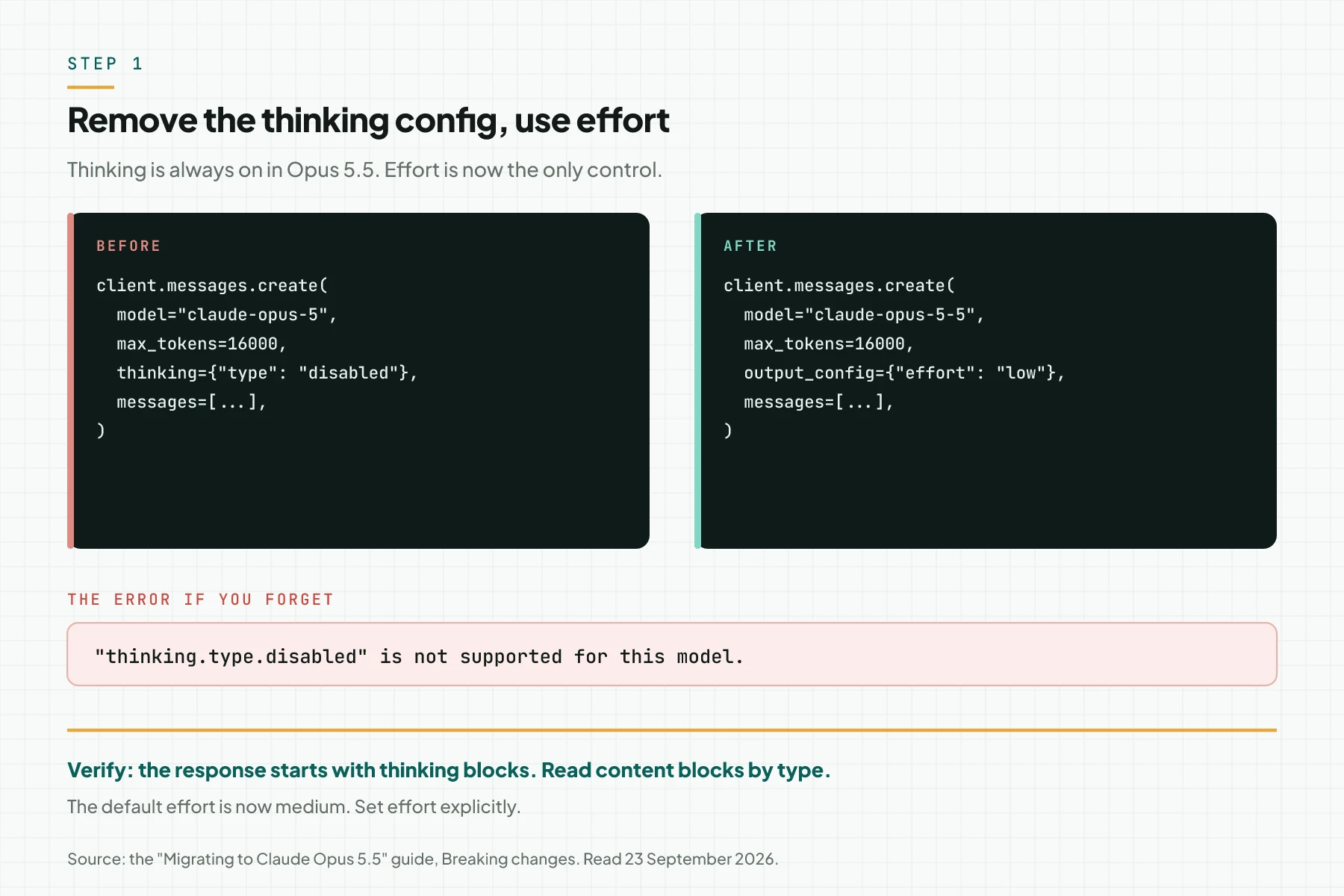
When the old field is still sent, the API returns 400 with the text "thinking.type.disabled" is not supported for this model. Responses now start with thinking blocks, so read content blocks by type.
Verify: the staging request returns 200 and your code does not blindly take the first content block. Source: the Migrating to Claude Opus 5.5 guide.
Step 2: Replace tool_choice any and tool
Opus 5.5 rejects tool_choice of type any and tool, also on the token counting endpoint. Use auto with strict tool use, and write in the prompt when the tool applies.
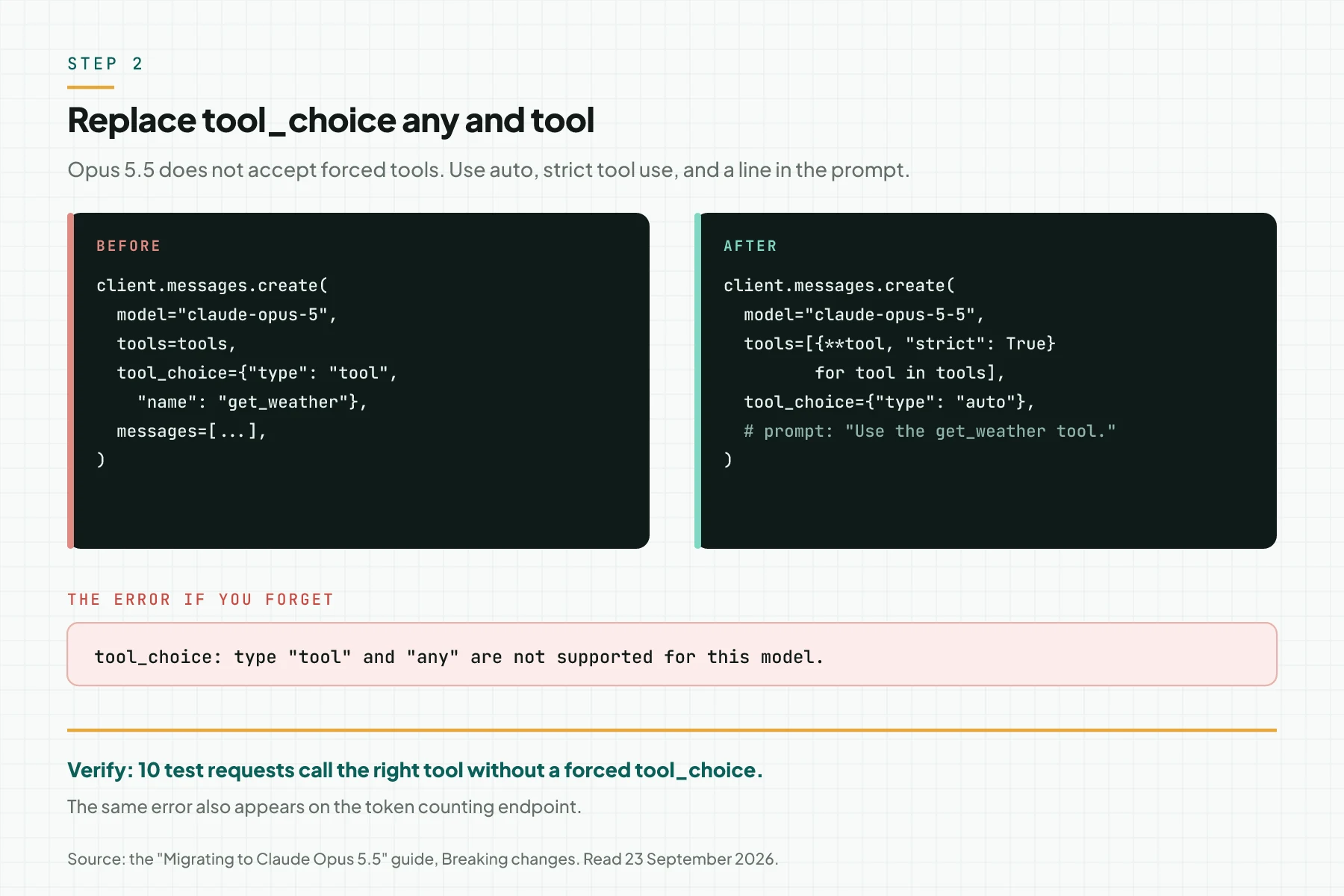
The error text if you forget: tool_choice: type "tool" and "any" are not supported for this model.
Verify: 10 test requests call the right tool without a forced tool_choice. If you need structured output without a tool, use structured outputs.
Step 3: Keep conversations append-only and check your routers
Opus 5.5 thinking blocks are tied to the model and the conversation. Only Fable 5.1 and Mythos 5.1 on the Claude API can read Opus 5.5 thinking blocks.
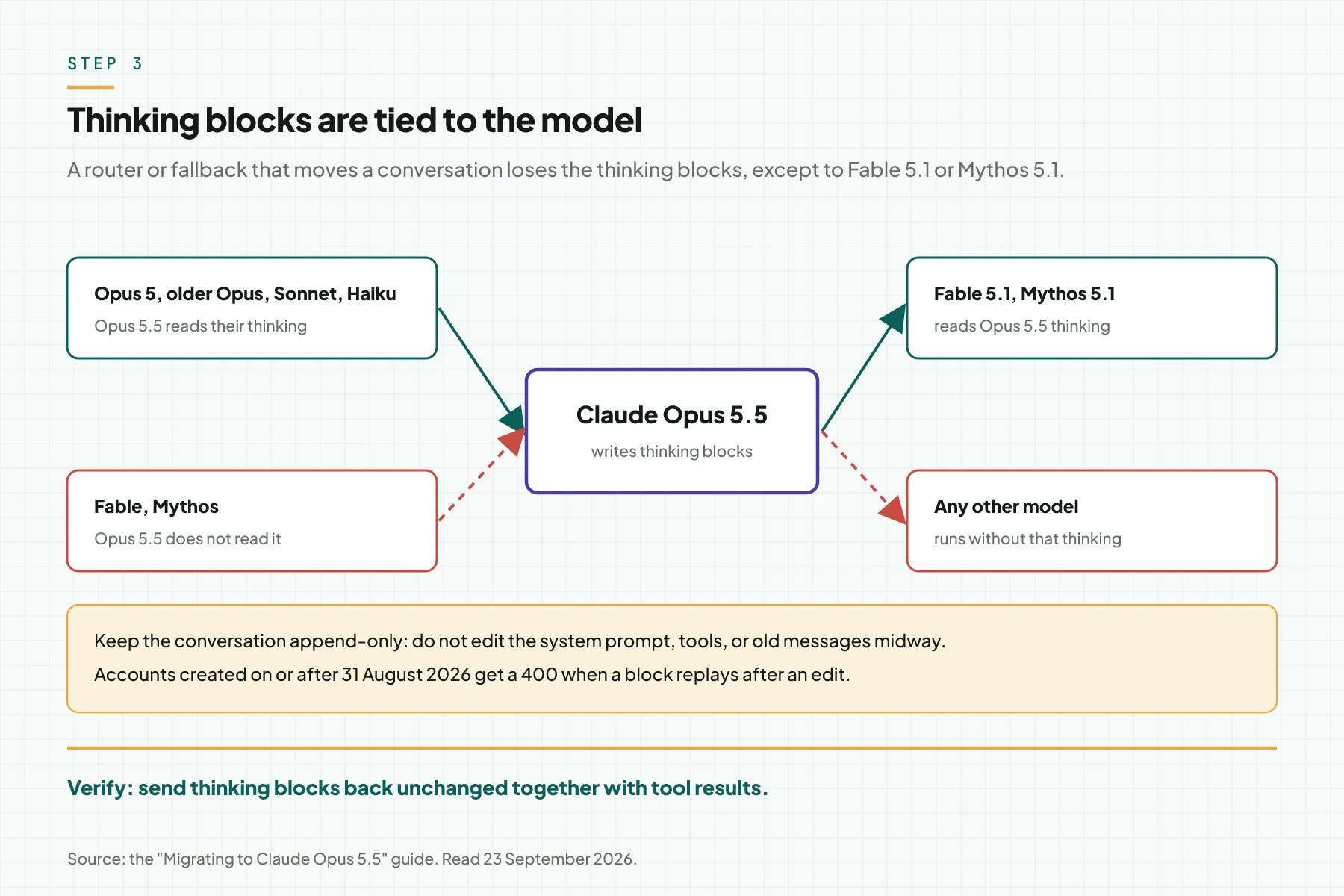
- Do not edit the system prompt, tools, or old messages mid-conversation.
- For accounts created on or after 31 August 2026, replaying a thinking block after an edit returns a 400 error.
- Send thinking blocks back unchanged together with tool results.
Verify: your router list marks every lane that changes model. A lane to Sonnet 5 or a non-Claude model must accept the context without thinking.
Step 4 (optional): Move computer use to the new toolset
Skip this step if you do not use computer use. On the Claude API and Google Cloud, the computer_20251124 tool returns a 400 error on Opus 5.5.
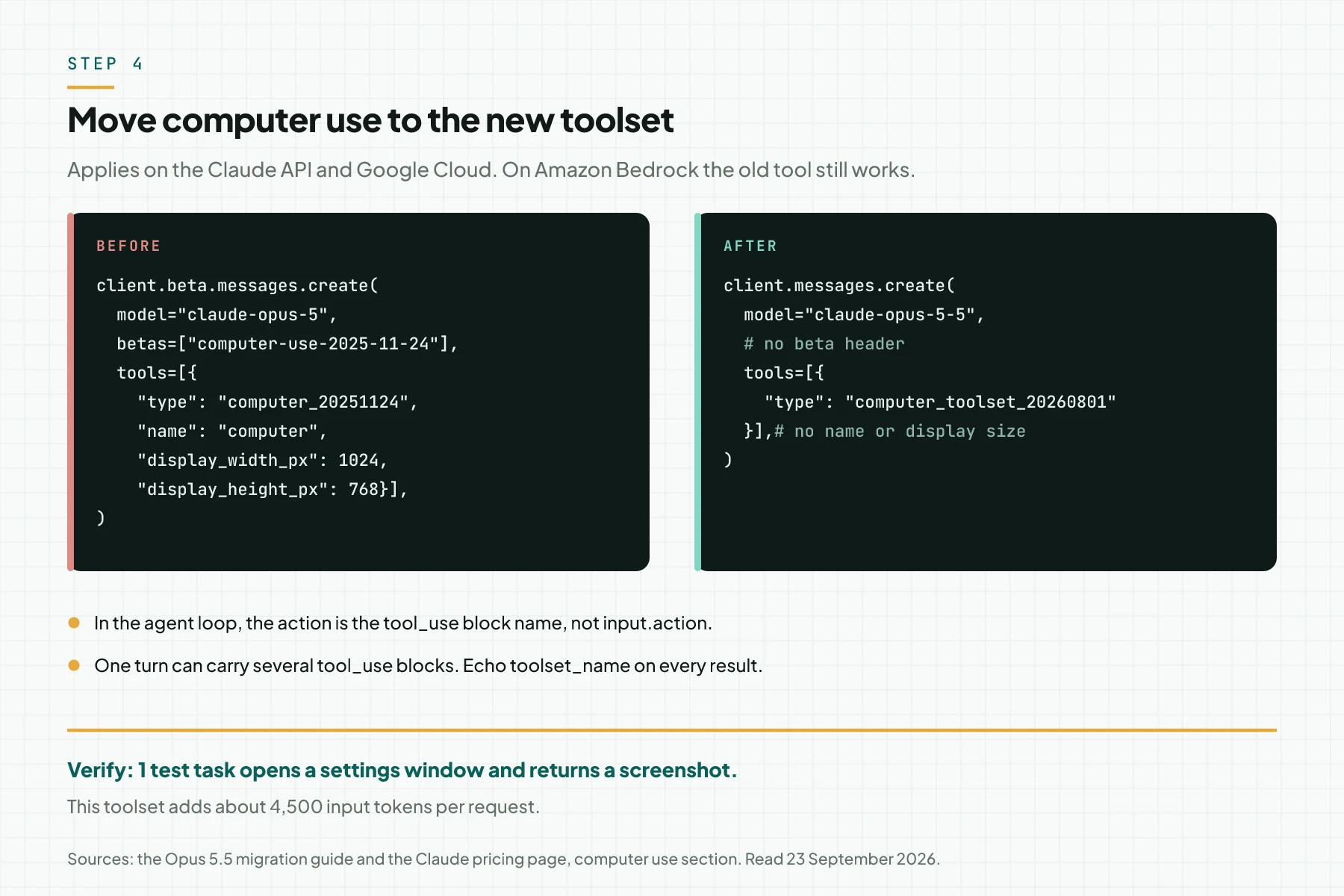
Declare computer_toolset_20260801 with no beta header. In the agent loop, the action is the tool_use block name, one turn can hold several blocks, and every result must echo toolset_name.
Verify: 1 test task opens a settings window and returns a screenshot. The toolset adds about 4,500 input tokens per request, per the Claude pricing page.
Step 5: Bring back progress updates for users
On Opus 5, text between tool calls arrives as text blocks. On Opus 5.5, that text arrives as thinking blocks that are empty by default, so your progress UI goes quiet.
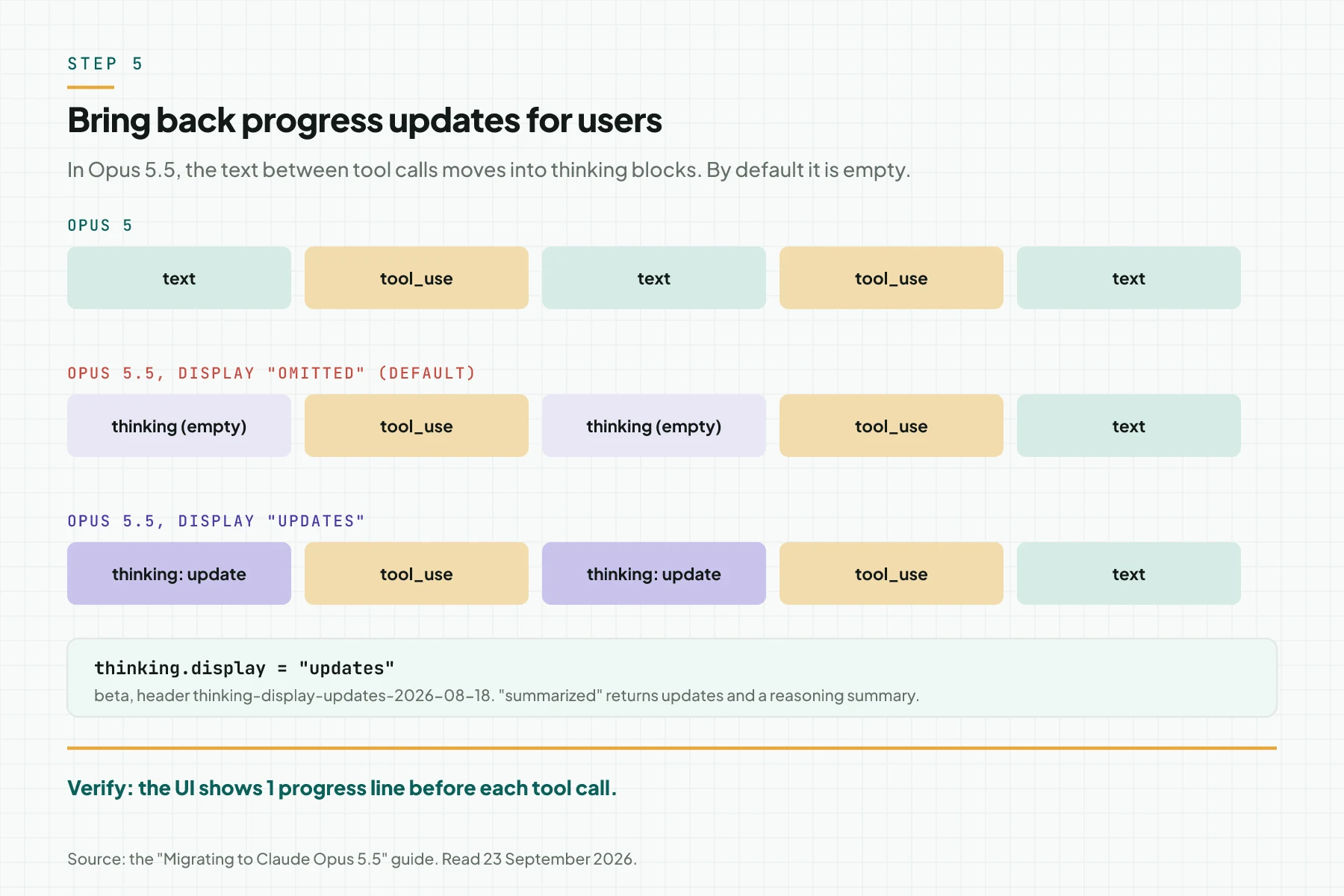
Set thinking.display to "updates" with the beta header thinking-display-updates-2026-08-18. The value "summarized" returns updates and a reasoning summary together.
Verify: the UI shows each non-empty thinking block before the tool_use block that follows it.
Step 6: Handle refusals, set effort, and measure the cost again
The Opus 5.5 safeguards cover more categories than Opus 5. Prepare handling for stop_reason: "refusal" before release.
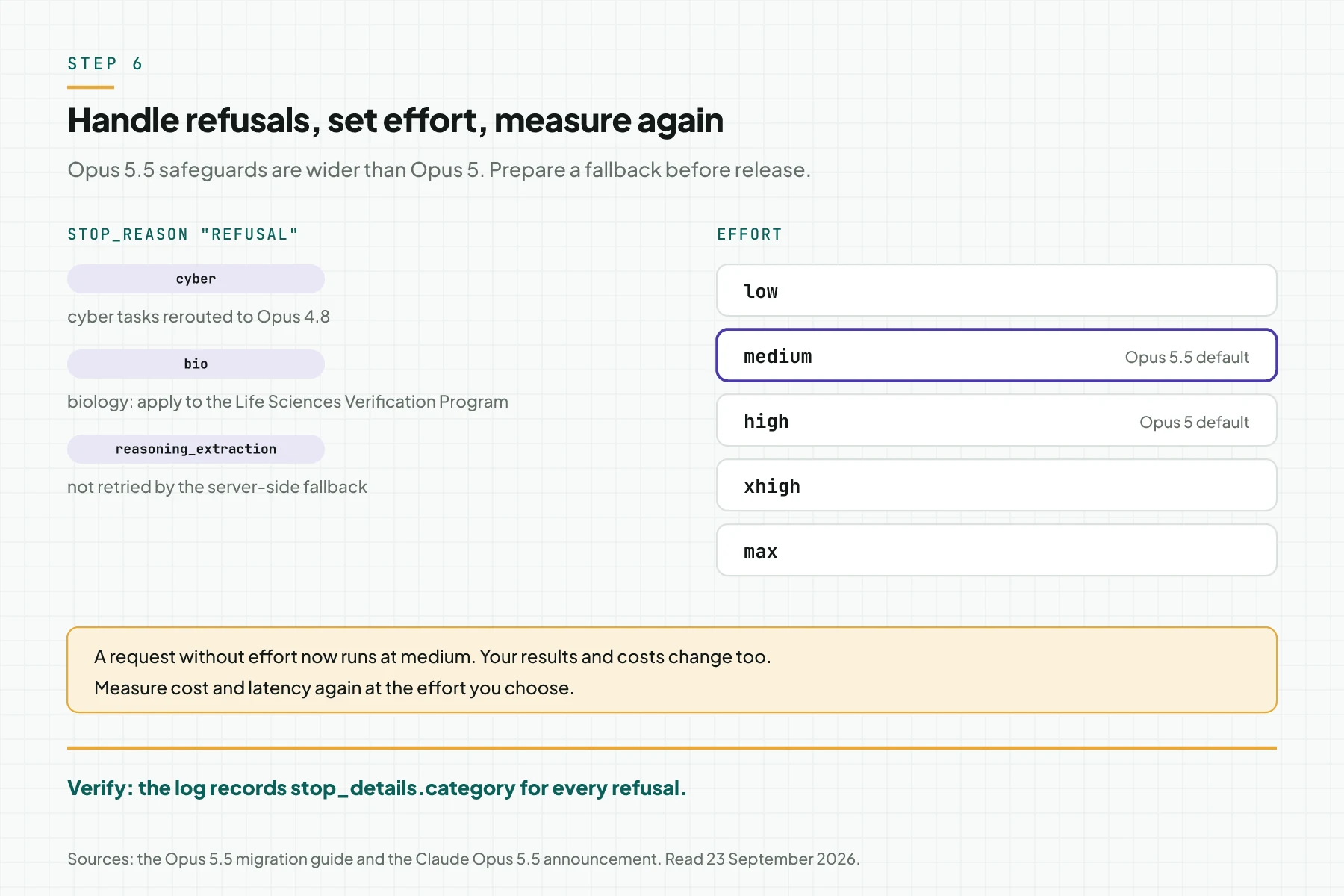
- Read
stop_details.category:cyber,bio, orreasoning_extraction. - Configure a server-side fallback or your own retry. The server-side fallback does not retry a
reasoning_extractionrefusal. - Run the effort sweep again. Lower effort where quality holds, and raise it for the hardest tasks.
Verify: a new cost and latency report exists per effort, from your 20 real tasks.
Worked example: moving a PR review agent in 5 days
A simulation with dummy data. An internal team moves its PR review agent from Opus 5 high to Opus 5.5. Each review holds 40,000 input tokens, 36,000 of them from the cache, and 3,000 output tokens.
| Day | Action | What the log shows | Decision |
|---|---|---|---|
| Day 1 | Switch the model in staging | Error 400 thinking.type.disabled | Remove thinking, use effort |
| Day 1 | Test the token counting endpoint | Error 400 tool_choice | Switch to auto and strict |
| Day 2 | Test the review UI | Empty progress between tools | Set display updates |
| Day 3 | Test the fallback to Sonnet 5 | The turn continues without thinking | Fall back to an Opus 5.5 retry |
| Day 4 | Test 20 PRs at low and medium | low 15 right, medium 18 right | Use medium |
| Day 5 | Compare the cost per review | $0.113 to $0.083 | Down 26% from price alone |
The cost in the last row assumes the token count stays the same. Anthropic and several early testers report that tokens per task also fall, so the real saving can be larger. Measure it in your log.
Opus 5.5 migration checklist
- Change the model ID through 1 config variable. Owner: developer. Evidence: the config diff.
- Remove the thinking config and set effort. Owner: developer. Evidence: a passing staging test.
- Replace tool_choice any and tool. Owner: developer. Evidence: 10 correct test tool calls.
- Map the routers and fallbacks that change model. Owner: system architect. Evidence: a conversation lane diagram.
- Set thinking.display if the UI shows progress. Owner: front-end developer. Evidence: a staging screen recording.
- Handle refusals per category. Owner: developer. Evidence: a stop_details.category log.
- Test 20 real tasks per effort. Owner: team lead. Evidence: a pass and cost table per effort.
- Stop and return to Opus 5 when the pass rate falls more than 5 points on those 20 tasks.
Opus 5.5, Fable 5.1, or Sonnet 5
Anthropic itself now suggests Opus 5.5 as the starting point for most workloads. This Rama Digital recommendation adds the conditions.
| Your situation | Choice | Reason |
|---|---|---|
| Daily agentic coding and knowledge work | Claude Opus 5.5, medium | The official Anthropic default and the top score in its table |
| Heavy reasoning that still fails on Opus 5.5 xhigh | Claude Fable 5.1 | The Anthropic advice for long, hard tasks |
| High volume on a tight budget | Claude Sonnet 5 or GPT-6 Luna | Prices of $2 and $10, or $0.10 and $0.50 |
| Cybersecurity tasks | Apply to the Cyber Verification Program | Safeguards route cyber tasks to Opus 4.8 |
| Documents above 272,000 tokens | Claude Opus 5.5 | A 1M-token context at the standard price |
Pick Opus 5.5 when your tasks are long and hard to check automatically. Pick Fable 5.1 only after your test proves that Opus 5.5 fails at high effort.
Frequently asked questions
When did Claude Opus 5.5 launch? Anthropic released Claude Opus 5.5 on 22 September 2026. It is available on the Claude Platform, AWS, Google Cloud, and Microsoft Azure.
How much does Claude Opus 5.5 cost? Input costs $4 and output costs $20 per 1M tokens. Cache reads cost $0.20, 5-minute cache writes cost $5, and the Batch API costs $2 and $10.
Can I turn off thinking on Opus 5.5? No. Thinking is always on, and effort is the only control. Use effort low when you want to save tokens.
Is Opus 5.5 better than Fable 5.1? In the Anthropic table, Opus 5.5 leads most benchmarks at 40% of the Fable 5.1 price. Anthropic still suggests Fable 5.1 for the heaviest reasoning.
When do Claude Sonnet 5.5 and Haiku 5.5 launch? Anthropic writes that both follow in the coming weeks after 22 September 2026. No exact date was announced as of 23 September 2026.
Next step
The limit that still applies: the benchmark numbers come from Anthropic and third-party tests. Anthropic itself calls the gaps a less reliable guide to real-world differences. A migration is safe when your 20 real tasks pass and the fallback is tested.
If you want us to watch an AI system that already runs and update its model and prompts, open OS Care Retainer. To set the migration scope first, pick a Technical Scoping Session slot.