Direct answer: ClaudeClaude ProThe paid subscription for the Claude AI assistant from Anthropic. It unlocks connectors to outside tools.Open the glossary Haiku 5.5 and GPT-6 Luna have the same token price: $0.10 input and $0.50 output per 1M tokens. Haiku 5.5 is stronger for multi-step agents. In the independent Artificial Analysis test, Haiku 5.5 wins 5 of 10 benchmarks, Luna wins 2, and 3 are ties. GPT-6 Luna costs less for short, high-volume tasks, because Luna writes fewer tokens.
Main condition: choose on cost per passed task, not on price per token. In our test, both models passed 54 of 54 short business tasks, but the Haiku 5.5 bill was 1.9x to 3.3x larger. Limit: our test used 6 short tasks with dummy data, so it does not apply to long agents, computer use, or documents above 100,000 tokens.
On 9 October 2026 we read the Anthropic announcement, Claude Docs, the OpenAI GPT-6 Luna model page, and the Artificial Analysis comparison page. On the same day we ran 108 APIAPIThe official door 2 systems use to exchange data, without anybody copying it by hand.Open the glossary calls with the same prompts through OpenRouter. Disclosure: the Rama Digital chat assistant has used GPT-6 Luna since 24 September 2026.
Why the price per token can mislead you
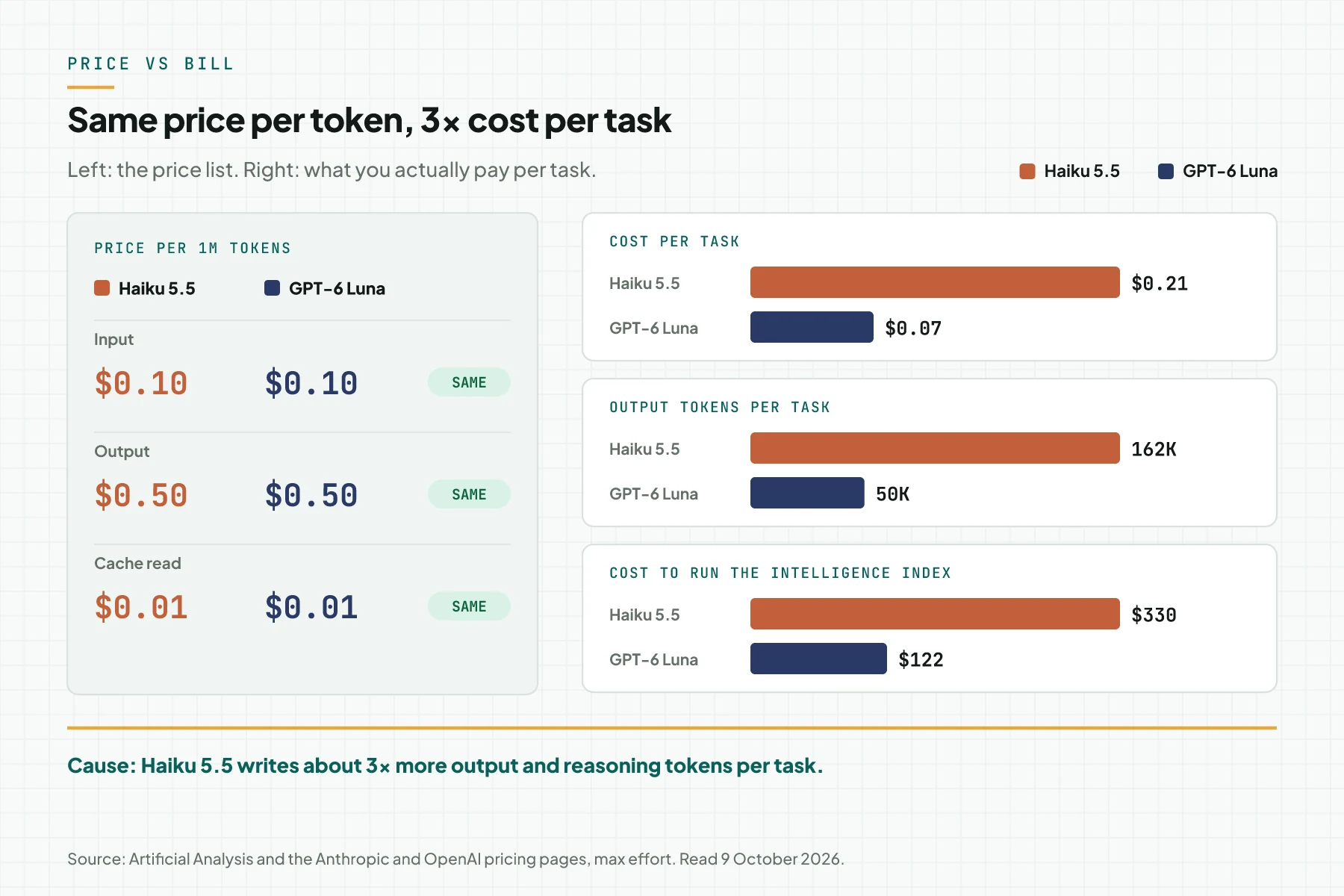
Two models with the same token price do not always give the same bill. Bill = token price x number of tokens. A model that thinks longer writes more reasoning tokens, and you pay for reasoning tokens as output tokens.
That is what happens with this pair. Artificial Analysis records 162k output tokens per task for Haiku 5.5 and only 50k for Luna. So the cost per task is $0.21 for Haiku 5.5 and $0.07 for Luna, or about 3x.
Last month we compared 4 low-cost models, including Haiku 4.5 and Luna. Read GPT-6 Luna vs DeepSeek Flash vs Gemini Flash vs Claude Haiku 4.5 for the context of this price class.
Head to head: official numbers and independent tests
Price and specifications
Anthropic released Claude Haiku 5.5 on 7 October 2026. Its price is 90% lower than Haiku 4.5 for prompts up to 100,000 tokens. Anthropic writes that Haiku 5.5 costs about 75% less to run on average. Source: the Claude Haiku 5.5 announcement.
| Item | Claude Haiku 5.5 | GPT-6 Luna |
|---|---|---|
| Model ID | claude-haiku-5-5 | gpt-6-luna |
| Release | 7 October 2026 | 22 September 2026 |
| Input / output per 1M tokens | $0.10 / $0.50 | $0.10 / $0.50 |
| Cache read / cache write | $0.01 / $0.125 | $0.01 / $0.125 |
| Long prompts | Above 100,000 tokens: $0.50 / $2.50 | Above 272,000 tokens: input and cache 2x |
| Context / max output | 1M / 128,000 tokens | 1,050,000 / 128,000 tokens |
| Effort | low, medium, high, xhigh, max; default medium | none, low, medium, high, xhigh, max; default medium |
| Knowledge cutoff | June 2026 | 18 May 2026 |
Sources: Claude Docs Models overview, the GPT-6 Luna model page, and the Anthropic price table, read 9 October 2026.
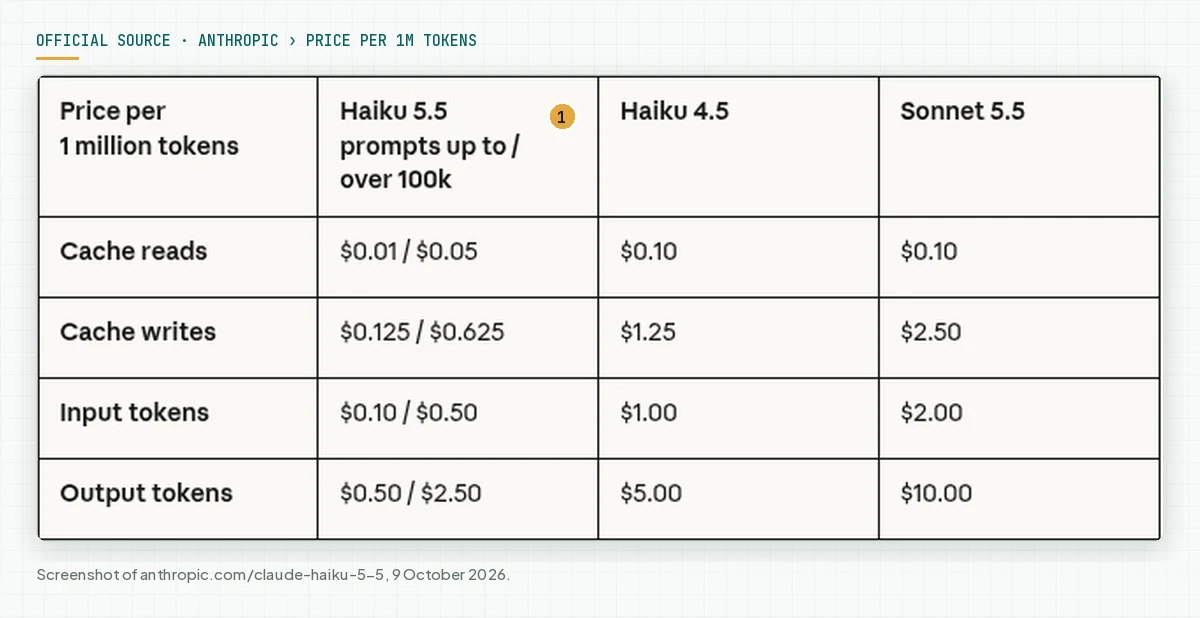
Watch the 100,000-token limit. Above it, Haiku 5.5 input becomes $0.50 and output $2.50 per 1M tokens. Luna only rises above 272,000 input tokens, and only for input and cache.
Vendor benchmarks: Haiku 5.5 leads by far on agents
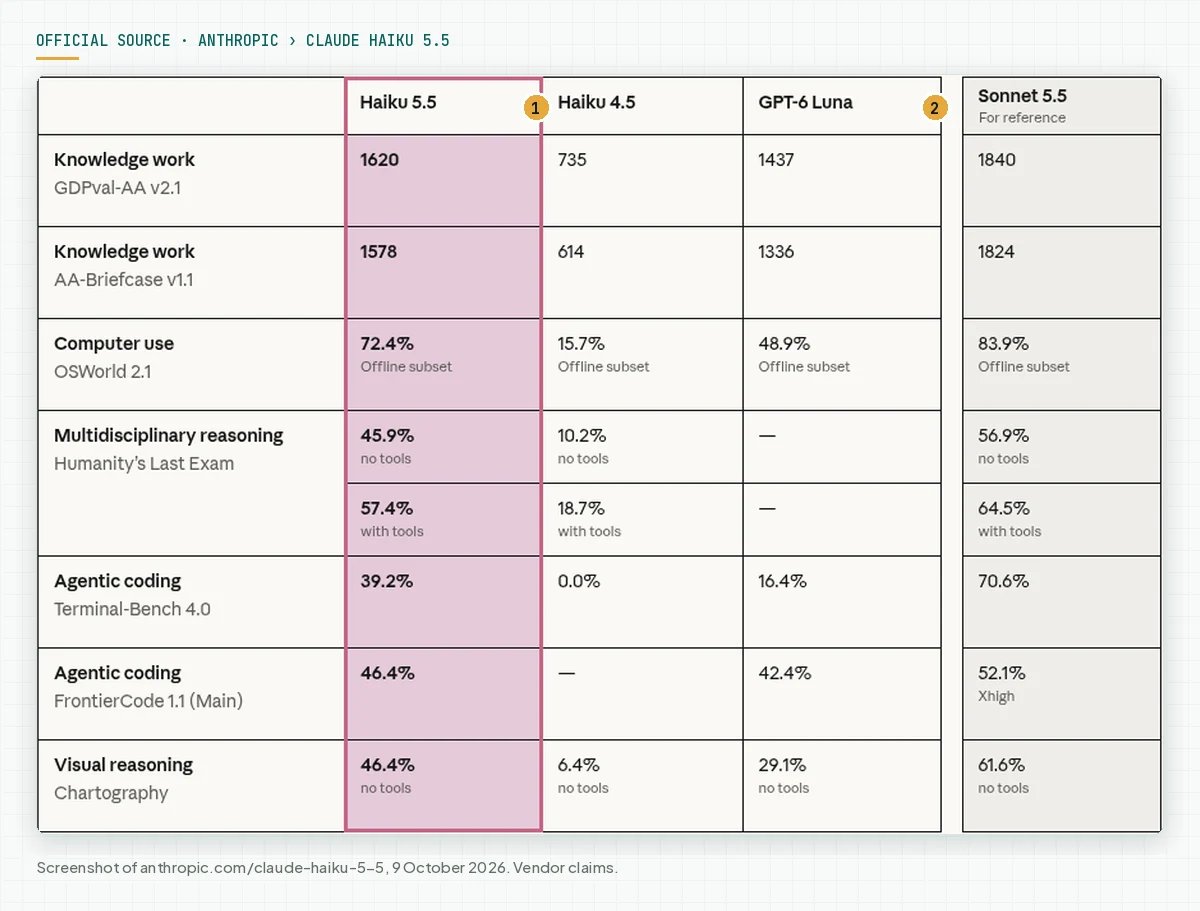
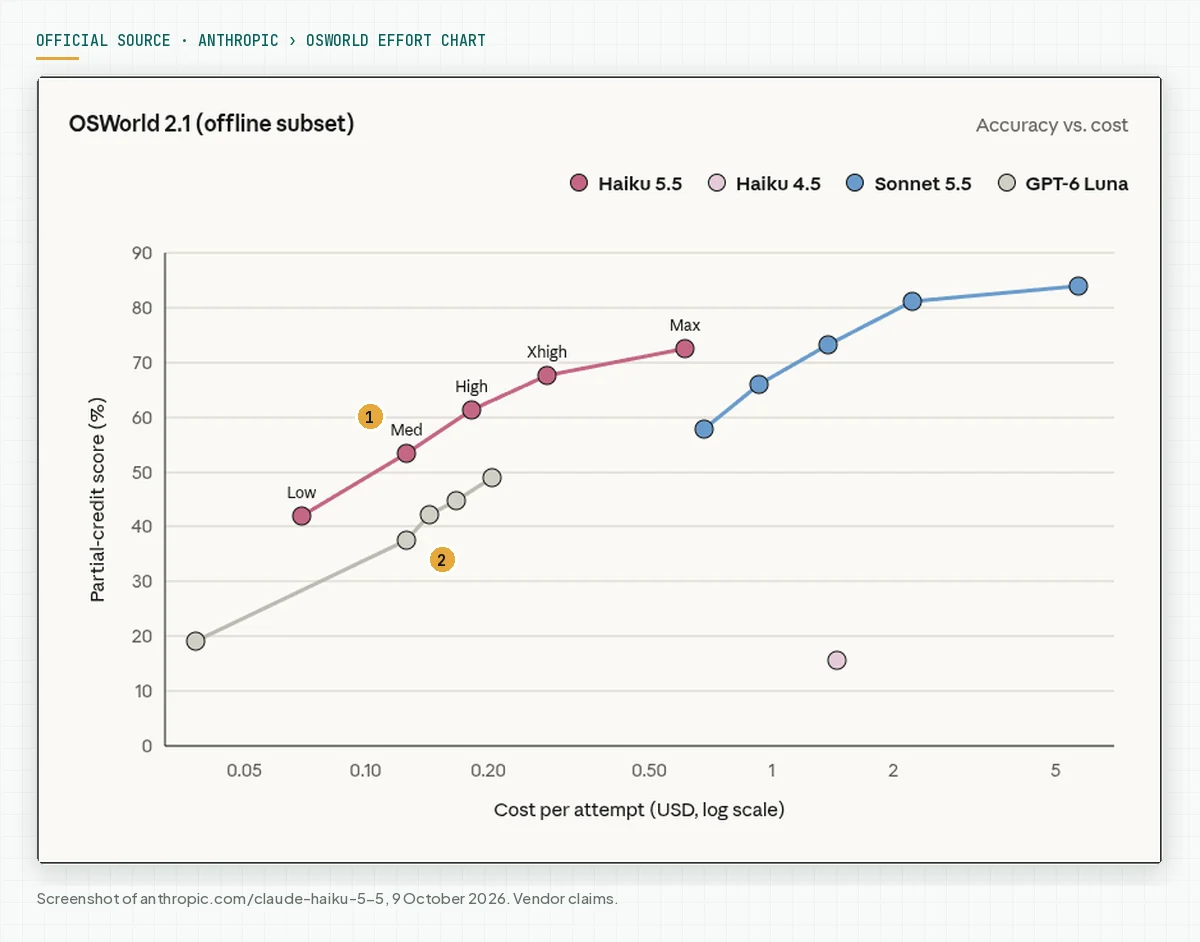
In the Anthropic table, Haiku 5.5 scores 72.4% on OSWorld 2.1 and Luna 48.9%. On Terminal-Bench 4.0, Haiku 5.5 scores 39.2% and Luna 16.4%. These are vendor claims, so we checked an independent source.
Independent test: a 5-2-3 score
Artificial Analysis tested both models at max effort on 10 benchmarks. The Intelligence Index is 43 for Haiku 5.5 and 38 for Luna. Haiku 5.5 wins Terminal-Bench (33% vs 13%) and GDPval-AA. Luna wins AutomationBench-AA (53% vs 35%) and GDP.pdf. Source: the Artificial Analysis comparison.
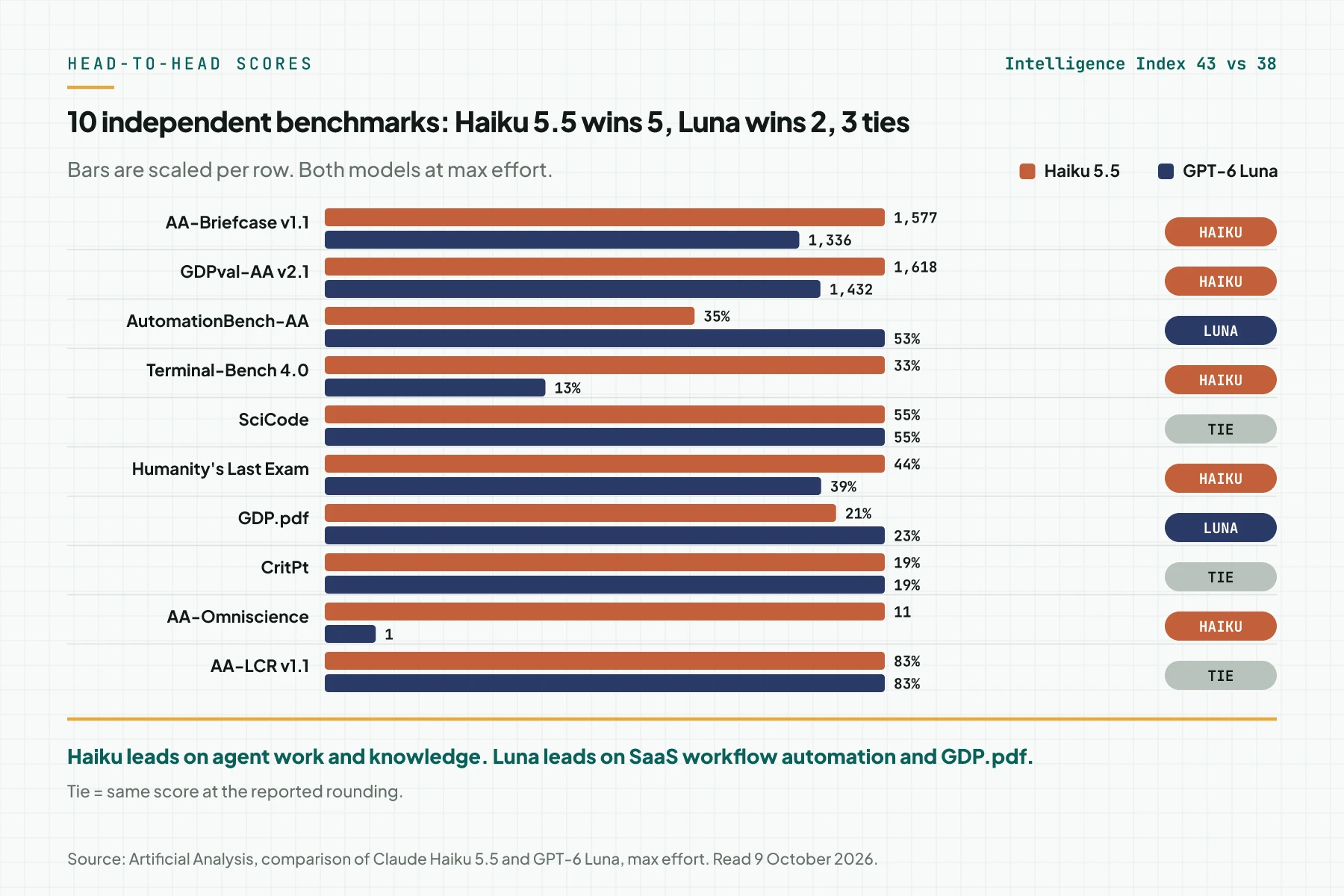
One result matters for chatbots: AA-Omniscience. This score penalizes wrong answers and does not penalize "I do not know". Haiku 5.5 scores 11 and Luna 1, so Haiku 5.5 makes up facts less often on this test.
Why the bill can be 3x
On the same page, the cost to run the full Intelligence Index is $330 for Haiku 5.5 and $122 for Luna. Reasoning tokens per task: 129k against 39k.
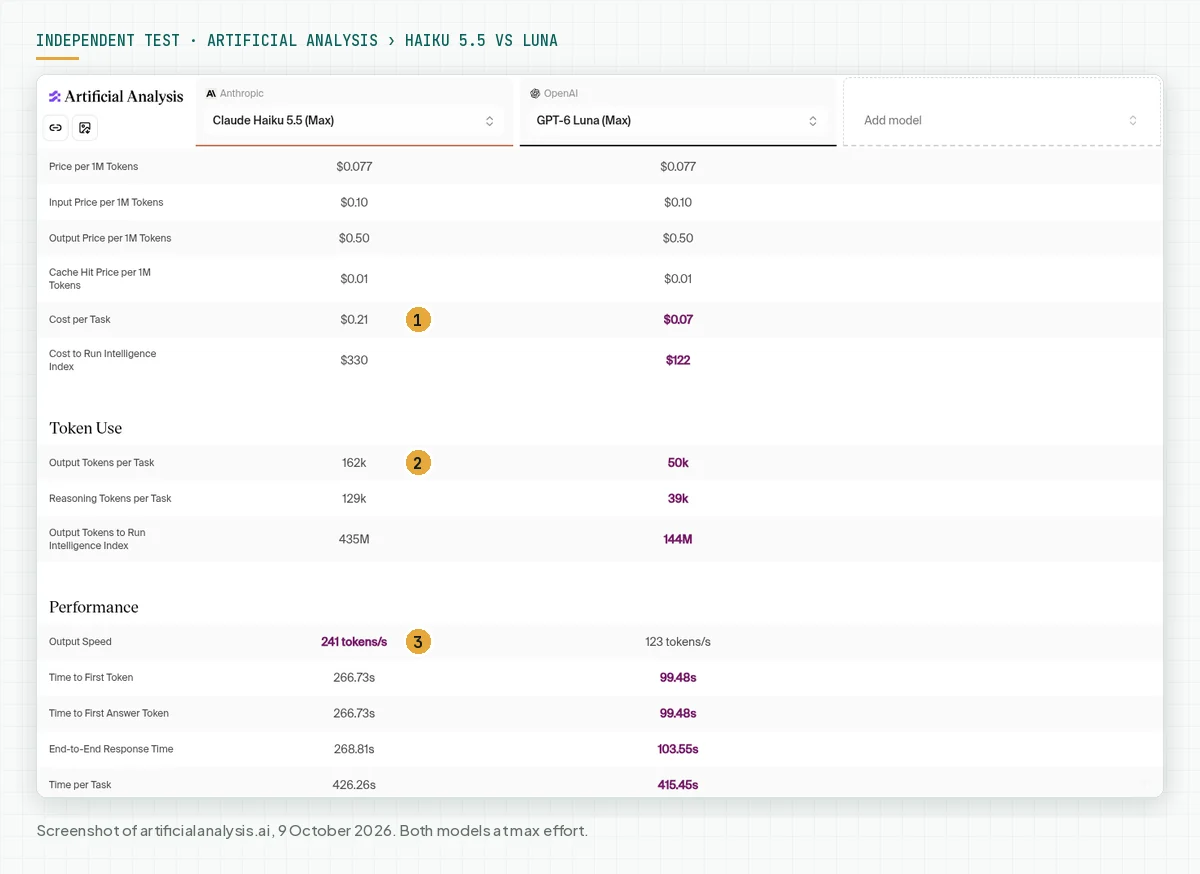
One result is a surprise. Haiku 5.5 writes 241 tokens per second and Luna 123. But the time per task is almost equal: 426 seconds against 415 seconds, because Haiku 5.5 thinks longer.
Effort: compare at the same cost
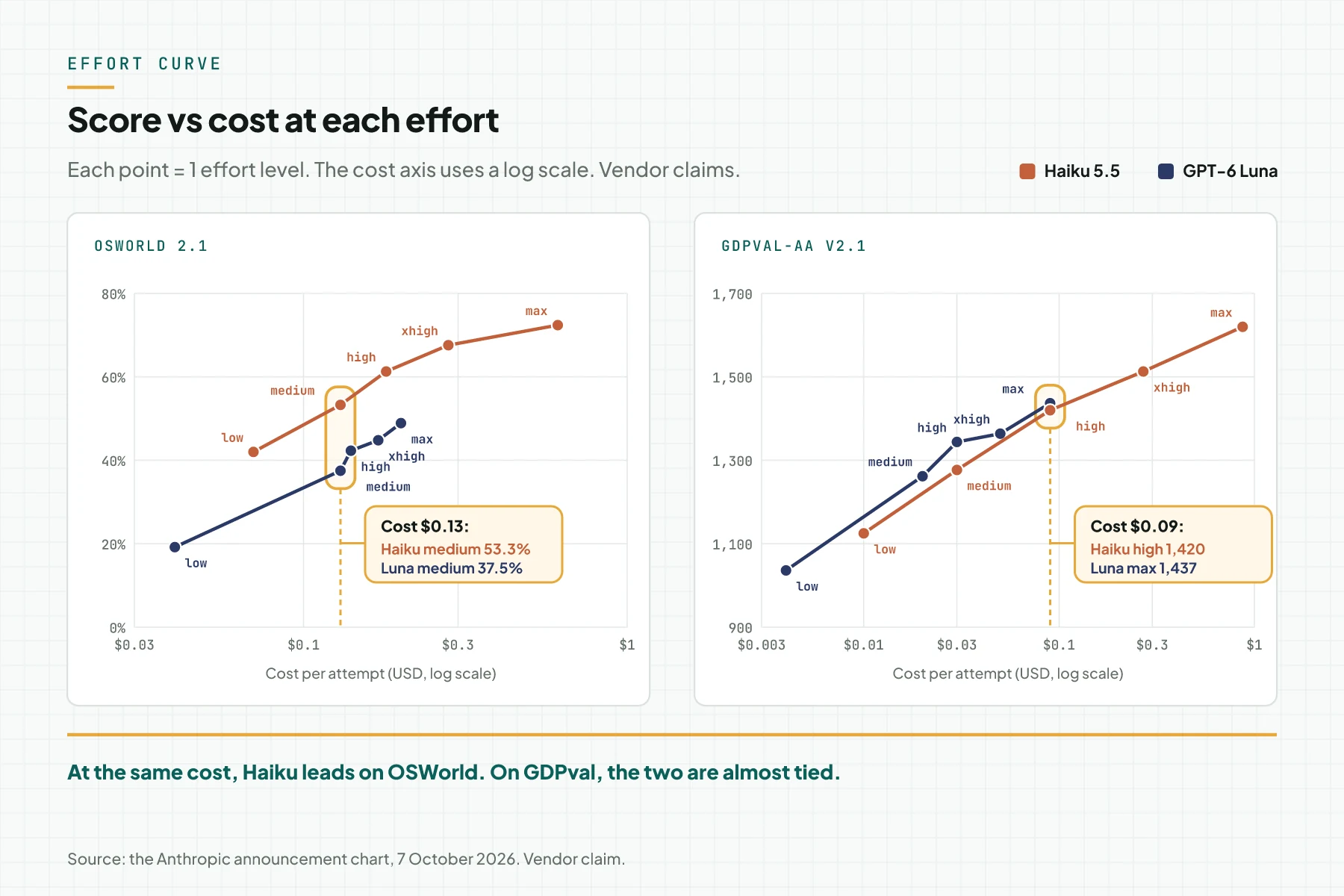
Haiku 5.5 is the first Haiku model with an effort setting. Anthropic published charts of score against cost per attempt for each effort. These charts are fair, because you can compare both models at the same cost.
At $0.13 per attempt on OSWorld, Haiku 5.5 medium scores 53.3% and Luna medium 37.5%. On GDPval-AA, the result is different. At $0.09, Haiku 5.5 high scores 1,420 and Luna max 1,437, which is almost a tie.
Rama Digital test: 108 calls, same prompts
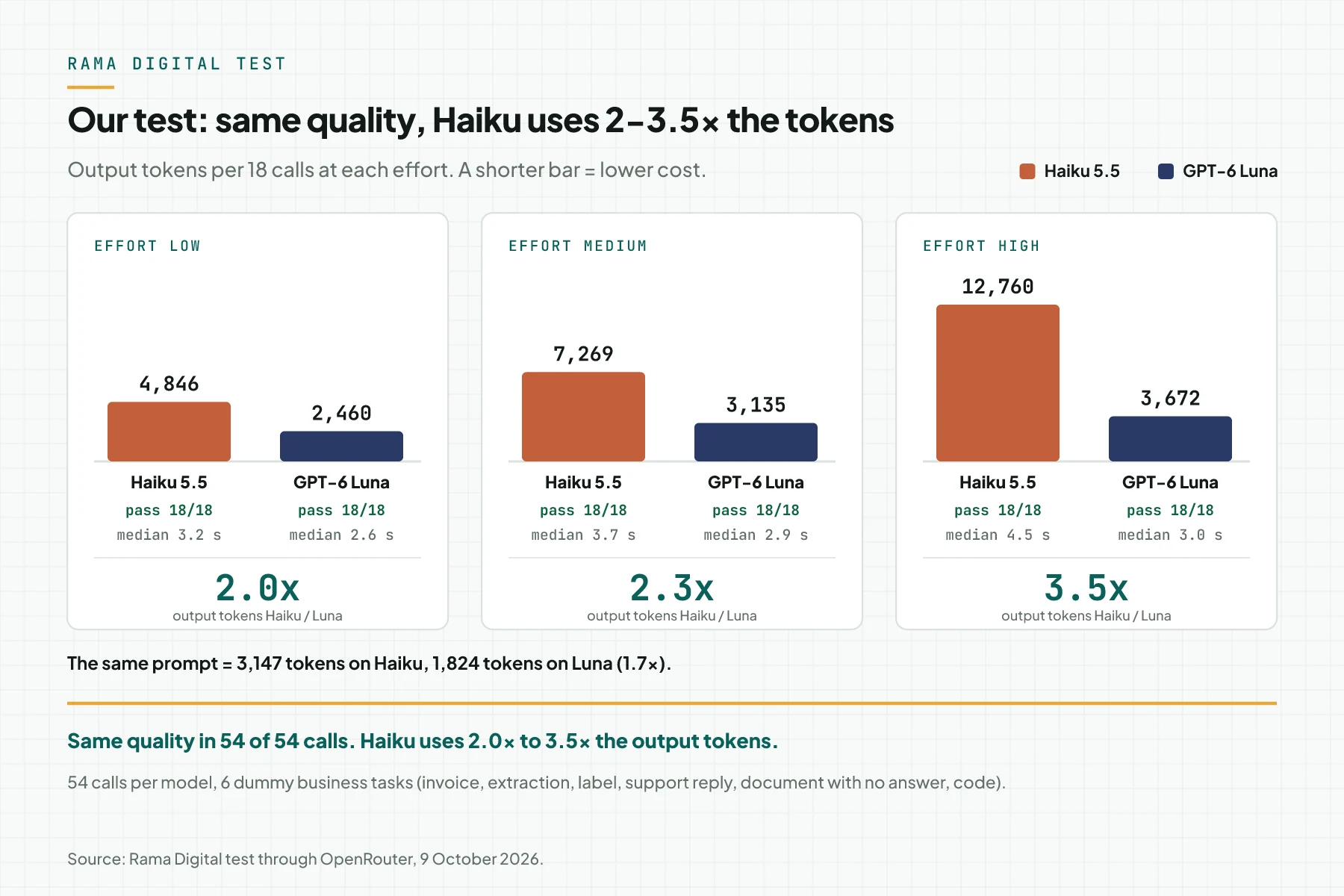
On 9 October 2026 we sent 6 dummy business tasks to both models through OpenRouter. The tasks: calculate an invoice with a discount and VAT, extract an order from a WhatsApp chat to JSON, label 8 customer messages, write a support reply without a fake discount, answer from a document that does not contain the answer, and write a JavaScript function that we test automatically.
Each task ran 3 times at effort low, medium, and high. That is 54 calls per model. Claude Platform on AWS served Haiku 5.5, and OpenAI served Luna.
| Effort | Passed Haiku / Luna | Median time Haiku / Luna | Output tokens Haiku / Luna | Cost Haiku / Luna (18 calls) |
|---|---|---|---|---|
| low | 18/18 / 18/18 | 3.2 / 2.6 s | 4,846 / 2,460 | $0.0027 / $0.0014 |
| medium | 18/18 / 18/18 | 3.7 / 2.9 s | 7,269 / 3,135 | $0.0039 / $0.0018 |
| high | 18/18 / 18/18 | 4.5 / 3.0 s | 12,760 / 3,672 | $0.0067 / $0.0020 |
Three findings from our test:
- Same quality: both models passed 54 of 54. One Haiku 5.5 answer first failed because our automatic checker misread the phrase "tidak menyebutkan" (does not mention). We checked it by hand, and the answer was correct.
- The same prompts counted as 3,147 tokens on Haiku 5.5 and 1,824 tokens on Luna, or 1.7x. Our prompts are in Indonesian. Claude Docs writes that the new Haiku 5.5 tokenizer counts text as about 30% more tokens than Haiku 4.5.
- Luna finished short tasks faster: a median of 2.9 seconds against 3.7 seconds at effort medium. The longer reasoning of Haiku 5.5 cancels its faster writing speed.
The limit of this test: 6 short tasks, 3 runs, no cache, and no tools. It does not measure long agents, where Haiku 5.5 leads in the benchmarks.
What you need before you choose
- Anthropic and OpenAI API accounts, or 1 OpenRouter account that serves both.
- 20 real tasks from your system, with correct answers that you wrote.
- The AI cost log of the last 14 days, if your system already runs.
- A small script that records input tokens, output tokens, time, and pass or fail per call.
- A monthly cost limit in the provider dashboard, so the test stays under control.
Step 1: Group your tasks
Split your AI tasks into 2 groups: multi-step agents and short high-volume tasks. Multi-step agents use tools, a browser, or a terminal. Short tasks are labels, extraction, summaries, and chat replies.
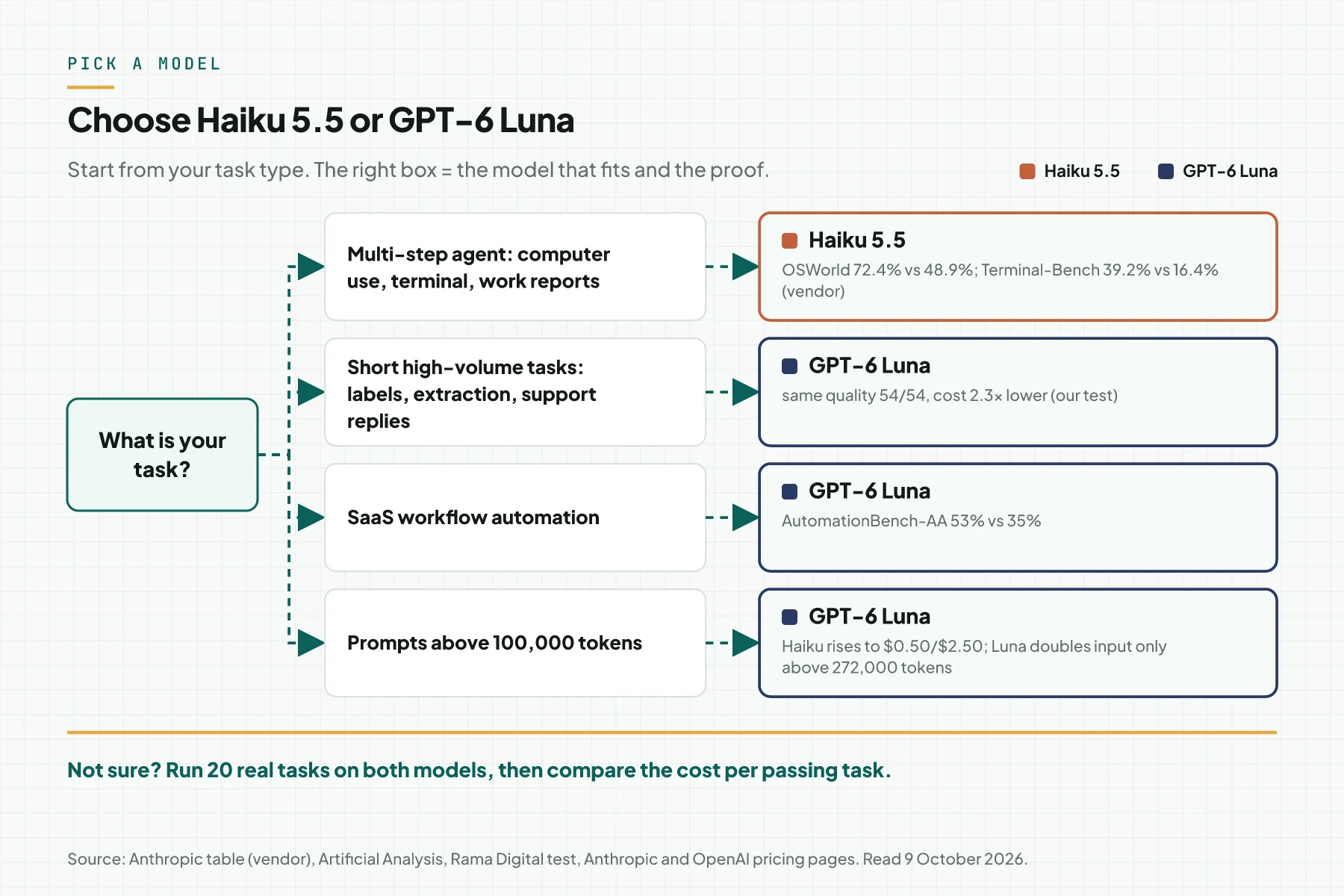
Rama Digital recommendation: start with Luna for short tasks and Haiku 5.5 for subagents. Anthropic itself recommends Haiku 5.5 as a subagent for Opus 5.5 and Sonnet 5.5.
Verify: each AI workflow has 1 group label in your architecture document.
Step 2: Run 20 real tasks on both models
Send the same 20 tasks to both models at effort medium, the default for both. Use the same prompts, tools, and data. Repeat each task 3 times, because AI model answers are not always the same.
For Haiku 5.5, set effort through output_config.effort. For Luna, set reasoning.effort. Through OpenRouter, both use reasoning: { effort: "medium" }.
Verify: your table has 120 rows, which is 20 tasks x 3 runs x 2 models, with no API errors.
Step 3: Calculate the cost per passed task
Divide the total cost by the number of passed tasks. This number is more honest than the price per token, because it counts reasoning tokens and failed answers.
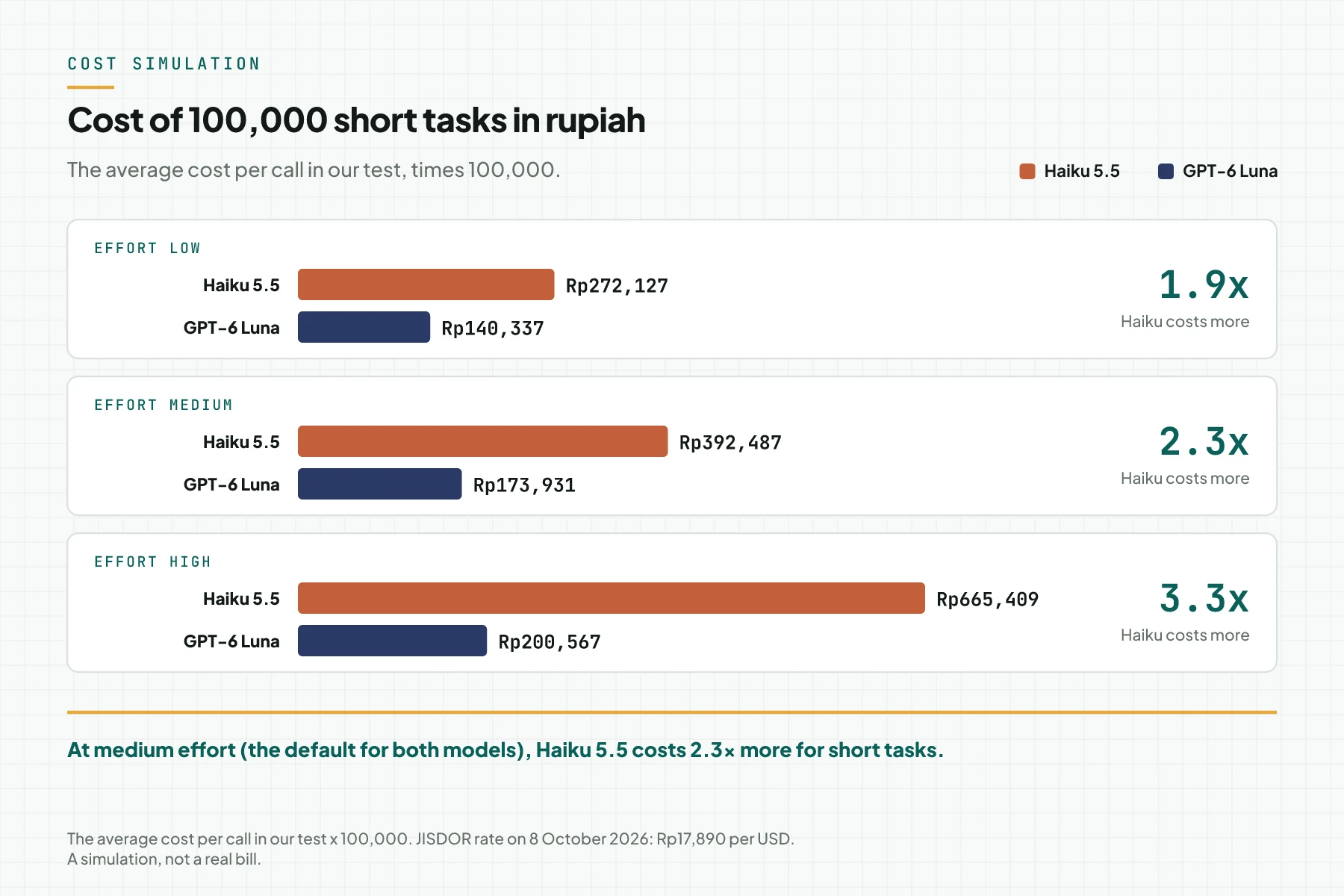
Example from our test: at effort medium, 1 short task cost on average $0.000219 on Haiku 5.5 and $0.000097 on Luna. Bank Indonesia JISDOR rate on 8 October 2026: Rp17,890 per USD. Rate source: Bank Indonesia JISDOR.
Verify: you have 1 rupiah amount per 1,000 passed tasks for each model.
Step 4: Fix your code before the move to Haiku 5.5
Skip this step if you do not use Claude. A new model ID alone is not enough, because Haiku 5.5 has 5 breaking changes from Haiku 4.5. Source: What's new in Claude Haiku 5.5.
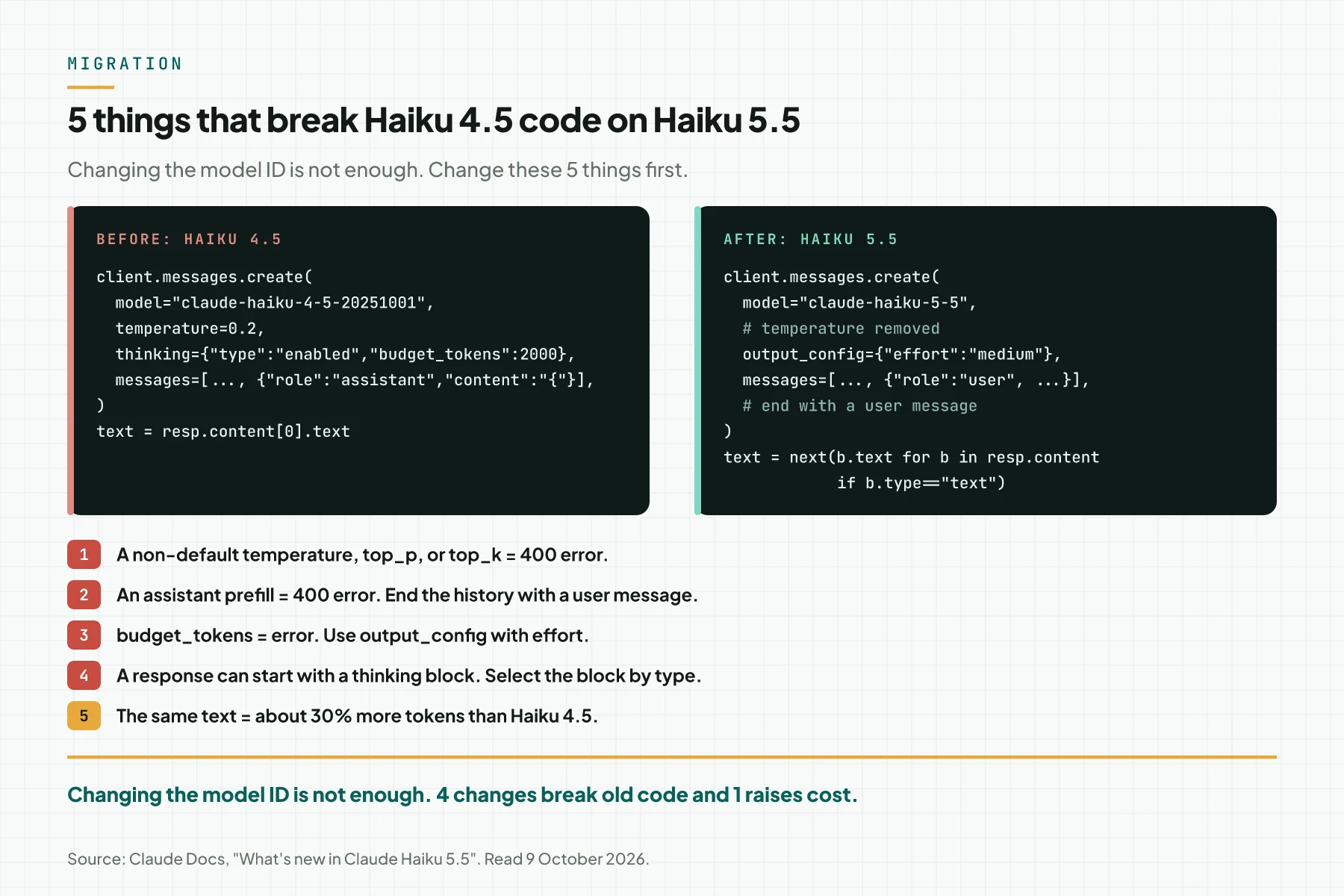
- Remove non-default
temperature,top_p, andtop_k. These values now return an error. - End
messageswith a user turn. Assistant prefill now returns an error. - Replace
budget_tokenswith adaptive thinking and effort. - Select the answer by
type, because a response can start with a thinking block. - Increase
max_tokens, because thinking tokens count toward that limit.
Verify: 20 test tasks run without a 400 error, and each answer has a text block.
Step 5: Set up a router and a cost limit
Send each task group to the winning model from Step 3. Add a fallback to the second model if the first provider fails. Set an alarm if output tokens per task rise 50% above the test number.
We use this pattern on client chatbots: a low-cost decision modelJevA small AI model from TypeSafe that decides what happens to each chat: reply, skip, flag for the team, or remove from follow-up. Jev writes no replies.How Jev picks the chats to answer sorts the chats first, and then the chat model replies. Read how to calculate GPT-6 and Claude API cost for the monthly formula.
Verify: the cost dashboard shows the cost per model per day, and 1 fallback test succeeds.
Simulation example: an online shop with 100,000 chats per month
Simulation with dummy data. "Example Shop" uses AI to label incoming chats and write the first reply. The cost numbers use our test averages at effort medium.
| Date | Action | What is logged | Result |
|---|---|---|---|
| 13 Oct 2026 | Group the tasks | 2 workflows: chat label, first reply | Both are short tasks |
| 14 Oct 2026 | Test 20 tasks x 3 x 2 models | Pass, tokens, time, cost | Both models pass 60/60 |
| 15 Oct 2026 | Calculate cost per passed task | Rupiah per 100,000 tasks | Haiku 5.5 Rp392.487, Luna Rp173.931 |
| 16 Oct 2026 | Choose Luna, Haiku 5.5 as fallback | Router configuration | Saves about Rp218.556 per month |
| 23 Oct 2026 | Review after 7 days | Output tokens per task | No alarm |
This gap is small for 1 shop. The gap grows if your prompts are long, because in our test Haiku 5.5 also counted input as 1.7x more tokens.
Checklist to choose Haiku 5.5 or Luna
- Label each AI workflow as an agentAI agentAn AI program that performs work steps by itself, for example reading a message, drafting a reply, and recording the result.Open the glossary or a short task. Owner: lead engineer. Evidence: architecture document.
- Collect 20 real tasks with correct answers. Owner: workflow owner. Evidence: dated test file.
- Run the test with 3 runs at effort medium on both models. Owner: engineer. Evidence: 120-row table.
- Calculate rupiah per 1,000 passed tasks. Owner: engineer. Evidence: sheet with rate and date.
- Fix the 5 breaking changes if you choose Haiku 5.5. Owner: engineer. Evidence: 0 400 errors in staging.
- Set up the router, fallback, and token alarm. Owner: platform engineer. Evidence: 1 successful fallback test.
- Stop and test again if passed tasks fall by more than 1 of 20, or if tokens per task rise more than 50%. Owner: workflow owner. Evidence: dated decision note.
Frequently asked questions
Which is cheaper, Claude Haiku 5.5 or GPT-6 Luna? The token price is the same: $0.10 input and $0.50 output per 1M tokens. The cost per task is different. Artificial Analysis records $0.21 against $0.07, and our test shows Haiku 5.5 at 2.3x the cost at effort medium.
Which is smarter, Haiku 5.5 or Luna? Haiku 5.5. The Artificial Analysis Intelligence Index is 43 against 38, and Haiku 5.5 wins 5 of 10 benchmarks. Luna wins AutomationBench-AA and GDP.pdf.
Which model fits a WhatsApp chatbot? For short high-volume replies, start with GPT-6 Luna, because the quality was the same in our test and the bill is smaller. Use Haiku 5.5 if the bot runs layered tools.
Does Haiku 4.5 code run on Haiku 5.5 without changes? Not always. Non-default temperature, assistant prefill, and budget_tokens return errors on Haiku 5.5. A response can also start with a thinking block, so select the answer block by type.
How do I reduce Haiku 5.5 tokens? Lower the effort to low or medium, then measure again. In our test, effort low used 2x the Luna output tokens, and high used 3.5x. For simple tasks, effort low still passed 18 of 18.
Next step
The limit that still applies: vendor numbers, Artificial Analysis, and our test are only a starting point, because your prompts and data are different. Test 20 real tasks before you move traffic. If your AI chatbot bill rises without better quality, see the AI Chatbot Optimization service. To read the cost log of your system with our team, book an AI Diagnostic session.
Want to see the larger models? Read Claude Sonnet 5.5 vs Sonnet 5 and GPT-6 Sol vs GPT-6 Luna vs Claude Opus 5.5.
Sources
- Anthropic: Introducing Claude Haiku 5.5
- Claude Docs: Models overview
- Claude Docs: What's new in Claude Haiku 5.5
- Claude Docs: Migrating to Claude Haiku 5.5
- OpenAI: GPT-6 Luna model
- OpenAI: Introducing GPT-6 Sol and Luna
- Artificial Analysis: Claude Haiku 5.5 vs GPT-6 Luna
- Artificial Analysis: Claude Haiku 5.5
- Artificial Analysis: GPT-6 Luna
- VentureBeat: Anthropic launches Claude Haiku 5.5
- Bank Indonesia: JISDOR rate