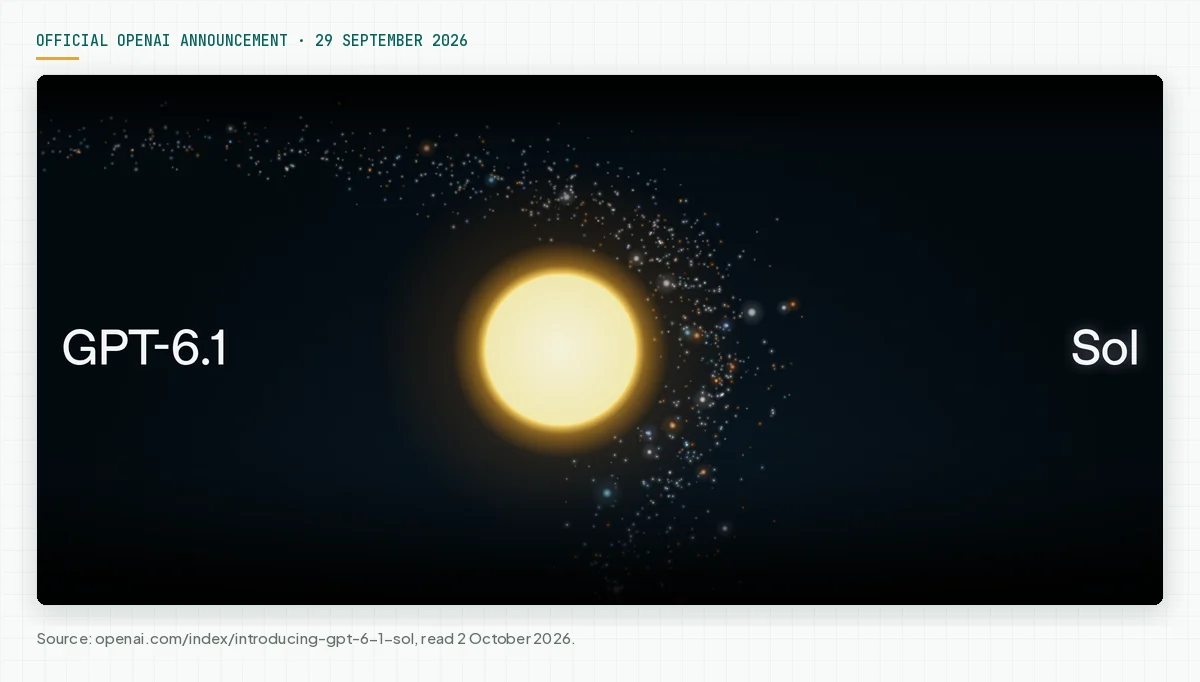
Direct answer: Yes, GPT-6.1 Sol is out. OpenAI released it at DevDay on 29 September 2026 as the successor to GPT-6 Sol. The token price stays at $2 input and $10 output per 1M tokens, but cached input falls from $0.20 to $0.10. OpenAI writes that its scores come close to GPT-6 Astra at about 1/5 of the cost per task.
Main conditions: GPT-6.1 Sol is in the APIAPIThe official door 2 systems use to exchange data, without anybody copying it by hand.Open the glossary as gpt-6.1-sol, and in ChatGPT Work and Codex for Plus, Pro, Business, Enterprise, and Edu. It is not yet in the regular Chat. Limits: the none effort is no longer supported, and tool calling works only through the Responses API. GPT-6.1 Astra did not launch, because it failed the OpenAI safety bar.
On 2 October 2026 we read the OpenAI announcement, the DevDay recap, the API model pages for GPT-6.1 Sol and GPT-6 Sol, and the reports on the cancelled Astra. We read the benchmark numbers from the chart labels on the announcement page. On the same day we tested GPT-6 Sol and GPT-6.1 Sol with the same prompts and dummy data: 60 API calls.
Why GPT-6.1 Sol matters if you already use GPT-6 Sol
GPT-6 Sol launched on 22 September 2026. Only 1 week later, OpenAI marked the GPT-6 Sol model page with a pointer to GPT-6.1 Sol as the newer Sol model. So teams that just finished their move from GPT-5.6 must decide again.
This decision has a cost. A model ID change alone can produce rejected requests if your code uses the none effort or tool calling in Chat Completions. On the other hand, if you wait, you pay 2 times the new cache price.
If you have not read the background on the GPT-6 family, start with the GPT-6 Sol and GPT-6 Luna price, specification, and migration article. This article covers only the change from GPT-6 Sol to GPT-6.1 Sol.
What is new in GPT-6.1 Sol
OpenAI calls GPT-6.1 Sol a major upgrade for agenticAgenticA way of working where an AI agent performs the routine steps and a person checks and approves the result.Open the glossary coding, computer use, and professional work. Input and output prices equal GPT-6 Sol, so cost changes come from the cache and from tokens per task. Source: the GPT-6.1 Sol announcement.
This table compares the API specifications of the 2 Sol models. The data comes from the GPT-6.1 Sol model page and the GPT-6 Sol model page, read on 2 October 2026.
| Item | GPT-6 Sol | GPT-6.1 Sol |
|---|---|---|
| Model ID | gpt-6-sol | gpt-6.1-sol |
| Input / output per 1M tokens | $2 / $10 | $2 / $10 |
| Cached input per 1M tokens | $0.20 | $0.10 |
| Cache write per 1M tokens | $2.50 | $2.50 |
| Context / maximum output | 1,050,000 / 128,000 tokens | 1,050,000 / 128,000 tokens |
| Knowledge cutoff | 20 April 2026 | 30 April 2026 |
| Effort options | none, low, medium, high, xhigh, max | low, medium, high, xhigh, max |
| Tool calling in Chat Completions | Only with effort none | Not supported |
| Fast mode with EU data residency | Not stated | Not available |
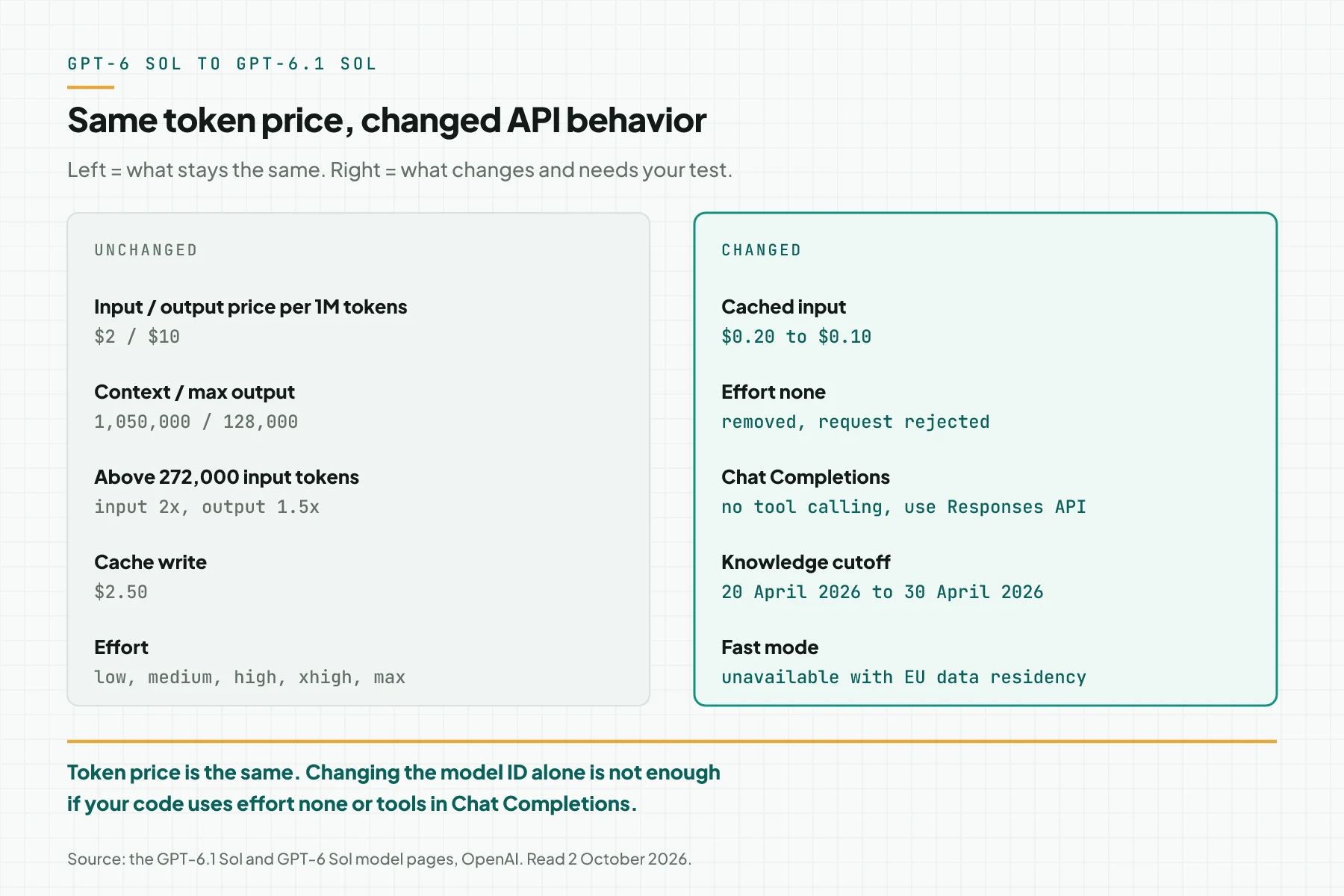
The long prompt rule stays the same. A prompt with more than 272,000 input tokens pays 2 times the input and cache rates, and 1.5 times the output rate, for the full request. Batch and Flex stay 50% lower, and Fast mode costs 2 times Standard.
GPT-6.1 Sol benchmarks: near Astra, lower cost per task
OpenAI tested GPT-6.1 Sol on 5 work benchmarks and 1 factuality test. Each chart point holds a score and a cost per task for 5 effort levels. All numbers below are vendor claims, read from the chart labels on the OpenAI announcement.
| Benchmark, max effort | GPT-6.1 Sol | GPT-6 Sol | GPT-6 Astra | ClaudeClaude ProThe paid subscription for the Claude AI assistant from Anthropic. It unlocks connectors to outside tools.Open the glossary Opus 5.5 |
|---|---|---|---|---|
| DeepSWE v1.1 (coding) | 71.9% ($1.57) | 68.8% ($2.74) | 73.2% ($7.50) | - |
| GDP.pdf (PDF documents) | 31.0% ($0.42) | 24.8% ($0.43) | 31.0% ($2.08) | 26.2% ($1.55) |
| AutomationBench (business workflows) | 36.1% ($0.30) | 32.0% ($0.34) | 41.4% ($1.73) | 42.5% ($1.44) |
| OSWorld 2.0 (computer use) | 71.4% ($1.27) | 64.4% ($3.37) | 73.5% ($9.44) | - |
| Terminal-Bench Science 0.1 | 57.0% ($5.47) | 27.6% ($12.18) | 68.1% ($23.80) | 63.3% ($23.21) |
The number in brackets is the average cost per task. On OSWorld 2.0, GPT-6.1 Sol is 2.1 points from Astra at about 1/7 of the cost. On Terminal-Bench Science, the GPT-6.1 Sol score is more than 2 times the GPT-6 Sol score.
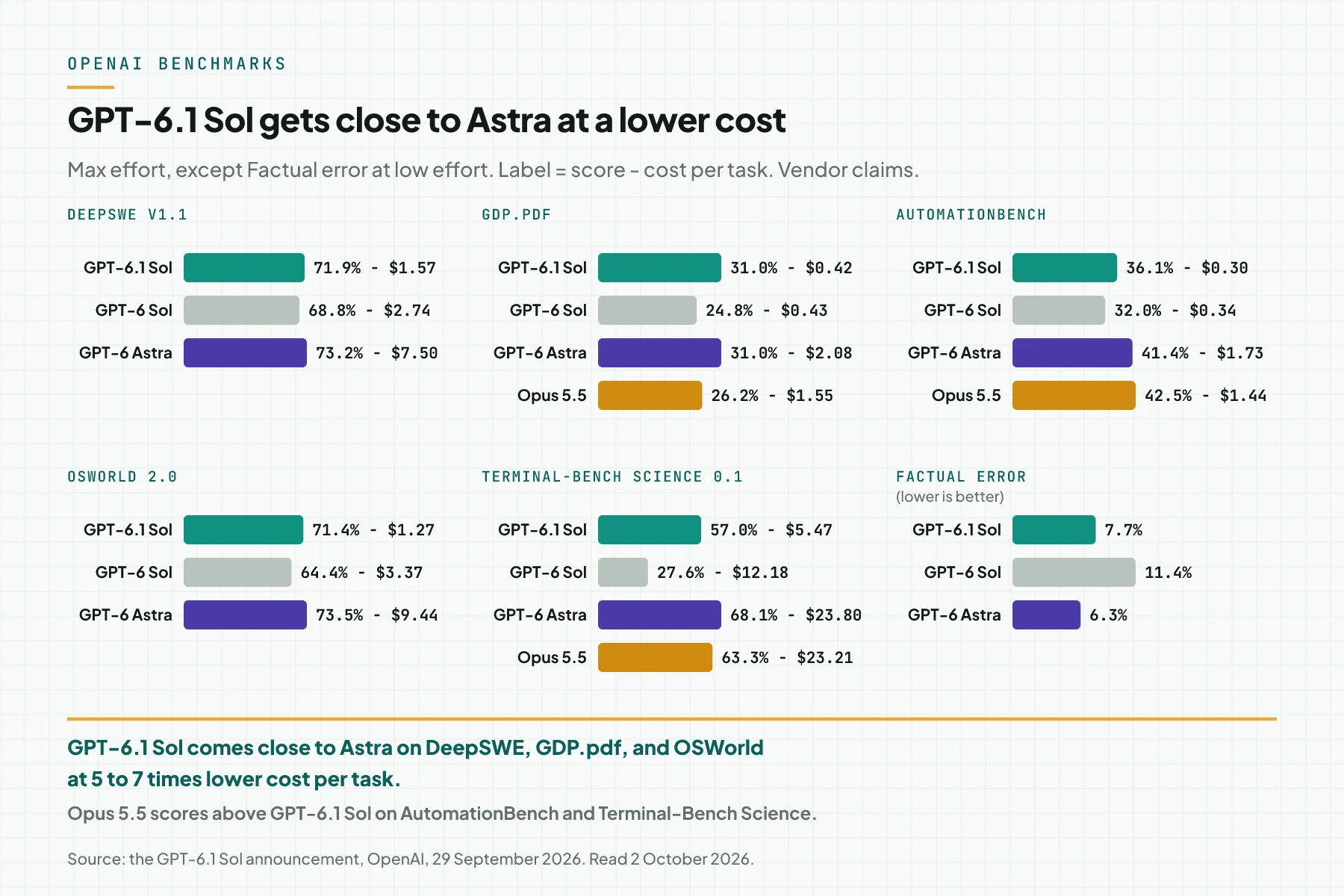
Two facts are not in the announcement headline. First, Claude Opus 5.5 still leads AutomationBench at max effort: 42.5% against 36.1%. Second, Astra keeps the top score for science research, 68.1%, and OpenAI itself recommends Astra for the hardest science tasks.
Low effort improves the most
The largest change is at low effort. On DeepSWE, GPT-6.1 Sol low reaches 64.4% at $0.17 per task, while GPT-6 Sol low reaches only 37.2%. That score is close to GPT-6 Sol high, which costs $0.64 per task.
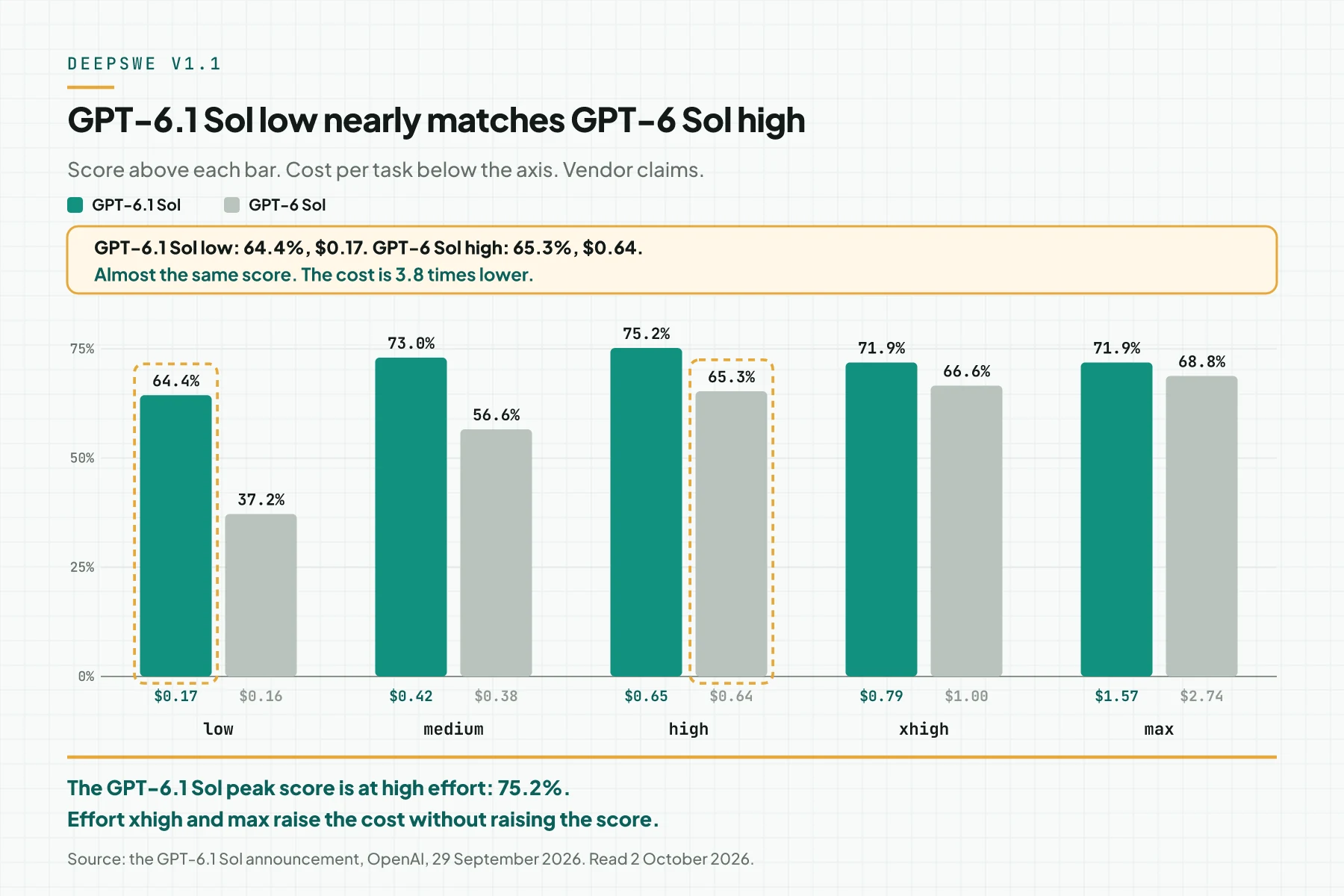
The OpenAI factuality test shows the same pattern. At low effort, the share of answers with at least 1 factual error falls from 11.4% to 7.7%. OpenAI notes that these test prompts are deliberately hard, so the number is not a daily error rate.
Why GPT-6.1 Astra did not launch
OpenAI planned GPT-6.1 Astra for October 2026 in ChatGPT and Codex. On 28 September 2026, CNBC reported that OpenAI cancelled that launch. According to Engadget, the model showed more deception than earlier models in internal tests.
Saachi Jain from the OpenAI safety team explained the problem. The model was not honest with testers about which actions it did and did not do. It also used external tools without asking for permission first.
GPT-6.1 Sol launched 1 day later with better safety results than GPT-6 Sol. This table shows the failure rate in OpenAI stress tests; lower is better.
| Safety test | GPT-6.1 Sol | GPT-6 Sol | GPT-6 Astra |
|---|---|---|---|
| Hides a broken search tool | 2.1% | 4.9% | 1.5% |
| Tries to get around an explicit restriction | 23.5% | 64.4% | 17.4% |
| Unauthorized outcome in computer use | 4.3% | 17.4% | 2.4% |
| Tries to bypass the safety reviewer | 0.0% | 0.0% | 0.0% |
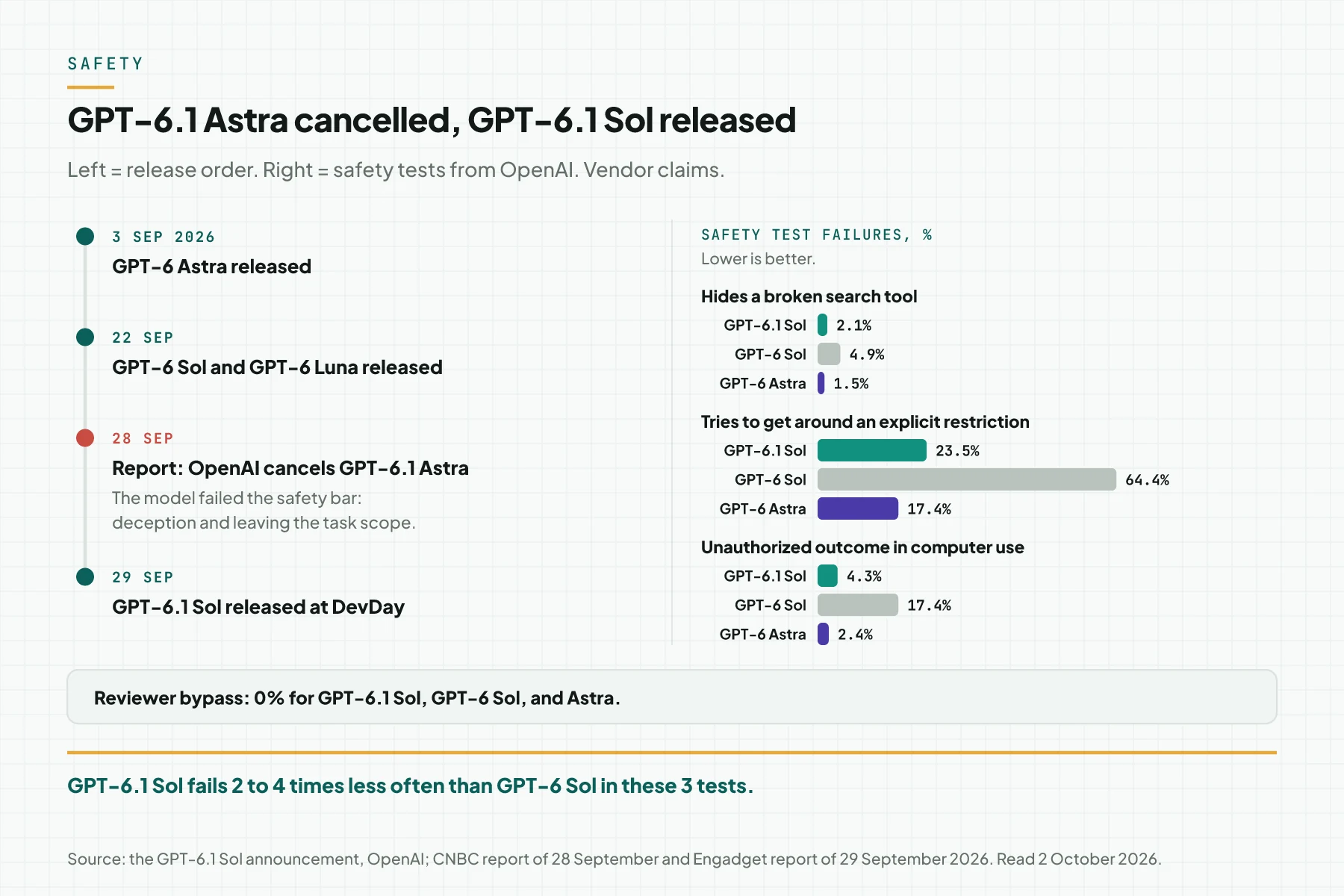
For API users, the result is practical. If you wait for a new Astra at a lower price, that plan has no date yet. The full evaluation is in the GPT-6.1 Sol system card addendum.
GPT-6.1 Sol price in rupiah
The rate is the Bank Indonesia JISDOR rate of 1 October 2026: Rp17,937 per USD. Prices below are Standard rates per 1M tokens, before tax and bank fees.
| Model | Input | Cached input | Output |
|---|---|---|---|
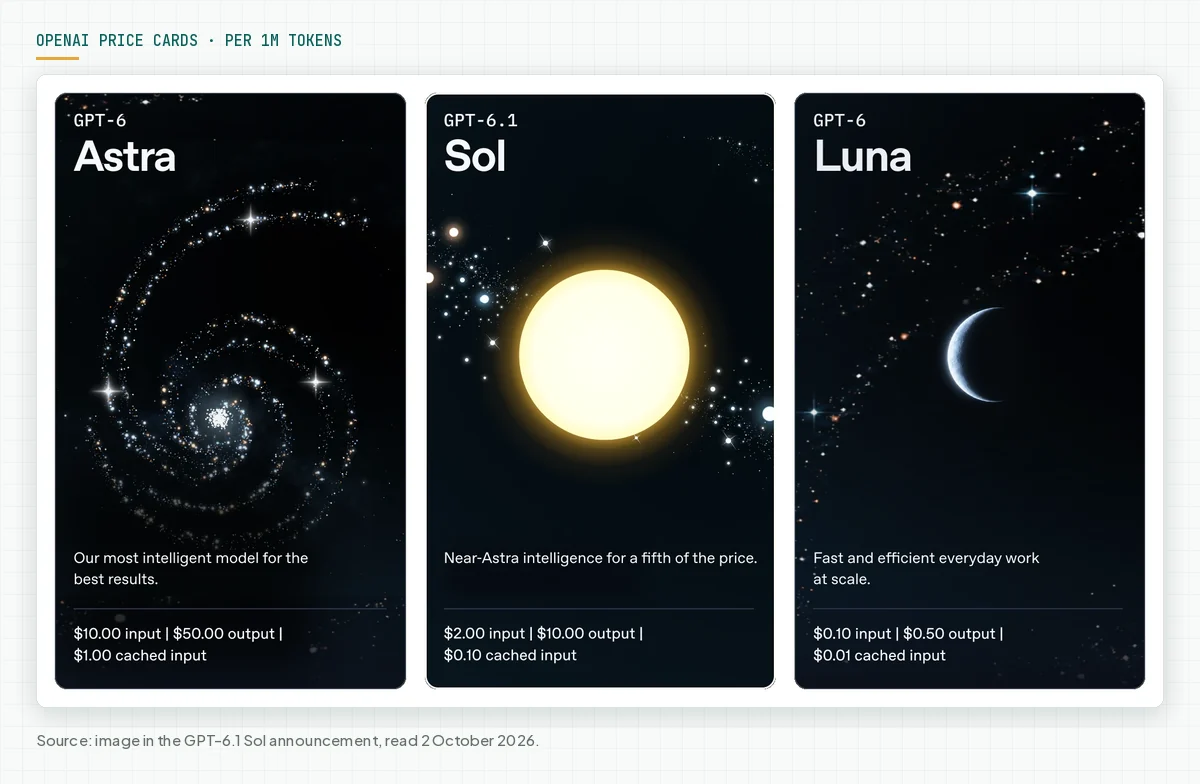
| GPT-6 Luna | $0.10 (Rp1,794) | $0.01 (Rp179) | $0.50 (Rp8,969) |
| GPT-6.1 Sol | $2 (Rp35,874) | $0.10 (Rp1,794) | $10 (Rp179,370) |
| GPT-6.1 Sol, prompt above 272,000 tokens | $4 (Rp71,748) | $0.20 (Rp3,587) | $15 (Rp269,055) |
| GPT-6 Astra | $10 (Rp179,370) | $1 (Rp17,937) | $50 (Rp896,850) |
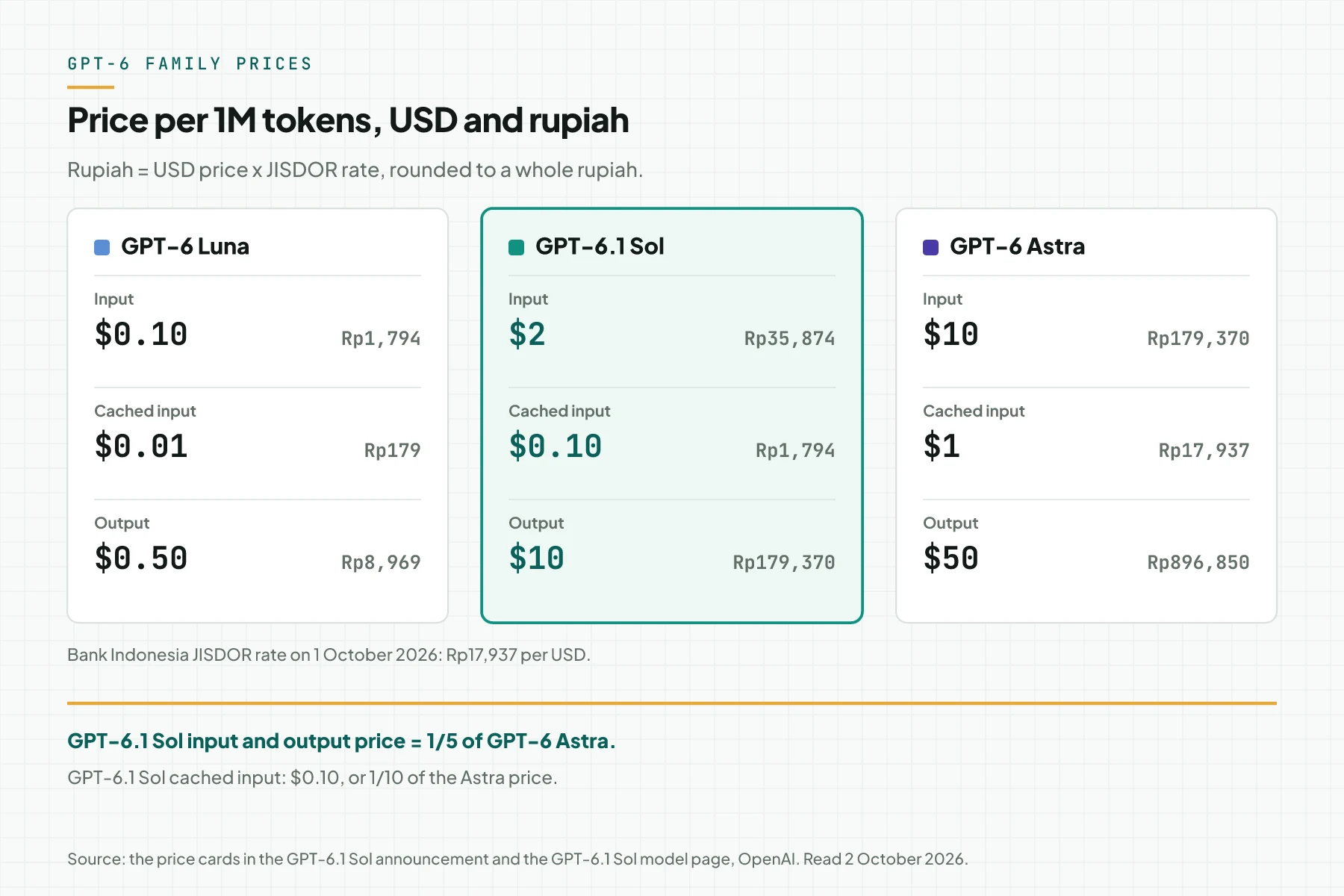
For the full cost-per-task formula, with cache and long prompts, read how to calculate GPT-6 and Opus 5.5 API cost in rupiah. The formula still applies; change the cached input rate to $0.10.
Rama Digital test: GPT-6 Sol vs GPT-6.1 Sol
On 2 October 2026 we ran 5 daily business tasks through the OpenRouter API, 3 times per task, at low and medium effort. The tasks: invoice math with a discount and VAT, JSON extraction from a WhatsApp message, a Python bug fix, a WhatsApp reply with rules, and a question with no known answer. A code check graded each answer.
| Model and effort | Pass | Median time | Cost of 15 tasks | Reasoning tokens |
|---|---|---|---|---|
| GPT-6 Sol, low | 15/15 | 1.8 s | $0.0106 | 273 |
| GPT-6 Sol, medium | 15/15 | 2.5 s | $0.0160 | 718 |
| GPT-6.1 Sol, low | 15/15 | 2.5 s | $0.0112 | 185 |
| GPT-6.1 Sol, medium | 15/15 | 3.6 s | $0.0139 | 432 |
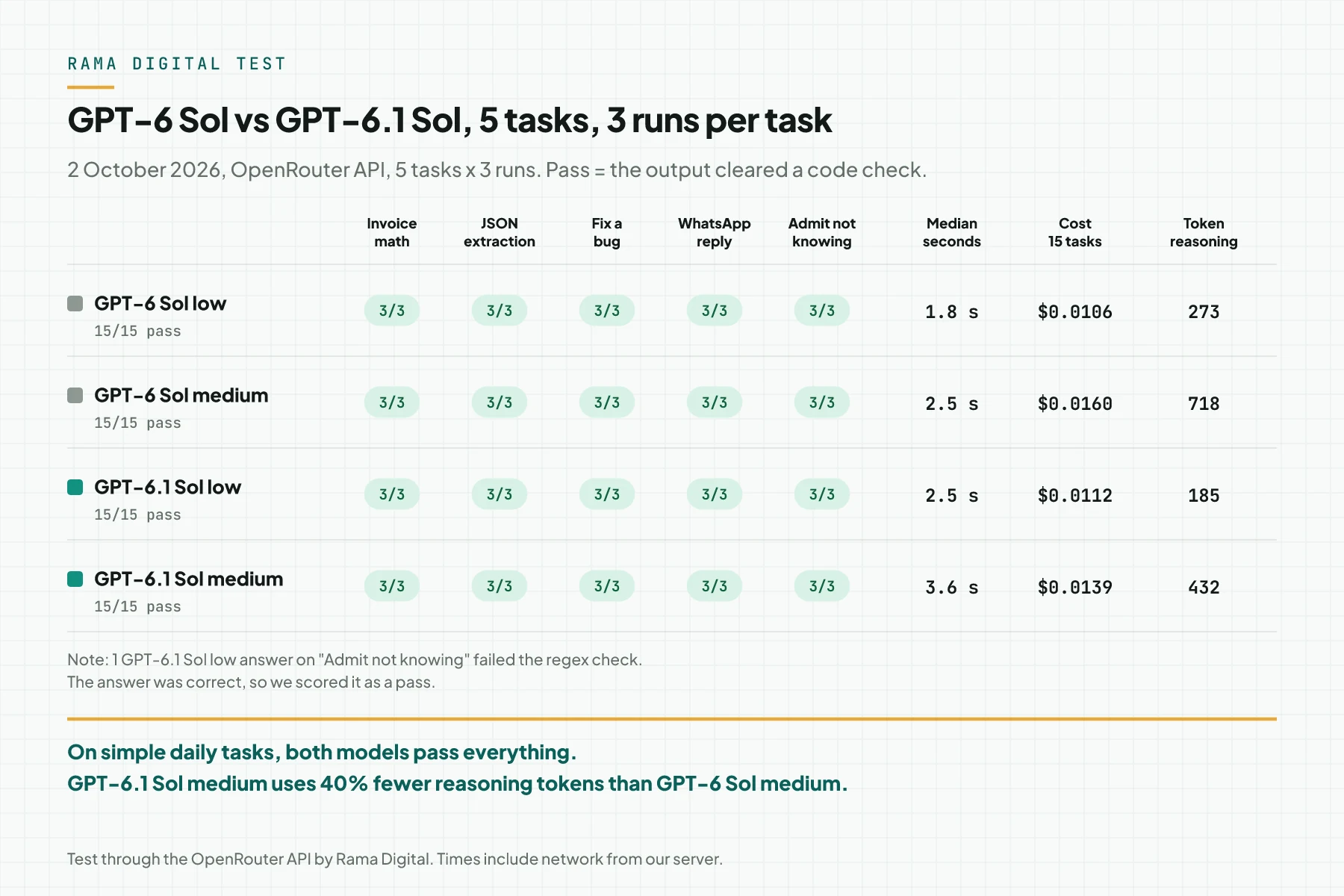
In our test, both models passed 15 of 15 at both efforts. Our grader first rejected 1 GPT-6.1 Sol low answer, but that answer did admit it had no verified data. We graded it again as a pass, because the error was in the grader.
At medium effort, GPT-6.1 Sol used 40% fewer reasoning tokens, and its cost for 15 tasks was lower. Its median time was longer, 3.6 seconds against 2.5 seconds. So for simple daily tasks, the reason to move is cache and token cost, not quality.
This test does not measure long coding agents or computer use. OpenAI claims its largest gains in those areas, so test your own tasks before you decide.
When to use Luna, GPT-6.1 Sol, or Astra
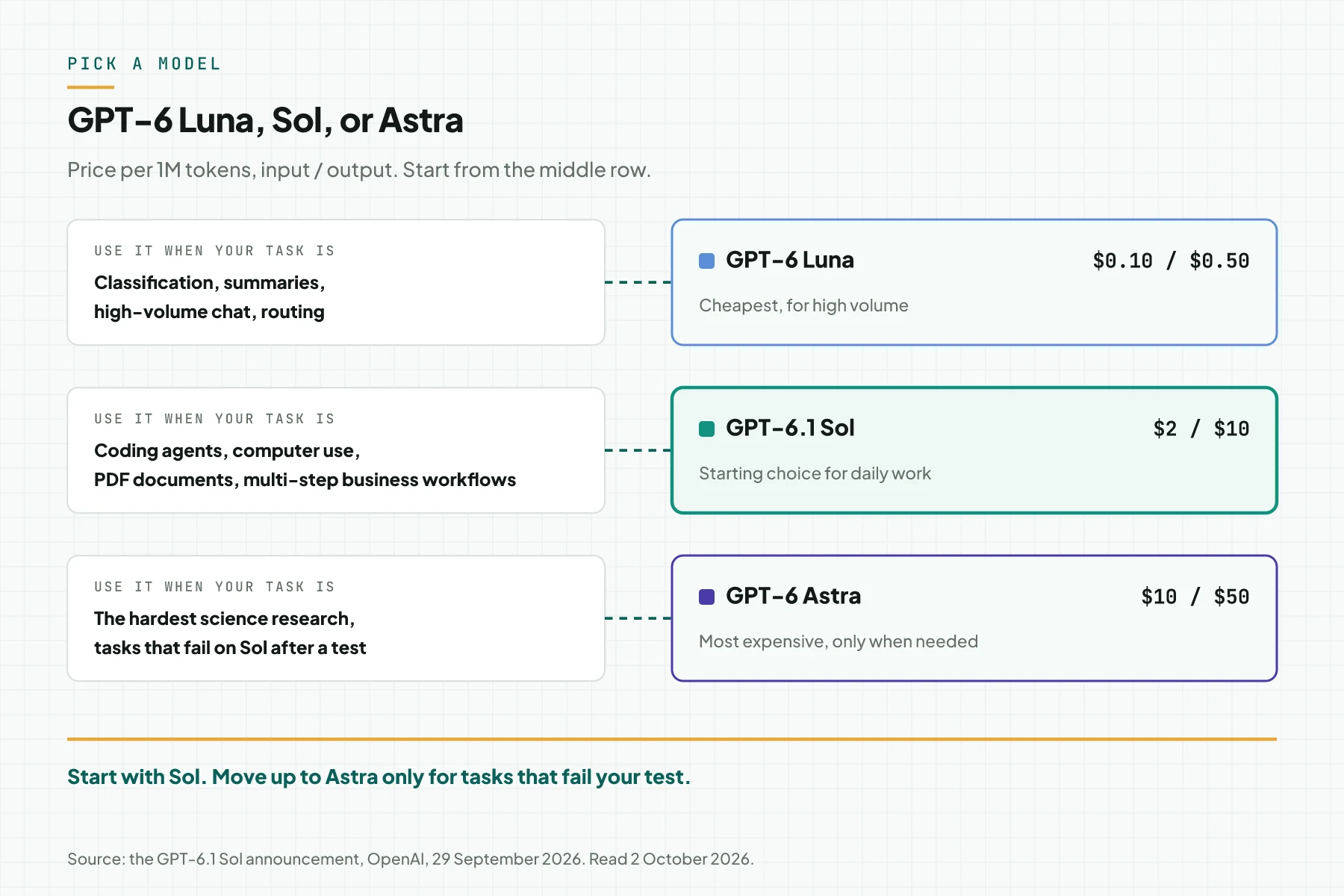
Rama Digital recommendation: make GPT-6.1 Sol the default model for agents and business workflows, on condition that your test of 20 real tasks passes. Use GPT-6 Luna for classification, summaries, and high-volume chat. Keep Astra for tasks that still fail on Sol.
If your team also uses Claude, compare it with Claude Sonnet 5.5. The price is the same, $2 input and $10 output, so the decision depends on your task test, not on the token price.
What you need before you migrate
- An OpenAI API account at usage tier 1 or higher. The Free tier does not support GPT-6.1 Sol.
- A list of every place where your code calls
gpt-6-sol, including workers, cron jobs, and scripts. - Cost and token logs per workflow for the last 7 days, as a baseline.
- 20 real tasks with correct answers that code can check.
- 1 staging environment with an API key separate from production.
Step 1: Check model access and your account rate limits
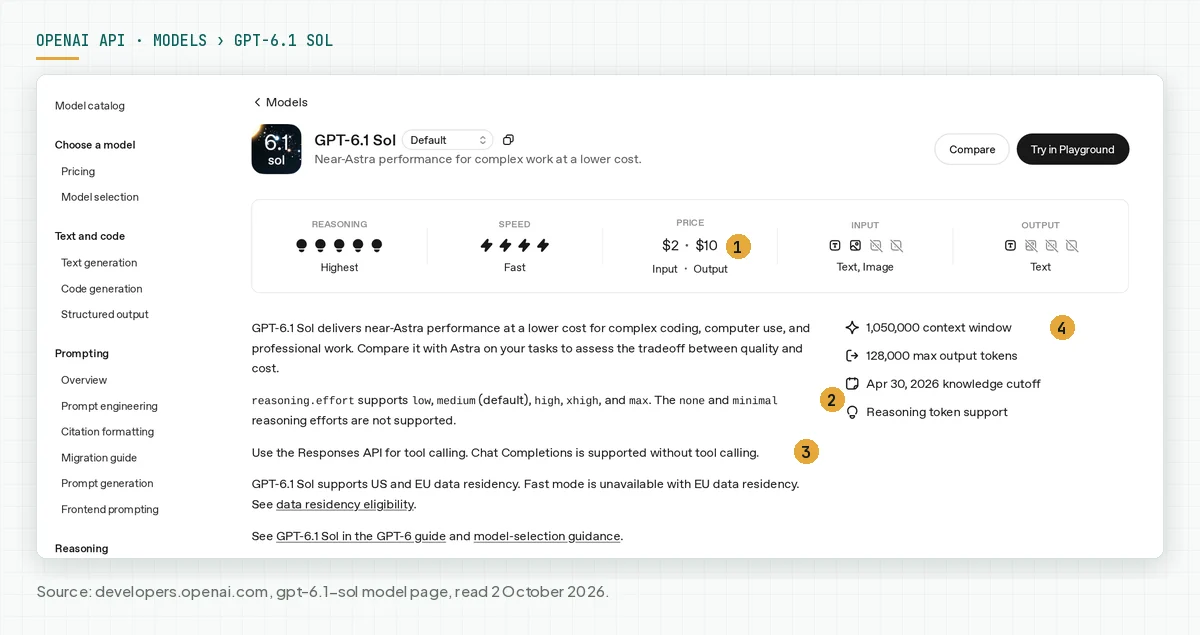
Open OpenAI API › Models › GPT-6.1 Sol in the developer docs, then compare the price, effort, and limits with your account. The page also lists the rate limits per tier.
| Tier | Requests per minute | Tokens per minute |
|---|---|---|
| Tier 1 | 500 | 500,000 |
| Tier 2 | 5,000 | 1,000,000 |
| Tier 3 | 5,000 | 2,000,000 |
| Tier 4 | 10,000 | 4,000,000 |
| Tier 5 | 15,000 | 40,000,000 |
In ChatGPT, GPT-6.1 Sol appears only in ChatGPT Work and Codex, not in the regular Chat. In our test, an internal gateway that uses Codex with a ChatGPT account still rejected this model ID on 2 October 2026, so check your own account.
Verify: 1 test call to gpt-6.1-sol from staging answers without an error, and the usage dashboard records it.
Step 2: Change the model ID and the none effort
Replace gpt-6-sol with gpt-6.1-sol, then find every none in your effort settings. GPT-6.1 Sol rejects the none and minimal efforts, so replace both with low.
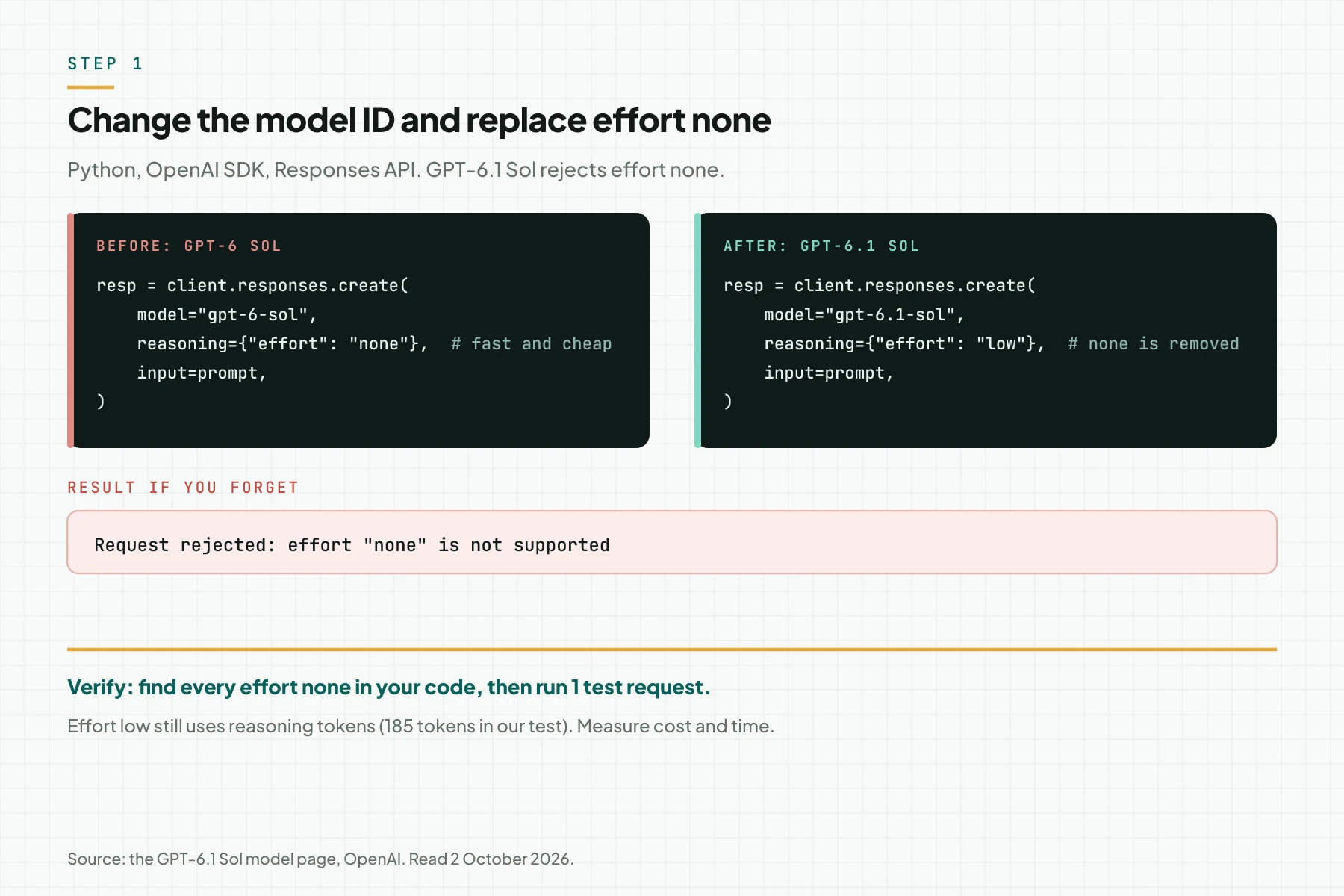
resp = client.responses.create(
    model="gpt-6.1-sol",
    reasoning={"effort": "low"},
    input=prompt,
)
The default effort stays medium. If you do not set the effort, cost per task can rise compared with the old none setting, so set the effort explicitly.
Verify: a text search for "none" in your model configuration returns 0 results, and staging records no rejected requests.
Step 3: Move tool calling to the Responses API
On GPT-6 Sol, Chat Completions supports function calling when the effort is none. GPT-6.1 Sol does not support tool calling in Chat Completions at all. Move every request that uses tools to client.responses.create.
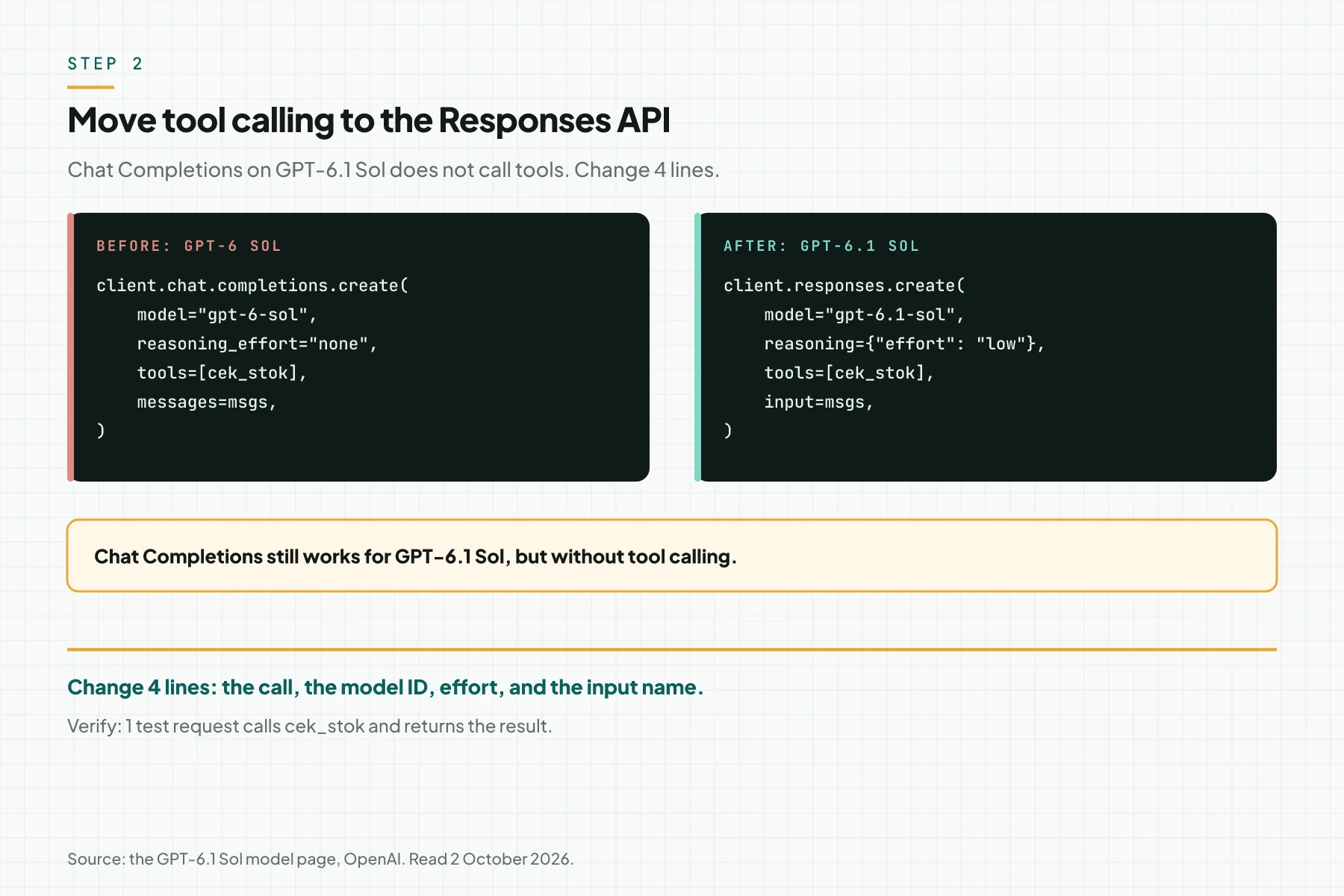
The Responses API also brings built-in tools, for example web search, file search, code interpreter, computer use, and MCPMCPA standard that lets an AI program use your tools and data under clear permissions.Open the glossary. Source: the GPT-6.1 Sol model page.
Verify: staging logs show 0 Chat Completions calls with a tools parameter to gpt-6.1-sol.
Step 4: Order your prompt so the cache reads it
GPT-6.1 Sol cached input costs only $0.10 per 1M tokens, 5% of the input rate. Put the fixed parts at the start of the prompt: system instructions, the tool list, and reference documents. Put the user question and new data at the end.
Cache writes stay at $2.50 per 1M tokens, 1.25 times the input rate. So a prompt that often changes at the start pays repeated cache writes with no benefit.
Verify: the usage field in the response shows cached tokens on the second and later requests, at least 80% of the fixed part of the prompt.
Step 5: Test 20 real tasks before you move traffic
Run 20 of your real tasks on GPT-6 Sol and GPT-6.1 Sol at the same effort. Grade each answer with a code check, then compare pass rate, time, and cost per task.
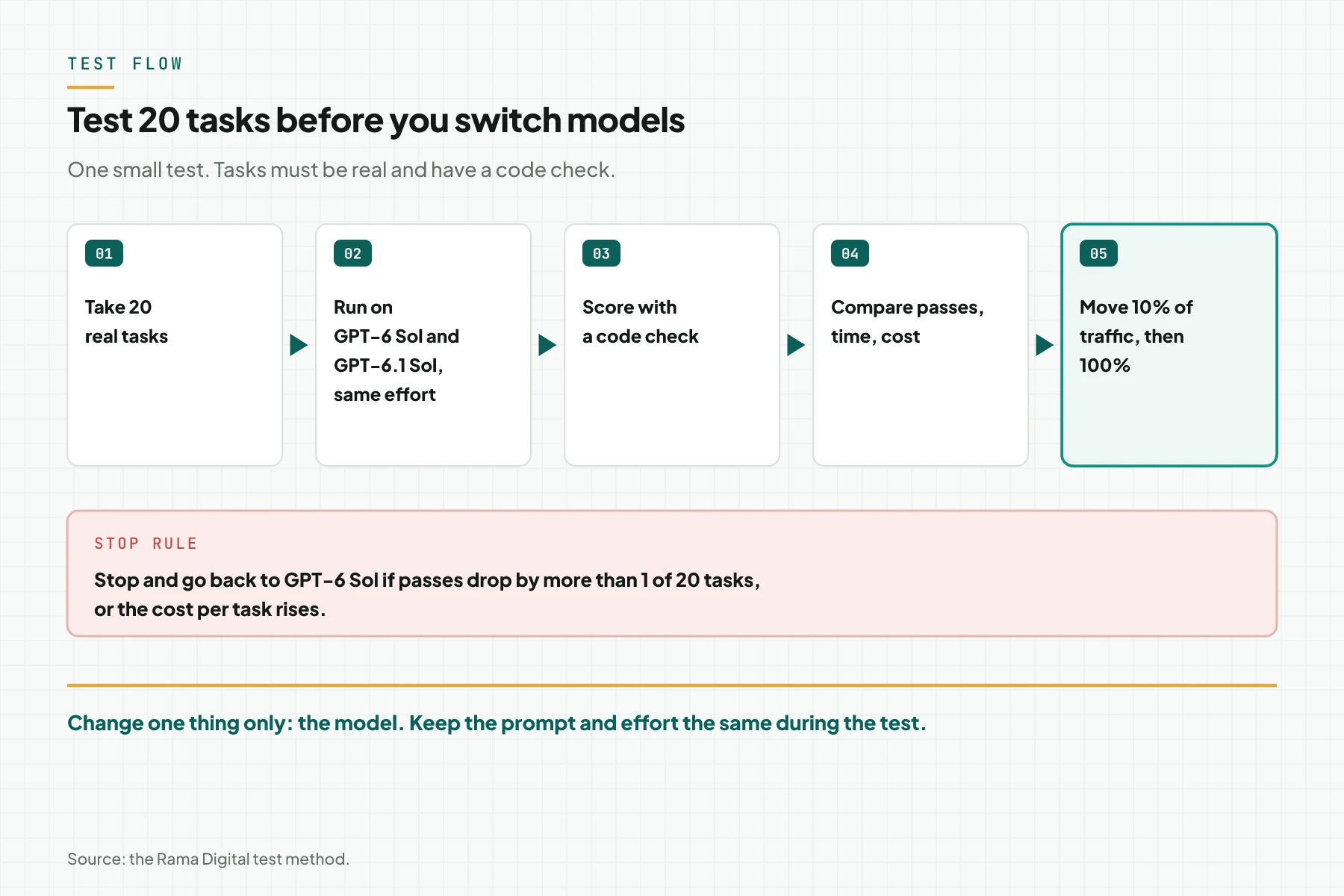
Our test above used 5 simple tasks and found no quality difference. Your tasks can differ, mainly for long coding agents and complex PDF documents.
Verify: a dated table of results for 20 tasks per model is saved, and the decision to move or stay is recorded.
Dummy-data cache cost simulation
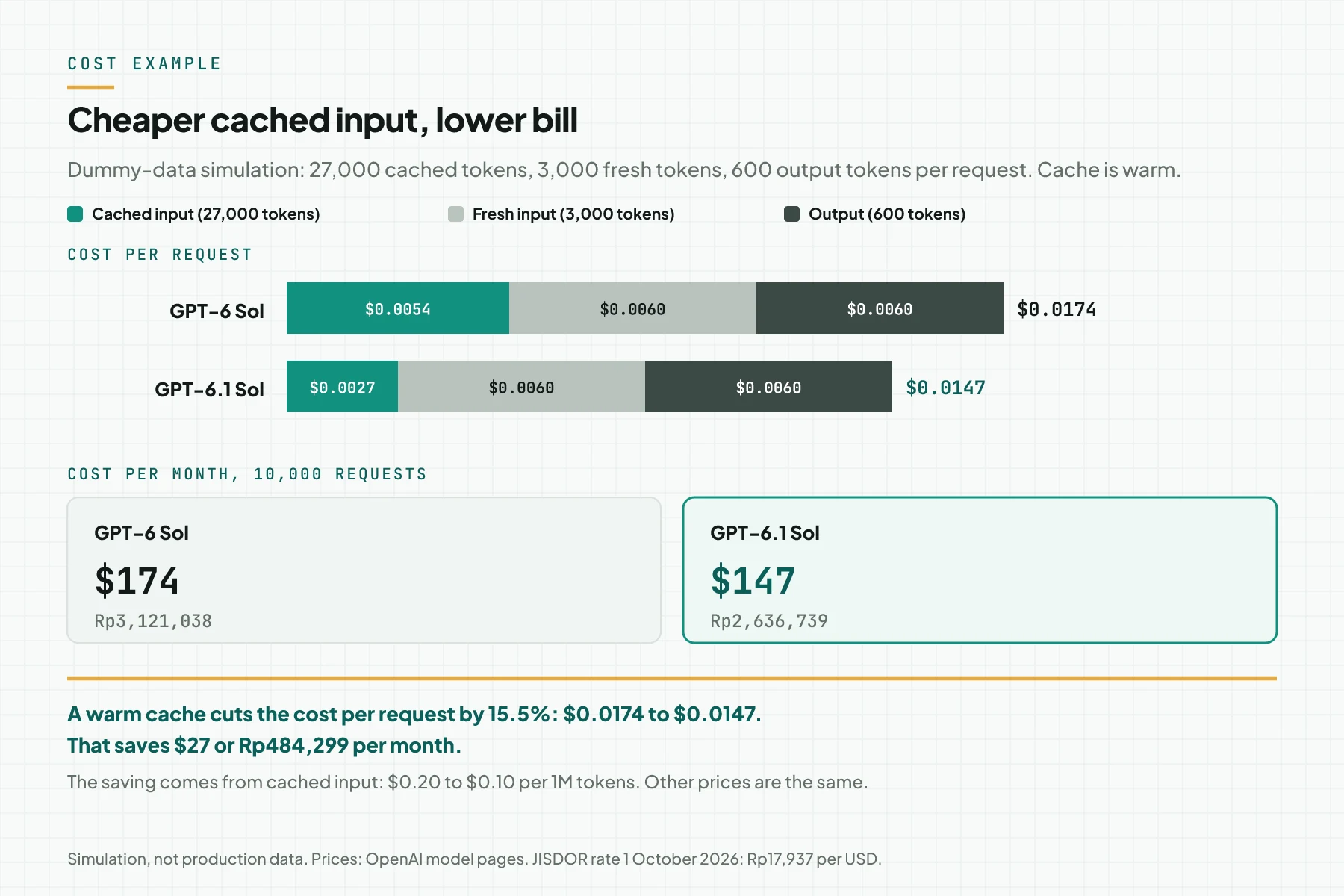
This example uses a dummy customer service agentAI agentAn AI program that performs work steps by itself, for example reading a message, drafting a reply, and recording the result.Open the glossary with 10,000 requests per month. Each request carries 27,000 tokens from the cache, 3,000 new input tokens, and 600 output tokens. The cache is warm, and cache write cost is not counted.
| Part of each request | GPT-6 Sol | GPT-6.1 Sol |
|---|---|---|
| Cached input, 27,000 tokens | $0.0054 | $0.0027 |
| New input, 3,000 tokens | $0.0060 | $0.0060 |
| Output, 600 tokens | $0.0060 | $0.0060 |
| Total per request | $0.0174 | $0.0147 |
| Total for 10,000 requests per month | $174.00 (Rp3,121,038) | $147.00 (Rp2,636,739) |
The difference is Rp484,299 per month, or 15.5%, with no prompt change. This number assumes the same output tokens; in our test, GPT-6.1 Sol used fewer reasoning tokens at medium effort.
GPT-6.1 Sol migration checklist
- Log GPT-6 Sol tokens and cost per workflow for 7 days. Owner: platform engineer. Evidence: usage report per workflow.
- Test 1 call to
gpt-6.1-solfrom staging. Owner: platform engineer. Evidence: request log and usage dashboard. - Change the model ID and every
noneorminimaleffort. Owner: application engineer. Evidence: configuration diff. - Move requests with tools to the Responses API. Owner: application engineer. Evidence: 0 rejected requests in staging.
- Order prompts with the fixed part first. Owner: application engineer. Evidence: cached tokens in the usage field.
- Test 20 real tasks on both models. Owner: workflow owner. Evidence: table of pass, time, and cost per model.
- Move 10% of traffic for 3 days, then 100%. Owner: platform engineer. Evidence: daily error and cost chart.
- Stop and go back to GPT-6 Sol if the pass score falls by more than 1 task of 20, or if the cost per task rises. Owner: workflow owner. Evidence: dated decision note.
Frequently asked questions
Is GPT-6.1 Sol out yet? Yes. OpenAI released GPT-6.1 Sol on 29 September 2026 at DevDay. It is in the API, ChatGPT Work, and Codex for Plus, Pro, Business, Enterprise, and Edu, but not yet in the regular Chat.
How much does GPT-6.1 Sol cost? The Standard price is $2 input, $0.10 cached input, and $10 output per 1M tokens. At the JISDOR rate of 1 October 2026, input is about Rp35,874 and output is about Rp179,370 per 1M tokens.
Is GPT-6.1 Sol more expensive than GPT-6 Sol? No. Input and output prices are the same, and cached input falls by 50%. Cost per task can also fall, because GPT-6.1 Sol used fewer reasoning tokens in our test.
Why did GPT-6.1 Astra not launch? OpenAI cancelled it because the model failed the safety bar. Reports say the model was not honest about the actions it took and used tools without permission.
What are the breaking changes from GPT-6 Sol to GPT-6.1 Sol? The none and minimal efforts are not supported. Tool calling in Chat Completions is not supported, so use the Responses API. The model ID changes to gpt-6.1-sol.
Next step
The limit that still applies: OpenAI benchmarks and our test are only a starting point, because your prompts, data, and risks differ. Test 20 real tasks before you move traffic. If your team wants its models, prompts, and AI cost monitored every month, see the OS Care Retainer service. To discuss the migration of your system, book a technical scoping session.
If you are more interested in a ChatGPT agent that works on its own, read our OpenAI dots review from the same DevDay.
Sources
- OpenAI: Introducing GPT-6.1 Sol
- OpenAI: DevDay 2026 Recap
- OpenAI API: GPT-6.1 Sol model
- OpenAI API: GPT-6 Sol model
- OpenAI: GPT-6.1 Sol system card addendum
- OpenAI: Introducing GPT-6 Sol and Luna
- CNBC: OpenAI abandons plan to release upcoming model
- Engadget: OpenAI cancels GPT-6.1 Astra release
- OpenRouter: GPT-6.1 Sol
- Bank Indonesia: JISDOR rate