Direct answer: use GPT-6 Luna for high-volume work that code can check. Use GPT-6 Sol for agents with tools and daily coding. Use ClaudeClaude ProThe paid subscription for the Claude AI assistant from Anthropic. It unlocks connectors to outside tools.Open the glossary Opus 5.5 for long tasks where a mistake is costly. Luna costs $0.10 and $0.50 per 1M input and output tokens. Sol costs $2 and $10. Opus 5.5 costs $4 and $20.
Main condition: this split holds when you measure the cost per successful task, not the price per token. Limit: no vendor benchmark compares all 3 models directly, so you still must test 20 of your real tasks before you move traffic.
We read the official OpenAI, Anthropic, and Artificial Analysis pages on 23 September 2026. On the same day we tested all 3 models with the same prompts: 18 calls at effort medium and 6 extra calls for Luna. The business example in this article uses dummy data.
Three launches in 1 day make the choice harder
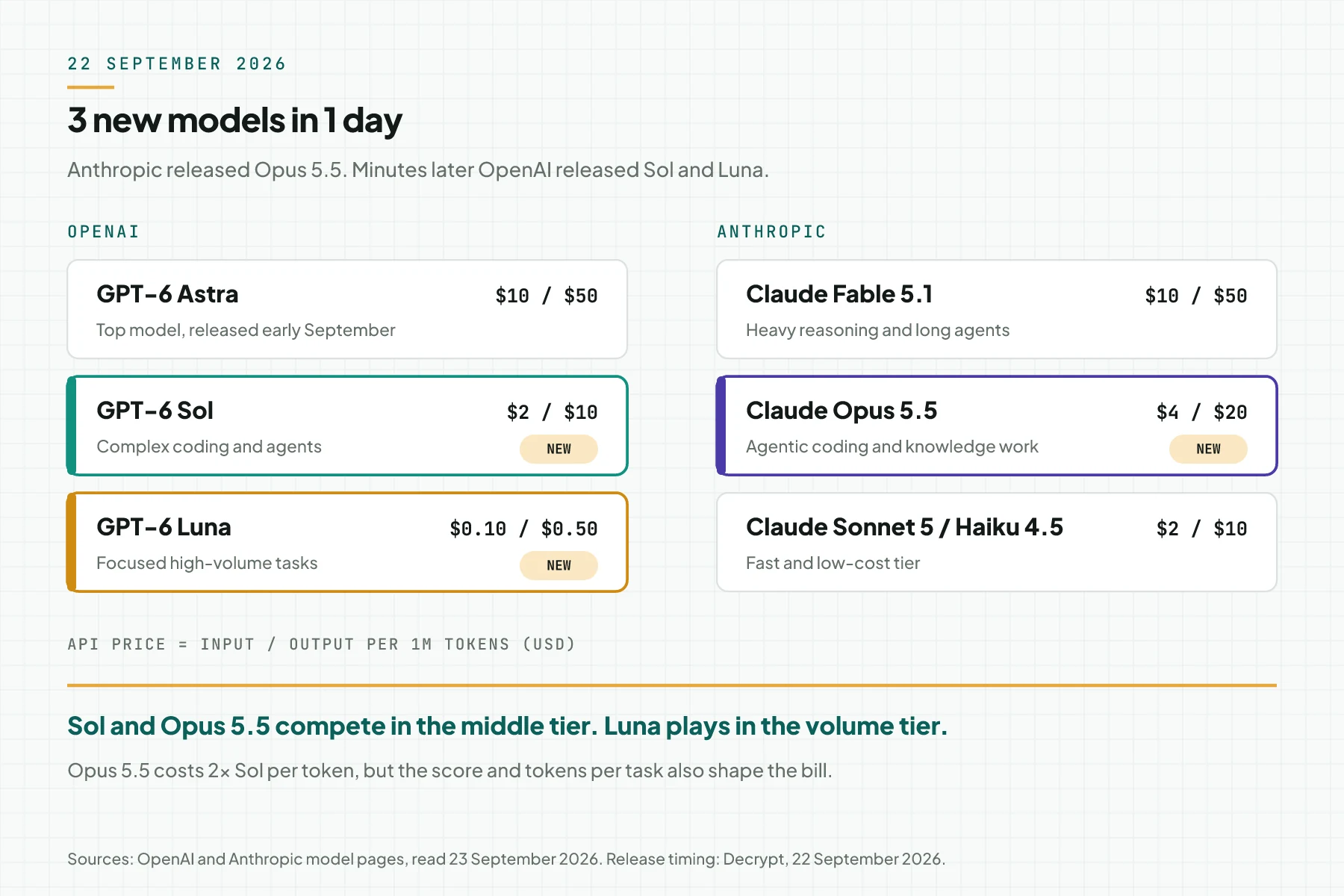
Anthropic released Claude Opus 5.5 on 22 September 2026. OpenAI released GPT-6 Sol and GPT-6 Luna on the same day. Decrypt reported that the 2 launches were only minutes apart.
The problem is simple. Each vendor compares its model with the older model of the other vendor, not with the new release. OpenAI compares Sol with Claude Opus 5 and Fable 5.1. Anthropic compares Opus 5.5 with GPT-6 Astra and GPT-5.6 Sol.
A team that runs more than 1 model must choose again. If you used GPT-5.6 before, also read how we read Sol, Terra, and Luna in GPT-5.6 (Indonesian). If you use Opus 5, compare it with our Claude Opus 5 release notes (Indonesian).
Specs and prices side by side
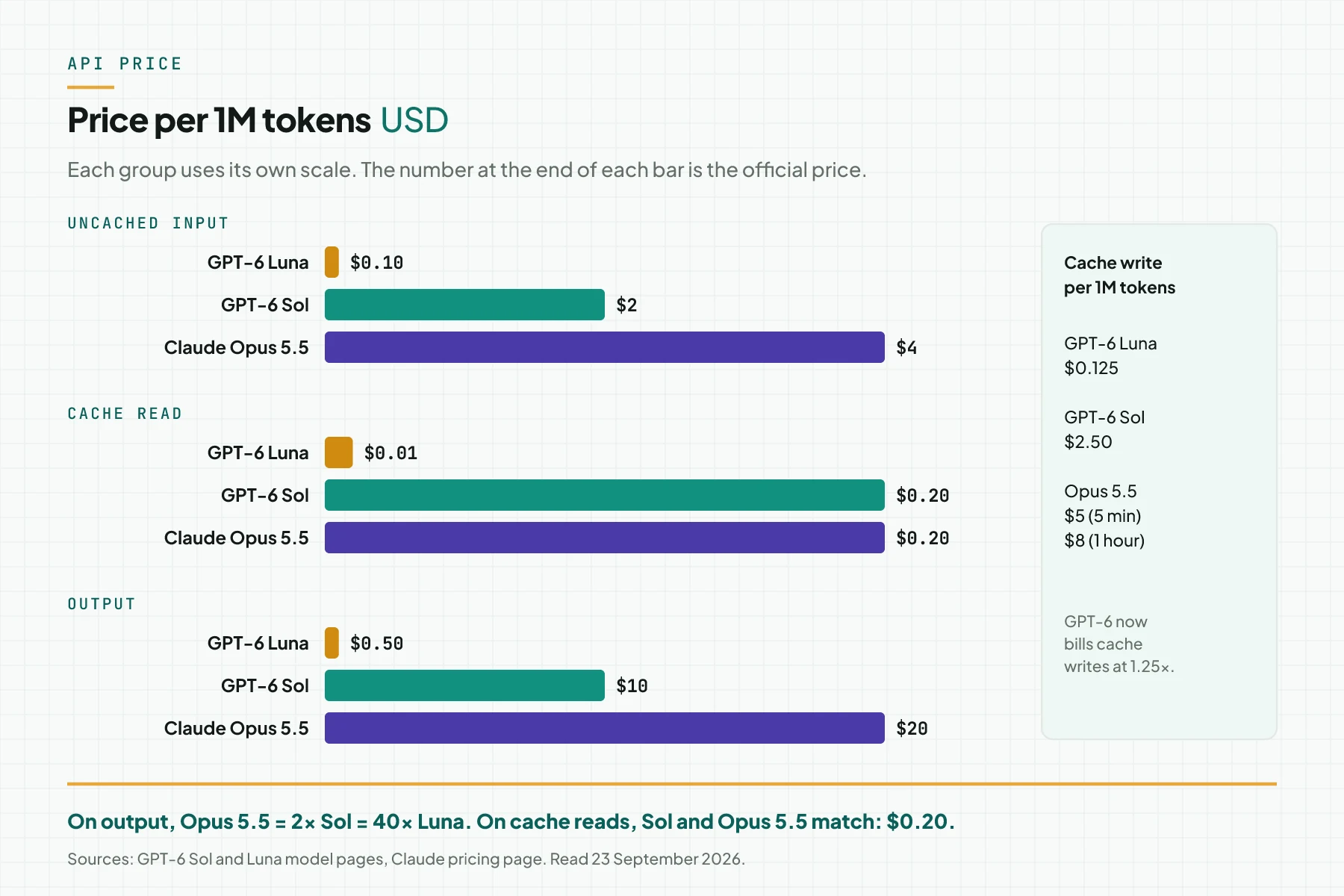
The table below uses numbers from the official model pages. Prices are in USD per 1M tokens on standard processing, read on 23 September 2026.
| Item | GPT-6 Sol | GPT-6 Luna | Claude Opus 5.5 |
|---|---|---|---|
| APIAPIThe official door 2 systems use to exchange data, without anybody copying it by hand.Open the glossary ID | gpt-6-sol | gpt-6-luna | claude-opus-5-5 |
| Input / output | $2 / $10 | $0.10 / $0.50 | $4 / $20 |
| Cache read | $0.20 | $0.01 | $0.20 |
| Cache write | $2.50 | $0.125 | $5 (5 min), $8 (1 hour) |
| Context / max output | 1,050,000 / 128,000 tokens | 1,050,000 / 128,000 tokens | 1M / 128,000 tokens |
| Prompt above 272,000 tokens | 2x input, 1.5x output | 2x input, 1.5x output | Standard price |
| Knowledge cutoff | 20 April 2026 | 18 May 2026 | June 2026 (reliable) |
| Effort levels | none to max, default medium | none to max, default medium | low to max, default medium |
| Batch | 50% of standard | 50% of standard | $2 / $10 |
Sources: the GPT-6 Sol model page, the GPT-6 Luna model page, the Claude models overview, and the Claude pricing page.
People often miss 2 rows. First, GPT-6 now bills cache writes at 1.25x the input price. Second, Opus 5.5 has no long-context premium, so a 900,000-token prompt costs the same per token as a 9,000-token prompt.
Availability in the apps
Sol and Luna are in ChatGPT Work and Codex for Plus, Pro, Business, Enterprise, and Edu plans. Free and Go users get Luna in the desktop app. OpenAI writes that neither model is in plain Chat yet.
Opus 5.5 is on the Claude Platform, Amazon Web Services, Google Cloud, and Microsoft Azure. Anthropic also raised the 5-hour usage limits on Pro, Max, Team, and seat-based Enterprise plans. In GitHub Copilot, Sol and Luna have been available since 22 September 2026.
Benchmarks: what you can compare and what you cannot
A benchmark number helps only when the method matches. We split the data into 3 kinds. The first is a benchmark both vendors publish. The second has similar scores but different cost methods. The third is an independent test with the same harness.
FrontierCode: 1 benchmark, 2 vendors
FrontierCode 1.1 Main checks whether a code change is ready to merge into a real codebase. OpenAI and Anthropic both publish a chart of scores per effort level for it. Both charts record the same Fable 5.1 max score, 50.3%, so the score scales match.
At effort medium, Opus 5.5 reaches 54.6% and Sol reaches 45.9%. Both cost $0.80 per task. Luna medium reaches 35.5% at $0.053 per task.
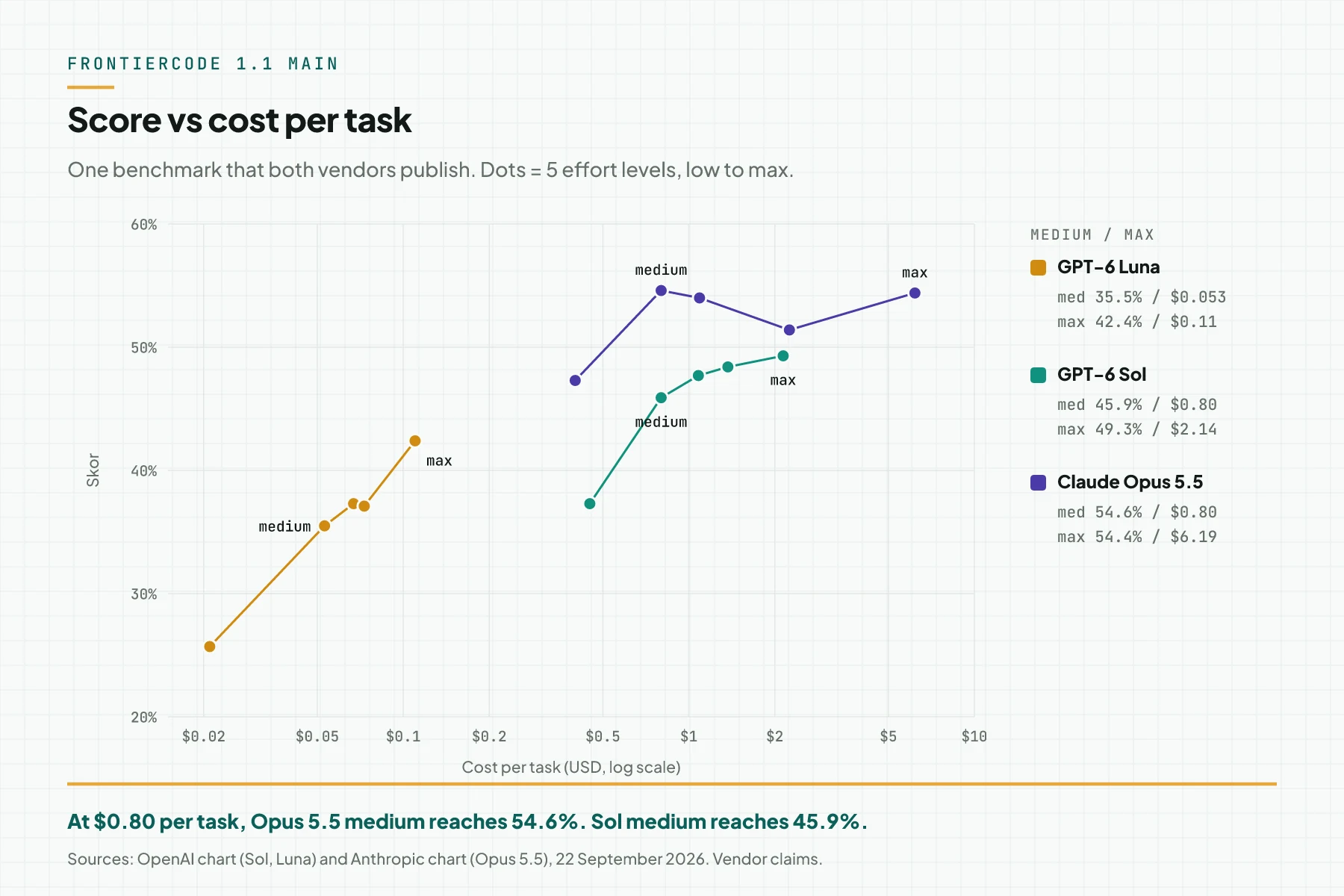
The limit: each vendor calculates the cost per task itself. The OpenAI chart puts GPT-6 Astra max at $4.59, while the Anthropic chart puts the same model at $4.36.
AutomationBench: similar scores, different cost methods
AutomationBench tests business workflows across apps. OpenAI reports Sol xhigh at 33.2% on version 1.0.6, at $0.27 per task. Anthropic reports Opus 5.5 max at 40.0% from the Zapier run, at $1.37 per task.
Both sources put Opus 5 max at 26.9%. The Opus 5 max cost differs widely, though: OpenAI says 11.1x the Sol cost, and the Anthropic chart says $1.27. So compare the AutomationBench scores with care, and do not compare its costs.
The Artificial Analysis independent test
Artificial Analysis tested all 3 models with the same harness at max effort. The results are in its Opus 5.5 article and its GPT-6 Sol and Luna article, both dated 22 September 2026.
| Measure | GPT-6 Sol | GPT-6 Luna | Claude Opus 5.5 |
|---|---|---|---|
| Intelligence Index v4.3.2 | 48 | 37 | 58 |
| Cost per index task | $1.06 | $0.07 | $5.98 |
| Terminal-Bench 4.0 | 44% | 13% | 59.6% |
| Output speed | 115 tokens per second | 154 tokens per second | Not recorded yet |
Opus 5.5 leads the score. Sol is 5.6x cheaper per task than Opus 5.5, and Luna is 85x cheaper. Artificial Analysis also records that Opus 5.5 max uses about 119,000 output tokens per index task.
What you need first
- 1 OpenAI API account and 1 Anthropic API account, or 1 gateway that forwards to both.
- A list of 20 real tasks from 1 workflow, each with the correct answer.
- 1 automatic checker per task: a JSON schemaSchemaExtra description inside page code that tells a search engine what the page is, for example an article, a service, or a question and answer.Open the glossary, a unit test, or a business rule.
- A per-request log that stores the model, effort, tokens, time, and checker result.
- A rupiah rate for cost reports. We use the Bank Indonesia JISDOR rate of 22 September 2026: IDR 17,883 per USD.
Step 1: Sort the work with 3 questions
Start from the work, not from the model. Answer the 3 questions below from the top, and stop at the first "yes".
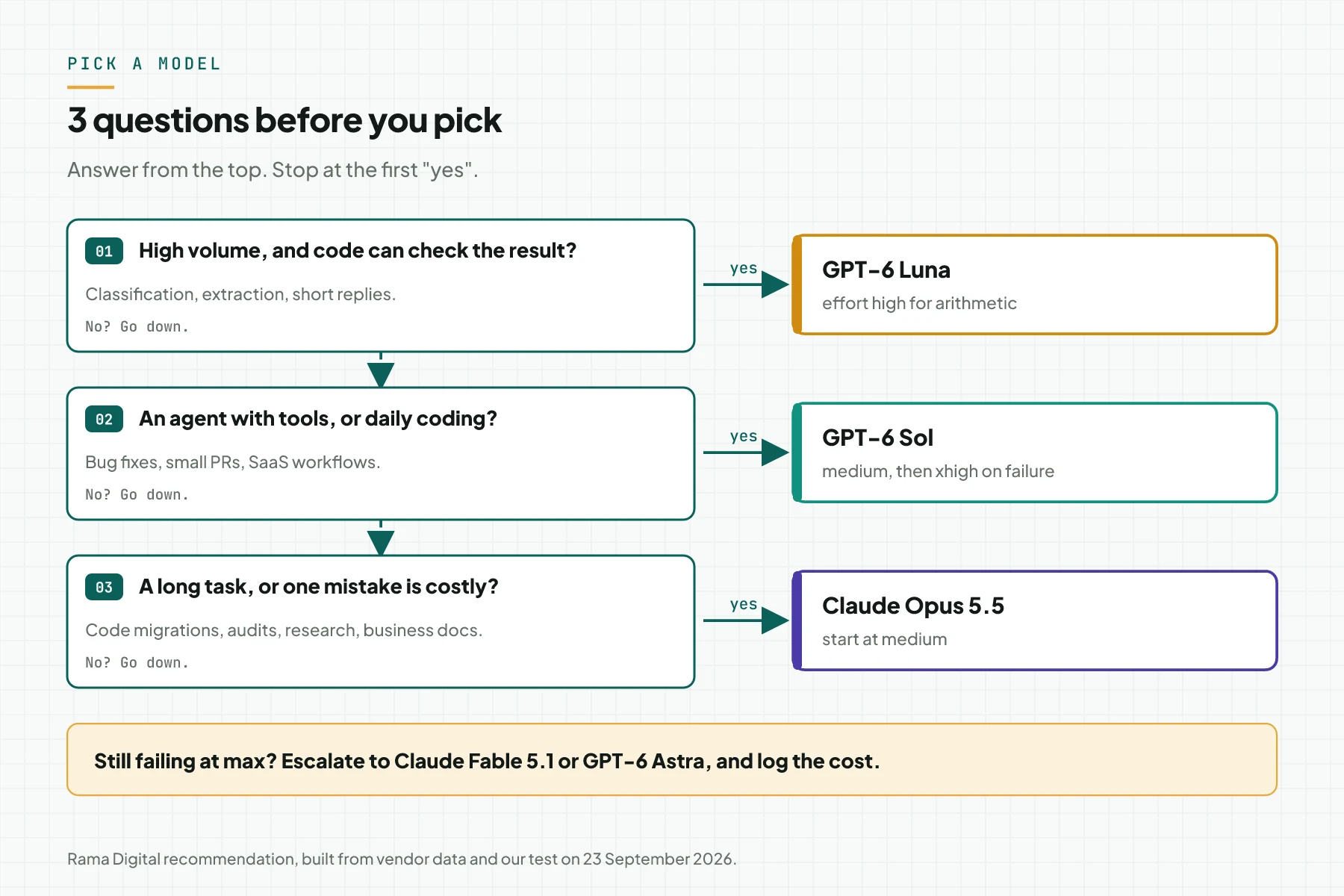
- High volume, and code can check the result? Examples: message classification, order data extraction, short replies. Pick Luna.
- An agent with tools, or daily coding? Examples: bug fixes, small PRs, SaaS workflows. Pick Sol.
- A long task, or one mistake is costly? Examples: code migrations, audits, research, business documents. Pick Opus 5.5.
Verify: every task on your 20-task list gets 1 lane. The split follows the focus each vendor writes: OpenAI names Sol for "complex coding and agenticAgenticA way of working where an AI agent performs the routine steps and a person checks and approves the result.Open the glossary workflows" and Luna for "focused, high-volume tasks".
Step 2: Test the 3 models with the same prompt
Send the exact same prompt to all 3 models, then score the output with code, not with taste. We did this on 23 September 2026 with 3 tasks. The tasks were a WhatsApp order to JSON, a reply to a customer complaint, and a VAT bug calculation.
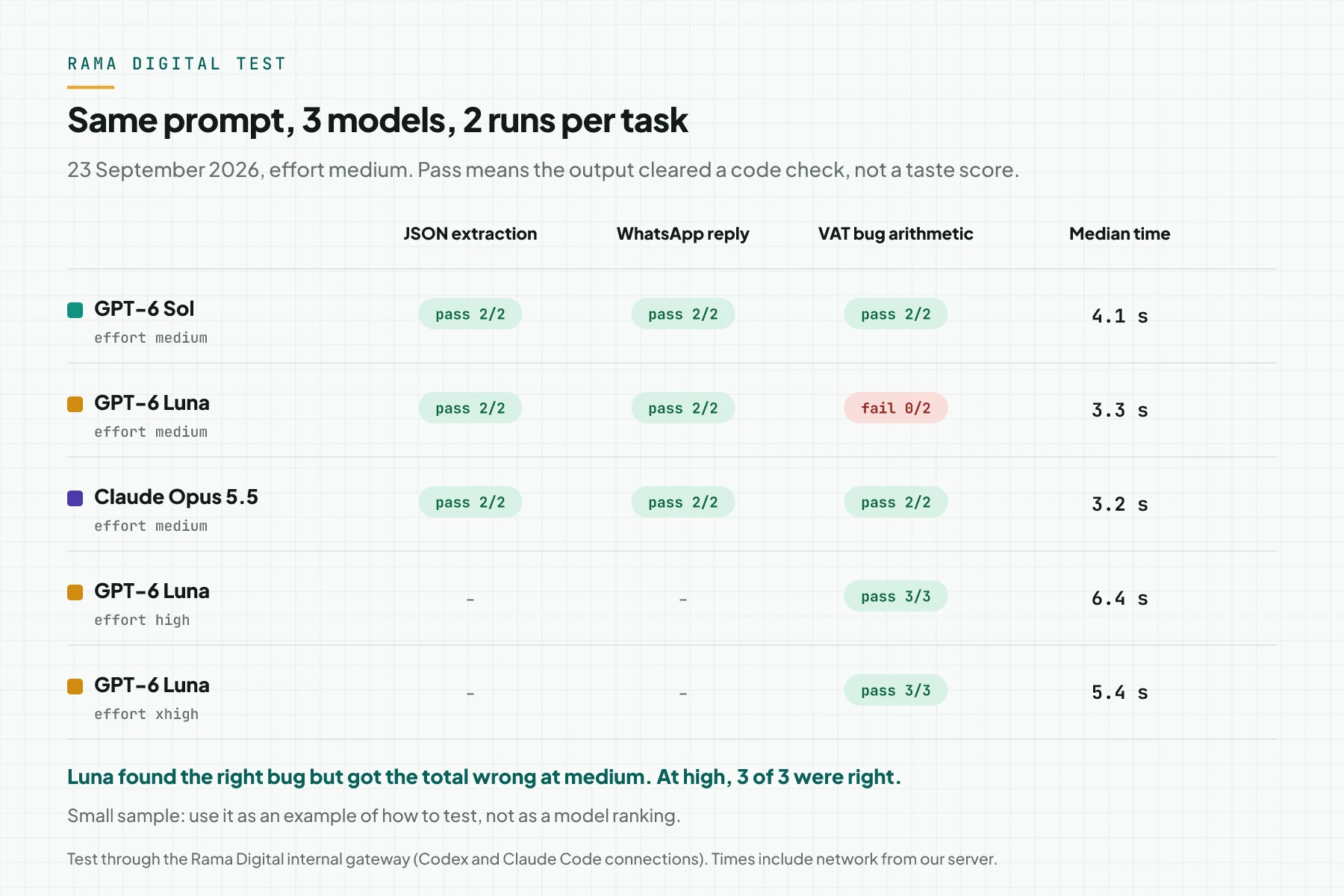
In our test, Sol and Opus 5.5 passed 6 of 6. Luna passed 4 of 6. Luna named the cause of the bug correctly, but its totals were wrong: 327,750 and 379,450, while the answer is 360,750.
We repeated that arithmetic task for Luna at effort high and xhigh, 3 times each. All 6 were right. The median time was 6.2 seconds, up from 2.1 seconds at medium.
One quality note. In 1 of 2 customer replies, Opus 5.5 added a promise "before 17.00" that the instructions did not contain. Check every time promise and action promise in an automatic reply.
The limit of this test: we used our internal gateway, which connects through Codex and Claude Code connections, not the paid API. Times include the network from our server, and token counts include harness instructions, so we do not calculate API cost from this test.
Step 3: Match your results against the independent test
Compare the results of your 20 tasks with the Artificial Analysis numbers. When your results point far from the independent test, check your prompt and your checker first.
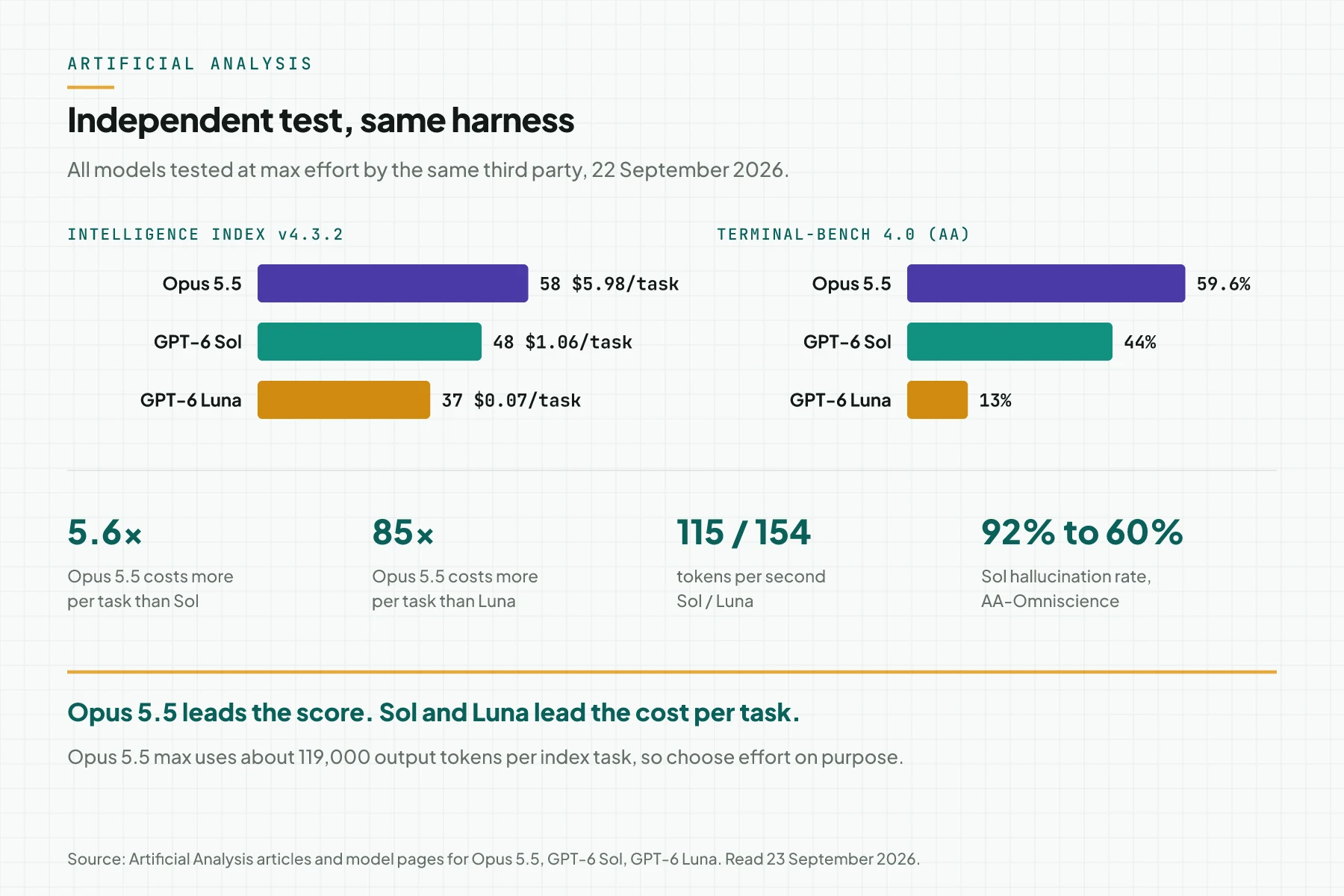
Three independent findings change the decision:
- The Sol hallucination rate fell from 92% to 60% on AA-Omniscience. Sol declines to answer more often, so its accuracy fell from 59% to 54%.
- Sol and Luna weakened on GDPval-AA v2.1, by about 100 and 75 Elo. Artificial Analysis links this to shorter deliverables.
- Opus 5.5 leads AA-Briefcase at 1,822 Elo, 143 above Fable 5.1.
Rama Digital recommends: for client reports and presentations, test Opus 5.5 first. For coding on a tight budget, test Sol first. The migration details for each model are in the GPT-6 Sol and Luna guide and the Claude Opus 5.5 guide.
Step 4: Install routing with a checker
Install 1 entry point that picks the lane, then 1 checker that scores the result. A task that fails the checker moves up 1 lane, from Luna to Sol, then to Opus 5.5.
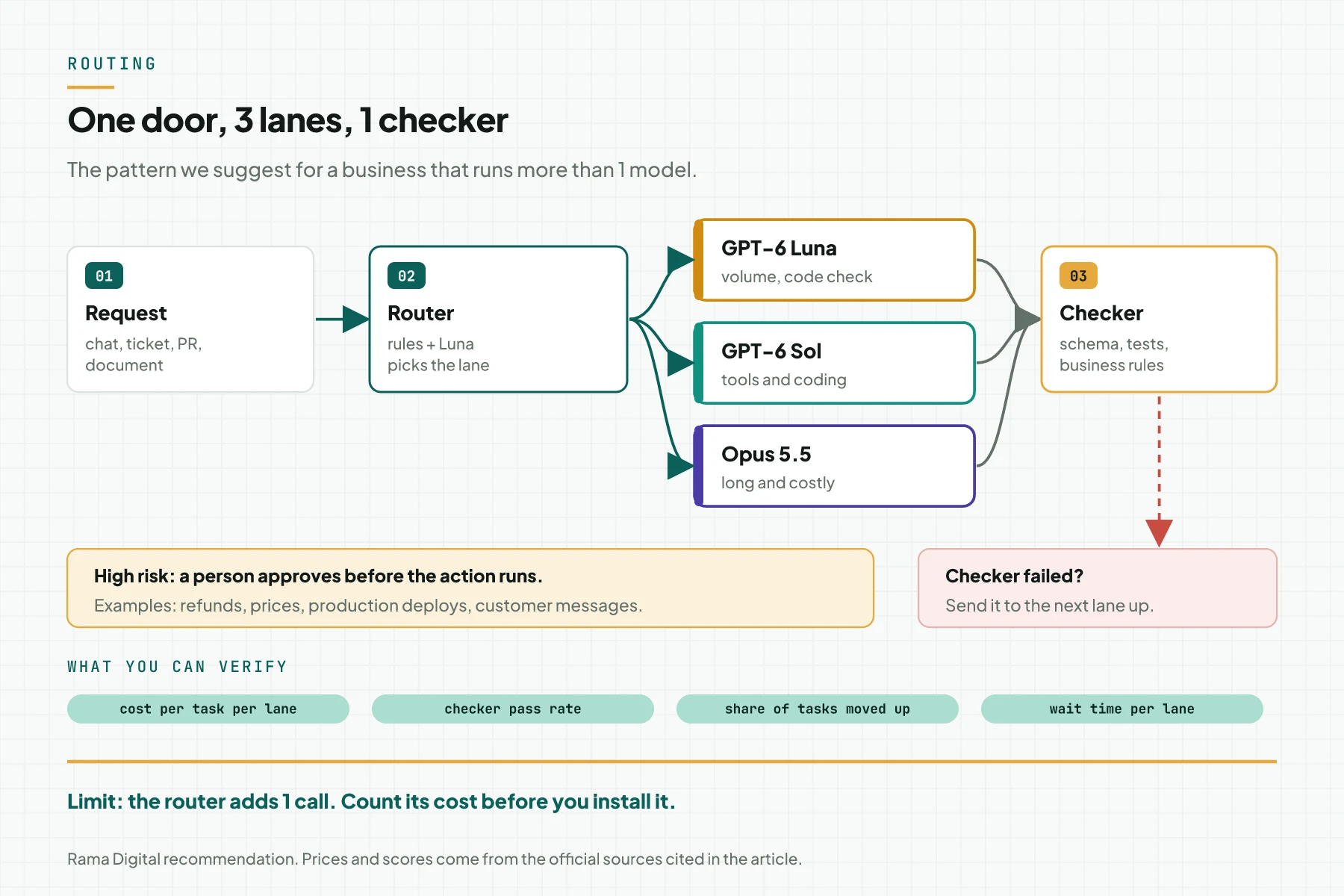
Set effort per lane, not per model. Start Luna at high for tasks with arithmetic, Sol at medium, and Opus 5.5 at medium. Raise effort only for tasks that fail.
Verify: after 1 week, your log answers 3 questions. What is the cost per task per lane? What share of tasks passes the checker? What share of tasks moves up a lane? The cost method is in the guide to API cost per task.
Worked example: 1 day at a dummy online shop
A simulation with dummy data. The online shop "Kopi Sleman" runs 3 lanes on 23 September 2026. The coding and report costs use the cost per task from vendor charts, not a real invoice.
| Time | Job | Lane and effort | Checker result | Cost |
|---|---|---|---|---|
| 09.00 | 1,200 overnight WhatsApp messages classified | Luna, high | 1,184 pass the schema, 16 fail | $0.14 |
| 09.20 | 16 failed messages classified again | Sol, medium | 16 pass the schema | $0.08 |
| 10.30 | Shipping-fee bug at checkout | Sol, medium then xhigh | Test fails once, then passes | $2.17 |
| 13.00 | Monthly sales report and recommendations | Opus 5.5, medium | A person corrects 1 number | $0.86 |
| 16.00 | Daily summary | - | 4 jobs done | $3.25 or IDR 58,081 |
The lesson from this simulation: the cheap lane handles the volume, and the largest cost comes from only 2 tasks. If the bug fix went straight to Opus 5.5 max, that task would cost $6.19 per the Anthropic FrontierCode chart.
Checklist before you move traffic
- Write 20 real tasks with correct answers. Owner: team lead. Evidence: the task list file.
- Build 1 automatic checker per task type. Owner: developer. Evidence: the checker script in the repo.
- Run all 3 models at default effort. Owner: developer. Evidence: the per-request log.
- Repeat failed tasks at 1 higher effort. Owner: developer. Evidence: a pass table per effort.
- Calculate the cost per successful task in rupiah. Owner: finance. Evidence: a sheet with the rate and its date.
- Mark high-risk tasks for human approval. Owner: process owner. Evidence: the list of approval rules.
- Move 10% of traffic for 7 days. Owner: team lead. Evidence: a daily cost and pass report.
- Stop and return to the old model when the pass rate falls more than 5 points or the cost rises more than 20%.
Recommendation per type of work
This Rama Digital recommendation applies to teams that already use the API. If you only use a chat app, pick the plan that includes the model, then test it with the same tasks.
| Work | First model | Starting effort | Escalation | Basis |
|---|---|---|---|---|
| Message classification and extraction | GPT-6 Luna | high when arithmetic is present | GPT-6 Sol | Our test and DeepSWE per effort |
| Bug fixes and small PRs | GPT-6 Sol | medium | Claude Opus 5.5 | FrontierCode and Coding AgentAI agentAn AI program that performs work steps by itself, for example reading a message, drafting a reply, and recording the result.Open the glossary Index |
| Codebase migrations and audits | Claude Opus 5.5 | medium | Claude Fable 5.1 | Terminal-Bench 4.0 and Anthropic claims |
| Reports, analysis, presentations | Claude Opus 5.5 | medium | GPT-6 Astra or Fable 5.1 | GDPval-AA and AA-Briefcase |
| Documents above 272,000 tokens | Claude Opus 5.5 or Sol | medium | - | The GPT-6 long-context premium |
Pick Sol when the budget per task is tight and your automatic checker is strong. Pick Opus 5.5 when 1 mistake costs more than the gap in cost per task.
Frequently asked questions
Which is smarter, GPT-6 Sol or Claude Opus 5.5? On the Artificial Analysis independent test, Opus 5.5 scores 58 and Sol scores 48 on the Intelligence Index. Sol is 5.6x cheaper per task, so the choice depends on the value of 1 task.
Can GPT-6 Luna run a customer service chatbot? Luna passed extraction and replies in our test. Luna got arithmetic wrong at effort medium, so use effort high for tasks that contain numbers.
Are the GPT-6 Sol and Luna prices a promotion? No. An OpenAI spokesperson confirmed to VentureBeat that these prices are permanent. The OpenAI announcement describes a 50% cut against the GPT-5.6 promotional prices.
Why can an Opus 5.5 bill be lower when its token price is 2x Sol? The cost depends on tokens per task and the success rate. On FrontierCode medium, both cost $0.80 per task, but Opus 5.5 scores higher.
Are all 3 models in ChatGPT and Claude already? Sol and Luna are in ChatGPT Work and Codex on paid plans. Opus 5.5 is in the Claude apps and Claude Code.
Next step
The limit that still applies: vendor numbers and independent tests are only a start, because your workflow has its own prompts, data, and risks. Test 20 real tasks before you move traffic or sign a budget.
If you want us to map the model lanes for your business, open AI Consulting for Business. To talk it through first, pick a 30-minute first consultation slot.
Sources
- OpenAI: Introducing GPT-6 Sol and Luna, 22 September 2026
- OpenAI: GPT-6 Sol model page
- OpenAI: GPT-6 Luna model page
- Anthropic: Introducing Claude Opus 5.5, 22 September 2026
- Anthropic: Claude models overview
- Anthropic: Claude pricing
- Artificial Analysis: Claude Opus 5.5
- Artificial Analysis: GPT-6 Sol and Luna
- GitHub Changelog: GPT-6 Sol and Luna in Copilot
- Decrypt: OpenAI and Anthropic launch timing
- Bank Indonesia: JISDOR rate