Direct answer: ClaudeClaude ProThe paid subscription for the Claude AI assistant from Anthropic. It unlocks connectors to outside tools.Open the glossary Sonnet 5.5 is the second model in the Claude 5.5 family, released on 28 September 2026. It has the Sonnet 5 price: $2 input and $10 output per 1M tokens. Anthropic writes that Sonnet 5.5 output is more than 30% faster. Cost per task also falls by up to 30%, because the model uses fewer tokens and tool calls.
Main condition: the saving comes from tokens per task, not from the token price, so measure it on your own data. A migration from Sonnet 5 needs 6 steps, because 5 breaking changes return a 400 error at once. Limit: higher-risk cyber requests fall back to Sonnet 5, and Opus 5.5 stays stronger for open-ended work that needs sustained judgment.
On 29 September 2026 we read the Anthropic announcement, the model page, the What's new page, the migration guide, and the refusals page. We also read the Artificial Analysis model pages. On the same day we tested Sonnet 5 and Sonnet 5.5 with the same prompts and dummy data: 36 calls for 5 tasks.
Why changing the model ID is not enough
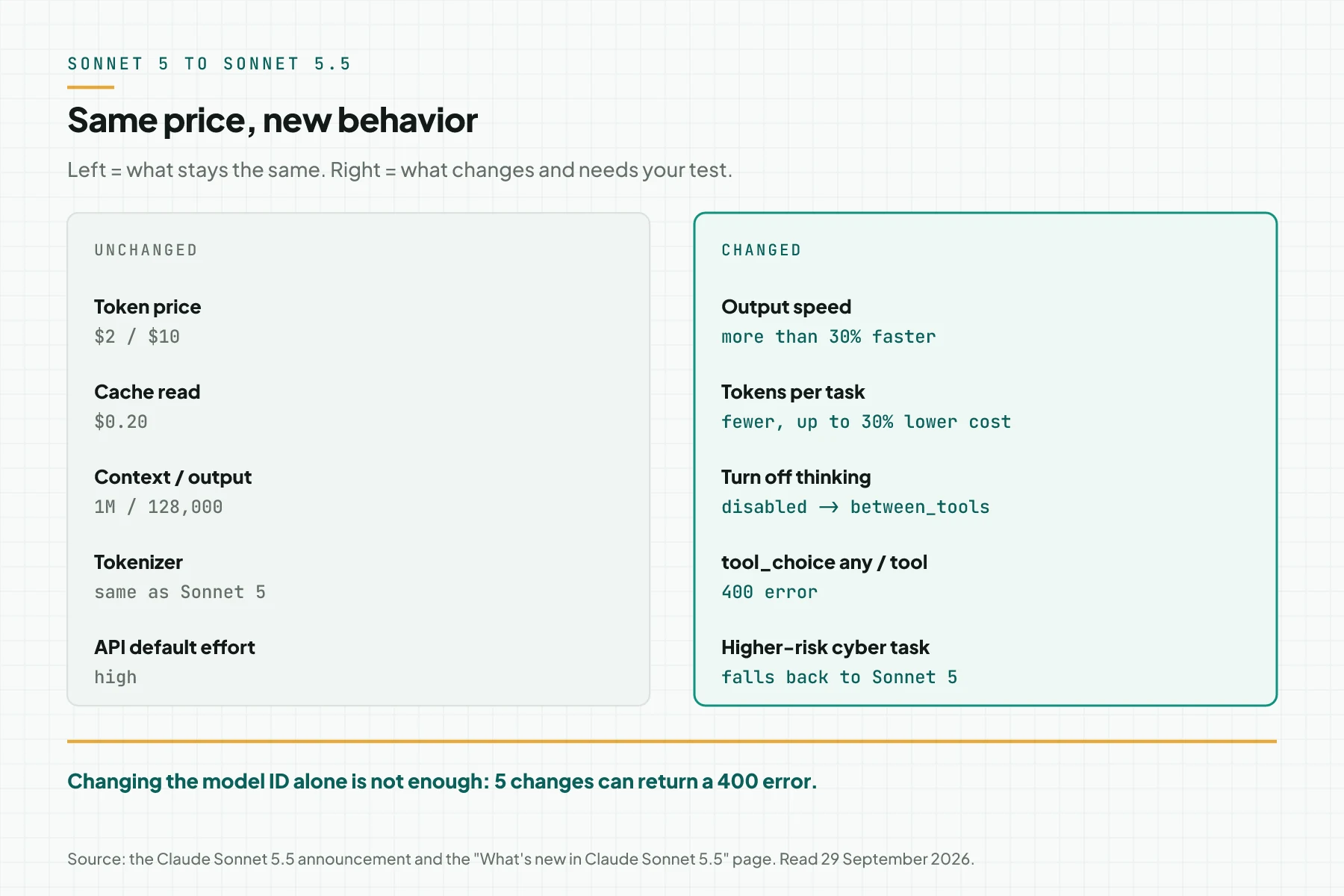
Many teams change claude-sonnet-5 to claude-sonnet-5-5 and call the migration done. On Sonnet 5.5, that pattern fails if your code turns thinking off with disabled or forces a tool with tool_choice. Both requests now return a 400 error.
The second problem returns no error. Text between tool calls now comes back as thinking blocks that are empty by default. So the progress screen of your agentAI agentAn AI program that performs work steps by itself, for example reading a message, drafting a reply, and recording the result.Open the glossary can go quiet with no message.
This pattern is the same as the Opus 5.5 migration last week. If you read our Claude Opus 5.5 migration guide, most steps below will look familiar.
What is new in Claude Sonnet 5.5
Anthropic positions Sonnet 5.5 as a faster, lower-cost partner for Opus 5.5. Sonnet 5.5 is strong at well-scoped daily tasks: bug fixes, documents, slides, and spreadsheets. Source: the Claude Sonnet 5.5 announcement.
Price and specifications
| Item | Claude Sonnet 5 | Claude Sonnet 5.5 | Claude Opus 5.5 |
|---|---|---|---|
| APIAPIThe official door 2 systems use to exchange data, without anybody copying it by hand.Open the glossary ID | claude-sonnet-5 | claude-sonnet-5-5 | claude-opus-5-5 |
| Input / output per 1M tokens | $2 / $10 | $2 / $10 | $4 / $20 |
| 5-minute cache write / cache read | $2.50 / $0.20 | $2.50 / $0.20 | $5 / $0.20 |
| Context / max output | 1M / 128,000 tokens | 1M / 128,000 tokens | 1M / 128,000 tokens |
| API default effort | high | high | medium |
| How to turn thinking off | disabled | between_tools | not possible |
| Minimum cacheable prompt | 1,024 tokens | 512 tokens | see the model page |
Sources: the Claude Sonnet 5.5 model page, the What's new in Claude Sonnet 5.5 page, and the Claude models overview, read on 29 September 2026. The Sonnet 5.5 tokenizer is the same as Sonnet 5, so the same text gives the same token count.
In Claude Code and the Claude apps, the default effort is medium. On the Claude Platform, the default effort is high. Sonnet 5.5 is available on the Claude API, Amazon Bedrock, Google Cloud, Microsoft Foundry, and Claude Platform on AWS.
Benchmarks according to Anthropic
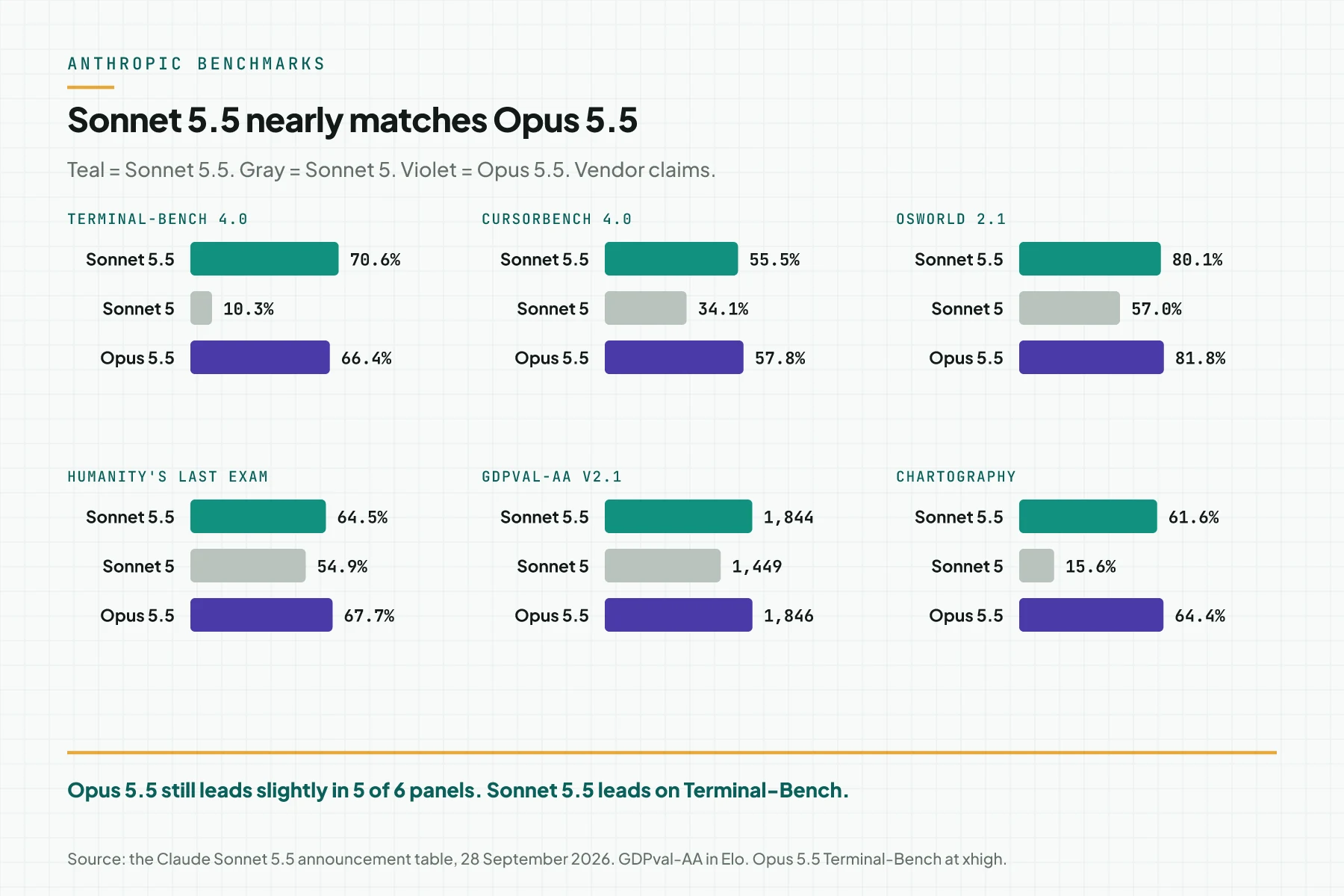
- Terminal-Bench 4.0: 70.6%, above Opus 5.5 at xhigh with 66.4%. The Anthropic table lists Sonnet 5 at only 10.3% with no footnote, so read this gap with care.
- CursorBench 4.0: 55.5%, up from 34.1% and 2.3 points below Opus 5.5.
- OSWorld 2.1 partial: 80.1%, up from 57.0%.
- GDPval-AA v2.1: 1,844 Elo, about 400 points above Sonnet 5 and 2 points below Opus 5.5.
Anthropic also writes that Sonnet 5.5 at low or medium effort can beat the top Sonnet 5 score for about one tenth of the cost per task. On FrontierCode, Sonnet 5.5 at max scored 46.2%, below xhigh at 52.1%, because max ran code-review subagents more often and hit timeouts.
Independent tests
Artificial Analysis lists Sonnet 5.5 at max effort with an Intelligence Index score of 56, rank 3 of 216 models. Output speed is 141.9 tokens per second. On the Sonnet 5 page, Sonnet 5 at max effort scores 38 at 76.8 tokens per second.
The index cost per task rises from $5.09 to $7.60 at max effort, because Sonnet 5.5 at max used 410M output tokens for the whole index. So the 30% saving applies only if you choose an effort below max.
Rama Digital test: same prompts, 2 models
In our test on 29 September 2026, we sent 5 business tasks with dummy data, 3 runs each per model. The tasks: invoice math with a discount and VAT, JSON extraction from a chat, a Python bug fix, a WhatsApp reply with 4 rules, and a question about a model that is not released. Code checked every answer, not a taste score.
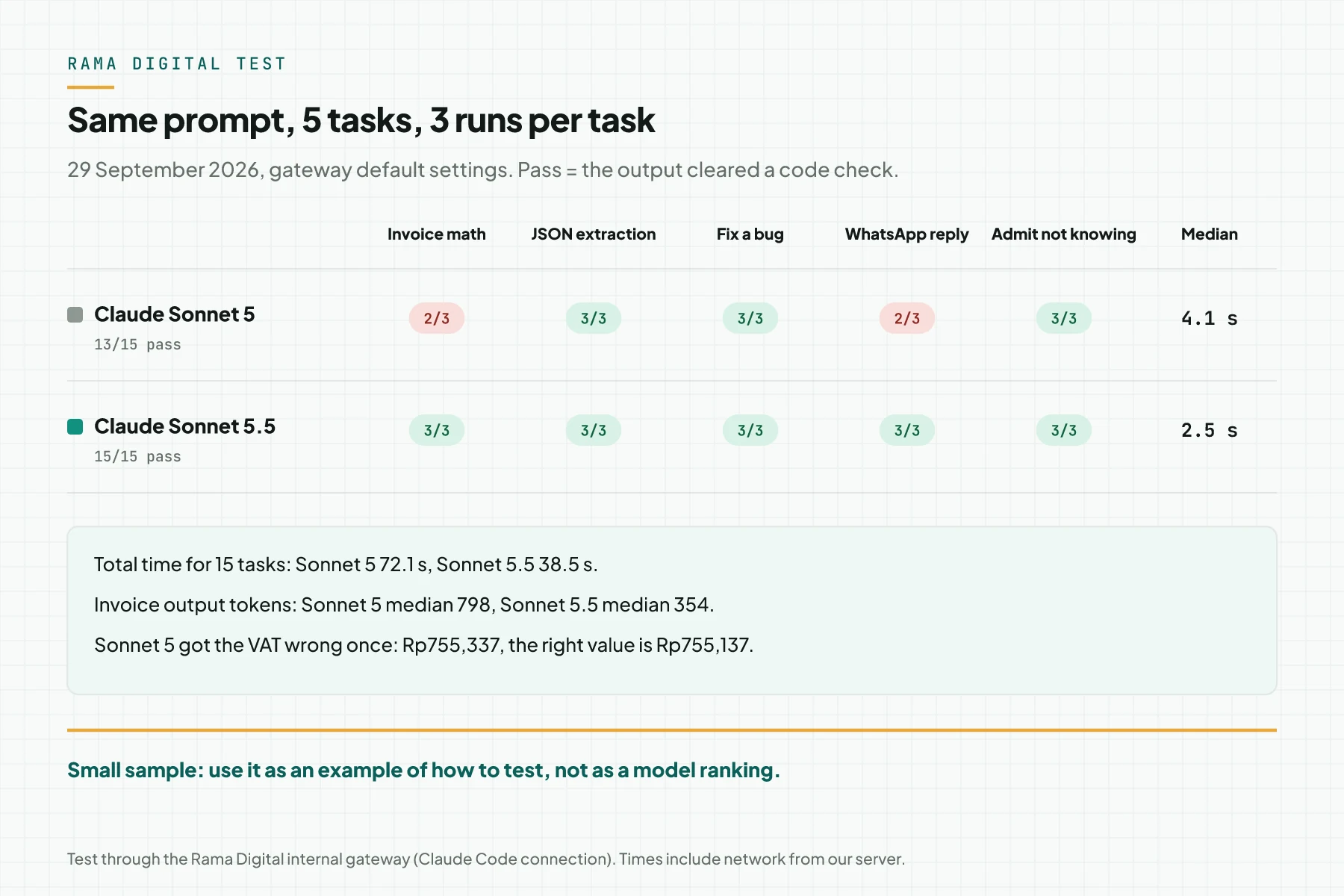
- Sonnet 5.5 passed 15 of 15. Sonnet 5 passed 13 of 15.
- Total time for 15 tasks: Sonnet 5 72.1 seconds, Sonnet 5.5 38.5 seconds, so 47% less.
- Sonnet 5 got the VAT wrong once at default settings and once at low effort. Its value was Rp755,337; the right value is Rp755,137.
- On invoice math, the median Sonnet 5.5 output was 354 tokens, and Sonnet 5 was 798 tokens.
- 1 Sonnet 5 WhatsApp reply added an emoji after the closing question, so it failed the rule "end with 1 question".
We tested through an internal gateway with a Claude Code connection, so times include network from our server. This sample is small. Use it as an example of how to test, not as a model ranking.
Cyber safeguards and the fallback to Sonnet 5
Sonnet 5.5 cyber capability is comparable to Opus 5, according to Anthropic. So Sonnet 5.5 is the first Sonnet released with cyber safeguards. Higher-risk cyber requests visibly fall back to Sonnet 5, and routine bug fixes are not affected.
- A refusal arrives as HTTP 200 with
stop_reason: "refusal"and astop_detailsobject. - There are 5 categories:
cyber,bio,frontier_llm,reasoning_extraction, andgeneral_harms. - Security teams can join the Cyber Verification Program. Biology research teams can join the Life Sciences Verification Program.
Anthropic also adds anti-distillation classifiers. Sonnet 5.5 thinking blocks are valid only in the account that made them. For AI content label duties in Europe, read our article on the Claude watermark and the EU AI Act.
Sonnet 5.5, Opus 5.5, or Haiku 4.5
Opus 5.5 costs 2x Sonnet 5.5, and Haiku 4.5 costs half of Sonnet 5.5. This table compares the 3 models from the official Anthropic pages.
| Attribute | Claude Haiku 4.5 | Claude Sonnet 5.5 | Claude Opus 5.5 |
|---|---|---|---|
| Position according to Anthropic | fastest model | combination of speed and intelligence | long agenticAgenticA way of working where an AI agent performs the routine steps and a person checks and approves the result.Open the glossary coding and knowledge work |
| Input / output per 1M tokens | $1 / $5 | $2 / $10 | $4 / $20 |
| Context / max output | 200,000 / 64,000 tokens | 1M / 128,000 tokens | 1M / 128,000 tokens |
| Relative latency | fastest | fast | moderate |
| Knowledge cutoff | February 2025 | June 2026 | June 2026 |
| Earliest retirement | 15 October 2026 | 28 September 2027 | 22 September 2027 |
Source: the Claude models overview, read on 29 September 2026. Haiku 4.5 can retire as early as 15 October 2026, and Anthropic writes that Haiku 5.5 follows in the coming weeks.
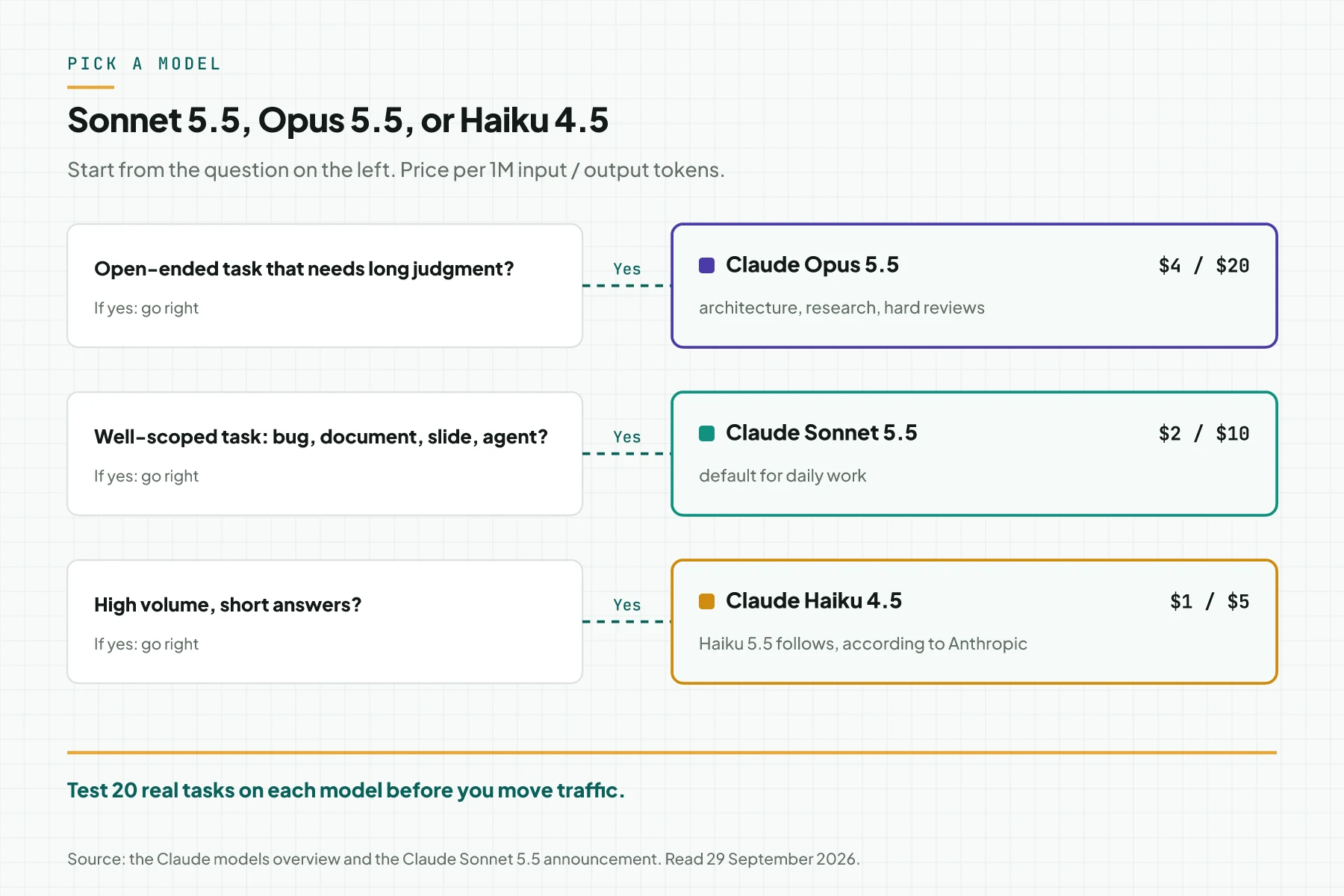
Rama Digital recommendation: make Sonnet 5.5 the default model for agents and automation with well-scoped tasks, if your test of 20 real tasks passes. Use Opus 5.5 for architecture design, research, and reviews that need sustained judgment. For high-volume tasks at the lowest price, compare first in our comparison of 4 low-cost AI models.
What you need
- Access to the Claude API or a cloud platform that already lists
claude-sonnet-5-5. - The latest Anthropic SDK and a staging environment.
- 20 real tasks with right answers, from the workflow you will move.
- A list of every place your code uses
thinking,tool_choice, computer use, and the advisor tool. - A 7-day log of Sonnet 5 tokens per task, as your cost baseline.
Anthropic ships an automatic skill in Claude Code: /claude-api migrate this project to claude-sonnet-5-5. The skill changes the model ID and the parameters, then gives you a checklist to verify by hand.
Step 1: Change the model ID and set effort explicitly
Change model to claude-sonnet-5-5 in your configuration, then set output_config.effort on every request. Sonnet 5.5 effort levels are recalibrated, so 1 level does not give the same amount of thinking as on Sonnet 5.
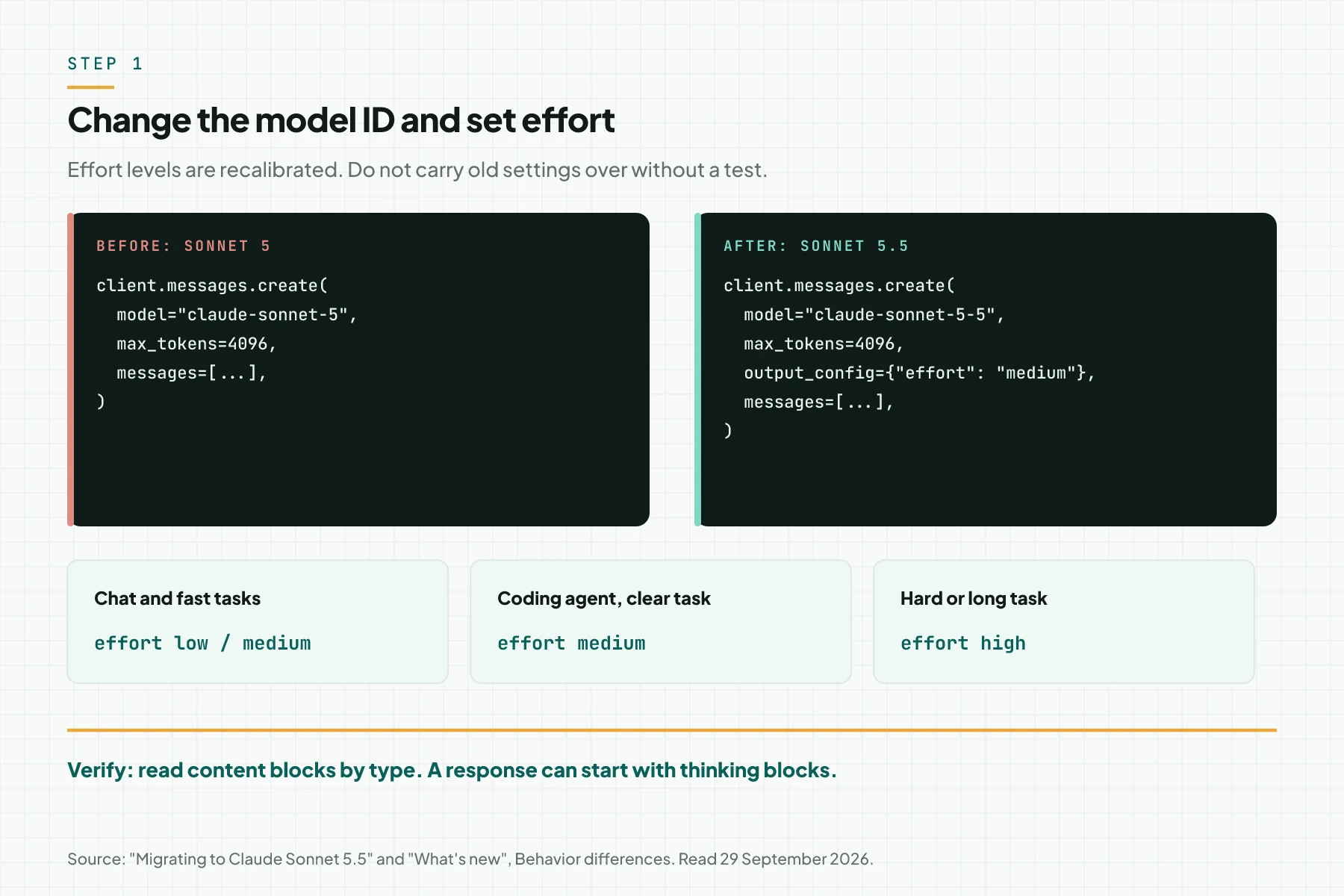
Starting points from Anthropic: high for general tasks, medium for coding agents with clear tasks, and low or medium for chat. A response can start with thinking blocks, so read content blocks by type, not by content[0].text.
Verify: 20 staging tasks return 200, and the pass score does not fall below Sonnet 5. Source: the Migrating to Claude Sonnet 5.5 guide.
Step 2: Replace thinking disabled with between_tools
If your code turns thinking off to save tokens, replace thinking: {"type": "disabled"} with thinking: {"type": "between_tools"}. This setting turns off up-front thinking, but the model still writes short notes between tool calls.
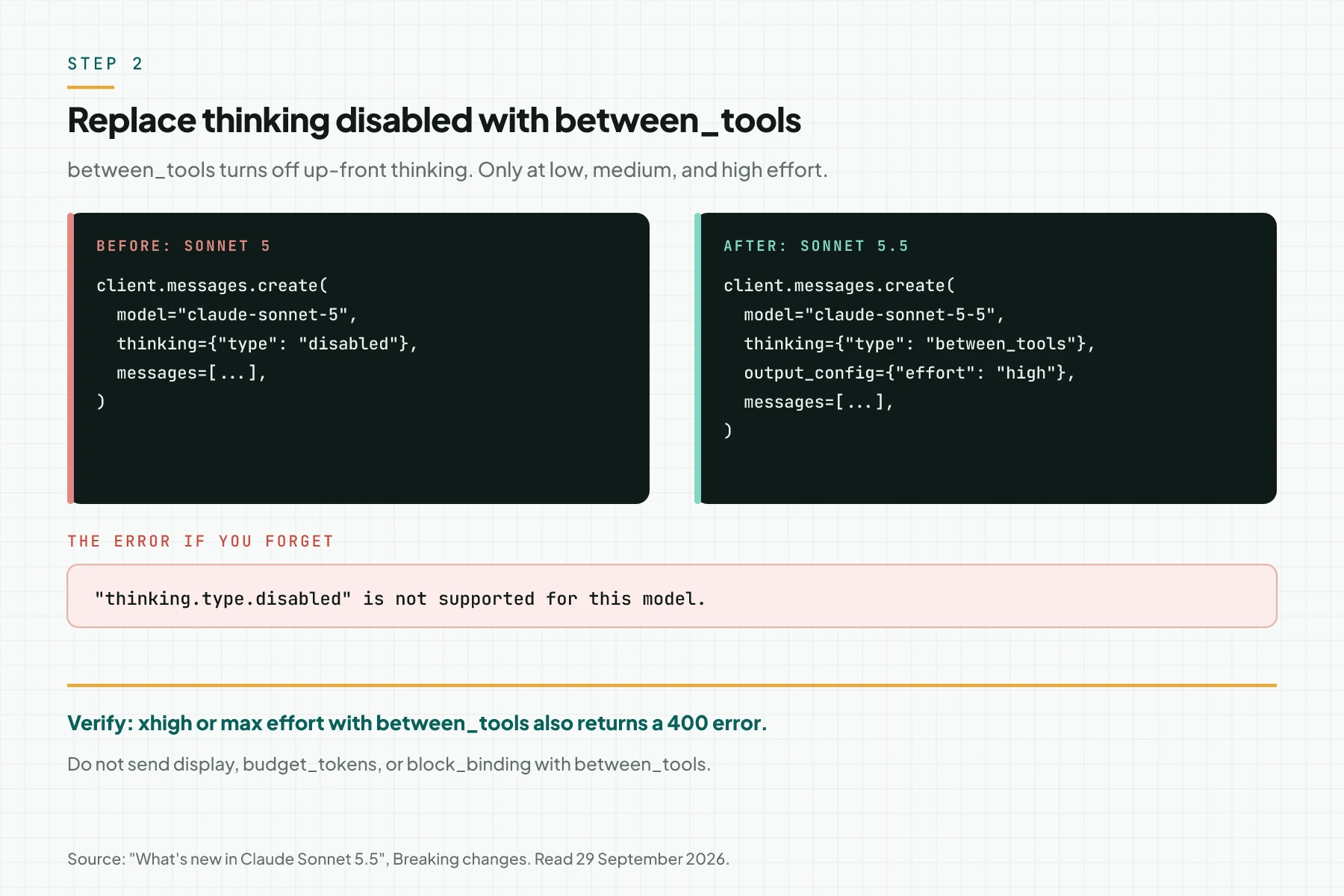
If the old field is still sent, the API returns 400 with the text "thinking.type.disabled" is not supported for this model. Do not send display, budget_tokens, or block_binding with between_tools, because all 3 also return a 400 error.
Verify: requests with between_tools return 200, and effort does not change mid-conversation. Source: What's new in Claude Sonnet 5.5.
Step 3: Replace tool_choice any and tool
Sonnet 5.5 rejects tool_choice of type any and tool, also on the token counting endpoint. Use auto with strict: true on every tool, then write in the prompt when the tool applies.
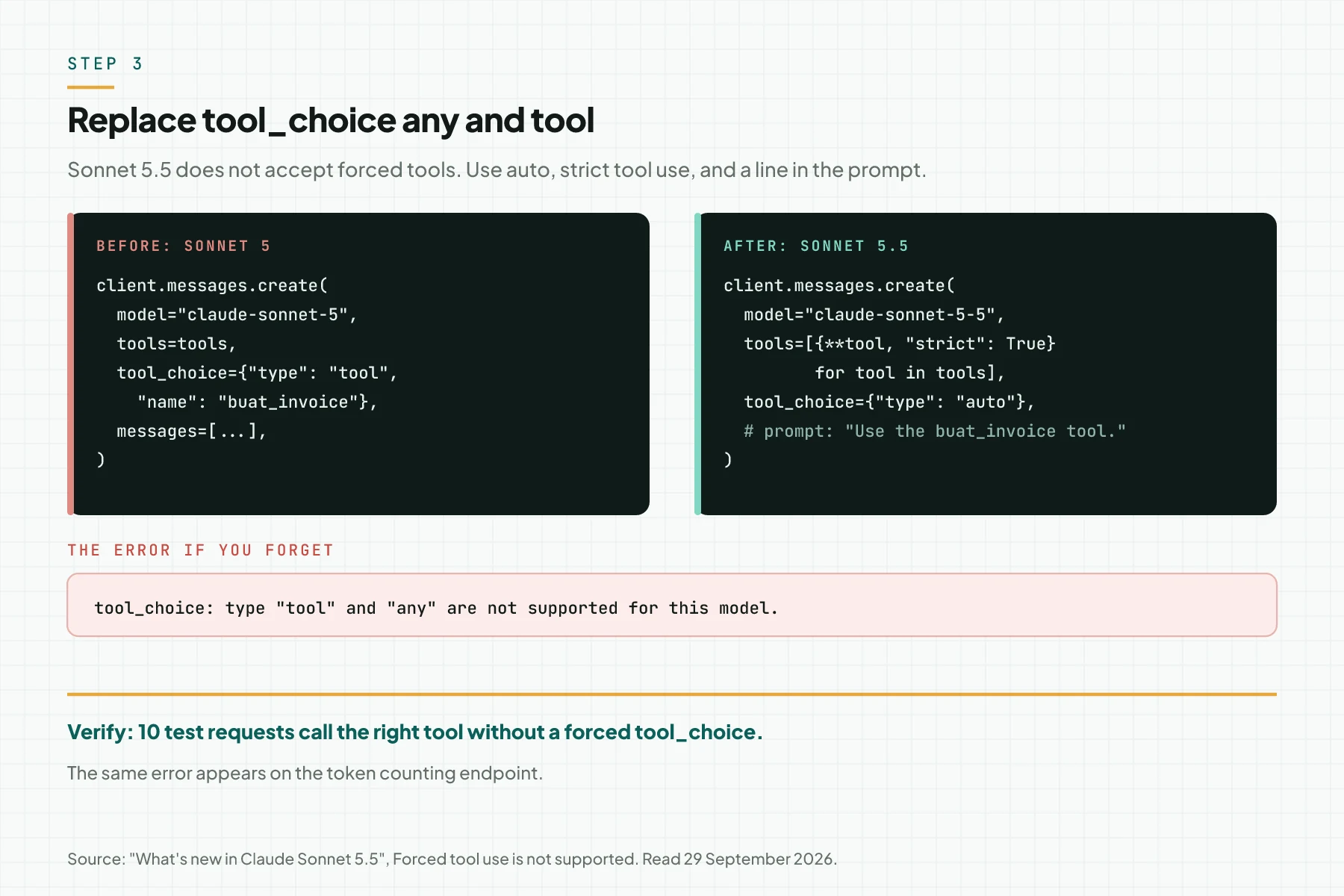
The error text if you forget: tool_choice: type "tool" and "any" are not supported for this model. If you only need schema-valid JSON without a tool, move the schema to structured outputs.
Verify: 10 test requests call the right tool without a forced tool_choice.
Step 4: Keep conversations append-only and bring back progress text
Every thinking block records the model that made it. Sonnet 5.5 reads blocks from Sonnet 5, Opus 4.8, and Haiku 4.5, but not from Opus 5, Opus 5.5, Fable, or Mythos. No other model reads Sonnet 5.5 blocks.
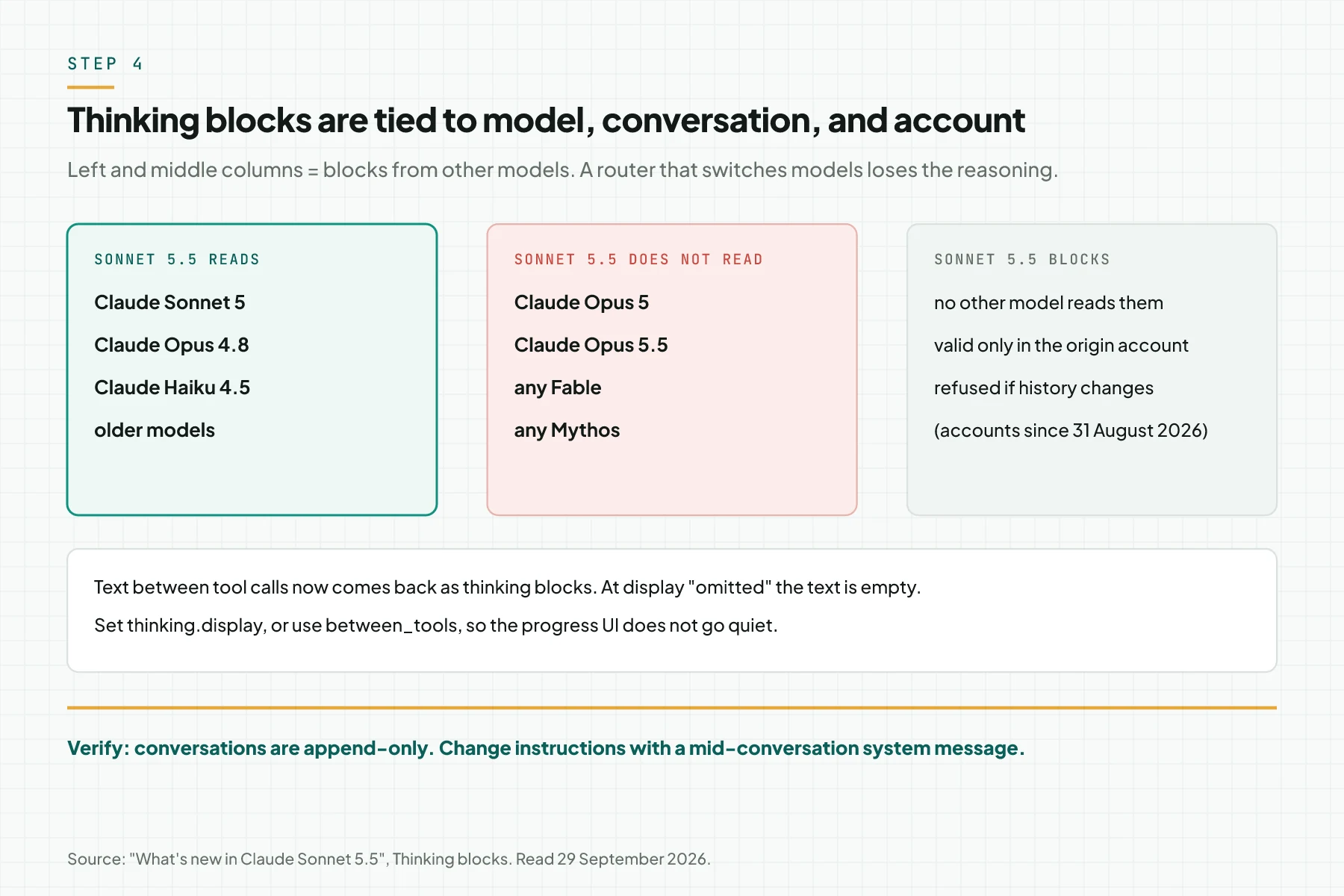
- Do not edit the system prompt, the tools, or earlier messages mid-conversation. For accounts created since 31 August 2026, that edit returns a 400 error when a thinking block is replayed.
- Change instructions with a mid-conversation system message.
- Pass thinking blocks back unchanged with the tool results.
- Set
thinking.displayif your UI shows progress text. Withbetween_tools, progress text comes back without this setting.
Verify: the UI shows progress text before each tool call, and a 10-turn conversation returns no 400 error.
Step 5 (optional): Move computer use and the advisor tool
Skip this step if you use neither computer use nor the advisor tool. On the Claude API and Google Cloud, the computer_20251124 tool returns a 400 error on Sonnet 5.5.
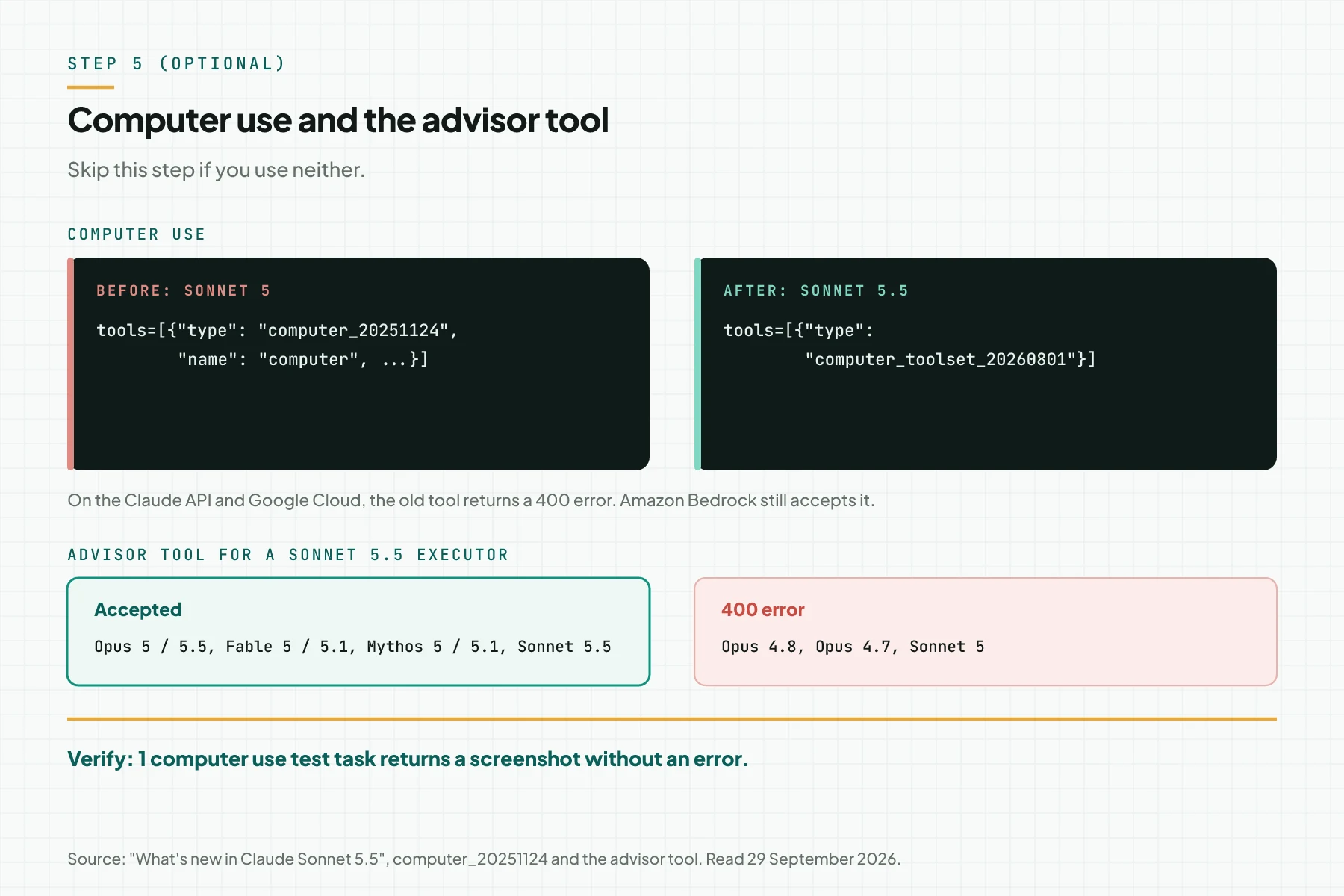
Declare computer_toolset_20260801 with no beta header. For the advisor tool, pick Opus 5, Opus 5.5, Fable 5, Fable 5.1, Mythos 5, Mythos 5.1, or Sonnet 5.5 itself. Advisor advice arrives encrypted as an advisor_redacted_result block.
Verify: 1 computer use test task returns a screenshot, and 1 advisor call returns 200.
Step 6: Handle cyber refusals and measure cost again
Prepare handling for stop_reason: "refusal" before release. On the Claude API, set fallbacks: "default" so the API retries cyber and frontier_llm refusals on Sonnet 5 automatically.
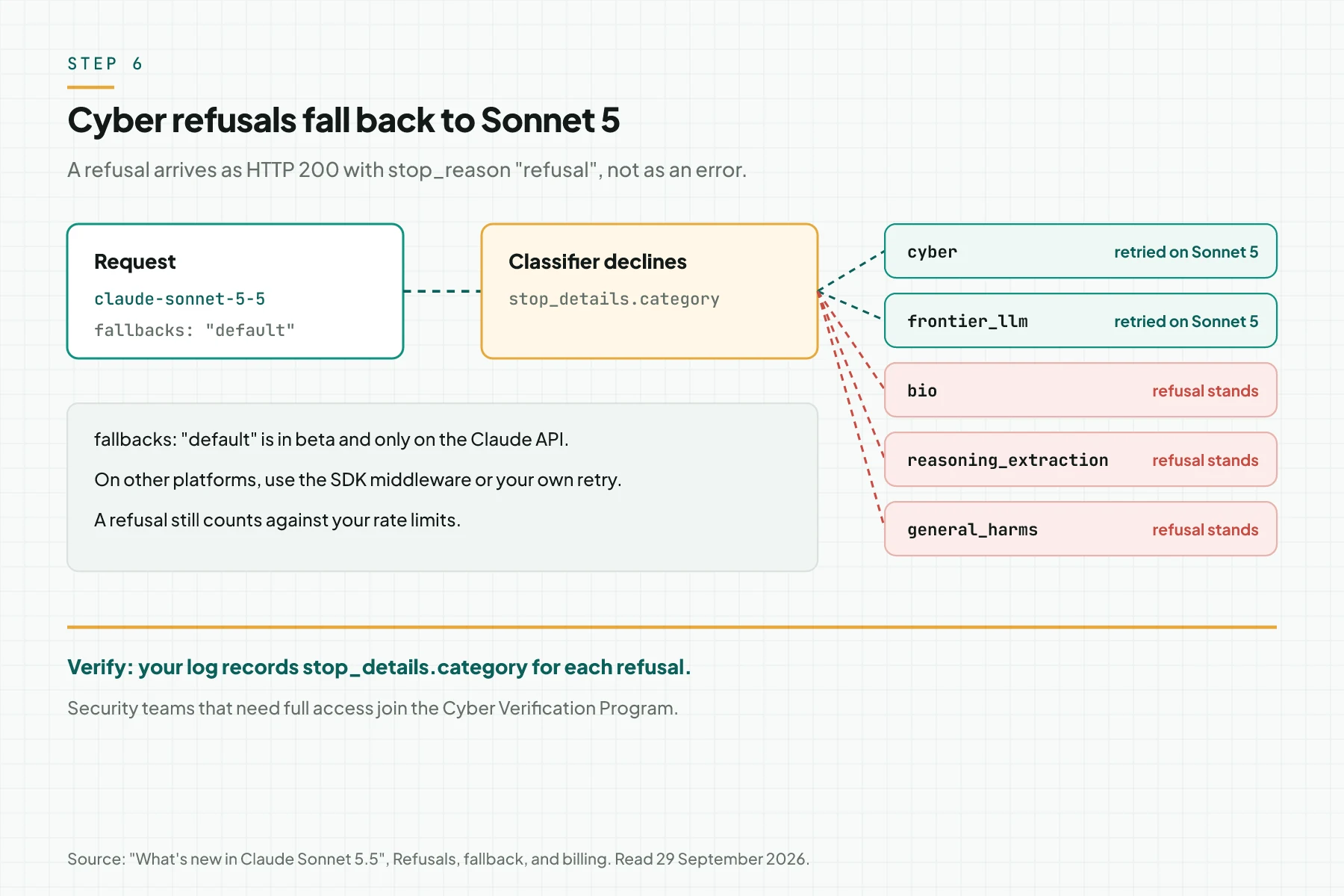
On Amazon Bedrock, Google Cloud, and Microsoft Foundry, use the SDK middleware or your own retry. A refusal still counts against your rate limits, and its billing depends on the category. Source: the Refusals and fallback page.
Then compare output tokens per task with the Sonnet 5 baseline. Verify: your log records stop_details.category for each refusal, and the cost report shows tokens per successful task.
Example: cost per answer falls at the same token price
Balyasny tested Sonnet 5.5 on 2,441 finance tasks, according to the Anthropic announcement. Sonnet 5.5 used about 121,000 tokens per answer, and Sonnet 5 used 497,000 tokens. This is a customer claim, so measure it again on your data.
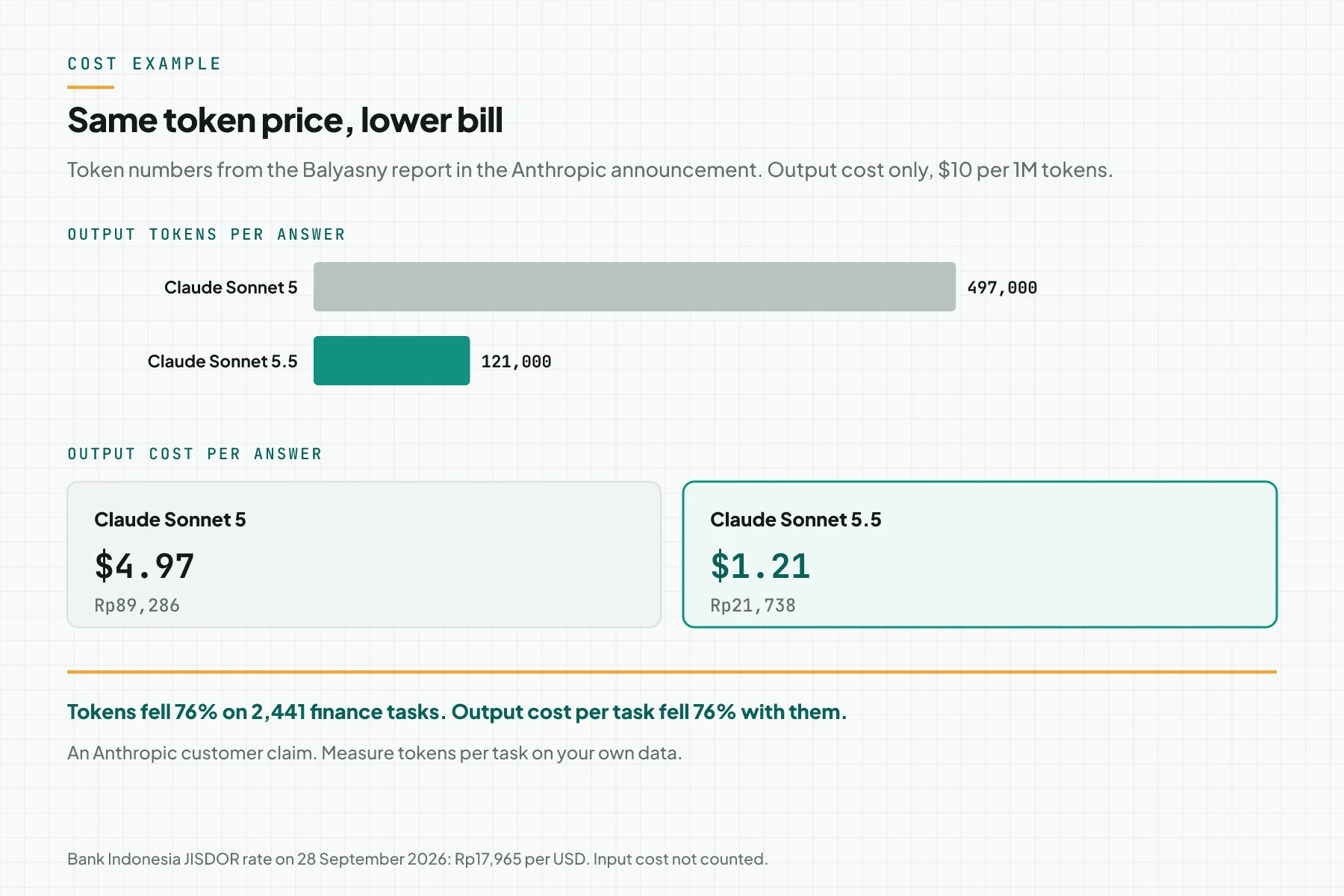
The simulation with dummy data below shows how the team at "Example Agency" logs the migration of 1 report agent. Bank Indonesia JISDOR rate on 28 September 2026: Rp17,965 per USD.
| Time | Action | What is logged | Result |
|---|---|---|---|
| 29 Sep 2026, 09:00 | Take the Sonnet 5 baseline | 497,000 output tokens per report | $4.97 or Rp89,286 per report |
| 29 Sep 2026, 10:00 | Steps 1 to 3 in staging | 20 tasks, effort medium | 20 of 20 return 200 |
| 29 Sep 2026, 13:00 | Test 20 real tasks | 121,000 output tokens per report | $1.21 or Rp21,738 per report |
| 30 Sep 2026, 09:00 | Move 10% of traffic | stop_details.category per refusal | 0 cyber refusals in 200 reports |
| 2 Oct 2026, 09:00 | Move 100% of traffic | Tokens per successful task | Output cost falls 76% |
Checklist for the move to Sonnet 5.5
- Log Sonnet 5 tokens per task for 7 days. Owner: platform engineer. Evidence: usage report per workflow.
- Change the model ID and set effort on every request. Owner: application engineer. Evidence: configuration diff.
- Replace
disabledwithbetween_tools, and forcedtool_choicewithautoplus strict. Owner: application engineer. Evidence: 0 400 errors in staging. - Keep conversations append-only and the progress UI active. Owner: frontend engineer. Evidence: recording of 1 agent session of 10 turns.
- Add refusal fallback and category logs. Owner: platform engineer. Evidence: 1 test refusal logged with its category.
- Test 20 real tasks on Sonnet 5.5 and Opus 5.5. Owner: workflow owner. Evidence: table of pass, tokens, and time per model.
- Stop and go back to Sonnet 5 if the pass score falls by more than 1 task of 20, or if tokens per task rise. Owner: workflow owner. Evidence: dated decision note.
Frequently asked questions
Is Claude Sonnet 5.5 more expensive than Sonnet 5? No. The price is the same: $2 input, $10 output, and $0.20 cache read per 1M tokens. Cost per task can fall because Sonnet 5.5 uses fewer tokens.
What is the Claude Sonnet 5.5 model ID? On the Claude API, Google Cloud, Microsoft Foundry, and Claude Platform on AWS, the ID is claude-sonnet-5-5. On Amazon Bedrock, the ID is anthropic.claude-sonnet-5-5.
Why does my code get a 400 error after the move to Sonnet 5.5? The usual causes are thinking disabled, tool_choice any or tool, non-default sampling parameters, and computer_20251124. Read the error text, then follow Step 2, 3, or 5.
Can Sonnet 5 answer my request instead of Sonnet 5.5? Yes, for cyber and frontier_llm refusals if you use the default fallbacks on the Claude API. Anthropic writes that routine bug fixes still run on Sonnet 5.5.
When should I still use Opus 5.5? Use Opus 5.5 for open-ended tasks that need sustained judgment, such as architecture design and research. Anthropic writes that Opus 5.5 stays stronger for that work.
Next step
The limit that still applies: Anthropic benchmarks and our test are only a starting point, because your prompts, data, and risks differ. Test 20 real tasks before you move traffic. If your team wants its models, prompts, and AI cost monitored every month, see the OS Care Retainer service. To discuss the migration of your system, book a technical scoping session.
Sources
- Anthropic: Introducing Claude Sonnet 5.5
- Anthropic: Introducing Claude Sonnet 5
- Claude Docs: Claude Sonnet 5.5
- Claude Docs: What's new in Claude Sonnet 5.5
- Claude Docs: Migrating to Claude Sonnet 5.5
- Claude Docs: Refusals and fallback
- Claude Docs: Models overview
- Artificial Analysis: Claude Sonnet 5.5
- Artificial Analysis: Claude Sonnet 5
- TechCrunch: Anthropic releases Sonnet 5.5
- Bank Indonesia: JISDOR rate