Direct answer: AI chatbot cost rises because every chat calls a model, and every call carries tokens. To cut cost, do not answer every chat with an expensive model. Filter chats first, pick the right model, trim the context, and limit tool output.
Main condition: this method applies to a WhatsApp chatbot that uses a language model billed per token. Limit: results vary by business. The numbers in this article come from 1 client case and from the Rama Digital chatbot itself.
Data sources: the daily bill of 1 B2B client (an industrial parts distributor) for 15-24 September 2026, and the Wulan chatbot audit with JevJevA small AI model from TypeSafe that decides what happens to each chat: reply, skip, flag for the team, or remove from follow-up. Jev writes no replies.How Jev picks the chats to answer on 20 September 2026. We masked the client identity.
Why AI cost rises when WhatsApp chat volume rises
Many business owners see the same pattern. A Click-to-WhatsAppCTWAA Click-to-WhatsApp ad. It sends people from Facebook or Instagram straight into your WhatsApp conversation.How to track CTWA ads ad runs, chat volume rises, then the AI bill follows. At times the bill rises faster than the chat count.
The simple formula looks like this:
Cost = message count × tokens per reply × price per token
Each factor can swell on its own:
- Message count rises when every message gets a reply, including stickers and "thanks".
- Tokens per reply rise when the bot re-reads the full chat history on every reply.
- Price stays high when the bot uses an expensive model for a light task.
When all 3 factors rise together, cost rises by multiples. So your savings plan must reach all 3 factors too. If you are not sure your chatbot is a plain chatbot or an agenticAgenticA way of working where an AI agent performs the routine steps and a person checks and approves the result.Open the glossary CRM, read the difference between an agentic CRM and a plain AI chatbot first.
From 1 October 2026, every reply also carries a Meta fee
From 1 October 2026, Meta bills a service message for every message it sends. A service message is a non-template reply inside the 24-hour window, including a chatbot reply. Every business number gets 1,000 free service messages per month. Message 1,001 and beyond costs Rp356.65 per message for an Indonesian recipient.
So a chatbot that answers every message pays twice: the AI model cost and the Meta fee. Example: 10,000 replies a month means 9,000 billed messages, or about Rp3.2M to Meta alone. Read the full rule in our article on the 1 October 2026 WhatsApp fee change.
The 3 most common causes of waste we find
In the client case, we found 3 main causes:
- The bot re-sends the full chat history. A longer conversation reads more tokens for 1 reply. 1 conversation read 516 thousand input tokens.
- High-reasoning mode is billed at the output rate. The model "thinks" before it answers. That thinking is billed at the output rate, which costs more than the input rate.
- The search tool returns too much data. The tool returns hundreds of products with every column. 1 tool reply held 368 products, at 121 KB.
In the 7 days before the change, conversations with over 100 thousand tokens of context used 69% of the cost. An image or voice message cost $0.435 per conversation on average. A text message cost $0.059 on average.
4 savings layers for an AI chatbot
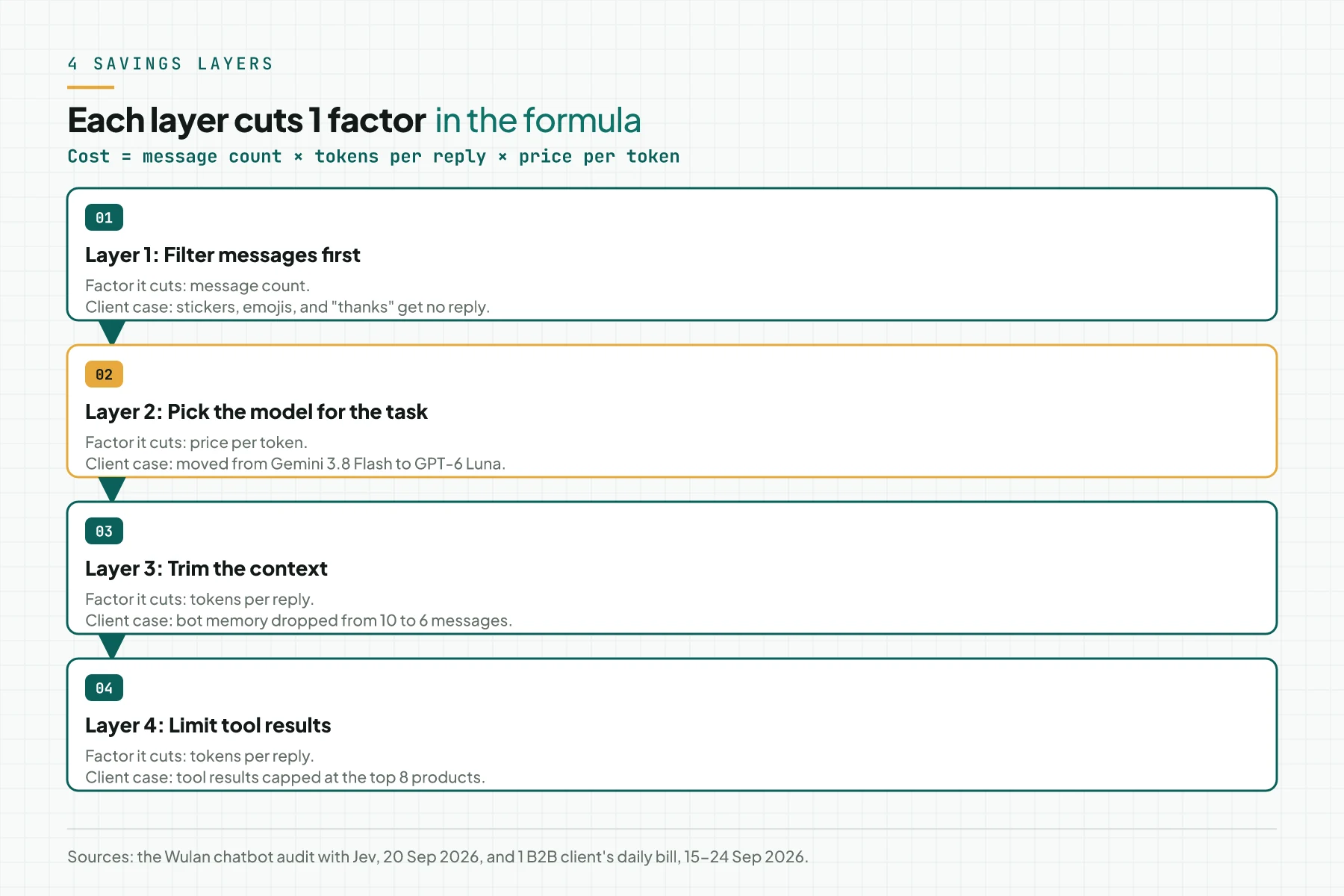
Each layer cuts 1 factor in the formula. Add each layer top to bottom.
| Layer | Factor it cuts | What it does | Client case example |
|---|---|---|---|
| 1. Filter | Message count | Decide which messages need a model reply | Stickers, emojis, and "thanks" get no reply. Personal photos get skipped. |
| 2. Pick the model | Price | Use a cheap model for daily chat | Moved to GPT-6 Luna |
| 3. Trim the context | Tokens per reply | Send only a short history | Memory dropped from 10 to 6 messages |
| 4. Limit the tool | Tokens per reply | Send only the relevant tool results | Tool results capped at the top 8 |
Layer 1: filter messages before the model
A filter reads a message before the chat model runs. A message that needs no reply never calls the model. As a result, the billed message count drops.
The filter must also know its own limit. In a 70-photo test on the client case, the filter skipped about 34 personal photos. Every product photo and every receipt photo still got a reply.
A simple example: a customer writes "ok, thanks" after receiving a price. Without a filter, the bot reads the full history and writes a new reply. With a filter, the bot only sends a 🙏 reaction.
Layer 2: pick the model for the task
An expensive model does not always answer daily chat better. Compare the price per 1 million tokens:
| Model | Input tokens | Output tokens | Cache tokens |
|---|---|---|---|
| Gemini 3.8 Flash | $0.75 | $3.75 | $0.075 |
| GPT-6 Luna | $0.10 | $0.50 | $0.01 |
For fuller price data and a unit-economics breakdown, read our review of GPT-5.6 Sol, Terra, and Luna.
Layer 3: trim the context
The bot does not need the full history to answer the newest message. In the client case, bot memory dropped from 10 to 6 messages. Tokens per reply dropped too.
Layer 4: limit tool results
A product search tool only needs to send the most relevant products. In the client case, tool results got capped at the top 8. The 368-product tool reply no longer happens.
Jev: the decision layer before the chat model
Layer 1 needs a fast, cheap decision. In our own chatbot, Wulan, Jev has made this decision since 24 September 2026.
Jev is the decision model from TypeSafe System One. Jev writes no text. Jev answers a typed question, such as yes/no, a choice, or a score, and attaches a confidence level.
Why Jev is cheap
- Jev answers many questions in 1 call.
- Jev costs 0.042 USD per 1 million input tokens. Output tokens are free.
- In Wulan, the Jev cost runs about 0.27 USD per 30 days.
- In the 20 September 2026 audit, Jev answered 1,100 questions in 287 calls. Total time: 20.8 seconds, at a cost of 0.0094 USD.
Why a decision does not need a chat model
A chat model is built to write a long answer. That task costs more, because the model reads the context and writes many output tokens.
An "answer or skip" decision needs no writing. It needs only 1 short answer and 1 confidence number. So a decision model can run at a small cost.
This split also makes the bot easier to audit. Every decision carries a logged answer and a logged confidence level. Your team can read why a chat got skipped or handed to a person.
Chat types and Jev's decisions
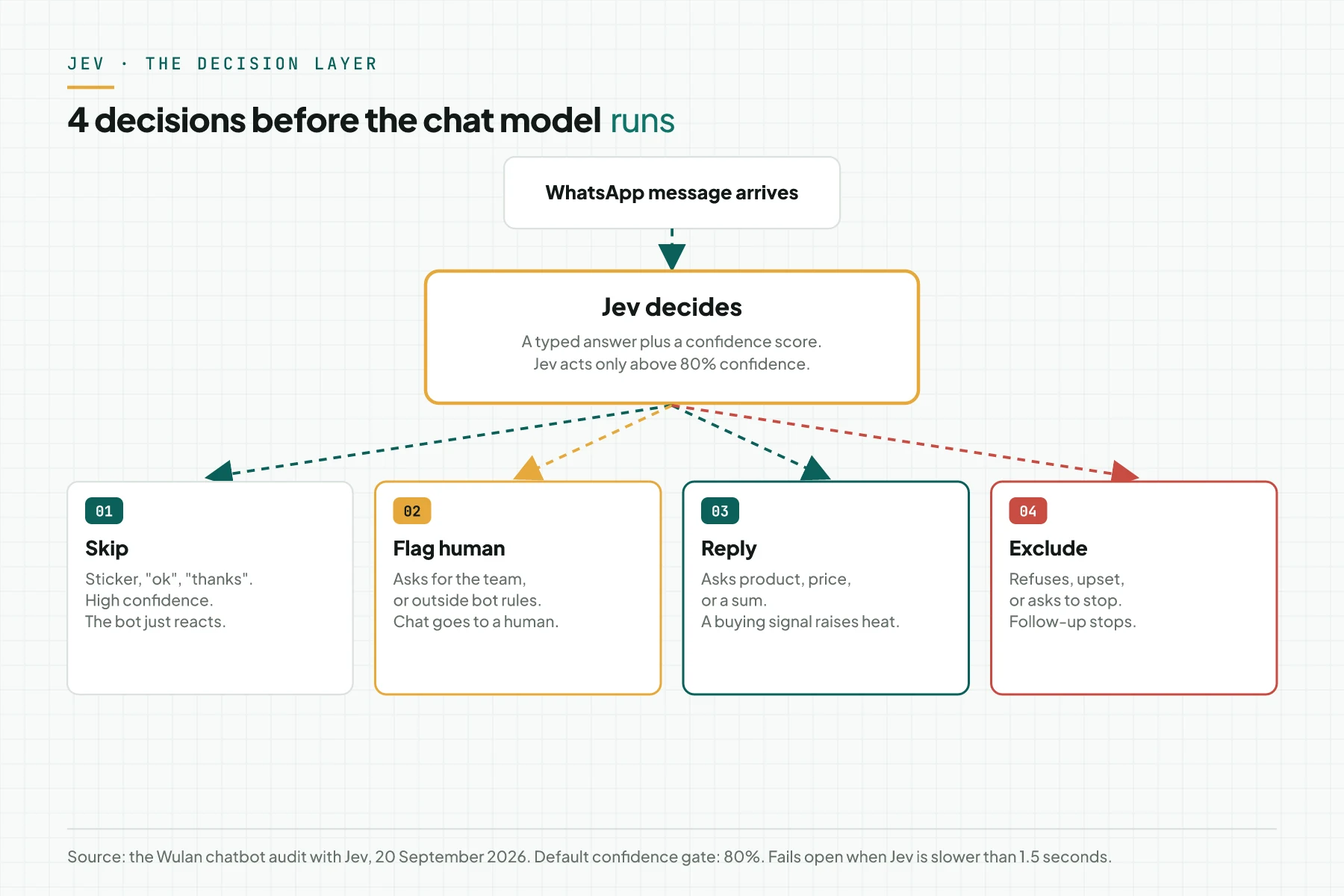
| Chat type | Decision | What happens |
|---|---|---|
| Only "thanks", "ok", or "later", with high confidence | Skip | The bot sends a 🙏 reaction without calling the chat model |
| The person asks for a human | Flag human | The bot hands the chat to the team |
| The question needs a calculation | Reply | The bot uses a stronger reasoning mode |
| A buying signal is present | Reply and flag | Lead temperature rises. This data does not go to Meta |
| The person refuses, asks to wait, is done, or is upset | Exclude | Automatic follow-up and nudge messages stop |
| The person asks to stop | Exclude and log | The request is logged for audit |
| A plain question on product or price | Reply | The chat model answers as usual |
Jev only acts when its confidence is high, for example above an 80% confidence gate. Below that gate, the bot runs as usual.
The exclude idea
A person who asks to stop, or who is upset, gets removed from follow-up. They also get removed from the retargetingRetargetingShowing ads to people who already interacted with you, for example opened a page or sent a chat.Open the glossary audience. This way, ad budget does not burn on someone who already said no.
Failing open and personal data
When Jev fails or runs slower than 1.5 seconds, the bot runs as usual. We call this failing open. The customer chat still gets a reply.
Before a message reaches Jev, the text gets anonymized. A name, an email, and a phone number all get removed from the text first.
Client case: cost per reply falls about 30x
Our client is 1 B2B company, an industrial parts distributor. Their WhatsApp chat holds many product photos and receipt photos.
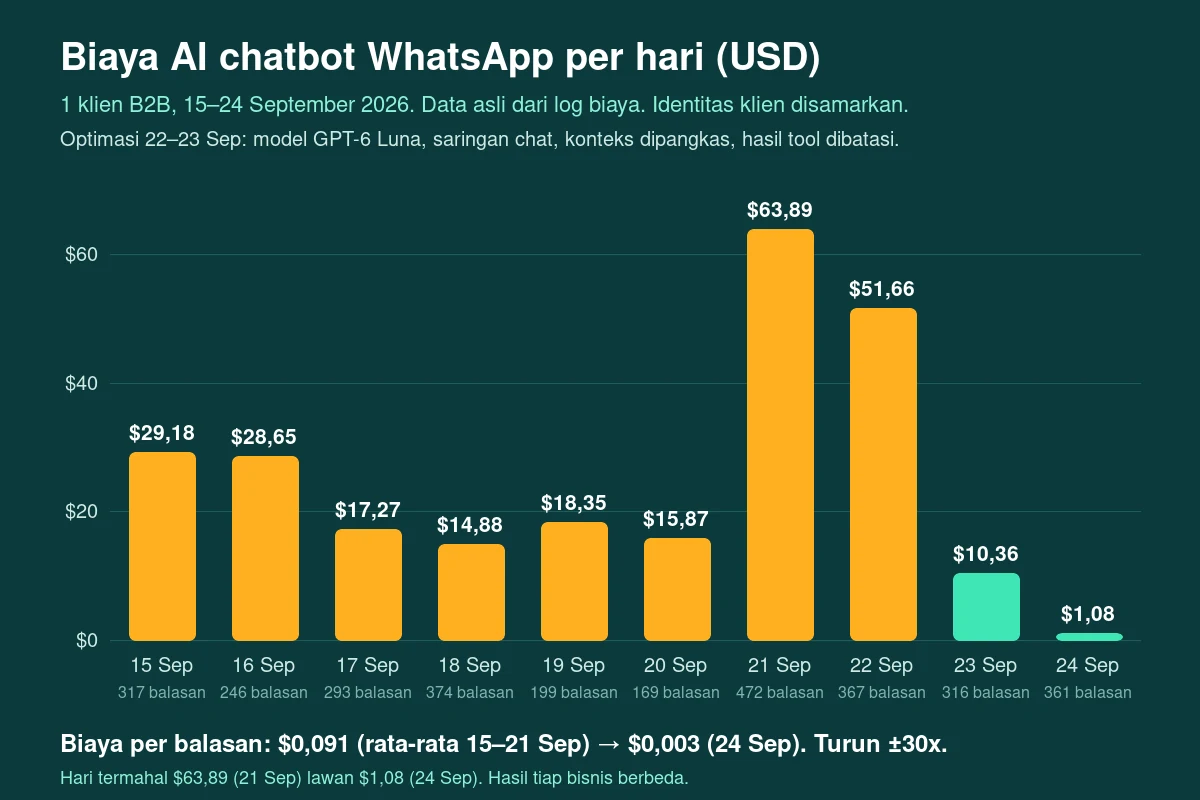
| Measure | Before | After |
|---|---|---|
| Cost per AI reply | $0.091 (15-21 Sep 2026 average) | $0.003 (24 Sep 2026) |
| 1-day cost | $63.89 (21 Sep, 472 AI replies) | $1.08 (24 Sep, 361 AI replies) |
| Average daily cost | about $26.87 | — |
The changes we made:
- A message filter before the model.
- A model move from Gemini 3.8 Flash to GPT-6 Luna.
- Bot memory dropped from 10 to 6 messages.
- Tool results capped at the top 8.
An honest note: in the client case, the filter used a small, cheap model, not Jev. Jev is the decision layer we use in our own chatbot. We also add Jev to the chatbot optimization service.
2 lessons from the re-test
Swapping a model without changing its rules is risky. In a re-test, the new model handed off chat to an admin 27 times out of 35 turns. The old model did this only 4 times. We added 2 more instruction rules, and the count fell to 0.
Check the model provider's rate limit. A new OpenRouter account gets a 20-request-per-minute limit for Luna. The client's live traffic once reached 25 chats a minute. So we added a backup model.
Step 1: Pull 7 days of daily AI bills
Open your AI cost log and copy the daily number for the last 7 days. Keep the per-day bill file as your evidence. The owner of this step is the business owner.
Verify: you have 1 file or 1 table with 7 rows, 1 row per day.
Step 2: Calculate the cost per AI reply
Divide the daily cost by the day's AI reply count. Keep the cost-per-reply table as your evidence. The owner of this step is the technical team.
Verify: every day on the Step 1 table now carries 1 cost-per-reply figure.
Step 3: Split text chat cost from image or voice chat cost
Mark every reply as text, image, or voice. Calculate the average cost for each type. Keep the cost-by-type table as your evidence. The owner of this step is the technical team.
Verify: the table shows 1 average cost figure for each message type.
Step 4: Find the conversation with the longest context
Sort conversations from the highest input token count to the lowest. Record the top 10 as your list of the most expensive conversations. The owner of this step is the technical team.
Verify: the list carries the conversation number, the token count, and the cost.
Step 5: Add a filter for stickers, emojis, and "thanks"
Build a rule that spots a message with no new content, such as a sticker, an emoji, or "thanks". Send a reaction for that message, without calling the chat model. Keep example skipped messages as your evidence. The owner of this step is the technical team.
Verify: you have at least 5 example messages the filter skipped correctly.
Step 6: Test the new model on old chats before the switch
Run the new model on old chats that already have a correct answer on file. Count how many chats it hands to an admin. Keep that count as your evidence. The owner of this step is the technical team.
Verify: you know the admin hand-off count for the old model against the new model.
Step 7: Stop the change if it skips an important chat
Check every chat the filter skipped. If the filter skips a product photo or a receipt, restore the old rule. Keep an example of a wrongly skipped chat as your evidence. The owner of this step is the business owner.
This is the stop criterion for the whole checklist. Verify: no important chat was skipped wrongly in the last 20 chats.
When you need an agentic CRM built from 0
Optimization fits when your chatbot already answers correctly, but its cost runs too high. The client case above is this type.
Build an agentic CRM from 0 when your chatbot does not yet log a lead, does not know the sales stage, or is not yet connected to your team. For this need, see the OpenClaw CRM Operating System.
Frequently asked questions
Why does AI chatbot cost rise faster than chat volume? Because every reply reads the chat history. A long conversation carries more tokens, so the cost per reply rises too.
Must every WhatsApp chat get an AI reply? No. A sticker, an emoji, and a "thanks" message need no model reply. A filter can send only a reaction and save a model call.
What is Jev? Jev is the decision model from TypeSafe System One. Jev writes no text. Jev answers a typed question with a confidence level, at 0.042 USD per 1 million input tokens.
Can a filter skip an important chat? Yes, when its rule is wrong. So test a filter against old chats. In the client case, every product photo and every receipt still got a reply.
What happens when Jev fails or runs slow? The bot runs as usual. When Jev fails or runs slower than 1.5 seconds, the chat model still answers the customer.
Does a switch to a cheap model alone cut cost? Not always. In a re-test, a new model with no added rule handed 27 of 35 turns to an admin. Change the instruction rules together with the model.
Next step
Results vary by business, and the numbers above come from 1 client case. To find where your own chatbot cost leaks, start from your own bill data.
Pick the Optimization package, IDR 6.9M fixed price, 1–2 weeks through the Chatbot AI Cost Optimization service. We read 14 days of cost logs, find the cause of waste, then add the 4 savings layers. A Custom package starts at IDR 17M for more than 1 bot or channel. Start with a 30-minute initial consultation.