Direct answer: use a decision model such as Jev when the result you need is a decision your code reads, for example picking one route, rating one reply, or holding one action. Use a generative LLM when the result you need is a sentence for a person. In a real system both run together, with the decision model standing in front of and behind the writer.
It holds when: this comparison uses jev-1.13 and the prices published on 21 September 2026. Limits: we do not compare accuracy on public benchmarks, because those figures move with every release and depend on the task.
We wrote this comparison from the official TypeSafe documentation and our own use on 20 and 21 September 2026.
Difference 1: the shape of the output
A generative LLM returns text. You ask for a closed answer, then your code guesses what the sentence meant. That guessing step is what breaks on edge cases.
# Jalur LLM: jawaban teks, lalu ditebak kode
balasan = llm("Klasifikasikan tiket ini. Jawab billing, teknis, atau sales.")
tim = balasan.strip().lower()          # "Billing." -> gagal cocok
if tim not in {"billing", "teknis", "sales"}:
    tim = "lainnya"                    # jatuh ke keranjang sampah

# Jalur model keputusan: jawaban sudah bertipe
tim = hasil["answers"]["tim"]["choice"]          # "billing"
yakin = hasil["answers"]["tim"]["confidence"]    # 0.98
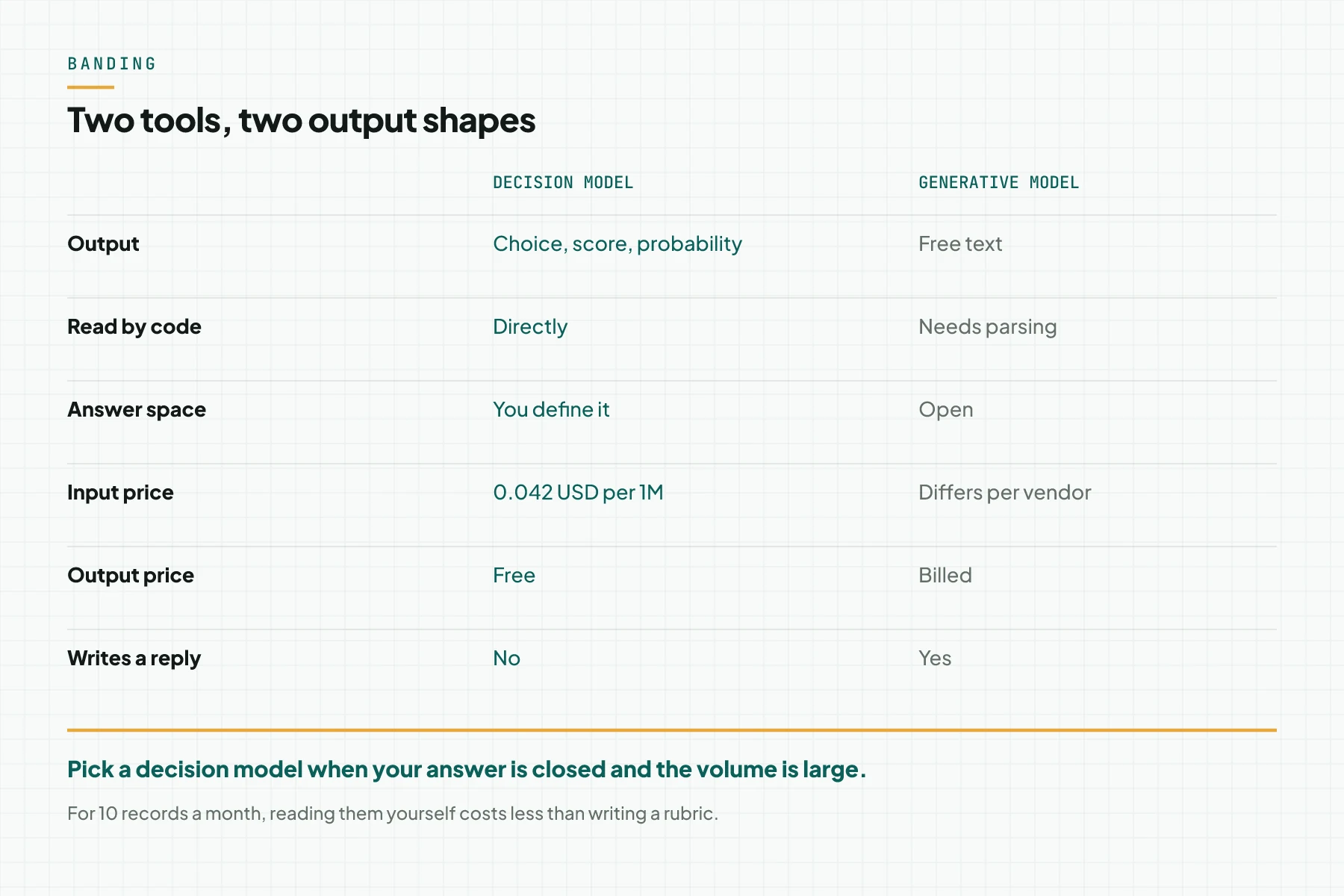
A decision model removes the guess. You write the answer space yourself, and what comes back is data with its probabilities and confidence.
Difference 2: who defines the answer space
With an LLM the answer space is open. You narrow it with instructions, and the model can still step outside them.
With a decision model the answer space is part of the request. Choice carries the option list, Score carries the ladder, and Noul has only 2 poles. The model has no way to answer outside that space.
The effect lands in your code. You need no format guard, no retry for broken JSON, and no bucket named "other".
Difference 3: cost and time
| Measure | Decision model (Jev) | Generative LLM |
|---|---|---|
| Input token price | 0.042 USD per 1M | Differs per vendor, usually far above that |
| Output token price | Free | Billed, often above the input price |
| Many questions at once | Evaluated in parallel in one request | Adds output tokens for every answer |
| Time in our test | Median 760 ms for one question from Jakarta | Depends on the length of the answer written |
That cost gap changes architecture decisions. A guard at 0.00003 USD per turn can run on every turn. A guard that costs 100 times more runs only on selected turns.
Difference 4: confidence as a gate
An LLM can be asked to state its own certainty, but that number arrives as text and is not calibrated.
Jev returns confidence as a separate field. TypeSafe measures it across groups of answers, so your threshold carries operational meaning. Source: the TypeSafe confidence page.
In our audit no follow-up score passed 0.80. Every automatic action therefore stayed back, and the human queue kept the work. Without the confidence field we would never have known.
They work together, not in turns
The right question is not "which is better". The right question is "which part belongs to whom".
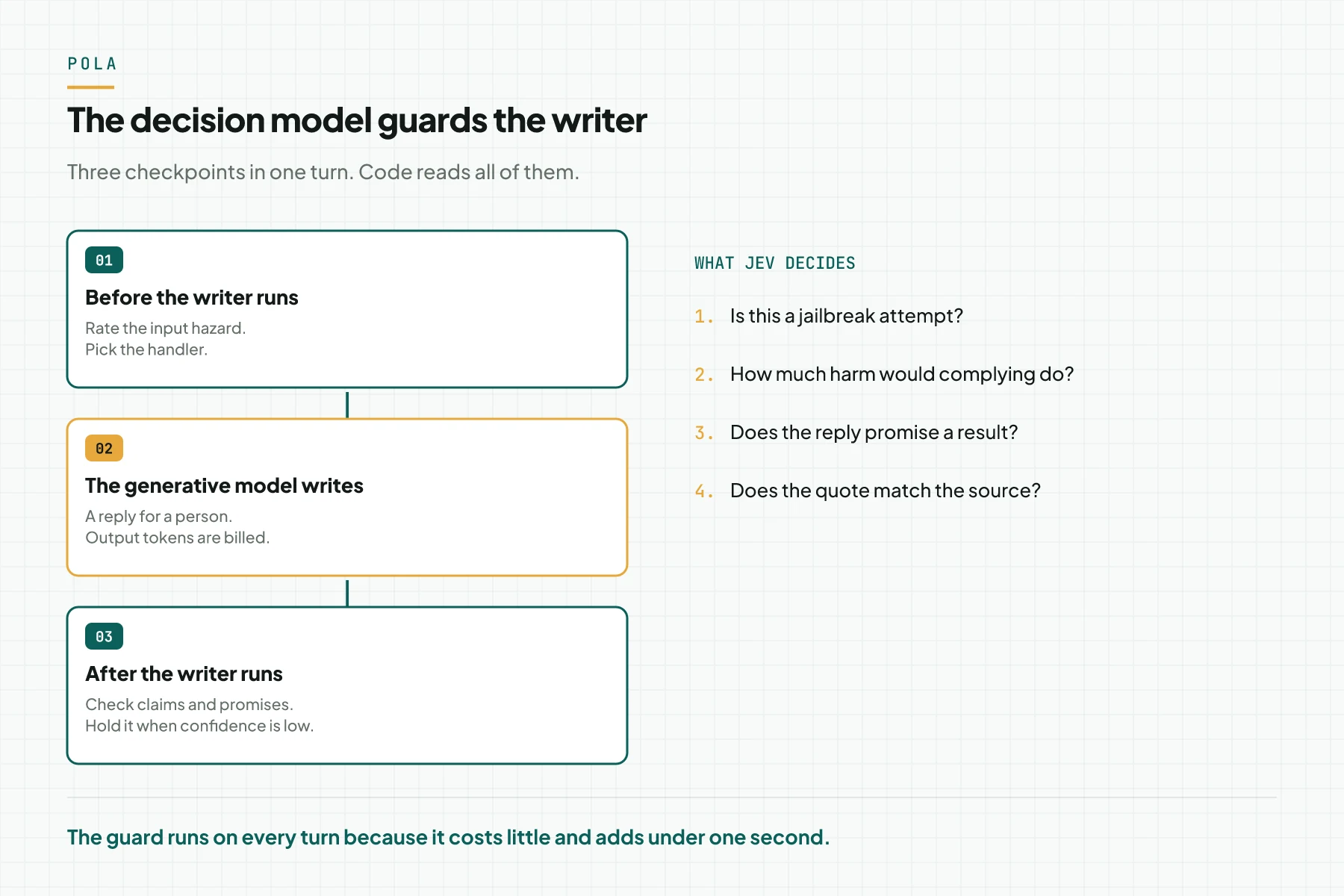
This pattern is called a guardrail. Before the writer runs, one request rates the input hazard and picks the route. After the writer runs, one request checks the claims and promises in the text. Source: the TypeSafe guardrails cookbook.
The second common pattern is routing. One Choice question picks the handler: deterministic code, an LLM, or a person. The cheap path handles most messages, and the LLM handles only the heavy ones. Source: the intent routing pattern.
Six questions that pick the tool
- Can I write the answer as a list? If yes, a decision model fits.
- Does a person read the result, or does code? Code means a decision model.
- Does this decision repeat thousands of times? High volume strengthens the decision model.
- Do I need a sentence that reads well? If yes, you need a generative model.
- Do I need to know when to hesitate? The confidence field exists only on the decision model.
- Does the answer need arithmetic? If yes, keep the arithmetic in code, on either tool.
When the first 3 answers point at a decision model, start there. You can add a generative model later without rebuilding the flow.
What a decision model cannot do
TypeSafe publishes the weak edges of jev-1.13 itself, reviewed on 17 September 2026. The list keeps you from the wrong use.
| Need | The right tool |
|---|---|
| Write a reply, a summary, or code | A generative model |
| Add a total, a difference, or a percentage | Plain code |
| Compare 2 dates | Plain code, after the parts are extracted |
| Count how often a word appears | Plain code |
| Pick 1 route from a closed list | A decision model |
Source: the jev-1.13 jaggedness page. We use that list as a filter before writing any rubric.
A real example from our system
Our CRM assistant uses a generative model to write its replies. That model is polite and informative, and not one number told us whether the replies sell.
We judged 43 replies with a decision model. The result: 19 gave a price, 8 diagnosed, 6 educated, and only 2 asked for the order. The full story is in our guide to auditing conversations with Jev.
Rama Digital recommends: do not replace your writer. Add a decision layer in front of it and behind it, then measure the change with the same rubric.
How the move looks in your code
The biggest difference is not the model. It is the guard code that disappears. These 3 things usually go away once a decision moves to a typed model.
- Format guards. No more checks for broken JSON, curly quotes, or an answer that carries an extra explanation.
- Retries. No more second call just because the first answer could not be read.
- The other bucket. No more foreign value to catch because the model answered outside the list.
One new job replaces them: writing the rubric. That work moves from code into language, and the result is readable by the non technical people on your team.
Frequently asked questions
Is Jev smarter than GPT or Claude? The question does not compare like with like. Jev writes no text, so the two do not perform the same task.
Could I use an LLM for the same job? You could, and many teams do. The difference lands in cost, speed, and how much guard code you have to write.
Can a decision model hallucinate? It can still pick the wrong option. The difference is that the answer always sits inside your list, so your system never receives an unknown value.
Which one is faster? In our test one Jev question from Jakarta finished in a median of 760 milliseconds. A generative model depends on the length of the answer it writes.
Do I need to change my architecture to try it? No. Start with one extra call at one decision point, then measure before adding another.
Next step
The remaining limit: picking the tool does not write the rubric. A vague rubric returns vague decisions on either tool. We wrote about testing your own system in Chaos engineering for vibe coders.
If you want us to map which part deserves a machine, open AI Diagnostic. To talk it through first, pick an AI Diagnostic slot.