Direct answer: Chaos engineering is the discipline of experimenting on a system, to build confidence the system withstands turbulent conditions in production (principlesofchaos.org, March 2019). For vibe coders, use the 1 + 6 pattern: the agentAI agentAn AI program that performs work steps by itself, for example reading a message, drafting a reply, and recording the result.Open the glossary builds Day 1. Days 2-7 map failure modes, inject faults, add observability, test security with a multi-agent workflow, and close with a game day.
Main condition: fits a feature with external dependencies (APIAPIThe official door 2 systems use to exchange data, without anybody copying it by hand.Open the glossary, webhookWebhookAn automatic message one system sends to another the moment something happens, for example an incoming WhatsApp message.Open the glossary, database, queue), staging or a feature flag, a tested backup, and 3 metrics. A production experiment runs only with a small blast radius, a stop rule, and the system owner's permission. Limit: chaos engineering does not replace unit tests, integration tests, or a pentest. The result is measured confidence in 1 feature, not zero incidents; the "7 days became 1 day" premise is a reader scenario, not data.
Sources read on 14 September 2026: principlesofchaos.org, Netflix, AWS, Azure, DORA, and METR. The example is a dummy simulation; no experiment ran for this article.
30-second summary
- The "7 days became 1 day" premise is a reader scenario. DORA 2024: each 25% rise in AI adoption relates to an estimated 1.5% drop in throughput and 7.2% in stability (DORA 2024, more than 39,000 respondents).
- METR, 10 July 2025: 16 developers were 19% slower with AI tools, while believing they were 20% faster (metr.org).
- Stack Overflow 2025: 84% use AI tools, yet 46% distrust their accuracy (survey.stackoverflow.co).
- Chaos engineering uses 4 steps and 5 principles (principlesofchaos.org, 2019); Netflix started it in 2011, Google runs DiRT (ACM Queue, 2012).
- Free tools: Toxiproxy (GitHub), Chaos Mesh (CNCF) and LitmusChaos (CNCF); Claude Code runs up to 16 agents (code.claude.com).
The feature ships in 1 day: the other 6 days go to chaos engineering
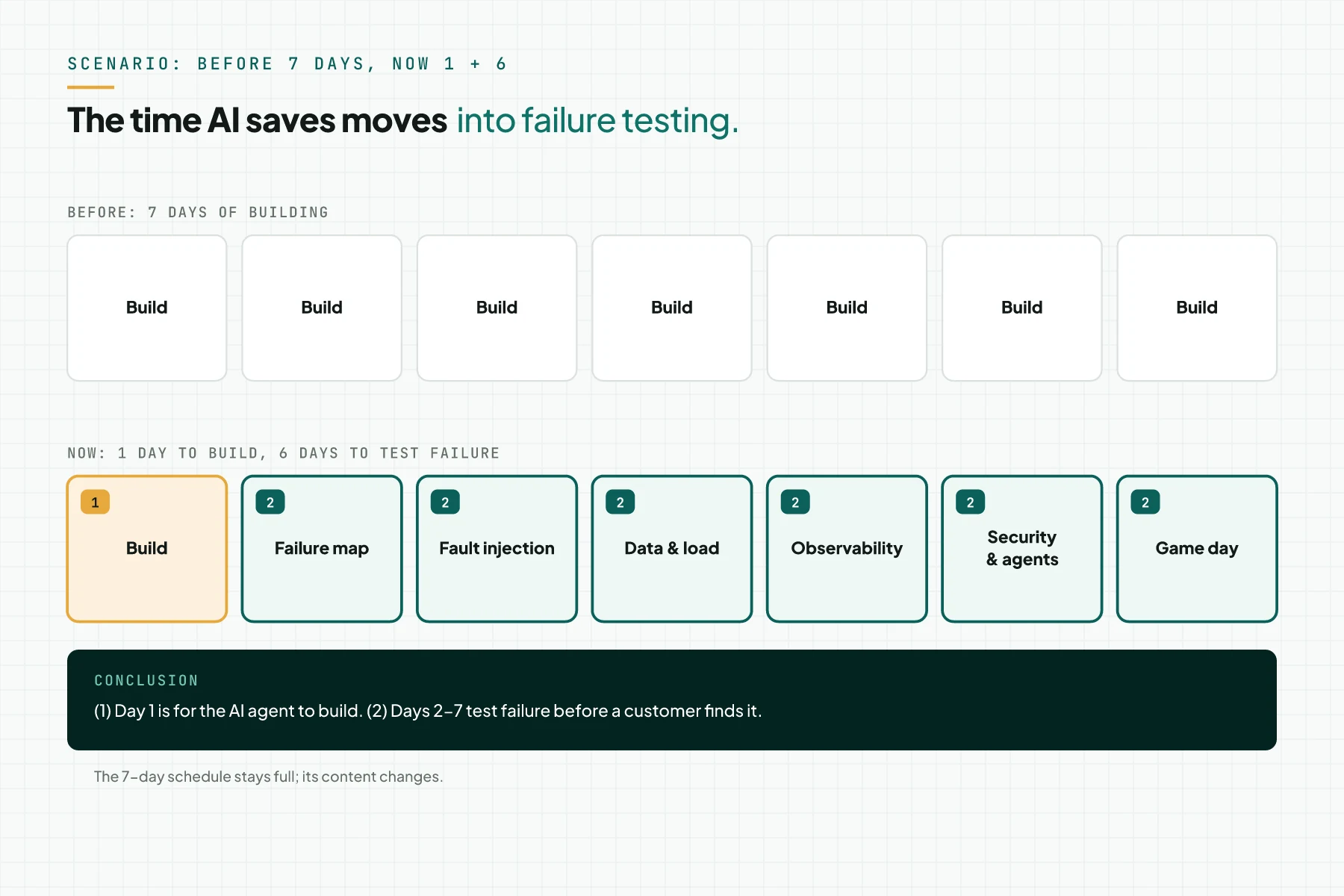
Say a feature that once took 7 days now ships in 1 day, built by an AI agent like Claude Code, Codex, OpenClaw, or Hermes. This is a reader scenario, not data. A team often rests or jumps ahead; both pile up features that never failed on purpose.
This style is called vibe coding: writing code in a somewhat careless fashion, with AI assistance (Merriam-Webster, 4 June 2026), a term from Andrej Karpathy in 2025. "Vibe coder" here is a neutral label.
DORA 2024: 75.9% rely on AI daily (DORA 2024). DORA 2025: 90% use AI, over 80% feel more productive, yet stability falls (Google Cloud, 24 September 2025): "AI doesn't fix a team; it amplifies what's already there."
METR: 16 developers were 19% slower on 246 tasks while still believing they were 20% faster (METR, 10 July 2025). Stack Overflow 2025: 84% use AI tools, yet 46% distrust accuracy, 66% frustrated by "almost right, but not quite" (Stack Overflow 2025).
The time AI saves should go into failing the feature on purpose, before a customer finds the failure. A tidy Day 1 uses the Spec to Task to Checklist workflow. A green test does not prove the feature correct; read RED in TDD.
What chaos engineering is: definition, 5 principles, and history
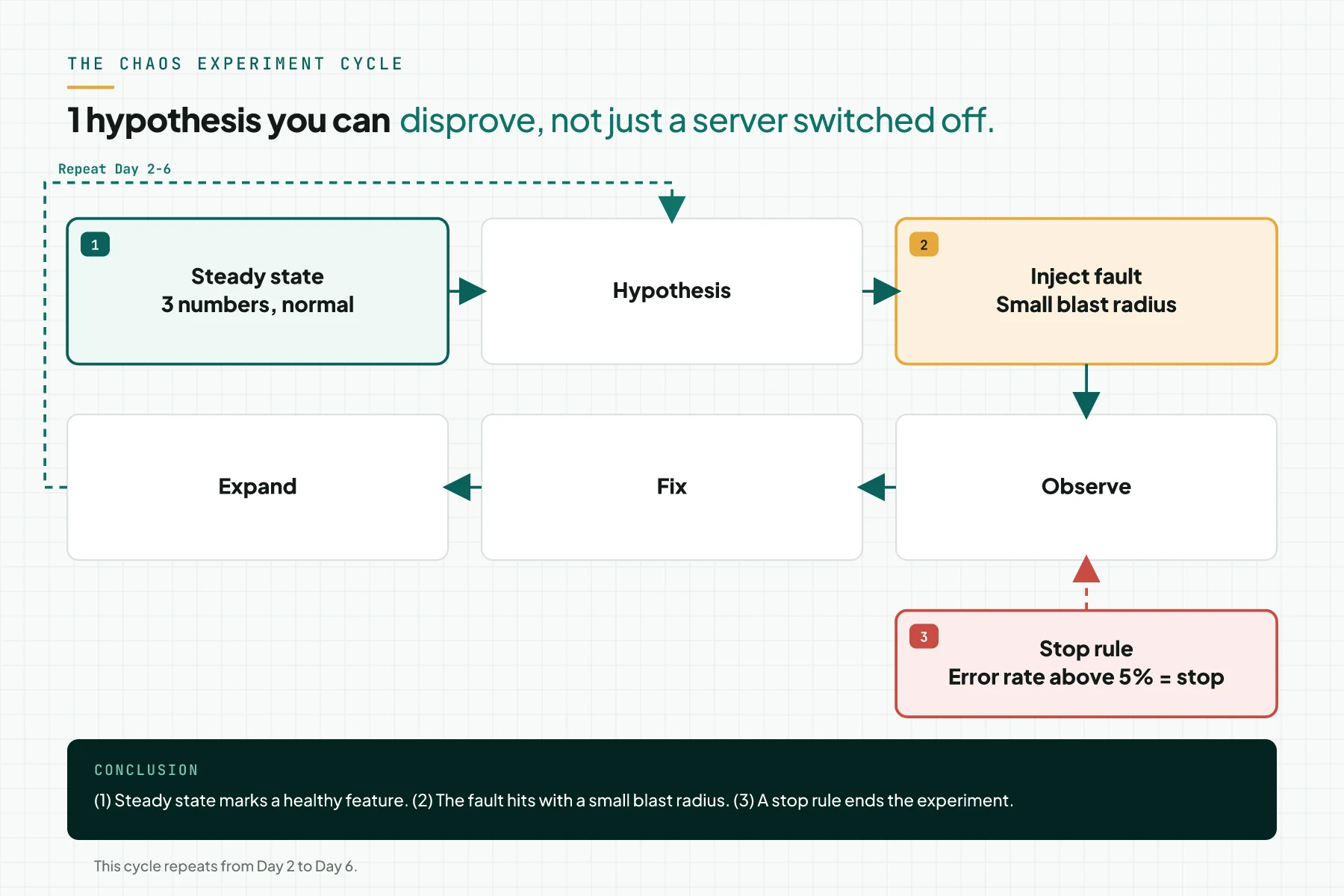
Chaos engineering uses 4 steps: define the steady state, form a hypothesis, inject a real-world variable, then disprove it (principlesofchaos.org, March 2019). Gremlin calls it finding failures before outages, a vendor claim (Gremlin).
Principle 1: build a hypothesis around the steady state
The steady state uses a measurable output, not an internal attribute. Netflix uses SPS, stream starts per second (Basiri 2016). AWS gives a template based on fault and metric (AWS REL12-BP04).
Principle 2: vary real-world events
Prioritise variables by impact or frequency, not guessing (principlesofchaos.org); AWS picks faults from post-incident analyses (AWS REL12-BP04).
Principle 3: run experiments in production
Chaos engineering favours production, but AWS recommends non-production first (AWS REL12-BP04); Gremlin reports 34% experiment there, a vendor claim (Gremlin 2021).
Principle 4: automate experiments to run continuously
Manual experiments do not last; Netflix runs Chaos Monkey on business days (Basiri 2016).
Principle 5: minimise blast radius
Blast radius is the part of the system an experiment can affect; magnitude is how severe (Gremlin glossary); AWS FIS allows 5 stop conditions per template (AWS FIS).
A short history: Netflix 2011, Google 2012, and IEEE 2016
Netflix wrote about Chaos Monkey on 19 July 2011 (Netflix Tech Blog), open source since 2012 (GitHub repo). Google DiRT started small (Krishnan 2012). Basiri and team named the discipline in 2016 (IEEE Software 2016).
A 6-day map: where each principle applies
Day 2 uses Principle 1-2; Day 3-4 use Principle 2 and 5; Day 5 adds observability. Day 6 uses Principle 4; Day 7 runs the game day.
Unit test, integration test, chaos experiment, game day, and pentest: the differences
A chaos experiment tests behaviour when 1 component fails, not correctness (principlesofchaos.org; Gremlin glossary; AWS REL12-BP05).
| Test type | Purpose | When | Blast radius | Tools |
|---|---|---|---|---|
| Unit test | Function correct for known inputs. | Day 1, every commit. | None. | Vitest, Jest, pytest. |
| Integration test | Components work on the normal path. | Day 1, every PR. | None; staging. | Test runner, test database. |
| Chaos experiment | Disprove steady state at 1 dependency failure. | Day 2-6, then scheduled. | Small; staging first, production with a stop rule. | Toxiproxy, Chaos Mesh, LitmusChaos, AWS FIS, Azure Chaos Studio. |
| Game day | Train the team and runbook on several failures. | Day 7, then scheduled. | Medium; production-like. | The same chaos tools, plus a runbook. |
| Pentest | Find security flaws to exploit. | Before release, after auth changes. | Limited to the approved scope. | OWASP API Top 10 methodology. |
Rama Digital recommendation: run unit tests and RED in TDD on Day 1. Run chaos experiments on Day 2-6, game day Day 7, the API pentest for modern applications before release (OWASP API Top 10 2023).
Prerequisites before Day 2
Prepare these 8 things.
- 3 metrics in 1 dashboard: latency, traffic, error rate (SRE Book).
- Staging like production, or a feature flag that disables the feature within 1 minute.
- A backup that has been restored, not just scheduled (Krishnan 2012).
- Written permission from the owner and notice to affected teams (AWS REL12-BP05).
- 1 test account, dummy data; no real customer data on staging.
- 1 feature with dependencies: webhook, an API, database, PDF, queue.
- Fault injection tools: Toxiproxy (v2.12.0); Chaos Mesh or LitmusChaos on Kubernetes (CNCF; CNCF); AWS FIS or Azure Chaos Studio (docs; docs).
- A stop rule, error rate above 5% for 2 minutes.
Step 1: Day 2 — Map the failure modes and define the steady state
This step sets the feature's normal numbers, then maps how it can fail. Steady state: 120 messages per hour, a 4-second p95 reply, errors under 1%. Build a failure-mode table, 1 row per dependency and fault; grow it to 10 rows or more.
| Dependency | Fault type | Priority | Hypothesis |
|---|---|---|---|
| Meta webhook | Duplicate | High | 1 order still makes 1 invoice. |
| Database | Down 30 seconds | High | Messages wait in the queue, none lost. |
| WhatsApp token | Expired | High | Alerts within 5 minutes; no duplicate invoice. |
Write 1 falsifiable hypothesis per row, the AWS template (AWS REL12-BP04). Ask an AI agent to read the code and output this list as structured dataSchemaExtra description inside page code that tells a search engine what the page is, for example an article, a service, or a question and answer.Open the glossary (Claude Code Workflows); a person sets priority. The cycle repeats through Day 6 (principlesofchaos.org).
Evidence: the dashboard shows the 3 metrics over 1 normal hour; every row has a metric.
Step 2: Day 3 — Inject dependency faults: latency, timeout, 500, and database down
This step injects 1 fault on 1 dependency, with the smallest blast radius and a ready stop rule.
Toxiproxy routes the connection through a proxy: add a latency toxic, then timeout, then down (Toxiproxy v2.12.0, 18 March 2025). On Kubernetes use Chaos Mesh NetworkChaos (Chaos Mesh). On cloud use AWS FIS (AWS FIS), or Azure Chaos Studio Experiments (classic), because Workspaces is still in public preview (Azure, 5 September 2026).
Observe the timeout, fallback, queue, and log with a request ID. AI code often lacks a timeout, or retries without backoff; a failed retry spends more server time under overload (Marc Brooker, AWS).
Fix: an explicit timeout, backoff with jitter, a fallback, a clear user message. Evidence: repeat the experiment; the hypothesis should hold.
Step 3: Day 4 — Break data and load: corrupt input, large payloads, spikes, and duplicates
This step tests data and load outside the norm: a missing field, wrong type, or a 2 MB payload. Expect a clear 400, not a leaked stack trace.
Send the same webhook twice, since Meta retries up to 36 hours (Meta Webhooks); fix with an idempotency key, the Stripe pattern (Stripe API). Turn off 1 dependency for 30 seconds, then restore it; watch for a retry storm and fix it with backoff. Send 10 times the normal traffic for 5 minutes; watch saturation (SRE Book).
1 agent builds a malformed-payload generator; another writes a failing test first, the RED in TDD pattern. Evidence: the test joins the suite, passes.
Step 4: Day 5 — Add observability, alerts, a runbook, and a rollback drill
This step adds observability: the 4 golden signals, latency, traffic, errors, saturation (SRE Book). At minimum, add 1 dashboard, 1 log with a request ID, and an error-rate and p95 alert.
A runbook is a documented process for 1 outcome (AWS OPS07-BP03): purpose, tools, permissions, steps, escalation, stored in the repo, validated by someone else.
Drill the rollback: deploy a broken version, run the runbook, record the time. An agent drafts it; a person validates it. Use /loop to watch alerts while the experiment runs.
Evidence: the alert fires during the drill; a second person finishes the rollback and records the time.
Step 5: Day 6 — Test permission and security failures with a multi-agent workflow
This step injects permission and security faults. Faults: an expired token, a 429 limit, an unsigned webhook, a rotated secret, based on OWASP API2 and API4 (OWASP API Top 10 2023). Meta requires an X-Hub-Signature-256 signature via the App Secret (Meta Webhooks).
Hypothesis: "If the WhatsApp token expires, the feature marks the message failed, alerts within 5 minutes, and creates no duplicate invoice once the token refreshes."
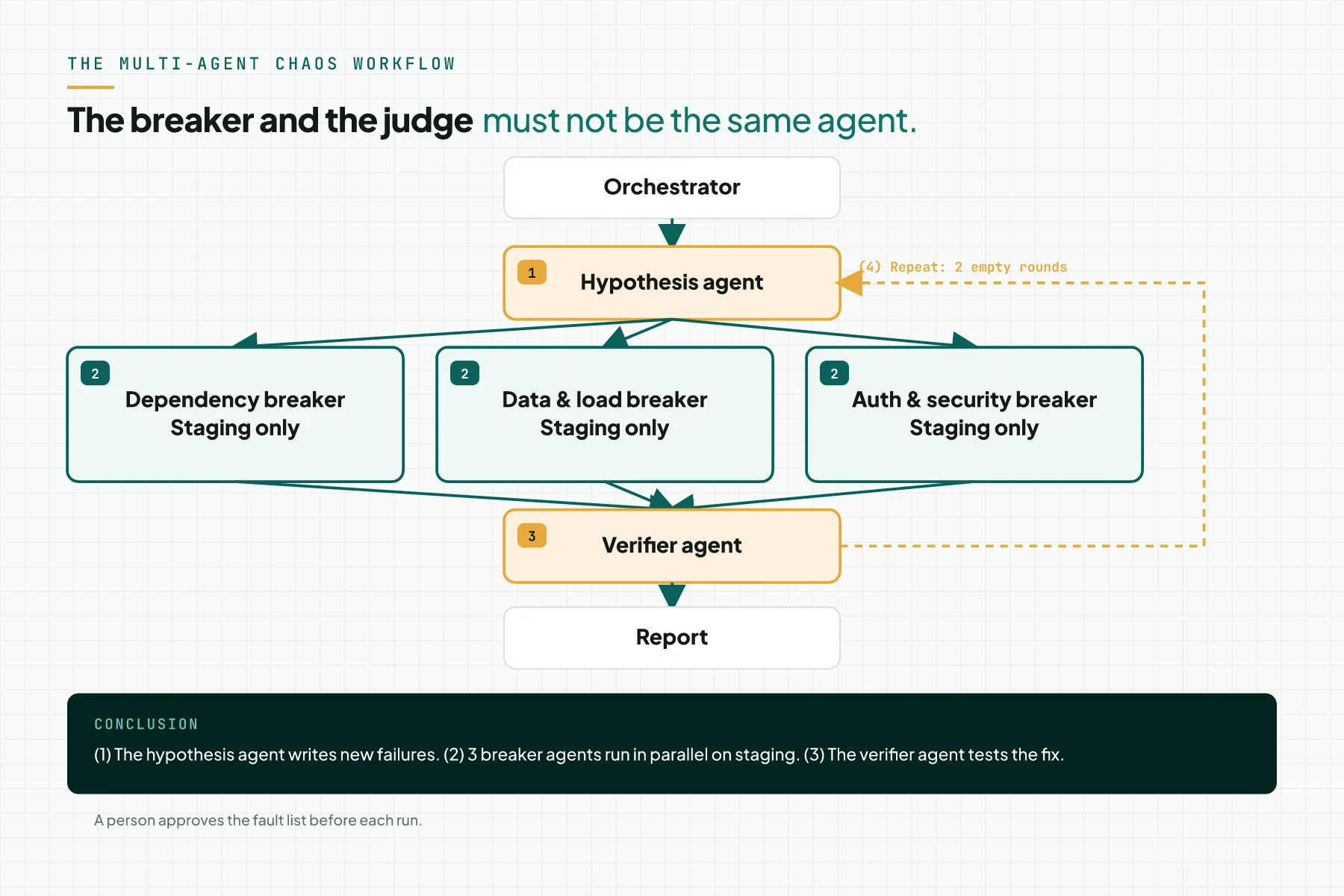
The multi-agent pattern uses orchestrator-workers and evaluator-optimizer (Anthropic). Roles: 1 orchestrator, 1 hypothesis agent, and 3 parallel breaker agents (dependency; data and load; auth and security), staging only. Then 1 verifier tries to disprove each finding and tests its fix.
A Claude Code subagent keeps its own context (Claude Code Subagents). tools and isolation: worktree limit each agent; agent() and parallel() run them, capped at 16 concurrent agents (Claude Code Workflows).
Sketch:
phase('Chaos Day 6');
let empty = 0;
while (empty < 2) {
  const hypothesis = await agent(promptHypothesis);
  const findings = await parallel([
    agent(promptDependency(hypothesis)),
    agent(promptData(hypothesis)),
    agent(promptAuth(hypothesis)),
  ]);
  const v = await agent(promptVerify(findings), { schema });
  empty = v.newFindings === 0 ? empty + 1 : 0;
}
Safety rules: no production credentials for breakers, every fault through staging, a separate verifier, and a person who approves the fault list. Read also agents that are agentic but deterministic, the Claude Code Workflows pattern, and the default size and brakes in Claude Code 2.1.219. Azure Chaos Studio adds a startchaos MCPMCPA standard that lets an AI program use your tools and data under clear permissions.Open the glossary plugin for autonomous agents (Azure, 5 September 2026), an industry signal.
Evidence: the finding count per round drops to 0 twice in a row. Every finding has a test that failed then passed; a forged webhook gets rejected 401 or 403.
Step 6: Day 7 — Run the game day, the retro, and the report
This step closes the 6-day drill. A game day runs 2-4 hours for 1 or more experiments, a vendor claim (Gremlin GameDay), stakeholders notified in advance (AWS REL12-BP05).
Gremlin names 4 roles: Owner, Coordinator, Reporter, Observer; a 2-person team combines roles. The agenda uses 3 scenarios from the Day 2 table that never ran together.
Close with a blameless retro: impact, actions, causes, follow-ups, no blame on individuals (Google SRE Book, Postmortem Culture). Write a 1-page report: steady state, experiments, findings, next date.
Evidence: the report lives in the repo; every finding has a ticket; passing experiments reschedule (principlesofchaos.org).
Simulation example: a WhatsApp-order-to-invoice feature, Day 1 to 7
A simulation with dummy data. Not a real client.
Example: a WhatsApp webhook from Meta, parse, create the order and PDF invoice, send back. Dependencies: database, PDF service, dummy "PayDummy" API, queue.
| Day | Experiment | Hypothesis | Result | Fix |
|---|---|---|---|---|
| Day 1 | AI agent builds the feature; tests green. | — | Normal path works. | None yet. |
| Day 2 | Map of 12 failure modes, 3 metrics. | Every mode has a metric. | 12-row table, 4 high priorities. | None yet; list approved. |
| Day 3 | Latency 3,000 ms to PDF. | Reply under 10 seconds, fallback. | Hangs 60 seconds; queue backs up 40. | 5-second timeout, fallback. |
| Day 3 | down on database, 30 seconds. | Messages wait in queue. | Messages lost without a log. | Store raw event; log ID. |
| Day 4 | Same webhook twice, Meta retries 36 hours. | 1 order = 1 invoice. | 2 invoices for 1 order. | Idempotency key = message ID. |
| Day 4 | 2 MB payload, price field "abc". | Rejected, clear 400. | 500 with stack trace. | 64 KB body limit, validation. |
| Day 5 | Repeat 3,000 ms latency, watch alerts. | Alert fires within 3 minutes. | No alert; dashboard shows only CPU. | 4 golden signals, p95 alert. |
| Day 5 | Rollback drill by a second person. | Rollback within 10 minutes. | Finished 14 minutes; 1 stale command. | Runbook updated, target 8 minutes. |
| Day 6 | Multi-agent: expired token, 429, unsigned webhook. | Rejected or alerted; no duplicate. | Round 1: 5; round 2: 2; 3-4: 0. | Verify signature; backoff 429. |
| Day 7 | Game day: replica down, spike, expired token. | Steady state holds; runbook used. | 1 finding: dashboard fails when replica is down. | Dashboard reads separate source; retro, report. |
14 findings in 6 days: 6 from Day 3-5, 7 from the multi-agent workflow, and 1 from the game day, all before the first customer.
Chaos engineering checklist for a new feature
- Write the steady state as 3 numbers. Owner: developer. Evidence: dashboard screenshot.
- Build a table of 10 or more failure modes, with priority. Owner: developer. Evidence: table in repo.
- Run dependency experiments on staging, with a stop rule. Owner: developer. Evidence: experiment log.
- Test duplicate webhooks and corrupt payloads; prove idempotency. Owner: developer. Evidence: test, failed then passed.
- Confirm error-rate and p95 alerts fire when a fault is injected. Owner: on-call. Evidence: recorded notification.
- Have a second person run the rollback runbook. Owner: on-call. Evidence: time recorded.
- Run the multi-agent workflow, breaker and verifier separate, staging only. Owner: developer. Evidence: report per round.
- Run a 2-hour game day, a blameless retro, a report. Owner: team. Evidence: follow-up tickets.
- Stop when 2 rounds find nothing new and every alert fired. Schedule passing experiments as regression tests.
FAQ: chaos engineering for vibe coders
What is chaos engineering? Experimenting on a system to build confidence it withstands turbulent conditions (principlesofchaos.org). Netflix started it in 2011 (Netflix Tech Blog), Basiri named it in 2016 (IEEE Software).
Does chaos engineering have to run in production? Not required; AWS recommends non-production first (AWS REL12-BP04), though Gremlin reports 34% experiment in production, a vendor claim (Gremlin 2021).
How is chaos engineering different from a unit test and a pentest? A unit test proves a function correct; a pentest finds flaws to exploit (OWASP API Security Top 10); a chaos experiment tries to disprove the steady-state hypothesis.
Can a vibe coder without an SRE team start chaos engineering? Yes, with 1 feature, staging, Toxiproxy, 3 metrics, and 1 stop rule, like DiRT (Krishnan 2012).
Which chaos engineering tools are free? Toxiproxy (GitHub), Chaos Mesh, and LitmusChaos (CNCF; CNCF); AWS FIS bills per minute (docs), Azure Chaos Studio Workspaces is still in preview (docs).
How do AI agents help without breaking production? A breaker agent gets a limited tool list and no production credentials (Claude Code Subagents); the verifier stays separate (Anthropic), via a workflow (Claude Code Workflows).
Next step
Chaos engineering does not replace unit tests, integration tests, or a pentest; the result is confidence in 1 feature, not zero incidents. To start without guessing, use Vibe Code Rescue: a forensic audit at Rp 7.5 million in 1-2 weeks. The audit decides a rescue from Rp 25 million, or a rebuild from Rp 40 million. To ask first, book a 30-minute session.
Sources
- principlesofchaos.org
- Gremlin: Glossary
- Gremlin: History
- Gremlin: GameDay
- Gremlin 2021
- AWS: REL12-BP04
- AWS: REL12-BP05
- AWS: OPS07-BP03
- AWS FIS
- AWS Builder: Backoff
- Azure Chaos Studio
- Netflix: Simian Army
- GitHub: chaosmonkey
- Basiri 2016
- Krishnan 2012
- CNCF: LitmusChaos
- CNCF: Chaos Mesh
- Chaos Mesh: Network
- GitHub: Toxiproxy
- SRE Book: Monitoring
- SRE Book: Postmortem
- Stripe: Idempotency
- Meta: Webhooks
- OWASP API Top 10
- DORA 2024
- DORA 2025
- METR 2025
- Stack Overflow 2025
- Merriam-Webster
- Anthropic: Effective Agents
- Claude Code: Subagents
- Claude Code: Workflows