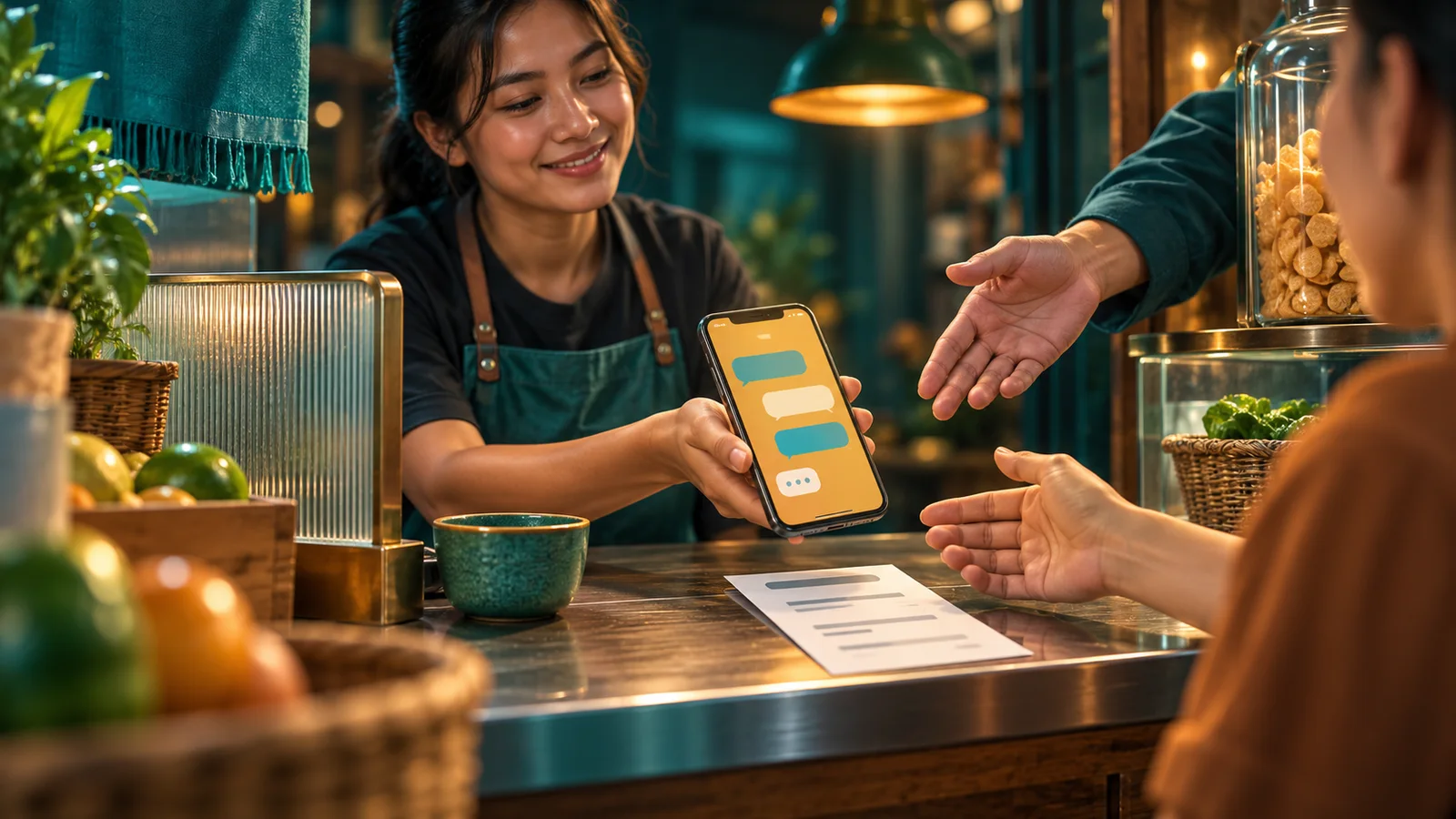
Direct answer: a WhatsApp AI chatbot can help close sales when it asks for the order, issues the invoice from the chat text, and gives 1 step in each reply. A bot that only explains the product rarely brings payment. In our audit on 20 September 2026, our AI assistant asked for the order in only 2 of 43 replies.
Main condition: this pattern fits products with a fixed price, such as a class or a package. Limit: the bot does not replace the team for negotiation, custom prices, and money objections. The bot also does not fix ads that bring people with no intent to buy.
Rama Aditya wrote this article from 2 internal audits of Wulan, the Rama Digital AI assistant on WhatsApp and the web. The first audit checked 227 sessions (6 to 20 September 2026). The second audit checked 273 chats (28 to 30 September 2026). All numbers are aggregate, with no names or numbers. Data updated 3 October 2026.
This article is part of the guide AI marketing consultant: what the work is and when you need one.
Why a WhatsApp AI chatbot gets many chats but few closings
The problem we see most often: many chats come in, but few transfers follow. The business owner then blames the bot. Our data shows the leak sits in 3 places, and the bot is only 1 of them.
Leak 1: the bot explains, but does not ask for the order
The audit on 20 September 2026 used JevJevA small AI model from TypeSafe that decides what happens to each chat: reply, skip, flag for the team, or remove from follow-up. Jev writes no replies.How Jev picks the chats to answer, a decision model, to score 43 Wulan replies one by one. The result: 19 replies gave a price, 8 diagnosed a need, 6 educated, and only 2 asked for the order. The mean handling score was 1.87 of 5.
Of 227 sessions, 149 sessions (66%) stopped right after the bot captured the contact. The bot asked for a name or an email, and then gave no next step. The buyer waited, the bot waited, and the chat died.
Leak 2: people send only the prefilled ad text
The audit on 30 September 2026 of 273 chats found that 182 people (67%) sent only 1 message. That message was usually the prefilled text from a click-to-WhatsAppCTWAA Click-to-WhatsApp ad. It sends people from Facebook or Instagram straight into your WhatsApp conversation.How to track CTWA ads ad (CTWA). The person taps the ad, the text goes out, and the person leaves.
This leak happens before the bot can work. A bot fix does not close it. You must fix the ad, the offer, and the visitor filter. Read how to audit Meta ads with AI for the ad side.
Leak 3: the ads bring the wrong people
From 28 to 30 September 2026, the Maps, Chatbot, and MCPMCPA standard that lets an AI program use your tools and data under clear permissions.Open the glossary ads spent Rp 1,467,160. They brought 135 chats and 0 orders. Jev found real buying intent in only 1 of 54 Chatbot chats. Most people who clicked did not have a chatbot at all.

What we changed, in order of impact
We changed Wulan in 4 steps between 20 September and 1 October 2026. The order follows the size of each leak, not the ease of the work. Each step has a switch, so the team can turn it off without a new deploy of other code.
1. Ask for the order explicitly
The new rule: when nothing else needs an answer, the bot gives 1 concrete step. That step is a payment link, a choice of schedule, or a formal offer. After 2 unanswered questions, the bot stops asking and gives that step.
We also removed the name question as a closing line. In live tests, the sentence "What name can I use for this summary?" appeared in almost every reply. That sentence asks for identity, not for a buying step.
2. Issue the invoice directly from the chat
A WhatsApp form looks tidy, but people rarely fill it in. Of 81 forms sent, 54 were read and only 2 were submitted. People prefer to type their answer in the chat.
Since 26 September 2026, the bot can create an order from the chat text. The bot checks that the name and the email are in the message, and then the server sends the invoice. The live test passed 8 of 8 scenarios. We do not have payment numbers from this path yet.
3. Filter chats with a decision model
A decision model does not write text. It answers typed questions, such as "ask for the order, ask again, or hand to the team?". The answer is a choice and a confidence score. Read what Jev is for how it works.
Since 26 September 2026, Jev checks risky replies before they go out. The offer gate blocks an offer when the need fit score is 0.15 or lower. Live tests recorded 300 to 690 ms of extra time per check.
4. Send 1 bubble per answer
From 28 to 30 September 2026, 1 reply held 2.38 bubbles on average. And 29% of replies held 4 to 5 bubbles. Class replies often held 2 asks at once: type your email and fill in the form. Almost everyone chose to stay silent.
Since 1 October 2026, Wulan sends 1 bubble per answer, at most 80 words. The second reason is cost. From 1 October 2026, Meta charges service messages per message, so each bubble has a price. See how to merge bubbles into 1 tidy message.

Before and after: numbers from 2 audits
This table compares the audits of 20 September and 30 September 2026. The units are not always the same. The first audit scored 43 replies, and the second audit scored 273 chats. Read these numbers as a direction, not as an A/B test.
| Measure | Before (audit 20 Sep 2026) | After (audit 30 Sep 2026) | Note |
|---|---|---|---|
| Bot asks for the order or a buying step | 2 of 43 replies (5%) | 215 of 273 chats (79%) | Different units: replies vs chats |
| Chats that stop early | 149 of 227 sessions (66%) stop after contact capture | 182 of 273 people (67%) send only the ad text | The leak moved from the bot to the ad |
| Invoice path | Form only: 81 sent, 2 submitted | Order from chat text since 26 Sep 2026 | No payment numbers for the new path yet |
| Bubbles per reply | Mean 2.38; 29% held 4 to 5 | 1 bubble since 1 Oct 2026 | New rule, not audited yet |
| Reply time | Mean 11.1 seconds per model turn | Median 36 seconds, p90 49 seconds | The second audit measured time on WhatsApp |
| Orders and paid | 5 paid class invoices, Rp 895,000 | 7 new orders, 5 paid, Rp 895,000 | Only the class product was paid |
Our inference: the way the bot closes improved a lot. But orders did not rise at the same rate, because 67% of people never wrote a second message. More bot fixes have a ceiling until the ads and the offer change too.
Our failures, written honestly
An audit that shows only wins is not useful. Here are 4 failures we found in real chats, with the action we took.
- Class questions refused. Ice breaker ads sent "What will I learn in the class?" with no ad context. Wulan refused 12 of 26 such questions (46%) as "out of scope". All 12 people stopped. We fixed the topic rule on 30 September 2026.
- The ice breaker test failed. On 28 September 2026, the ice breaker ad got 42 sessions, 7 forms, and 0 sign-ups. The old prefilled text ad got 97 sessions, 92 forms, and 4 sign-ups. We paused both ice breaker ads.
- Money objections got a cold answer. A person who wrote that they had no capital got the answer "No need to force it". We added a price objection rule, but it is not tested in real chats yet.
- The chatbot ads hit the wrong audience. The Chatbot Optimization campaign from 25 to 27 September 2026 spent Rp 349,875 for 32 chats and 0 invoices. Of 8 people who stated their bot status, 7 had no bot.
The main lesson: a long chat does not mean intent to buy. The fastest paid class order came from a 2 message chat. Wulan gave the price and 2 session choices, and the invoice was paid 5 minutes later. A 14 message chat in the same audit did not pay.
Worked example: from an ad chat to an invoice
This example is a simulation with dummy data. The flow follows the Wulan rules since 1 October 2026. Product: an online class with a fixed price and a fixed date.
| Step | Input | System decision | Output |
|---|---|---|---|
| 1 | A person taps a CTWA ad. The prefilled text "I want to join the class" goes out. | The decision model marks the message as ad text, not proven intent. | 1 bubble: price, 2 dates, 1 question "Which session do you choose?" |
| 2 | The person answers "Monday session, name Budi, email budi@example.com". | The name and the email are in the message. The product has a fixed price. The bot may create the order. | The server issues the invoice and sends the payment link. |
| 3 | The person asks "Can I get a discount?" | Fixed price, no discount in the catalog. Negotiation is not a bot task. | The bot says there is no discount, and offers the team if the person wants to talk. |
| 4 | No reply for 24 hours. | The 24 hour customer service window closes. The next message must be a template. | 1 template reminder. If the person writes "STOP", the follow-up stops. |
Step 4 follows the Meta rule. The Meta document on customer service windows states that the 24 hour window starts when the user sends a message. Outside that window, the business can send only approved templates.
Our reminder data (28 to 30 September 2026): 216 reminders sent, 44 answered within 24 hours (20%), and 14 answered with "STOP". We keep 1 reminder per person.
Cost: a bot that closes must also stay cheap
A bot that asks for the order more often also sends more messages. From 1 October 2026, Meta charges service messages per message, at the same rate as utility messages. Service messages inside the free entry point window from a CTWA ad stay free. Since 28 September 2026, Meta states that this window can stay open for up to 7 days.
For Indonesian numbers, a service message above 1,000 messages per business number costs Rp356.65. The full rates are in the WhatsApp API price list for October 2026.
The AI model cost also matters. For 1 B2B client, the cost per AI reply fell from USD 0.091 (mean for 15 to 21 September 2026) to USD 0.003 (24 September 2026), about 30 times lower. That client uses a small, cheap model as a filter. Results differ for each business. Read how to cut AI cost when chats rise.
Limits: what the bot does not do
Rama Digital recommendation: hand these 4 situations to a human team. The bot can answer factual questions, but it must not decide the items below.
- Price negotiation, discounts outside the catalog, and special payment terms.
- Custom offers that need a review of the need.
- Money objections that touch personal conditions.
- Complaints, refunds, and payment problems.
A decision model can also be wrong. In the audit on 30 September 2026, Jev flagged 33 class chats as "wrong fact". A manual read showed those flags were false. Read the transcript before you trust an automatic label.
AttributionAttributionHow a system decides which ad or channel receives the credit for 1 sale.High clicks, low sales: the tracking gap is also a limit. A bot that issues invoices must connect the chat, the ad, and the payment. Read AI marketing attribution from ad to transfer to connect that data.
Checklist to audit a closing chatbot
- Pull the transcripts of the last 3 days. Owner: chat admin. Evidence: count of chats and messages.
- Count the share of people who sent only 1 message. Owner: marketing. Evidence: the number per ad.
- Count the share of replies that ask for the order. Owner: bot owner. Evidence: a sample of 40 replies.
- Count the mean bubbles per reply. Owner: bot owner. Evidence: the outbound message log.
- Compare forms sent with forms submitted. Owner: chat admin. Evidence: those 2 numbers.
- Match chats to paid invoices per ad. Owner: finance. Evidence: the list of paid invoices.
- Read 20 chats that the bot flagged as a problem. Owner: business owner. Evidence: a note per chat.
- Stop criterion: if more than 60% of people send only the ad text, fix the ad first, not the bot.
Frequently asked questions
Can a WhatsApp AI chatbot close a sale on its own? Yes for products with a fixed price, when the bot asks for the order and issues the invoice. For custom prices and negotiation, a human team still closes.
Why do many chats from ads never reply again? In our audit, 67% of people sent only the prefilled ad text. That text goes out with 1 tap, so it does not always show intent to buy.
Is a WhatsApp form better than a normal chat? In our data, no. Of 81 forms sent, only 2 were submitted. People prefer to type, so the bot must read the answer from the chat text.
How many bubbles should 1 bot reply have? We use 1 bubble per answer, at most 80 words, since 1 October 2026. Each bubble outside a free window is a paid message.
Does a decision model replace the chat model? No. The decision model only picks the step and gives a score. The chat model still writes the reply. The decision model added 300 to 690 ms in our tests.
Does Rama Digital guarantee higher sales? No. We measure order requests, leaks, and cost per reply. Sales also depend on your ads, your price, and your product.
Next step
The limit that stays: the bot does not fix ads that hit the wrong audience, and it does not replace the team for negotiation. If your bot already runs and the AI cost or the order requests are a problem, see Jasa Optimasi Chatbot AI WhatsApp. To discuss your chat data first, book a 30 minute first consultation.
Sources
- Meta, WhatsApp Business Platform: Send messages, customer service windows (read 3 October 2026).
- Meta, WhatsApp Business Platform: Non-template message pricing (read 3 October 2026).
- Meta, WhatsApp Business Platform: Pricing, free entry point windows (read 3 October 2026).
- Rama Digital internal audit: Wulan audit with Jev, 20 September 2026 (227 sessions, 43 replies).
- Rama Digital internal audit: Wulan chat audit, 30 September 2026 (273 chats, 2,599 messages).