At a press conference in Jakarta on 11 November 2026, Google Indonesia Country Director Veronica Utami showed 1 large number: 105 million Indonesians use generative AI this year. That is the largest user base in Southeast Asia, according to Fortune Indonesia.
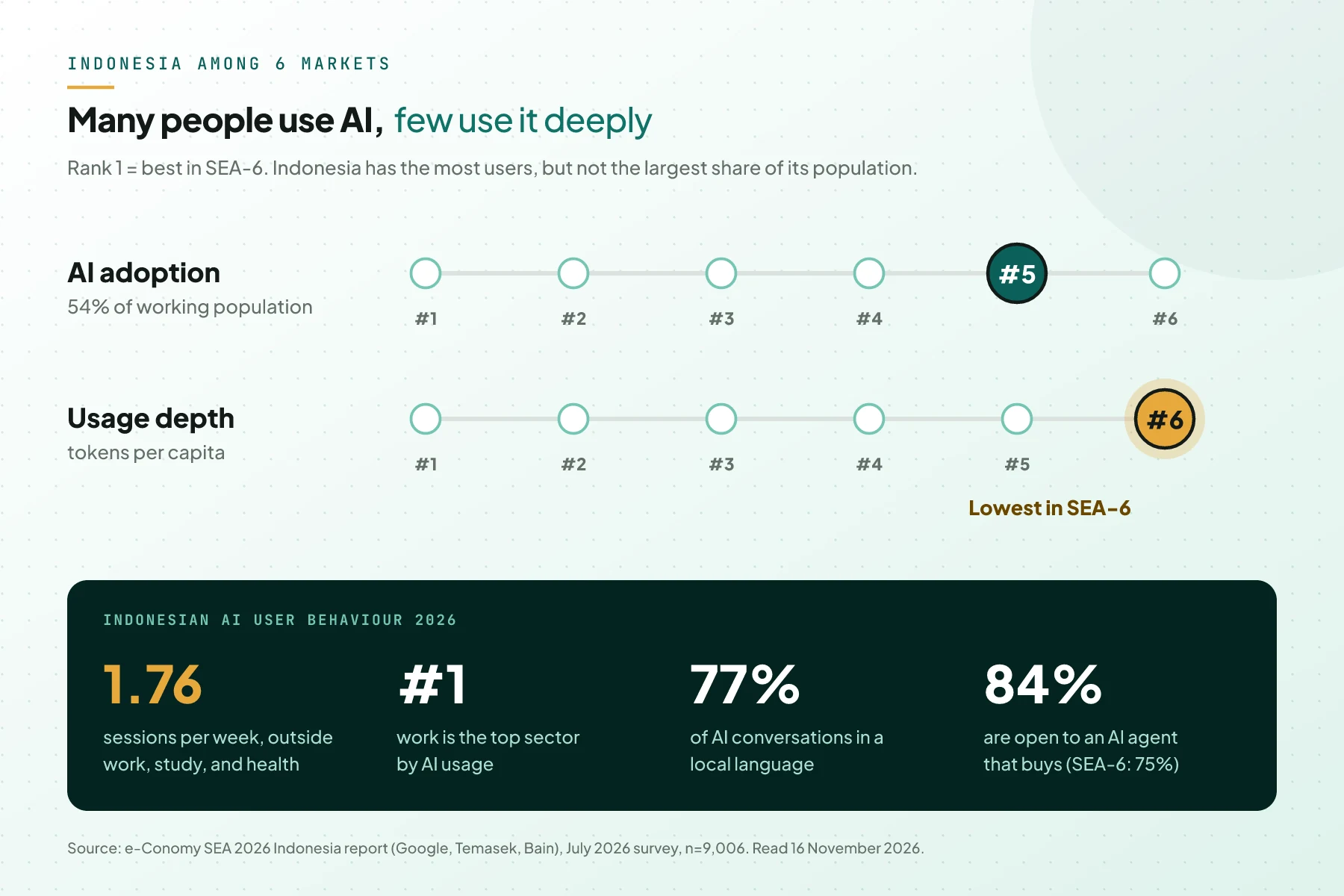
The same page of the report shows a second number. An average Indonesian user opens AI for only 1.76 sessions per week, the lowest of the 6 largest Southeast Asian markets.
So Indonesians try AI quickly, but they seldom use it for long work. The same pattern occurs easily in an office: all staff get an AI account, but only a small number of tasks really change.
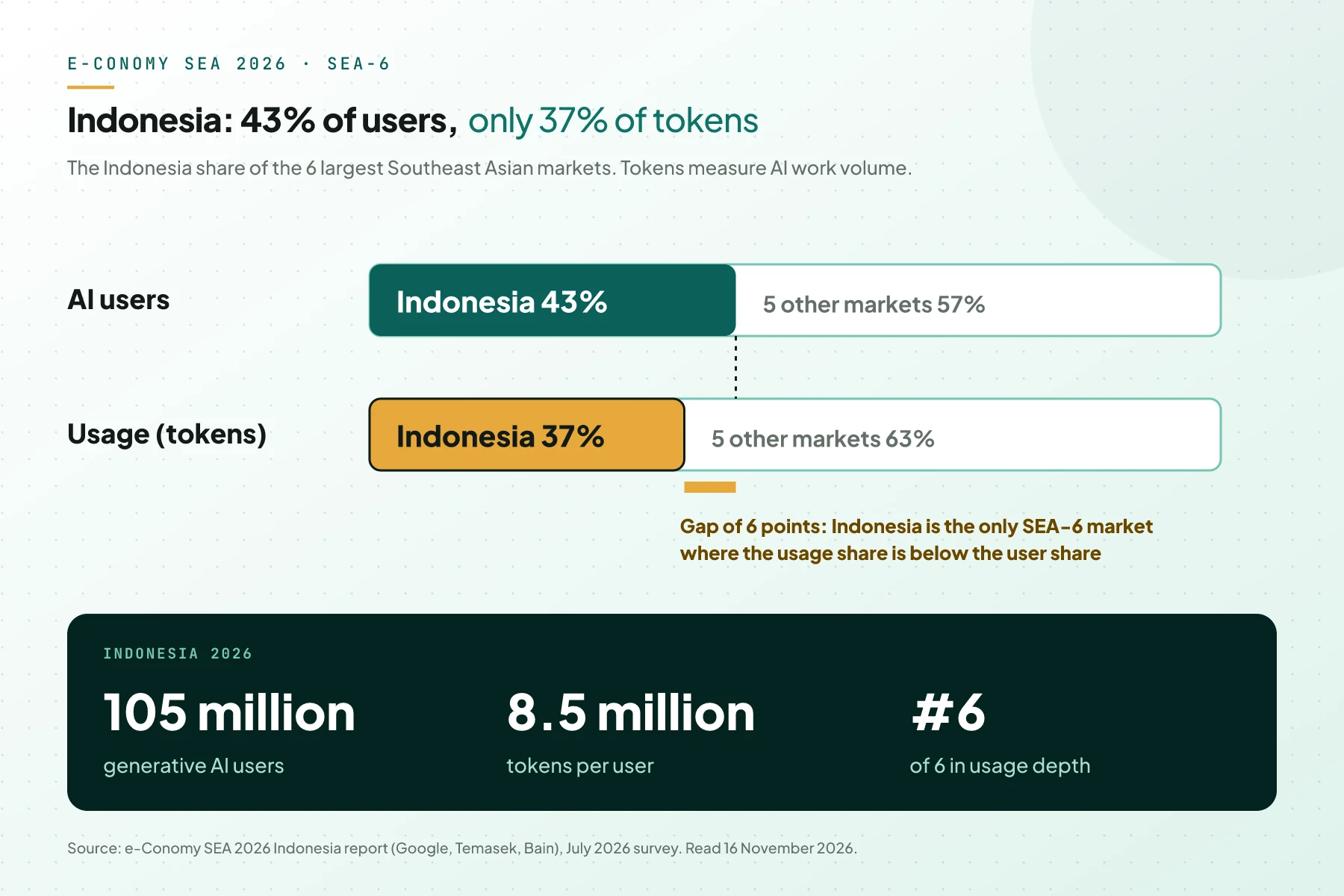
Indonesia has 43% of users, but only 37% of usage
Indonesia has 43% of the AI users in the 6 largest Southeast Asian markets, but it uses only 37% of the tokens in that region.
These numbers are in the e-Conomy SEA 2026 Indonesia country report from Google, Temasek, and Bain & Company. The report says that Indonesia is the only market in the region where the usage share is smaller than the user share. The average usage is 8.5 million tokens per user.
A token is a part of text that an AI model reads and writes. A short question uses few tokens. Long work, for example a summary of 30 documents or a monthly report, uses many more tokens.
The session number has a limit. The 1.76 figure does not include sessions for work, study, and health. But the token measure includes all use, and that measure also puts Indonesia in the last position.
Rank 5 in reach, rank 6 in depth
Indonesia is at rank 5 of 6 markets for AI adoption, and at rank 6 for usage depth per capita.
The report says that 54% of the Indonesian working population use generative AI. That share is smaller than the regional average of 58% of the working population, or 243 million people, according to the Bain press release of 21 October 2026.
Most of the current use is still trial use. Willy Chang, Partner at Bain & Company, said that approximately 80% of AI use in Indonesia is exploratory, for example text translation and drafts, according to Investortrust.id.
The whole region uses approximately 10% of the US level
AI use per capita in Southeast Asia is approximately 10% of the United States level, and approximately 60% of tokens come from consumers, not companies.
Both numbers are in the Bain press release. Company use is stronger in more mature markets: 45% to 60% of usage in Singapore and Malaysia comes from company work.
The Bain report summary also says that only approximately 1% to 2% of the SEA-6 population pay for generative AI. The comparison is 3% of households in the United States. Bain projects that AI use in the region can increase up to 60 times by 2030.
For a business owner, that projection is not a promise. It shows only that the largest gap is in usage depth, not in the number of people who tried AI.
The number of AI accounts in your office can mislead you
The number of accounts shows who can use AI, while the number of weekly processes shows which work really changed.
Use this example calculation, which is not report data. A team has 10 staff and 10 paid AI accounts. In 1 week, only 3 staff use AI for repeated work. The cost per active user becomes 3.3 times the cost per account.
In the purchase report, that team shows 100% AI use. In the work report, only 30% of the team use it. This is the same as the national pattern: wide on paper, shallow in practice. We discuss other adoption errors in the article on common AI adoption errors in companies.
Measure the usage depth of your team this week
Record the work processes that use AI for 5 working days, then compare them with the number of AI accounts that you pay for.
- Write a list of the repeated work processes of your team, for example customer chat replies, captions, or sales summaries.
- Mark each process that used AI at least 1 time this week.
- Count the staff who use AI for those processes, not the staff who have an account.
- Divide the monthly AI bill by the number of active staff. This is the cost per active user.
- Select 1 repeated process, then record its work time before and after AI use.
Use this simple rule. This rule is our rule, not a number from the report.
- If fewer than half of the account holders are active, do not add accounts. Train the team on 1 process first.
- If more than half are active, but only 1 or 2 processes use AI, add 1 new process each month.
- If 1 process is stable for 4 weeks, think about automation for that process. The article every staff member has an AI agent gives examples.
What this report does not prove
This report measures usage volume, not profit, and one of its authors sells AI services.
- Google is an author of the report and also sells Gemini and Google Cloud. The survey in the report is a Google and YouGov survey from July 2026, with 9,006 AI users in 6 markets.
- Tokens measure the quantity of text, not the value of work. One correct prompt can be more useful than 100 long prompts.
- The report does not show that deeper use increases the profit of a business.
- The Indonesia report gives 2 different daily use numbers: 16% on the summary page, and 1 in 4 users on the next page. Thus we do not use either number.
- The session number does not include work, but work is the top sector for AI use in Indonesia. Data on AI usage depth in Indonesian offices: no data yet.
Your buyers are more ready for agents than your team
84% of Indonesian AI users are open to an AI agentAI agentAn AI program that performs work steps by itself, for example reading a message, drafting a reply, and recording the result.Open the glossary that finds the best price and completes a purchase for them, above the SEA-6 average of 75%.
The same report says that 77% of AI conversations in Indonesia use a local language, not English. The Indonesian digital economy, where those purchases occur, reaches US$119 billion in 2026, an increase of 16% from 2025, according to that report.
So the pressure comes from 2 directions. Buyers start to let agents compare shops, while sales teams still use AI for short drafts. We discuss how agents read shop pages in the study of AI agent sessions on checkout pages.
The report answers the question "how many people use AI". The number 105 million gives that answer. The open question is in your own office: how many tasks changed this week?
Questions and answers
How many generative AI users does Indonesia have in 2026?
The e-Conomy SEA 2026 report records 105 million generative AI users in Indonesia, or 54% of the working population. That is the largest number in Southeast Asia.
What does AI usage depth mean?
Usage depth measures how much people use AI, not only whether they used it one time. The report measures it with tokens per capita. Indonesia is at the last rank in SEA-6.
How do I measure the AI usage depth of my team?
Record the work processes that use AI for 5 working days. Count the staff who actively use AI, then divide the monthly AI bill by that number of active staff.
Does deeper AI use always increase profit?
No. The e-Conomy SEA 2026 report measures usage volume, not profit. Measure the work time of 1 process before and after AI use to see the result in your business.
If you want your marketing team to use AI for real work processes, not only drafts, open the Claude class for marketing managers.