Microsoft Clarity reported on 29 October 2026 that the checkout event appeared in 25.21% of sessions that involved an AI agentAI agentAn AI program that performs work steps by itself, for example reading a message, drafting a reply, and recording the result.Open the glossary, and in 14.65% of human sessions on the same sites. This means agents from OpenAI, Google, and Anthropic already open checkouts, fill forms, and book appointments, and these events can enter your ad conversionConversionThe action you count as a result, for example a paid order, a sign-up, or a chat that becomes a qualified buyer.Open the glossary data.
An AI agent session is a browser session that an agent runs for a user. For example, an agent opens a store, fills a form, and then clicks the pay button. Clarity calls it an agentic-classified session, and it is different from a crawler because the agent works on the page like a visitor.
What did Clarity find in 5.2 million sessions?
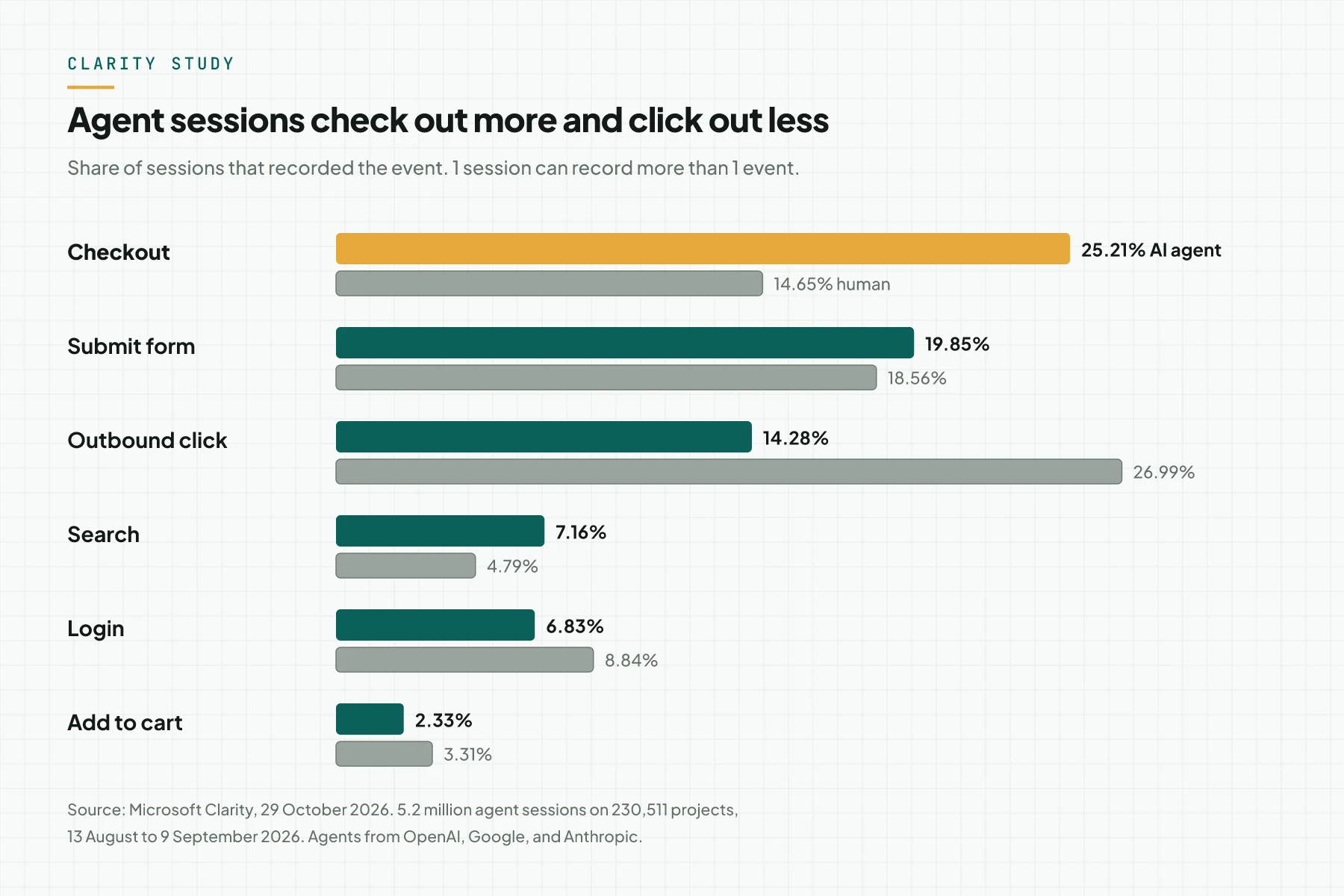
Clarity found that agent sessions record checkout, booking, and search more often, but record outbound clicks less often. The data comes from more than 5.2 million agent sessions on 230,511 Clarity projects, from 13 August to 9 September 2026 (UTC), according to the Microsoft Clarity blog post of 29 October 2026.
The comparison group is human sessions in the same period and on the same Clarity projects. Clarity measures the share of sessions that recorded each Smart Event. One session can record more than 1 event.
| Event | AI agent sessions | Human sessions |
|---|---|---|
| Checkout | 25.21% (306,621 sessions) | 14.65% |
| Submit form | 19.85% (241,391 sessions) | 18.56% |
| Outbound click | 14.28% (173,655 sessions) | 26.99% |
| Book appointment | 8.42% (102,401 sessions) | Not in the top 10 |
| Search | 7.16% (87,096 sessions) | 4.79% |
| Login | 6.83% (83,096 sessions) | 8.84% |
| Add to cart | 2.33% (28,289 sessions) | 3.31% |
The largest gaps are in checkout and outbound click. Checkout appears about 1.7 times more often in agent sessions, and outbound click appears almost 2 times more often in human sessions. Submit form is almost equal: 19.85% in agent sessions and 18.56% in human sessions.
Clarity also wrote that agent session volume increased by 88% in 3 weeks, based on its own data. The post does not give the comparison weeks or the starting volume.
Why does this checkout number not prove that agents buy?
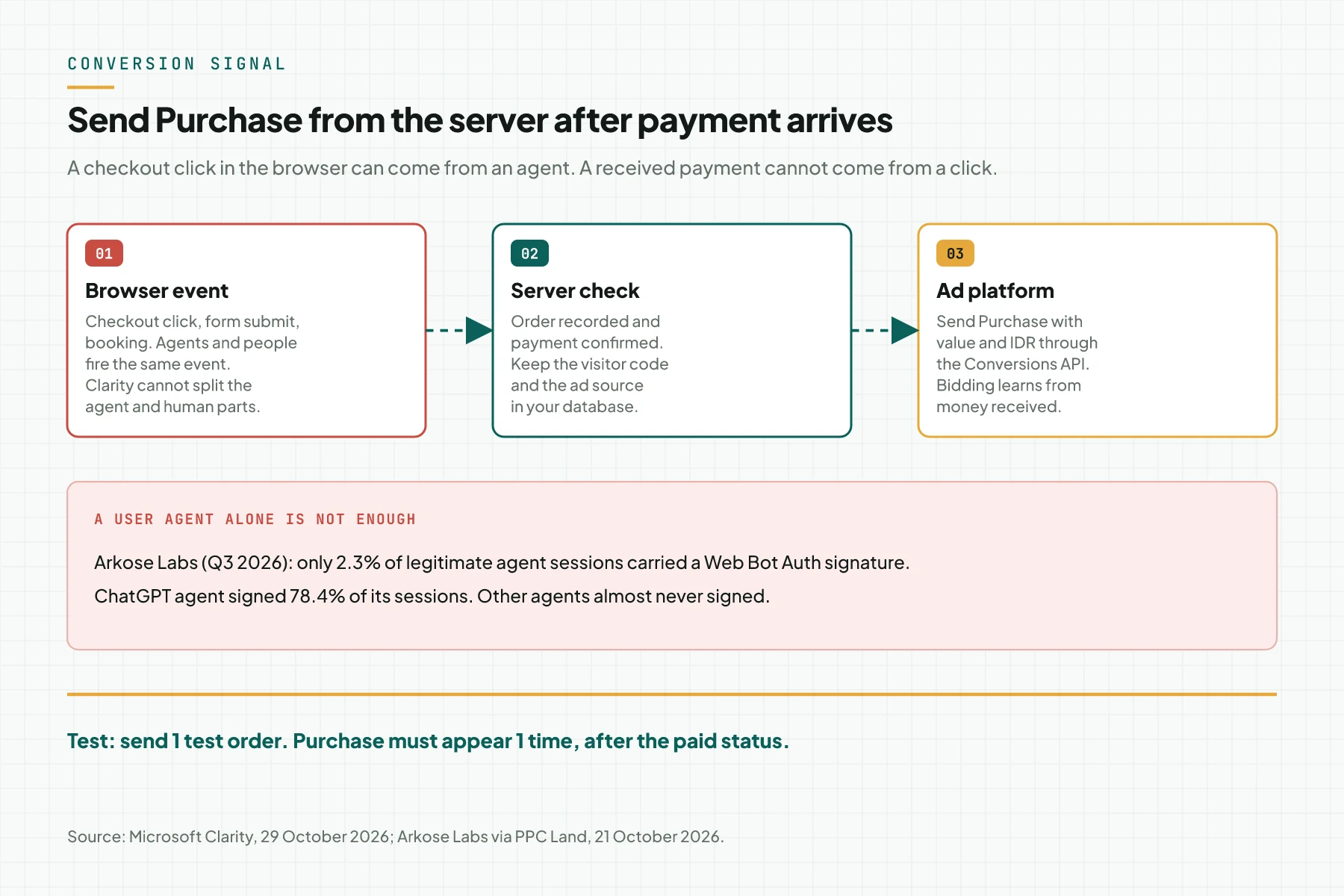
The checkout number shows recorded events, not paid orders. Clarity itself gives 2 important limits in the same post.
- Human handoff. An agent session can contain parts that a person completes. Clarity cannot split the agent part and the human part.
- Not a funnel. Clarity counts each event separately. It writes that these events are not steps in 1 funnelFunnelThe order of stages a buyer passes, from meeting you to paying you.Open the glossary and do not prove that an agent completed a task.
PPC Land found 1 calculation problem in its analysis of 1 November 2026. Each session count divided by its percentage gives a base of about 1.22 million sessions, not 5.2 million. With a base of 5.2 million, checkout appears in only about 5.9% of agent sessions.
In agent sessions, checkout appears more than 10 times as often as add to cart: 306,621 against 28,289 sessions. In human sessions, the ratio is about 4.4. Clarity does not explain this gap and does not define the Checkout event.
The study also gives no split by country, industry, device, or agent provider. So these numbers do not yet describe Indonesian sites. Check your own Clarity project before you make a decision.
How does this affect your ad conversion data?
Browser events that an agent triggers can enter Meta Ads or Google Ads as conversions, and bidding then learns from them. The risk is highest when a PixelPixelA piece of code on a web page that tells the ad platform somebody opened the page or took an action.What is the Meta Pixel? or tag sends Purchase on the checkout click, not when the payment arrives.
- Cost. Cost per conversion falls in the report, but no money arrives. Bidding then looks for more sessions like these.
- Measurement. Conversion rate rises without new orders. Submit form appears in 19.85% of agent sessions and 18.56% of human sessions, so frequency alone cannot separate them.
- Team workflow. Your team must match conversion events against paid orders every week. Without this step, the ad report and the cash report differ.
A user agent alone cannot filter agents. Arkose Labs found that only 2.3% of legitimate agent sessions carried a Web Bot Auth signature in Q3 2026, according to PPC Land, 21 October 2026. ChatGPT agent signed 78.4% of its sessions.
| Event sent from the browser | Risk | Replace with |
|---|---|---|
| Purchase on checkout click | An agent can trigger it without payment | Purchase from the server after the paid status |
| Lead on form submit | Agent and human rates are almost equal | Lead after contact data is validated |
| Schedule on booking | Book appointment appears in 8.42% of agent sessions | Schedule after the appointment is confirmed |
What should you check this week?
Start with these 5 steps. Each step uses tools that you already have.
- Open your Clarity project. Find the Agent Activity dashboard, which Clarity makes available for projects with agent traffic.
- List all conversion events that you send to Meta Ads and Google Ads. Mark the events that a browser click triggers.
- Move Purchase to a server event that fires after payment is confirmed. Send value and the IDR currency together. See a server path in the guide to ChatGPT Ads conversion tracking with the Conversions API.
- Compare checkout events with paid orders every week. Examine a gap that grows without new sales.
- Test your checkout flow with 1 agent. Record the step where the agent stops or asks for a person.
For a quick check, use the Tracking Health Check. For a full audit of your ad tracking, see Data Health Audit.
How does Rama Digital use this data?
We send Purchase to Meta only for money received, from the server, not from the page. Reading, click, and scroll events stay in our own database. With this rule, agent sessions do not change the bidding signal, even when an agent fills a form or opens a checkout.
We also give each visitor 1 code, and we connect that code to the order and the payment. So a paid order from an agent session still counts as a sale, with the correct ad source. Attribution Bridge installs this path for your business.
Other shopping agents are also moving. Meta released Muse in the United States on 8 September 2026, and the Clarity study does not include Muse. Read Muse, the AI agent from Meta for its effect on WhatsApp businesses.
Conclusion: change your conversion signal before agent traffic grows
Move the Purchase event from the browser click to the confirmed payment this week. Clarity recorded an 88% rise in agent session volume in 3 weeks, but it gives no numbers by country. Check your own Clarity project before you change your ad budget.
Questions and answers
Do AI agents really buy on my website?
Not always. Clarity writes that an agent session can contain a human handoff, and a checkout event does not prove a completed task. Check received payments, not checkout clicks.
Is the Agent Activity dashboard in Clarity a paid feature?
Clarity says its service is free. The post of 29 October 2026 says the Agent Activity dashboard is generally available for projects with agent traffic, and it gives no extra cost.
Does the 25.21% number apply to Indonesian websites?
Not necessarily. The Clarity study gives no split by country, industry, or device. Look at your own Clarity project for the numbers of your site.
Should I block AI agents?
This study gives no reason to block agents. An agent session can bring a buyer who gave the agent the task. Start with measurement: separate browser events from received payments.
Which event is safe for ad bidding?
Use a server event that fires after the paid status, with value and the IDR currency. For leads, send the event after contact data is validated, not when the form is sent.