Google released Gemini 4 Carbon on 10 November 2026 with 2 prices in 1 announcement. The first price lasts only 21 days.
Koray Kavukcuoglu, SVP of Google DeepMind and Chief AI Architect of Google, wrote the announcement on the official Google blog. Until 30 November 2026, Carbon costs US$2 per 1 million input tokens and US$10 per 1 million output tokens. After that introductory period, the price becomes US$4 and US$20.
The increase does not stop at Carbon. The Gemini API pricing page, which we read on 16 November 2026, shows the same schedule for Gemini 4 Argon. A team that measures AI agentAI agentAn AI program that performs work steps by itself, for example reading a message, drafting a reply, and recording the result.Open the glossary cost this month uses a price that disappears in 2 weeks.
The same work costs 2 times more from 1 December
From 1 December 2026, Carbon and Argon input and output prices double, while the Gemini 4 Hydrogen price stays the same.
| Model, Standard tier | Input to 30 Nov | Input from 1 Dec | Output to 30 Nov | Output from 1 Dec |
|---|---|---|---|---|
| Gemini 4 Carbon | US$2 | US$4 | US$10 | US$20 |
| Gemini 4 Argon | US$2 | US$4 | US$10 | US$20 |
| Gemini 4 Hydrogen | US$1.50 | US$1.50 | US$7.50 | US$7.50 |
All prices in the table are per 1 million tokens. The output price of all 3 models includes thinking tokens, which the model uses to reason before it answers. You do not read those tokens, but you pay for them at the output price.
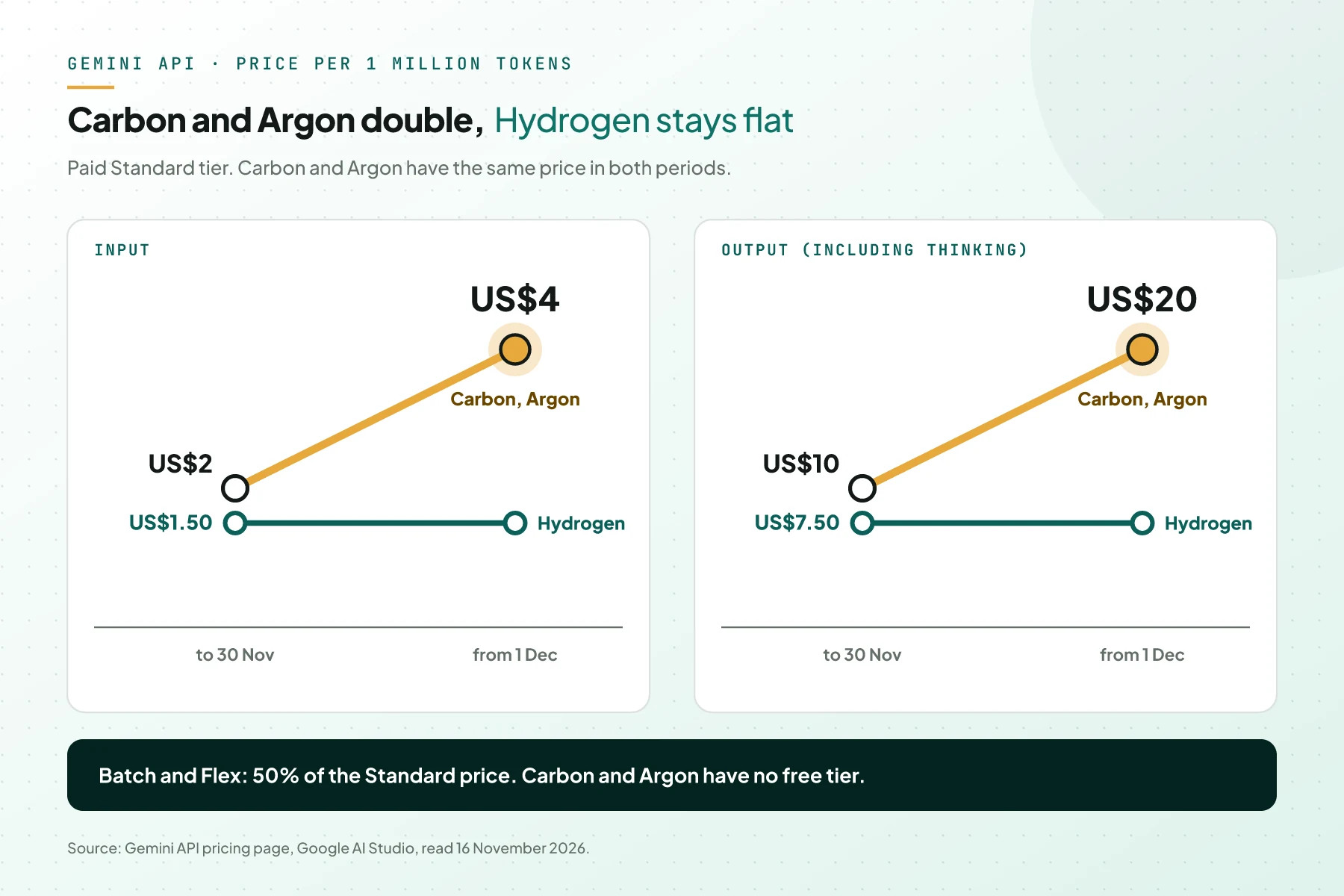
Batch and Flex modes cost 50% of Standard in both periods. The Carbon context caching price also increases, from US$0.10 to US$0.20 per 1 million tokens. Carbon and Argon have no free tier.
The "cheaper per task" claim depends on the number of tokens
Google says Carbon is more than 2 times cheaper per task, but the comparison is with the next best model from outside Google.
The claim uses 3 benchmarks: CursorBench 4.0, WANDR from Perplexity, and AutomationBench from Zapier. Cost per task equals the number of tokens multiplied by the price per token. A model that uses fewer tokens can cost less per task, even at the same price per token.
Here a voice weakens the claim, and that voice comes from Google itself. The same announcement says that Carbon uses more tokens to reason and to verify its work. Google also says that Argon stays the better choice for most software engineering and knowledge work.
So Carbon and Argon have the same price per token, but Carbon uses more tokens for the same task. Google does not say how many more. You can measure that number only from your own usage data.
The calculation for 1 agent that reads 50 documents a day
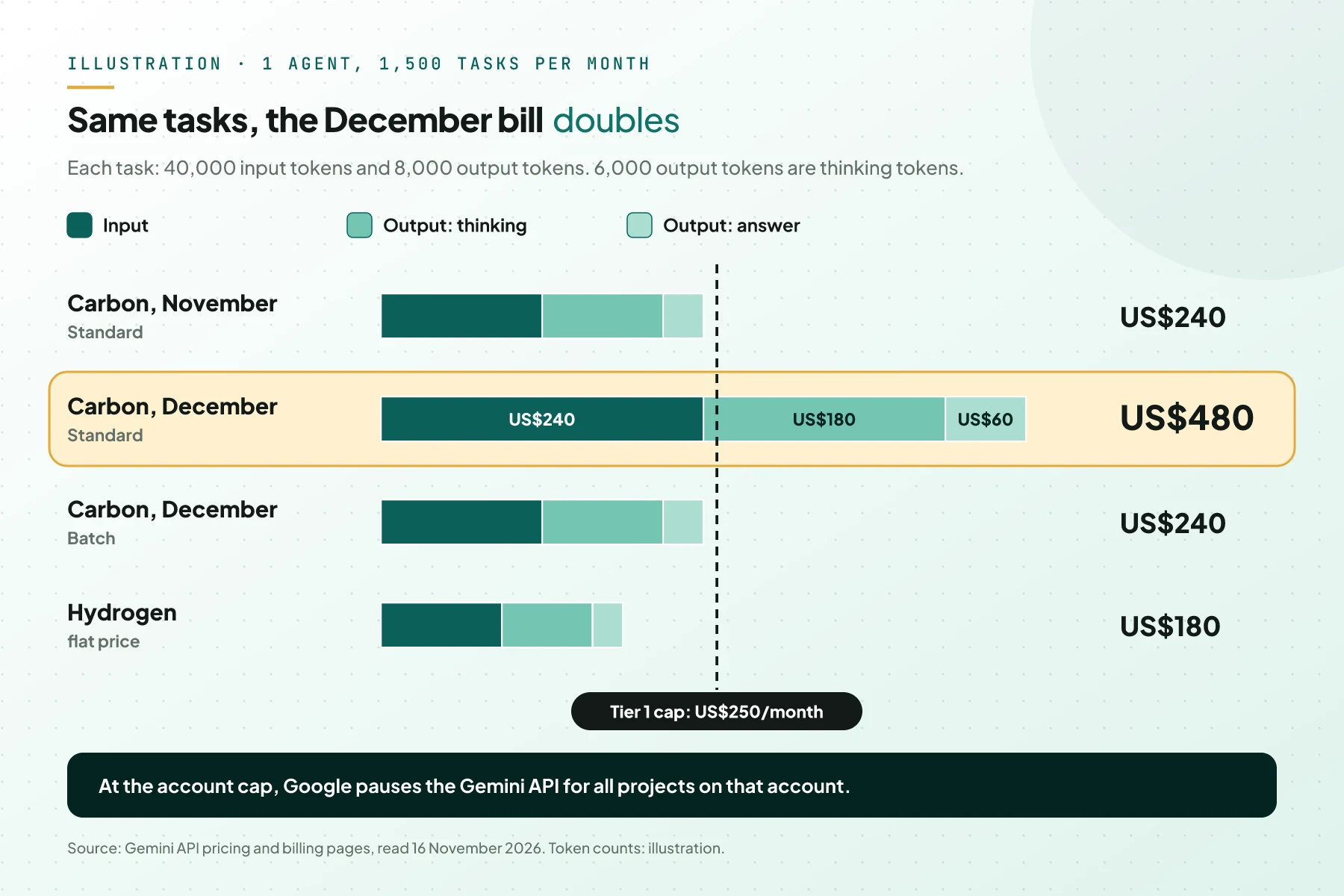
Our example agent costs US$240 in November and US$480 in December, for the same work.
This calculation is an illustration, not customer data. The agent reads 50 documents a day for 30 days, so it runs 1,500 times a month. Each run uses 40,000 input tokens and 8,000 output tokens, and 6,000 of the output tokens are thinking tokens.
| Carbon component, Standard tier | Tokens per month | November | December |
|---|---|---|---|
| Input | 60 million | US$120 | US$240 |
| Output: thinking tokens | 9 million | US$90 | US$180 |
| Output: answer | 3 million | US$30 | US$60 |
| Total | 72 million | US$240 | US$480 |
Thinking tokens carry US$180 of the US$240 December output cost. That is 3 of every 4 dollars of output cost, for text that you never read.
The US$480 itself is not the largest risk. The largest risk starts when the bill reaches the account cap.
A US$250 cap can stop all of your projects
A Tier 1 Gemini API billing account has a usage cap of US$250 a month, and our example agent goes past that cap in December.
The Gemini API billing page lists the monthly cap for each tier: Tier 1 US$250, Tier 2 US$2,000, and Tier 3 US$20,000 to US$100,000. The cap applies at the billing account level, for all projects that use the Gemini API. When an account reaches the cap, Google pauses the service for all projects on that billing account.
In November, the example agent costs US$240 and stays below the cap. In December, it costs US$16 a day, so the bill goes past US$250 on day 16. After that, chatbots and other scripts on the same billing account also stop.
The same page has a form to request a higher cap. Send that request before 1 December, not after the service stops.
Three ways to control the December bill
You can control the bill with a spend cap for each project, Batch or Flex mode, and a less expensive model for routine tasks.
A spend cap for each project. Google added this feature to AI Studio on 16 March 2026. Open the Spend page, then select Monthly spend cap. A project editor, owner, or admin can change it.
The billing page calls the feature experimental. Billing data can be late by up to about 10 minutes. Long agent sessions and Batch jobs can go past the cap, so set the cap below the account tier cap.
Batch or Flex. In December, the example agent costs US$240 in Batch mode. That is the same as the November Standard bill. This mode suits work that does not need an immediate answer, for example document summaries at night.
Hydrogen for routine tasks. With the same number of tokens, the example agent costs US$180 a month on Hydrogen. Hydrogen can use a different number of tokens, so test its answer quality on 1 task first. We described the role of Hydrogen in Google Search in the article Gemini 4 Hydrogen in Google Search.
In Indonesia, the rupiah exchange rate also enters the bill
The Gemini API is available in Indonesia, but its prices are in US dollars, so the rupiah exchange rate also sets your December bill.
Indonesia is on the list of Gemini API regions. In the Gemini app and AI Mode, Carbon is available only to Google AI Ultra subscribers. We found no public data on Carbon use by businesses in Indonesia.
The calculation above is for 1 agent. If your team gives each staff member 1 agent, as in the article each staff member has an AI agent, multiply the calculation by the number of agents. The tier cap applies to the total.
Five things to check before 1 December
Check these 5 things this week, while the introductory price still applies.
- Open the Spend page in AI Studio. Record the Carbon and Argon cost for this month.
- Multiply the cost of the 2 models by 2 for the December projection.
- Compare that projection with the tier cap of your billing account.
- If the projection goes past the cap, request a higher tier or move work before 1 December.
- Set a spend cap for each project below the account tier cap.
If thinking tokens take more than half of the output of a task, test that task on Argon or Hydrogen first. If a task can wait, move it to Batch.
Limits of this calculation
The calculation in this article uses 1 example agent, and the number of tokens per task in your system can differ by a large amount.
- All benchmark numbers come from the Google announcement, with benchmarks owned by Google partners.
- Google can change the pricing page at any time. We read it on 16 November 2026.
- This calculation does not include Grounding with Google Search cost, tax, or exchange rate changes.
The 10 November announcement has 2 prices. Your December budget must use the second price.
Questions and answers
When does the Gemini 4 Carbon price increase?
From 1 December 2026, Carbon costs US$4 per 1 million input tokens and US$20 per 1 million output tokens. The US$2 and US$10 prices apply until 30 November 2026.
Does the Gemini 4 Hydrogen price also increase?
No, according to the Gemini API pricing page on 16 November 2026. Hydrogen stays at US$1.50 for input and US$7.50 for output per 1 million tokens.
Do thinking tokens appear on the bill?
Yes. The Gemini API pricing page says that the output price of Carbon, Argon, and Hydrogen includes thinking tokens.
What occurs when a billing account reaches its tier cap?
Google pauses the Gemini API service for all projects on that billing account. You can request a higher cap through the form on the Gemini API billing page.
If you want us to calculate your AI agent cost and set its limits in your work process, open the Rama Digital AI business process automation service.