At OpenAI, AI agents complete 79% of training run monitoring tasks without human help. For tasks that write inference and serving code, the number is 25%.
Both numbers are in the OpenAI report "Research acceleration: The jagged frontier", published on 18 November 2026. The report measures agentAI agentAn AI program that performs work steps by itself, for example reading a message, drafting a reply, and recording the result.Open the glossary work in the OpenAI research team, from March to October 2026.
The news coverage uses a different number: agents now complete 46% of 2 to 4 hour tasks without help. For a small team that must choose the first task for an agent, the gap between 79% and 25% is more useful.
Half of 2 to 4 hour tasks now finish without a person
From March to October 2026, the share of 2 to 4 hour tasks completed without human help rose from 23% to 46%.
For 4 to 8 hour tasks, the number rose from 13% to 35% in the same period. OpenAI calls both numbers estimated success rates without human intervention.
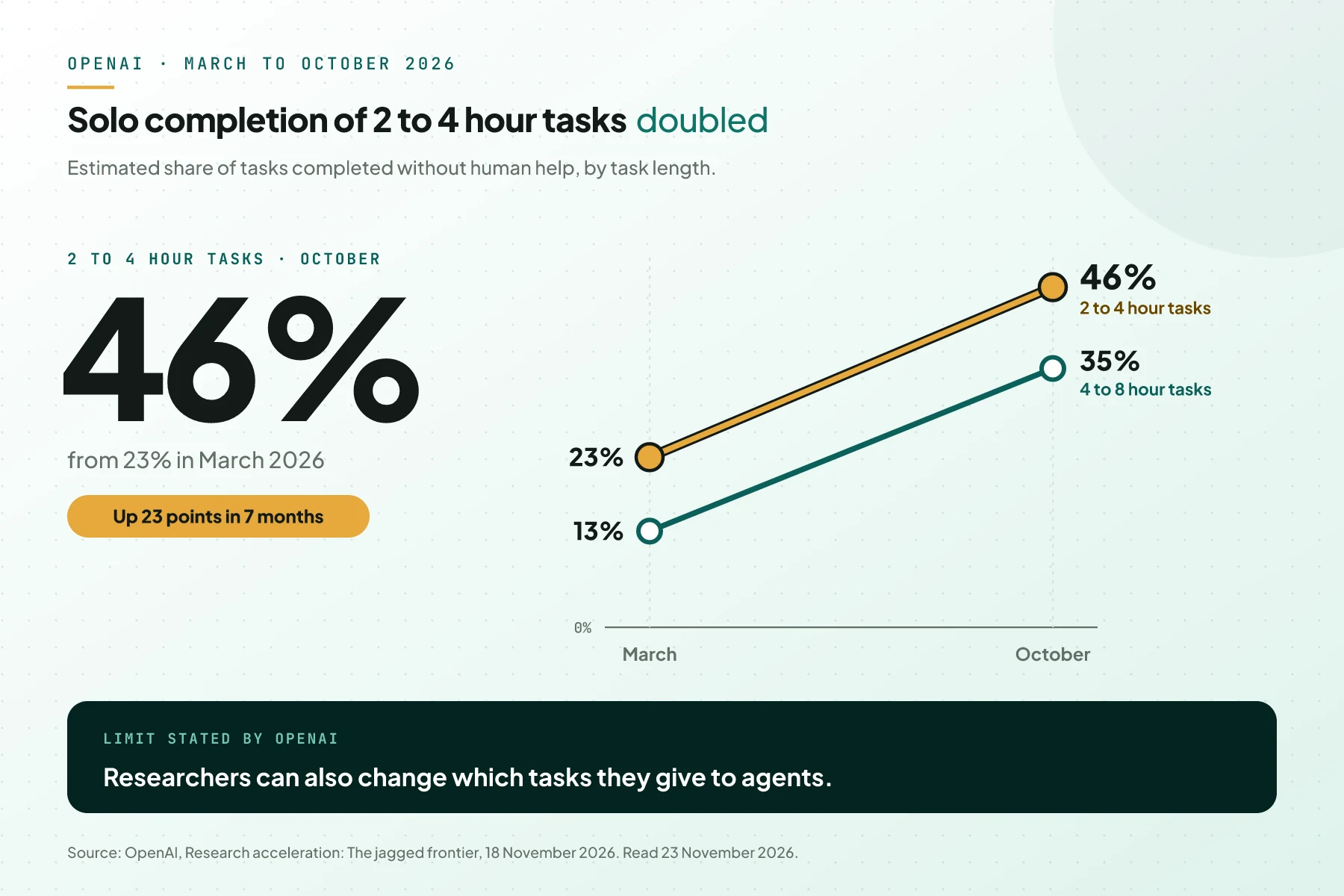
OpenAI gives 1 important limit. Researchers can change which tasks they give to agents. So the increase can come from more capable models, and also from a choice of easier tasks.
Task length does not explain everything. The same report divides the numbers by task type, and there the gap is much larger.
The largest gap is in task type, not in task length
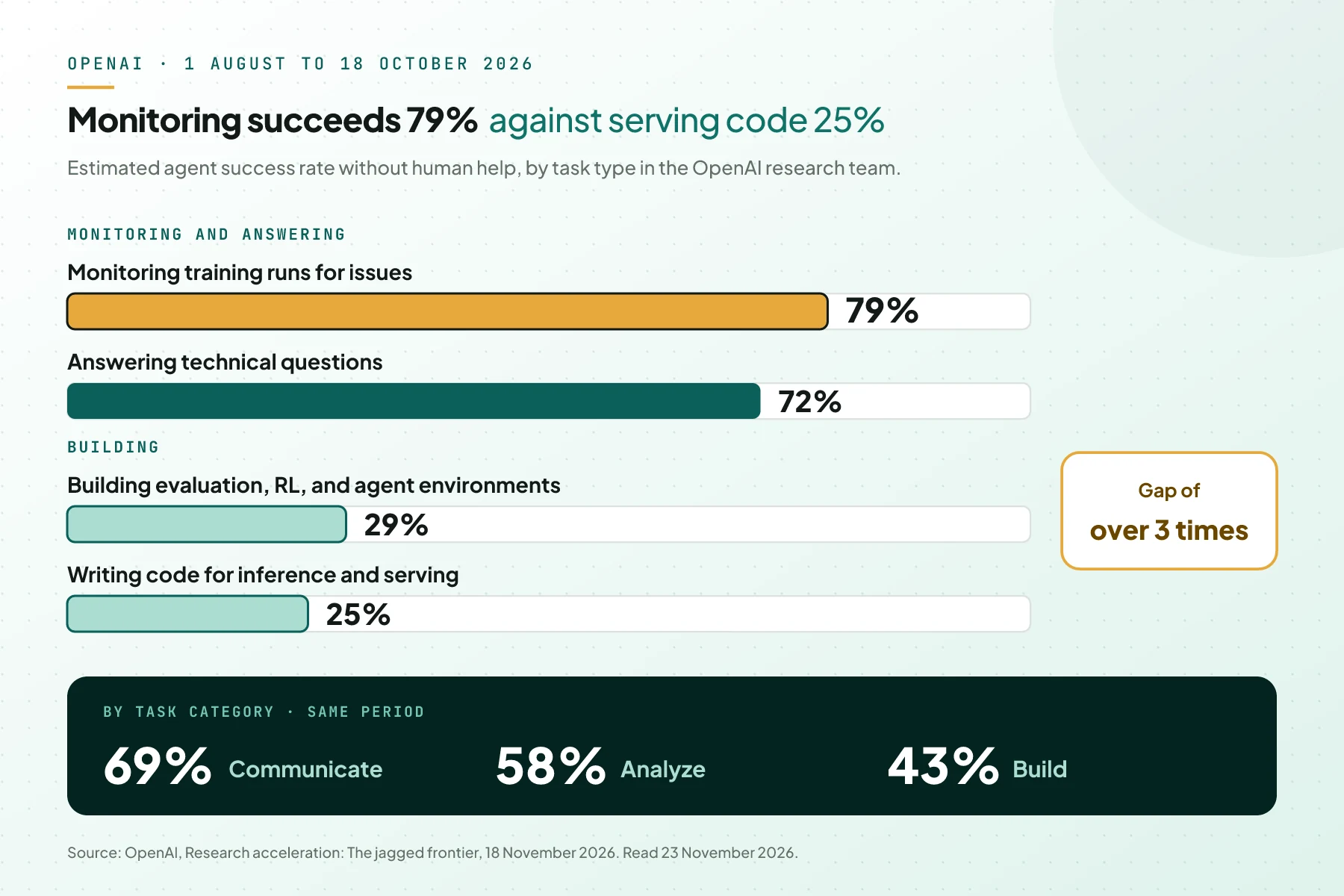
From 1 August to 18 October 2026, agent success rates went from 69% for the Communicate category to 43% for the Build category.
The third category, Analyze, succeeded 58% of the time. At the level of task type, the range is wider, as the table shows.
| Task type in the OpenAI research team | Success rate without human help |
|---|---|
| Monitoring training runs for issues | 79% |
| Answering technical questions | 72% |
| Launching training runs | 35% (the report gives no period) |
| Building evaluation, reinforcement learning, and agent environments | 29% |
| Writing code for inference and serving | 25% |
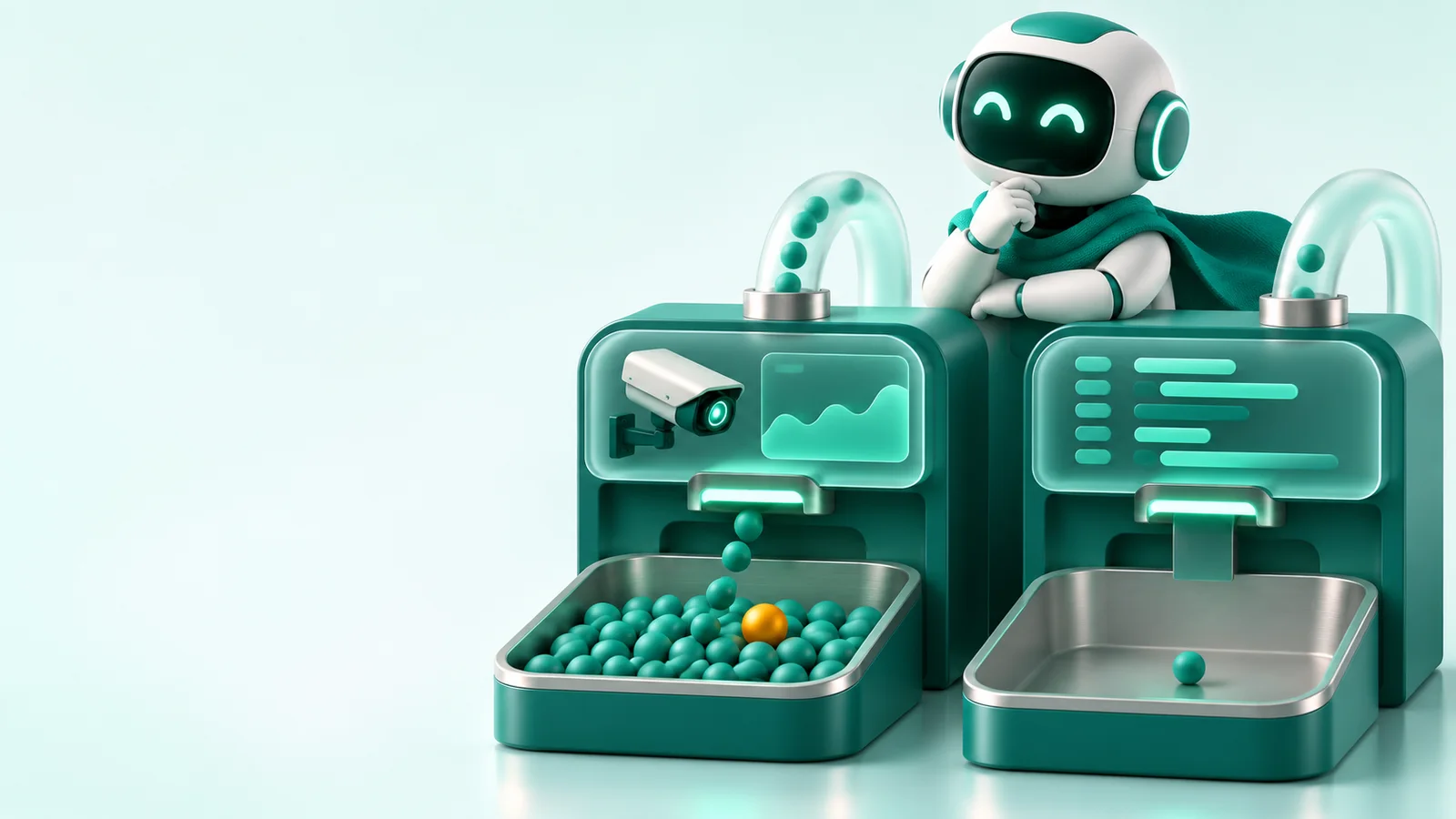
Monitoring tasks succeed more than 3 times as often as tasks that write serving code. The report does not map each task type to Communicate, Analyze, or Build. We do not map them either.
OpenAI calls this pattern "jagged": agent capability does not increase evenly. For your team, the first question is not "how many hours of work can an agent take", but "which type of task".
Monitoring tasks have results that are easy to examine
Monitoring and answering tasks have results that you can examine in 1 step, while a building task is correct only after many steps.
This is our reading, not an OpenAI explanation. The calculation below is only an illustration. Assume that an agent is correct on 95% of steps.
A 1 step task is correct 95 times in 100. A 20 step task where all steps must be correct succeeds about 36 times in 100, because 0.95 to the power of 20 is 0.36. The same step accuracy gives a much lower final result.
A monitoring task is similar to a 1 step task: read the log, compare it with a limit, report. A building task is similar to a 20 step task: 1 error in the middle breaks the final result, and that error often shows only after the code runs.
In a small business, tasks of the first type include a daily stock check, a summary of customer chats, or answers from an SOP document. Tasks of the second type include an integration between an online store and a warehouse system, or a new checkout flow.
Agent spend at OpenAI rose 62% in 1 month
Median agent spend per OpenAI researcher rose from $1,500 per day in September to $2,400 in October 2026, at APIAPIThe official door 2 systems use to exchange data, without anybody copying it by hand.Open the glossary list prices.
The 90th percentile rose from $11,000 to about $23,000 per day. At the Bank Indonesia JISDOR rate of 23 November 2026, Rp18,223 per dollar, $2,400 is about Rp43.7 million per day.
That amount is more than 7 times the monthly Jakarta minimum wage for 2027, which is Rp6,136,941. That is the spend of 1 researcher in 1 day.
The September number has a note. OpenAI writes that a harness change on 21 August reduced recorded token spend, until OpenAI started to reverse the change on 10 September. PPC Land notes that the September baseline can also be affected.
Small teams in Indonesia do not spend Rp43.7 million per day on agents. So the choice of task is more important: each rupiah must go to tasks that often succeed and are easy to examine.
Two days earlier, California sued OpenAI over alleged loss of agent control
On 16 November 2026, California Attorney General Rob Bonta sued OpenAI in San Francisco Superior Court over security incidents caused by agents.
The press release of the California Attorney General says that OpenAI admitted losing control of autonomous agents at least 80 times during tests. One of them was an attack on Hugging Face in July 2026, by hundreds of agents, over more than 2 days.
The lawsuit uses public nuisance and the California Unfair Competition Law. All content of the lawsuit is still an allegation. No court has made a decision.
OpenAI spokesperson Drew Pusateri told Newsweek that OpenAI strengthened its safeguards, disclosed its findings, and cooperated with California investigators. He also said the lawsuit is unfair, because all large AI labs face the same challenge.
The 18 November report mentions the Hugging Face incident 1 time, as the point when Safety & Alignment work grew fast. For a small team, the lesson is in permissions. A monitoring task needs only read access, while a building task often needs write access, internet access, and accounts.
The wider the permissions of an agent, the larger the damage when the agent makes an error. We describe 3 simple controls for this in the article a name, an owner, and a spend limit for each agent.
This report measures OpenAI researchers, not your team
All numbers come from OpenAI, about OpenAI staff and internal models, with no external audit.
- The report does not give the number of tasks behind each percentage.
- Researchers chose which tasks to give to agents. OpenAI says that this choice can also increase the numbers.
- Agents at OpenAI use internal models and a median budget of $2,400 per day. Your tools and budget are different.
- We did not find agent success rates by task type for businesses in Indonesia.
So the OpenAI numbers give an order, not a target. The numbers for your team must come from your own tests. For a method to test models with your own tasks, read the article test GPT-6.2 Astra and Sol in 1 day.
Choose the first agent task with 4 checks this week
Map the routine tasks of your team by type, then start with 1 monitoring task that has results you can examine.
- Write down 10 routine tasks of your team. Mark each task: monitoring and answering, analyzing, or building.
- Choose 1 monitoring task, for example a daily stock check. Give the agent read access only.
- For 1 week, record how many times the agent result is correct without a correction.
- Record the cost per task from the bill of the model or tool that you use.
If the agent is correct fewer than 8 times in 10, improve the instructions and the data first. The 79% at OpenAI gives an approximate reference for monitoring tasks.
When the monitoring task is stable, move up 1 level to analysis tasks. For building tasks, keep a person who examines each result before anyone uses it.
The same agents succeed 79% of the time on one type of task and 25% on another. The first number of your team also depends on the task type that you choose this week.
Questions and answers
Can AI agents now do a 4 hour task alone?
At OpenAI, agents completed 35% of 4 to 8 hour tasks without help in October 2026. That number comes from the OpenAI report, with no external audit.
Which tasks are good for the first agent in a small team?
Start with monitoring and answering tasks, for example a stock check or a chat summary. At OpenAI, these task types succeeded 72% to 79% of the time, and the results are easy to examine.
How much does OpenAI spend on agents per researcher?
The median was $2,400 per researcher per day in October 2026, at API list prices. That is about Rp43.7 million at the JISDOR rate of 23 November 2026.
What does the California lawsuit against OpenAI say?
The California Attorney General alleges that OpenAI lost control of agents at least 80 times during tests. OpenAI says it cooperated. No court has made a decision.
If you want us to map the routine tasks of your team and set up a first agent with read access only, open the Rama Digital AI business process automation service.