On 4 June 2026, a developer with the account che.kulhan wrote on the OpenAI developer forum. They used AgentAI agentAn AI program that performs work steps by itself, for example reading a message, drafting a reply, and recording the result.Open the glossary Builder and ChatKit for the chatbots of several clients. One day before, OpenAI announced that Agent Builder will shut down.
They asked OpenAI to review the decision. In their words, managing their own backend "makes the use of this tool economically unviable". OpenAI did not change the schedule: the OpenAI Deprecations page still shows 30 November 2026, 11 days from today.
For the clients of such a chatbot, only the chat window on the site is visible. The logic that answers customers runs in Agent Builder. If your vendor built your chatbot the same way, you have 11 days to make sure that logic has moved.
OpenAI announced the shutdown 240 days after launch
OpenAI launched Agent Builder on 6 October 2025, then announced its shutdown on 3 June 2026, 240 days later.
Agent Builder is a visual canvas that builds agents from nodes, with little code. OpenAI introduced it at DevDay 2025 together with ChatKit, according to the InfoQ report of 10 October 2025. ChatKit puts a chat window on a website.
The notice of 3 June gave a transition window of 180 days. If Agent Builder shuts down on schedule, its life is 420 days, less than 14 months.
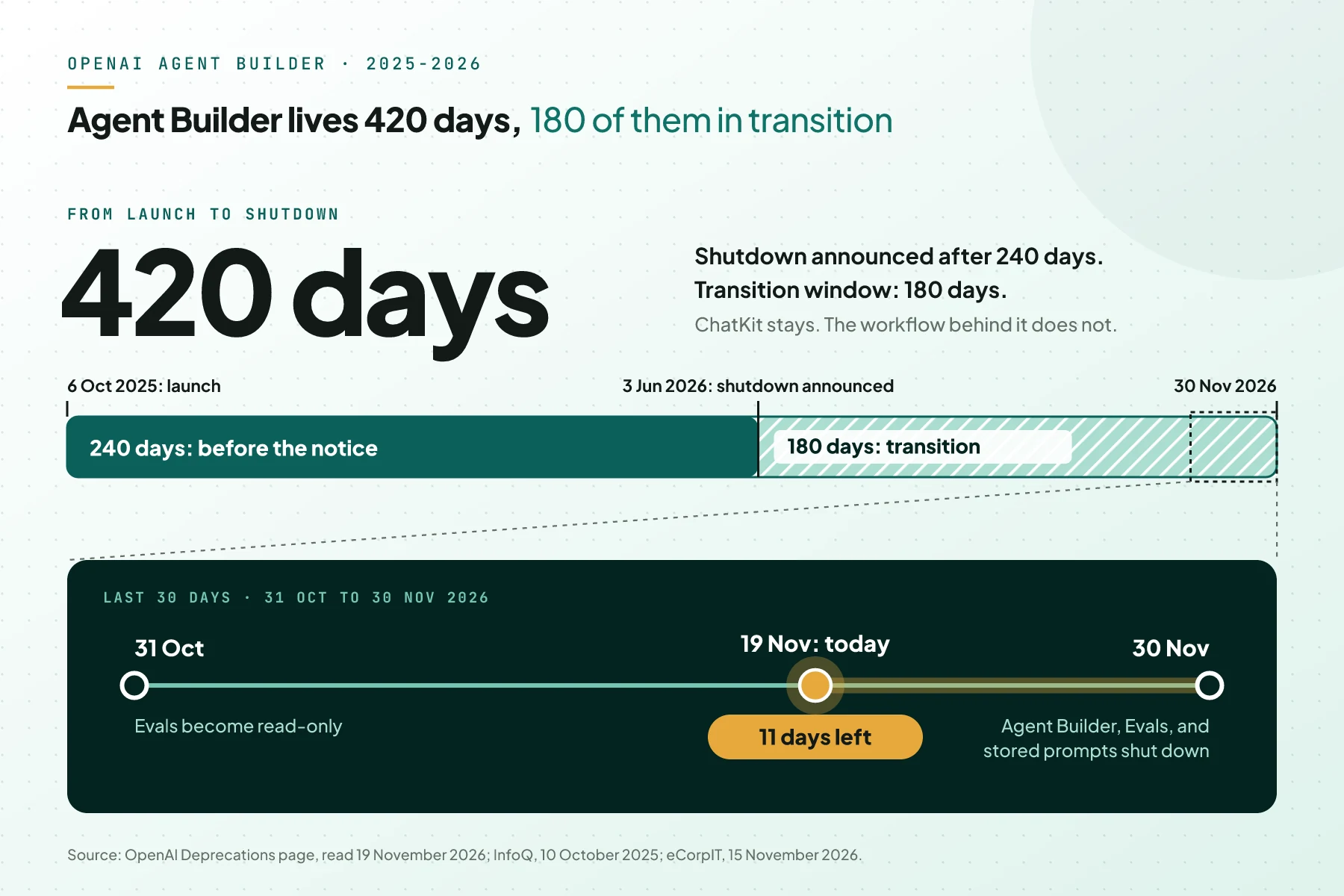
The same date also shuts down 2 other services. The /v1/prompts endpoint for stored prompts stops on 30 November 2026. Evals has been read-only since 31 October 2026, according to the eCorpIT summary updated on 15 November 2026.
By the rules of OpenAI, 180 days is not a short notice. The Deprecations page promises at least 6 months of notice before OpenAI retires a generally available model. Agent Builder got almost the same period.
The chat window stays, the workflow behind it does not
ChatKit does not shut down, but ChatKit that uses an Agent Builder workflow has support only during the transition window.
The ChatKit guide gives 2 ways to use ChatKit. The first way uses a workflow that OpenAI runs in Agent Builder. The second way uses an agent on your own server.
For the first way, OpenAI writes that existing users can continue to use it during the transition window. For new work and migration plans, OpenAI sends users to the second way.
We read the Deprecations page, the Agent Builder guide, the ChatKit guide, and the migration guide on 19 November 2026. None of them states that a published workflow continues to answer after 30 November.
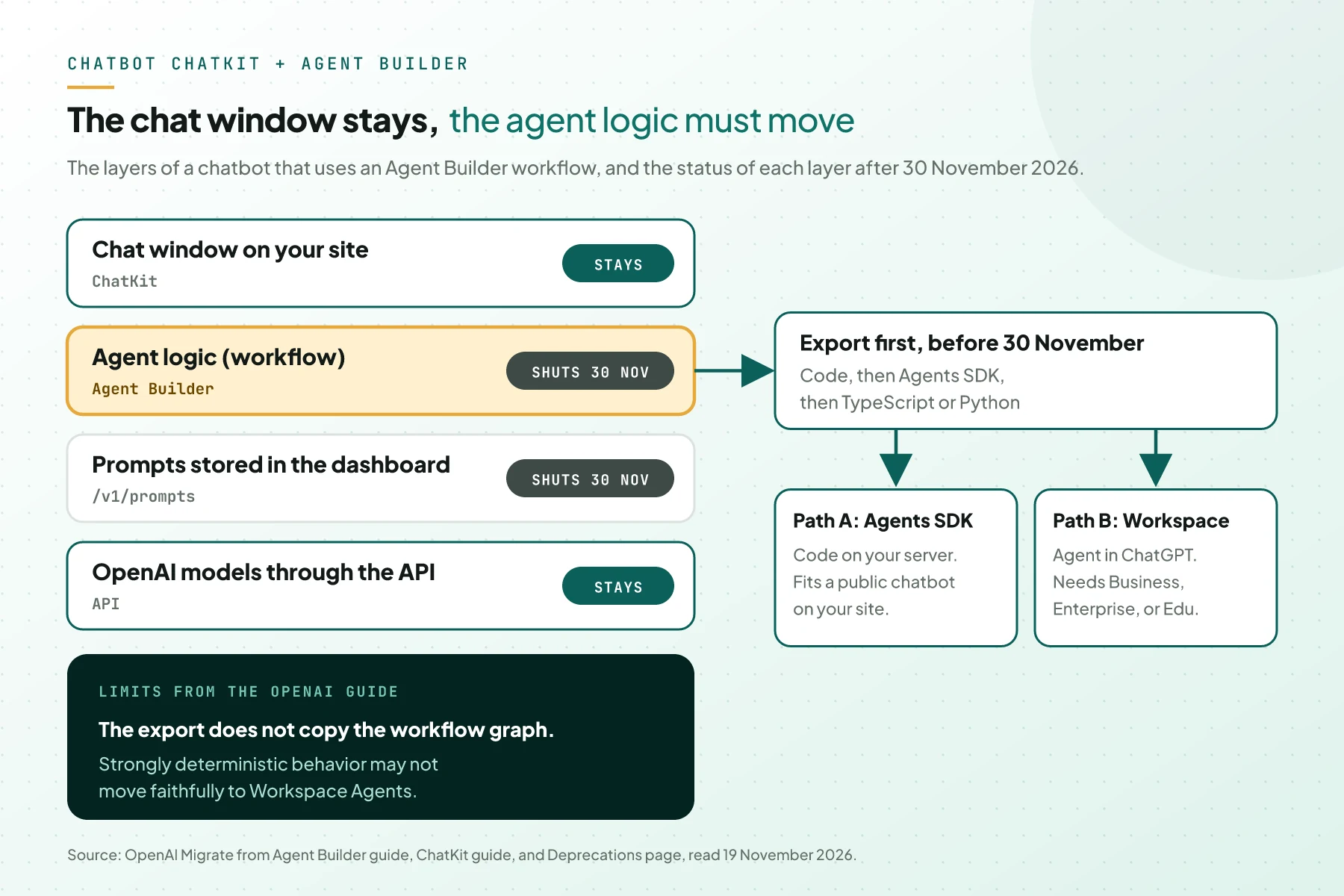
So the risk is not the chat window. The risk is the part that reads the question, calls the tools, and writes the answer.
Both migration paths start from 1 code export
OpenAI gives 2 replacement paths: Agents SDK for agents in code, and Workspace Agents for agents that you build with plain language in ChatGPT.
The first step is the same for both paths, according to the OpenAI migration guide. The workflow owner opens the workflow in Agent Builder, selects Code, then selects Agents SDK. The result is TypeScript or Python code.
The guide lists access to the workflow in Agent Builder as a condition for the export, so the export must be done before 30 November. The same guide states that this process does not convert the workflow graph. It also does not guarantee that all behavior moves without change.
| Item | Agents SDK | Workspace Agents |
|---|---|---|
| How you build | TypeScript or Python code | Plain language in ChatGPT |
| Where the agent runs | Your server or application | A ChatGPT workspace |
| Requirement | Your team does the server, deployment, and tests | A ChatGPT Business, Enterprise, or Edu plan, with permission to create agents |
| Fits | A public chatbot on your site through ChatKit | An internal agent that your team shares |
| Limit from OpenAI | You validate the runtime, tools, authentication, permissions, and deployment | A strongly deterministic workflow may not move faithfully |
For a chatbot on your site, Workspace Agents cannot replace the old workflow, because that agent runs inside ChatGPT. Your customers do not sign in to the ChatGPT workspace of your company. A public chatbot needs Agents SDK on your own server, with ChatKit connected to that server.
Your own server brings costs that OpenAI carried before
The developer on the forum moved the client chatbots in 18 days, but they had to find a low-cost server and solve new problems.
On 8 June 2026, che.kulhan reported that their ChatKit backend had moved to their own FastAPI server. On 22 June, they wrote that the server runs on IBM, the lowest-cost provider they found. They still had to solve cold starts, the delay when a server starts from an idle state.
Another forum user, Analystfirst, gave a lighter calculation on 13 June. In their view, a backend for many clients can use 1 shared code base. The differences between clients stay as data: instructions, tools, and knowledge.
They also gave 1 warning. Do not keep workflow prompts as stored prompts in the OpenAI dashboard, because that feature shuts down on the same date. If you do, you migrate 2 times.
In Indonesia, nobody has counted the affected agents
We found no data on the number of Indonesian businesses that use Agent Builder, so only your vendor can tell you your position.
OpenAI does not publish Agent Builder user numbers by country. The sources that we read also give no global number.
In its overview, the Deprecations page states that affected customers always get an email. That email goes to the owner of the OpenAI account. If your vendor built the agent with their own account, the email goes to the vendor, not to you.
The same pattern occurs with decisions of other vendors. Gemini 4 Carbon and Argon prices double from 1 December 2026, as we wrote in our article on the Gemini 4 price increase. In 2 weeks, 2 vendor decisions changed the life or the cost of business agents.
4 questions for your agent vendor before 30 November
Send these 4 questions to your vendor this week, and ask for written answers.
- Does our agent use Agent Builder, or ChatKit with a workflow ID from Agent Builder?
- Is the workflow already exported to Agents SDK, and where is that code kept?
- Are any instructions of our agent stored as prompts in the OpenAI dashboard?
- Who pays for the new server, and when do you test the replacement agent with real customer questions?
If the answer to question 1 is no, record the tool that the vendor uses, because that tool also has a life span. If the answer is yes and question 2 is not done, the export is the first task for the vendor before 30 November.
Also ask for a copy of the agent instructions and knowledge documents in files that you keep. That copy is your starting point if you change vendor or platform.
The developer with the account che.kulhan made that choice in June. They chose their own server and accepted the new costs. Your vendor has 11 days to make the same choice, if they have not yet.
If you want us to check an agent that already runs and write its migration plan, see the Rama Digital AI business process automation service.
Questions and answers
Does a chatbot that uses ChatKit stop on 30 November 2026?
ChatKit stays available. But ChatKit that uses an Agent Builder workflow has support only during the transition window. Move the workflow to your own server with Agents SDK before that date.
How do I export a workflow from Agent Builder?
Open the workflow in Agent Builder, select Code, then select Agents SDK. Select TypeScript or Python, then copy the full export. This export does not copy the workflow graph.
Can Workspace Agents replace a chatbot on my site?
Not directly. Workspace Agents run inside ChatGPT and need a Business, Enterprise, or Edu plan. A public chatbot on your site needs an agent on your own server.
What else shuts down with Agent Builder?
Evals and the /v1/prompts endpoint for stored prompts shut down on 30 November 2026. Evals has been read-only since 31 October 2026. ChatKit does not shut down.