
Direct answer: The Meta Ads algorithm selects an ad in 3 stages: retrieval, ranking, and then the auction. Meta Ads Andromeda is the retrieval engine. On 28 October 2026, Meta published a new generation of Andromeda. This version gives a score to every eligible ad, at over 1 billion ads per second on 1 GPU server. Meta calls this 100 times the 2024 version. You do not need to change a setting, because the change applies automatically.
Main condition: Andromeda works on ad delivery for Facebook and Instagram. The advice in this article applies when your account records conversionConversionThe action you count as a result, for example a paid order, a sign-up, or a chat that becomes a qualified buyer.Open the glossary events and has budget for more than 1 creative concept. Limit: Meta claims a 2.4% increase in conversions on Facebook since 2025. The claim has no baseline, no test design, and no Instagram figure. Do not use the number as a result promise for your account.
We read the Engineering at Meta post of 28 October 2026, the Andromeda post of 2 December 2024, the Meta help page about ad auctions, and the Meta help page about performance per asset on 4 November 2026. We also read the PPC Land analysis of 28 October 2026, Social Media Today of 27 October 2026, and Marketing Brew on 28 September 2026. Andromeda has no setting, so we cannot test it directly. The numbers in the simulation section are dummy data, not client data.
What is the Meta Ads algorithm?
The Meta Ads algorithm is a chain of models that selects 1 ad for 1 chance to show an ad, in 3 stages in sequence. Each time a person opens Facebook or Instagram, the 3 stages run in milliseconds.
- Retrieval. The system filters the pool of eligible ads into a shortlist. the Andromeda post of 2 December 2024 gives the first scale: tens of millions of candidates become a few thousand candidates per request.
- Ranking. A heavier model gives a detailed value to each ad on the shortlist. Meta uses a central ranking model named GEM. the Meta GEM post gives the details.
- Auction. According to the Meta help page about ad auctions, the winner is the ad with the highest total value. Total value combines the bid, the estimated action rate, and ad quality.
This sequence has a practical result. An ad that fails retrieval never enters ranking or the auction. A high bid does not help an ad that is not on the shortlist. The general explanation of each stage is on the page about how an ad algorithm works from retrieval to auction.
What is Meta Ads Andromeda?
Meta Ads Andromeda is the Meta machine learning system for personalized ads retrieval, the first stage of the Meta ads recommendation pipeline. Meta uses this definition in the Meta post of 28 October 2026.
Meta first described Andromeda on 2 December 2024, as the engine behind Advantage+ automation. The 2024 version ran on the NVIDIA Grace Hopper Superchip and the Meta MTIA accelerator. Meta reported a 6% recall gain and an 8% ad quality gain on selected segments. Model capacity grew 10,000 times.
Meta rebuilt Andromeda because of the number of ads. According to the 2026 post, generative AI creative tools helped advertisers make hundreds of millions of new ads. The candidate pool became much larger. the PPC Land analysis of 28 October 2026 quotes the Meta investor report: almost 10 million advertisers used Meta generative AI creative tools in the third quarter of 2026.
What changed in the 2026 generation of Andromeda?
Andromeda 2026 gives a score to every eligible ad with a model close to ranking-stage quality, inside the same latency budget. There are 4 main changes.
Every eligible ad gets a score
The production pipeline processes over 1 billion ads per second on 1 GPU server. Meta calls this 100 times the 2024 system, which evaluated tens of millions of ads per second per GPU card. the PPC Land analysis of 28 October 2026 notes one weakness: the units differ, per card against per server.
A mixture-of-experts model reads people and ads
Meta replaced 1 user tower with a set of specialized user towers, named experts. These experts read 4 types of signal: sequences of ad engagement, user cohort representations, semantic features from an LLM, and engagement across Meta apps.
The ad side reads the ad content together with the context at the moment of serving. A gating layer then routes each candidate to the most relevant experts. Meta states that this model needs about 300 times fewer inference FLOPs than the 2024 model.
Targeting runs as index matching on the GPU
Meta calls index matching the step that enforces advertiser targeting rules. This step checks targeting logic across tens of feature categories. The index updates all day as ads are created, changed, or expire.
Before, index matching ran on CPU servers that were separate from the GPU. Now index matching, scoring, and top candidate selection run on the same GPU. Network traffic fell by about 100 times. Meta states that the meaning of targeting rules stays complete. the PPC Land analysis of 28 October 2026 notes that Meta published no test for that claim.
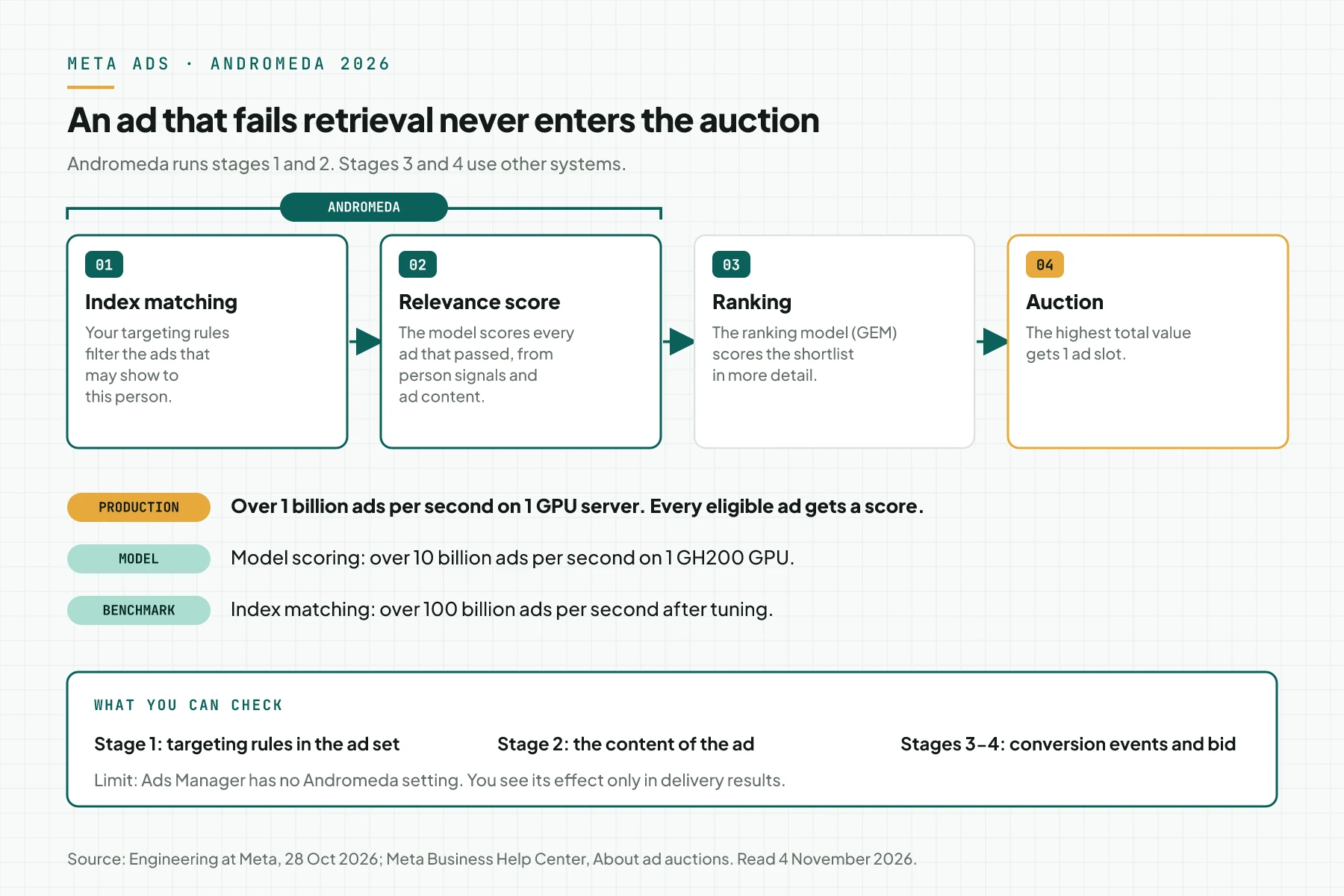
The diagram above shows where Andromeda sits. Andromeda runs stages 1 and 2. For an advertiser, targeting controls stage 1, and the content of the ad controls stage 2.
Meta and NVIDIA tested the hardware limits
Since early 2026, Meta and NVIDIA have tuned each component. The gating kernel became 5.3 times faster, from 2.4 billion to over 10 billion ads per second. Index matching reached over 100 billion ads per second. These are benchmark numbers, not all in production yet.
Andromeda 2024 and 2026 in one table
This table uses numbers from the 2 Engineering at Meta posts. All numbers are Meta claims. No outside party audited them.
| Attribute | Andromeda 2024 | Andromeda 2026 |
|---|---|---|
| Post date | 2 December 2024 | 28 October 2026 |
| Candidate selection | Tens of millions of candidates become a few thousand per request | Every eligible ad gets a score, then the top candidates pass |
| Speed | Tens of millions of ads per second per GPU card | Over 1 billion ads per second per GPU server |
| Model | Deep neural network for GPU, capacity up 10,000 times | Mixture-of-experts, about 300 times fewer inference FLOPs |
| Impact claim | Recall up 6%, ad quality up 8% on selected segments | Facebook conversions up 2.4% since 2025 |
| Hardware | NVIDIA Grace Hopper and MTIA | NVIDIA GH200, further tests on Grace Blackwell |
How to read the 2.4% conversion claim
The 2.4% claim is a Meta number without a baseline, a test design, or an Instagram figure, so use it as a direction, not a promise. The Meta post gives this claim 1 sentence.
- The period "since 2025" has no end date.
- Meta does not state which Andromeda version gave the increase.
- On 21 October 2026, Meta gave investors a different number: Facebook conversions rose 1.4% in the third quarter because of Andromeda. Meta does not explain how 1.4% relates to 2.4%.
- The metric changed. The 2024 post used ad quality. The 2026 post uses conversions. Meta publishes no definition of either.
Meta also states that the new system lowers Meta costs, because each GPU evaluates more ads. The Meta server cost is not your ad price. According to the PPC Land analysis of 28 October 2026, the average price per ad on Meta rose 14% worldwide in the third quarter of 2026, while impressionsImpressionThe number of times your ad or page appeared on a screen. An impression is not a person and not a search.Open the glossary rose 10%.
Rama Digital recommendation: in front of a client, call 2.4% a Meta claim for Facebook. Then show the numbers from the client account.
What Andromeda changes for Meta Ads targeting
Meta still enforces targeting, but its role is a filter: targeting decides who may see the ad, not who matches best. The model decides the match order.
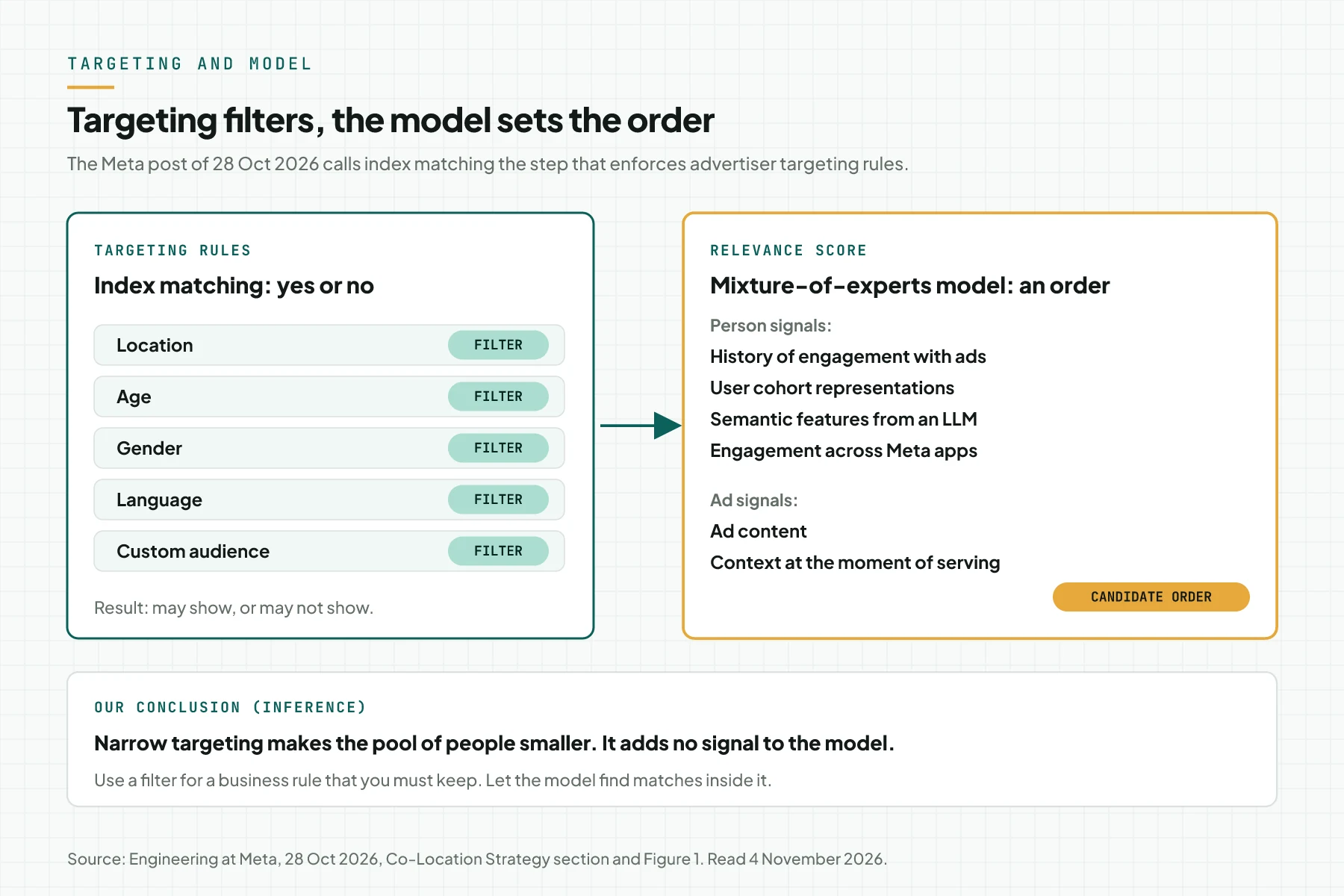
From this architecture, we draw an inference. A narrow stack of interests makes the pool of people smaller. The stack adds no signal for the model, because the model already reads the engagement history of each person. So broad targeting is a sensible start, on the condition that your business rules stay locked.
Business rules that still need a filter:
- The location of your service area, for example a store radius or a delivery city.
- An age limit that the law or the product policy requires.
- The language of the ad.
- A custom audience for retargetingRetargetingShowing ads to people who already interacted with you, for example opened a page or sent a chat.Open the glossary or to exclude current customers.
The opposite case also exists. A retargeting campaign still needs a custom audience, because its goal is people who already know your brand. Fewer ad sets also help, because each ad set needs data to complete the learning phase.
What Andromeda changes for ad creative
The model reads the ad content, so each different creative concept gives the model 1 new option to match to different people. Small variations give no new option.
The 2026 post states that the ad side combines the ad content with the context at the moment of serving. From that, we draw an inference: 2 ads with near-identical content get near-identical scores for the same person. The 2 ads compete inside the same group.
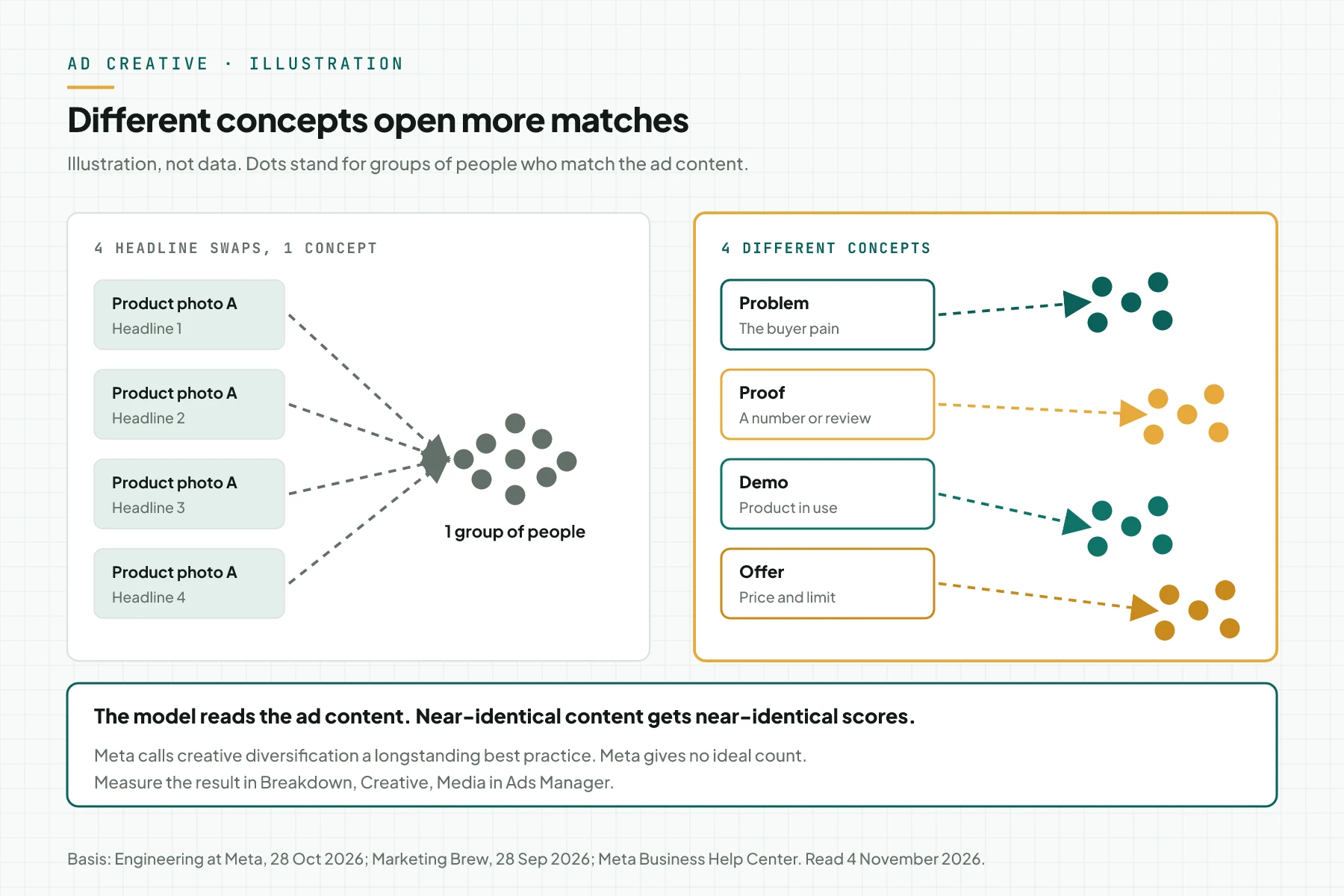
Meta does not disclose how its models read creative assets. A Meta spokesperson told Marketing Brew on 28 September 2026 that creative diversification is a longstanding best practice with measurable results. Meta calls its advice outcome-based, not specific to 1 model. Meta gives no ideal number of ads.
A different concept usually differs on 1 of these 4 items: reason to buy, format, persona, or the hook in the first 3 seconds. A new headline, a new button color, or a new photo background is not a new concept. For a test flow that keeps data clean, read how to test AI creative variants without breaking measurement. For a team that produces many ads, read a creative production cadence for Meta Ads.
Step 1: Separate required targeting rules from guesses
Open each active ad set, then write each targeting limit into 2 groups: required business rules and interest guesses.
Required rules are service location, legal age, language, and the exclusion of current customers. Guesses are stacks of interests and behaviors. Keep the first group. Test the second group against broad targeting in Step 5.
Evidence: a 2-column table for each ad set in the campaign notes.
Step 2: Make 3 to 5 creative concepts with different reasons to buy
Write 1 sentence with the reason to buy for each concept before the design team starts, then remove concepts with the same reason.
Examples of reasons to buy: a problem the buyer feels, proof from a number or a review, a demo of the product in use, and an offer with a time limit. Rama Digital recommendation: start with 3 to 5 concepts per ad set. Use fewer concepts with a small budget, because each concept needs delivery to give a readable result.
Evidence: a concept list with 1 reason sentence each, and no 2 sentences the same.
Step 3: Clean the conversion signal before you add budget
Make sure that the PixelPixelA piece of code on a web page that tells the ad platform somebody opened the page or took an action.What is the Meta Pixel? and the Conversions API record the event you optimize for, with value and currency on each event that has a price.
The model learns from engagement and conversions. A missing, duplicate, or valueless event teaches the model from wrong data. Open Events Manager, run Test Events, and then make 1 test transaction.
Evidence: a Test Events capture and the Event Match Quality score for the main event.
Step 4: Read performance per asset in Ads Manager
Open Ads Manager, click Breakdown, select Creative, and then select Media to see the result of each image and video that you uploaded.
The menu paths according to the Meta help page about performance per asset:
- Images and videos: Breakdown, then Creative, then Media.
- Text variations: Breakdown, then Dynamic creative element, then select a text option.
- Assets that you removed from an ad: Breakdown, then Ad delivery.
There are 3 limits. The Media report does not include extra formats from the Show as collection or Show as carousel options. Meta states that the feature may not be available to every account. According to Social Media Today of 27 October 2026, custom conversions such as Donate and Subscribe do not show in this report.
Evidence: a weekly export of the Media breakdown, with spend and results per asset.
Step 5: Test the impact with your own account data
Compare the old structure and the new structure with a Meta A/B test, not by comparing this month with last month.
A month-to-month comparison mixes season, price changes, and Meta system changes with unannounced dates. An A/B test splits people at random, so both cells run at the same time. Write the stop rule before the test starts.
Evidence: an A/B test report with the conversion count and the cost per result in each cell.
Simulation: an audit of 1 ad set with dummy data
This example uses dummy data for a fictional online store. The numbers in the table do not come from a client account. The table shows decisions, not results that we promise.
| Day | Action | What the account shows | Decision |
|---|---|---|---|
| Day 1 | Targeting audit | East Java location, age 25 to 45, and 6 stacked interests | Location and age are required. The 6 interests go into the guess group. |
| Day 1 | Creative audit | 8 ads with 1 product photo and 8 headlines | The 8 ads count as 1 concept. The team makes 4 new concepts. |
| Day 2 | Event check | 30% of Purchase events have no value | Fix the value and currency parameters before the test. |
| Day 3 | Start A/B test | Cell A: old structure. Cell B: location and age only, with 4 concepts. | Write the stop rule before the test runs. |
| Day 10 | Read the Media breakdown | The demo concept gets 52% of cell B spend. The offer concept gets 6%. | Replace the offer concept with a new concept, not with a new headline. |
| Day 17 | Read the A/B test result | Purchase count and cost per purchase in each cell | Select a cell with the stop rule from day 3. |
Copy the sequence: filter first, concepts second, signal third, then the test. The 52% and 6% numbers only show how to read the breakdown.
Checklist for the ad team
Use this checklist before you change a campaign structure because of Andromeda. Each item has an owner and evidence to keep.
- Mark each targeting limit as required or guess. Owner: media buyer. Evidence: a table per ad set.
- Write 1 reason-to-buy sentence per creative concept. Owner: creative team. Evidence: the concept list.
- Test conversion events in Test Events. Owner: tracking lead. Evidence: a Test Events screenshot.
- Export Breakdown, Creative, Media each week. Owner: media buyer. Evidence: the export file.
- Run 1 A/B test for each structure change. Owner: account owner. Evidence: the A/B test report.
- Keep Meta claims apart from account data in each client report. Owner: account manager. Evidence: the monthly report.
- Stop the test when 1 cell gets no delivery for 3 days, or when cost per result passes the limit you wrote before the test. Owner: account owner. Evidence: the decision log.
Questions and answers
Can you control or turn off Andromeda in Ads Manager?
No. Ads Manager has no Andromeda setting. Meta states that advertisers get better performance automatically, and you see the effect only in delivery results.
Is detailed targeting still useful after Andromeda?
Yes, as a filter for business rules. Index matching still enforces your targeting rules. A narrow interest stack makes the pool of people smaller, so test the stack against broad targeting.
What is the ideal number of ads for Andromeda?
Meta gives no number. The Rama Digital recommendation is 3 to 5 concepts with different reasons to buy per ad set, with fewer concepts for a small budget.
Does Andromeda also work on Instagram?
Yes. The caption of the system diagram in the Meta post mentions a score for every eligible ad across Facebook and Instagram. The 2.4% conversion claim mentions only Facebook.
What is the difference between Andromeda and GEM?
Andromeda works at the retrieval stage and selects the candidate shortlist. GEM is the Meta central ranking model that gives a detailed value to that shortlist before the auction.
Will ad costs fall because of Andromeda?
Not necessarily. Meta states that its server cost falls. The auction still sets the ad price, and the average price per ad on Meta rose 14% in the third quarter of 2026.
Next step
A limit still applies: Meta publishes no rollout date, setting, or dedicated report for Andromeda. You can read its impact only through a clean structure and a fair test. If your team wants us to audit the targeting, creative concepts, and conversion signal of your account, see the Meta Ads Performance Management service. To discuss your case first, book a 30-minute session.
Sources
- Engineering at Meta: Meta Andromeda, Powering the Next Generation of Ads Retrieval. 28 October 2026. Read 4 November 2026.
- Engineering at Meta: Meta Andromeda, Supercharging Advantage+ automation. 2 December 2024.
- Engineering at Meta: Generative Ads Model (GEM).
- Meta Business Help Center: About ad auctions. Read 4 November 2026.
- Meta Business Help Center: View creative performance for individual media assets. Read 4 November 2026.
- PPC Land: Meta says Andromeda lifted Facebook conversions 2.4% since 2025. 28 October 2026.
- Social Media Today: Meta adds individual performance data for ad creative. 27 October 2026.
- Marketing Brew: creative diversification best practices. 28 September 2026.