Direct answer: Andromeda vs GEM is not a choice between 2 Meta Ads algorithms, because the 2 systems work at different stages. Andromeda is the retrieval engine that picks a shortlist, and GEM is a foundation model that teaches the ranking models that score it. GenRecs, a generative approach, has worked in Facebook Feed retrieval since the third quarter (Q3) of 2026.
Main condition: All 3 systems run automatically inside the Meta ads system. Limit: Ads Manager has no setting or dedicated report for any of the 3. Every impact number here is a Meta claim with a different metric, period, and population, so do not use it as a result promise.
On 4 November 2026, we read 4 Engineering at Meta posts in full: GEM, 13 October 2026, GenRecs Tokenization, 19 October 2026, Andromeda, 28 October 2026, and GEM, 10 November 2025. We also read 2 Meta for Business pages of 28 October 2026: 3 AI innovations in ads ranking and how the Meta ads system picks an ad. The numbers in the simulation are dummy data.
Andromeda vs GEM: why the 2 names get mixed up
The names get mixed up because Meta announced several systems in 1 month and often credits results to a combination of systems.
- Close publication dates. The GEM post came out on 13 October 2026, the GenRecs post on 19 October, and the Andromeda post on 28 October.
- A loose use of the word ranking. The Meta for Business page puts Andromeda under an ads ranking title, but the engineering post separates retrieval and ranking.
- Combined credit for results. According to Meta for Business, Facebook had a 15.7% uplift in conversionsConversionThe action you count as a result, for example a paid order, a sign-up, or a chat that becomes a qualified buyer.Open the glossary in Q2 2026. Meta credits that number to user-understanding models, GEM, and sequence learning together.
Practitioners also call every delivery change an Andromeda update. According to PPC Land, Meta never published a rollout date for one.
What is Meta Andromeda?
Meta Andromeda is the ads retrieval engine, the first stage that picks candidates before ranking. According to the 2026 Andromeda post, the 2026 version scores every eligible ad with quality close to the ranking stage.
The Andromeda post also states that index matching enforces advertiser targeting rules. The production pipeline processes over 1 billion ads per second on 1 GPU server. The post reports a 2.4% increase in Facebook conversions since 2025.
According to Meta for Business, Andromeda complexity rose 10 times in Q3 2026 with no extra compute cost. As a result, conversions rose 1.37% on Facebook and 0.24% on Instagram Reels.
For detail on the retrieval stage, read our guide to the Meta Ads Andromeda algorithm.
What is Meta GEM?
Meta GEM (Generative Ads Recommendation Model) is a foundation model that learns from the data of all surfaces, then teaches the models that serve ads. GEM does not score ads directly in each request.
According to the 2026 GEM post, running a model as large as GEM in real time is too expensive. So GEM transfers its knowledge to hundreds of vertical models that serve ads. The transfer uses distillation, a compact LoopFM representation, and embeddings that Solaris computes in advance.
The 2026 version predicts clicks across all surfaces and conversions across the main objectives in 1 model. Patterns from plentiful click data help conversion tasks with little data. According to Meta for Business, campaigns with few conversions also benefit.
According to Meta for Business, GEM now reads an engagement history 2 times as long through a model 2.5 times as complex. The engineering post names the new architecture Kunlun.
According to the 2026 GEM post, GEM gave an 18.9% conversion improvement and a 12% CTRCTRClicks divided by impressions, as a percentage. CTR shows how often people press the ad or the search result they saw.Open the glossary improvement across Meta ad surfaces and objectives. For targeted users, GEM added conversion uplifts of 5.8% on Facebook, 4.1% on Instagram, and 1.6% off-site over the past year. The first GEM version raised Instagram conversions 5% in Q2 2025, according to the 2025 GEM post.
What are GenRecs and generative retrieval?
GenRecs (Generative Recommenders) uses an LLM architecture to read ad content and personal preferences together. The older approach scores each ad candidate one at a time.
The foundation is GenRecs Tokenization. According to the GenRecs post, tokenization represents each item with a set of stable semantic tokens instead of 1 dedicated ID. Items include ads, products, pages, and pixels.
A multimodal model reads the text and images of an item, then a tokenizer turns it into tokens. Similar items share tokens. The example in the GenRecs post: a new trail shoe uses what the model learned from last season's shoe.
Generative retrieval is GenRecs at the retrieval stage, and Meta says it enriches Andromeda. According to Meta for Business, the model generates a semantic ID for the ideal ad, then matches it to the available ads. The launch on Facebook Feed in Q3 2026 raised conversions nearly 2% across targeted segments.
Paired with GEM and the Adaptive Ranking Model, GenRecs Tokenization gave a 0.35% lift in conversions across surfaces. Meta measured it in February 2026, according to the GenRecs post. The Andromeda post does not mention generative retrieval, so the split of work between the 2 paths is not clear.
According to Meta for Business, new ads and products now start to perform faster. We infer from the token design that ads which clearly show the product give the model clearer input.
Comparison table of Andromeda, GEM, and GenRecs
This table compares the 3 systems on 10 attributes. All numbers are Meta claims from the 2026 Andromeda post, the 2026 GEM post, the GenRecs post, and Meta for Business.
| Attribute | Andromeda | GEM | GenRecs and generative retrieval |
|---|---|---|---|
| Pipeline stage | Retrieval, the first stage. | Ranking, behind the vertical models. | Retrieval on Facebook Feed, plus tokens for ranking. |
| Job | Picks a shortlist from all eligible ads. | Predicts clicks and conversions, then teaches the ranking models. | Generates a semantic ID for the ideal ad, then matches it. |
| Input signals | Targeting rules, ad engagement, user cohorts, LLM features, ad content. | Ad and organic engagement, person and ad attributes. | Text and images of items, plus engagement patterns. |
| Output | Top candidates for ranking. | Labels and embeddings for the vertical models. | Semantic tokens and retrieval candidates. |
| Scale or speed | Over 1 billion ads per second per GPU server. | 2.5 times the complexity, 2 times the history length. | Meta publishes no speed number. |
| Model type | Mixture-of-experts for retrieval. | LLM-style foundation model, Kunlun architecture. | LLM-based generative model. |
| Hardware | NVIDIA GH200. | Latest-generation GPUs, vendor not named. | Not stated. |
| Impact claim | Facebook conversions up 2.4% since 2025. Q3 2026: 1.37% on Facebook, 0.24% on Instagram Reels. | Conversions up 18.9% and CTR up 12% across all surfaces and objectives. | Conversions up nearly 2% across targeted Facebook Feed segments. Tokenization: 0.35%. |
| What the advertiser controls | Targeting rules and ad content. | Optimization event, conversion value, and signal quality. | Clear text and images about the product. |
| What Ads Manager shows | No setting or report. | No setting or report. | No setting or report. |
The advertiser control row is a Rama Digital inference from the Meta descriptions.
How Andromeda, GEM, and GenRecs work together
For 1 chance to show an ad, the ad goes through retrieval, ranking, and the auction, with each system at a different point.
- Index matching checks the targeting rules. An ad outside the rules is not eligible.
- Andromeda scores ads and picks the top candidates. On Facebook Feed, generative retrieval also enriches the result.
- Vertical ranking models, which learn from GEM, predict clicks and conversions for each candidate.
- The auction picks the highest total value. According to the Meta help page about auctions, total value combines the bid, the estimated action rate, and ad quality.
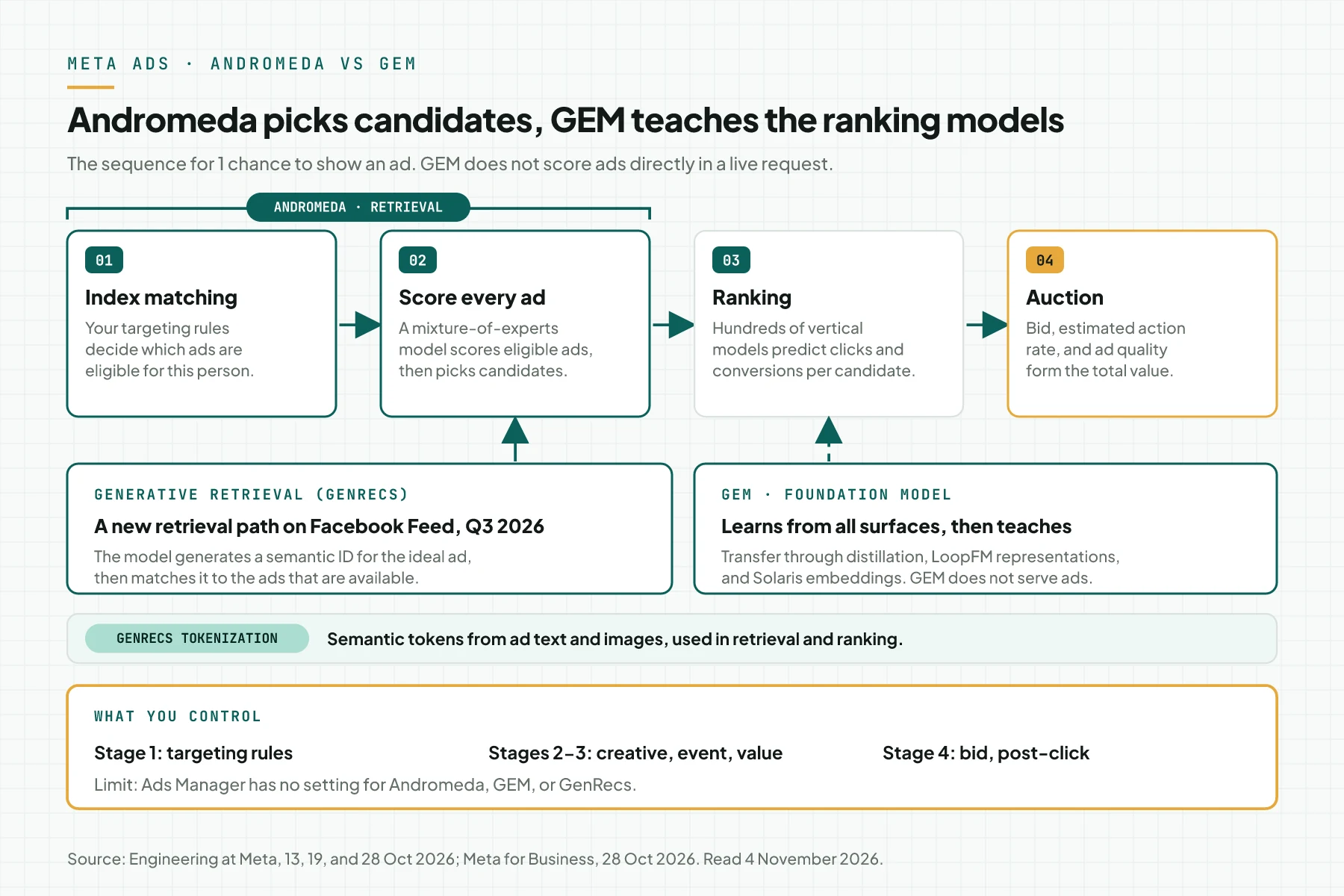
Andromeda and generative retrieval decide which ads enter the shortlist. GEM decides how smart the models that score that shortlist are. We infer, though Meta does not state it, that the ranking predictions enter the auction as the estimated action rate.
As a result, an ad that fails retrieval never benefits from GEM. See also how an ad algorithm works from retrieval to auction.
How to use this map to diagnose delivery
The symptom in Ads Manager points to the stage to check, so start at the earliest stage before you blame the algorithm. This procedure is a Rama Digital heuristic from what Meta describes.
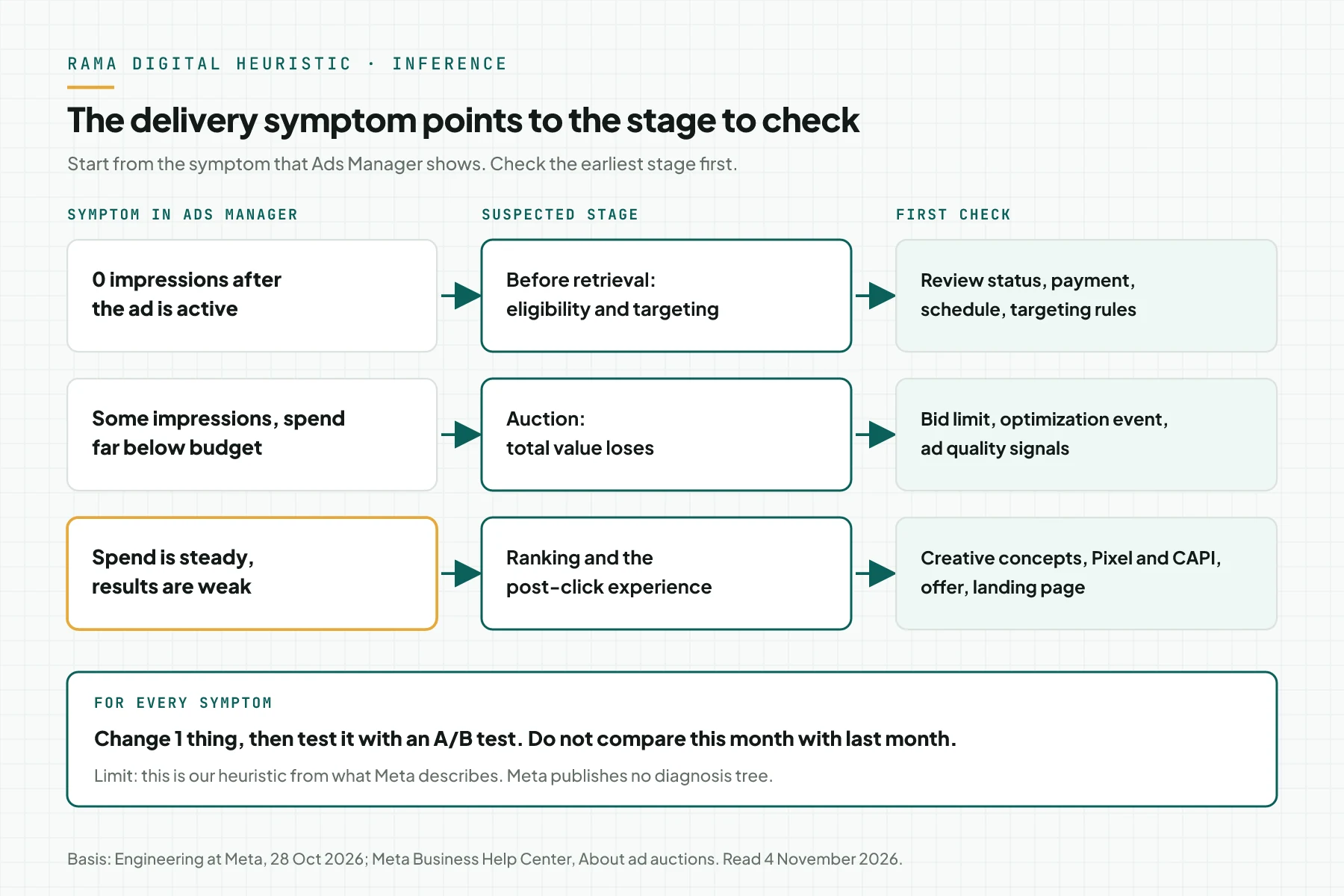
Meta publishes no diagnosis tree, and 1 symptom can have more than 1 cause.
Step 1: Check impressions before you blame the algorithm
Open Ads Manager, then check the Delivery column and impressionsImpressionThe number of times your ad or page appeared on a screen. An impression is not a person and not a search.Open the glossary of each ad for the last 3 days.
0 impressions on an active ad point to a cause before the models start. Check the ad review status, payment, schedule, and targeting rules. An ad outside the targeting rules is never eligible for retrieval, so a smarter model does not help.
Evidence: the ad status and the estimated audience size for each ad set.
Step 2: When the ad shows little, check how it competes in the auction
Compare daily spend with the daily budget, then check the bid limit, optimization event, and ad quality signals.
Spend far below budget often means that the ad loses the auction. A tight bid limit lowers the bid part of total value. An event with few conversions gives the model little data.
According to Meta for Business, ad quality also reads the post-click experience, from more than 200 million survey responses a year.
Evidence: spend against budget per ad set, with the bid setting and event.
Step 3: When delivery is steady but results are weak, check creative, signal, and offer
Open Breakdown, Creative, Media in Ads Manager, then check the conversion event and landing pageLanding pageThe page an ad points to. It carries 1 offer and 1 action, with no menu pulling the visitor elsewhere.What is a landing page? of the ads with the most spend.
Here the ad passed retrieval and wins auctions, but predictions do not turn into results. Check creative concepts with different reasons to buy, PixelPixelA piece of code on a web page that tells the ad platform somebody opened the page or took an action.What is the Meta Pixel? and Conversions API events with value and currency, and the offer and landing page.
The Meta help page about performance per asset explains results per asset. See also how to test AI creative variants without breaking measurement.
Evidence: a Media breakdown export, a Test Events result, and notes from the landing page check.
Step 4: Test 1 change with an A/B test
Change 1 variable per test, then compare cell A and cell B that run at the same time.
A month-to-month comparison mixes season, auction prices, and undated Meta system changes. An A/B test splits people at random. Write the stop rule before the test starts.
Evidence: an A/B test report with results and cost per result in each cell.
Simulation: 3 ad sets with 3 symptoms
This example uses dummy data for a fictional online store, not client data or a result promise.
| Ad set | Symptom (dummy data) | Suspected stage | First action |
|---|---|---|---|
| Ad set A | 0 impressions for 2 days. Ad status: rejected. | Before retrieval | Fix the ad for the rejection reason, then submit it again. |
| Ad set B | Spend IDR 40,000 of an IDR 200,000 daily budget. Cost cap IDR 15,000. | Auction | Test a looser cost cap in an A/B test. |
| Ad set C | Full spend of IDR 200,000 per day, 900 clicks, 0 purchases. | Ranking and post-click | Check the Purchase event in Test Events, then check the checkout page. |
Copy the sequence: eligibility first, the auction second, then creative, signal, and offer.
What the Meta claims do not prove
Meta claims for the 3 systems use different metrics, periods, and populations, so you cannot compare or add the numbers.
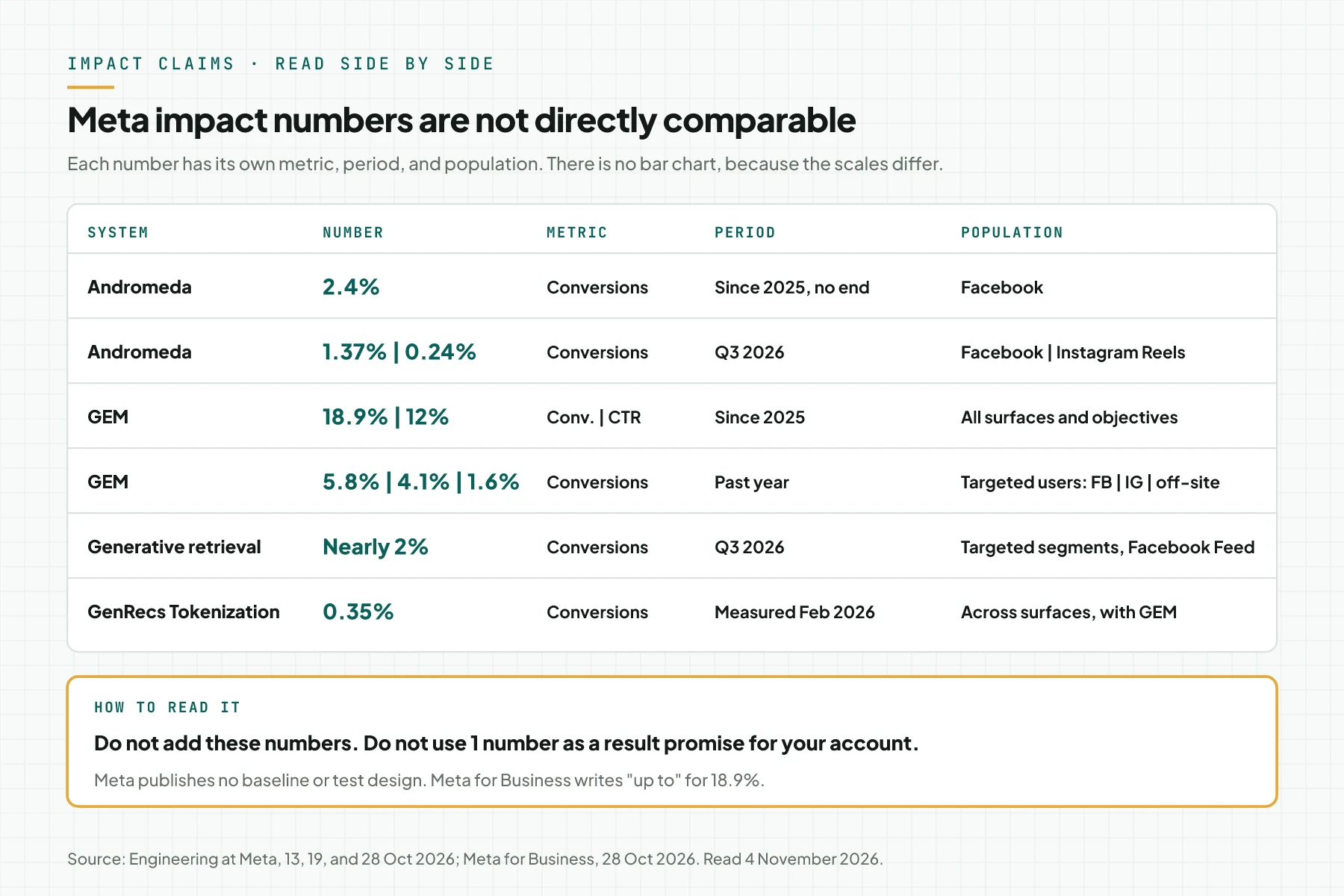
- Different metrics. Most claims use conversions, and 1 claim uses CTR. Meta publishes no definition of each metric.
- Different periods. The 2.4% number applies since 2025 with no end date. The 1.37% and nearly 2% numbers apply to Q3 2026.
- Different populations. Some claims cover Facebook only, some all surfaces, some only targeted segments.
- A maximum, not an average. The engineering post states 18.9% for GEM. The Meta for Business page writes "up to a 18.9%".
- No test design. No post publishes a baseline, test design, or outside audit.
Do not read 18.9% against 2.4% as proof that GEM matters 8 times as much as Andromeda. The 2 numbers do not use the same yardstick. Meta also credits results to combinations of systems, so we suspect that part of the gains overlap.
Rama Digital recommendation: in a client report, write each Meta claim with its metric, period, and population. Then show the client account data.
Checklist for the ad team
Use this checklist before you call a delivery problem an algorithm problem.
- Check the status and impressions of each active ad. Owner: media buyer. Evidence: a Delivery column capture.
- Compare spend with budget and the bid setting. Owner: account owner. Evidence: a weekly table.
- Test conversion events in Test Events. Owner: tracking lead. Evidence: a Test Events capture.
- Write each Meta claim with its metric, period, and population. Owner: account manager. Evidence: the monthly report.
- Stop the test when 1 cell gets no delivery for 3 days, or when cost per result passes the limit you wrote before. Owner: account owner. Evidence: the decision log.
Questions and answers
What is the difference between Andromeda and GEM?
Andromeda works at retrieval and picks a shortlist from all eligible ads. GEM is a foundation model that teaches the ranking models that score that shortlist.
Does GEM replace Andromeda?
No. The 2 systems work at different stages. Meta states that GenRecs enriches Andromeda, its existing retrieval model.
What is generative retrieval in Meta Ads?
Generative retrieval is GenRecs at the retrieval stage. The model generates a semantic ID for the ideal ad, then matches it to the available ads.
Does the GEM 18.9% claim mean my ad results will rise 18.9%?
No. The number is a Meta claim across all surfaces, with no baseline or test design. Measure the impact on your account with an A/B test.
Which system has the largest effect on my ad results?
Public Meta data does not answer that question. Start from the symptom, as in the diagnosis steps above.
Next step
A limit still applies: Meta publishes no setting, report, or rollout date for Andromeda, GEM, or GenRecs. You can read their impact only through an ordered diagnosis and a fair test.
To have us map the delivery symptoms of your account, see the Meta Ads Performance Management service. To discuss your case first, book a 30-minute session.
Sources
We read all sources on 4 November 2026.
- Engineering at Meta: Generative Ads Model (GEM) 2026. 13 October 2026.
- Engineering at Meta: GenRecs Tokenization. 19 October 2026.
- Engineering at Meta: Meta Andromeda 2026. 28 October 2026.
- Engineering at Meta: GEM, The Central Brain. 10 November 2025.
- Meta for Business: Three New AI Innovations in Ads Ranking. 28 October 2026.
- Meta for Business: How Meta's Ads System Matches Your Ad. 28 October 2026.
- Meta Business Help Center: About ad auctions.
- Meta Business Help Center: creative performance per media asset.
- PPC Land: analysis of the Andromeda 2.4% claim. 28 October 2026.