Direct answer: The Meta Ads Andromeda strategy that we recommend has 4 parts. Combine ad sets until each one has budget for about 50 results per week. Add new creative concepts in 1 batch. Narrow the targeting only for business rules that you must keep, and send buying signals back to Meta.
Main condition: This advice is for Facebook and Instagram accounts that record conversionConversionThe action you count as a result, for example a paid order, a sign-up, or a chat that becomes a qualified buyer.Open the glossary events. Each recommendation has a condition, a counter-case, a metric, and a stop rule. Limit: According to PPC Land, Meta never published a rollout date for an "Andromeda update". This advice does not promise a lower cost per result.
On 4 November 2026, we read 5 Meta help pages, 1 Meta for Business post, the Conversions API documentation, and 1 Engineering at Meta post. Data marked "on our account" comes from our own ad account audit, September 2026. Simulation numbers are dummy data.
What changes for advertisers after Andromeda?
Andromeda now scores every eligible ad, so your structure, creative, and conversion signal become the main inputs to the Meta system. The mechanism is in our article about how the Meta Ads Andromeda algorithm works. Meta Ads tips for 2026 from Meta for Business are general: adopt Advantage+, add creative variety, and test incrementality. This article applies them by business type.
The learning phase rule behind our advice
All structure advice here comes from 1 Meta rule: an ad set needs about 50 results in the 7 days after its last significant edit.
The rule is on the Meta page about the learning phase. During the learning phase, performance is less stable and the CPACPAThe average cost of 1 result, for example 1 order or 1 qualified buyer.Open the glossary is usually higher. According to the Meta page about significant edits, these 6 edits are always significant:
- A change to targeting.
- A change to ad creative.
- A change to the optimization event.
- A new ad in the ad set.
- A pause of 7 days or longer.
- A change of bid strategy.
A large budget change can also restart learning. An ad set that is unlikely to get about 50 events per week gets the Learning limited status. According to the Meta page about Learning limited, causes include a small audience, a low budget, a rare event, or too many ads.
Campaign structure: combine first, split only for a reason
Rama Digital recommendation: start with as few ad sets as possible, and split only when 2 groups need a different event, message, or budget.
From the 50-result rule, we derive 1 formula. The formula is our inference, not a Meta formula. The minimum daily budget per ad set equals 50 times the target cost per result, divided by 7.
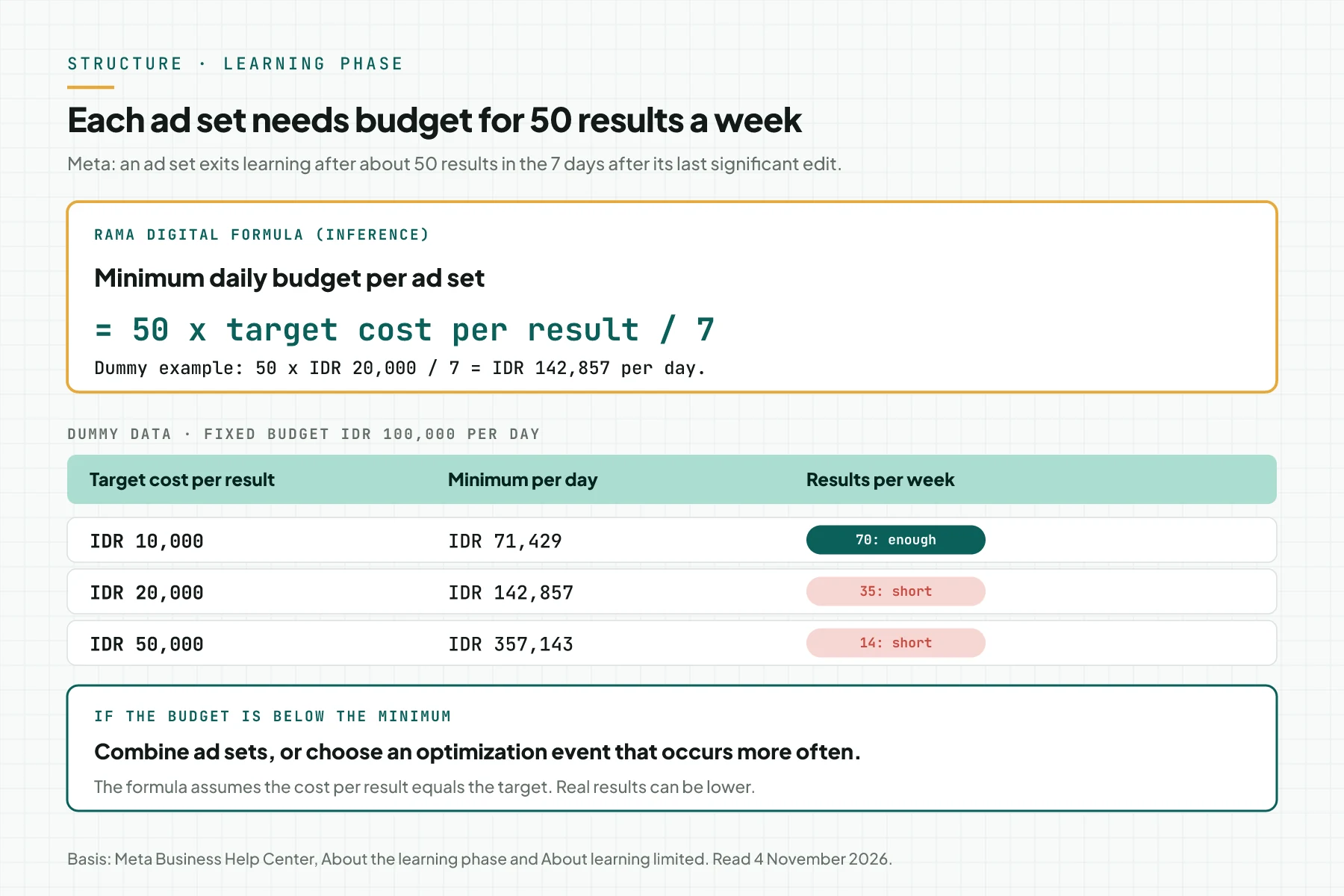
The table in the figure holds the counter-case. At IDR 100,000 per day and a target of IDR 20,000, 1 ad set gets only 35 results per week. For that case, Meta gives 5 options: combine ad sets, expand the audience, raise the budget, raise the bid, or choose a more frequent event.
The Meta page about combining ad sets gives an example: 3 ad sets for interests in dogs, dog toys, and dog collars work better as 1 ad set. For segment reports, use breakdowns.
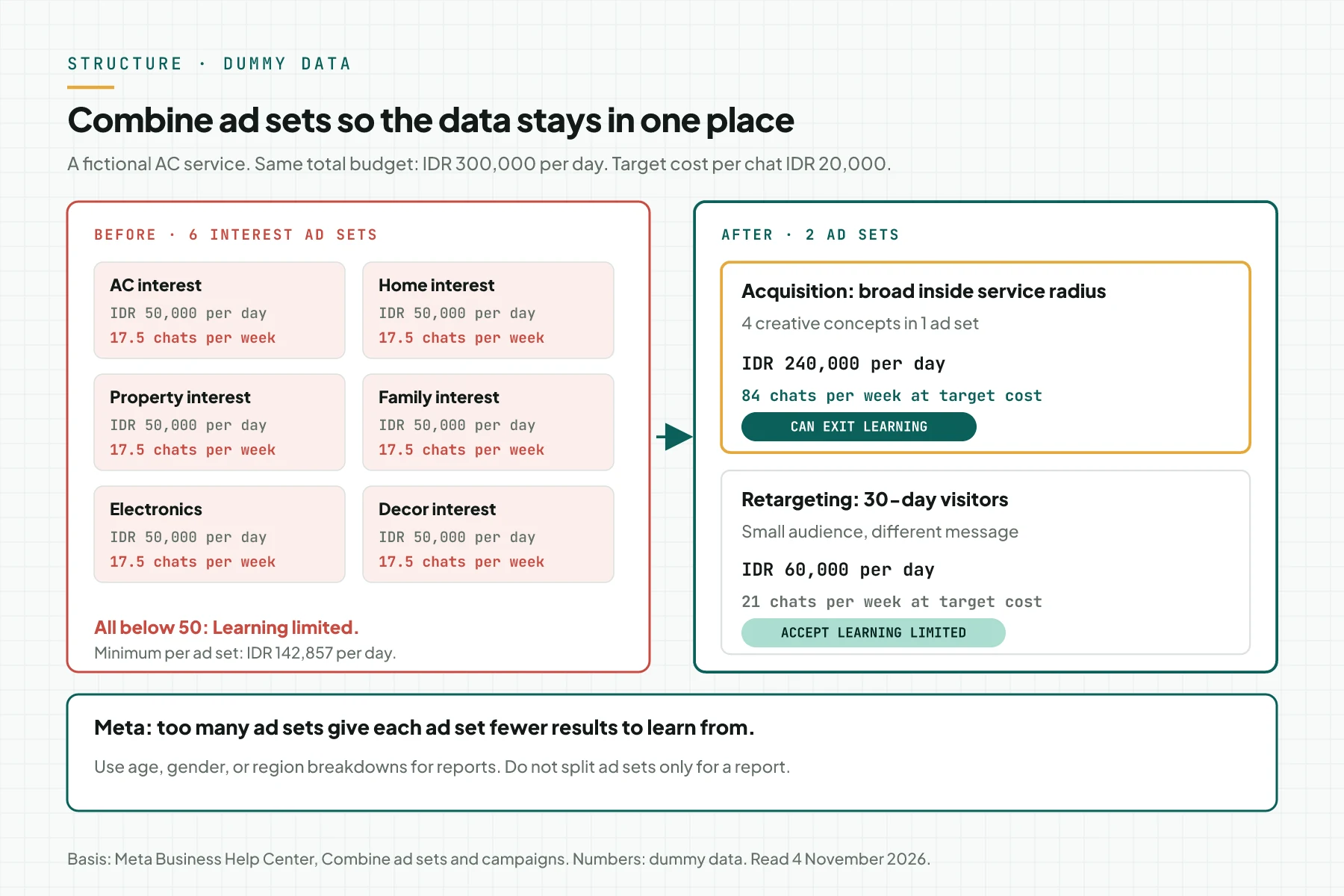
Split an ad set only when the event, message stage, or language differs. On our account, a Dynamic Creative ad set also accepts only 1 ad. Our Lead event fired 5 times in 7 days, 30 August to 6 September 2026. For that reason, we limit our account to 2 ad sets.
Creative cadence: new concept or variation
A new concept is creative that is materially different from the old creative, not a new headline on the same photo.
The term comes from the Meta page about creative fatigue. Meta shows Creative fatigue when the cost per result reaches 2 times that of your past ads. For that case, Meta suggests a new ad with a materially different image or video.
Creative is a new concept if the reason to buy, the person in it, or the format and first 3 seconds change. A new headline or button color is a variation. Our inference: the model reads the ad content, so a variation gives it no new option.
Rama Digital recommendation: add new concepts in 1 batch, because a new ad is a significant edit. 7 ads in 7 days can restart learning 7 times.
| Budget per ad set | Active concepts | New batch |
|---|---|---|
| Below the formula | 2 to 3 | Every 14 days |
| 1 to 3 times the formula | 3 to 5 | Every 14 days |
| Above 3 times the formula | 5 or more | Every 7 days |
The table numbers are our recommendation. According to Marketing Brew, Meta gives no ideal creative count. Our stop rule: pause a concept that spends 2 times the target cost per result with 0 results. For the production flow, see creative production cadence for Meta Ads.
When to keep targeting narrow and when to go broad
Rama Digital recommendation: use broad targeting inside the business rules that you must keep, and narrow it only for 4 cases with a business reason.
According to Engineering at Meta, index matching enforces targeting rules before the model scores the ads. A small audience is one cause of Learning limited. Our inference: stacked interests make the pool smaller and add no signal. Keep the targeting narrow for:
- A local service radius.
- A legal age limit.
- RetargetingRetargetingShowing ads to people who already interacted with you, for example opened a page or sent a chat.Open the glossary to visitors, chat contacts, or buyers.
- A B2B client list, and current customers excluded.
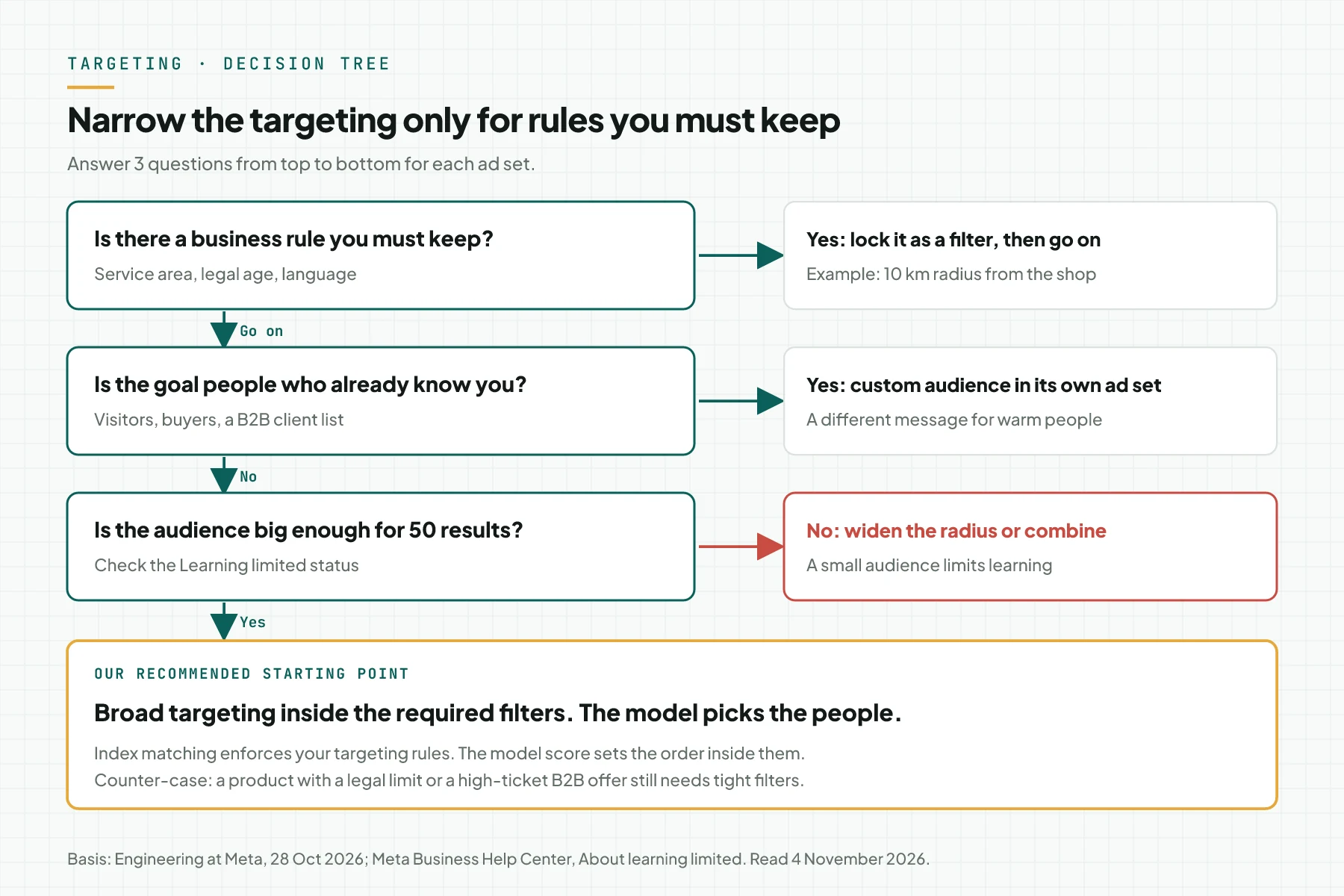
On our account, the minimum age in acquisition ad sets is 25, because our buyers are business owners. Counter-case: a product with a legal limit, or a B2B offer for a few job roles, still needs tight filters.
Placements: we use Facebook and Instagram only
Rama Digital recommendation for B2B lead generation: select Facebook and Instagram placements only, because our account data shows spend without buyers elsewhere.
The Meta position is different. Meta for Business names 6 apps where ads run, including WhatsApp and Audience Network, and recommends Advantage+ as a whole.
On our account, the audit of 6 September 2026 recorded a spend of IDR 8,220,793. Audience Network spent IDR 1,070,128, or 13%, with a CTRCTRClicks divided by impressions, as a percentage. CTR shows how often people press the ad or the search result they saw.Open the glossary of 20.56% and 30.79%. We read that CTR as accidental clicks. From 27 to 29 September 2026, automatic placements added WhatsApp Status. It took 58% of spend in 1 campaign, with a CTR of 0.33% and 0 buyers by 30 September 2026.
The condition: this is data from 1 B2B account, partly from before our Conversions APICAPIA server path that sends conversion data from your system to the ad platform, without depending on the buyer browser.What is the Conversions API (CAPI)? was live. Counter-case: an e-commerce account with complete Purchase events can test Advantage+ placements with an A/B test.
Click-to-WhatsApp campaigns: optimize for buying signals
For Click-to-WhatsAppCTWAA Click-to-WhatsApp ad. It sends people from Facebook or Instagram straight into your WhatsApp conversation.How to track CTWA ads (CTWA) ads, optimize for a purchase event when it is available, and send chat stages back to Meta through the Conversions APIAPIThe official door 2 systems use to exchange data, without anybody copying it by hand.Open the glossary.
According to the Conversions API documentation for business messaging, updated 28 September 2026, purchase optimization is available for ads that click to WhatsApp and Messenger. Supported events include LeadSubmitted, QualifiedLead, and Purchase. They represent chat interactions only, with ctwa_clidCTWA CLIDThe unique code Meta attaches to the first WhatsApp message from an ad click. It connects the buyer to the ad.What a CTWA CLID is as the ad click ID. The basics are in what the Conversions API is.
On our account, a test on 19 September 2026 found 1 accepted CTWA setup for purchases: the Sales objective, the Purchase event, and a WhatsApp dataset. For a lead goal through chat, Ads Manager offered only Maximize number of conversations.
Rama Digital recommendation: send LeadSubmitted when the person replies, QualifiedLead when the data is complete, and Purchase with an IDR value when paid. Watch the cost per QualifiedLead from your CRM. Our stop rule: pause a CTWA ad that spends over IDR 50,000 with 0 chats. Counter-case: without chat events, optimize for conversations.
Meta Ads Andromeda strategy by business type
This table summarizes our Meta Ads Andromeda strategy for 5 business types, with a condition, counter-case, basis, metric, and stop rule.
| Business type | Action | Condition and counter-case | Basis | Metric | Stop rule |
|---|---|---|---|---|---|
| Small business | 1 ad set, broad targeting, 2 to 3 concepts. | Budget below the formula. Far below 50 results: choose a more frequent event. | Meta, Learning limited | Results since the last edit | Learning limited for 14 days: change the event. |
| Local service | Radius as a filter, broad targeting inside it, CTWA. | A tiny radius causes Learning limited. Widen it to the service limit. | Index matching; our inference | Cost per chat and booking rate | 2 times the target with 0 chats: pause. |
| E-commerce | Optimize for Purchase with value, 3 to 5 concepts. | Purchase recorded by Pixel and Conversions API. Below 50 per week: combine. | Meta for Business | Cost per purchase and ROAS | 2 times the target CPA with 0 purchases: pause. |
| Lead generation via WhatsApp | CTWA with LeadSubmitted, QualifiedLead, and Purchase events. | The team records chat stages. Without chat events, optimize for conversations. | Conversions API | Cost per QualifiedLead | 0 QualifiedLead in 7 days: turn off. |
| High-ticket B2B | Maximum 2 ad sets, optimize for Lead. | Purchase is too rare. If qualified leads reach 50 per week, test a deeper event. | Our account data | CTR and CPC for the first 30 days | CTR falls and CPC rises for 2 days: turn off. |
The 2 times target rule is ours, not a Meta rule.
What to stop doing
Stop these 6 habits, because each habit splits your data or restarts learning without a reason.
- Stacking interests in a small ad set.
- Running many small ad sets. According to Meta, each ad set then learns from fewer results.
- Making headline-only variations.
- Adding 1 ad every day, because each new ad is a significant edit.
- Editing an ad set during the learning phase.
- Judging this month against last month. According to PPC Land, the average price per ad on Meta rose 14% in the third quarter of 2026.
How to report Meta claims to a client
Separate 3 types of numbers in every report: Meta claims for the platform, client account data, and the result of a fair test.
According to Meta for Business, platform results show what happened, and a Conversion Lift study shows what happened because of the ads. Meta gives 1.4% and 2.4% for Andromeda. According to PPC Land, Meta does not explain how the 2 numbers relate.
| Number type | Example | How to write it in the report |
|---|---|---|
| Meta claim | Facebook conversions up 1.4% in the third quarter of 2026 | A Meta claim for Facebook, with no public baseline. |
| Account data | Results and cost per result | What happened, not why. |
| Test result | An A/B test or Conversion Lift | The impact of a change. |
Step 1: Calculate the minimum budget for each ad set (day 1)
List every active ad set with its optimization event, daily budget, and results since the last significant edit.
In Ads Manager, open Columns, then add Last significant edit and Results. Evidence: a table of actual and minimum budgets.
Step 2: Combine ad sets with the same event and rules (day 2)
Combine ad sets with the same optimization event, location, and language into 1 ad set with broad targeting.
Make all changes on the same day. Pause the old ad sets, do not delete them. Evidence: a list of ad sets before and after.
Step 3: Upload 3 to 5 concepts in 1 batch (day 3)
Upload all new concepts on the same day, because each new ad is a significant edit.
Remove creative that differs only by headline. Evidence: a concept list with the upload date.
Step 4: Send buying signals and lock edits for 7 days (days 3 to 10)
Make sure the main event carries value and currency, then do not change targeting, creative, or the event for 7 days.
Test website events in Events Manager, Test Events. Evidence: an event log and a note of no edits.
Step 5: Read the results and decide the next move (days 10 to 14)
Compare the results since the last significant edit with the number 50, then read performance per concept before you replace creative.
Open Breakdown, Creative, then Media. Test the new structure with an A/B test. Evidence: a results export and a written decision.
14-day simulation with dummy data
This simulation uses dummy data: a fictional AC service, a budget of IDR 300,000 per day, and a target cost per chat of IDR 20,000.
| Day | Action | What is recorded | Decision |
|---|---|---|---|
| Day 1 | Audit | 6 interest ad sets, IDR 50,000 per day each, all Learning limited | Minimum is IDR 142,857 per ad set. Combine. |
| Day 2 | Combine | Acquisition IDR 240,000, retargeting IDR 60,000 | Accept Learning limited on retargeting. |
| Day 3 | Batch | 4 concepts: price, speed, technician proof, warranty | Lock edits until day 10. |
| Day 10 | Read results | Acquisition: IDR 1,680,000, 61 chats | Passed 50 results. Wait for day 14. |
| Day 12 | Media breakdown | Warranty concept: IDR 41,000, 0 chats | Pause, because spend passed 2 times the target. |
| Day 14 | Decision | Acquisition: IDR 2,640,000, 109 chats, IDR 24,220 per chat | 21% above target. Prepare the next batch. |
Copy the order: calculate, combine, batch, lock, then read. The table numbers are not results that we promise.
14-day transition checklist
Use this checklist during the transition. Each item has an owner and evidence.
- Calculate the minimum budget per ad set. Owner: media buyer. Evidence: budget table.
- Combine matching ad sets. Owner: media buyer. Evidence: list before and after.
- Mark creative as a concept or a variation. Owner: creative team. Evidence: concept list.
- Set placements explicitly. Owner: media buyer. Evidence: settings capture.
- Send events with value. Owner: tracking lead. Evidence: event log.
- Separate Meta claims and account data. Owner: account manager. Evidence: weekly report.
- Stop the transition if the cost per result is still above 2 times the target on day 14. Owner: account owner. Evidence: decision log.
Questions and answers
Does the formula 50 times the target divided by 7 come from Meta?
No. Meta only states the rule of about 50 results in 7 days. The formula is a Rama Digital inference.
Does 1 new ad restart the learning phase?
Yes. Meta lists a new ad added to the ad set as a significant edit.
Must every account turn off WhatsApp Status and Audience Network?
No. That is our rule for B2B lead generation. An e-commerce account can test them with an A/B test.
Must you turn off an ad set that is Learning limited?
Not always. Meta states that Learning limited is not a penalty.
Next step
A limit still applies: this advice comes from Meta rules, our inference, and data from 1 of our accounts. For an audit of your structure and signals, see the Meta Ads Performance Management service. To discuss your case first, book a 30-minute session.
Sources
We read all sources on 4 November 2026.
- Meta: About the learning phase
- Meta: Significant edits and learning phase
- Meta: About learning limited
- Meta: Combine ad sets and campaigns
- Meta: Creative fatigue recommendations
- Meta for Business: How Meta ads system matches your ad, 28 October 2026
- Meta: Conversions API for Business Messaging, 28 September 2026
- Engineering at Meta: Meta Andromeda, 28 October 2026
- PPC Land: Andromeda and Facebook conversions, 28 October 2026
- Marketing Brew: creative diversification, 28 September 2026