Direct answer: We checked 8 popular claims about Meta Andromeda against the text that Meta published itself. No claim is fully supported. 3 claims contradict Meta, 3 claims have no evidence from Meta, and 2 claims are partly true. Meta Andromeda has no setting in Ads Manager, so many claims come from readings of delivery results.
Main condition: These verdicts check the Meta text published up to 4 November 2026. The sources are 2 Engineering at Meta posts, the Meta Business Help Center, and the Meta Q3 2026 reports. Limit: The verdicts do not check the results in your account. A claim with no evidence from Meta can still fit a specific account, so test it yourself.
We read all sources on 4 November 2026. For each claim, we read at least 1 agency or vendor page that makes it, and we recorded the sentence and the date. This article uses no client data and contains no simulation.
Why Meta Andromeda myths spread so easily
Meta Andromeda myths spread because advertisers cannot see the system, and Meta publishes few numbers.
- No setting. Ads Manager has no Andromeda switch or report.
- No rollout date. According to PPC Land on 28 October 2026, Meta never published a rollout date for one Andromeda update.
- A closed view of creative. A Meta spokesperson told Marketing Brew on 28 September 2026 that Meta does not discuss how its models read each creative asset.
- Changing Meta numbers. Meta used ad quality in 2024 and conversionsConversionThe action you count as a result, for example a paid order, a sign-up, or a chat that becomes a qualified buyer.Open the glossary in 2026, with 2 conversion figures: 1.4% and 2.4%.
According to Marketing Brew, Meta has also tested creative insights metrics in the Insights APIAPIThe official door 2 systems use to exchange data, without anybody copying it by hand.Open the glossary with a small number of agencies since June 2026. So some agencies see data that other advertisers do not see.
In short, Andromeda in Meta Ads works at the retrieval stage. Index matching enforces targeting, and then a model scores ads from person signals and ad content. The full explanation is in our article on how the 2026 Meta Ads Andromeda algorithm works.
How we give a verdict
We use 4 verdict labels that only check how well a claim matches the Meta text.
- Supported: the Meta text states the same thing.
- Partly: 1 part of the claim matches, but another part does not.
- No evidence from Meta: Meta published no text that supports or rejects the claim.
- Contradicts Meta: Meta text or numbers state a different thing.
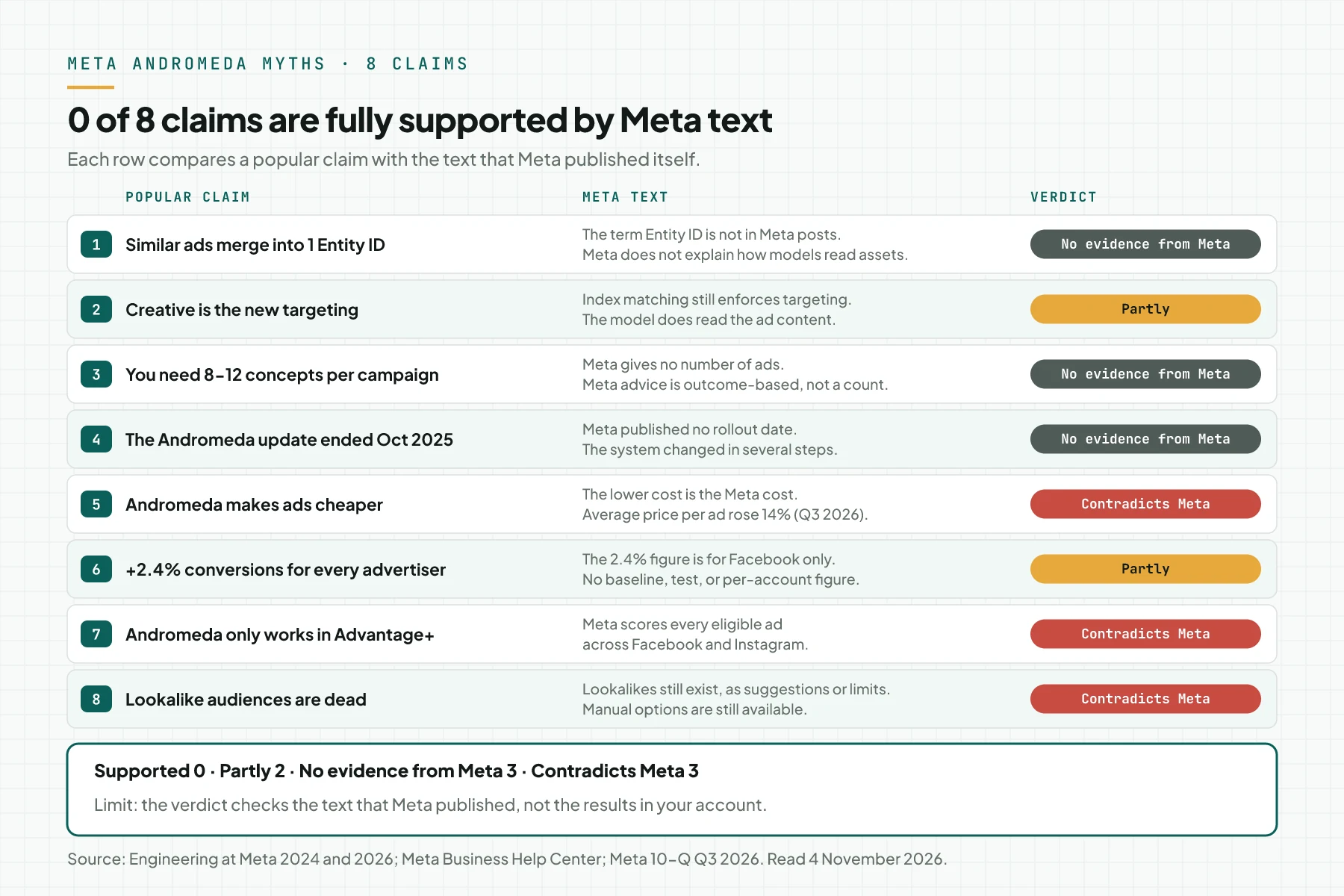
The matrix above shows the 8 verdicts that we explain below.
Claim 1: Similar ads merge into 1 Entity ID
Our verdict: no evidence from Meta, because the term Entity ID does not appear in the Meta text about Andromeda.
The claim: A Precis blog post of 19 July 2026 states: "This is what Meta refers to as a Creative Entity ID". That paragraph links to no Meta document.
The Meta text: The term Entity ID is not in the 2024 Andromeda post or the 2026 Andromeda post. A Meta spokesperson called the Meta advice "deliberately outcome-based (not model-specific)".
Verdict: No evidence from Meta. The advice to make different creative matches Meta. The idea of 1 ID for similar ads is a reading by other parties.
Do this: Read results per asset through Breakdown, Creative, and then Media, as the Meta help page on assets shows. Stop an ad because its data is weak, not because of a "similar" label.
Claim 2: Creative is the new targeting
Our verdict: partly, because the Meta model does read the ad content, but Meta still enforces your targeting rules.
The claim: A Chatterbuzz Media page of 27 May 2026 uses the section title "Creative Is the New Targeting". The page states: "The algorithm overrides your audience definitions if creative signals suggest a better match elsewhere."
The Meta text: The 28 October 2026 post says that index matching enforces advertiser targeting rules. The Meta for Developers page states that location, minimum age, language, and custom audience exclusions are not expanded.
Verdict: Partly. Creative does matter more. But creative only beats audience suggestions, which Meta may expand. Audience limits still apply.
Do this: Lock your business rules as limits, for example your service area and the legal age. Keep interests as suggestions. The order of delivery stages is on the page about how an ad algorithm works from retrieval to auction.
Claim 3: You need 8 to 12 concepts per campaign
Our verdict: no evidence from Meta, because Meta published no ideal number of ads for Andromeda.
The claim: A Segwise page of 27 April 2026 advises you to "run 8-12 conceptually distinct concepts per campaign". The same page calls that number "a workable rule of thumb".
The Meta text: The 2 Engineering at Meta posts contain no creative count. Meta calls creative diversification a "longstanding best practice". An example of the Meta advice: "diversify your creative, test, and let the system optimize".
Verdict: No evidence from Meta. The range of 8 to 12 is a rule of thumb from other parties.
Do this: Count concepts by reason to buy, not by number of files. A small budget needs fewer concepts, because each concept needs delivery. Read how to test AI creative variants without breaking measurement and a creative production cadence for Meta Ads.
Claim 4: The Meta Andromeda update ended in October 2025
Our verdict: no evidence from Meta, because Meta never published a rollout date for one Andromeda update.
The claim: A Confect guide of 10 March 2026 states: "The rollout completed globally in October 2025." Its timeline section names no Meta document as the source.
The Meta text: In December 2024, Meta already wrote that Andromeda ran on Instagram and Facebook. The 2026 post describes a new generation without a rollout date. PPC Land on 28 October 2026 notes that practitioners call any delivery change an Andromeda update.
Verdict: No evidence from Meta. The Meta text describes several steps: 2024, hardware tests with NVIDIA since early 2026, and the 2026 generation.
Do this: When results fall, first check the budget, creative, events, and season in your account.
Claim 5: Andromeda makes ads cheaper
Our verdict: contradicts Meta, because the lower cost in the Meta text is the Meta cost, and the average price per ad rose.
The claim: An AdMakeAI post of 18 May 2026 states: "Andromeda specifically rewards creative diversity with lower CPMs." A Welcome.AI summary of 28 October 2026 says that the new design "reduces costs while improving performance".
The Meta text: The 28 October 2026 post states that the lower costs are for Meta. According to the Meta Q3 2026 results release, the average price per ad rose 14% and impressionsImpressionThe number of times your ad or page appeared on a screen. An impression is not a person and not a search.Open the glossary rose 10% year over year. The Meta Form 10-Q says that higher ad demand drove the price increase.
Verdict: Contradicts Meta. The 14% figure is an average across all Meta apps. It does not isolate the effect of Andromeda, and it is not the CPMCPMThe cost of 1,000 ad impressions. CPM prices reach, not results.Open the glossary of your account.
Do this: Measure cost per result, not only CPM. Make sure that the PixelPixelA piece of code on a web page that tells the ad platform somebody opened the page or took an action.What is the Meta Pixel? and the Conversions API record your conversion events correctly.
Claim 6: Conversions rose 2.4% for every advertiser
Our verdict: partly, because the 2.4% figure comes from Meta, but Meta names only Facebook and gives no per-account figure.
The claim: A summary point on Welcome.AI states: "2.4% rise in conversions since 2025 indicates strong ROIROIProfit minus all costs, divided by all costs. ROI counts profit, while ROAS counts gross revenue.Open the glossary for advertisers". That point does not mention the Facebook limit.
The Meta text: The Meta sentence is: "Since 2025, Meta Andromeda has delivered a 2.4% increase in conversions on Facebook." It has no baseline, test design, end date, or Instagram figure. According to PPC Land, Meta gave investors another figure: Facebook conversions rose 1.4% in Q3 2026.
Verdict: Partly. The 2.4% figure is correct as a Meta claim for Facebook. It is wrong as a figure for Instagram, for a specific account, or as proof of ROI.
Do this: For a promise to a client, use the numbers from the client account.
Claim 7: Andromeda only works in Advantage+ campaigns
Our verdict: contradicts Meta, because Meta states that Andromeda scores every eligible ad across Facebook and Instagram.
The claim: A Balistro page of 7 August 2026 records the question "isn't Andromeda just Advantage+?" in nearly every strategy call. We found no page that states this claim as a fact, but the belief circulates. The 2024 Meta post title uses the phrase "Supercharging Advantage+ automation".
The Meta text: The 2024 post states that Advantage+ increases the number of eligible ads. The Figure 2 caption in the 2026 post mentions a score for every eligible ad across Facebook and Instagram.
Verdict: Contradicts Meta. Advantage+ adds ads to the candidate pool, but Andromeda scores every eligible ad. Our inference: ads from manual campaigns also pass through Andromeda.
Do this: Select Advantage+ or a manual setup from the result of an A/B test.
Claim 8: Lookalike audiences are dead
Our verdict: contradicts Meta, because Meta still documents lookalikes as an active option, as a suggestion or as a limit.
The claim: An article on alexneiman.com on 30 March 2026 has the title "Lookalike Audiences Are Dead". It states that advertisers who still build lookalikes are "fighting the platform".
The Meta text: According to the Advantage+ lookalike help page, Advantage+ lookalike treats a lookalike as a suggestion. The system may reach people outside it. That page also states that manual options are still available. According to the Meta help page about audience controls, you can set age, gender, interests, and custom audiences as limits.
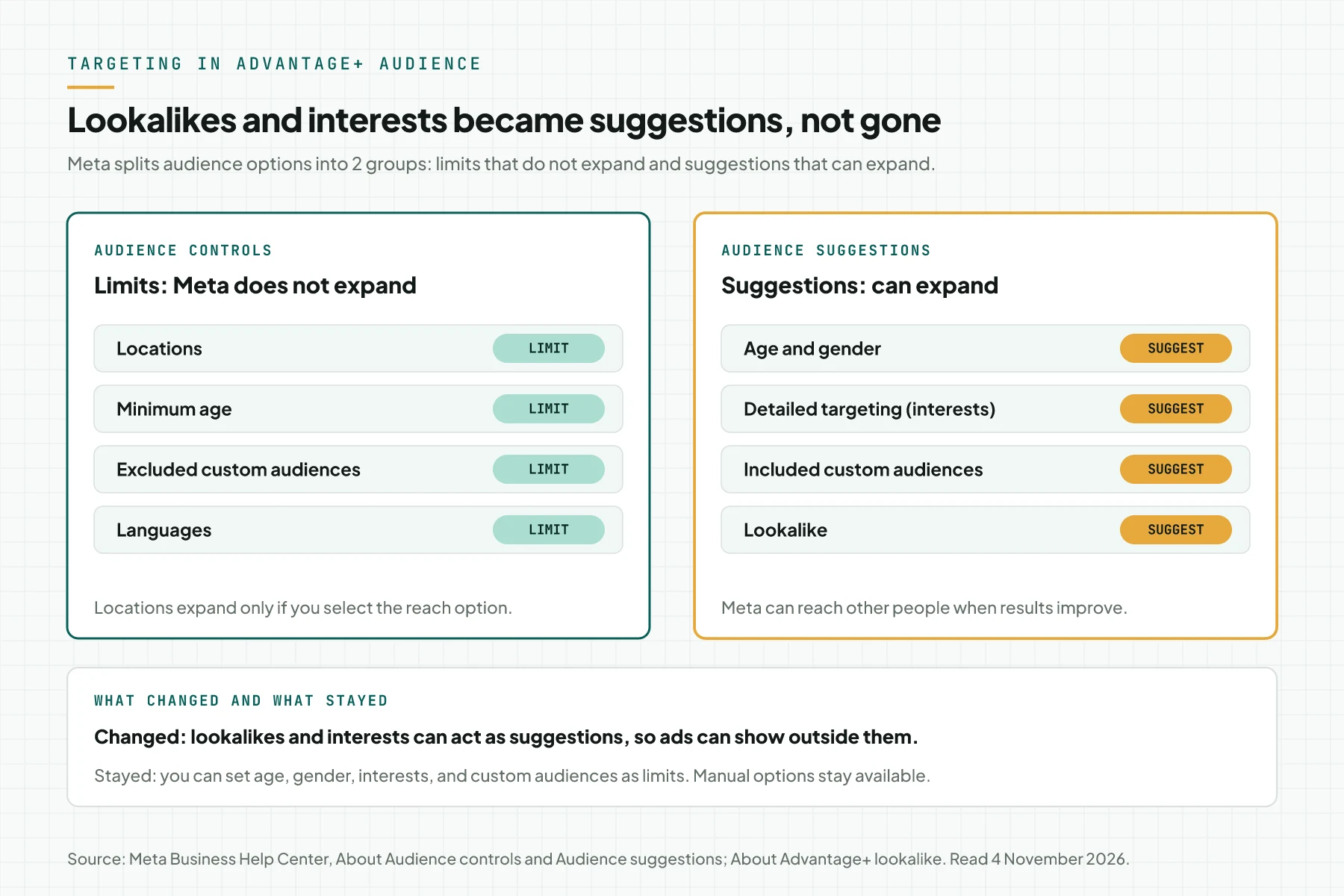
The diagram above shows the real change. According to the Advantage+ detailed targeting help page, interest expansion does not apply to location, age, and gender. The Meta help page about Advantage+ audience also does not recommend Advantage+ audience for retargetingRetargetingShowing ads to people who already interacted with you, for example opened a page or sent a chat.Open the glossary.
Verdict: Contradicts Meta. In many setups, lookalikes and interests changed role from limits to suggestions. They did not disappear.
Do this: Test lookalikes against Advantage+ audience in an A/B test. Meta itself gives an example hypothesis: custom audiences against interest-based audiences.
Summary of the 8 verdicts
Of the 8 claims, 3 contradict Meta, 3 have no evidence from Meta, and 2 are partly true.
| Claim | Claim source | Meta source | Verdict |
|---|---|---|---|
| Similar ads merge into 1 Entity ID | Precis, 19 July 2026 | Engineering at Meta; Marketing Brew | No evidence from Meta |
| Creative is the new targeting | Chatterbuzz Media, 27 May 2026 | Engineering at Meta; Meta for Developers | Partly |
| 8 to 12 concepts per campaign | Segwise, 27 April 2026 | Engineering at Meta; Marketing Brew | No evidence from Meta |
| The update ended in October 2025 | Confect, 10 March 2026 | Engineering at Meta; PPC Land | No evidence from Meta |
| Ads become cheaper | AdMakeAI, 18 May 2026; Welcome.AI, 28 October 2026 | Engineering at Meta; Form 8-K and 10-Q | Contradicts Meta |
| +2.4% conversions for all | Welcome.AI, 28 October 2026 | Engineering at Meta | Partly |
| Only in Advantage+ | Balistro, 7 August 2026 | Engineering at Meta | Contradicts Meta |
| Lookalikes are dead | alexneiman.com, 30 March 2026 | Meta Business Help Center | Contradicts Meta |
Our inference: claims with an exact number, date, or new term rarely have a Meta source.
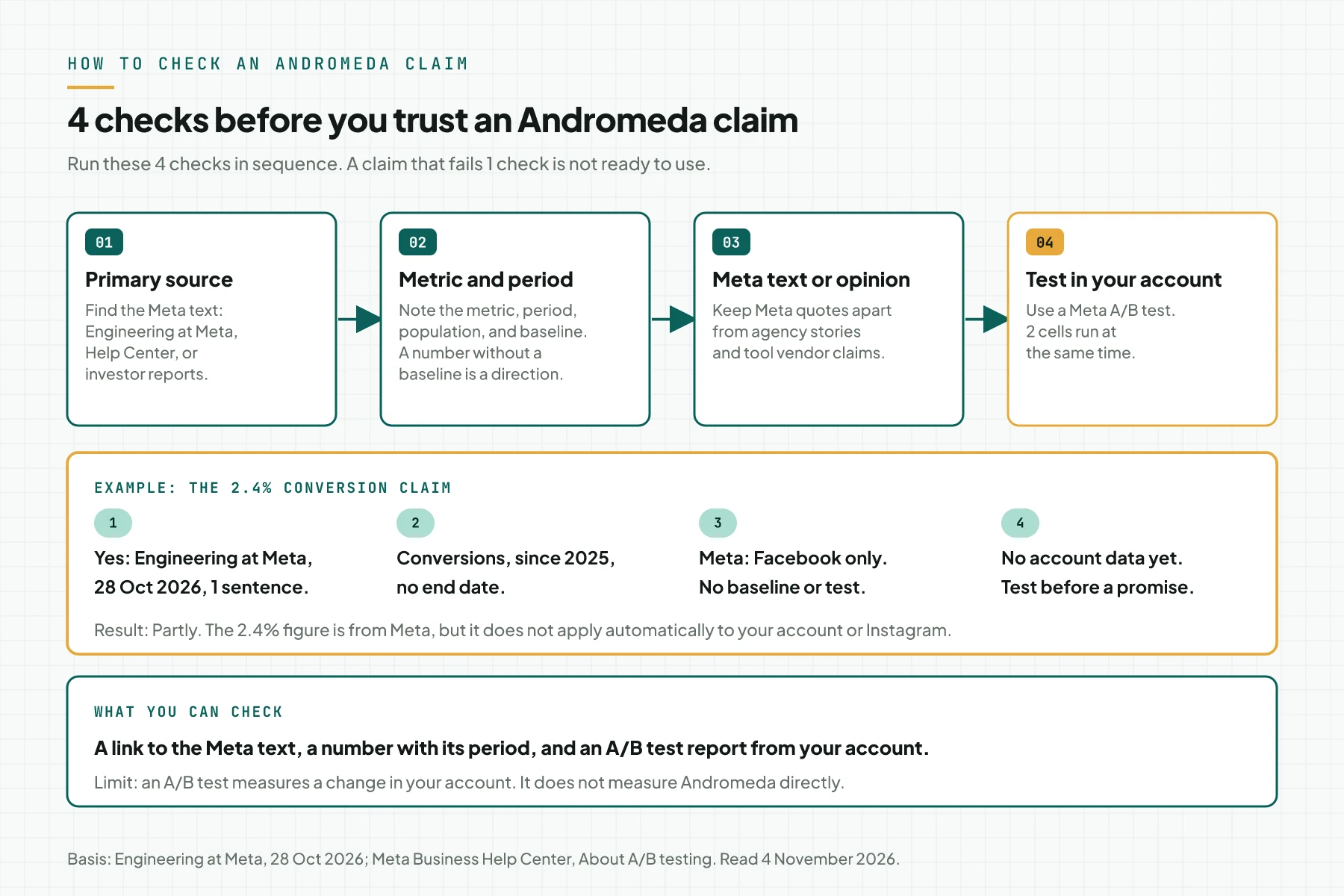
Step 1: Find the primary source from Meta
Open the text that Meta published itself before you read what other parties say about Andromeda.
Use 3 primary sources: Engineering at Meta for architecture, the Meta Help Center for settings, and Meta investor reports for prices.
Evidence: the source link and the date you read it, or the note "no Meta source".
Step 2: Check the metric, period, population, and baseline
Write 4 items for each number: the metric, the period, the population, and the baseline for comparison.
For the 2.4% claim, the metric is conversions and the period is since 2025 with no end date. The population is Facebook, and there is no baseline. A number without a baseline only gives a direction. Evidence: a 4-column table for each number.
Step 3: Separate the Meta text from other readings
Mark each sentence as Meta text, a quote from a Meta spokesperson, or an agency or vendor opinion.
In Marketing Brew, an agency director said that Meta sees 2 identical videos with different text as 1 creative. The Meta spokesperson did not discuss that detail. So the agency sentence is experience, not a Meta document. Evidence: a source label on each sentence.
Step 4: Test the claim in your account with an A/B test
Test the claim with a Meta A/B test, because an A/B test splits people at random and runs 2 versions together.
According to the Meta help page about A/B testing, nobody sees both versions. Meta does not recommend informal tests that turn ad sets on and off. Use the same budget, and write the stop rule before the test. Evidence: an A/B test report with the cost per result in each cell.
Questions and answers
Did Meta ever announce a date for a Meta Andromeda update?
No. Meta published technical posts on 2 December 2024 and 28 October 2026, without a rollout date.
Is Entity ID an official Meta term?
We did not find the term in the 2 Engineering at Meta posts about Andromeda. Meta does not discuss how its models read each creative asset.
How many creatives does Meta recommend for Andromeda?
Meta gives no number. Match the number of concepts to your budget, because each concept needs delivery.
Are lookalikes and interest targeting still useful?
Yes. Meta offers both as suggestions or limits. For retargeting, Meta does not recommend Advantage+ audience.
Does the 2.4% claim apply to Instagram?
Meta names only Facebook and published no Instagram figure, although Andromeda scores ads in both apps.
Next step
A limit still applies: Meta can change Andromeda without an announcement, and these verdicts only check the text up to 4 November 2026. If your team wants us to check the targeting, creative, and conversion signal of your account, see the Meta Ads Performance Management service. To discuss a claim that you saw, book a 30-minute session.
Sources
We read all sources below on 4 November 2026.
- Engineering at Meta: Meta Andromeda, next generation, 28 October 2026.
- Engineering at Meta: Meta Andromeda, 2 December 2024.
- Meta Reports Third Quarter 2026 Results, Form 8-K, 21 October 2026.
- Meta Form 10-Q, third quarter 2026.
- Meta Business Help Center: About Advantage+ audience.
- Meta Business Help Center: About Audience controls and Audience suggestions.
- Meta Business Help Center: About Advantage+ lookalike.
- Meta Business Help Center: About Advantage+ detailed targeting.
- Meta Business Help Center: About A/B testing.
- Meta Business Help Center: creative performance per media asset.
- Meta for Developers: Advantage+ audience, 26 June 2026.
- Marketing Brew: creative diversification, 28 September 2026.
- PPC Land: Andromeda and the 2.4% claim, 28 October 2026.
- Claim pages: Precis, Chatterbuzz Media, Segwise, Confect, AdMakeAI, Welcome.AI, Balistro, and alexneiman.com.