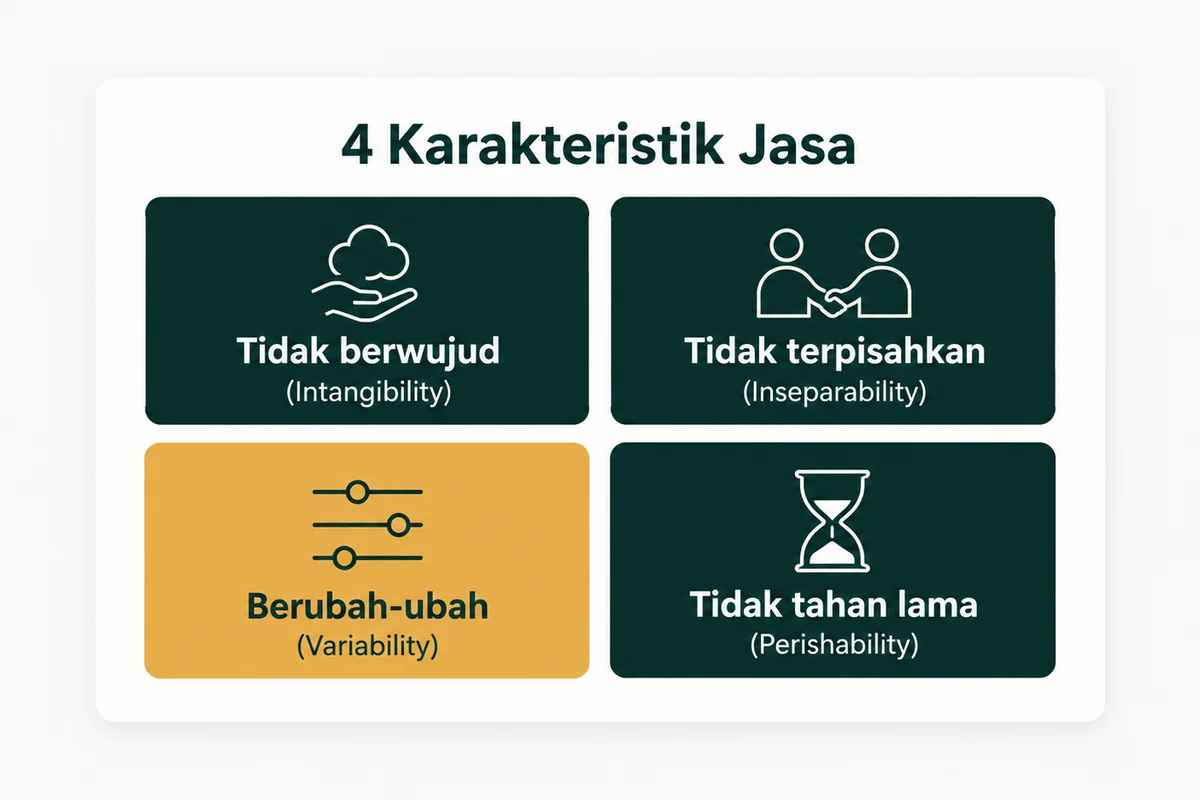
Direct answer: a service has 4 main characteristics. A service is intangible, inseparable from its provider, variable in quality (also called heterogeneous), and perishable. The 4 traits are often shortened to IHIP.
These 4 traits separate a service from a good. You can hold, store, and inspect a good before you buy it. You cannot do that with a service.
| Characteristic | What it means | Example |
|---|---|---|
| Intangibility | The buyer cannot see or hold the service before buying | Tax advice, design work |
| Inseparability | The service is produced and consumed at the same moment | A haircut, a class |
| Variability | The result differs by person, time, and place | A massage, a motorcycle service |
| Perishability | A service cannot be stored and sold tomorrow | An empty seat, a hotel room |
1. Intangibility
A service cannot be seen, touched, smelled, or tested before the purchase. The buyer buys a promise.
So the buyer looks for other signals: a tidy place of business, customer reviews, a certificate, or the way the staff answer a question.
Example: you cannot test a sofa cleaning service before your sofa is cleaned. You judge it from photos of earlier work and from what a neighbour says.
2. Inseparability
A good is made in a factory and sold later. A service is made and used at the same moment, and the buyer is often present inside it.
So the person who does the work becomes part of the product. Other customers also shape the experience, for example a crowded queue at a clinic.
Example: a tutor and a student must share the same room and the same hour. Change the tutor and the service changes with them.
3. Variability or heterogeneity
Two haircuts from 1 salon can differ. The cause is who does the work, at what hour, and how busy the place is.
So a service business writes standards, trains people, and uses checklists. The goal is to narrow the gap between the highest and the lowest result.
Example: a workshop uses a 20-point checklist so a morning service matches an afternoon service.
4. Perishability
A service cannot be stored. An empty seat today cannot be sold again tomorrow, and an idle work hour simply disappears.
So a service business manages demand and capacity: a lower price in quiet hours, an appointment system, and extra staff in the busy season.
Example: a hotel lowers the weekday price and raises the weekend price, because an empty room cannot be saved.
When the question asks for 5 characteristics
Some textbooks add 1 more trait: lack of ownership. A buyer owns nothing after the transaction. The buyer receives a benefit or the right to use something for a period.
Example: an airline passenger buys the right to sit during the flight, not the seat. A gym member buys the right to use the equipment during the membership, not the equipment.
So the list becomes 5: intangibility, inseparability, variability, perishability, and lack of ownership. Name your source when your lecturer uses the 4-trait version.
The 4 traits across 4 sectors
An exam often asks for an example inside one sector. This table uses 1 row per sector.
| Sector | Intangible | Variable | Perishable |
|---|---|---|---|
| Laundry | The customer sees only the finished result | Ironing differs between staff | An idle machine hour cannot be saved |
| Education | Knowledge cannot be held before the class runs | Results differ by teacher and class | An empty class hour disappears |
| Tourism and hotels | The stay is felt only during the stay | Service differs by shift and season | An empty room cannot be sold tomorrow |
| Clinics | A patient judges by credentials and reviews | Examinations differ between doctors | An empty appointment slot disappears |
The inseparability column is missing on purpose, because the answer is the same for all 4 sectors: the service is produced while the customer is present.
How a service differs from a good
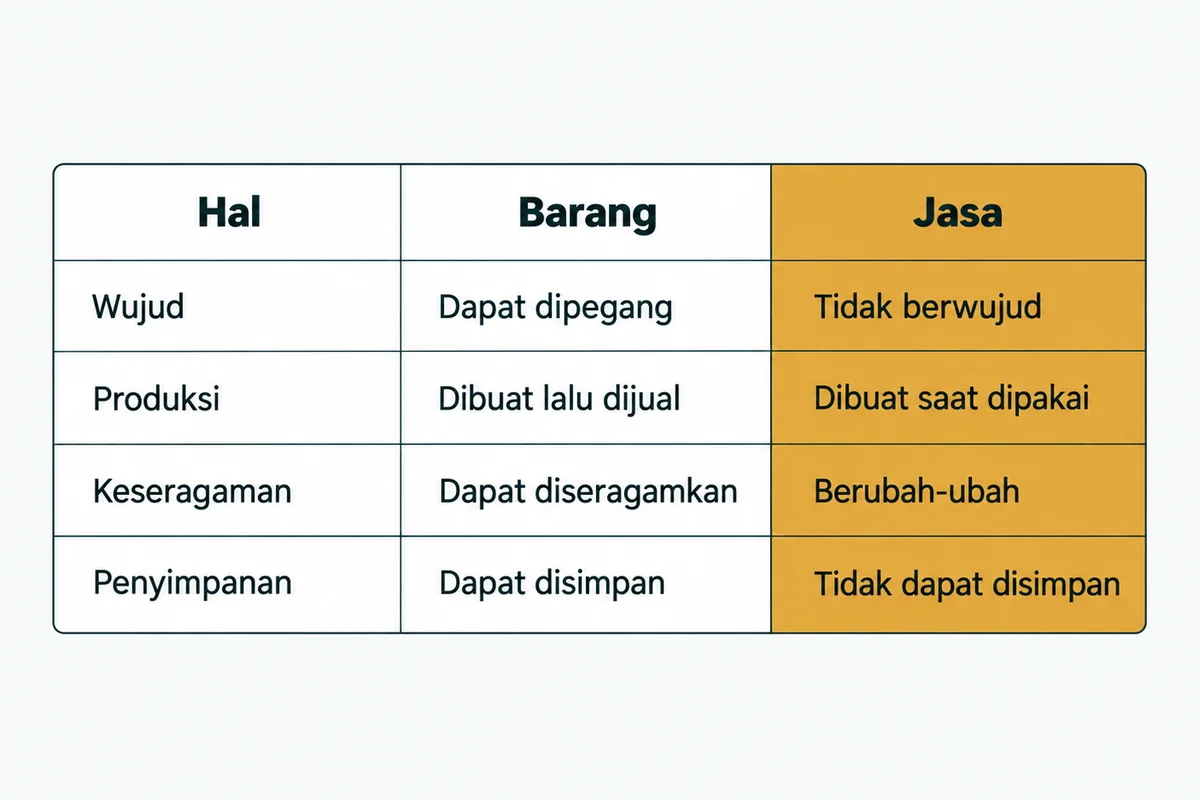
An exam question often reads "name the 4 main characteristics that separate a service from a good". This table is the answer.
| Aspect | Good | Service |
|---|---|---|
| Form | Tangible, can be held | Intangible |
| Production and use | Separated in time and place | Happen together |
| Uniformity | Can be standardised | Varies by person and time |
| Storage | Can be held as inventory | Cannot be stored |
| Ownership | Passes to the buyer | Does not pass, the buyer receives a benefit |
| Quality check | Inspected before the purchase | Judged during and after use |
The characteristics according to Kotler, and the academic source
Marketing Management by Philip Kotler and Kevin Lane Keller summarises the same 4 characteristics: intangibility, inseparability, variability, and perishability. That book is the one most marketing courses quote.
The original source is older. Valarie Zeithaml, A. Parasuraman, and Leonard Berry described the traits and the problems that follow them in Problems and Strategies in Services Marketing, Journal of Marketing, volume 49 number 2, 1985, pages 33 to 46.
The same authors then built a service quality model in A Conceptual Model of Service Quality, Journal of Marketing, volume 49 number 4, 1985. That model produced SERVQUAL.
Some lecturers use the IHIP acronym: intangibility, heterogeneity, inseparability, perishability. The content is the same, only the order differs.
A service and a service firm are different questions
These 2 terms get mixed up in exams. The characteristics of a service describe the product. The characteristics of a service firm describe the business, and usually belong to an accounting class.
| Question | The answer is about |
|---|---|
| Characteristics of a service | The product: intangible, inseparable, variable, perishable |
| Characteristics of a service firm | The business: it sells expertise, holds no merchandise inventory, records revenue when the work is delivered, and reports no cost of goods sold |
Read the question first. If it says "service firm" inside an accounting chapter, the second row is the answer.
4 mistakes that cost marks
- Naming the traits with no example. The examiner looks for proof that you understand, and an example is that proof.
- Swapping inseparability and perishability. Inseparability is about the moment of production. Perishability is about storage.
- Answering with service firm traits. Check the chapter the question belongs to.
- Writing the traits in English only. Write both the local term and the original term, so the answer still reads correctly when the examiner uses the other one.
What the 4 traits mean for a service business owner
This part sits outside the exam, and it is the reason the 4 traits matter.
- Intangible means you sell evidence. Photos of finished work, named reviews, and a written scope replace the product a buyer cannot hold.
- Inseparable means your people are the product. Training the staff moves the result more than one extra advert.
- Variable means standards decide your reputation. A written checklist cuts complaints faster than an apology.
- Perishable means the calendar is money. An idle hour is gone, so an appointment system and quiet-hour pricing become the main tools.
I cover how to check whether the advertising for a service business pays for itself in how to calculate ROAS and break-even ROAS.
Checklist for answering the question
- Write the 4 characteristics with both the local term and the original term.
- Give 1 real example for each one.
- State the consequence for the buyer, not only the definition.
- Check whether the question asks about a service or a service firm.
- Name a source in an essay answer, for example Kotler or Zeithaml 1985.
- Use a comparison table when the question asks how a service differs from a good.
Questions people ask
What are the 4 characteristics of a service? A service is intangible, inseparable from its provider, variable in quality, and perishable.
What does IHIP mean in services marketing? IHIP stands for intangibility, heterogeneity, inseparability, and perishability. It holds the same 4 traits in a different order.
What is the easiest difference between a good and a service? A good can be stored and inspected before the purchase, while a service is created as it is used and cannot be stored.
Do Kotler's characteristics differ from the others? No. Kotler and Keller use the same 4 traits, and the early academic source is the 1985 paper by Zeithaml, Parasuraman, and Berry.
What is an example inside a laundry business? It is intangible because the customer sees only the result, inseparable because the work starts after the customer arrives, variable because ironing differs between staff, and perishable because an idle machine hour cannot be saved.
Why is service quality hard to keep equal? People deliver it at different hours and under different conditions. Written standards, training, and checklists narrow the gap, but they do not remove it.
Sources
- Zeithaml, Parasuraman, and Berry, Problems and Strategies in Services Marketing, Journal of Marketing, volume 49 number 2, 1985, pages 33 to 46. The source of the service traits and the problems that follow them.
- Parasuraman, Zeithaml, and Berry, A Conceptual Model of Service Quality and Its Implications for Future Research, Journal of Marketing, volume 49 number 4, 1985. The basis of the service quality model and SERVQUAL.
- Philip Kotler and Kevin Lane Keller, Marketing Management. The textbook that summarises the 4 characteristics used in marketing courses.