In mid-November 2026, Google Ads published a help page for 1 feature that has no on/off switch. The feature turns on by itself in every Search campaign that uses Smart Bidding, with no sign-up. Its name is Search Journey Awareness, and it makes Smart Bidding learn from conversionsConversionThe action you count as a result, for example a paid order, a sign-up, or a chat that becomes a qualified buyer.Open the glossary that you do not use for bidding.
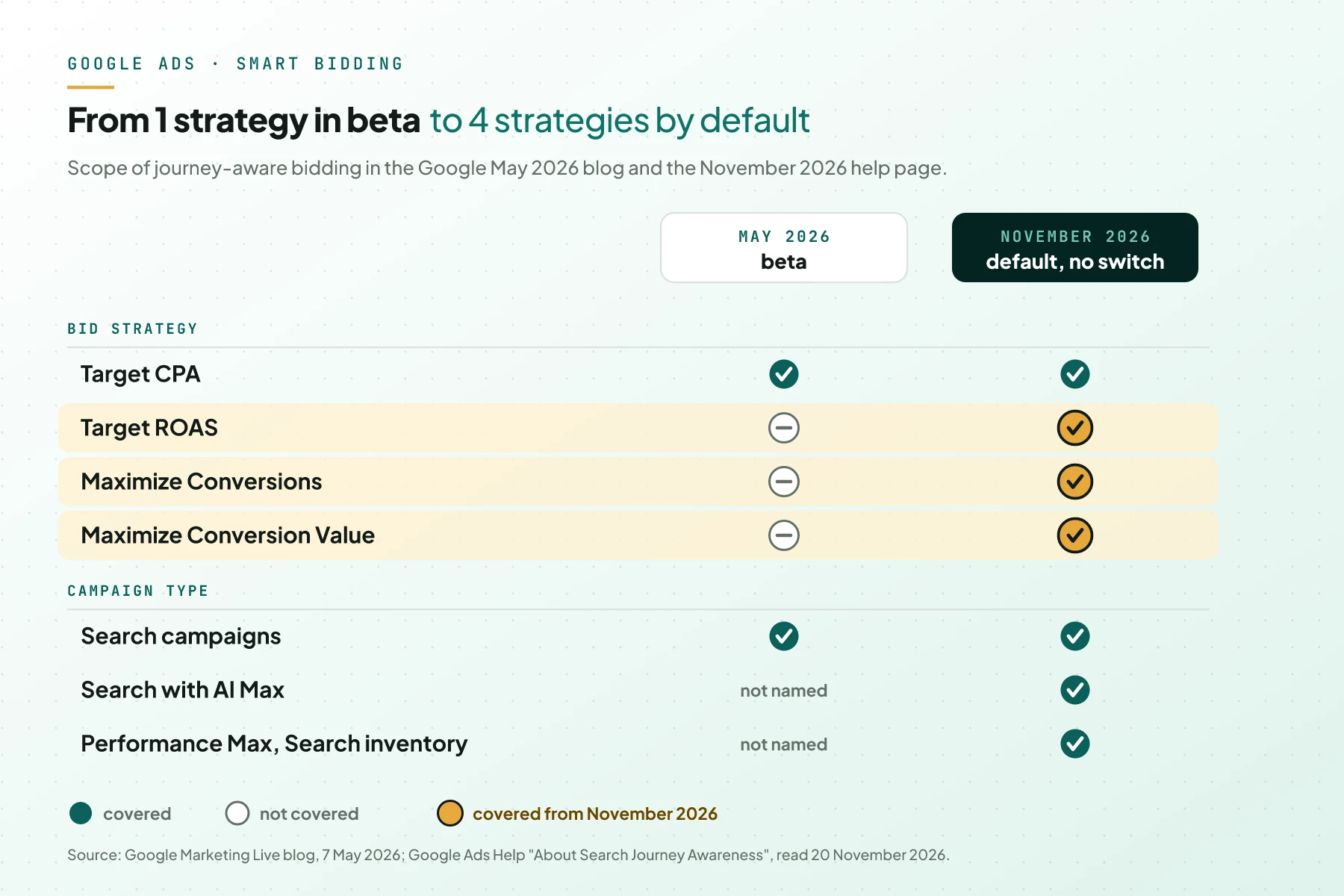
In May 2026, the same feature was in beta for 1 bid strategy. Now it is the default for 4 strategies.
This change gives a new meaning to the Goals page in your account. Before, secondary conversion actions only filled reports. Now those actions also teach bidding, 3 weeks before the 12.12 sales season.
One sentence in a help page replaced a beta program
Google now turns on Search Journey Awareness by itself for Search campaigns with Smart Bidding, with no sign-up and no on/off switch.
The rule is in the About Search Journey Awareness page in Google Ads Help, which we read on 20 November 2026. The feature turns on when an account meets 3 conditions. Condition 1: a Search campaign, including AI Max, or Search inventory in Performance Max.
Condition 2: the Target CPACPAThe average cost of 1 result, for example 1 order or 1 qualified buyer.Open the glossary, Target ROASROASRevenue from ads divided by ad spend. A ROAS of 4 means each Rp 1,000 of ad spend returns Rp 4,000 of gross revenue.How to calculate ROAS and break-even ROAS, Maximize Conversions, or Maximize Conversion Value bid strategy. Condition 3: the account sends conversion signals from the full buyer journey. The page says that the feature is currently for Search only.
Barry Schwartz of Search Engine Roundtable reported the page on 17 November 2026, with a screenshot dated 16 November. In his view, the feature is not new, but the page is.
The new part is the scope. On 7 May 2026, the Google Marketing Live blog said the feature was in beta, and only for Search campaigns that optimize to Target CPA.
The plan for this feature was public since a Search Engine Roundtable report on 17 November 2025, for 2026. Up to 20 November 2026, we found no other Google announcement about the expansion to 4 strategies, apart from the help page.
Secondary conversions only filled reports, and now they also teach bidding
Smart Bidding still bids for the primary goal, but it now also learns from conversion actions that the account does not use for bidding.
The About conversion goals page divides conversion actions into 2 roles. Primary actions are used for bidding and go into the Conversions column. Secondary actions are for observation only and go into the All conversions column.
Search Journey Awareness changes the role of secondary actions. Smart Bidding now reads patterns from early steps, such as sign-ups, and from deep steps, such as purchases. Reports do not change: the Conversions column still shows primary actions only.
Take a service business that sells through WhatsApp. A buyer clicks an ad, clicks the WhatsApp button, asks for a quote, then pays. If only the payment is primary, Smart Bidding used to learn only from the payment.
| Buyer step | Example action | Category in Google Ads | Recommended role |
|---|---|---|---|
| First contact | Click on the WhatsApp button | Contact | Secondary |
| Serious interest | Quote request | Request quote | Secondary |
| Qualified lead | Lead passes the sales team check | Qualified lead | Secondary |
| Sale | Payment received | Converted lead or Purchase | Primary |
Now Smart Bidding also sees which clicks bring chats and quote requests. This helps when payments are few.
Google Ads coach Jyll Saskin Gales described the feature, when it was still a plan in November 2025, as "like using micro-conversions without actually having to implement micro-conversions." On her blog on 7 May 2026, she wrote that lead gen accounts with few quality leads are the most likely to benefit.
Google says 2 different things about secondary conversions
One Google page says secondary actions are for observation only, while the Search Journey Awareness page says Smart Bidding learns from them.
The About conversion goals page still uses the word observation for secondary actions. The Search Journey Awareness page says Smart Bidding learns from actions that are not used for bidding. We read both pages on 20 November 2026.
The FAQ on the new page adds 2 limits. First, more secondary actions do not damage a campaign, because Smart Bidding ignores secondary signals that it predicts are not useful. Second, a change to a secondary action does not change active bidding performance.
So Google keeps the effect of secondary actions small by design, and that effect is difficult to measure from outside. The page gives no result numbers for this feature. Do not expect cost per conversion to fall next week because you fixed the labels.
One rule is clear: the Default category is not supported. An action in that category does not help this feature, whatever it measures.
Before 12.12, the risk is the primary goal, not the secondary labels
A change to a primary goal makes Smart Bidding learn again for 1 to 2 conversion cycles in most cases, the Google Ads guide says.
The guide to conversion goal changes gives that learning time for almost all changes. Examples are a new goal, an added or removed primary action, and a changed action category. The Search Journey Awareness page also warns about short-term performance changes after such a change.
A conversion cycle is the delay from click to conversion. If your delay is 7 days, 2 cycles are 14 days. A primary goal change on 28 November completes its learning at about 12 December.
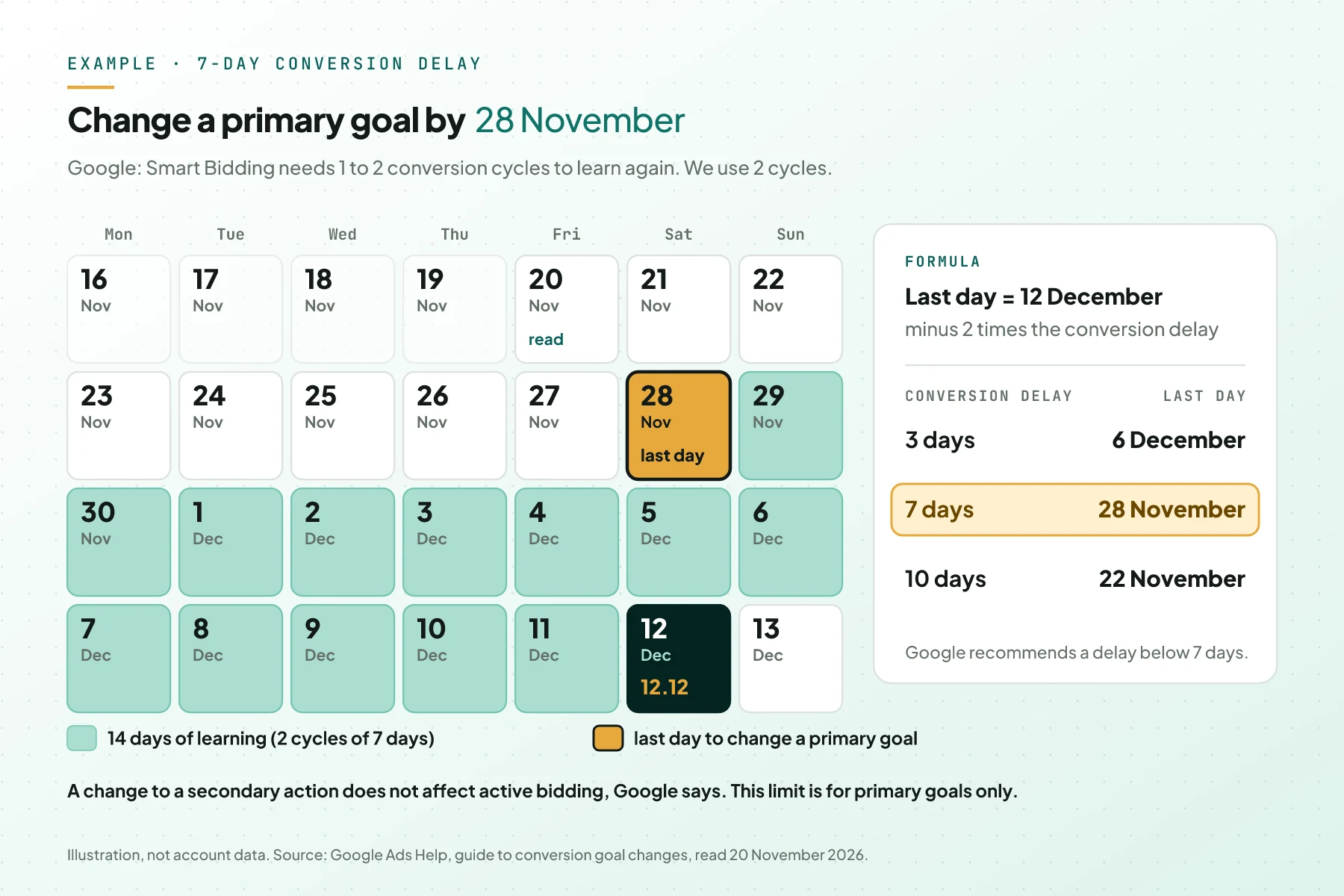
Calculate your own last day: 12 December minus 2 times your conversion delay. With a 10-day delay, the last day is 22 November. With a 3-day delay, the last day is 6 December.
The same guide gives 1 more sequence. Set budgets to the amount that you plan to spend before you change conversion tracking. If you must change a goal before 12.12, set the sales budget first, then change the goal.
When you prepare the account for 12.12, also check the clicks that Google did not charge on the Google Ads Invalid traffic card. That card uses the same data as your cost reports.
In Indonesia, the buyer path often ends outside the view of Google Ads
The Search Journey Awareness page names no country, and the Indonesian Google Ads Help shows the same English text.
We cannot confirm from outside an account that the feature is active for Indonesian accounts. We also found no data on the number of Indonesian accounts that use the 4 strategies.
You can check 1 thing yourself. If your sale ends in a WhatsApp chat and a bank transfer, both steps occur outside your website. Google Ads does not see them unless you upload the data.
For that upload, Google recommends enhanced conversions for leads as the start, not the old offline conversion import. Without that data, the deepest step that Smart Bidding sees is the WhatsApp click. Search Journey Awareness then has no final step to learn from.
The delay is also important. Google recommends a conversion delay below 7 days for the final goal. If your buyers usually pay 2 weeks after the chat, the payment signal arrives later than that recommendation.
If you upload data from more than 1 source, first read how to prevent double counts in the article on Data Manager in Google Analytics.
Four checks on the Goals page this week, from the safest first
Do the first 3 checks at any time, then decide check 4 with the last day from your conversion delay.
| Check | Location | Warning sign | Action |
|---|---|---|---|
| 1. Default category | Goals, conversion summary | A secondary action is still in the Default category | Move it to the correct goal with the 3-dot icon, then Change to another goal |
| 2. Missing steps | List of conversion actions | No action for chats, quotes, or qualified leads | Add those actions as secondary |
| 3. Report columns | Conversions and All conversions columns, last 30 days | The 2 numbers are equal | The account sends no secondary signals yet. Start with check 2 |
| 4. Primary goal | Goal settings in the Search campaign | An early step, such as a WhatsApp click, is primary while payment data exists | Change it before your last day, or wait until after 12 December |
Use 1 rule for check 4. If today is later than 12 December minus 2 times your conversion delay, do not change the primary goal until the sales period ends.
Do not remove old actions when you clean up. Google says that you should not replace or remove existing signals when you restructure goals.
Google removed the on/off switch, but it did not remove your work. You still give each step its label, and Smart Bidding learns only from the steps that you record.
Questions and answers
Can I turn off Search Journey Awareness?
No. The Google Ads page, read on 20 November 2026, says there is no on/off switch. The feature is active for Search campaigns with Target CPA, Target ROAS, Maximize Conversions, or Maximize Conversion Value.
Can more secondary conversions reduce campaign performance?
Google says no. Smart Bidding ignores secondary signals that it predicts are not useful. We have not seen test data from a third party for this claim.
How long does Smart Bidding learn again after a primary goal change?
Google says 1 to 2 conversion cycles in most cases. If the delay from click to conversion is 7 days, plan for up to 14 days.
Does this feature apply to Performance Max?
Only to the Search inventory in Performance Max. The page says the feature is currently for Search only, so other Performance Max channels are not included.
If you want us to map the buyer steps from ad click to payment, open the Rama Digital ad tracking class.