Direct answer: Uncanny Toolkit for LearnDash 3.8.2 and older has 2 critical flaws with a CVSS 3.1 score of 9.8. CVE-2026-65555 is a privilege escalation flaw. CVE-2026-119096 lets accounts that an admin did not verify still log in. Today, check the version, update to 3.8.3, then look for signs.
The vendor released 3.8.3 on 29 October 2026. That release closes both flaws. On 9 November 2026, both flaws are not in CISA KEV and have no attack reports.
Main condition: Every site with plugin version 3.8.2 or older must update, because the vendor does not name the CVE-2026-65555 module. The risk goes up when Front End Login uses manual user verification and sign-up is open. Limit: This article has no request contents, parameter values, payloads, or attack sequence.
We read the CVE-2026-65555 record, the CVE-2026-119096 record, the Patchstack advisory, the Uncanny Toolkit plugin page, and the CVE record API on 9 November 2026, from 06.30 to 07.00 WIB. We tested 3 check scripts, a plugin update, and a plugin-off step in podman containers with the official WordPress, WP-CLI, and MariaDB images. We did not test an attack.
Problem: 2 critical flaws in a course login plugin
Uncanny Toolkit for LearnDash is a free add-on plugin from Uncanny Owl for the LearnDash LMS. The plugin page shows 20,000 active installs. Online course sites use it for the login page, the verification of new students, and the User Switching feature for admins.
The CVE-2026-65555 record gives CVE-2026-65555 the class CWE-266, Incorrect Privilege Assignment. The CVSS vector shows AC:L, PR:N, and UI:N, so the attack is easy and needs no login. The impact is C:H, I:H, and A:H, so the confidentiality, integrity, and availability of the site can all take full damage.
The CVE-2026-119096 record gives CVE-2026-119096 the class CWE-287, Improper Authentication. Its score is also 9.8. This flaw is in the account verification gate of the Front End Login module.
The CVE-2026-65555 report reached Patchstack on 26 October 2026. The vendor released 3.8.3 on 29 October. The CVE-2026-119096 record came out on 31 October, the Patchstack advisory on 2 November, and the CVE-2026-65555 record on 4 November 2026.
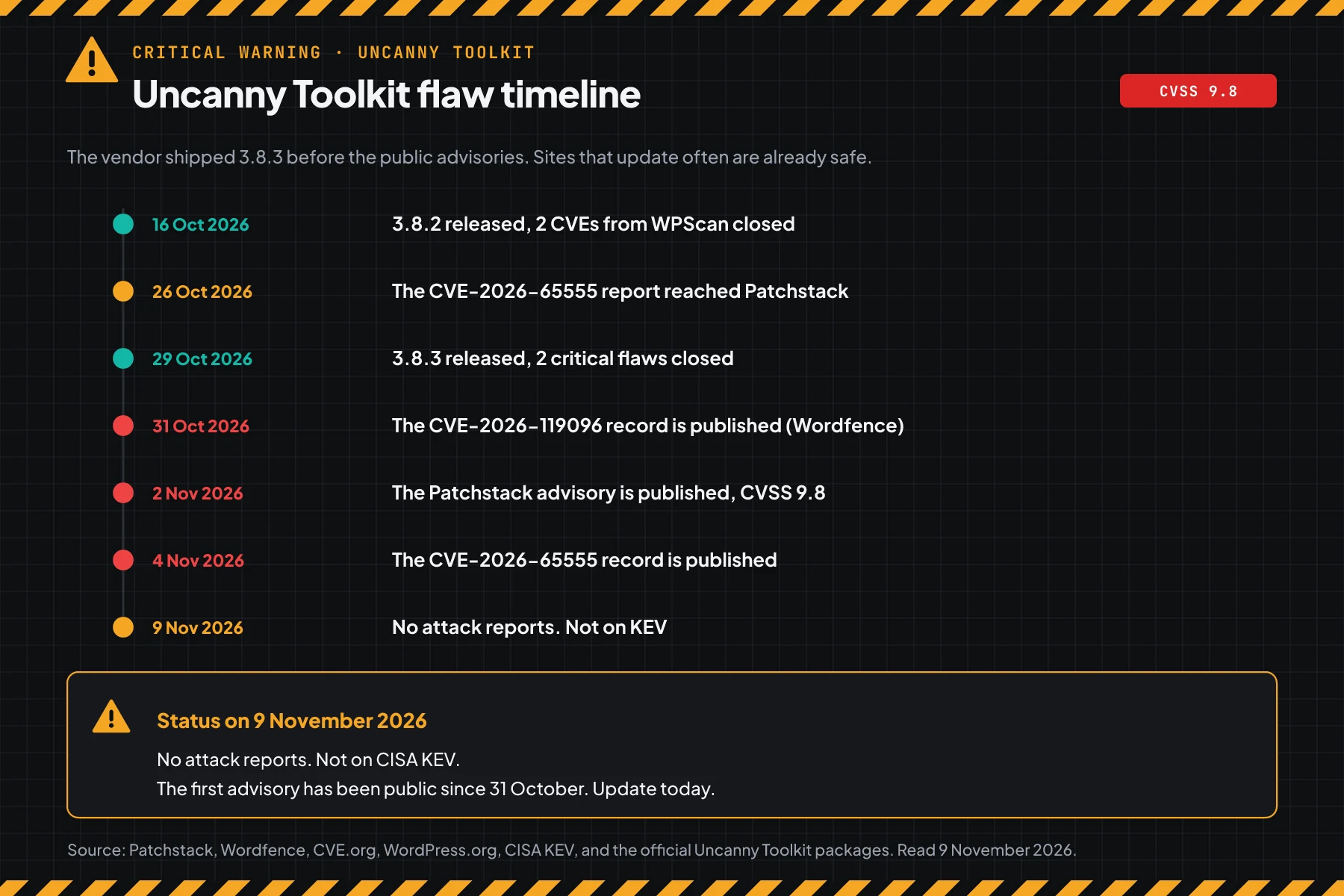
On 9 November 2026, both flaws are not in CISA KEV (catalog 2026.11.06). Patchstack, Wordfence, and the vendor have no attack reports. Patchstack has no virtual patch rule for CVE-2026-65555, so the update is the only official fix.
How it works: access rights and the verification gate
This section uses the official summaries and the patch contents. Its purpose is to help you choose your steps, not to explain how to attack.
Summary from the CVE records
CVE-2026-65555: Patchstack writes that the plugin gives the wrong access rights, so a person can raise their access rights. Patchstack does not name the module or the function. The safe release is 3.8.3.
CVE-2026-119096: the Wordfence advisory says that the account verification gate in the plugin login function can be skipped. A person who knows the password of an account that is not verified, or of an account that an admin suspended, can still log in and get a session.
What release 3.8.3 changes
The 3.8.3 changelog lists 3 security fixes. We also compared the code in the official 3.8.2 and 3.8.3 packages:
- Front End Login: accounts with a correct password could skip manual user verification. In 3.8.3, the "not verified" check runs inside the WordPress login flow, on the same account that logs in (the new function
block_unverified_ajax_login). - Front End Login: the WP 2FA integration could complete a login without a full second factor. In 3.8.3, the 2FA token carries a single-use login nonce (the function
consume_login_nonce). - User Switching: the built-in library goes up to User Switching 1.12.2.
Rama Digital analysis: the Front End Login fix matches CVE-2026-119096. Patchstack does not say which fix closes CVE-2026-65555, so we do not guess the module. Treat every site with version 3.8.2 or older as exposed. Limit: we read the code and did not test an attack.
Exploitation status on 9 November 2026
| Source | Status |
|---|---|
| CISA KEV | Not listed (catalog 2026.11.06) |
| CVE-2026-65555 record (CVSS 3.1) | Score 9.8, Critical class, CWE-266 |
| CVE-2026-119096 record (CVSS 3.1) | Score 9.8, Critical class, CWE-287 |
| Patchstack and Wordfence | No exploitation reports |
| Uncanny Owl | Both flaws closed in 3.8.3, the latest version on 9 November 2026 |
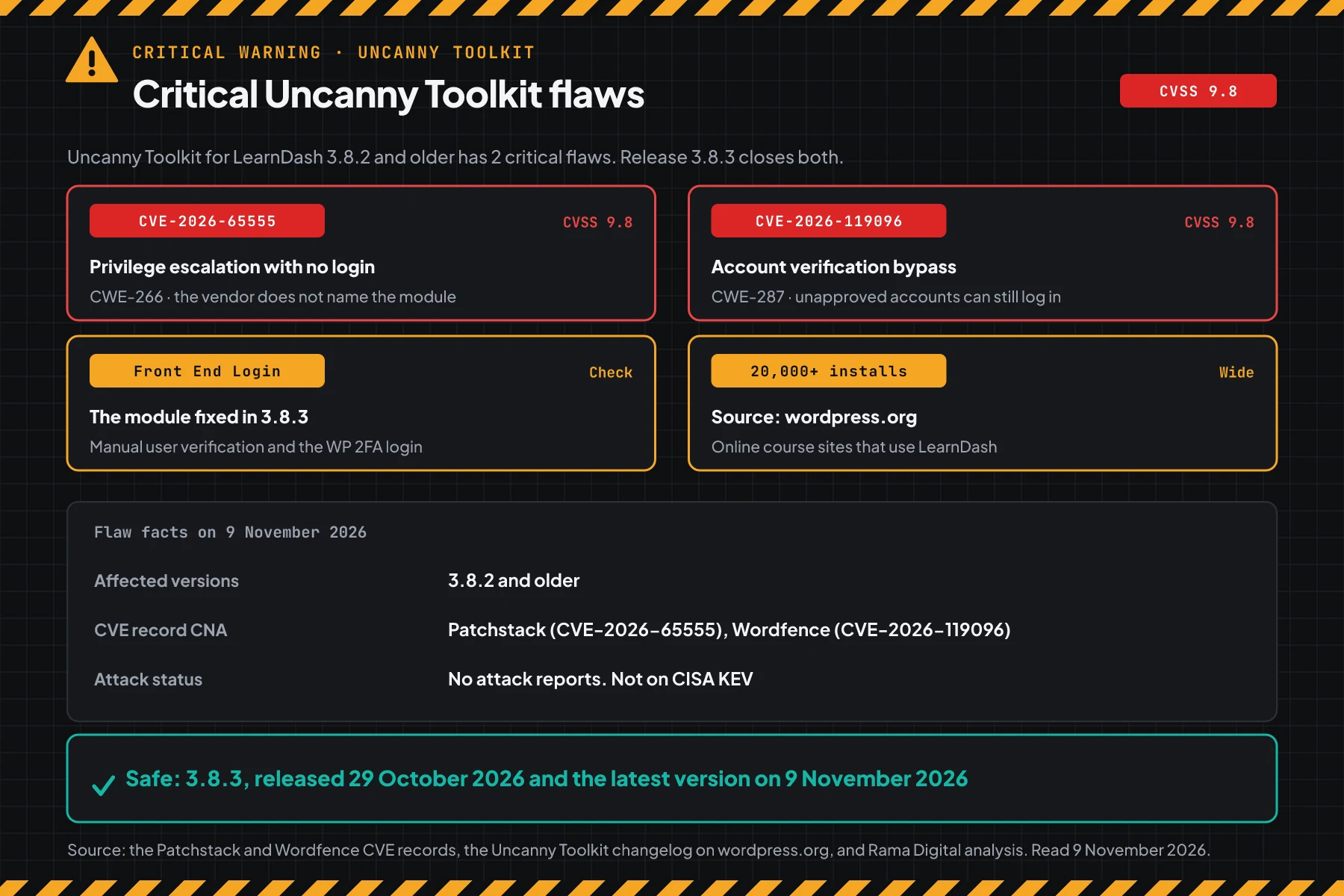
A score of 9.8 is in the Critical class. The impact is an account with higher rights or an account that should stay on hold, which can open student data and course payment data. We write a critical warning even with no attack reports.
Who is most at risk
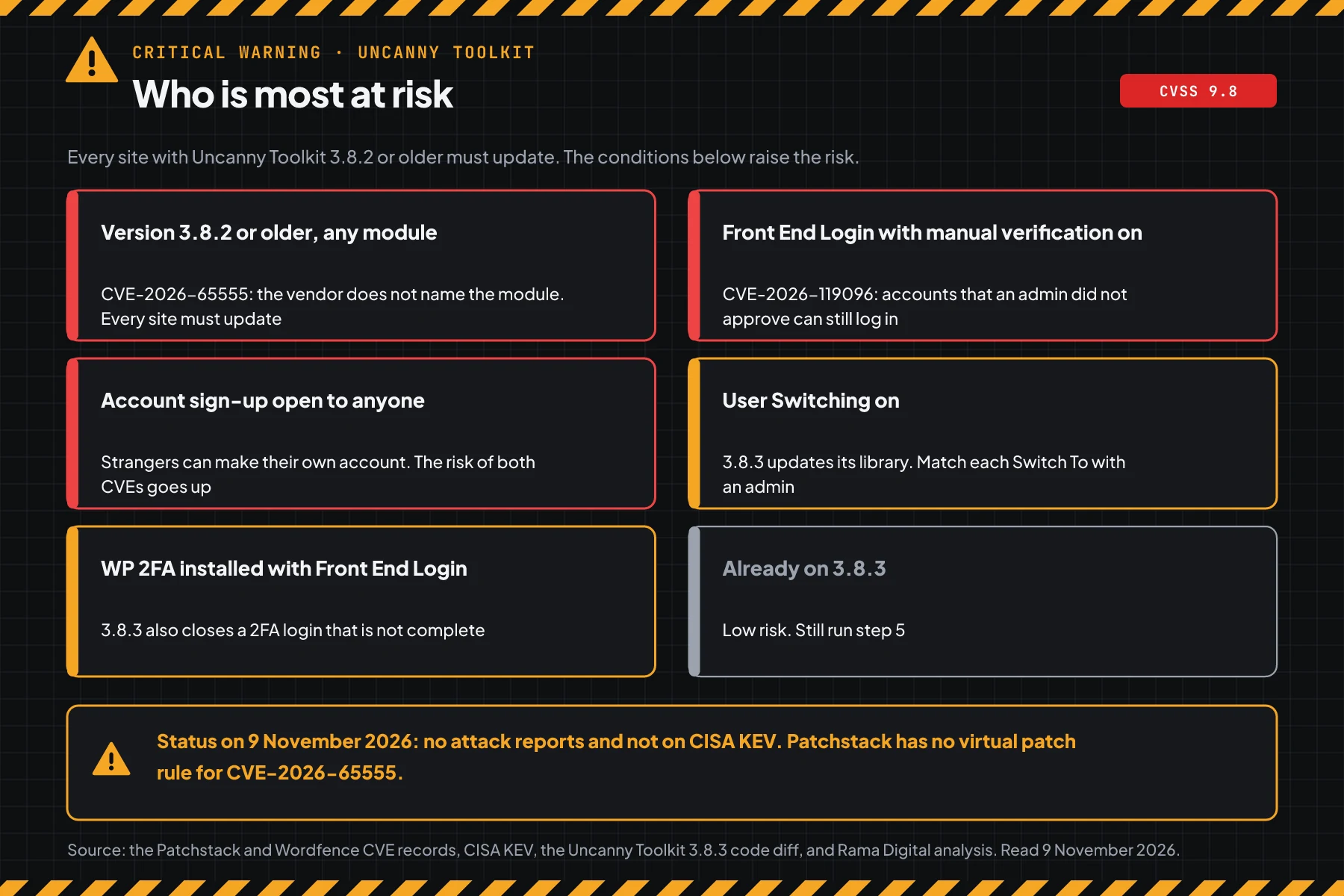
The risk depends on the version, the active modules, and the sign-up settings. The vendor does not name the CVE-2026-65555 module, so every site with an old version must update. This table helps you sort your sites when you manage many sites.
| Site condition | Risk | Reason |
|---|---|---|
| Version 3.8.2 or older, any module | High | CVE-2026-65555 does not name a module |
| Front End Login with manual user verification on | Highest | CVE-2026-119096: accounts that an admin did not approve can still log in |
| Account sign-up open to anyone | High | Strangers can make their own account, so the risk of both CVEs goes up |
| User Switching on | Check | 3.8.3 updates the User Switching library |
| WP 2FA installed with Front End Login | Check | 3.8.3 also closes a 2FA login that is not complete |
| Already on 3.8.3 | Low | Still look for signs from the time before the update |
Course sites often use more plugins that hold sign-up data. Also check form plugins, for example the JetFormBuilder form plugin flaw CVE-2026-119481, and booking plugins, for example the LatePoint booking plugin flaw CVE-2026-118066. Also patch the WordPress core, for example for the WordPress core update flaw CVE-2026-119977.
Vulnerable and safe versions
Uncanny Toolkit 3.8.2 and older is vulnerable to CVE-2026-65555 and CVE-2026-119096. Versions below 3.8.2 are also vulnerable to 2 more CVEs from WPScan. Version 3.8.3 closes all 4 CVEs.
| Uncanny Toolkit version | Status on 9 November 2026 | Update to |
|---|---|---|
| Below 3.8.2 | Vulnerable to 4 CVEs, 2 of them critical (9.8) | 3.8.3 |
| 3.8.2 | Vulnerable to CVE-2026-65555 and CVE-2026-119096 | 3.8.3 |
| 3.8.3 | Safe from 4 CVEs on 9 November 2026 | Use this version |
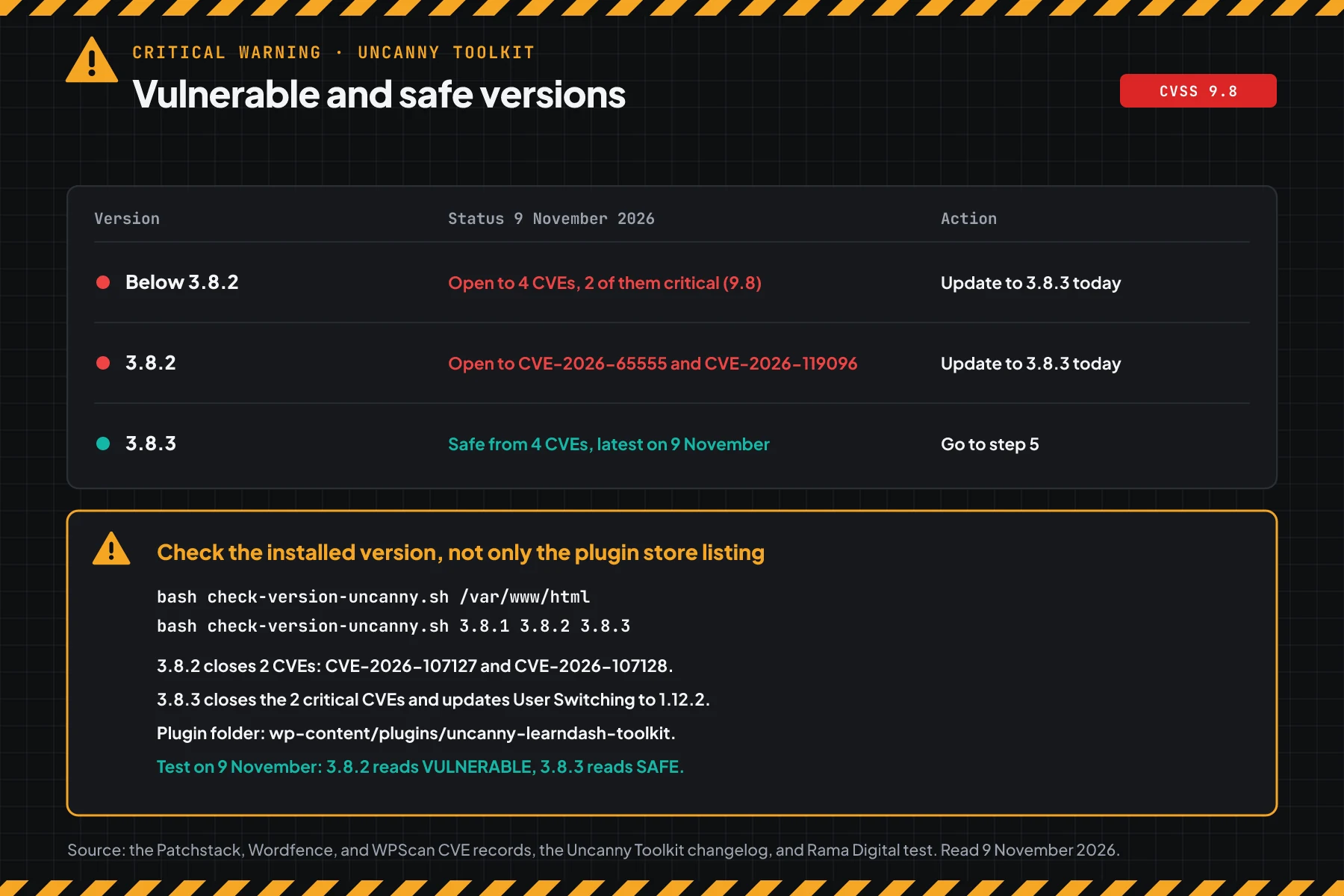
The version data comes from the CVE-2026-65555 record, the CVE-2026-119096 record, and the changelog on the Uncanny Toolkit plugin page. The 3.8.3 changelog lists fixes for Front End Login, the WP 2FA integration, and the User Switching library.
4 Uncanny Toolkit CVEs that you must know
This table shows the CNA, the publish date, the score, the class, and the first safe version. The scores of CVE-2026-107127 and CVE-2026-107128 come from the CISA rating in the CVE records.
| CVE | CNA | Published | CVSS 3.1 | Class | Safe in |
|---|---|---|---|---|---|
| CVE-2026-65555 | Patchstack | 4 Nov | 9.8 | Privilege escalation (CWE-266) | 3.8.3 |
| CVE-2026-119096 | Wordfence | 31 Oct | 9.8 | Account verification bypass (CWE-287) | 3.8.3 |
| CVE-2026-107127 | WPScan | 21 Oct | 7.5 | Password reset with no request origin check | 3.8.2 |
| CVE-2026-107128 | WPScan | 21 Oct | 5.0 | A multisite subsite admin changes the verification of other accounts | 3.8.2 |
Before you start
- SSH access with sudo to the server, or an administrator account in the WordPress dashboard.
- WP-CLI on the server when you use the
wpcommands. Steps 1, 3, and 4 also work in the dashboard. - A recent backup of the database and the files, for example a VPS snapshot or a backup from the hosting panel.
- Access to the web server access logs, for example
/var/log/apache2/or/var/log/nginx/. - A list of all WordPress sites that use Uncanny Toolkit, also staging sites and old course sites.
Step 1: Check the Uncanny Toolkit version
Save this script as check-version-uncanny.sh in the ~/cek folder. The script reads the Version header from uncanny-learndash-toolkit.php, then compares it with versions 3.8.2 and 3.8.3.
#!/usr/bin/env bash
# Check the Uncanny Toolkit for LearnDash plugin version against CVE-2026-65555 and CVE-2026-119096 (CVSS 3.1 9.8).
# Data: CVE records from the Patchstack, Wordfence, and WPScan CNAs, and the official changelog on wordpress.org.
# Use on the server: sudo bash check-version-uncanny.sh /var/www/html
# Use for versions that you copied: bash check-version-uncanny.sh 3.8.1 3.8.2 3.8.3
# The script only reads files. The script changes nothing.

# 3.8.2 fixes CVE-2026-107127 and CVE-2026-107128. 3.8.3 fixes CVE-2026-65555 and CVE-2026-119096.
SAFE_OLD=3.8.2
SAFE=3.8.3

# lower A B: true when version A is below version B.
lower() { [ "$1" != "$2" ] && [ "$(printf '%s\n%s\n' "$1" "$2" | sort -V | head -n1)" = "$1" ]; }

check() {
  local v="$1"
  if ! [[ $v =~ ^[0-9]+\.[0-9]+(\.[0-9]+){0,2}$ ]]; then
    printf '%-7s UNKNOWN, compare it with the safe version table by hand\n' "$v"
    return
  fi
  if lower "$v" "$SAFE_OLD"; then
    printf '%-7s VULNERABLE to 4 CVEs, 2 critical (9.8) -> update to %s today\n' "$v" "$SAFE"
  elif lower "$v" "$SAFE"; then
    printf '%-7s VULNERABLE to CVE-2026-65555 and CVE-2026-119096 (9.8) -> update to %s today\n' "$v" "$SAFE"
  else
    printf '%-7s SAFE for the 4 CVEs in releases 3.8.2 and 3.8.3\n' "$v"
  fi
}

DIR=/var/www/html
VERSIONS=()
for x in "$@"; do
  if [ -d "$x" ]; then DIR="$x"; else VERSIONS+=("$x"); fi
done

if (( ${#VERSIONS[@]} > 0 )); then
  for v in "${VERSIONS[@]}"; do check "$v"; done
  exit 0
fi

FILE="$DIR/wp-content/plugins/uncanny-learndash-toolkit/uncanny-learndash-toolkit.php"
if [ ! -r "$FILE" ]; then
  echo "Cannot read the plugin file: $FILE"
  echo "Give the WordPress folder as an argument, for example: sudo bash check-version-uncanny.sh /var/www/html"
  echo "If Uncanny Toolkit is not installed, you have nothing to do for this CVE."
  exit 1
fi
v=$(sed -nE 's/^[[:space:]]*\*?[[:space:]]*Version:[[:space:]]*([0-9.]+).*/\1/p' "$FILE" | head -n1)
echo "WordPress folder: $DIR"
check "${v:-unreadable}"
# On the server: read the version from the plugin folder
sudo bash check-version-uncanny.sh /var/www/html
# Check versions that you noted from other sites
bash check-version-uncanny.sh 3.8.1 3.8.2 3.8.3
# Manual check without the script
grep -i "Version:" /var/www/html/wp-content/plugins/uncanny-learndash-toolkit/uncanny-learndash-toolkit.php
cd /var/www/html && sudo -u www-data wp plugin get uncanny-learndash-toolkit --field=version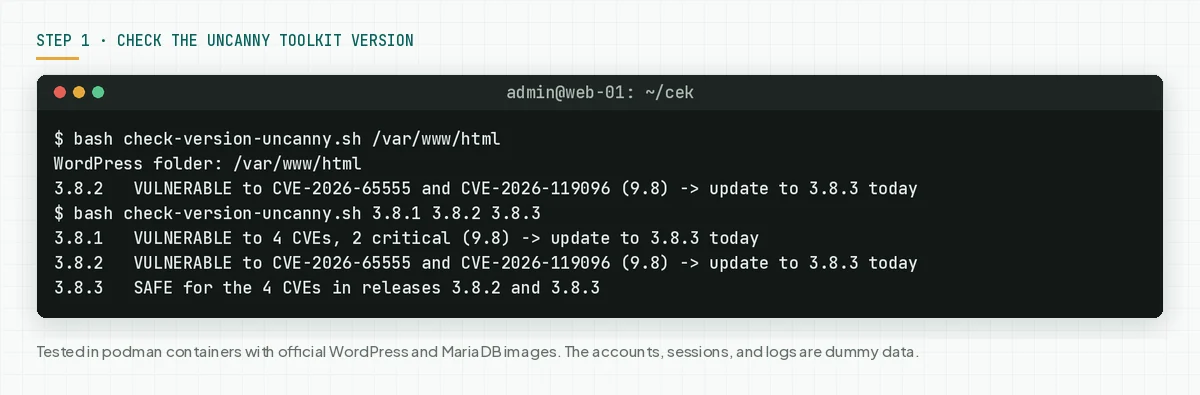
In the dashboard, open Plugins > Installed Plugins. The Uncanny Toolkit for LearnDash row shows your version.
Check the result: "VULNERABLE" means go to steps 2 and 3 today. "SAFE for the 4 CVEs" still means run step 5, because the advisories were public before your update.
Step 2: Check the exposed modules and settings
This script answers 5 questions: which plugin version you have, whether Front End Login and User Switching are on, whether manual user verification is on, whether sign-up is open, and how many accounts are not verified.
Save this script as check-exposure-uncanny.sh. The script uses WP-CLI to read the plugin settings and the user data. The script only reads and does not change data.
#!/usr/bin/env bash
# Check the exposure to CVE-2026-65555 and CVE-2026-119096: the Uncanny Toolkit version, the Front End Login and
# User Switching modules, manual user verification, open registration, and accounts that are not verified.
# Use: sudo -u www-data bash check-exposure-uncanny.sh /var/www/html
# The script uses WP-CLI to read data. The script only reads. The script sends no attack request.

DIR="${1:-/var/www/html}"
# WP-CLI loads the PHP code of the site. On a breached site, that code can belong to the attacker.
# So the script does not run WP-CLI as root. As root, the script switches to the web user.
# setsid cuts the web user process off from the root terminal, so that process cannot inject keystrokes.
# Without setsid, the WP-CLI checks are skipped.
WPUSER="${WPUSER:-www-data}"
AS=()
if [ "$(id -u)" = 0 ]; then
  [ "$WPUSER" = root ] && { echo "WPUSER must not be root."; exit 1; }
  if ! command -v setsid >/dev/null 2>&1; then AS=(false)
  elif command -v runuser >/dev/null 2>&1; then AS=(setsid -w runuser -u "$WPUSER" -- env HOME=/tmp)
  elif command -v sudo >/dev/null 2>&1; then AS=(setsid -w sudo -u "$WPUSER" -- env HOME=/tmp)
  else AS=(false); fi
fi
WP() { "${AS[@]}" wp --path="$DIR" --skip-themes --skip-plugins "$@" </dev/null 2>/dev/null; }
# wp db query stays silent when stdout goes to a pipe. Capture to a variable first, then process it.
Q() { local out; out=$(WP db query "$1" --skip-column-names 2>/dev/null); printf '%s' "$out"; }

if ! command -v wp >/dev/null 2>&1 || [ -z "$(WP option get siteurl)" ]; then
  echo "WP-CLI is missing or cannot read the site. Use step 1 to check the version, then open Uncanny Toolkit > Modules."
  exit 0
fi

echo "1. Uncanny Toolkit for LearnDash plugin status"
ver=$(WP plugin get uncanny-learndash-toolkit --field=version)
st=$(WP plugin get uncanny-learndash-toolkit --field=status)
if [ -z "$ver" ]; then
  echo "   Uncanny Toolkit is not installed. No action for this CVE."
  exit 0
fi
echo "   Version: $ver  ·  Status: ${st:-unknown}"
vuln=0
if [ "$(printf '%s\n%s\n' "$ver" 3.8.3 | sort -V | head -n1)" != 3.8.3 ]; then
  vuln=1
  echo "   CHECK: versions below 3.8.3 are vulnerable to CVE-2026-65555 and CVE-2026-119096. Update in step 3."
else
  echo "   Safe version for CVE-2026-65555 and CVE-2026-119096."
fi

# Active modules are in the uncanny_toolkit_active_classes option. Front End Login settings are in the FrontendLoginPlus option.
mod=$(WP option get uncanny_toolkit_active_classes --format=json)
flp=$(WP option get FrontendLoginPlus --format=json)
active() { printf '%s' "$mod" | grep -q "$1" && echo active || echo not active; }
setting() { printf '%s' "$flp" | tr -d ' ' | grep -qE "\"name\":\"$1\",\"value\":\"($2)\"" && echo yes || echo no; }
echo "2. Modules related to release 3.8.3"
m_flp=$(active FrontendLoginPlus); m_us=$(active UserSwitching)
echo "   Front End Login: $m_flp"
echo "   User Switching:  $m_us"
echo "3. Front End Login settings"
v_man=$(setting uo_frontendloginplus_needs_verifcation on)
echo "   Manual user verification: $v_man"
echo "   Plugin registration form: $(setting uo_frontend_registration '[^0"][^"]*')"
echo "4. WordPress registration"
reg=$(WP option get users_can_register); role=$(WP option get default_role)
[ "$reg" = 1 ] && echo "   Open to anyone. Default role: $role" || echo "   Closed."
echo "5. Accounts that are not verified (uo_is_verified = 0)"
p=$(WP db prefix | tr -d '[:space:]')
n_un=$(Q "SELECT COUNT(*) FROM ${p}usermeta WHERE meta_key = 'uo_is_verified' AND meta_value = '0'")
echo "   ${n_un:-0} accounts."
echo "6. WP 2FA plugin (release 3.8.3 also fixes its integration)"
tfa=$(WP plugin get wp-2fa --field=status)
echo "   ${tfa:-not installed}"

echo
if (( vuln )) && [ "$m_flp" = active ] && [ "$v_man" = yes ]; then
  echo "Result: CHECK, vulnerable version with Front End Login and manual verification on. Update today in step 3."
elif (( vuln )); then
  echo "Result: CHECK, vulnerable version. The vendor does not name the CVE-2026-65555 module, so update today in step 3."
else
  echo "Result: safe version. Go to step 5 to look for signs from the time before the update."
fi
# Check the version, the Front End Login and User Switching modules, manual verification, sign-up, and unverified accounts
sudo -u www-data bash check-exposure-uncanny.sh /var/www/html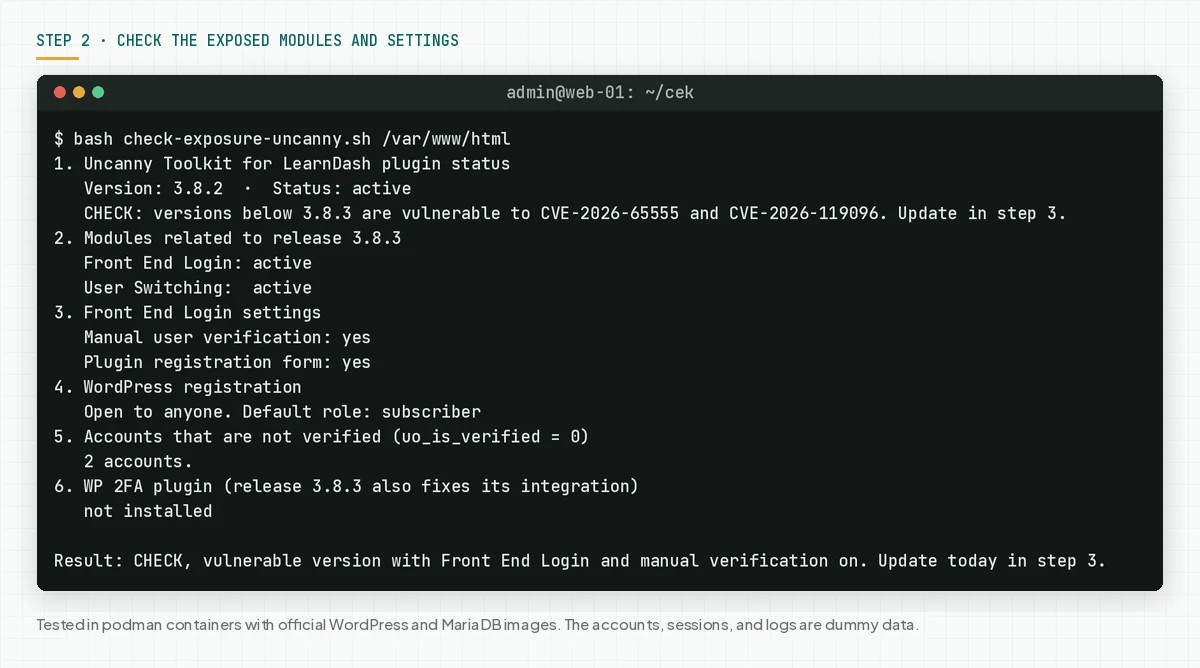
In our test, version 3.8.2 is active with Front End Login and User Switching. Manual user verification is on, sign-up is open to anyone, and 2 accounts are not verified. All this data is dummy data.
Check the result: "CHECK" means update today. Front End Login with manual verification on raises the CVE-2026-119096 risk. Without that module, you must still update because of CVE-2026-65555.
Step 3: Back up, then update to 3.8.3
Only the update closes both flaws. Make a backup first, then update.
# 1. Make a database backup first, then move the file off the server.
cd /var/www/html
sudo -u www-data wp db export /tmp/backup-before-update.sql
# 2. Update the plugin to 3.8.3
sudo -u www-data wp plugin update uncanny-learndash-toolkit --format=table
# 3. Check the version again
sudo bash ~/cek/check-version-uncanny.sh /var/www/html
# 4. Open the login page and the sign-up page, then confirm that both work normally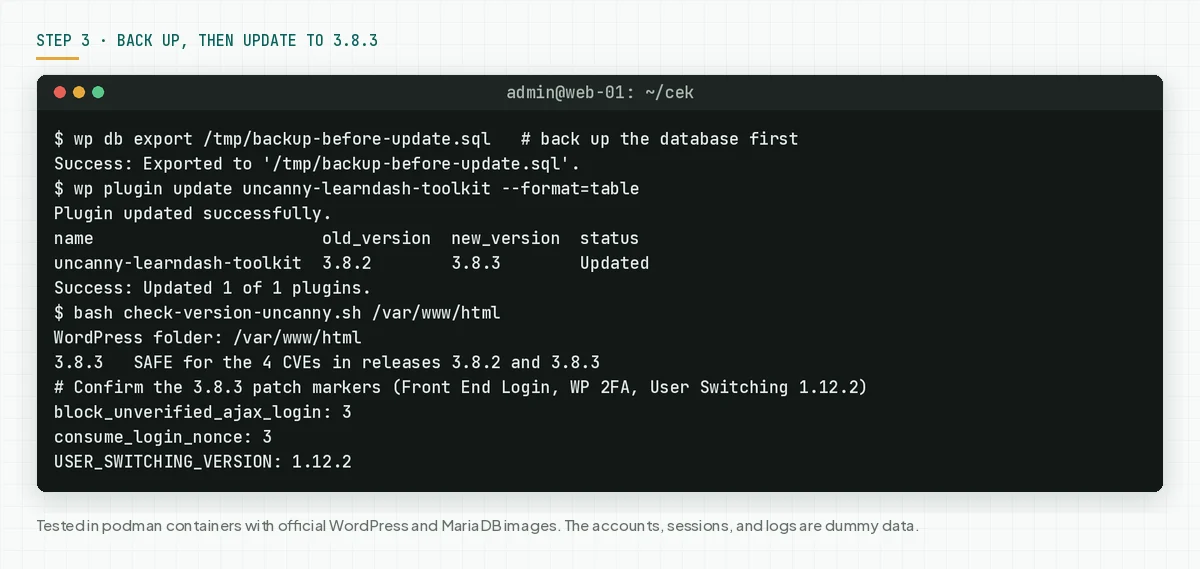
- Make a database backup first, then move the file off the server.
- Update in Plugins > Installed Plugins, or with WP-CLI.
- Run
check-version-uncanny.shagain. The correct result: "SAFE for the 4 CVEs". - Open the login page and the sign-up page, then confirm that students can log in and sign up.
- Do this again on every site, also staging and old course sites.
In our test, the update from 3.8.2 to 3.8.3 worked with wp plugin update uncanny-learndash-toolkit. After the update, we found the patch marker block_unverified_ajax_login (3 times) in frontend-login-plus.php, consume_login_nonce (3 times) in the WP 2FA code, and User Switching version 1.12.2.
Check the result: the version script prints "SAFE for the 4 CVEs" on every site, and the login page opens normally.
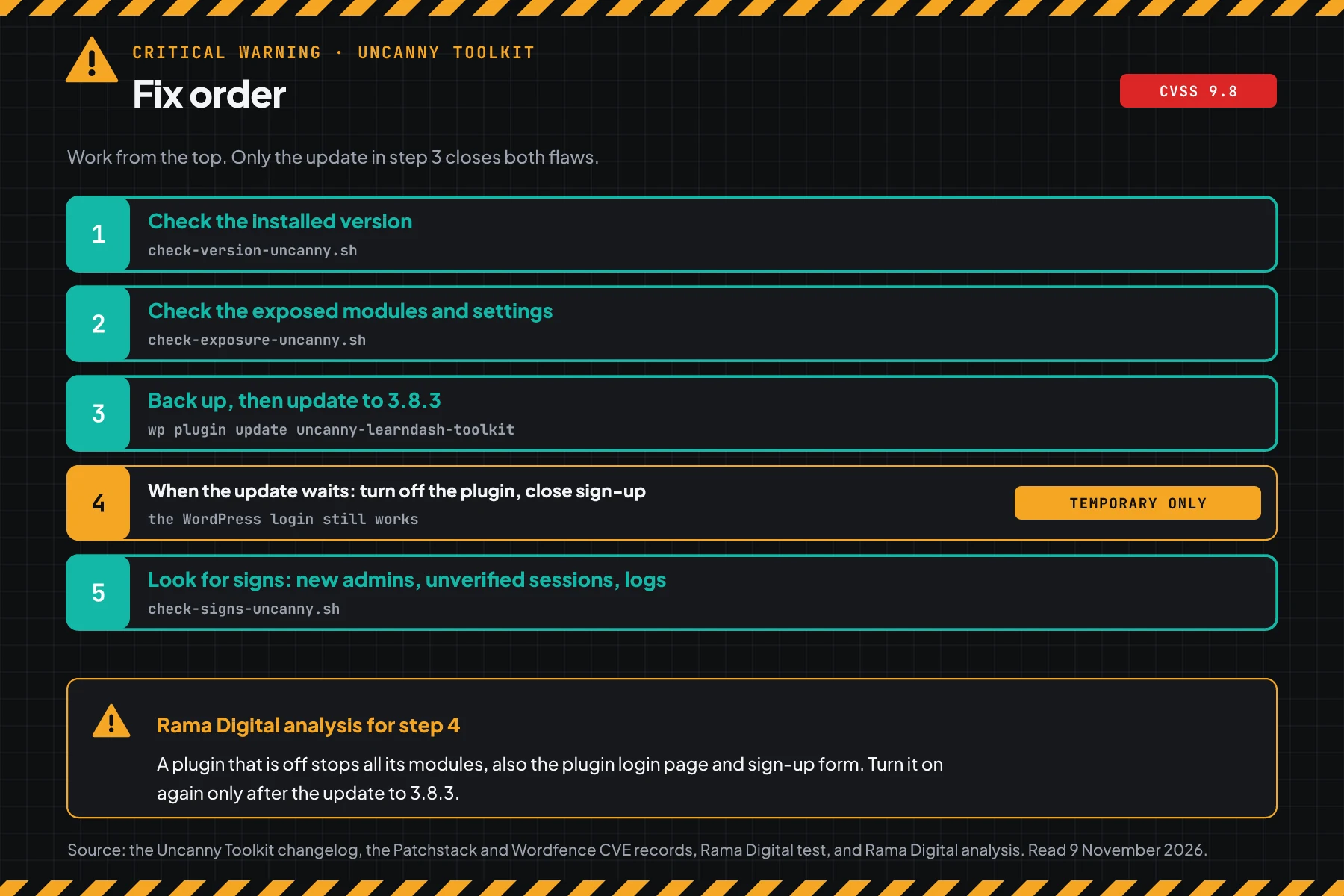
Step 4: Turn off the plugin when the update must wait
This step is only a temporary layer. Use it when you cannot update today, for example because you must test on staging first.
# When you cannot update today: turn off the plugin and close sign-up
cd /var/www/html
sudo -u www-data wp plugin deactivate uncanny-learndash-toolkit
sudo -u www-data wp option update users_can_register 0
sudo -u www-data wp plugin list --name=uncanny-learndash-toolkit --fields=name,status,version --format=table
# The WordPress login still works (replace example.com with your domain)
curl -s -o /dev/null -w '%{http_code}\n' https://example.com/wp-login.php
# Turn it on again only after the update to 3.8.3
# sudo -u www-data wp plugin activate uncanny-learndash-toolkit
# sudo -u www-data wp option update users_can_register 1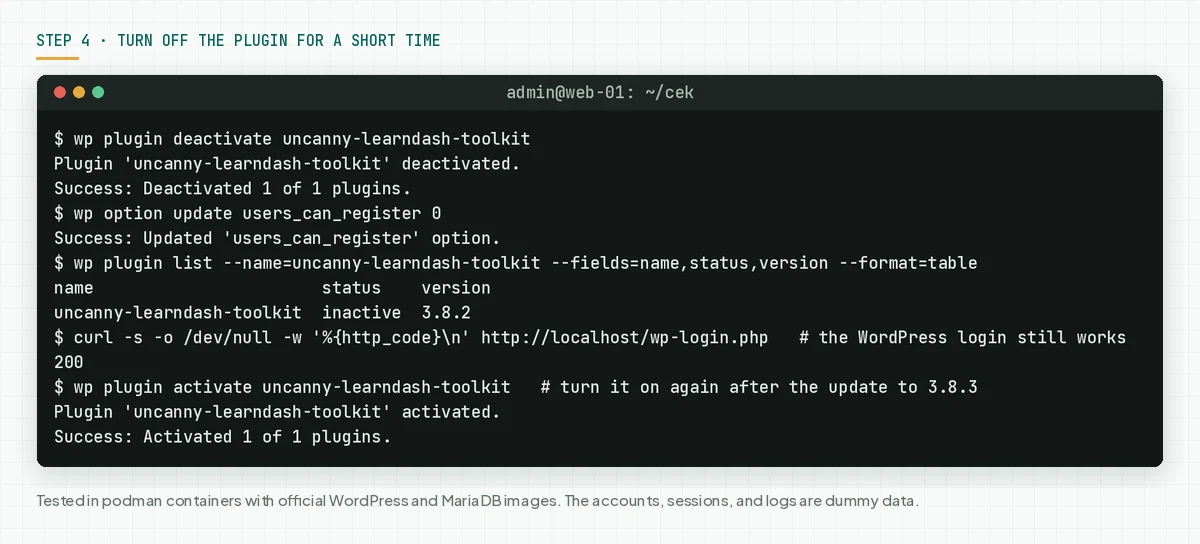
In our test, the plugin status is inactive and the version stays 3.8.2. The wp-login.php page still answers 200, so admins and students can still log in through the WordPress login. We turned the plugin on again after the update.
Rama Digital analysis: a plugin that is off stops the plugin code, so both flaws do not run while the plugin is off. But the login page, the sign-up form, and other plugin features also stop. The version stays 3.8.2, so the update to 3.8.3 is still required today.
Check the result: the plugin list prints inactive, and the WordPress login still works. Turn the plugin on again only after the version reads "SAFE for the 4 CVEs". Open sign-up again when your site needs it.
Step 5: Look for signs of abuse
Release 3.8.2 came out on 16 October, and the CVE-2026-65555 report arrived on 26 October. Search from 16 October 2026 or earlier, mainly when your site gets many sign-ups.
Save this script as check-signs-uncanny.sh. The script reads new WordPress accounts, unverified accounts that have a login session, and the web access log. The script prints account names, times, and IPs, not passwords or session tokens.
Run it with sudo, because web access logs are usually readable by root only. The script still runs WP-CLI as the web user www-data, because the PHP code on a breached site can belong to the attacker. For another web user, add WPUSER=apache after sudo.
#!/usr/bin/env bash
# Look for signs of CVE-2026-65555 and CVE-2026-119096 in WordPress accounts, login sessions, and web access logs.
# Use: sudo bash check-signs-uncanny.sh /var/www/html [other log files ...]
# Run it as root, because web access logs are usually readable by root only. WP-CLI still runs as www-data.
# Other web user: sudo WPUSER=apache bash check-signs-uncanny.sh /var/www/html
# The script only reads. The script prints account names, times, and IPs, not passwords or session tokens.

DIR="${1:-/var/www/html}"
shift 2>/dev/null
CAND=("$@")
if (( ${#CAND[@]} == 0 )); then
  for f in /var/log/apache2/access.log* /var/log/nginx/access.log* /var/log/httpd/access_log*; do CAND+=("$f"); done
fi
# Use regular files only. Skip symlinks to devices such as /dev/stdout, so that the script does not hang.
LOGS=()
for f in "${CAND[@]}"; do [ -f "$f" ] && LOGS+=("$f"); done
# WP-CLI loads the PHP code of the site. On a breached site, that code can belong to the attacker.
# So the script does not run WP-CLI as root. As root, the script switches to the web user.
# setsid cuts the web user process off from the root terminal, so that process cannot inject keystrokes.
# Without setsid, the WP-CLI checks are skipped.
WPUSER="${WPUSER:-www-data}"
AS=()
if [ "$(id -u)" = 0 ]; then
  [ "$WPUSER" = root ] && { echo "WPUSER must not be root."; exit 1; }
  if ! command -v setsid >/dev/null 2>&1; then AS=(false)
  elif command -v runuser >/dev/null 2>&1; then AS=(setsid -w runuser -u "$WPUSER" -- env HOME=/tmp)
  elif command -v sudo >/dev/null 2>&1; then AS=(setsid -w sudo -u "$WPUSER" -- env HOME=/tmp)
  else AS=(false); fi
fi
WP() { "${AS[@]}" wp --path="$DIR" --skip-themes --skip-plugins "$@" </dev/null 2>/dev/null; }
# Without WP-CLI, or when WP-CLI cannot read the site, the account and session checks do not run.
WPOK=0
command -v wp >/dev/null 2>&1 && [ -n "$(WP option get siteurl)" ] && WPOK=1
Q() { local out; out=$(WP db query "$1" --skip-column-names 2>/dev/null); printf '%s' "$out"; }
signs=0
since=$(date -d '14 days ago' '+%Y-%m-%d' 2>/dev/null || date '+%Y-%m-%d')

echo "1. WordPress accounts with rights above subscriber, registered in the last 14 days"
if (( WPOK )); then
  new=$(WP user list --fields=user_login,user_registered,roles --format=csv | awk -F, -v d="$since" '
    NR>1 { t=$2; gsub(/"/,"",t); if (t < d) next
           # The role column can hold several roles. Check every role, not only the first one.
           for (i=3; i<=NF; i++) { r=$i; gsub(/"/,"",r); if (r != "" && r != "subscriber" && r != "customer") { print; next } } }')
  if [ -n "$new" ]; then
    echo "   CHECK: new accounts with higher rights:"
    printf '%s\n' "$new" | sed 's/^/   /'
    signs=$((signs + 1))
  else
    echo "   0 new accounts with higher rights."
  fi
  echo "   All administrators:"
  WP user list --role=administrator --fields=user_login,user_registered --format=csv | sed 's/^/   /'
else
  echo "   WP-CLI is missing or cannot read the site. Check by hand: Users > All Users, sorted newest first."
fi

echo "2. Accounts that are not verified but have an active login session"
if (( WPOK )); then
  p=$(WP db prefix | tr -d '[:space:]')
  ids=$(Q "SELECT v.user_id FROM ${p}usermeta v JOIN ${p}usermeta s ON s.user_id = v.user_id AND s.meta_key = 'session_tokens' WHERE v.meta_key = 'uo_is_verified' AND v.meta_value = '0' AND s.meta_value NOT IN ('', 'a:0:{}') ORDER BY v.user_id")
  if [ -n "$ids" ]; then
    echo "   CHECK: these accounts are not verified, but they logged in:"
    for id in $ids; do
      name=$(WP user get "$id" --field=user_login)
      WP user session list "$id" --fields=login_time,ip --format=csv | awk -F, -v n="$name" 'NR>1 {printf "   %s  login %s  IP %s\n", n, $1, $2}'
    done
    signs=$((signs + 1))
  else
    echo "   0 accounts."
  fi
else
  echo "   Check by hand: Users > All Users, the Uncanny Toolkit verification column."
fi

echo "3. User Switching requests and AJAX logins in the web access log"
if (( ${#LOGS[@]} == 0 )); then
  echo "   No access log found. Give the log path as an argument."
else
  all=$(zcat -f "${LOGS[@]}" 2>/dev/null)
  sw=$(printf '%s\n' "$all" | grep -F 'action=switch_to_user')
  n_sw=$(printf '%s' "$sw" | grep -c .)
  echo "   Switch To requests: $n_sw"
  if (( n_sw > 0 )); then
    printf '%s\n' "$sw" | awk '{t=$4" "$5; gsub(/[][]/,"",t); print "   " t "  IP " $1}'
    echo "   Match each line with an admin who uses this feature."
    signs=$((signs + 1))
  fi
  ajax=$(printf '%s\n' "$all" | grep -F 'POST /wp-admin/admin-ajax.php')
  n_ajax=$(printf '%s' "$ajax" | grep -c .)
  echo "   $n_ajax POST requests to admin-ajax.php. This mixes with normal traffic."
  if (( n_ajax > 0 )); then
    echo "   Top 5 IPs:"
    printf '%s\n' "$ajax" | awk '{print $1}' | sort | uniq -c | sort -rn | head -n 5 | awk '{printf "   IP %s: %s\n", $2, $1}'
  fi
fi

echo
if (( signs > 0 )); then
  echo "Result: $signs SIGNS to check. If an account or a session is not from your team, start incident response."
  if (( ! WPOK )); then echo "Checks 1 and 2 did not run. Check the accounts and sessions by hand too."; fi
elif (( ! WPOK )); then
  echo "Result: checks 1 and 2 did not run, so the site is not proven clean. Check the accounts and sessions by hand."
else
  echo "Result: no SIGNS from this check. Attackers can delete logs, so update anyway and keep watching."
fi
# Check new admins, unverified accounts that logged in, and the access log
sudo bash check-signs-uncanny.sh /var/www/html
# Logs in another location, for example a log per site
sudo bash check-signs-uncanny.sh /var/www/html /var/log/nginx/example.com.access.log*
# Check the WordPress admin list
cd /var/www/html
sudo -u www-data wp user list --role=administrator --fields=user_login,user_registered
# Plugin update time: the change time of the plugin file
date -r wp-content/plugins/uncanny-learndash-toolkit/uncanny-learndash-toolkit.php '+%Y-%m-%d %H:%M'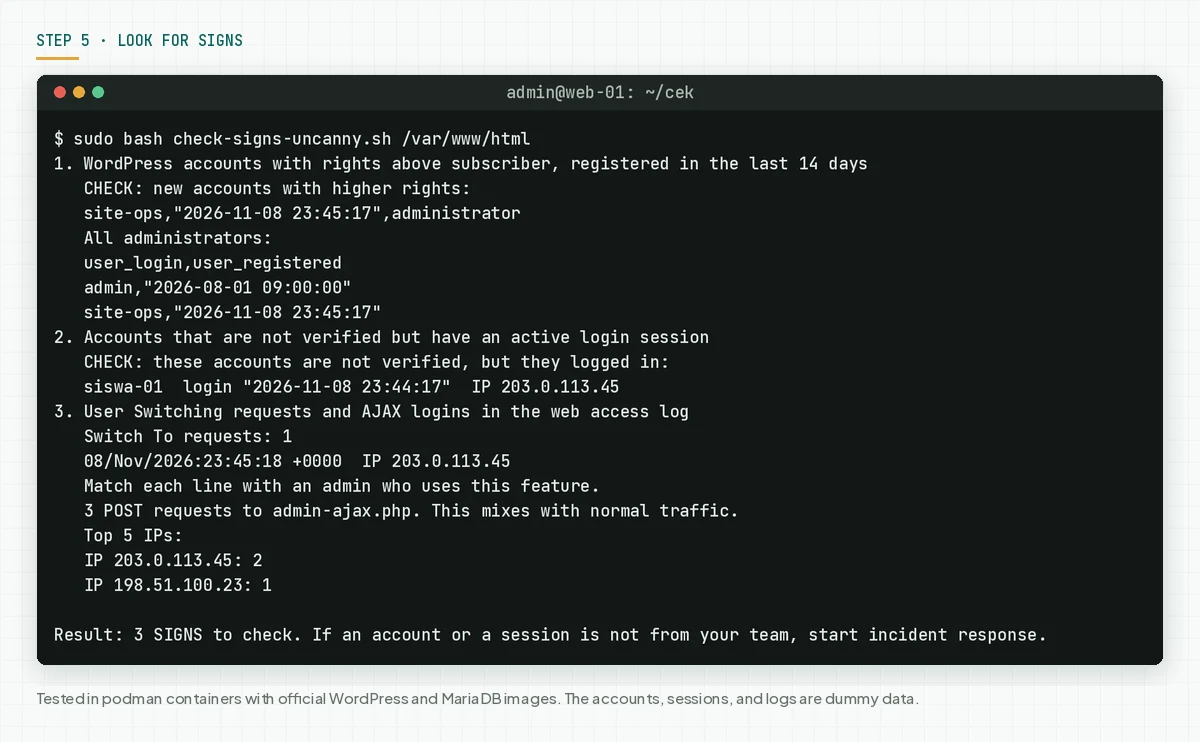
In our test, the script found the new admin site-ops, the account siswa-01 that is not verified but logged in, and 1 Switch To request in the log. That is 3 SIGNS. The IPs use the RFC 5737 documentation blocks, and all data is dummy data.
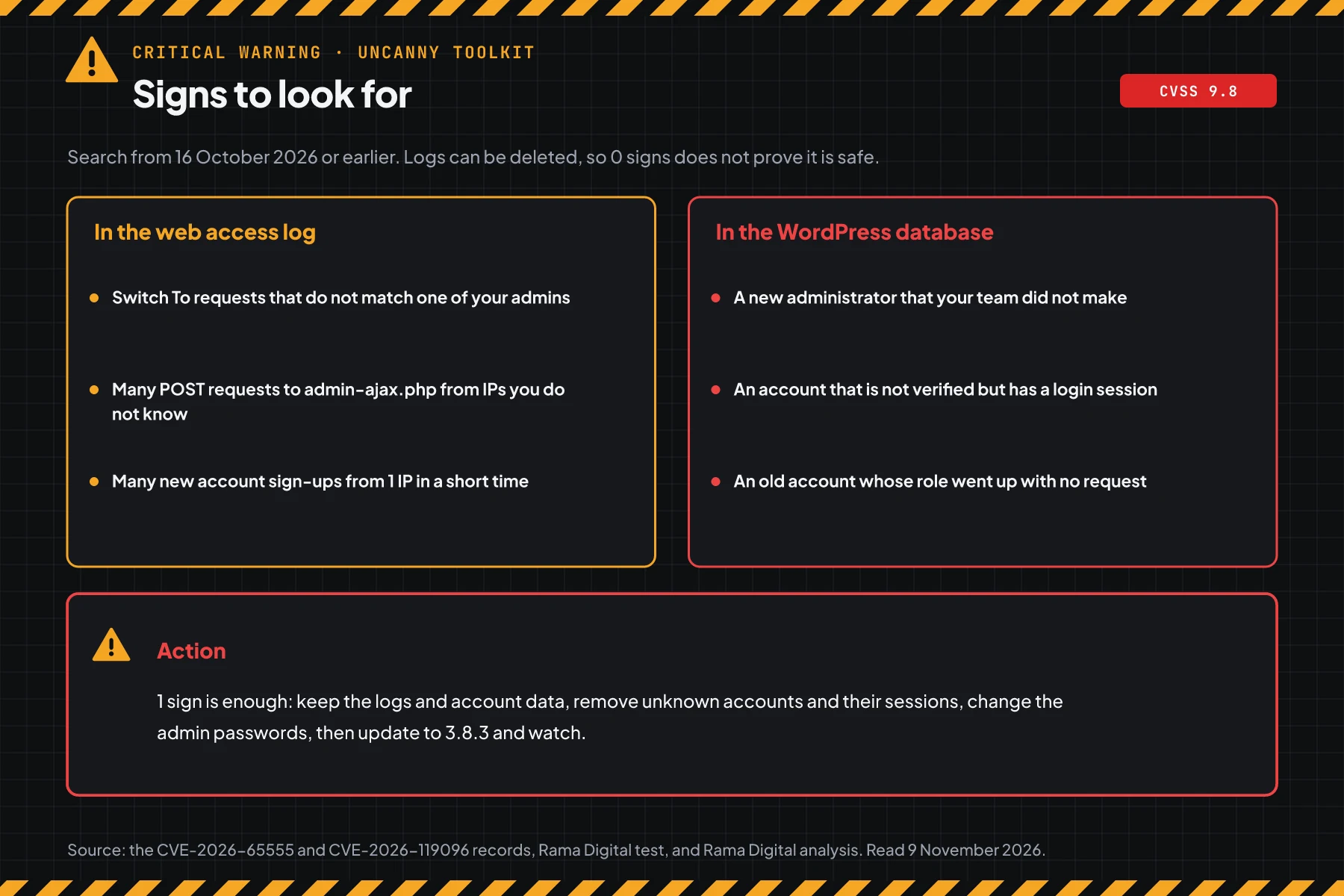
POST requests to admin-ajax.php mix with normal traffic, so the count alone does not prove an attack. Compare the login time of an unverified account with the time of a new admin or a raised role.
Check the result: the script prints "no SIGNS from this check", and the admin list holds only people you know. Attackers can delete logs, so no signs does not prove that the site is safe.
When you find even 1 sign, keep the web logs and the account data as evidence. Remove unknown accounts, change the admin passwords, and change the salts with wp config shuffle-salts so that all login sessions end. Then update to 3.8.3 and keep watching.
When the site holds student or buyer data in Indonesia, Indonesian Law 27/2022 on Personal Data Protection requires a written notice no later than 3 times 24 hours after a personal data leak.
Example: 1 morning of response for 3 course sites
This simulation uses dummy data. The site names, times, and results are not customer data.
| Time (WIB) | Dummy site | What was checked | Result | Action |
|---|---|---|---|---|
| 08.00 | kursus-a (3.8.2, Front End Login with manual verification, open sign-up) | Steps 1, 2, and 5 | VULNERABLE, 1 unverified account logged in, 1 new admin | Incident response, then update |
| 08.30 | akademi-b (3.8.1, only User Switching) | Steps 1 and 2 | VULNERABLE to 4 CVEs, clean log | Update to 3.8.3 |
| 09.00 | kelas-c (3.8.3, automatic updates) | Steps 1 and 5 | SAFE for the 4 CVEs, clean log | Record the version and the next check date |
The lesson from the simulation: a vulnerable version with an unverified account that logged in needs step 5 first, not only the update. The update closes the flaws, but it does not remove accounts or sessions that already exist.
Who installs the patch
The patch duty is different for each service type, so this table helps you know who acts today.
| Service type | Patch owner | What you do |
|---|---|---|
| Shared hosting with cPanel or another panel | You | Check the version in the dashboard, update the plugin, and ask the provider for the access log |
| Managed WordPress hosting | The provider and you | Update the plugin, then ask for written log evidence |
| Your own VPS | Your team | Steps 1 to 5 |
| A course site from an agency or a freelancer | As in the maintenance contract | Ask for the version today, then ask for an update date |
For a WordPress site that you manage yourself, put login plugin updates on the same schedule as other plugin updates. Rama Digital recommends automatic updates for login and sign-up plugins, because these plugins hold student accounts. When automatic updates are off, schedule a weekly version check and patch critical flaws in 24 hours.
Checklist for today
- Make a list of all sites with Uncanny Toolkit. Owner: the web team. Evidence: the list of sites and versions.
- Check the version with step 1. Owner: the site admin. Evidence: the script output.
- Check the modules and settings with step 2. Owner: the site admin. Evidence: the script output.
- Make a backup, then update to 3.8.3. Owner: the site admin. Evidence: the version script output after the update.
- When the update must wait, turn off the plugin with step 4. Owner: the site admin. Evidence: the plugin list with the status inactive.
- Look for signs with step 5. Owner: the site admin and the security team. Evidence: the script output and the admin list.
- Turn on automatic updates for the login plugin when they are off with no written reason.
Questions and answers
Did attackers already use this flaw?
On 9 November 2026, there are no attack reports and both flaws are not in CISA KEV. The score is 9.8 and the advisories are public, so update today.
My site does not use Front End Login. Am I safe?
No. The vendor does not name the CVE-2026-65555 module, so every site with version 3.8.2 or older must update to 3.8.3.
Are sites without LearnDash also affected?
The CVE records do not name LearnDash as a condition. In our test, the plugin was active without LearnDash. Check every site that has Uncanny Toolkit installed.
Does turning off the plugin close the flaw?
While the plugin is off, its code does not run. But the version stays vulnerable, and the flaw opens again when the plugin is on. Only the update to 3.8.3 closes the flaw.
Can a firewall plugin replace the update?
No. Patchstack has no virtual patch rule for CVE-2026-65555. Only the update closes the flaw in the plugin code.
How do I know that someone abused this flaw?
Run step 5. Check for new admins, unverified accounts with a login session, roles that went up with no request, and Switch To requests that do not match your admins.
Next step
The limits that still apply: a plugin that is off is not a fix, and an update does not remove accounts or sessions that an attacker already made. When your site shows a sign in step 5, or you need help with an audit and recovery, use Vibe Code Rescue. For 1 urgent issue today, book a 30-minute session.
Sources
- CVE-2026-65555 record: CVSS 3.1 score 9.8, CWE-266, the vulnerable version range up to 3.8.2.
- CVE-2026-119096 record: CVSS 3.1 score 9.8, CWE-287, the vulnerable version range up to 3.8.2.
- Patchstack advisory: the report and advisory dates of CVE-2026-65555.
- Wordfence advisory: the summary of CVE-2026-119096 and the disclosure date.
- Uncanny Toolkit plugin page: the 3.8.2 and 3.8.3 changelog, the latest version, and the active install count.
- CVE record API: the raw CVE record data.
- CISA KEV: the CISA KEV status on 9 November 2026.
- RFC 5737: the documentation IP blocks for the dummy data in this article.
- Indonesian Law 27/2022 on Personal Data Protection: the duty to report a personal data leak.