On 9 November 2026, Vonny Ernita Susamto stood in front of reporters in Jakarta with good news. Micro seller transactions on Tokopedia and TikTok Shop grew 60% from last year, in the #BeliLokal campaign of quarter 3 2026.
The Senior Director of Tokopedia and TikTok Shop Indonesia said that online shopping opens opportunities for local businesses, JawaPos and Kontan reported on 10 November 2026. One week before, a different number was published. It did not appear on that stage.
That number is the part of each sale that the platform keeps. For non-mall FMCG sellers, that part grew more than 2 times in 2 quarters. Harbolnas 2026 starts on 10 December. A seller who sets prices with the fee calculation of last year will calculate wrong.
The average take rate grew more than 2 times in 2 quarters
The average Shopee take rate for non-mall FMCG sellers grew from 7.21% at the end of 2025 to 18.55% in quarter 2 2026.
The data comes from Cube, an e-commerce research company in Bangkok, through its August 2026 Take-Rate Tracker. Databoks summarised the Shopee numbers on 2 November 2026. In quarter 3 2024, Shopee took 8.83%, and then 7.21% in quarters 3 and 4 2025.
TikTok Shop shows the same pattern. Its take rate was 5.41% in quarter 3 2024 and stayed between 5% and 7% until the end of 2025. In quarter 2 2026, it was 14.68%, a second Databoks summary shows.
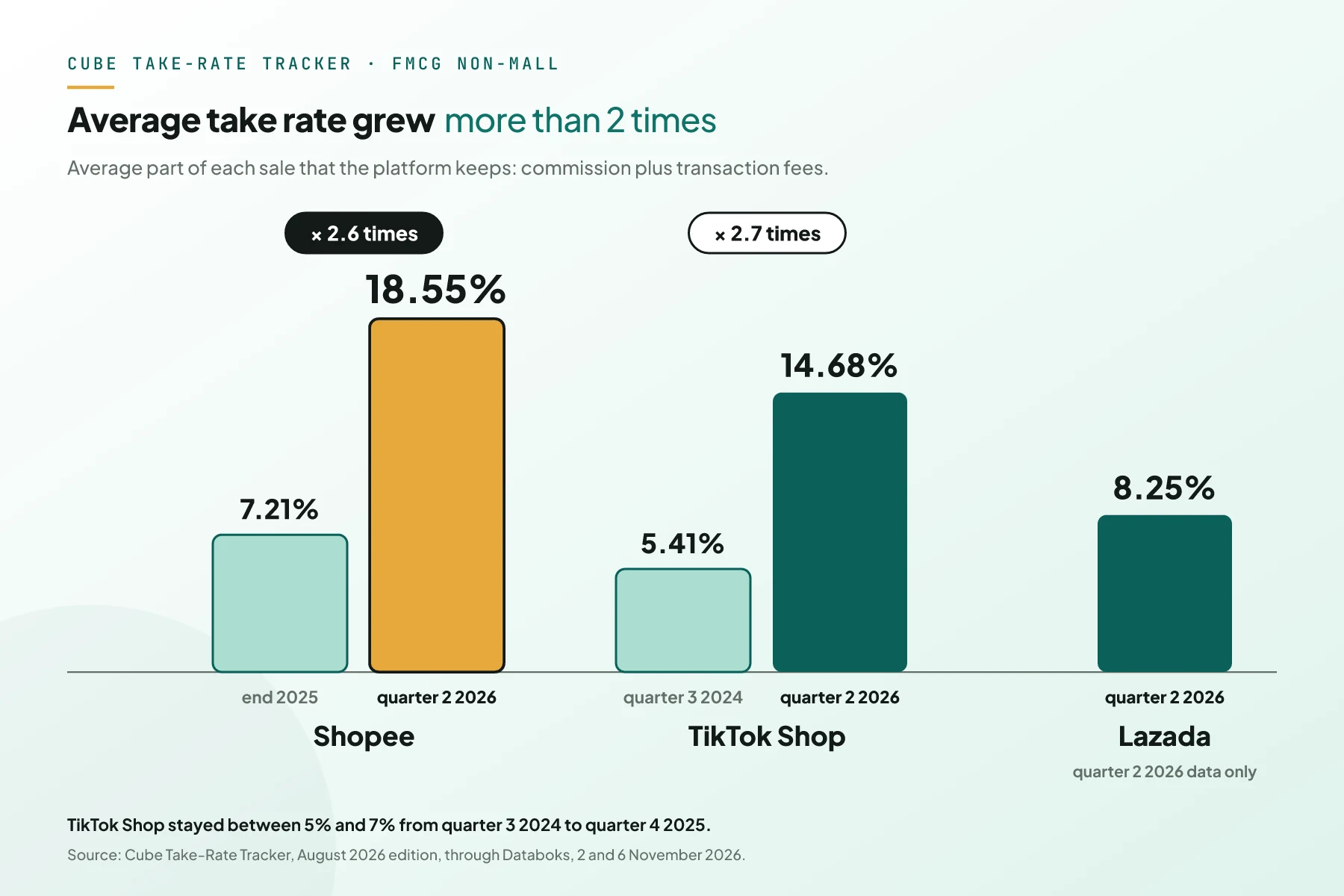
Lazada is far below. The Databoks comparison of 6 November 2026 shows a Lazada take rate of 8.25% in quarter 2 2026. Cube calculates the take rate as commission fees plus transaction fees. The definition does not mention ad costs.
One order of Rp100,000 leaves about Rp81,000
The marketplace fee now has 4 mandatory layers, and 2 of those layers are fixed amounts in rupiah.
The fee list is on the Seller Fee Introduction page of TikTok Shop by Tokopedia, updated on 2 November 2026. We use this page because its rates are public. The page lists 4 main fees for non-mall sellers:
| Fee | Official rate | Basis |
|---|---|---|
| Platform commission | 2.5% to 12.2% | Product price minus seller discount |
| Dynamic commission | 3% to 8%, maximum Rp60,000 per product | Product price minus seller discount |
| Order processing | Rp1,250 | Per order |
| Logistics service | Rp540 to Rp5,060 | Per order, by package size and route |
Now calculate 1 example order. A beauty product at Rp100,000 has a dynamic commission of 7%, the rate table per category shows, valid since 16 September 2026. For the platform commission we use an example of 8%, and for logistics Rp2,800, the middle of the official range.
The result: commission Rp8,000, dynamic commission Rp7,000, processing Rp1,250, and logistics Rp2,800. The total fee is Rp19,050, or 19.05% of the price. The seller receives Rp80,950, before product cost and packaging.
Cheap products carry the heaviest fee
Fixed fees in rupiah make the fee share increase when the product price decreases.
With the same example rates, a Rp250,000 product loses 16.62%. A Rp50,000 product loses 23.1%. A Rp25,000 product loses 31.2%, because Rp4,050 of fixed fees does not decrease with the price.
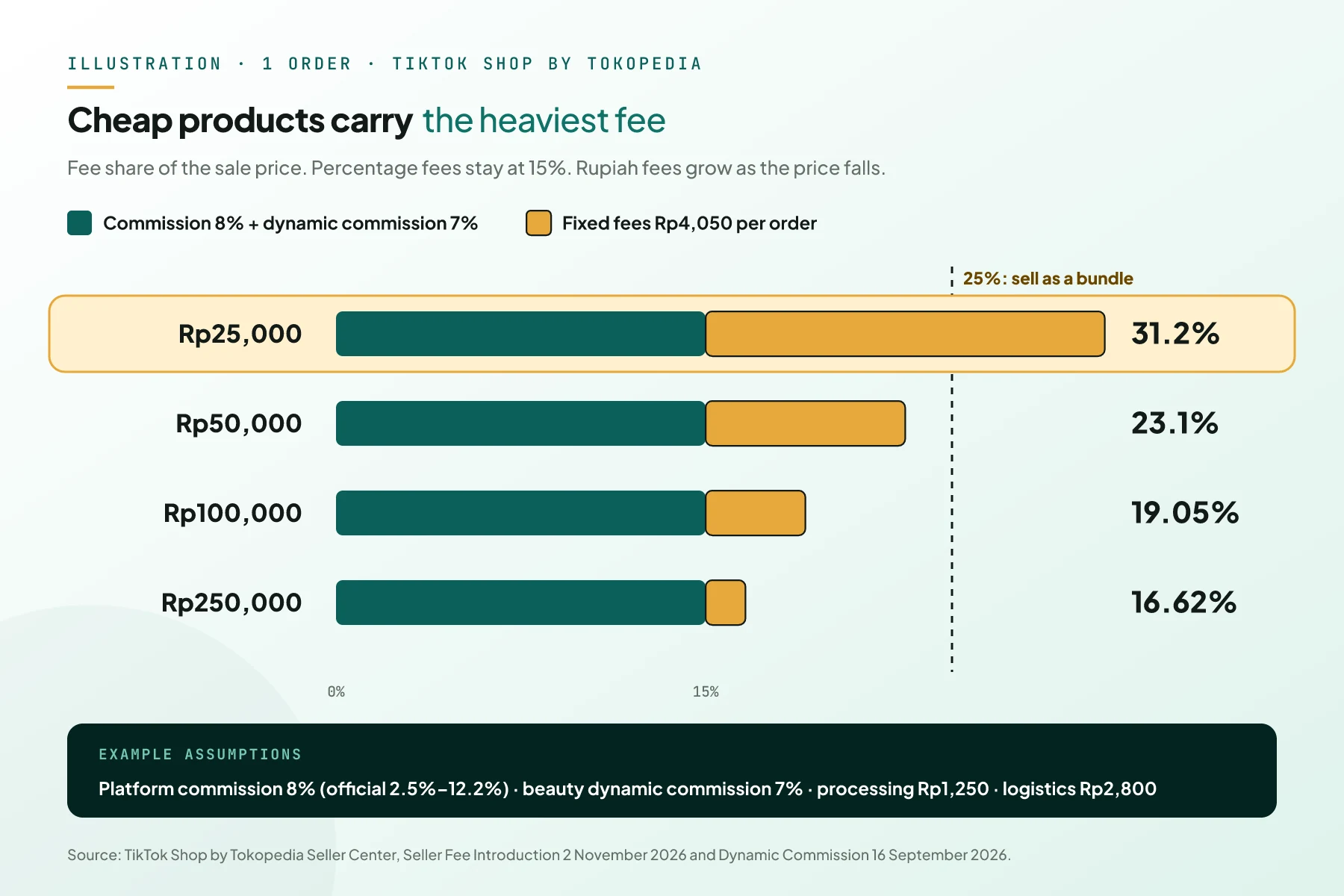
This is important for Harbolnas, because FMCG products are usually cheap and bought as single units. A seller discount also makes the commission basis smaller, but it does not change the fixed fees. A 20% discount on a Rp100,000 product increases the fee share from 19.05% to 20.1%.
Our example is higher than the Cube average of 14.68%. The Cube average mixes many categories, prices, and rates. Thus the number from your own store is more useful than the average of any other seller.
A 50% fee discount exists for micro and small businesses, with conditions
Micro and small businesses that sell only domestic products can request a service fee discount of at least 50%.
The legal basis is Permen UMKM Number 3 of 2026, enacted on 17 June 2026. Applications through SAPA UMKM opened on 25 October 2026, UKMIndonesia.id reports, quoting Temmy Satya Permana, Deputy for Small Business at the Ministry of UMKM. The discount applies to administration fees, commission, or basic store fees, not to ads and promotion.
The process is long. The marketplace collects applications each Friday, then has up to 10 calendar days to verify, then 5 days to activate the discount. The longest path takes about 3 weeks, before the ministry verification time.
The rule does not apply to ready-to-eat processed food and to electronics made by large industry. The marketplace fee pages also do not yet show which fee lines get the discount. If the discount applies only to the platform commission, the Rp100,000 example order falls from 19.05% to 15.05%.
More volume is not the same as more money
The platform numbers and the Cube numbers do not contradict each other, but they measure different things.
Platforms report transactions. The 10.10 Promo Guncang increased transactions up to 9 times on Tokopedia and up to 4 times on TikTok Shop, Kontan reports. Harbolnas 2025 recorded Rp36.4 trillion in transactions, and Trade Minister Budi Santoso targets 5% to 10% growth in 2026, JawaPos reported on 27 August 2026.
Cube measures the part that stays with the platform. Transactions that grow 60% with a fee that grows 2 times can give a smaller profit. For a check of ad spend before 12.12, read our article on the Google Ads Invalid Traffic card.
Limits of this data
The Cube data stops at quarter 2 2026, before the dynamic commission cap fell to Rp60,000 on 16 September 2026.
- The data covers only non-mall FMCG sellers. Other categories and Mall sellers can be different.
- The Cube method and full tables are behind a paywall. We read the numbers through the Databoks summaries, which do not explain the cause of the increase.
- The quarter 3 2026 numbers are not published yet.
- The example order uses an example platform commission and logistics fee. The rate of your subcategory can be lower or higher.
- News sources give different start dates for the 50% discount. We use 25 October 2026 from the most recent source.
Five steps before your Harbolnas prices are fixed
Calculate the fee from your own store report before you set prices for 10 December.
- Open the October 2026 income report. Divide the total fees by the total order value.
- Do the same for January 2026, and then compare the 2 numbers.
- For your 5 best-selling products, record the platform commission and the category dynamic commission in Seller Center.
- Calculate the money that you receive per product after all fees, product cost, and packaging.
- If your business is micro or small and sells only local products, apply for the discount through SAPA UMKM this week.
If your fee per product is above 25%, do not sell that product as a single unit in Harbolnas. Combine it into a bundle, because the Rp1,250 fixed fee and the logistics fee apply per order, not per product. If your fee is below 15%, you still have space for a discount.
Micro seller transactions did grow 60%. The question that the stage of 9 November did not answer is how many rupiah stay with the seller.
Questions and answers
What is the average Shopee and TikTok Shop take rate for FMCG sellers now?
Cube data through Databoks shows that in quarter 2 2026 Shopee took 18.55%, TikTok Shop 14.68%, and Lazada 8.25% from non-mall FMCG sellers.
Which fees does TikTok Shop by Tokopedia take from each order?
There are 4 main fees: platform commission 2.5% to 12.2%, dynamic commission 3% to 8%, processing Rp1,250, and logistics Rp540 to Rp5,060 per order.
Who can get the 50% marketplace service fee discount?
Micro and small businesses that are verified in SAPA UMKM and sell only domestic products. The discount does not apply to ad and promotion fees.
Why do cheap products pay a larger fee share?
The processing fee and the logistics fee are fixed rupiah amounts per order. On a Rp25,000 product, those fixed fees alone are 16.2% of the price.
If you want a margin report per product that connects to marketplace stock and orders, see the Rama Digital AI Native ERP service. For search checks before 12.12, also read our note on the Google November 2026 core update.