Google released the November 2026 core update on 10 November 2026 at 10:06 Pacific time, which is 01:06 WIB on 11 November. The rollout can take up to 2 weeks, so start the Search Console analysis on about 2 December 2026, not now.
A core update is a broad change to the ranking systems of Google Search. Google states that core updates do not target specific sites or pages. The November 2026 update applies globally and to all languages, so Indonesian-language sites are included.
What did Google announce on 10 November 2026?
Google announced 1 regular core update that applies globally, to all languages, with a rollout of up to 2 weeks. The official status is on the Google Search Status Dashboard.
In a Google LinkedIn post, Google gives the goal: to show relevant, satisfying content from all types of sites. On 13 November 2026, the dashboard did not yet show the rollout as complete.
| Item | Data | Source |
|---|---|---|
| Start | 10 Nov 2026, 10:06 PT (11 Nov 2026, 01:06 WIB) | Google Search Status Dashboard |
| Rollout length | Up to 2 weeks, estimated end about 24 Nov 2026 | Google Search Status Dashboard |
| Scope | Global, all languages, all types of sites | Google Search Status Dashboard, Google LinkedIn |
| Order | 3rd core update of 2026, after March and May | Search Engine Journal, 10 Nov 2026 |
| Status on 13 Nov 2026 | Still running | Google Search Status Dashboard |
How long does this core update rollout take?
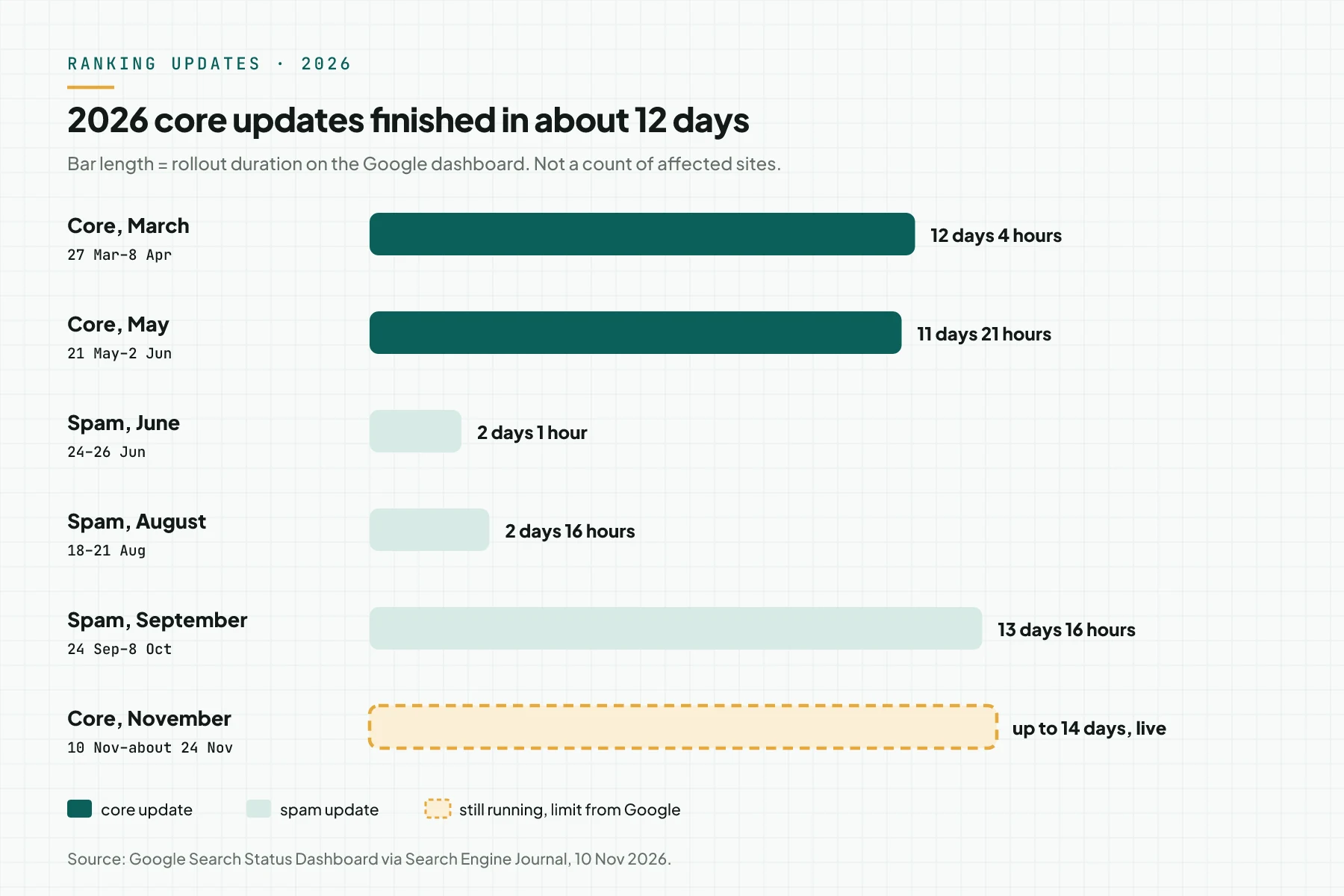
This rollout can take up to 2 weeks, and the 2 earlier core updates this year finished in about 12 days. Search Engine Journal reported on 10 November 2026 that the March core update ran 12 days 4 hours, and the May core update ran 11 days 21 hours.
The September 2026 spam update ran 13 days 16 hours, from 24 September to 8 October. We cover that update in our article on the Google September 2026 spam update.
When can you start to read Search Console data?
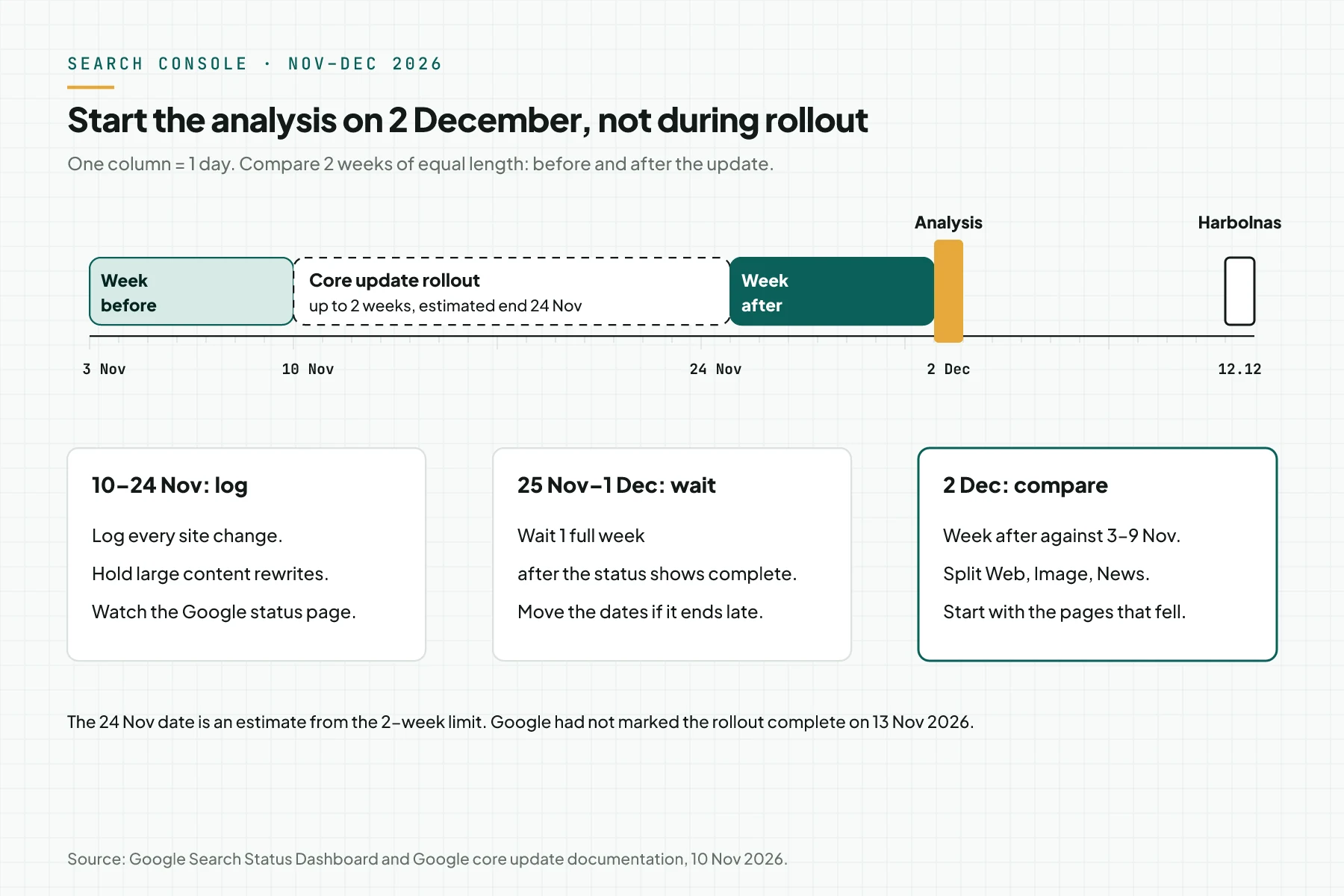
Read the data no earlier than 1 full week after Google marks the rollout complete. The Google core update documentation tells you to wait at least 1 week, then compare that week with a week before the rollout started.
If the rollout ends on 24 November 2026, use this schedule:
- 3–9 November 2026: the comparison week before the update.
- 10–24 November 2026: the rollout. Log changes, but do not judge the data.
- 25 November–1 December 2026: the week after the update.
- 2 December 2026: compare the 2 weeks in the Search Console Performance report.
The 24 November date is an estimate from the 2-week limit. If Google marks the end later, move all later dates by the same number of days.
How do you read position changes correctly?
Separate small drops from large drops before you change a page. Google gives an example: a fall from position 2 to 4 is a small drop, and a fall from position 4 to 29 is a large drop.
| Pattern in Search Console | Meaning | Action |
|---|---|---|
| Small fall, for example position 2 to 4 | Small drop | Do not make large changes. Do not change pages that still perform well. |
| Large fall on top queries, for example position 4 to 29 | Large drop | Assess the page again with the Google self-assessment questions. |
| Fall only in Image, Video, or News | Effect on 1 search type | Analyze that search type apart from Web. |
Use this sequence in Search Console:
- Open the Performance report, then select the Web search type.
- Set the dates on the Compare tab: 25 November–1 December against 3–9 November.
- Sort the pages by the largest click difference.
- Open the top queries of each page, then check the position change.
- Do steps 1–4 again for Image, Video, and News.
For a large drop, apply the Google self-assessment questions to the whole site, not to 1 page only. If you also track traffic from AI features, read our guide to the generative AI report in Search Console.
What must online stores prepare before the 12.12 sale?
Prepare a backup plan for product and promotion pages, because fair data arrives only 10 days before 12.12, the Indonesian national online shopping day (Harbolnas). The rollout ends about 24 November, 3 days before Black Friday on 27 November 2026.
- List the organic pages that bring the most sales.
- Save the clicks and positions of those pages for 3–9 November as the baseline.
- Prepare a backup search ads budget for pages with a large drop.
- Do not change the URL, title, or structure of promotion pages during the rollout.
- Log each content release and technical change with its date.
Backup ads keep sales while organic positions move. Ads do not repair organic rankings.
What should you not do during the rollout?
Do not rewrite or delete content because of 2–3 days of data. Google recommends real content improvements, not quick fixes, and calls content removal a last resort.
Recovery also takes time. Google states that recovery can take several months, and some changes show only at the next core update. Google also runs smaller core updates that it does not announce.
If you also want your pages to show as a source in AI answers, read how to get your website cited by ChatGPT.
Questions and answers
Is the November 2026 core update a penalty?
No. Google calls a core update a broad change that does not target specific sites or pages. A lower position does not mean that your site broke a Google rule.
Does this update apply to Indonesian-language sites?
Yes. The Google Search Status Dashboard states that this update applies globally and to all languages, which includes Indonesian.
When does the November 2026 core update rollout end?
Google gives a limit of up to 2 weeks from 10 November 2026, so the estimate is about 24 November. Check the exact date on the Google Search Status Dashboard.
Do I need to change my content now?
No. Log your changes, then wait for 1 full week of data after the rollout ends. Change a page only when the drop is large and consistent.
Next step
Mark 2 December 2026: compare 25 November–1 December with 3–9 November, for each search type. Until that date, log changes and prepare backup ads for your 12.12 pages. For help to read that data, see our SEO service.