Short answer: ChatGPT, Perplexity, Gemini, and ClaudeClaude ProThe paid subscription for the Claude AI assistant from Anthropic. It unlocks connectors to outside tools.Open the glossary cite pages that their bots can read, that sit in a search index, and that answer the question clearly. There is no sign-up form to get cited. You prepare the 7 items below, then measure the result every month.
This work is called GEOGEOThe work of preparing a page so an AI answer engine quotes it correctly, not only a classic search engine.GEO Service (Generative Engine Optimization) (Generative Engine Optimization). The difference between SEOSEOThe work of making your page easy to find and easy to choose in search results, without paying for ads.SEO services, AEO, AIOAIOAIO has 2 meanings: AI Overview, the AI answer summary above Google results, and AI Optimization, the work to get your page cited in that summary.AIO Service for Google AI Overviews, and GEO is in our article SEO, GEO, AEO, and AIO compared (in Indonesian).
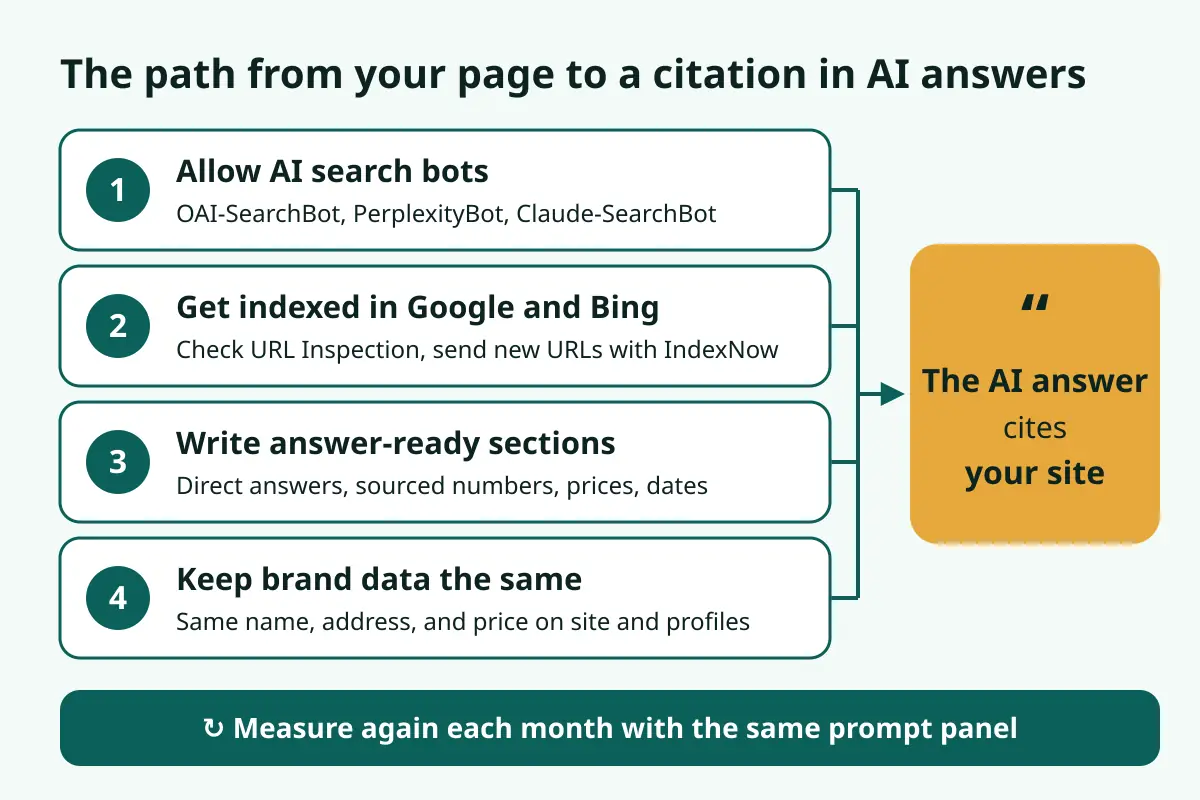
The diagram below shows 4 basic conditions and 1 measurement step. Steps 5 and 6 add proof from other sources and 1 extra signal.
1. Allow AI search bots in robots.txt
Allow the search bot of each AI platform in robots.txt, because that bot finds pages for answers.
Each platform uses more than 1 bot. A search bot is different from a model training bot. This table summarizes the official documentation that we checked in November 2026.
| Bot | Platform | Function | If you block it |
|---|---|---|---|
| OAI-SearchBot | ChatGPT | Finds pages for ChatGPT search features | The page does not show in ChatGPT search answers. Navigational links can still show. |
| GPTBot | OpenAI | Collects content that can train models | ChatGPT search does not change. This setting is separate from OAI-SearchBot. |
| PerplexityBot | Perplexity | Shows and links sites in Perplexity results | Perplexity recommends that you allow it. Perplexity does not use it to train models. |
| Claude-SearchBot | Claude | Indexes pages for Claude search results | Visibility in Claude search results can decrease. |
| ClaudeBot | Anthropic | Collects content for model training | Your new content is excluded from training data. |
| Googlebot | Google Search, AI Overviews, AI Mode | Indexes pages for Google | The page disappears from Google Search and its AI features. |
| Google-Extended | Gemini | Controls use of content for Gemini training and grounding in Gemini apps | Google Search is not affected. |
| bingbot | Bing, Copilot | Indexes pages for Bing | The page disappears from Bing, the source for Bing AI summaries and Copilot. |
An example rule set that opens AI search and closes OpenAI model training:
User-agent: OAI-SearchBot
Allow: /

User-agent: PerplexityBot
Allow: /

User-agent: Claude-SearchBot
Allow: /

User-agent: GPTBot
Disallow: /
GPTBot and ClaudeBot control training data. Choose their rules to match your company data policy.
Know these 3 limits:
- Changes take time. OpenAI writes that its systems need about 24 hours after a robots.txt update. Perplexity writes that changes can take up to 24 hours.
- Bots that act on a user request, such as ChatGPT-User and Perplexity-User, may not follow robots.txt. To leave ChatGPT search, OpenAI tells you to use an OAI-SearchBot rule.
- A firewall or CDN can block a bot before the bot reads robots.txt. Perplexity writes that custom WAF rules cannot bypass Cloudflare Bot Fight Mode.
2. Make sure Google and Bing index your pages
Make sure Google and Bing index your pages, because AI Overviews, Gemini, and Copilot take sources from a search index.
Google's guide to generative AI features (15 May 2026) says that a page must be indexed and eligible to show with a snippet to appear as a supporting link. Check each important page with URL Inspection in Search Console.
For Bing, add your site to Bing Webmaster Tools and submit a sitemap. Use IndexNow to announce new or changed URLs. The IndexNow FAQ says that 1 submission goes to all participating engines: Bing, Naver, Seznam, Yandex, Yep, and Amazon. 1 submission holds up to 10,000 URLs.
IndexNow does not guarantee indexing. Each engine decides for itself. Google is not a participant, so keep your sitemap for Google. Crawling, sitemap, and canonical details are in the article technical SEO for AI search (in Indonesian).
3. Write answer-ready sections
Put a direct answer at the start of each page section, because AI engines build answers from passages that answer 1 question.
Researchers from Princeton and partners tested this approach in the GEO study at the KDD 2024 conference. They measured that changes to page content can increase visibility in generative engine answers by up to 40%.
Use this checklist on each important page:
- The first sentence of each section answers the question in 25 words or fewer.
- Each number appears with its period and source in the same sentence.
- Prices, durations, and terms appear as text, not as images.
- The update date shows on the page.
- The Q&A section uses real customer questions.
- Comparisons use a table.

An example from our test. In November 2026 we ran 11 general prompts about GEO services in ChatGPT, Perplexity, and Gemini. The AI answers cited agency pages that publish prices. Our site was not cited in those 11 prompts.
This is a small observation, not a study. We used it as a starting point, then published the prices of 3 packages on our service page.
4. Keep brand data the same everywhere
Use the same name, address, services, and prices on every profile, so AI engines do not find data that conflicts.
- Your site: the About page, the contact page, and Organization schemaSchemaExtra description inside page code that tells a search engine what the page is, for example an article, a service, or a question and answer.Open the glossary with your official profiles in
sameAs. - Google Business Profile: the same name, category, opening hours, and address as your site.
- LinkedIn, Instagram, and industry directories: a short description and a link to the same site.
More detail is in the article entity consistency for GEO. If your business is eligible, also read how to claim your business in ChatGPT Business Hub.
5. Collect brand mentions on third-party sources
Collect brand mentions in relevant media, directories, and communities, because AI engines also read sources outside your site.
- Profiles in industry directories and associations.
- Media coverage that uses original data from your business.
- Answers in forums and communities under a clear identity.
- Case studies with clients, with client permission.
Do not buy backlinks or publish mass-produced articles. Google spam policies prohibit link spam and scaled content abuse. Do not create fake reviews.
6. Add llms.txt if it is cheap, but do not expect Google to read it
llms.txt is a short list of important pages for language models, but Google states that Google Search does not use it.
Google's guide to generative AI features says that Google Search does not use llms.txt or special AI markup. The OpenAI, Perplexity, and Anthropic bot documentation that we checked in November 2026 also does not mention llms.txt.
The file is cheap to make, and we use it on our own site. Do this step last, after steps 1 to 5.
7. Measure with a prompt panel every month
Measure results with a fixed prompt list every month, because AI answers change and 1 answer is not proof.
- Write 30 prompts that your customers type. Mix general prompts, comparison prompts, and prompts with a city name.
- Run the prompts in ChatGPT, Perplexity, Gemini, Claude, and Copilot. Record the date, the search mode, and the cited sources.
- Calculate citation share: the number of answers that cite your site divided by the number of all answers.
- Repeat with the same prompts every month. Look at the direction of 3 measurements, not at 1 number.
Use official data too. Bing Webmaster Tools has an AI Performance report for citations in Copilot and Bing AI summaries. Bing released it as a public preview on 10 February 2026. Search Console has a generative AI performance report for Google.
A record sheet format is in the article prompt log for ChatGPT, Gemini, and Perplexity monitoring (in Indonesian).
What you cannot control
Nobody can guarantee a citation, because each AI engine picks its own sources.
- A model's built-in knowledge changes only when the model is trained again. The steps above mainly affect answers that use web search.
- Bots that act on a user request may ignore robots.txt.
- The Bing AI Performance report does not show the rank or authority of a page inside an answer.
Do you want to know what AI engines say about your brand now? The Rama Digital GEO service starts with a GEO Check: 30 prompts on 5 AI engines in 5 working days, IDR 8.48M.
Questions and answers
Does blocking GPTBot remove my site from ChatGPT?
No. OpenAI separates GPTBot and OAI-SearchBot. GPTBot controls model training data. OAI-SearchBot controls whether your site shows in ChatGPT search answers.
How long does a robots.txt change take in ChatGPT and Perplexity?
OpenAI writes that its systems need about 24 hours after a robots.txt update. Perplexity writes that changes can take up to 24 hours.
Does llms.txt get my site cited in Google AI Overviews?
No. Google's guide states that Google Search does not use llms.txt. For AI Overviews, a page must be indexed and eligible to show with a snippet.
Does IndexNow send URLs to Google?
No. The IndexNow FAQ lists Bing, Naver, Seznam, Yandex, Yep, and Amazon. Google is not on that list. For Google, use a sitemap and URL Inspection in Search Console.
How do I know if ChatGPT cites my website?
Run a fixed prompt list in ChatGPT with search on, then record the sources in each answer. Repeat every month with the same prompts so you can compare the results.
Sources
- OpenAI, Overview of OpenAI Crawlers, checked November 2026.
- Perplexity, Perplexity Crawlers, checked November 2026.
- Anthropic, crawlers and how to block them, checked November 2026.
- Google Search Central, guide to generative AI features, 15 May 2026.
- Google, common crawlers and Google-Extended, checked November 2026.
- Bing Webmaster Blog, AI Performance public preview, 10 February 2026.
- IndexNow FAQ, checked November 2026.
- Aggarwal et al., GEO: Generative Engine Optimization, KDD 2024.