Direct answer: an honest SEOSEOThe work of making your page easy to find and easy to choose in search results, without paying for ads.Open the glossary service report carries 8 numbers: non-brand impressionsImpressionThe number of times your ad or page appeared on a screen. An impression is not a person and not a search.Open the glossary, non-brand clicks, average position for your top 10 queries, pages that receive clicks, conversionsConversionThe action you count as a result, for example a paid order, a sign-up, or a chat that becomes a qualified buyer.Open the glossary from organic, indexed pages, AI citations, and answer share. You check the report with 1 method: open Search Console for your own property, split brand and non-brand queries, then compare the result with the vendor report over the same 28 days. A report full of green charts that never moves sales usually reports total impressions, page 1 keyword counts, and backlink counts. Those 3 numbers rise without a single new buyer, because they count views and work volume, not non-brand clicks and conversions.
Main condition: this method holds when you own the Search Console and Analytics access for your property, and the vendor uses the same 28-day period every month. Limit: a report measures results, a report does not cause results. SEO results usually appear in month 3 to month 6, so 1 first-month report does not yet judge vendor quality (Doit.co.id, how long SEO takes). This article also promises no Google ranking to anyone.
This article was published on 4 August 2026. We checked every price source and every AI impact source before publication: market prices from Optimaise and Dipstrategy, the AI OverviewsAIOThe AI answer summary above search results. It answers part of the question before anybody presses a link.Open the glossary impact from Ahrefs and Contently, result timing from Doit.co.id, and AI monitoring tool prices from Ryze. Every example here uses labelled dummy data, never customer records.
Green charts, flat sales: what happens
A monthly report often uses numbers that are easy to lift. Total impressions rise when more people search your brand name, for example after 1 ad campaign starts. Page 1 keyword counts rise when the vendor adds long-tail phrases that nobody searches.
Those numbers are not a lie. They answer the wrong question. The right question is this: how many new people found you this month, and how many of them bought.
The load grew in 2026. Ahrefs recorded organic CTRCTRClicks divided by impressions, as a percentage. CTR shows how often people press the ad or the search result they saw.Open the glossary falling 34 percent to 61 percent on keywords that trigger AI Overviews (Ahrefs, AI Overviews reduce clicks). Contently recorded zero-click behaviour reaching 80 percent to 83 percent on queries with AI Overviews, and Google referral traffic to publishers down 38 percent against the year before (Contently, AI Overview traffic impact). A steady ranking can therefore run beside falling clicks.
To check whether your monthly invoice buys real work, first read what monthly SEO service work contains. This article continues from the other side: what that report must prove.
How an SEO report hides the result
The page 1 keyword count misleads
An SEO tool counts every phrase that appears in the top 10 results as 1 page 1 keyword. Phrases with no searchers are counted. Phrases that contain your own brand name are counted.
A vendor can therefore report a rise from 40 to 120 page 1 keywords without 1 extra click. Ask for the search volume and the clicks for each of those keywords. A keyword that brings no click within 90 days is not a result.
Total impressions hide non-brand
Total impressions add up 2 different kinds of demand. A brand query comes from a person who already knows your name. A non-brand query comes from a person who does not know your name and searches for the problem.
SEO work must lift the second group. When the first group rises because of ads, the total rises too, and a non-brand fall hides inside it. Non-brand impressions are therefore more honest than total impressions: that number moves only when new people find you.
2 new AI numbers: AI citations and answer share
AI engines now answer without sending a click. Contently recorded that brands cited inside AI Overviews receive 35 percent more organic clicks (Contently, brands cited by AI). A 2026 report must therefore carry 2 new numbers.
AI citations is the count of AI engine answers that name your brand or your page, taken from 1 fixed prompt list. Answer share is AI citations divided by the number of prompts tested. When 6 of 20 prompts name you, your answer share is 30 percent. The method and its limits are covered in SEO service for AI search.
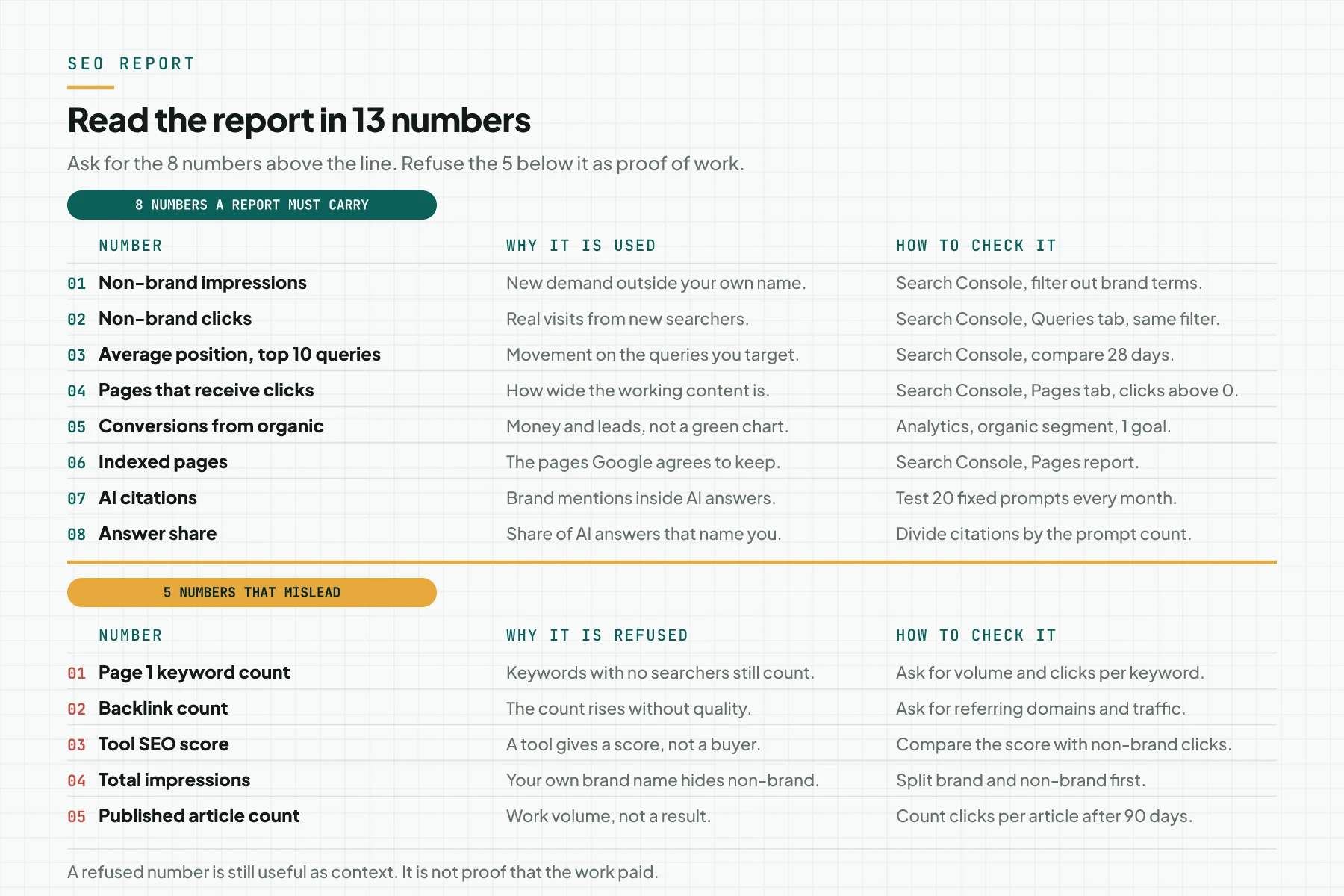
The diagram above uses the same 3 columns for each number: the number, the reason it is used or refused, and the way you check it yourself. The third column matters, because a number you cannot check yourself stays a vendor claim.
Comparison: 8 required numbers and 5 misleading ones
The table below sums up those 13 numbers. The last column names the place where you check the number without vendor help.
| Number | Status | What it answers | Where you check it |
|---|---|---|---|
| Non-brand impressions | Required | New demand outside your name | Search Console, Queries tab |
| Non-brand clicks | Required | Real visits from new searchers | Search Console, Queries tab |
| Average position, top 10 queries | Required | Movement on the queries you target | Search Console, compare 28 days |
| Pages that receive clicks | Required | How wide the working content is | Search Console, Pages tab |
| Conversions from organic | Required | Money and leads | Analytics, organic segment |
| Indexed pages | Required | The pages Google keeps | Search Console, Pages report |
| AI citations | Required | Brand mentions inside AI answers | Test 20 fixed prompts monthly |
| Answer share | Required | Share of AI answers that name you | AI citations divided by prompts |
| Page 1 keyword count | Misleading | Phrase volume, searchers included or not | Ask for volume and clicks per keyword |
| Backlink count | Misleading | Link quantity without link quality | Ask for referring domains and traffic |
| Tool SEO score | Misleading | A tool grade, not buyer behaviour | Compare the score with non-brand clicks |
| Total impressions | Misleading | Brand and non-brand views mixed | Split brand and non-brand first |
| Published article count | Misleading | Work volume, not work result | Count clicks per article after 90 days |
A misleading number still helps as context. The published article count explains how large the month's work was. It does not prove that the work produced buyers.
What you need before you check a report
- Search Console access for your domain property, as an owner or a full user.
- Analytics access with 1 conversion goal agreed with the vendor.
- A list of 10 to 20 brand names, including misspellings and abbreviations.
- A list of 20 fixed prompts that your buyers ask AI engines.
- 1 vendor report file from last month, in a form you can store.
- 1 fixed 28-day period, for example day 1 to day 28 of each month.
When you do not hold Search Console access yourself, ask for that access first. Vendor-only access leaves you unable to check 1 single number in the report.
Step 1: Ask for the 8 numbers in the same format every month
Send 1 written request to the vendor. Name the 8 required numbers from the table above, and ask for the same page format every month. A format that changes each month makes comparison impossible.
Ask for 1 change column against the previous period too, in percent and in absolute numbers. A percent without the absolute number hides a small base: a rise of 200 percent from 2 clicks to 6 clicks sounds large and stays small. Keep that request as a contract attachment.
Step 2: Split brand and non-brand queries in Search Console
Open Search Console, pick your property, then open the Performance report on the Queries tab. Set the date range to the last 28 days, then turn on the comparison with the previous 28 days. Add a query filter with the Does not contain option, then type your brand name. Repeat the filter for each common misspelling.
What is left is your non-brand impressions and clicks. Record 4 numbers: total impressions, brand impressions, non-brand impressions, and non-brand clicks. You know the step worked when brand plus non-brand impressions equal the total impressions for the same period.
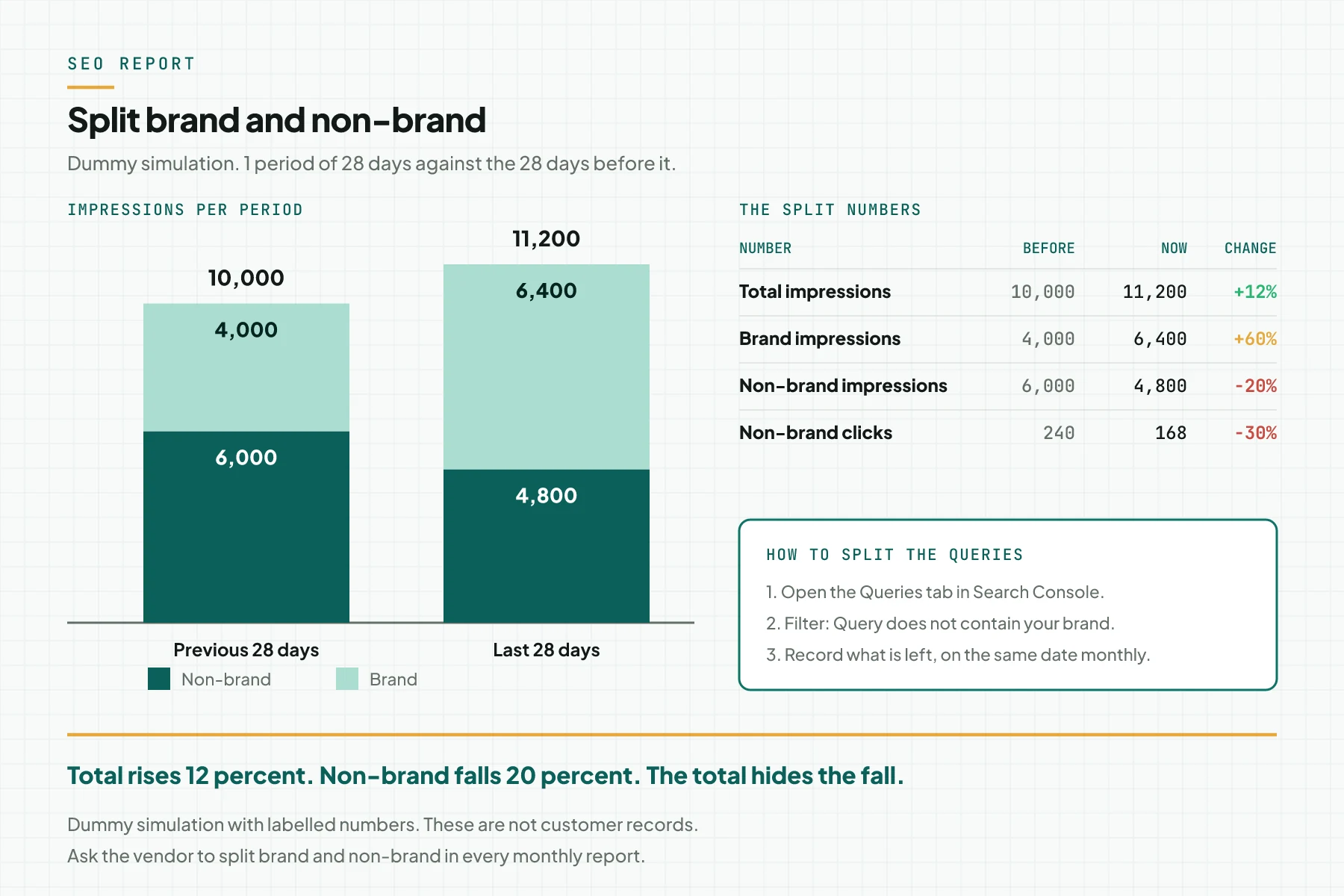
The diagram above uses dummy simulation data. Total impressions rise from 10,000 to 11,200, and a report that stops there looks positive. After the split, brand impressions rise 60 percent while non-brand impressions fall 20 percent and non-brand clicks fall 30 percent. Save a screenshot of this filter every month, on the same date.
Step 3: Test 20 AI prompts and calculate answer share
Write 20 questions your buyers ask, not 20 keywords. Ask each question to 4 AI engines on the same day every month. Record 1 row per prompt: the engine, the date, the brands named, and the links cited.
Count AI citations as the number of answers that name you. Count answer share as AI citations divided by 20. AI engine answers differ between sessions, so treat this number as a 3-month trend, not as an exact 1-month figure.
A paid tool can replace this manual work. Semrush AI Visibility Toolkit is priced at USD 99 per month per domain, Profound at USD 99 to USD 399 per month, and Peec AI at EUR 89 to EUR 199 per month (Ryze, AI visibility tools pricing compared). At the rate of Rp 16,300 per USD, USD 99 equals Rp 1,613,700 per month.
Step 4: Connect the organic numbers to money
Open Analytics, select the organic traffic segment, then show 1 agreed conversion goal. That goal can be a submitted form, an incoming WhatsApp message, or a completed order. Pick 1 goal only, and keep the same goal for the whole contract.
Divide the monthly fee by the organic conversions for that month. The result is your cost per organic conversion. That number falls when the work succeeds, and that is the number worth taking into a meeting, not a tool score.
Results do not arrive at once. SEO results usually appear in month 3 to month 6, competitive keywords need 6 to 12 months, and local SEO moves in month 1 to month 3 (Doit.co.id, how long SEO results take). The full timing expectation sits in how long SEO results take.
Example: 6 months of reports for 1 simulated shop
The table below is a simulation with dummy data for 1 fictional shop. These numbers are examples for explanation, not customer records. The AI prompt set is 20 prompts every month.
| Month | Non-brand impressions | Non-brand clicks | AI citations | Organic conversions | Buyer decision |
|---|---|---|---|---|---|
| Month 1 | 6,000 | 240 | 1 | 3 | Keep as the baseline |
| Month 2 | 5,400 | 210 | 1 | 2 | Ask which pages fell |
| Month 3 | 4,800 | 168 | 2 | 2 | Month 3 review, ask for a written plan |
| Month 4 | 5,600 | 205 | 3 | 4 | The plan works, continue |
| Month 5 | 6,900 | 268 | 4 | 5 | Technical fixes start to show |
| Month 6 | 8,100 | 330 | 6 | 7 | Continue the contract, widen the scope |
This simulation shows 3 things. First, month 2 and month 3 fall, and the fall is visible only because the numbers used are non-brand numbers. Second, answer share rises from 5 percent in month 1 to 30 percent in month 6, because 6 of 20 prompts name the shop. Third, the buyer decision in month 3 is to ask for a written plan, not to stop at once.
Checklist before you pay the next invoice
- Ask for the 8 required numbers on 1 page in a fixed format. Owner: the business owner. Evidence to keep: the report file for the current month.
- Open Search Console yourself, then split brand and non-brand queries. Owner: the marketing staff. Evidence to keep: a screenshot of the filter with its numbers.
- Compare the vendor numbers with your own over the same 28 days. Owner: the marketing staff. Evidence to keep: 1 dated difference table.
- Test 20 fixed prompts on 4 AI engines, then calculate answer share. Owner: the marketing staff. Evidence to keep: the prompt list and answer screenshots.
- Count organic conversions against 1 agreed goal. Owner: the business owner. Evidence to keep: the Analytics organic segment report.
- Ask for a written plan for each number that falls 2 months in a row. Owner: the vendor. Evidence to keep: the plan email with its date.
- Stop criterion: when non-brand clicks do not rise after 6 months and the vendor gives no written plan, end the contract at the next review.
Run these 7 items on the same date every month. A check that moves its date produces a comparison that does not match.
Market prices and what you can fairly demand
The numbers below give you a base for judgement. Indonesian market prices in 2026 run from Rp 500,000 to Rp 3,000,000 for a one-off SEO audit, Rp 500,000 to Rp 2,000,000 for keyword research, Rp 300,000 to Rp 1,500,000 per article, Rp 500,000 to more than Rp 5,000,000 per month for backlinks, and Rp 1,000,000 to more than Rp 5,000,000 per technical SEO project (Optimaise, SEO service prices).
| Service level | Market price per month | What you can fairly demand |
|---|---|---|
| Small business | Rp 2,000,000 to Rp 8,000,000 | The 8 required numbers and 1 written plan |
| Mid-market | Rp 8,000,000 to Rp 20,000,000 | Competitor analysis and a question session too |
| Enterprise | Rp 20,000,000 to Rp 50,000,000 and above | A dashboard and AI visibility monitoring too |
Source for the price levels above: Dipstrategy, Indonesian SEO price standards 2026. The same source names a 6-month minimum contract as the market standard, and flags a price under Rp 1,000,000 per month with a page 1 promise as a black hat risk. For AI engine monitoring, cmlabs Indonesia starts at Rp 15,000,000 per month, while global GEOGEOThe work of preparing a page so an AI answer engine quotes it correctly, not only a classic search engine.Open the glossary agencies charge USD 4,000 to USD 10,000 per month (Gen-Optima, GEO agencies in Indonesia 2026). At the rate of Rp 16,300 per USD, USD 4,000 equals Rp 65,200,000 per month.
Rama Digital recommendation: demand the 8 required numbers at every price level, and raise the other demands with the level. This recommendation holds when you already own the Search Console and Analytics access yourself.
| Rama Digital monthly package | Promotional price per month | Standard price per month | Work hours per month |
|---|---|---|---|
| Pantau | Rp 1,080,000 | Rp 1,800,000 | 1 |
| Rawat | Rp 3,540,000 | Rp 5,900,000 | 8 |
| Tumbuh | Rp 7,080,000 | Rp 11,800,000 | 18 |
| Perluas | Rp 14,280,000 | Rp 23,800,000 | 36 |
The Pantau package monitors 30 prompts on 4 AI engines and sends 1 monthly report. The Rawat package adds a monthly crawl, up to 5 priority fixes, monitoring of 20 prompts on 2 AI engines, a 28-day Search Console report, and 1 updated page. The monthly contract runs for at least 6 months, with a review in month 3 and a right to stop.
Frequently asked questions
My SEO agency sends a report, how do I know it is honest? Open Search Console for your own property, pick the same 28-day period, then split brand and non-brand queries. Compare your non-brand impressions and clicks with the numbers in the report. A large gap without an explanation is a sign to ask.
Which SEO metrics actually matter? Non-brand clicks and conversions from organic sit closest to money. Non-brand impressions show new demand, and AI citations show whether AI engines name you. Those 4 numbers form the core, and the other 4 required numbers explain the cause.
My SEO report is full of green charts but sales stay flat, why? Green charts usually measure total impressions, page 1 keyword counts, and backlink counts. All 3 rise without new buyers. Ask for non-brand clicks and organic conversions over the same period, then judge the report again.
Why does the page 1 keyword count mislead? A tool counts every phrase in the top 10 results, including phrases with no searchers and phrases that carry your own brand name. The count can triple without 1 extra click. Ask for volume and clicks per keyword instead.
What is answer share and how do I calculate it? Answer share is the number of AI engine answers that name you divided by the number of prompts tested. When 6 of 20 prompts name you, your answer share is 30 percent. Use the same prompt list every month so the numbers stay comparable.
How long should I wait before I judge a vendor? SEO results usually appear in month 3 to month 6, while local SEO can move in month 1 to month 3. Use the month 3 review to judge the process and the plan, then use month 6 to judge the result.
Next step
The limit that still holds: an honest report shows the result, and the report itself repairs nothing. A number can fall in a month when the work was correct, for example after an algorithm change. Pair each falling number with 1 written plan, not with 1 vendor change.
If you want a monthly report with those 8 numbers, plus prompt monitoring on 4 AI engines, see Monthly SEO and AI Visibility Service for the contents of each package. If you want us to review 1 vendor report first, book a 30-minute session.
Sources
- Optimaise: SEO service prices in Indonesia
- Dipstrategy: Indonesian SEO price standards 2026
- Ahrefs: AI Overviews reduce organic clicks
- Contently: AI Overview traffic impact
- Doit.co.id: how long SEO results take
- Ryze: AI visibility tools pricing compared 2026
- Gen-Optima: GEO agencies in Indonesia 2026