Direct answer: SEOSEOThe work of making your page easy to find and easy to choose in search results, without paying for ads.Open the glossary services for AI search make your pages crawlable, retrievable, and quotable for ChatGPT, Gemini, Perplexity, and AI OverviewsAIOThe AI answer summary above search results. It answers part of the question before anybody presses a link.Open the glossary. You write 1 answer sentence that stands alone on every important page, with the number, the date, and the source inside it. You then test 15 buying prompts on 4 AI engines each month, and you record the brands the engines name. Classic SEO still works, because AI engines take their material from indexed web pages.
Main condition: this method holds when your site lets AI bots read the pages, the main text appears in the first HTML, and your brand and service names stay the same across the site. Limit: nobody can guarantee that an AI answer names your brand. AI engines change their answers without notice, and the same prompt can give different answers to different users. We sell a process, a measure, and evidence, not a ranking promise.
Rama Digital read Indonesian market prices, global GEOGEOThe work of preparing a page so an AI answer engine quotes it correctly, not only a classic search engine.Open the glossary prices, monitoring tool costs, and AI Overviews impact data on 16 September 2026. Main sources: the Ahrefs study on AI Overviews clicks, the Contently report on AI Overviews traffic impact, and the 2026 Indonesian SEO price standard from Dipstrategy. The 90-day timeline in this article uses labelled dummy data, not customer data.
Organic traffic fell after AI Overviews: what actually happened
Your readers did not stop searching. They stopped clicking. The search engine answers on the results page, and the reader leaves without opening any site.
These numbers show the size of the change. Ahrefs recorded an organic click-through rate drop of 34% to 61% when an AI Overview appears on a query. Contently recorded 80% to 83% zero-click on queries with AI Overviews, and a 38% fall in Google referral traffic to publishers against the year before.
One number changes your decision. Contently also recorded that brands cited inside AI Overviews receive 35% more organic clicks. So the problem is not the lost clicks. The problem is who gets cited inside that answer box.
This article belongs to the Rama Digital SEO cluster. Read the pillar article on what SEO services are first if you do not yet know what an SEO vendor does each month.
How an AI engine picks its citations: 5 stages
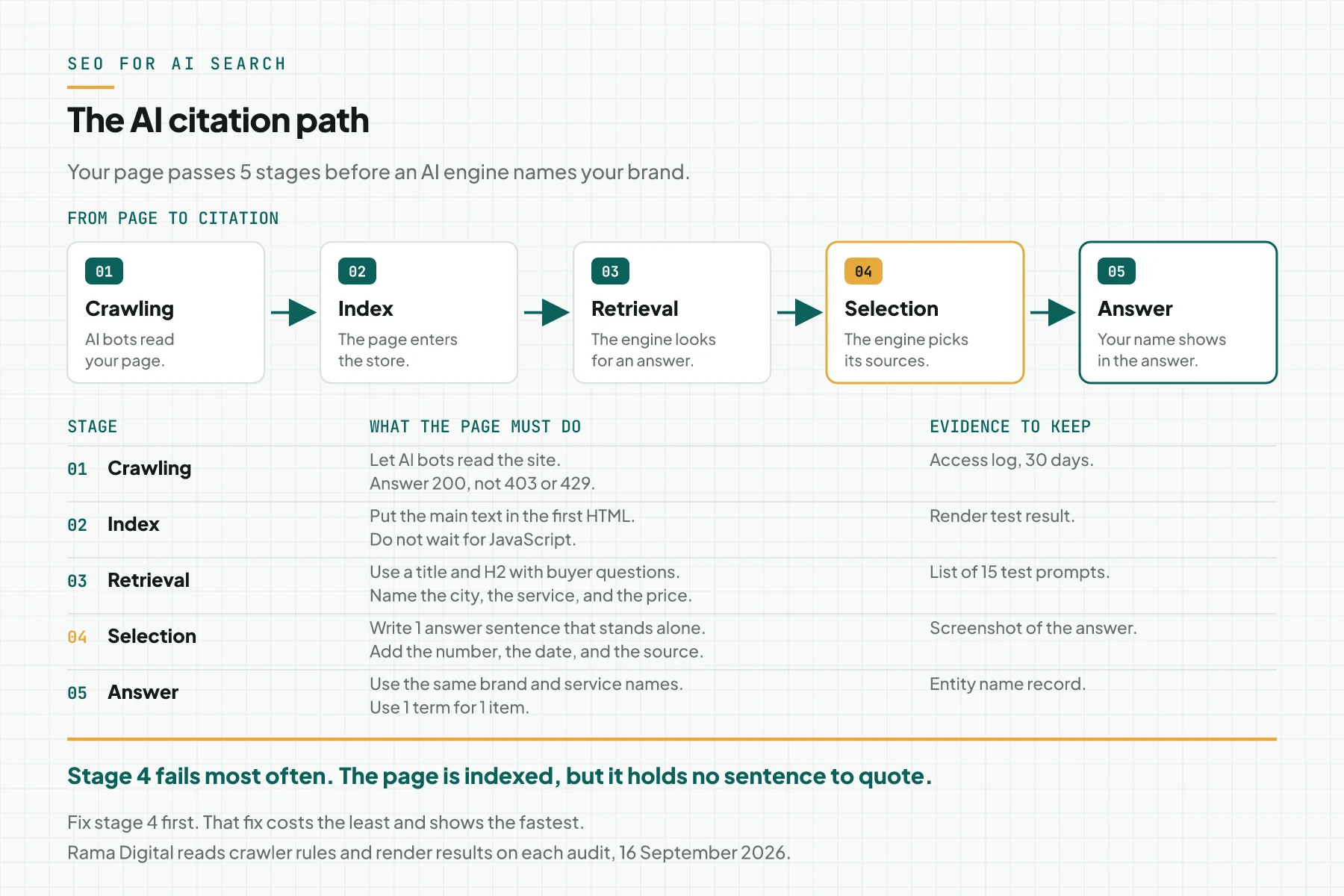
An AI engine does not judge your site like a panel. It runs 5 technical stages, and your page drops out at the first stage it fails. The diagram below maps all 5 stages with the page requirement and the evidence you keep.
Stages 1 and 2: crawling and index
AI bots such as OAI-SearchBot read your page and store its content. A page that answers 403 or 429 never enters that store. A page that keeps its main text only inside JavaScript also risks being read as empty.
Your action here is simple. Let AI bots read the site, then check the access log for the last 30 days. Keep the list of pages that answer anything other than 200 as evidence.
Stage 3: retrieval when a question arrives
An AI engine looks for material only after somebody asks. It splits that question into several internal searches, then pulls the pages that match. Your page joins that pull when its title and H2 use the words a buyer uses.
This explains why a service page built from slogans is rarely pulled. That page holds no sentence that matches a buyer question, such as "how much does it cost" or "is it safe".
Stage 4: citation selection
This stage fails most often. Your page is indexed and retrieved, yet the engine picks another source. The engine picks a sentence it can move into the answer without extra context.
The fix is cheap. Write 1 answer sentence that stands alone at the start of every important page. Put the number, the date, and the source in the same sentence.
What changed and what stayed the same in classic SEO
The question "is SEO still useful when people ask AI" has a firm answer. SEO still works, because AI engines take material from the web index. What changed is the measure and the shape of the sentence, not the technical base.
| Part | Classic SEO (stayed the same) | AI search (what changed) |
|---|---|---|
| Bot access | Googlebot must be able to read the page. | AI bots such as OAI-SearchBot must also be able to read the page. |
| Measure | Keyword position and click count. | Brand mention count and citation count in answers. |
| Content shape | A long page that answers 1 intent. | 1 answer sentence that stands alone inside that long page. |
| Evidence in the text | Sources may sit in the closing section. | The number, the date, and the source must sit in the same paragraph. |
| Measuring tool | Search Console and rank tools. | Manual prompt tests, plus a paid AI monitoring tool when the budget allows. |
| Time to result | Usually 3 to 6 months, and 6 to 12 months for competitive keywords. | No standard range exists yet. Measure it with your own monthly prompt test. |
The market uses 3 names for overlapping work. AEO means Answer Engine Optimization, the work that makes your page the answer. GEO means Generative Engine Optimization, the work that makes a generative engine cite you. Rama Digital uses 1 term for all of it: AI visibility.
What you prepare before the test
- Google Search Console access for your domain. Owner: the marketing team.
- Server log or Cloudflare report access for the last 30 days, to check how the site answers AI bots.
- Accounts on 4 AI engines: ChatGPT, Gemini, Perplexity, and Claude. A free account is enough for the first test.
- 1 empty sheet with columns for date, engine, prompt, answer, cited sources, and your brand position.
- 1 service page you may edit today, to test the answer sentence fix.
- A list of 3 rivals that your buyers name on the phone.
Step 1: Build 15 buying prompts
Write 15 prompts that your buyers really type. Do not use short keywords such as "SEO services". AI engines accept long sentences, so use long sentences that name the city, the trade, and the problem. Split those 15 prompts into 6 types, as the table shows.
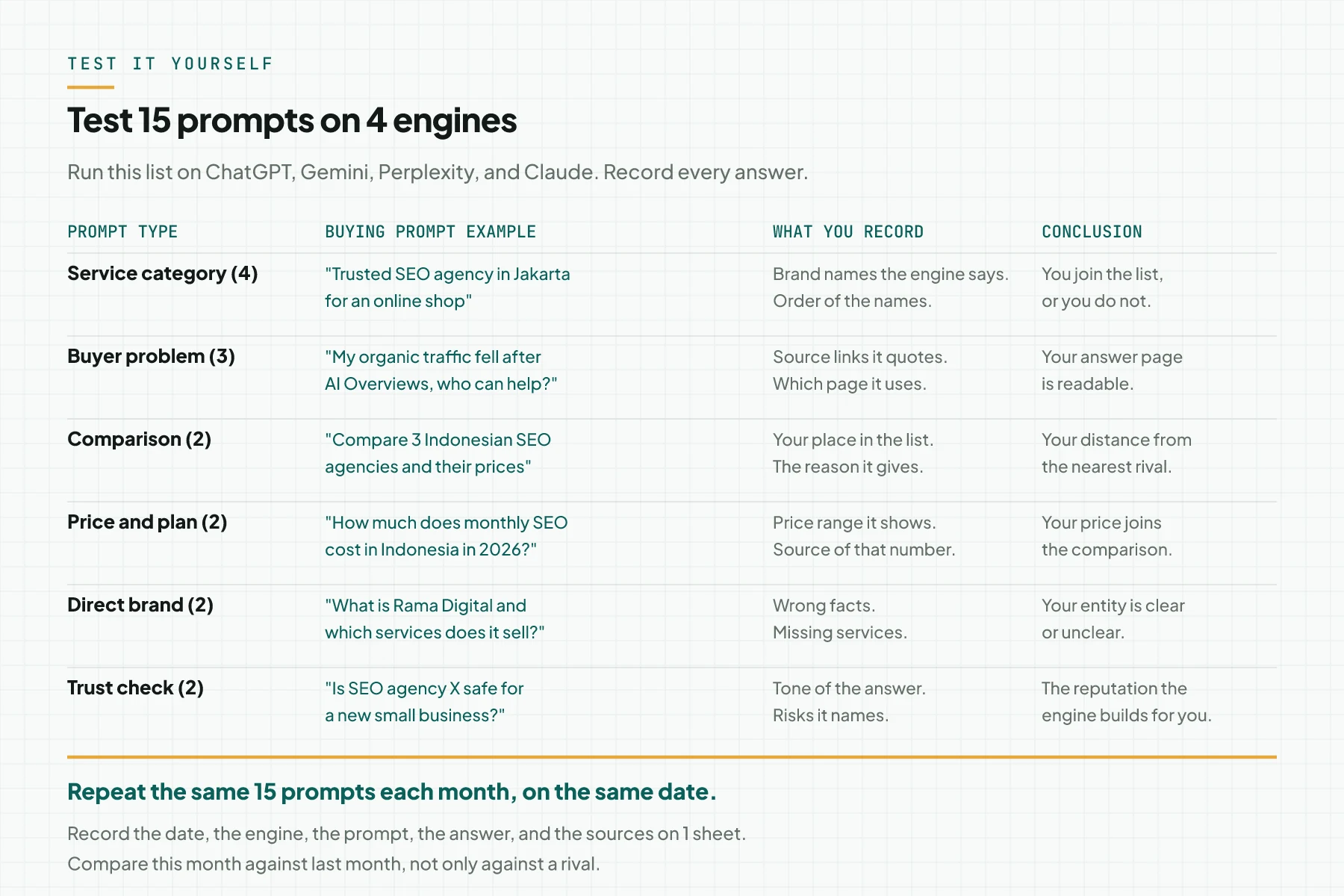
Keep those 15 prompts as a fixed list. A list that changes every month makes the comparison meaningless. The evidence you keep is 1 sheet with 15 prompt rows and the date you wrote them.
Step 2: Run the prompts on 4 AI engines
Run the same 15 prompts on ChatGPT, Gemini, Perplexity, and Claude. That gives 60 answers in 1 round. Use a new chat window for each prompt, and turn off personalisation history where the engine offers it.
Record 4 items for each answer: the brands named, the order of the names, the source links quoted, and any wrong fact about you. Keep a screenshot of the answer as evidence. Screenshots matter because engine answers change, and you must be able to prove the starting condition.
One full round takes 60 to 90 minutes when you do it yourself. In our internal test, recording took the most time, not running the prompts.
Step 3: Record the result and set 3 fixes
Count 1 base number: how many of the 60 answers name your brand. That number becomes your first-month baseline. Compare the next month against that number, not only against a rival.
Then pick 3 fixes, and only 3. Rank them by the stage that failed in the first diagram. Fix bot access first, then the answer sentence, then the consistency of your brand and service names.
Write an owner and a due date on every fix. A fix without an owner never lands. Read the article on SEO reporting if you want the monthly report format you can demand from a vendor.
A 90-day simulation with dummy data
The table below is a simulation with dummy data. Its numbers are not a customer result, and they are not a promise. The table shows the shape of the record you keep, not the size of the rise you should expect.
| Date | Action | What is recorded | Observed result |
|---|---|---|---|
| 1 July | Run 15 prompts on 4 engines. | 60 answers and their screenshots. | The brand appears in 4 of 60 answers. |
| 8 July | Open AI bot access. Fix 3 pages that answer 403. | Access log, 30 days. | All 3 pages answer 200. |
| 15 July | Add 1 answer sentence to 6 service pages. | Page revisions and their dates. | Each page holds a number, a date, and a source. |
| 1 August | Repeat the same 15 prompts. | 60 answers and their screenshots. | The brand appears in 11 of 60 answers. |
| 1 September | Align service names on 12 pages. Repeat the 15 prompts. | Entity name record and 60 answers. | The brand appears in 17 of 60 answers. |
Look at the shape of the decision. You change 1 thing, you repeat the same test, then you read the difference. Without a fixed monthly test, you cannot separate your own work from an engine change.
llms.txt: an extra discovery path, not a ranking factor
Many vendors sell an llms.txt install as the key to AI visibility. We refuse that framing. llms.txt is 1 text file that points machine readers at your important pages.
Rama Digital recommendation: treat llms.txt as an extra discovery path. Add it when it is cheap and easy to maintain. Do not buy an expensive plan whose core promise is that file.
The reason is plain. No major search engine has announced llms.txt as a ranking factor. The file does not replace bot access, main text in the first HTML, or an answer sentence worth quoting.
Market prices and the Rama Digital position
Price decides whether you buy a process or buy a promise. This table holds the market prices we read on 16 September 2026. We convert with Rp 16.300 per 1 USD.
| Type of work | Market price | Source |
|---|---|---|
| One-off SEO audit | Rp 500.000 to Rp 3.000.000 | Optimaise |
| Monthly SEO for a small business | Rp 2.000.000 to Rp 8.000.000 per month | Dipstrategy |
| Monthly SEO for a mid-size company | Rp 8.000.000 to Rp 20.000.000 per month | Dipstrategy |
| GEO in Indonesia (cmlabs) | From Rp 15.000.000 per month | Gen-Optima |
| Global GEO agency | USD 4.000 to USD 10.000 per month, about Rp 65.200.000 to Rp 163.000.000 | Gen-Optima |
| Mid-market AEO and GEO retainer | USD 2.000 to USD 8.000 per month, about Rp 32.600.000 to Rp 130.400.000 | The Digital Elevator |
| AI visibility monitoring tools | Semrush USD 99 per month per domain. Profound USD 99 to USD 399 per month. Peec AI EUR 89 to EUR 199 per month. | Ryze |
A component breakdown for GEO costs sits in the 2026 GEO cost guide from WebFX. For classic SEO components, Optimaise records keyword research at Rp 500.000 to Rp 2.000.000, content at Rp 300.000 to Rp 1.500.000 per article, and technical SEO at Rp 1.000.000 to more than Rp 5.000.000 per project.
Remember 1 price signal. Dipstrategy warns that a price below Rp 1.000.000 per month with a page-1 promise risks black hat methods. Dipstrategy also names a 6-month minimum contract as the market standard.
Here is where the Rama Digital packages sit against those market numbers. The promotional price runs 40% below the normal price. The service page holds the full package content.
| Rama Digital package | Promotional price | Content related to AI search |
|---|---|---|
| Pindai | Rp 2.520.000, normal Rp 4.200.000, 3 working days | Up to 100 URLs. 15 test prompts on 2 AI engines. Written report and a recording. |
| Audit | Rp 8.640.000, normal Rp 14.400.000, 2 weeks | Up to 1.000 URLs. 197 check rules. 40 test prompts on 4 AI engines. 3 rivals analysed. |
| Audit dan Perbaikan | Rp 17.280.000, normal Rp 28.800.000, 5 weeks | All of Audit. Our team applies the priority fixes. |
| Pantau | Rp 1.080.000 per month, normal Rp 1.800.000 | Monitor 30 prompts on 4 AI engines. Monthly report. |
| Tumbuh | Rp 7.080.000 per month, normal Rp 11.800.000 | Monitor 50 prompts on 4 AI engines. 2 new articles. 3 pages updated. 2 rivals analysed. |
The Pindai fee credits in full against Audit or Audit dan Perbaikan when you continue within 30 days. The monthly contract runs for 6 months at least, with a month-3 review and a right to stop. Read the article on what an SEO audit is if you want to see the audit checks first.
Your checklist before you buy SEO services for AI search
- Ask the vendor to show their test prompt list. Owner: the buyer. Evidence: the prompt list file with its date.
- Ask for 1 sample monthly report they have sent before. Owner: the buyer. Evidence: the report file with masked data.
- Check whether the vendor names how many AI engines they monitor. Owner: the buyer. Evidence: the quote from the written offer.
- Refuse a vendor who promises a fixed place in AI answers. Owner: the buyer. Evidence: a written note from the sales call.
- Run your own 15 prompts before you sign. Owner: the marketing team. Evidence: 60 answer screenshots.
- Set the baseline together with the vendor on day 1. Owner: the vendor and the buyer. Evidence: 1 baseline sheet both sides sign.
- Put the month-3 review date inside the contract. Owner: the buyer. Evidence: the contract clause that names the date.
- Stop when your brand mention count has not moved after 6 months and the vendor cannot show a finished technical fix. Write this stop criterion down before you pay.
The limit that still applies: this checklist lowers your risk, but it does not guarantee a result. AI engines change without notice, and your test result holds for that test date only.
Next step: start with Jasa Audit SEO dan Visibilitas AI to see the starting condition of your site. If you would rather review your 15 prompts first, book a 30-minute session with us.
Frequently asked questions
Is SEO still useful when people ask AI? Yes. AI engines take their answer material from indexed web pages, so a page that is not indexed is never cited. What changed is the measure: you count brand mentions, not only keyword positions.
How do I make my business appear in ChatGPT? Let AI bots read your site, serve the main text in the first HTML, then write 1 answer sentence that stands alone on every important page. After that, test 15 buying prompts each month and fix the stage that failed.
What is AEO and how does it differ from GEO? AEO means Answer Engine Optimization, the work that makes your page the answer. GEO means Generative Engine Optimization, the work that makes a generative engine cite you. Both share the same technical base, and we call it AI visibility.
Does llms.txt raise my Google ranking? No. llms.txt is an extra discovery path, not a ranking factor, and no major search engine has announced it as one. Add it when it is cheap, but do not buy a plan whose core promise is that file.
How much does AI search optimisation cost in Indonesia? GEO agencies in Indonesia start from Rp 15.000.000 per month according to Gen-Optima, while global agencies charge USD 4.000 to USD 10.000 per month. The Rama Digital Pantau package starts at Rp 1.080.000 per month for 30 prompts on 4 AI engines.
How long until I see a result? For classic SEO, results usually show in 3 to 6 months, and in 6 to 12 months on competitive keywords according to Doit. For AI visibility, no standard range exists yet, so measure it with your own monthly prompt test.
Sources
- Ahrefs: AI Overviews reduce organic clicks by 34% to 61%
- Contently: the AI Overviews impact on publisher traffic
- Optimaise: SEO service prices in Indonesia
- Dipstrategy: the 2026 Indonesian SEO price standard
- Gen-Optima: 10 GEO agencies in Indonesia 2026
- The Digital Elevator: the AEO and GEO pricing guide
- WebFX: Generative Engine Optimization cost
- Doit: how long SEO results take
- Ryze: AI visibility tool pricing compared 2026