Direct answer: an SEOSEOThe work of making your page easy to find and easy to choose in search results, without paying for ads.Open the glossary audit is a structured check of your site against 1 fixed rule list, page by page. The audit covers 22 groups, from URL and HTTP status to schemaSchemaExtra description inside page code that tells a search engine what the page is, for example an article, a service, or a question and answer.Open the glossary, page content, and AI citations. What you receive is a prioritised finding list, not 1 single score. Each finding names the page, the cause, the repair, the repair time, and the cost of leaving it.
Main condition: this answer holds when your site is live, a robot can crawl it, and it is connected to Google Search Console. Limit: an audit finds and ranks problems, but an audit does not repair them and does not lift rankings on its own. SEO results usually appear in 3 to 6 months, and competitive keywords need 6 to 12 months, per doit.co.id on SEO result timing.
We read the price and market sources in this article on 16 September 2026: the Optimaise SEO price list, the Dipstrategy 2026 SEO price standard, the Ahrefs study on AI Overview clicks, and the Contently report on AI Overview traffic. The 22 check groups come from the SEO, AIOAIOThe AI answer summary above search results. It answers part of the question before anybody presses a link.Open the glossary, and GEOGEOThe work of preparing a page so an AI answer engine quotes it correctly, not only a classic search engine.Open the glossary rules we apply to our own site. Every audit result in this article uses labelled dummy data, not real customer data.
The problem: an audit report that changes nothing
Most site owners have received an audit report before. It holds 80 PDF pages, 1 large score on the cover, and hundreds of warnings in no order. The team then cannot tell what to do first.
Such a report fails at 1 point: it names problems, but it does not name decisions. You need to know which finding keeps a page out of the index, which finding only costs clicks, and which finding can wait 3 months. Without that order, a team repairs small items and leaves large ones.
A second problem arrived when AI engines entered the results page. Ahrefs recorded organic CTR falling 34% to 61% at the top position when AI Overviews appear. Contently recorded 80% to 83% zero-click rates on queries with AI Overviews, and Google referral traffic to publishers fell 38% year on year. An audit that only checks rankings cannot see that loss. For the full scope of SEO work, read the pillar article on SEO services.
The 3 audit layers and the limit of each
A useful audit uses 3 layers. Each layer uses different tools, finds different problems, and misses different things. Removing 1 layer means accepting 1 blind spot.
Layer 1: automated tools scan every URL
A crawler reads each URL, then reports HTTP status, titles, headings, canonicals, hreflang, and JSON-LD. This layer is strong at scale: 1,000 URLs finish in 1 hour to 1 day. It finds 404 errors, redirect chains, duplicate titles, and broken schema.
Its limit is clear. A tool does not know whether 1 page answers the reader's question. A tool marks a page green when the page is technically correct but empty in substance.
Layer 2: a person reads the pages
An editor opens 10 to 30 important pages, then reads them the way a buyer reads. This layer finds answers that miss the question, number claims without a source, schema prices that differ from the page price, and the wrong reader intent. No tool reports those findings.
This layer also decides the order. Tools give a list; a person gives priority, a time estimate, and an owner. Its limit is scale: a person does not read 1,000 URLs one by one.
Layer 3: a citation test on AI engines
We run a fixed prompt list on AI engines, then record who gets cited. This layer answers 1 question the other layers cannot: does your brand appear when a buyer asks an AI assistant. Contently recorded that brands cited in AI Overviews receive 35% more organic clicks.
The limit of this layer is cause. A citation test shows that you are not cited, but it does not show the technical reason. Layers 1 and 2 supply that reason. The full treatment sits in the article on SEO for AI search.
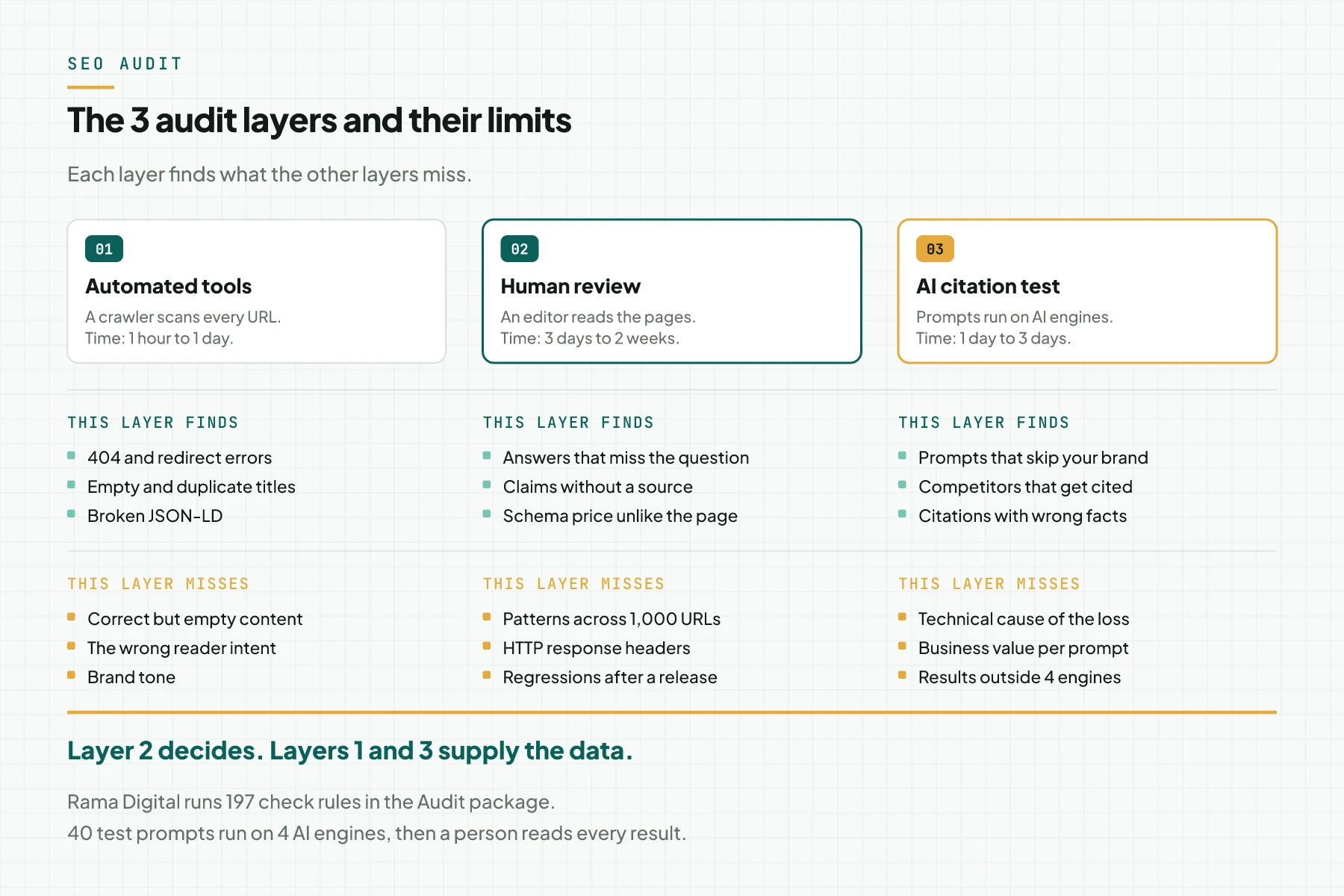
The diagram above shows that split of work. Layer 1 gives coverage, layer 3 gives market evidence, and layer 2 turns both into decisions. An audit built on 1 layer produces a list, not a plan.
The 22 check groups in our audit
The table below names 22 check groups, 1 real example finding for each, and the layer that usually finds it. Our Audit package splits these 22 groups into 197 check rules. The example findings are illustrations, not the result for 1 named customer.
| Check group | Example finding | Layer that finds it |
|---|---|---|
| URL and HTTP status | An important page returns 404 or 500 | Layer 1 |
| Canonical | 2 URLs share the same canonical | Layer 1 |
| Redirects | A 3-hop redirect chain on old URLs | Layer 1 |
| Indexing and environment | A noindex tag left on a production page | Layer 1 |
| XML sitemap | The sitemap lists old URLs and admin pages | Layer 1 |
| Language and hreflang | An EN hreflang points at an unpublished page | Layer 1 |
| Title and description | Duplicate titles on 40 product pages | Layer 1 |
| Heading structure | 1 page uses 3 H1 tags at once | Layer 1 |
| Open Graph and social preview | The social image returns 404 when shared | Layer 1 |
| General JSON-LD rules | Broken JSON-LD, so no schema is read | Layer 1 |
| Organization and WebSite | The brand name differs between page and schema | Layer 2 |
| Article and BlogPosting | The schema date differs from the visible date | Layer 2 |
| Breadcrumb | The visible breadcrumb differs from BreadcrumbList | Layer 2 |
| FAQ | FAQ schema holds an answer no reader sees | Layer 2 |
| Service, Offer, and price schema | The schema price differs from the page price | Layer 2 |
| Content images and alt text | Images without alt text on 60 pages | Layer 1 |
| Video | Video schema ships without a playable video | Layer 2 |
| Page content and direct answer | The page delays the answer to paragraph 8 | Layer 2 |
| Evidence and sources | A number claimed without a source or a date | Layer 2 |
| AIO and GEO | The answer cannot be quoted without extra context | Layer 3 |
| Internal links | The service page receives no internal link | Layers 1 and 2 |
| Google Search Console | Clicks fall after a release, with no alarm | Layers 1 and 2 |
Look at the third column. 12 of the 22 groups come from automated tools, 8 groups need a person, and 1 group needs an AI citation test. An audit built on tools alone therefore misses almost half of the list.
Free audits and paid audits: the difference
A free audit works as a warm-up. It checks 1 page, returns a score, and stops there. The table below compares the 4 audit types sold in the Indonesian market.
| Audit type | What it checks | What it misses | Market price |
|---|---|---|---|
| Free online tool audit | 1 page, an automatic score, a few tags | Content, reader intent, priority, AI citations | Rp 0 |
| Paid tool audit | Every URL, technical findings, a raw report | Priority, brand tone, business decisions | Rp 1,000,000 to over Rp 5,000,000 per technical SEO project |
| One-off human audit | Technical and content work, with priority and timing | AI citations, monitoring after a release | Rp 500,000 to Rp 3,000,000 |
| Human audit plus AI citation test | Technical, content, 4 AI engines, Search Console data | The repair work itself | Rp 8,640,000 in our Audit package |
The numbers in the 2 middle rows come from the Optimaise SEO price list, read on 16 September 2026. A one-off audit at Rp 500,000 to Rp 3,000,000 is the market range for a written report. That range rarely includes an AI citation test, because AI monitoring tools carry their own monthly cost.
A 2026 comparison of AI visibility tool pricing lists Semrush AI Visibility Toolkit at USD 99 per month per domain, Profound at USD 99 to USD 399 per month, and Peec AI at EUR 89 to EUR 199 per month. At Rp 16,300 per USD, USD 99 equals Rp 1,614,000 per month. That tool cost sits inside the price of any audit that includes layer 3.
What to prepare before the audit
An audit runs faster when access is ready on day 1. Prepare these 6 items.
- Read access to Google Search Console for the correct property, including the domain property.
- Read access to the analytics tool you use, covering the last 12 months.
- A list of the 10 pages that earn money, ranked by the business owner.
- A list of 3 competitors you believe take the same buyers.
- 1 test account on the CMS, so we can check 1 page without touching other content.
- The name of 1 owner who may decide which repairs go ahead.
Step 1: Collect access and the URL list
Open Google Search Console, then Settings, then Users and permissions, and add the reviewer as a restricted user. Take the URL list from your sitemap, then compare it with the Page indexing report.
Verify this step with 1 number: the URL count in the sitemap should be close to the indexed page count. A large gap is your first finding. Keep both numbers as early evidence.
Step 2: Run the crawl and read the raw findings
Run a crawler across the whole domain with the URL limit your package allows. Our Scan package uses up to 100 URLs, and the Audit package uses up to 1,000 URLs. Group the output by the 22 groups in the table above.
Verify this step by comparing the HTTP status of every important page. Every page that earns money must return 200. Record each 404, each 500, and each redirect chain as a candidate P0 finding.
Step 3: Read 10 important pages with human eyes
Open the 10 pages from the owner's list, then read the first paragraph of each. Ask 1 question: does that paragraph answer the buyer without extra context. Record every page that delays the answer to paragraph 5 or later.
Also compare the price, the service name, and the date on the page against its schema. A gap between visible text and schema is a finding tools often miss. Keep a screenshot of each gap as evidence.
Step 4: Test prompts on AI engines
Write the prompt list a buyer actually types, then run that list on the AI engines you choose. The Scan package uses 15 prompts on 2 engines, and the Audit package uses 40 prompts on 4 engines. Record the brand cited in each answer.
Verify this step with 1 simple table: prompt, engine, cited brand, and test date. Repeat the same test every month, because AI answers change. Keep a screen recording for every prompt that names a competitor.
Step 5: Sort the findings into P0, P1, and P2
Give each finding 1 level. P0 blocks indexing, P1 lowers clicks, and P2 slows growth. Order the work by that level, not by the warning count in a tool report.
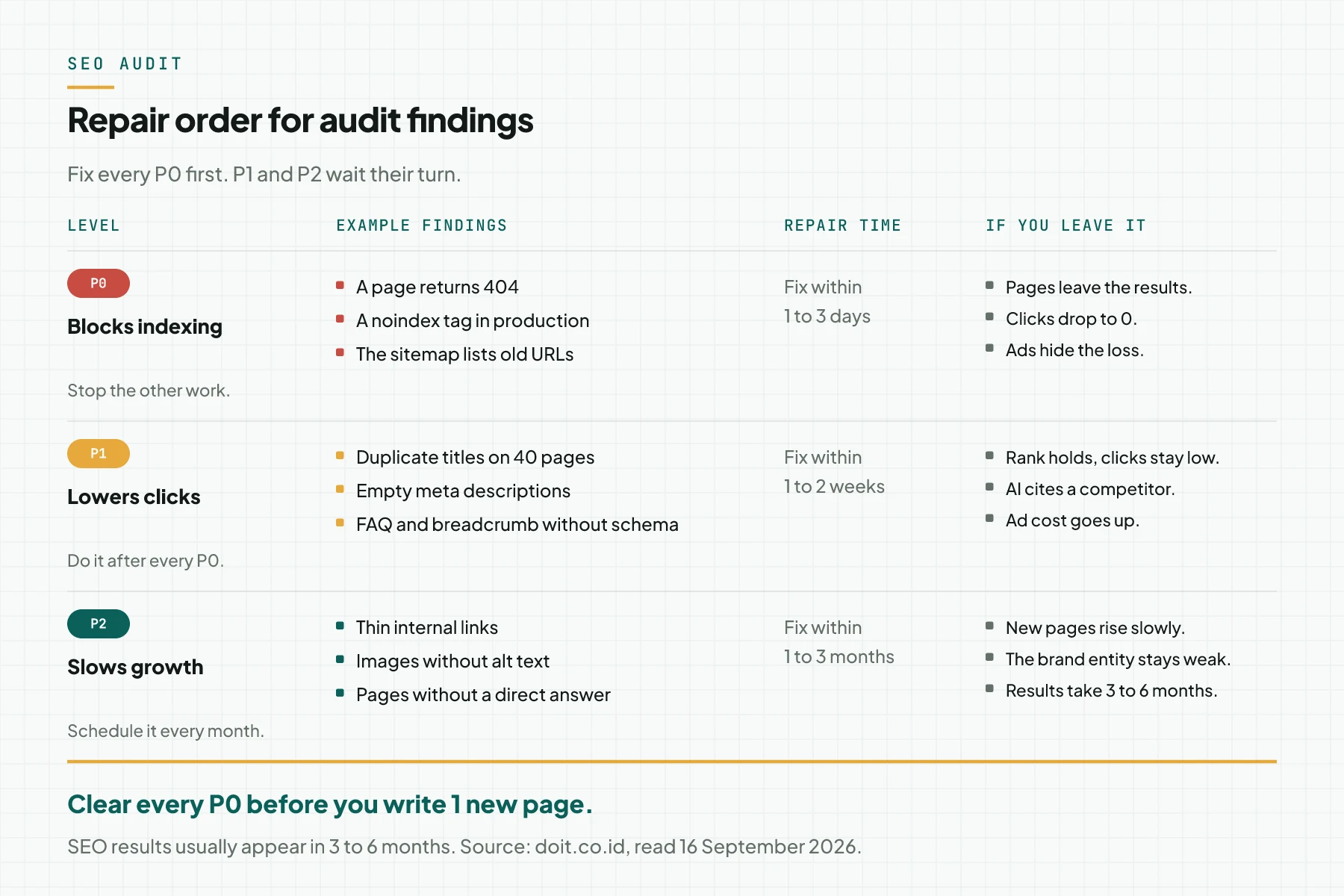
Verify this step with 1 stop rule: write no new page while 1 P0 stays open. Publishing new articles on top of broken indexing adds cost without adding clicks. Keep the P0 list with a completion date for each item.
Example: an audit of 1 fictional shop (dummy data simulation)
The simulation below uses 1 fictional shop called Toko Rasa with 420 URLs. Every number is dummy data for explanation, not the result of 1 real customer. The date range follows the Audit package duration of 2 weeks.
| Day | Input | What was recorded | Output |
|---|---|---|---|
| Day 1 | Search Console access and the 10 money pages | Sitemap lists 512 URLs, 388 URLs indexed | A gap of 124 URLs becomes the first finding |
| Day 3 | A crawl of 420 URLs | 17 pages return 404, 9 pages carry noindex | 26 P0 findings, repair estimate 2 days |
| Day 6 | Human reading of the 10 money pages | 6 pages delay the answer to paragraph 7 | 6 P1 findings, repair estimate 1 week |
| Day 9 | 40 test prompts on 4 AI engines | The shop brand appears in 5 of 40 answers | 1 P1 finding and 3 new page proposals |
| Day 12 | Building the repair order | 26 P0, 7 P1, 19 P2 with named owners | 1 five-week plan and 1 presentation session |
The day 9 row shows the value of layer 3. That shop ranked well on 3 keywords, yet the shop brand appeared in only 5 of 40 AI answers. No crawl tool report would surface that finding.
Reader checklist before you buy an audit
Use these 7 items to judge the audit offer you receive. Each item names 1 action, 1 owner, and 1 piece of evidence to keep.
- Ask for a redacted sample report. Owner: the vendor. Evidence: 1 sample PDF file.
- Ask for the list of check groups used. Owner: the vendor. Evidence: a written list, not a tool name.
- Ask how many URLs the scope covers. Owner: the vendor. Evidence: the URL limit in the offer.
- Ask whether a person reads the pages, and how many. Owner: the vendor. Evidence: the page count in the offer.
- Ask whether an AI citation test is included, and on which engines. Owner: the vendor. Evidence: the prompt count and engine names.
- Prepare the access and 1 internal owner before the audit starts. Owner: the business owner. Evidence: a name and a job title.
- Stop criterion: refuse any offer that promises Google position 1 by a named date. Dipstrategy notes that prices under Rp 1,000,000 per month with a page 1 promise carry black hat risk.
SEO audit prices and where ours sit
Audit prices in Indonesia split by the layers you buy. Optimaise lists a one-off SEO audit at Rp 500,000 to Rp 3,000,000, keyword research at Rp 500,000 to Rp 2,000,000, content at Rp 300,000 to Rp 1,500,000 per article, and backlinks at Rp 500,000 to over Rp 5,000,000 per month. Dipstrategy lists monthly SEO for small business at Rp 2,000,000 to Rp 8,000,000, mid-market at Rp 8,000,000 to Rp 20,000,000, and enterprise at Rp 20,000,000 to Rp 50,000,000 and above, with a 6-month minimum contract as the market standard.
Prices for layer 3 sit at another level. Gen-Optima records cmlabs Indonesia from Rp 15,000,000 per month and global GEO agencies at USD 4,000 to USD 10,000 per month. The Digital Elevator lists mid-market AEO and GEO retainers at USD 2,000 to USD 8,000 per month, and WebFX breaks down the 2026 GEO cost components. At Rp 16,300 per USD, USD 2,000 equals Rp 32,600,000 per month.
Our audit packages sit below that GEO range because an audit is one-off work, not a retainer. The table below names the prices that apply. How to read an offer sits in the SEO pricing article.
| Audit package | Promo price | Standard price | Duration |
|---|---|---|---|
| Scan | Rp 2,520,000 | Rp 4,200,000 | 3 working days |
| Audit | Rp 8,640,000 | Rp 14,400,000 | 2 weeks |
| Audit and Repair | Rp 17,280,000 | Rp 28,800,000 | 5 weeks |
Rama Digital recommendation: start with Scan when you have never been audited, then move to Audit once you have seen the sample findings. We credit the Scan fee in full toward Audit or Audit and Repair when you continue within 30 days. This recommendation holds for a site under 1,000 URLs.
Frequently asked questions
What gets checked in an SEO audit? The audit covers 22 groups: URL and HTTP status, canonicals, redirects, indexing, sitemap, hreflang, titles, headings, Open Graph, JSON-LD, Organization, Article, breadcrumb, FAQ, price schema, images, video, page content, evidence and sources, AIO and GEO, internal links, and Google Search Console.
What is the difference between a free and a paid SEO audit? A free audit checks 1 page and returns an automatic score. A paid audit checks every URL, adds human reading, adds an AI citation test, then sorts findings into P0, P1, and P2 with a repair time estimate.
I want to audit my website, where do I start? Start with access. Prepare Google Search Console, a list of the 10 pages that earn money, and 1 decision owner. Then run the crawl, read 10 pages with human eyes, and sort the findings.
How long does an SEO audit take? The Scan package finishes in 3 working days for up to 100 URLs. The Audit package finishes in 2 weeks for up to 1,000 URLs. Repairs follow the audit, and results usually appear 3 to 6 months later.
Does an audit guarantee a ranking increase? No. An audit finds and ranks problems, then your team or our team repairs them. We sell a process and a measurement, not a promised position on the Google results page.
Does an audit need to be repeated? Yes, after every large release and every 3 months. A template change can kill schema, alter a canonical, or add a noindex tag. Monthly monitoring catches that regression faster than a yearly audit.
Next step
The limit that still applies: an audit gives a prioritised finding list, but the repair stays separate work. We do not promise a position on the Google results page, and no agency can promise one. What we do promise is the check coverage, the test prompt count, and the report date.
To see the scope of each package, open the SEO Audit and AI Visibility Service page. To ask questions first, book a 30-minute session.
Sources
- Optimaise: SEO service prices in Indonesia
- Dipstrategy: Indonesian SEO price standard 2026
- Ahrefs: how AI Overviews affect organic clicks
- Contently: AI Overview traffic impact
- doit.co.id: how long SEO results take
- Ryze: AI visibility tool pricing compared 2026
- Gen-Optima: GEO agencies in Indonesia 2026
- The Digital Elevator: AEO and GEO pricing guide
- WebFX: generative engine optimization cost