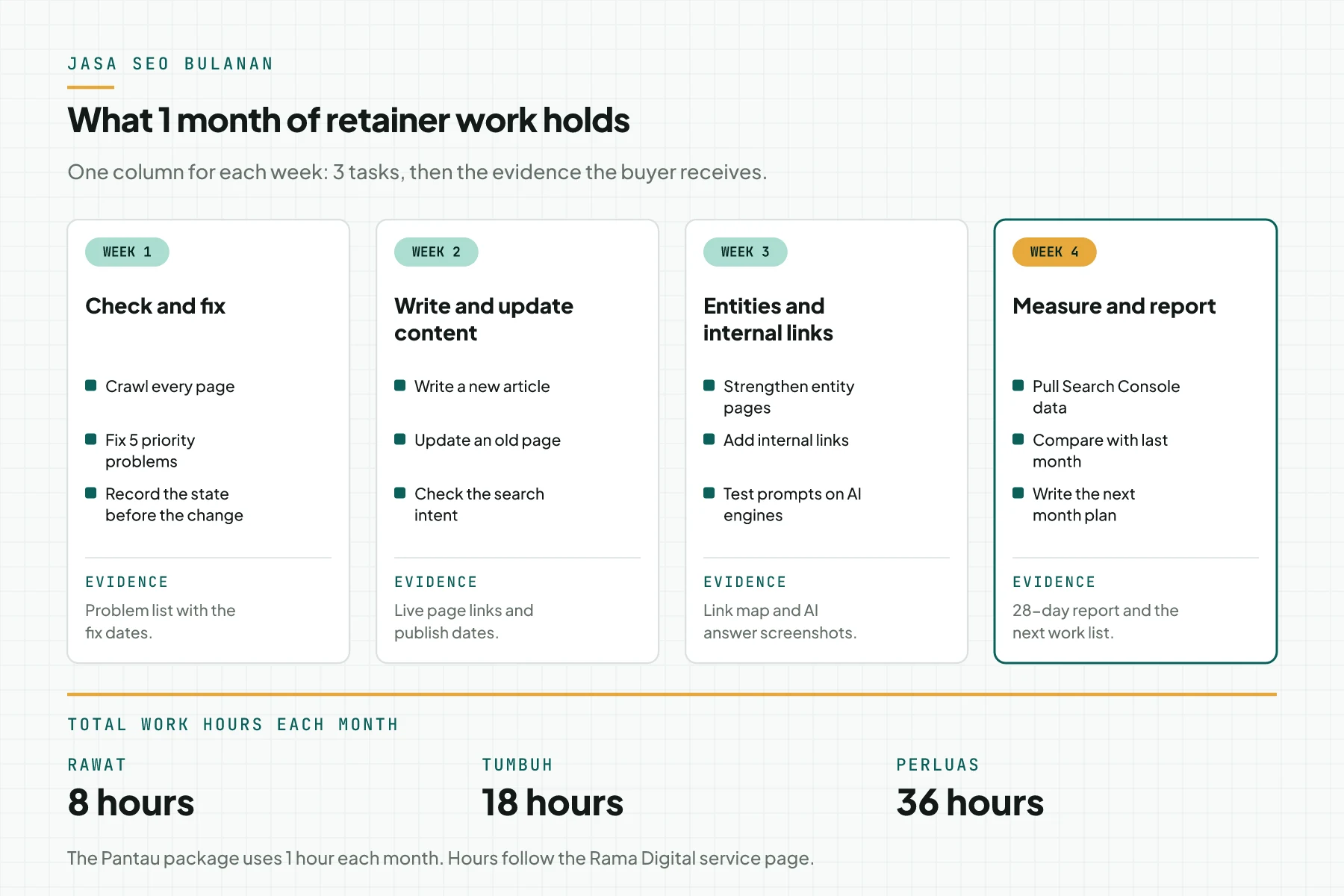
Jawaban langsung: a monthly SEOSEOThe work of making your page easy to find and easy to choose in search results, without paying for ads.Open the glossary service repeats 4 work blocks each month: technical checks and fixes, new or updated content, entity and internal link work, then measurement and the report. The agency spreads those 4 blocks across 4 weeks. Each block must leave 1 piece of evidence you can check yourself, such as a list of changed URLs or a link to a live page. An honest package names the work hours for each month, not only the task names.
Kondisi utama: this 4-week pattern applies to a retainer with fixed monthly hours, on a site that is live and connected to Search Console. Batas: this article promises no position on Google. Rama Digital sells a process and a measure, not a rank. Paid backlinks also stay outside our monthly packages.
We read Indonesian market prices, GEOGEOThe work of preparing a page so an AI answer engine quotes it correctly, not only a classic search engine.Open the glossary retainer prices, AI monitoring tool costs, and data on the AI impact on organic clicks on 16 September 2026. Our sources: Optimaise: SEO service prices in Indonesia, Dipstrategy: Indonesian SEO price standards 2026, gen-optima: 10 GEO agencies in Indonesia 2026, The Digital Elevator: AEO and GEO pricing guide, WebFX: generative engine optimization cost 2026, Ahrefs: AI Overviews reduce clicks, Contently: AI Overview traffic impact, Doit.co.id: how long SEO results take, and Ryze: AI visibility tool pricing compared 2026. Every example here uses dummy data, not real customer data, and we convert with Rp 16.300 for each USD.
The problem: you pay each month and see no work
A retainer buyer receives 1 report with a rising chart. The report names a tool score, not the pages that changed. Without that list, you cannot tell 8 hours of work from 1 hour of work.
The problem grew in 2026. Ahrefs recorded an organic CTRCTRClicks divided by impressions, as a percentage. CTR shows how often people press the ad or the search result they saw.Open the glossary drop of 34% to 61% on keywords that show AI OverviewsAIOThe AI answer summary above search results. It answers part of the question before anybody presses a link.Open the glossary. Source: Ahrefs, AI Overviews reduce clicks.
Contently recorded that 80% to 83% of queries with AI Overviews end with no click, and that Google referral traffic to publishers fell 38% against the year before. Source: Contently, AI Overview traffic impact. So the click curve can fall while the agency works correctly, and you need a different kind of evidence.
If the basics are new to you, read the cluster pillar: what an SEO service is first. This article continues that page and answers 1 question: which work is reasonable each month.
How an SEO retainer works: 4 work blocks in 1 month
A retainer splits the hours into 4 blocks. The order stays fixed, because each block uses the output of the block before it. Technical fixes come first, so new content lands on pages that are already clean.
Block 1: technical checks and fixes
The team crawls every page, then writes a dated problem list. From that list, the team picks 5 priority problems and fixes them. The team records the page state before the change, so you can compare.
The market price for technical SEO per project is Rp 1,000,000 to more than Rp 5,000,000. Source: Optimaise, SEO service prices. A retainer cuts that work into monthly portions, so you pay for repeated fixes, not for 1 large project.
Block 2: new content and updated content
The team writes a new article and updates an old page in the same week. An old page often returns a result sooner, because it already has a history. Each page must answer 1 search intent.
The market price for content is Rp 300,000 to Rp 1,500,000 for each article, and keyword research is Rp 500,000 to Rp 2,000,000. Source: Optimaise, content and keyword research prices. Those numbers become your calculator: 2 articles each month represent Rp 600,000 to Rp 3,000,000 of the package value.
Block 3: entities and internal links
The team strengthens your entity pages, which state who you are, what you sell, and where you work. Then the team adds internal links from supporting pages to the main pages. Last, the team tests prompts on AI engines and keeps the screenshots.
This block matters because brands cited in AI Overviews receive 35% more organic clicks. Source: Contently, brands cited in AI Overviews. Monitoring tools add a fixed cost: the Semrush AI Visibility Toolkit at USD 99 each month for each domain, Profound at USD 99 to USD 399 each month, and Peec AI at EUR 89 to EUR 199 each month. Source: Ryze, AI visibility tool pricing compared 2026.
Block 4: measurement and the report
The team pulls 28 days of Search Console data, compares it with the period before, then writes the plan for next month. A useful report names the period, the work, the evidence, and the next decision. A report with no period cannot be compared.
To read a report line by line, see how to read an SEO service report. For time expectations, see how long SEO results take.
Comparison table: 4 monthly packages and their hours
This table uses the Rama Digital service page numbers on 16 September 2026. The promotional price sits 40% under the standard price. The hours are the hours the team records for your work that month.
| Package | Work hours each month | AI prompt monitoring | Content and fixes | Promotional price each month |
|---|---|---|---|---|
| Pantau | 1 | 30 prompts on 4 AI engines | None; the monthly report only | Rp 1,080,000 |
| Rawat | 8 | 20 prompts on 2 AI engines | Monthly crawl, 5 priority fixes, 1 updated page | Rp 3,540,000 |
| Tumbuh | 18 | 50 prompts on 4 AI engines | All of Rawat, 2 new articles, 3 updated pages, 2 competitor reviews, 1 session of 60 minutes | Rp 7,080,000 |
| Perluas | 36 | 50 prompts on 4 AI engines | All of Tumbuh, 4 new articles, 8 updated pages, entity work, a dashboard | Rp 14,280,000 |
The standard price for each month is Rp 1,800,000 for Pantau, Rp 5,900,000 for Rawat, Rp 11,800,000 for Tumbuh, and Rp 23,800,000 for Perluas. The monthly contract runs for 6 months as a minimum, with a review in month 3 and a right to stop. A 6-month minimum is also the Indonesian market standard. Source: Dipstrategy, Indonesian SEO price standards 2026.
How to read work hours from a price
Use 1 formula: work hours = (monthly price − tool cost) ÷ hourly rate. You need 2 numbers from the vendor, the tool cost they carry and their hourly rate. A vendor who refuses both numbers sells a closed box.
Here is a calculation with dummy data. The monthly price is Rp 5,900,000. The tool cost is 1 AI monitoring licence at USD 99, which is Rp 1,613,700 at Rp 16.300 for each USD. The hourly rate is Rp 450,000. So (Rp 5,900,000 − Rp 1,613,700) ÷ Rp 450,000 = 9.5 work hours.
Use the formula on a cheap offer. A price under Rp 1,000,000 each month with a page-1 promise risks black hat methods. Source: Dipstrategy, the risk under Rp 1,000,000. At that price, 1 monitoring licence already costs more than the package, so no work hours remain.
The same formula explains the Pantau package. Its promotional price of Rp 1,080,000 sits under the price of 1 AI monitoring licence, so the package buys monitoring and a report, not repair work. The Indonesian retainer market runs from Rp 2,000,000 to Rp 8,000,000 for small businesses, Rp 8,000,000 to Rp 20,000,000 for mid-size companies, and Rp 20,000,000 to Rp 50,000,000 and above for enterprises. Source: Dipstrategy, Indonesian retainer price ranges.
What to prepare before month 1
Prepare these 6 items before month 1 starts. Without them, week 1 goes to waiting for access.
- Search Console access on your domain property, for 1 team email address.
- Editor access in your page system, for 1 test page as a minimum.
- 1 decision owner on your side, with authority to approve text changes.
- A list of 10 questions your buyers ask before they buy.
- 1 shared folder for the monthly evidence, with a name for each month.
- A list of 2 competitors you want to watch, with their site addresses.
Step 1: Check and fix in week 1
Ask the team to crawl every page, then to send a dated problem list. Pick the 5 priority problems together, and approve the order in writing. Keep the page state before the change.
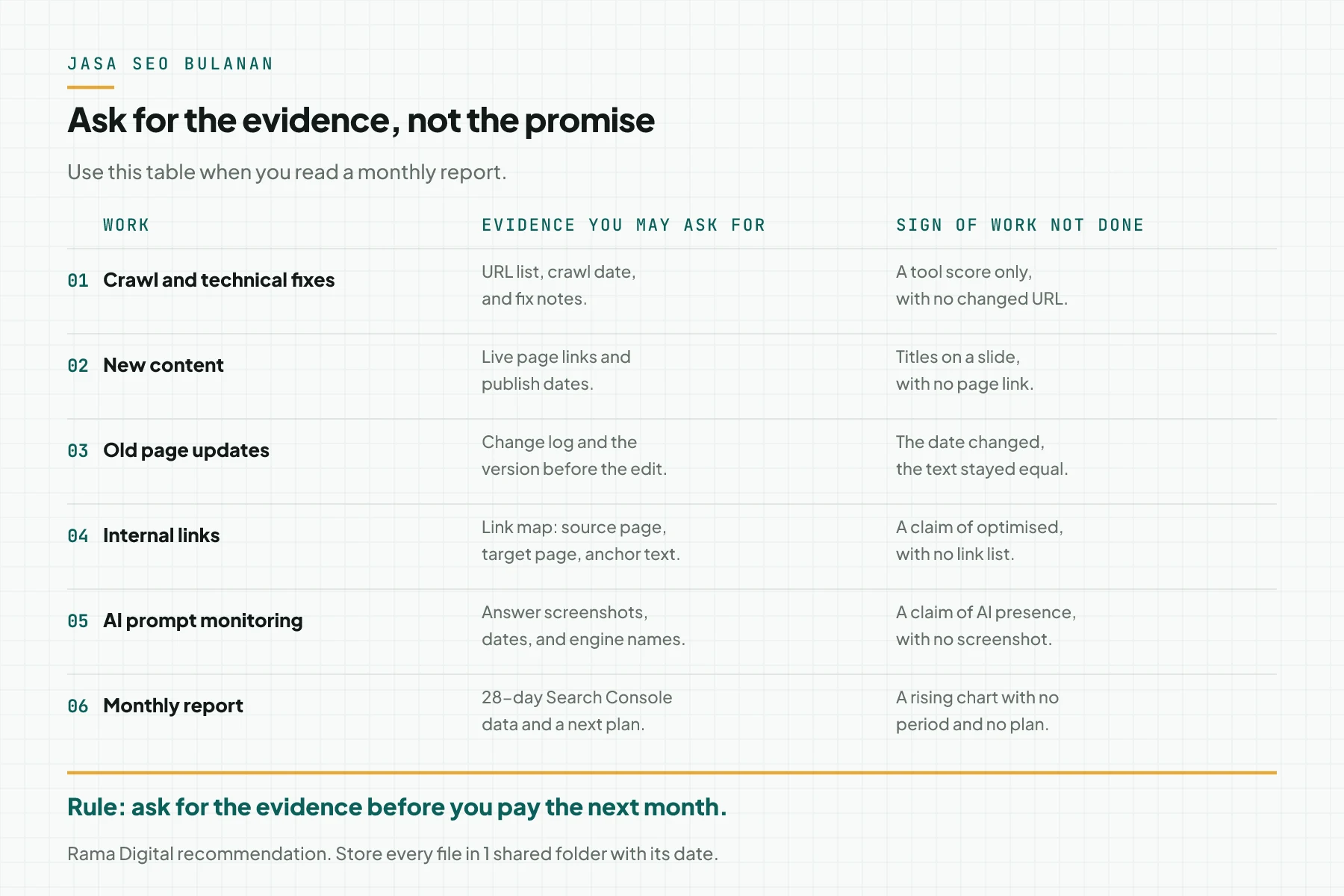
Evidence you may ask for at the end of week 1: the list of changed URLs, the crawl date, and a fix note for each URL. A sign of work not done: the report shows a tool score only, with no changed URL.
Step 2: Write and update content in week 2
Approve the search intent for each page before the writing starts. Ask for 1 direct answer sentence at the top of each page, because AI engines quote sentences that stand alone. Update the old pages in the same week.
Evidence you may ask for at the end of week 2: live page links, publish dates, and a change log for each old page. A sign of work not done: titles on a slide, with no page link you can open.
Step 3: Strengthen entities and internal links in week 3
Ask the team to make your name, services, service area, and proof clear on the main pages. Then ask for a link map: source page, target page, and anchor text. Last, ask the team to test buyer prompts on AI engines.
Evidence you may ask for at the end of week 3: the link map in 1 table, and screenshots of the AI answers with dates and engine names. A sign of work not done: a claim that the pages are optimised, with no link list and no screenshot.
Step 4: Measure and report in week 4
Ask for 28 days of Search Console data, not for a period that moves each month. Compare those 28 days with the 28 days before. Close with a work plan for next month that names the first 3 tasks.
Evidence you may ask for at the end of week 4: the 28-day report, the period comparison, and the next month work list. A sign of work not done: a rising chart with no period and no work plan.
A 1-month simulation with dummy data
The example below is a simulation with dummy data, not real customer data. A building material shop owner uses the Tumbuh package with 18 work hours. The table shows the input, the work record, and the evidence kept.
| Date | Work | Hours | Evidence kept |
|---|---|---|---|
| 2 June | Monthly crawl, 312 pages scanned | 2 | A list of 14 problems with the crawl date |
| 4 June | Fix of the 5 priority problems | 3 | Notes on the state before and after |
| 9 June | New article 1: how to select cement | 3 | Link to the live page |
| 11 June | New article 2: reinforcement bar sizes | 3 | Link to the live page |
| 16 June | Update of 3 old pages | 2 | A change log for each page |
| 18 June | 11 internal links added | 1 | Link map from source to target |
| 23 June | 50 prompts tested on 4 AI engines | 2 | 50 dated screenshots |
| 25 June | Review of 2 competitors | 1 | A summary of 2 pages |
| 30 June | 28-day report and a session of 60 minutes | 1 | The report and the session recording |
The observable output: 18 work hours produced 9 dated pieces of evidence. Click counts stay outside the promise, because clicks depend on competitors and on the shape of the results page. SEO results usually appear in 3 to 6 months, and local SEO appears in 1 to 3 months. Source: Doit.co.id, how long SEO results take.
Checklist for an SEO retainer buyer
- Ask for the 4-week work calendar before month 1 starts. Owner: you. Evidence to keep: 1 dated calendar document.
- Set up 1 shared folder for the monthly evidence. Owner: your operations staff. Evidence to keep: the folder link and the naming rule.
- Check the list of changed URLs each month. Owner: the agency. Evidence to keep: the URL list with fix dates.
- Match the published article count against your package. Owner: you. Evidence to keep: live page links with their dates.
- Ask for AI answer screenshots with the date and the engine name. Owner: the agency. Evidence to keep: 1 screenshot file for each prompt.
- Compare the 28-day report with the 28 days before. Owner: you. Evidence to keep: 2 reports in sequence.
- Run the month 3 review that the contract names. Owner: you and the agency. Evidence to keep: dated review minutes.
- Stop criterion: stop the renewal when 2 months in sequence give no URL list, no live page links, and no report with a period. Owner: you. Evidence to keep: the 2 reports with no evidence.
If you want a service that runs this calendar, see the Monthly SEO and AI Visibility Service page. If you want to check the packages first, book a session of 30 minutes.
Market price position and the Rama Digital position
This table compares the market ranges with our packages on 16 September 2026. The market numbers come from the public pages of other providers. Our numbers come from our own service page.
| Segment | Market range each month | Rama Digital package |
|---|---|---|
| Small business retainer | Rp 2,000,000 to Rp 8,000,000 | Rawat, Rp 3,540,000 promotional, 8 hours |
| Mid-size retainer | Rp 8,000,000 to Rp 20,000,000 | Tumbuh, Rp 7,080,000 promotional, 18 hours |
| Enterprise retainer | Rp 20,000,000 to Rp 50,000,000 and above | Perluas, Rp 14,280,000 promotional, 36 hours |
| Indonesian GEO retainer | From Rp 15,000,000 | AI prompt monitoring sits in all 4 packages |
| Global GEO retainer | USD 4,000 to USD 10,000, which is Rp 65,200,000 to Rp 163,000,000 | No equal package; our scope is narrower |
| Mid-market AEO and GEO retainer | USD 2,000 to USD 8,000, which is Rp 32,600,000 to Rp 130,400,000 | No equal package; our scope is narrower |
Source for the Indonesian retainer ranges: Dipstrategy. Source for the Indonesian and global GEO prices: gen-optima, GEO agencies in Indonesia 2026. Source for the mid-market AEO and GEO retainer: The Digital Elevator, AEO and GEO pricing guide. Cost components of GEO in 2026: WebFX, generative engine optimization cost.
Rama Digital recommendation: pick the package with the hours you need now, then move up after month 3. This recommendation holds when your site is live and you can grant access in week 1. When your site is not live, fix the base pages first, because a retainer cannot measure a page that does not exist.
Frequent questions
What does an SEO agency do each month? The agency runs 4 blocks: technical checks and fixes, new or updated content, entity and internal link work, then measurement and the report. Each block leaves dated evidence.
What should my monthly SEO package contain? The package must name the work hours, the article count, the updated page count, the number of AI prompts watched, and the report period. Contents with no numbers give you nothing to check.
How do I know my SEO agency really works? Ask for 4 pieces of evidence: the changed URL list, live page links, the internal link map, and a 28-day report with a period comparison. Ask for them before you pay the next month.
How many work hours are reasonable for Rp 5,900,000 each month? Use (price − tool cost) ÷ hourly rate. With a tool cost of Rp 1,613,700 and a rate of Rp 450,000, the answer is 9.5 hours. Our Rawat package gives 8 hours at that standard price.
Do the Rama Digital monthly packages include backlinks? No. The market price for backlinks is Rp 500,000 to more than Rp 5,000,000 each month, and we choose to spend the hours on fixes, content, and entities.
Is a price under Rp 1,000,000 each month reasonable? Dipstrategy reports that such a price risks black hat methods. The licence for 1 AI monitoring tool already costs Rp 1,613,700 each month, so no work hours remain.
Your next decision
The limit that still applies: this calendar governs the work and the evidence, not a position on Google. Results usually appear in 3 to 6 months, and competitive keywords need 6 to 12 months. Our contract runs for 6 months as a minimum, with a review in month 3 and a right to stop.
If you want our team to run this 4-week calendar on your site, open the Monthly SEO and AI Visibility Service page to read the contents of each package. If you want to check the fit first, book a session of 30 minutes and bring your list of buyer questions.
Sources
- Optimaise: SEO service prices in Indonesia
- Dipstrategy: Indonesian SEO price standards 2026
- gen-optima: 10 GEO agencies in Indonesia 2026
- The Digital Elevator: AEO and GEO pricing guide
- WebFX: generative engine optimization cost 2026
- Ahrefs: AI Overviews reduce clicks
- Contently: AI Overview traffic impact
- Doit.co.id: how long SEO results take
- Ryze: AI visibility tool pricing compared 2026