Direct answer: a decision model fits any point whose answer is closed and repeats. These 8 points come from our own system and from the official TypeSafe cookbooks: a chat turn guard, lead triage, a claim guard, intent routing, ad review, article quality, search re-ranking, and an agentAI agentAn AI program that performs work steps by itself, for example reading a message, drafting a reply, and recording the result.Open the glossary step guard.
It holds when: each point carries a written rubric and your code reads the result. Limits: this list promises no outcome. We name the question shapes and the effects we measured ourselves, not a sales increase.
We wrote this list on 19 September 2026, using the TypeSafe documentation and our own use inside the Rama Digital systems.
The 8 decision points
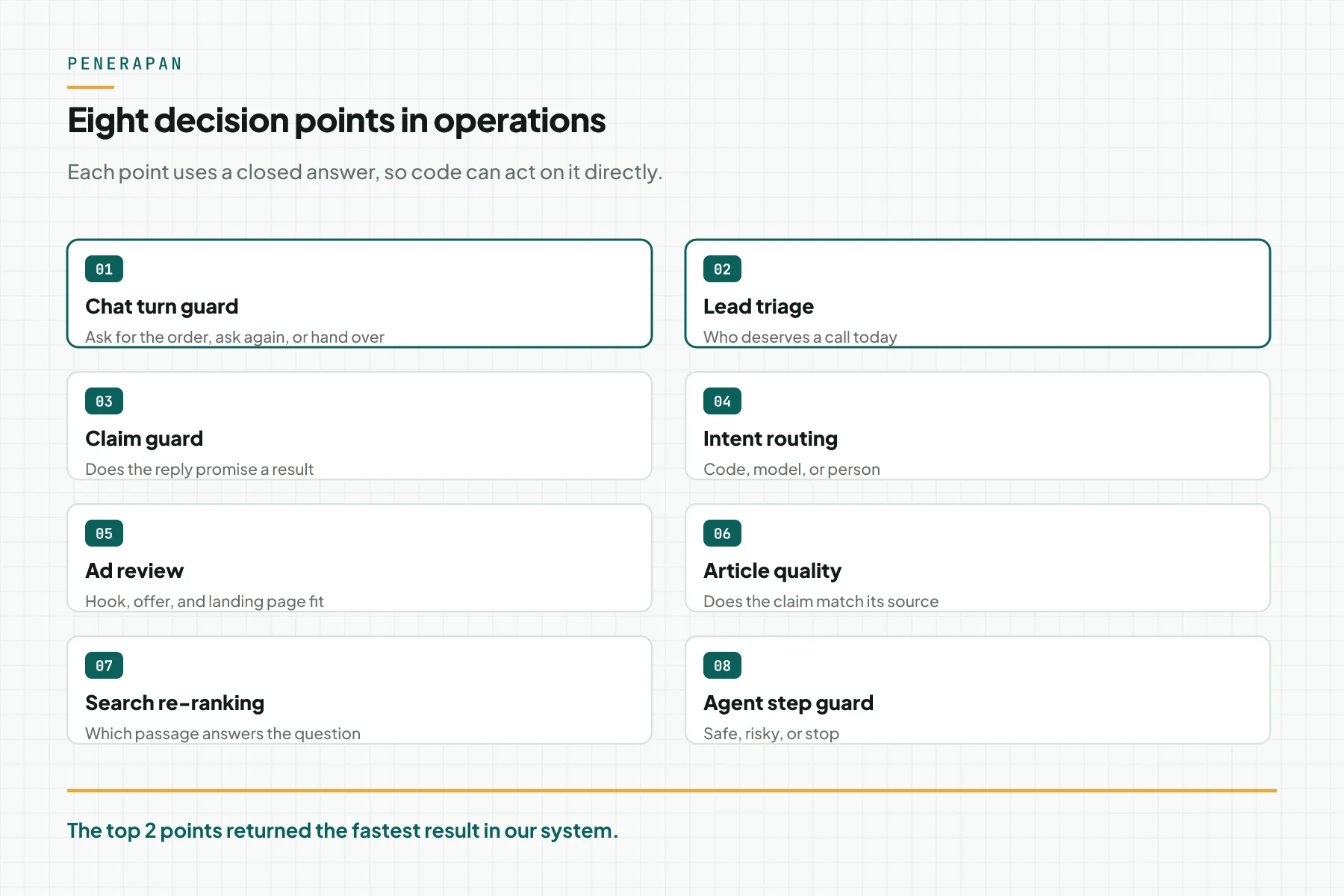
The order follows impact rather than ease. Start from the point you repeat most.
1. A chat turn guard
Before the assistant reply leaves, one call decides the next step: ask for the order, ask one more question, or hand over to a person.
{
  "state": { "balasan_asisten": "...", "pertanyaan_pengunjung": "..." },
  "model": "jev-latest",
  "questions": {
    "langkah_berikutnya": {
      "type": "choice",
      "instructions": "Langkah apa yang harus diambil sistem setelah balasan ini?",
      "criteria": {
        "minta_order": "Kebutuhan sudah jelas dan harga sudah disebut",
        "tanya_lagi": "Masih ada 1 hal wajib yang belum terjawab",
        "lempar_manusia": "Pengunjung meminta orang, marah, atau kasusnya di luar katalog"
      }
    }
  }
}
In our system this point was born from one finding: of 43 assistant replies, only 2 asked for the order. The full story is in our guide to auditing conversations with Jev.
2. Morning lead triage
Give the model a record of every lead: channel, entry page, message count, stage, service, and payment status. Three questions are enough: how well it was handled, why it stalled, and whether a person should chase it today.
The conversation content need not travel. In our audit, 227 session records were judged in seconds without opening a single chat.
3. A claim guard before text leaves
One Noul question holds back a promise you cannot support: a guaranteed rank, a guaranteed result, or a number with no source. A second question rates how much harm the promise would cause if it slipped through.
This pattern is called a guardrail, and TypeSafe publishes its own cookbook for it. Source: the TypeSafe guardrails cookbook.
4. Routing every inbound message
One Choice question picks the handler: deterministic code, a generative model, or a person. The cheap path handles most messages, and the large model handles only the heavy ones.
Confidence becomes the second gate. An answer under your threshold does not run automatically; it joins the review queue. Source: the intent routing pattern and the confidence-gated routing pattern.
5. Reviewing ads and landing pages
Send the ad text together with a summary of its landing pageLanding pageThe page an ad points to. It carries 1 offer and 1 action, with no menu pulling the visitor elsewhere.What is a landing page?, then ask closed questions: the hook type, the offer shape, the call to action, the awareness stage, and whether the landing page matches the promise.
Because every question runs in one request, reviewing dozens of ads stops at a small cost. We use the same pattern to judge assistant replies.
6. Article quality and citation checks
One Choice question checks whether a quote really supports the claim written beside it. Low confidence marks the article for a human read.
This check holds back the error that damages trust most: the right number under the wrong source. Source: the citation check cookbook.
7. Re-ranking search results
Take 20 to 30 candidates from a plain keyword search, then judge each candidate against the user question with one question per pair.
The same pattern filters RAG passages: keep the ones that answer, flag the ones that contradict, and drop the ones carrying a hidden instruction. Source: the re-ranking cookbook and the RAG passage cookbook.
8. An agent step guard
An agent that runs long sequences needs a checker at every step. One Score question rates the risk of the next step: safe, risky, or stop.
It costs little and adds under one second, so the guard can run on every step without changing how the agent feels to use.
The question shape that makes all of this work
All 8 points follow the same rule: the question must be checkable by someone else. A question about taste returns an answer about taste.
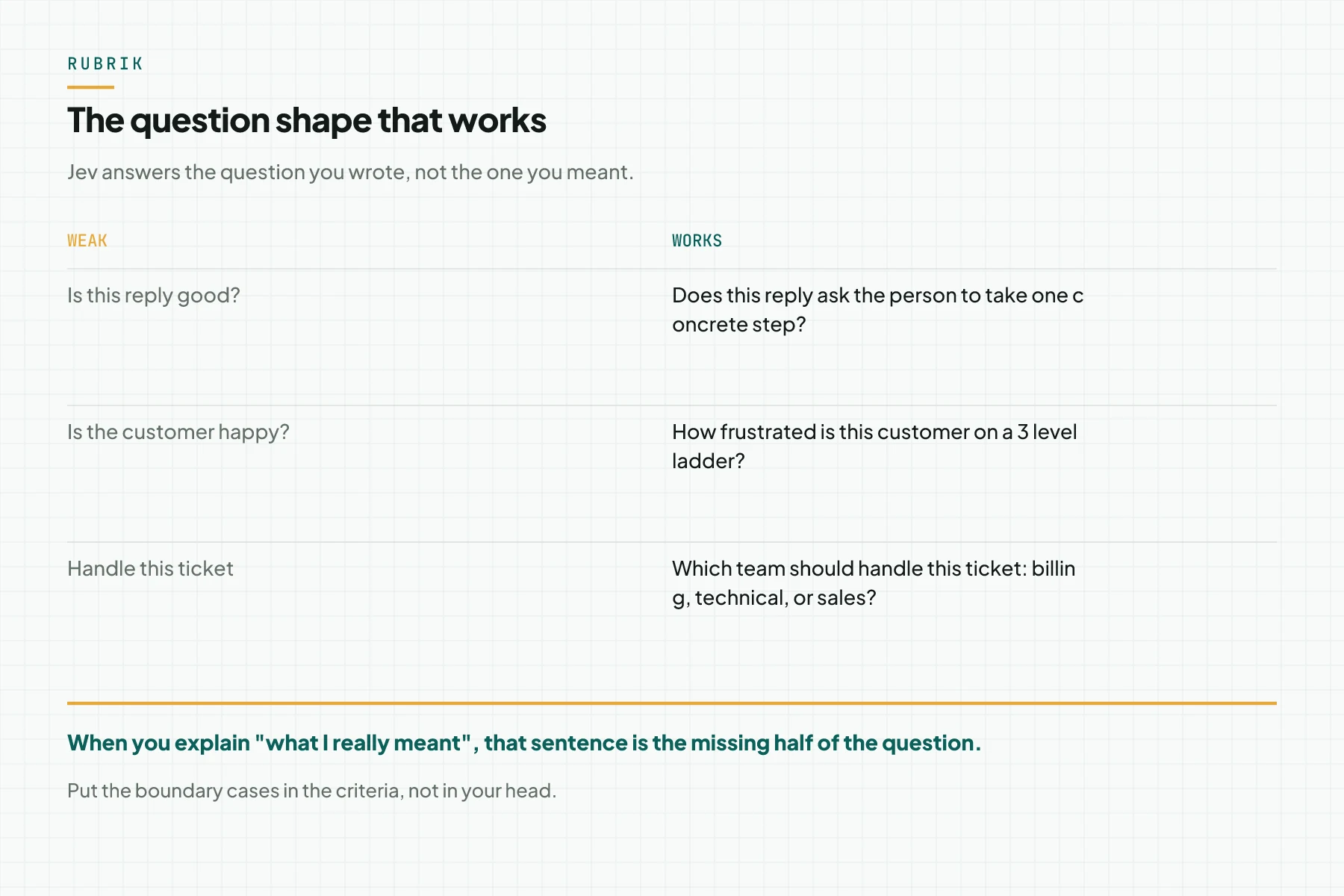
Three habits keep a rubric healthy. First, write one condition sentence in the instruction. Second, write one sentence per option. Third, test it on 10 records whose answers you already know.
How to pick your first point
| Question | If the answer is yes |
|---|---|
| Does this decision repeat every day? | It deserves to be the first point |
| Can the answer be written as a list? | The rubric is easy to build |
| Is a mistake expensive? | Set a high confidence threshold |
| Are the people already overloaded? | The effect shows in the first week |
Rama Digital recommends: take one point, run it for 2 weeks, then measure the change with the same rubric before adding a second.
What changes after one point runs
The first effect is not saved money. It is sight. You start seeing patterns that volume used to hide.
In our system the first point surfaced 3 things in a single run. First, the spread of sales moves: 19 replies gave a price, 8 diagnosed, and 2 asked for the order. Second, the stall reason: 149 of 227 sessions died right after contact capture. Third, reply length: 17 of 43 replies passed 80 words.
Those 3 numbers became 3 rule changes in the same week. Without a decision point they stay feelings rather than work.
The mistakes people make on the first rollout
- Installing every point at once. An untested rubric multiplies into 8 problems rather than one.
- Sending the whole history as the state. Answer quality falls and the cost rises at the same time.
- Skipping the confidence threshold. Without it, automatic actions run on answers that are not settled.
- Not storing the results. With no record you cannot compare before and after a change.
All 4 appeared in our own rollout. The fix is plain: one point, a filtered state, a written threshold, and stored results.
Frequently asked questions
Do all 8 points go in at once? No. One point that runs cleanly beats 8 that are half finished.
Is training data needed? No. A decision model uses the rubric you write in sentences, not labelled examples.
What if an answer is wrong? The confidence threshold holds the automatic action back, and uncertain records join the human queue. Fix the rubric, then test again on 10 records.
Does this replace the team? No. These points move the sorting work, not the work of deciding anything large.
What does it cost to start? A trial on 10 records costs almost nothing. Our full audit of 227 sessions stopped at 0.0094 USD.
Next step
The remaining limit: a list of points does not replace a rubric. A vague rubric returns vague decisions. We wrote about checking a claim before you use it in What is a meat proxy.
If you want us to map the decision points inside your operation, open AI Diagnostic. To talk it through first, pick an AI Diagnostic slot.