Direct answer: Meat proxy is an informal term for someone who forwards AI output without reading, understanding, or checking it. The person acts as an intermediary between the AI and the recipient. Niklas Gruhn’s essay describes this pattern in conversations and code review.
Main condition: The term highlights missing human judgment when someone presents AI output as an answer ready for use. Limit: Using AI to write or translate does not automatically show this pattern. Assess the sender’s checks and responsibility.
Evidence basis: Rama Digital read the primary sources on 15 September 2026. This article contains editorial analysis, proposed process diagrams, and a simulation with dummy data. We did not run a productivity experiment or use customer data.
What does meat proxy mean, and where did it come from?
Here, meat refers to a human, while proxy means an intermediary. A sender receives a question, passes it to AI, and returns the answer. The problem appears when the sender cannot explain the reasoning behind that answer.
The page meat-based llm proxies, dated 31 March 2026, already uses the phrase meat proxy. On 3 August 2026, Gruhn published an essay about the same pattern. Simon Willison linked to the essay and later noted the March use.
This record does not prove who first created the term. These dates follow the dates displayed on the source pages. This article therefore does not credit a single person as its inventor.
The term carries a mocking tone. Rama Digital recommends using it to discuss a process that needs improvement. Avoid using it as a personal label in staff assessments.
Why does this pattern create work for a team?
Imagine asking why some orders have not shipped. A colleague replies with a long explanation of supply chains. The answer does not identify the orders, the latest data, or an action you can take.
In this example, the recipient still needs to find the facts and make the decision. Producing text quickly has not completed the task. The sender has passed the checking work to the next person.
When you design a workflow, separate drafting time, evidence checking, and decision completion. Record all 3 if you want to evaluate a process change. The number of messages sent does not explain whether a recipient can act.
Another problem appears when an answer contains a commitment. Shipping promises, refunds, and project scope need to follow current data and team authority. A convincing draft does not prove that the team can meet a commitment.
Define responsibilities at the start. Our article on agentic AI for company workflows explains the relationship between data, actions, and control. Senders also need to know which decisions they own in everyday communication.
How does responsibility move through a meat proxy workflow?
The following framework is Rama Digital’s analysis of a communication process. Locate the point where AI output becomes an answer that others treat as ready. That point needs an owner.
Context stops at the initial request
A short question can omit budget limits, internal policies, or changes to an order’s status. The sender needs to supply those details when they affect the decision. Do not expect the recipient to infer missing context.
A draft becomes a conclusion without checks
AI produces working material, and the sender treats it as a final decision. Nobody has checked the sources, calculations, or exceptions. In this situation, the sender’s name comes without evidence of review.
The recipient repeats the checking work
The recipient opens sources, checks calculations, or requests more information. The sender passes follow-up questions back to AI without making a decision. The loop ends when someone checks the evidence and chooses an action.
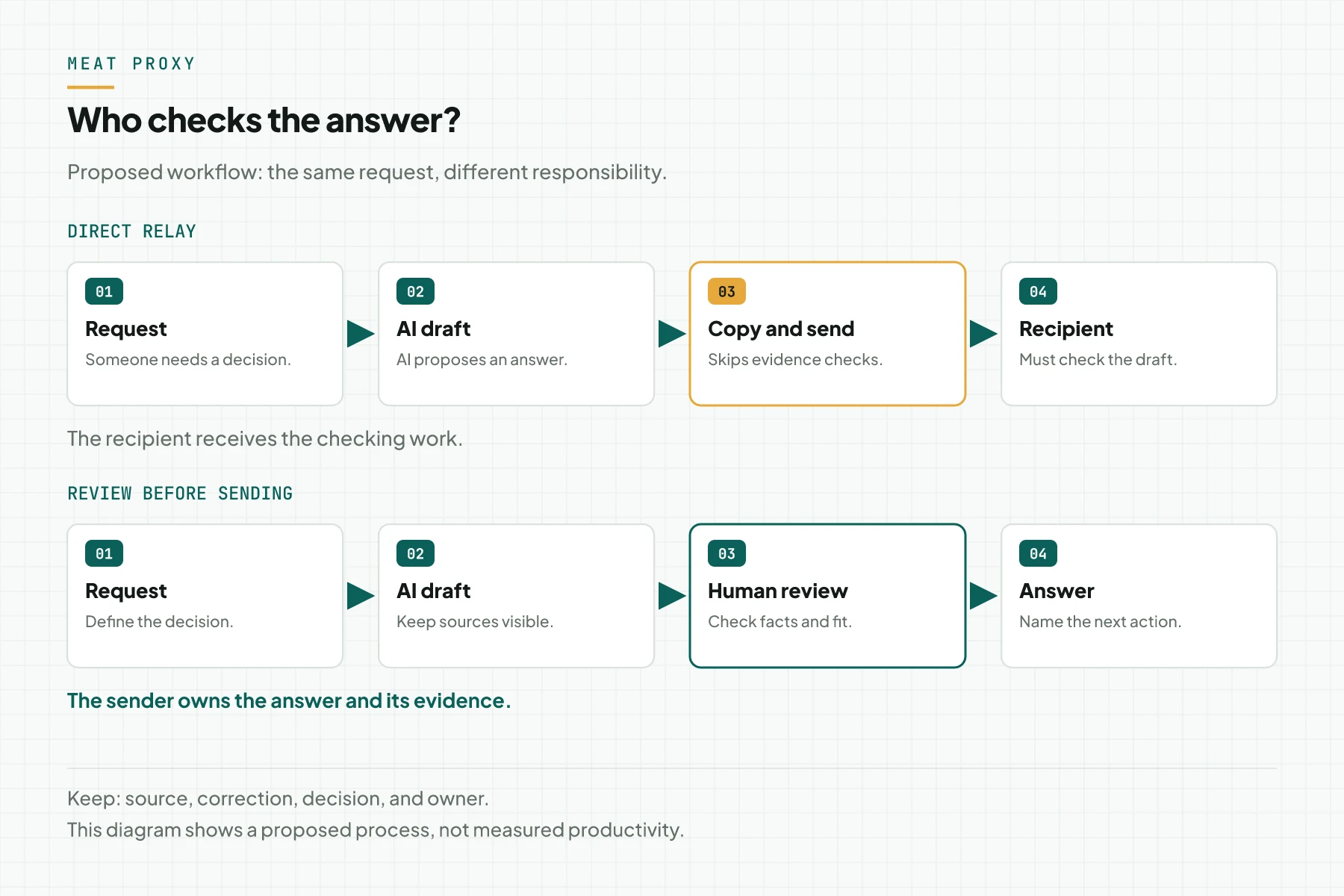
The diagram shows where checks belong before a final recommendation. A human’s presence in the middle of a workflow does not demonstrate that those checks happened.
How does this differ from responsible AI use?
This table is a practical Rama Digital framework. Compare behavior that you can inspect. The application name and text length do not determine the category.
| Work pattern | Human role | Review evidence | Result for the recipient |
|---|---|---|---|
| Meat proxy | Forwards AI output. | The sender cannot show the basis of the answer. | The recipient must check working material. |
| AI with human review | Checks and adapts the answer. | Sources, corrections, and reasons for the decision. | An answer that fits the task, with its limits. |
| Human-in-the-loop | Reviews decisions at defined points. | Acceptance criteria, authority, and decision records. | An action that follows the review result. |
| Agreed automation | Sets rules and handles exceptions. | Rule tests and processing records. | A system message with a clear origin and purpose. |
Human-in-the-loop means human involvement in a system’s decision process. In this framework, the reviewer needs to understand the information and be able to stop an action. An approval button without review leaves the problem in place.
An automated form receipt can run without a manual check of each message. We recommend limiting its content to known processing facts. Do not present it as a personal assessment of a customer’s problem.
What does the research establish?
Lee and colleagues’ CHI 2025 survey covered 319 workers and 936 examples of AI use. Greater confidence in AI correlated with less reported critical thinking. This association does not prove that AI causes a decline in thinking ability.
The study used self-reports from English-speaking participants. It does not measure meat proxy prevalence or Indonesian workers specifically. The authors also note that unchanged output can still follow critical judgment.
Rama Digital recommends asking for review evidence when assessing work. Do not use the percentage of changed text as your only measure. A person can change many words without checking a single material claim.
How can you assess an answer without guessing its author?
Check whether the sender can explain the decision. Request a source for claims that determine an action. Ask which conditions would make the sender change their recommendation.
A short answer is not necessarily correct, and a long answer is not necessarily poor. Using AI for language assistance does not show a lack of judgment. Focus your review on the content that people use to work.
If someone sends a draft for review, agree on the reviewer’s responsibility. A sender can request help in an unfamiliar field. State that need openly before handing over the document.
A clear request could say: “I have not checked the cost assumptions in section 2. Please check the calculation before we set the budget.” The draft status and review request are visible from the start.
How to check AI output before sending it
Prepare 1 task, permitted sources, and the name of the decision owner. Use dummy data for practice. Follow your organization’s data access rules for actual work.
The following process is a Rama Digital recommendation. Apply stricter checks when an answer can change money, access, data, or customer commitments. This checklist does not guarantee that you will find every error.
Define the required decision
Write the work question in 1 sentence. For example: “Identify the orders that the warehouse team needs to follow up today.” Also define the cutoff time for the data.
Record the required output before asking AI for help. The team may need an order list and action owners, rather than a discussion of warehouse management. Remove material that does not help that decision.
Separate facts, assumptions, and proposals
Mark data that comes from a work source. Separate proposed causes from proposed actions. Do not turn an unknown status into certainty just to complete the answer.
Create a review record with columns for the claim, source, and status. Open a source cited by AI before using it. Check whether it supports the claim in the same context.
Check the parts that determine an action
Repeat calculations from the original data. Check dates, units, categories, and exceptions. A working link does not prove that an answer is correct.
For code changes, compare program behavior with the agreed requirements. Keep the relevant check results. Our chaos engineering guide for vibe coders gives examples of checking behavior when dependencies fail.
Request review from someone with relevant knowledge when you cannot assess the result. Comparing answers from several models can help reveal differences. Agreement between models still needs support from sources or test results.
Shape the answer for the recipient
Start with the conclusion that the evidence supports. State limits that could change the decision. End with the next action and its owner.
Remove terms that do not help the reader. Keep technical terms when the recipient needs them. Editing should clarify a decision that you understand and can explain.
Hold claims that you cannot support
Pause a final recommendation when a material source is missing. Report the review status and the information you still need. Name the person who will obtain that evidence.
If you have already sent an error, inform the recipient of the correction. Identify the changed part and its effect on the action. Keep the corrected version under your team’s document rules.
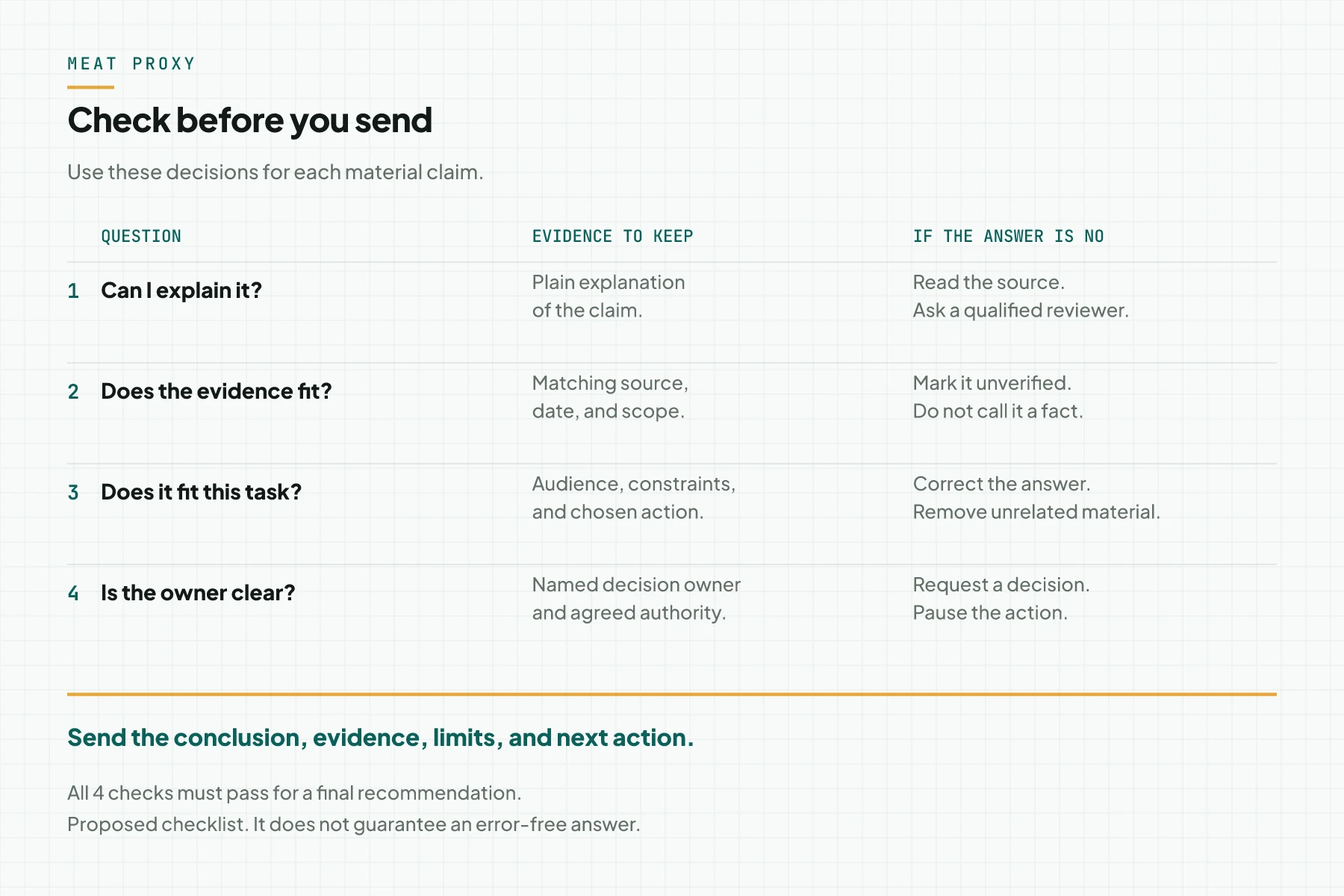
The diagram shows how review appears in evidence, limits, and selected actions. Ticking every box without opening the sources does not carry out this process.
Worked example: checking an order report
Dummy-data simulation, 15 September 2026. A shop owner requests the number of late orders that need warehouse action. The practice dataset contains 40 orders with their status at 09:00 WIB.
The simulated draft calls 8 unshipped orders late. However, 3 orders are still within their shipping deadlines. We designed these numbers for practice; they are not results from testing a particular model.
| Time, WIB | Input | Check | Output |
|---|---|---|---|
| 09:00 | 40 orders in the practice dataset. | Check each order’s deadline. | The sender records the source and data time. |
| 09:05 | The draft reports 8 late orders. | Compare shipping status with deadlines. | 3 orders are not yet due. |
| 09:10 | 8 orders minus 3. | Count the orders past their deadlines. | 5 orders need follow-up. |
| 09:15 | 5 orders are past their deadlines. | Check warehouse notes for the cause. | The cause remains unconfirmed. |
| 09:20 | A list of 5 orders and evidence limits. | Assign the action owner. | The warehouse team receives the review task. |
The sender then prepares the answer below. This is an example of work after review. The table times only show the simulation sequence; they are not a delivery-time promise.
Of 40 orders, 5 were past their shipping deadlines at 09:00 WIB. I checked the order list and each order’s deadline. The warehouse team needs to check these 5 orders; the cause of the delay remains unconfirmed.
You can inspect the improvement: the category is correct, the count matches, and a possible cause has not become a fact. The recipient knows the next task. If order statuses change, the report owner needs to update the data time and conclusion.
You can replace orders with support tickets, invoices, or code review findings. Keep status, cause, and action separate. Do not send practice data as an actual customer record.
A checklist for senders and reviewers
Apply this list to 1 work item before extending it across the team. Assign an owner and evidence for each check. Adjust review depth to the decision’s impact.
- Sender: write the required decision. Keep the request and task boundaries.
- Data owner: confirm which sources are permitted. Keep each source name and update time.
- Sender: separate facts from assumptions. Keep a claim record and its review status.
- Reviewer: check claims that determine an action. Keep references or repeated calculation results.
- Sender: adapt the answer to the recipient’s needs. Keep the conclusion and its limits.
- Decision owner: define the next action. Keep the owner’s name and follow-up time.
- Sender: hold recommendations when material evidence or authority is unclear. Keep the reason for the pause and required checks.
For team evaluation, record errors that passed review and repeat questions from recipients. Discuss those examples when improving the process. Do not assess staff only by the volume of text they produce.
Frequently asked questions about meat proxy
Is everyone who uses AI a meat proxy? No, using AI does not automatically make someone a meat proxy. Check whether the sender understands the output, checks the evidence, and takes responsibility for the answer.
Is copying AI output without changing words always wrong? You can accept suitable text after checking it. Changing the words alone does not show that you checked whether the content is correct.
How does a meat proxy differ from human-in-the-loop? A meat proxy forwards output without the required judgment. A human-in-the-loop reviewer checks decisions with information, criteria, and authority to stop an action.
Is asking AI to review its own answer sufficient? AI self-review does not provide independent evidence. Check material claims against original sources, calculations, or test results.
How should I respond to a colleague who only forwards AI answers? Ask for their conclusion, supporting evidence, and proposed action. Agree on a format for the next answer without applying personal labels or guessing which tool they used.
Must I announce every use of AI? Follow your organization’s rules, task requirements, and agreements with the recipient. Explain AI’s role when it affects their assessment.
The next step for your team
A checklist organizes review, but it does not replace subject knowledge or ensure that every answer is correct. Start with 1 recurring task. Check whether the recipient receives a usable conclusion and the evidence they need.
If your team needs practice with work tasks, explore AI Training for Company Teams. To discuss the initial need, book an Initial Consultation. Bring an anonymized task example so the discussion can focus on the review process.
Sources
We read these sources on 15 September 2026. The recommendations, checklist, and simulation are Rama Digital editorial material.