On 28 July 2026, BCA President Director Hendra Lembong explained how BCA raises its loan rates. BCA waits for existing loans to mature, then raises rates in steps. He also said that BCA raises rates only for selected customers, as Kontan reported on 28 July 2026.
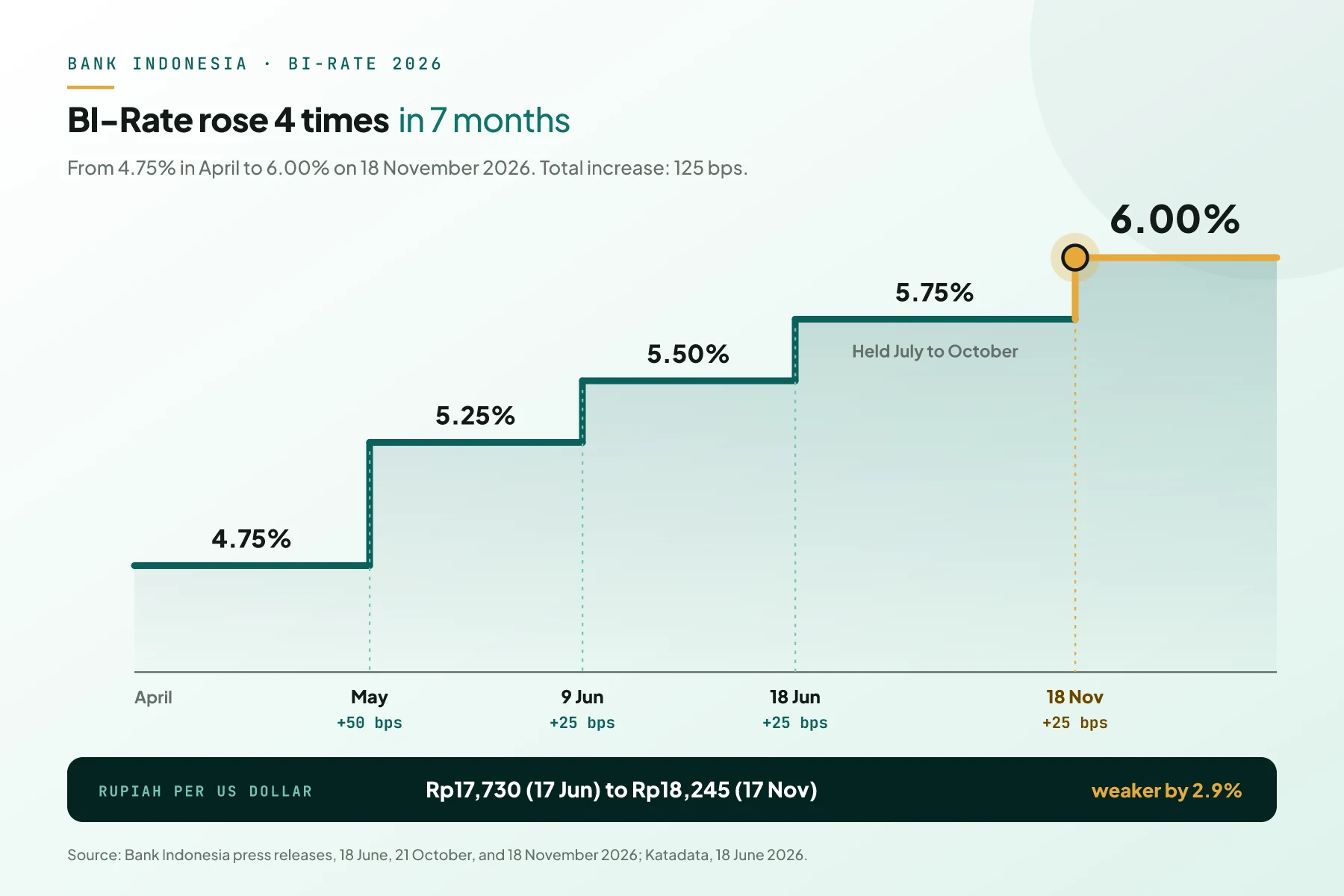
On 18 November 2026, Bank Indonesia raised the BI-Rate by 25 bps to 6.00%. This is the 4th increase since May 2026, a total of 125 bps from 4.75%, according to Bank Indonesia on 18 November 2026.
For a business owner with a loan, the 6.00% figure does not tell when the bill goes up. BI data up to July 2026 gives a clear signal. The increase reaches new loans first, then it follows the dates in your loan agreement.
BI-Rate rose 125 bps in 7 months
The BI-Rate rose from 4.75% to 6.00% between May and November 2026, in 4 steps. 1 bps equals 0.01 percentage point, so 125 bps equals 1.25 percentage points.
In May, BI raised the BI-Rate by 50 bps to 5.25%. On 9 June BI added 25 bps to 5.50%, then 25 bps more to 5.75% on 18 June, according to Katadata, 18 June 2026. BI then held 5.75% up to its October meeting, according to the Bank Indonesia press release of 21 October 2026.
BI gave 2 reasons for the November increase: the rupiah and inflation. The rupiah was at Rp18,245 per US dollar on 17 November, 0.66% weaker than at the end of October. October inflation was 3.23% per year, still inside the BI target of 2.5±1%.
The average loan rate rose only 16 bps
The average bank loan rate rose only 16 bps from May to July 2026, while the BI-Rate rose 100 bps. The rate was 8.72% in May and 8.88% in July.
The new loan rate moved faster, from 9.31% in May to 9.88% in July, an increase of 57 bps. The June and July figures are in the Bank Indonesia rate transmission assessment, August 2026. The May figure is in Kontan, 28 July 2026.
The bank prime lending rate (SBDK) almost did not move: 8.62% in April, 8.65% in May, and 8.61% in June. The April and May figures are in the Bank Indonesia SBDK assessment, July 2026. SBDK does not include the risk premium of each borrower, so your rate is higher than this figure.
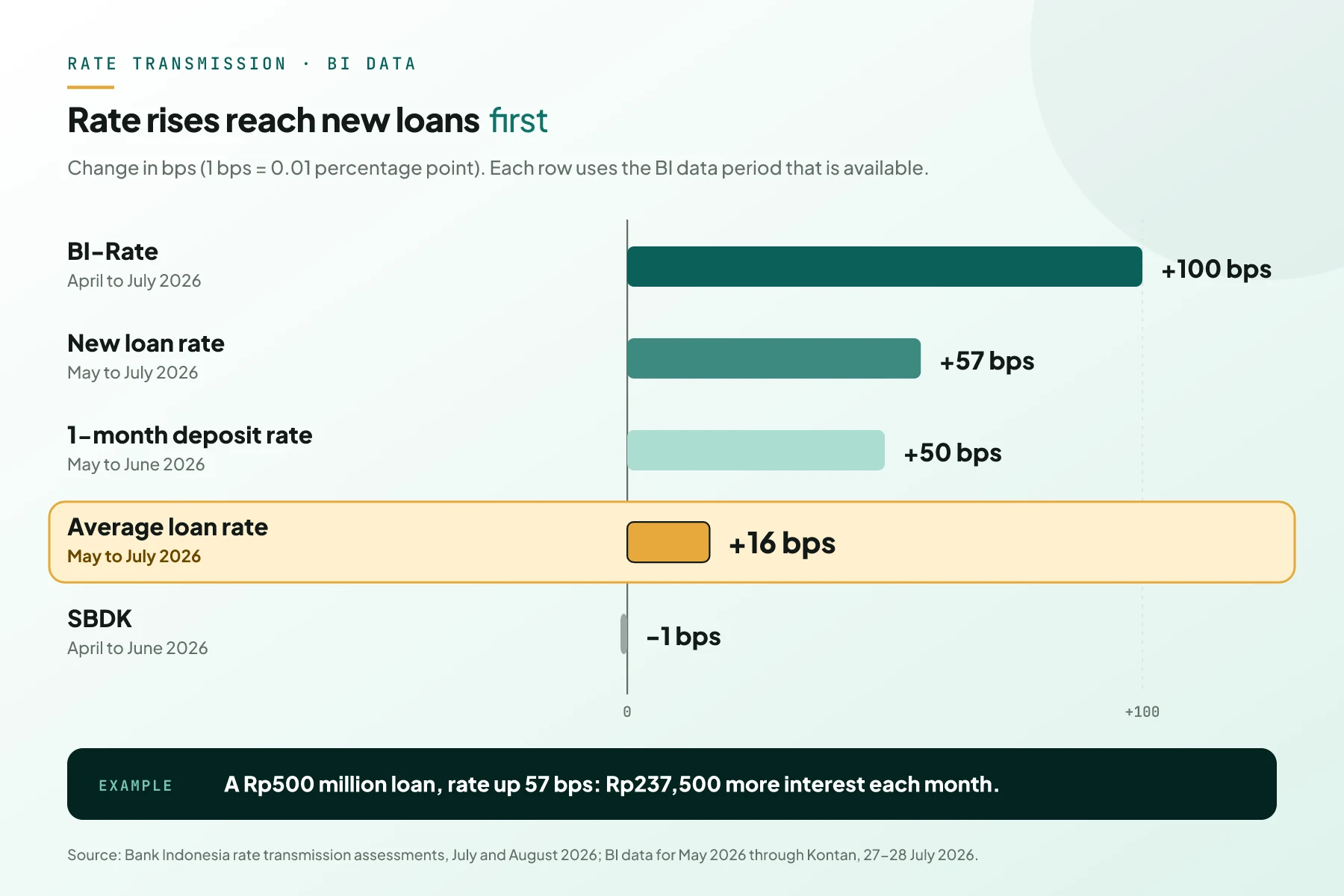
The gap between 16 bps and 57 bps is the core of this story. Loans that already run did not get a new price yet. Loans that were just signed already have the new price.
Banks carry part of the cost, for now
Banks pay higher deposit rates first, before they charge higher loan rates. In June 2026, the 1-month deposit rate rose 50 bps, from 4.26% to 4.76%, while the new loan rate rose only 18 bps.
Josua Pardede, Chief Economist of Bank Permata, reads that gap as a cost that banks carry themselves, according to Kontan, 27 July 2026. He names 3 things that hold old loans in place: the fixed-rate period, the rate review schedule, and the terms of the loan agreement.
The BI assessment of August 2026 shows the same thing: banks absorb the higher cost of funds through efficiency and margin. Josua expects the average loan rate to reach 8.9% to 9.1% at the end of 2026. That forecast assumes a BI-Rate of 5.75%, before the November increase.
3 moments when your loan gets a new price
A BI-Rate increase reaches your loan at 3 moments, and all 3 are written in your own documents.
- A new loan. The bank prices it from today's cost of funds. In July 2026, the new loan rate was 9.88%, while the average of all loans was 8.88%.
- A floating-rate review date. A floating-rate loan agreement states a review schedule. The bank uses that schedule to adjust your rate.
- A renewal or a higher limit. Overdraft and working capital loans have a maturity date. When you renew or raise the limit, the bank calculates your rate again.
A fixed-rate loan does not change until the fixed-rate period ends. BCA also does not raise the rate for all customers at once. So 2 businesses at the same bank can get the increase in different months.
Calculate the extra interest for 3 loan sizes
The extra interest each month equals the loan principal multiplied by the rate increase, divided by 12. This table uses a fixed principal, like an overdraft that is fully used.
| Loan principal | Up 16 bps | Up 57 bps | Up 125 bps |
|---|---|---|---|
| Rp100 million | Rp13,333 | Rp47,500 | Rp104,167 |
| Rp500 million | Rp66,667 | Rp237,500 | Rp520,833 |
| Rp1 billion | Rp133,333 | Rp475,000 | Rp1,041,667 |
Use the 57 bps column as the base case for a loan that gets a new price. That figure equals the increase in the new loan rate from May to July 2026. The 125 bps column is the upper limit, if the bank passes on the full BI-Rate increase.
Example: a Rp1 billion loan with a 125 bps increase adds Rp1,041,667 each month, or Rp12.5 million each year. This table is an illustration. A loan with principal repayments pays a smaller extra amount each month.
2 BI policies move in different directions
BI raised the BI-Rate, but BI also gave banks more funds for lending. In October 2026, BI cut the reserve requirement of conventional banks from 9% to 8% from 1 November, then to 7% from 1 December.
In November, BI opened a financing channel of up to 3% of bank third-party funds for job-creating sectors and MSMEs. This channel starts on 1 December 2026. The BI assessment of August 2026 shows that the MSME loan rate fell slightly, from 10.34% in June to 10.32% in July.
That average does not apply to every bank. Danamon raised its SBDK for MSME loans by 25 bps to 9.85% as of May 2026, according to Kontan, 27 July 2026. Check the SBDK of your own bank, not the average.
Bills in US dollars rise faster than loan rates
For a business that pays for software, AI tools, or imported materials in US dollars, a weaker rupiah adds cost faster than loan rates do. The rupiah fell from Rp17,730 per US dollar on 17 June to Rp18,245 on 17 November 2026, a drop of 2.9%.
A bill of US$100 each month rose from Rp1,773,000 to Rp1,824,500, an increase of Rp51,500. This increase reaches the next bill, with no wait for a review date. The June rate is in the Bank Indonesia press release of 18 June 2026, and your bank or card rate can be different.
Prices in US dollars can also rise on their own. For example, the Gemini 4 Carbon price rises from 1 December 2026. The price increase and the weaker rupiah add up on the same bill.
A decision rule for the next 3 months
Start with your loan agreement, because the dates in that document decide when the increase reaches you. Do these 5 steps this week.
- Open the loan agreement. Write down the rate type and the next review or renewal date.
- If your rate is fixed, write down the end date of the fixed-rate period.
- If the rate floats and the review date falls within 3 months, calculate the 57 bps scenario. Add the result to your cash flow plan.
- If you plan a new loan or a higher limit, compare the SBDK at 3 banks. Banks must publish their SBDK under POJK Number 13 of 2024.
- Calculate the US dollar bills of the last 3 months again with the latest exchange rate.
The rule: if the extra cost makes the month-end cash balance negative in the 3-month plan, change the payment schedule before the review date. Read how to find the lowest cash point in the article on the cash flow J-curve.
If your loan, bill, and cash data sit in many files, put them in 1 system. See the AI Native ERP development service from Rama Digital.
The limits of this data
The loan rate data in this article stops at July 2026. The sources that we opened do not include August to October data, so we do not know how far rates rose after July.
The average also hides differences between banks: from June to July 2026, the new loan rate of state-owned banks fell from 8.03% to 7.87%. In the same period, the new loan rate of private national banks rose. Bank lending still grew 13.21% per year in October 2026, according to Bank Indonesia.
Go back to Hendra Lembong: the bank waits for old loans to mature. That maturity date is not in a BI press release. That date is in your loan agreement.
Questions and answers
Does my loan payment go up as soon as the BI-Rate goes up?
Not always. A fixed-rate loan does not change until the fixed-rate period ends. A floating-rate loan changes on the review date in the loan agreement.
How much extra interest does a Rp500 million loan pay?
With a 57 bps increase, the extra interest is Rp237,500 each month. With a 125 bps increase, it is Rp520,833 each month. Both figures use a fixed loan principal.
What is SBDK and where can I see it?
SBDK is the bank prime lending rate, the base rate before the risk premium of the borrower. Banks must publish their SBDK under POJK Number 13 of 2024. Check the official website of your bank.
Do MSMEs get a lower loan rate?
The average MSME loan rate fell slightly, from 10.34% in June to 10.32% in July 2026. From 1 December 2026, BI opens a financing channel for MSMEs. Each bank can still raise its own MSME SBDK.