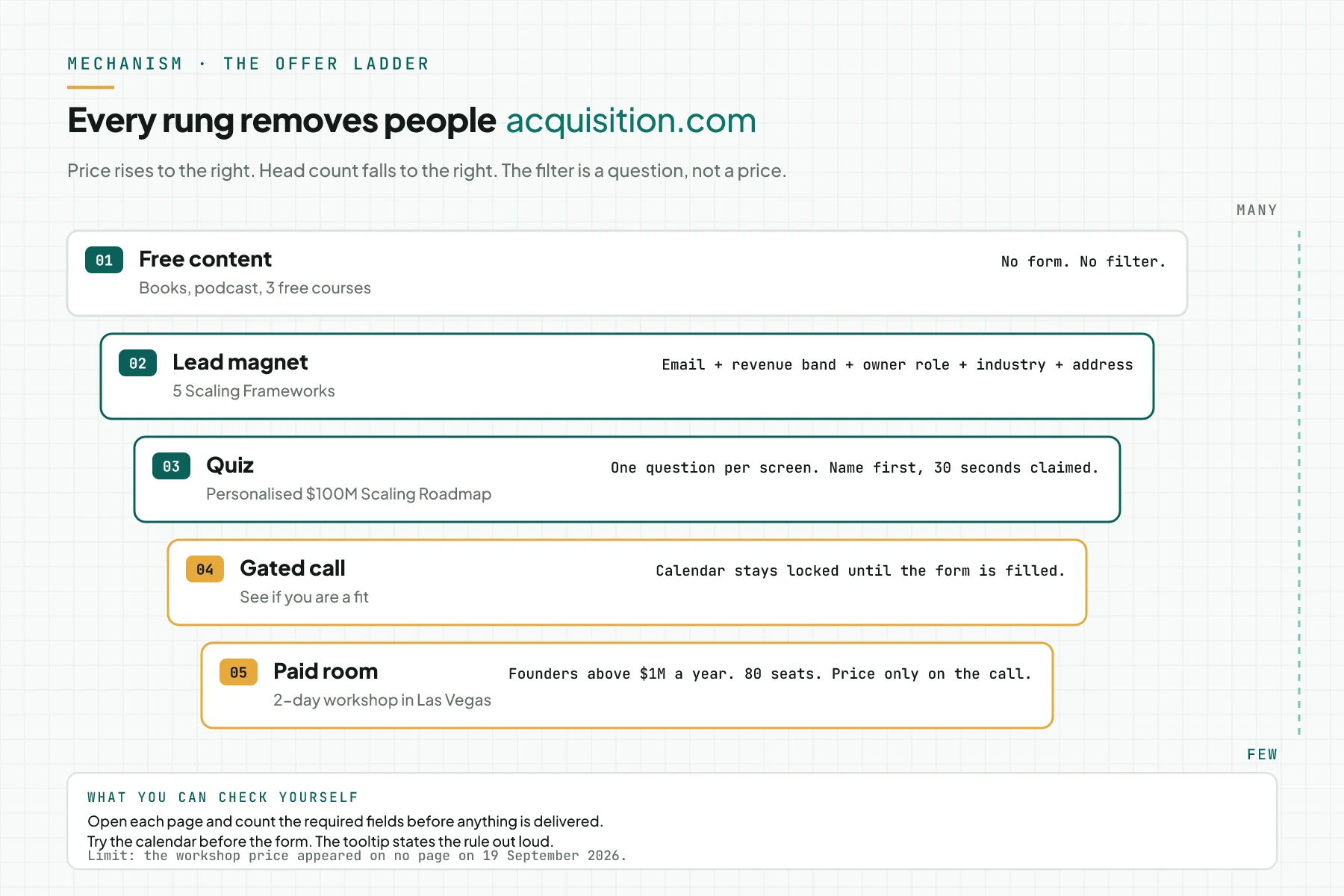
Direct answer: the Alex Hormozi funnelFunnelThe order of stages a buyer passes, from meeting you to paying you.Open the glossary is not 1 brilliant ad. It is 1 offer ladder with 5 rungs, and every rung removes people with a question, not with a price. Hundreds of ads fill the first rung, then forms and a locked scheduler filter the rest until the people left are owners above 1 million dollars a year. Behind that ladder sits 1 layer that is never advertised: an advisory practice and 2 investment arms.
Main condition: this pattern fits a high value offer that closes in a conversation, not in a shopping cart. Limit: the Meta Ad Library shows no cost, no audience, and no sales result. This article reads what is visible, then marks which line is a fact and which line is a claim by the page owner.
We wrote this article on 19 September 2026. We opened the Alex Hormozi Ad Library page with the United States filter and Active ads, opened 1 ad down to the detail view, then walked 4 destination pages on acquisition.com. We submitted no data to any form, so every screenshot shows an empty form.
The problem: people copy the ad, not the machine
A business owner sees a Hormozi ad, then copies the writing style. Short hook, broken lines, a large promise. The ad runs, clicks arrive, and nobody buys.
Only the top layer was copied. What actually moves money sits out of sight in the feed: the order of the offers, the qualifying questions, and the gate in front of the call scheduler. We covered the same symptom in our guide to Meta Ads ratios per funnel stage.
This article takes that hidden part apart. Part 1 reads the evidence in the Ad Library. Part 2 reads the offer ladder. Part 3 gives 7 steps, so you can repeat the check on your own competitor.
Part 1: what the Meta Ad Library actually shows
The active ad count is an estimate, and the estimate is large
The Meta Ad Library shows every ad that is running, with no ad account needed. The Alex Hormozi page answered about 770 results when we started and about 790 results on a later read the same day. The Ad Library APIAPIThe official door 2 systems use to exchange data, without anybody copying it by hand.Open the glossary answered 774 at a nearby moment. Source: the Alex Hormozi Ad Library page and the ads_archive endpoint reference, both accessed on 19 September 2026.
That number is an estimate, not an exact count. Meta prints a tilde in front of it, so do not use a small difference as proof. What matters is the order of magnitude: hundreds of active ads for 1 page, in 1 country, on 1 day.
4 message angles run at the same time, not in turns
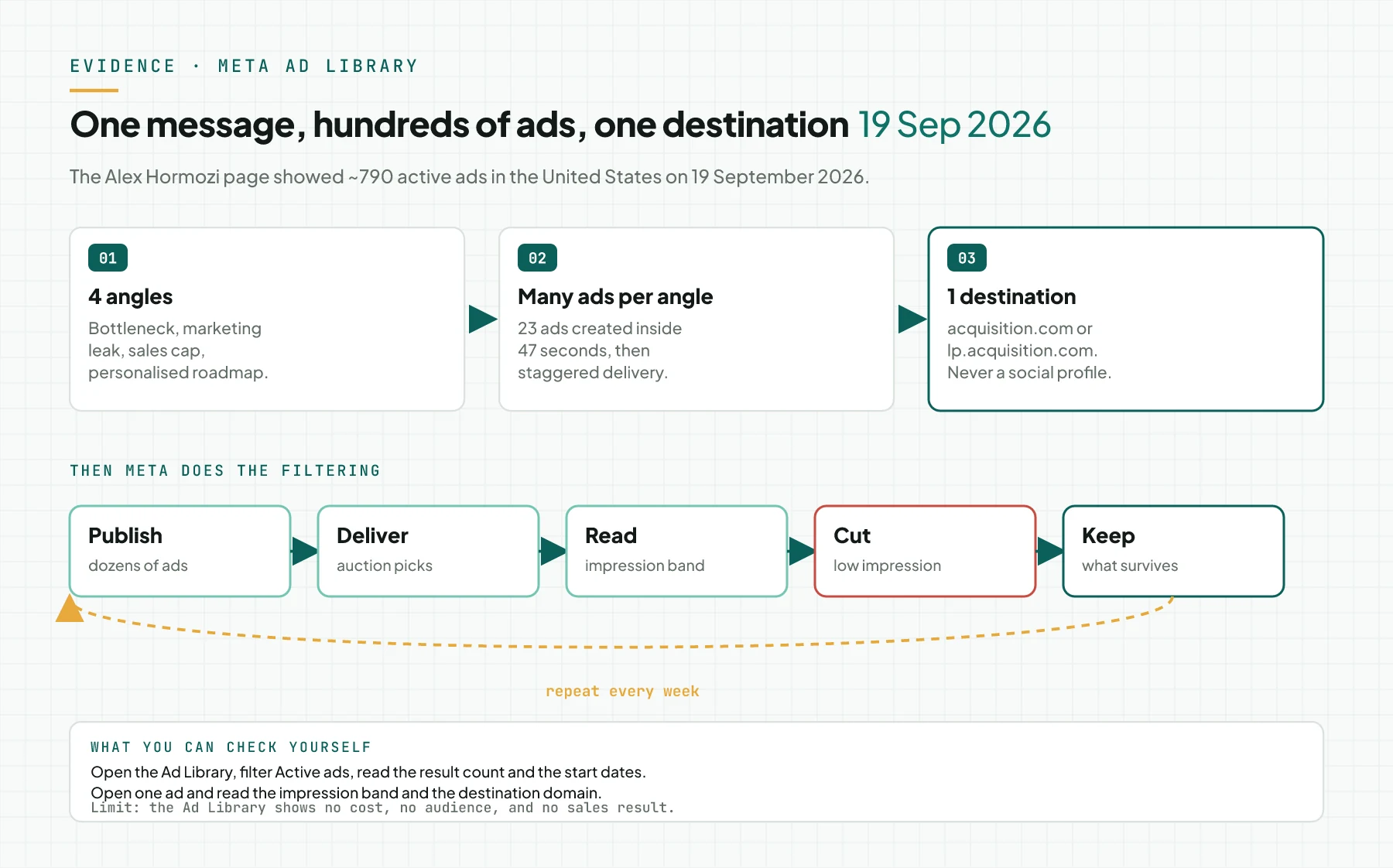
We read the ad copy on the results page, then grouped it. On 19 September 2026 there were 4 angles running together, and each angle used its own vocabulary.
| Message angle | Opening idea it uses | What the ad asks for |
|---|---|---|
| The owner is the bottleneck | Owners do not see that they cap their own growth | Book a call about a workshop seat |
| Marketing leaks | A first marketing workshop after holding it back | A call for owners above 1 million dollars a year |
| Sales stops at the owner | The owner still closes more deals than the team | Apply for a Sales Workshop seat |
| Personalised roadmap | Answer a few questions and the roadmap arrives free | An email plus qualifying answers |
The split matters. Angles 1 to 3 sell the same thing, a 2 day workshop in Las Vegas. Angle 4 sells nothing and only collects data. So 1 page runs 2 jobs at once: it fills the list and it fills the calendar.
23 ads were born inside 47 seconds
On our test, the 23 newest ads from the Ad Library API used the same link title. Their creation stamps span 47 seconds, from 04:18:26 to 04:19:13 UTC on 19 September 2026. Their delivery then started between 05:41 and 05:50 UTC.
A person does not build 23 ads in 47 seconds through the Ads Manager interface. So those ads came from the API or from a bulk tool, then went live one by one. This is not creativity, this is production.
The impression band shows which ads just died
The Ad Library shows an impressionImpressionThe number of times your ad or page appeared on a screen. An impression is not a person and not a search.Open the glossary band for some ads, not an exact number. The ad we opened carried a Low impression count label and a band under 100 impressions, with 5 hours of total active time. Source: the ad with Library ID 1797221671291334, opened on 19 September 2026.
That number is not a failure. It is the filter at work: dozens of ads go live, the auction picks a few, and the rest fade. The account owner does not guess the winner, the account owner gives Meta enough candidates.
The Ad Library also shows the destination domain. The Sales Workshop ad points at lp.acquisition.com, not at acquisition.com. A separate subdomain lets them replace pages without touching the main site.
Part 2: the offer ladder, and the filter on each rung
After the click, everything becomes visible. We walked 4 pages on acquisition.com and found 1 repeating pattern: every step forward asks the reader for 1 more thing.
Rung 1: free content with no form
The acquisition.com home page puts 3 items under the heading FREE ADVANCED TRAINING: $100M Money Models, an Offer Creation Course, and a Lead Generation Course. The same page prints 4 numbers: 10,000 businesses advised, an NPS of 81, 97.1 percent client retention, and 12,000 workshop participants. Source: the acquisition.com home page, read on 19 September 2026.
Treat those 4 numbers as claims by the page owner. The page names no method, no period, and no population. Numbers like these build trust, they do not prove a result.
Rung 2: a lead magnet that is really a qualifying form
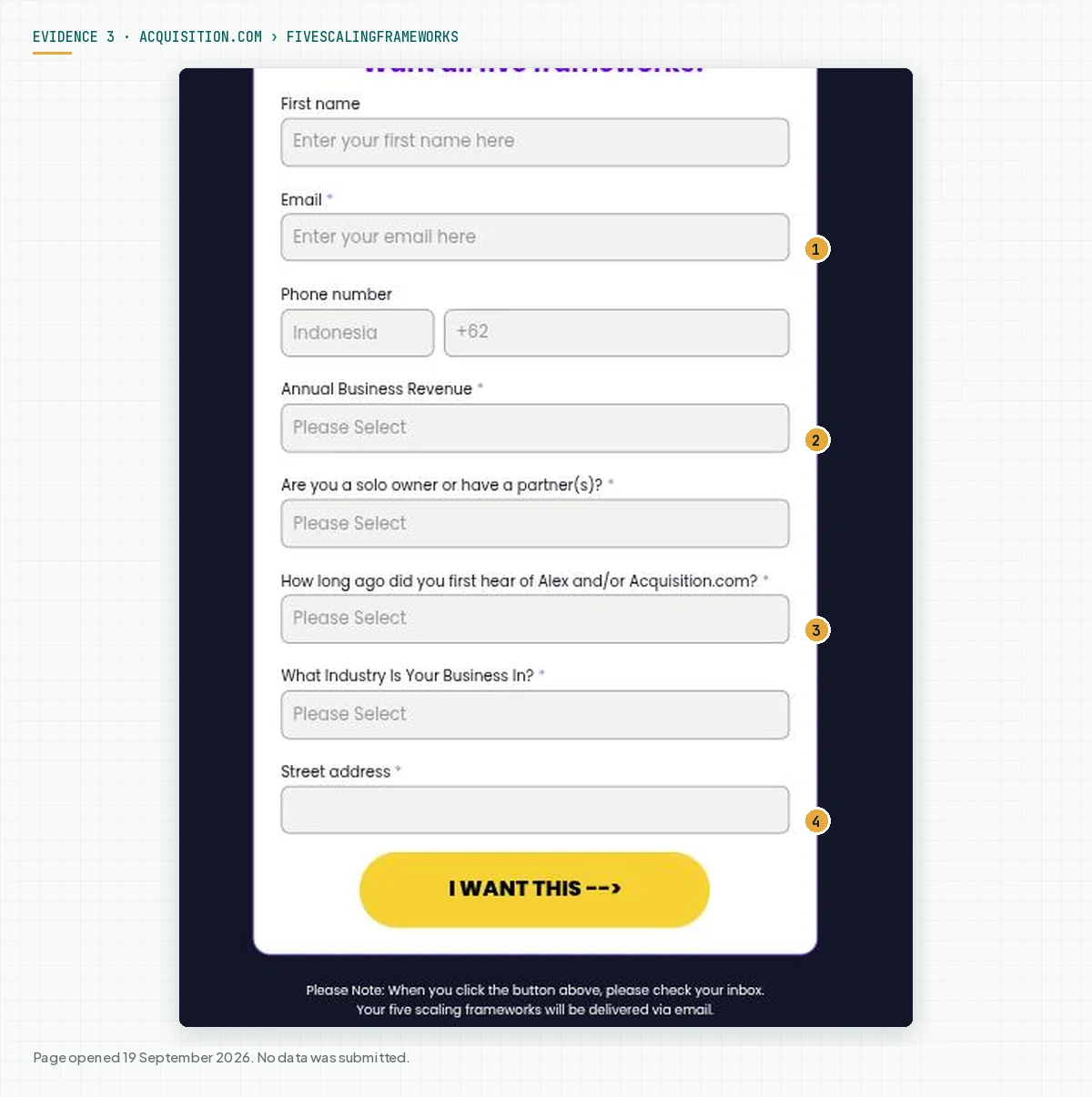
The ad promises 5 free frameworks and asks only for an email. The page asks for more: first name, a required email, a phone number, a required annual revenue band, a required ownership status, a required answer on how long the reader has known Alex, a required industry, and a required street address. Source: the fivescalingframeworks page, opened on 19 September 2026.
The question about how long the reader has known Alex is the most interesting one. It helps no file delivery at all. It measures the age of brand awareness, and the answer sticks to every lead.
Rung 3: a quiz that asks for a name first
The roadmap page uses a quiz, not a long form. The first screen asks only for a first name and a last name, then states that the process takes about 30 seconds. The page also states that more than 250,000 business owners have requested the roadmap. Source: the roadmap page, opened on 19 September 2026.
The order is reversed on purpose. A long form asks for many things before anyone commits. A quiz asks for 1 small thing first, then adds questions after the person is already moving.
Rung 4: a calendar that stays locked until the form is filled
The workshop page carries a scheduler on the right. We clicked a date before filling the form, and the scheduler refused with a message that the form comes first. The scheduler runs on iClosed, whose name is printed in the widget footer.
That gate changes what a booked call means. The calendar is no longer open to anyone, and every taken slot carries qualifying answers. The sales team opens the call with data, not with introductions.
Rung 5: a paid room with seats the reader can count
The workshop page lists 4 dates. Two October dates are marked SOLD OUT with 0 seats, 9 to 10 November shows 20 seats left, and 2 to 3 December is still open. The same page states a capacity of 80 founders and says seats usually fill around 60 days out. Source: the acquisition.com workshop page, read on 19 September 2026.
On our test, the same page printed 2 different capacity numbers. The top section says 100 seats per workshop, the schedule section says 80 founders. We record this as a mismatch on that page, not as a conclusion about the event.
No page we opened printed a price. The price question sits in the FAQ list, and the answer stays collapsed. So the price only appears inside the call, after qualification passes.
Social proof the reader can filter by industry
The workshop page carries dozens of Google reviews with an author name and an industry label. The labels cover construction, roofing, cleaning services, med spas, physicians, agencies, and law firms. The page invites the reader to filter the reviews down to their own industry.
The job is not to stack praise. The job is to remove the objection "my business is different". The reader finds 1 review from their own industry, and the objection disappears before the call starts.
Every page has variants, and the URL admits it
We typed the workshop page address, and the browser stopped on an address ending in 4b. The lead magnet page and the roadmap page each add an lp_var parameter to the URL, with 2 different values that share the same prefix. Source: those 3 pages, opened on 19 September 2026.
This pattern means the page you see may not be the page someone else sees. They test page variants, not only ad creative. So when you take a competitor apart, record the final URL after the redirect, not the URL you typed.
The working lesson is simple. Test destination pages with the same discipline you use on ad creative, then store the variant name in the decision log. How to read a test result without picking the wrong winner sits in our guide to creative measurement in Meta Ads.
4 offers, 4 filters: what is asked and what is given
The table below sums up what we saw on 19 September 2026. The last column names what is removed at that step.
| Offer | What is given | What is asked | What is removed |
|---|---|---|---|
| 5 Scaling Frameworks | Framework files by email | 8 fields, 5 of them required | Non owners, small revenue, industries outside the target |
| Scaling Roadmap | A personalised roadmap | A staged quiz, name first | People who stop in the middle of the quiz |
| Workshop call | A fit conversation | A form before the calendar opens | People who will not fill a form |
| 2 day workshop | A seat in the room | Revenue above 1 million dollars a year | Businesses under the revenue threshold |
Notice that no filter says "we are expensive". The filter is always a question or a condition the reader can check. That design makes people filter themselves, and the sales team receives fewer calls at a higher quality.
One Sales Workshop ad even prints the rejection openly: it states that the page is not for a sales rep or a partner. A rejection line raises list quality, because the wrong person stops earlier.
What you need before you copy this pattern
- A browser and internet access. The Meta Ad Library opens with no ad account.
- The page name or Page ID of the competitor you want to check.
- 1 empty document to record dates, URLs, and screenshots.
- Access to your own Ads Manager, if you plan to apply the result.
- 1 offer that already sells, because a funnel enlarges an offer, it does not replace one.
- 1 person on duty to answer conversations on the same working day.
Step 1: Open the Ad Library and read the active ad count
Open the Meta Ad Library on its official page, pick a country, then pick the All ads category. Search the competitor page name, open the page, and set the Active status filter to Active ads.
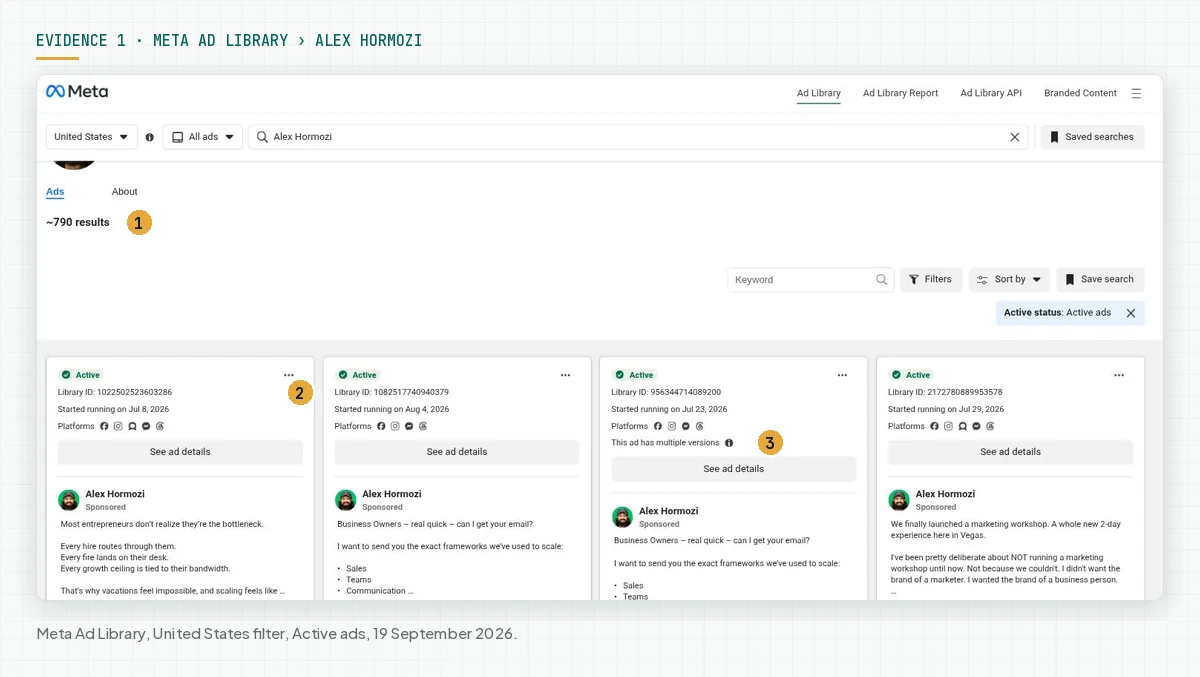
Record 3 things: the result count, the start date of the oldest ad, and the start date of the newest ad. How to check it: reload the page after a few minutes and see whether the number moves. Official tool list: Meta Ad Library tools in the Transparency Center.
Step 2: Open 1 ad and read the impression band and the destination
Click See ad details on 1 ad card. The window shows the Library ID, the start date, total active time, the platform list, and the impression band when it is available.
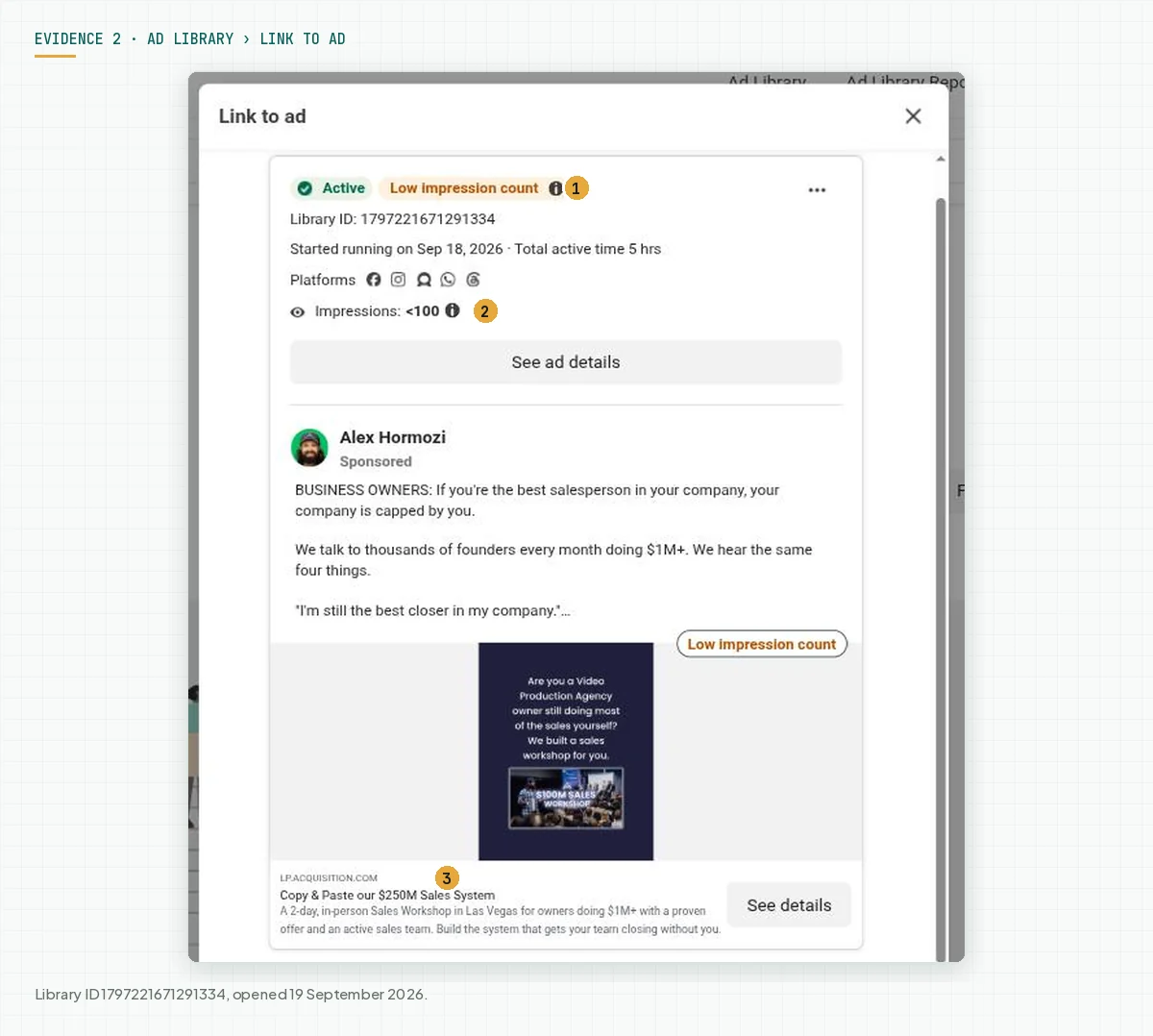
Record the destination domain, then open it in another tab. How to check it: compare the destination on 5 different ads and see whether they all land in 1 place.
Step 3: Map every offer and count its required fields
Open every destination page, then count how many fields are marked required. Submit nothing. You only need to see what is asked before anything is given.
Turn the result into a table: offer name, what is given, what is asked, and what is removed. How to check it: your table should show the field count rise as the offer value rises.
Step 4: Test the gate in front of the call scheduler
Find the scheduler on the highest offer page. Click 1 date before filling the form, then read the message that appears.
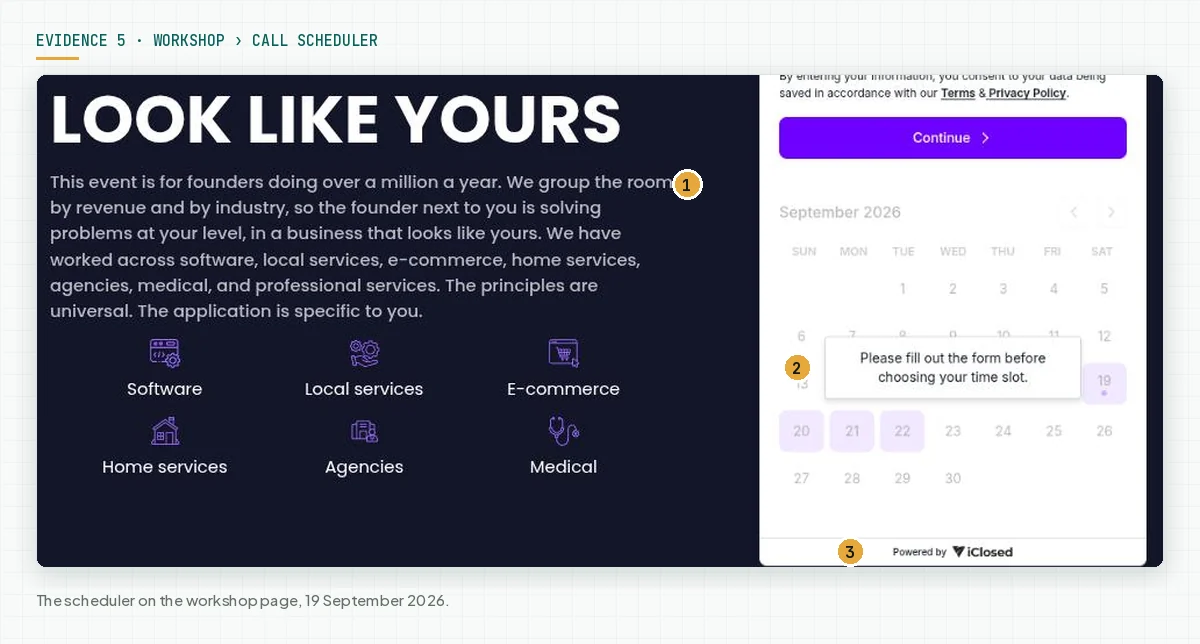
Record the order: form first, calendar second. How to check it: the time slots stay unselectable until the required fields are filled.
Step 5: Record the scarcity a reader can count
Open the event schedule section, then record every date with its status and remaining seats. Useful scarcity is always a number, a date, or a quota the reader can count.
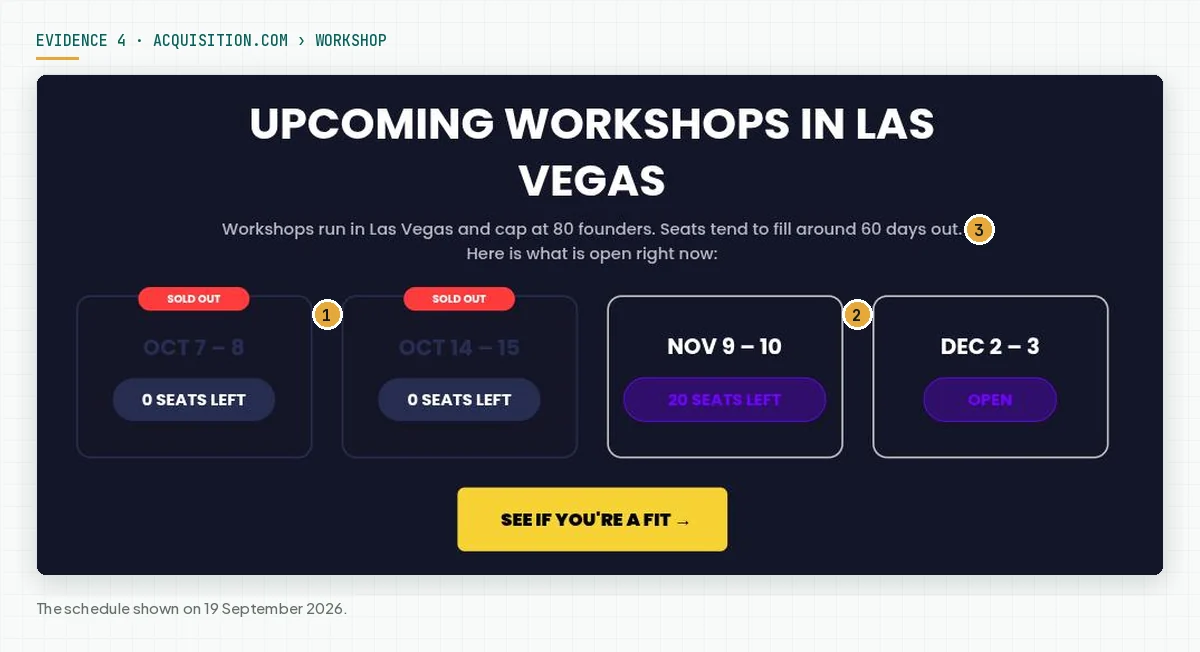
Compare that with a scarcity claim that carries no number. How to check it: a past date, or a quota that never changes, is the mark of false scarcity.
Step 6: Measure the friction at the entrance
Open the cheapest or the free offer, then count how many things the first screen asks for. The first screen decides how many people enter the list.
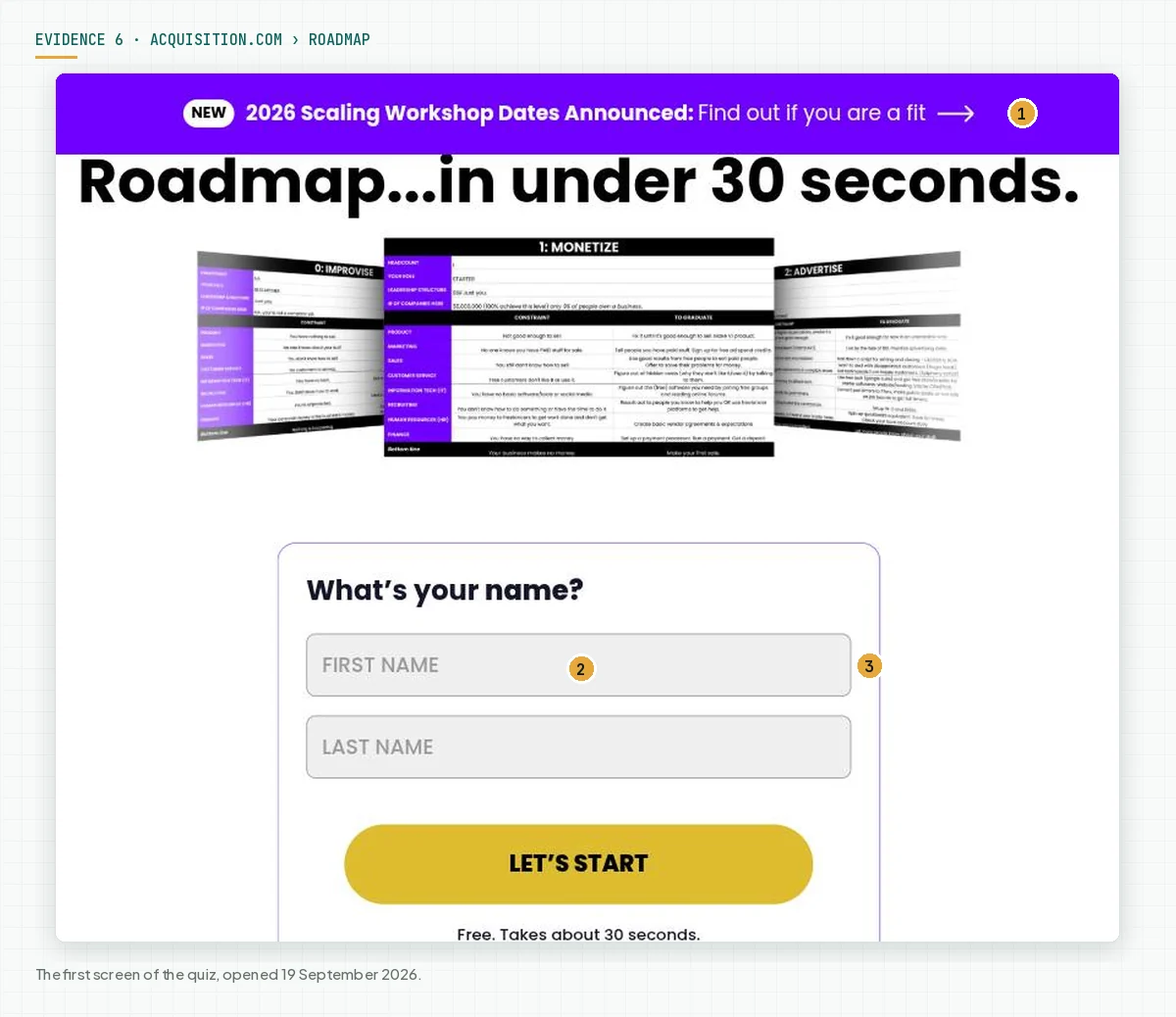
Compare the field count on the first screen with the total field count. How to check it: a free offer that asks for 8 fields at once loses more people than a staged quiz.
Step 7: Build the Indonesian version that runs on WhatsApp
Replace email with WhatsApp, and replace the phone call with a booking link. The qualifying questions stay the same, only the container changes.
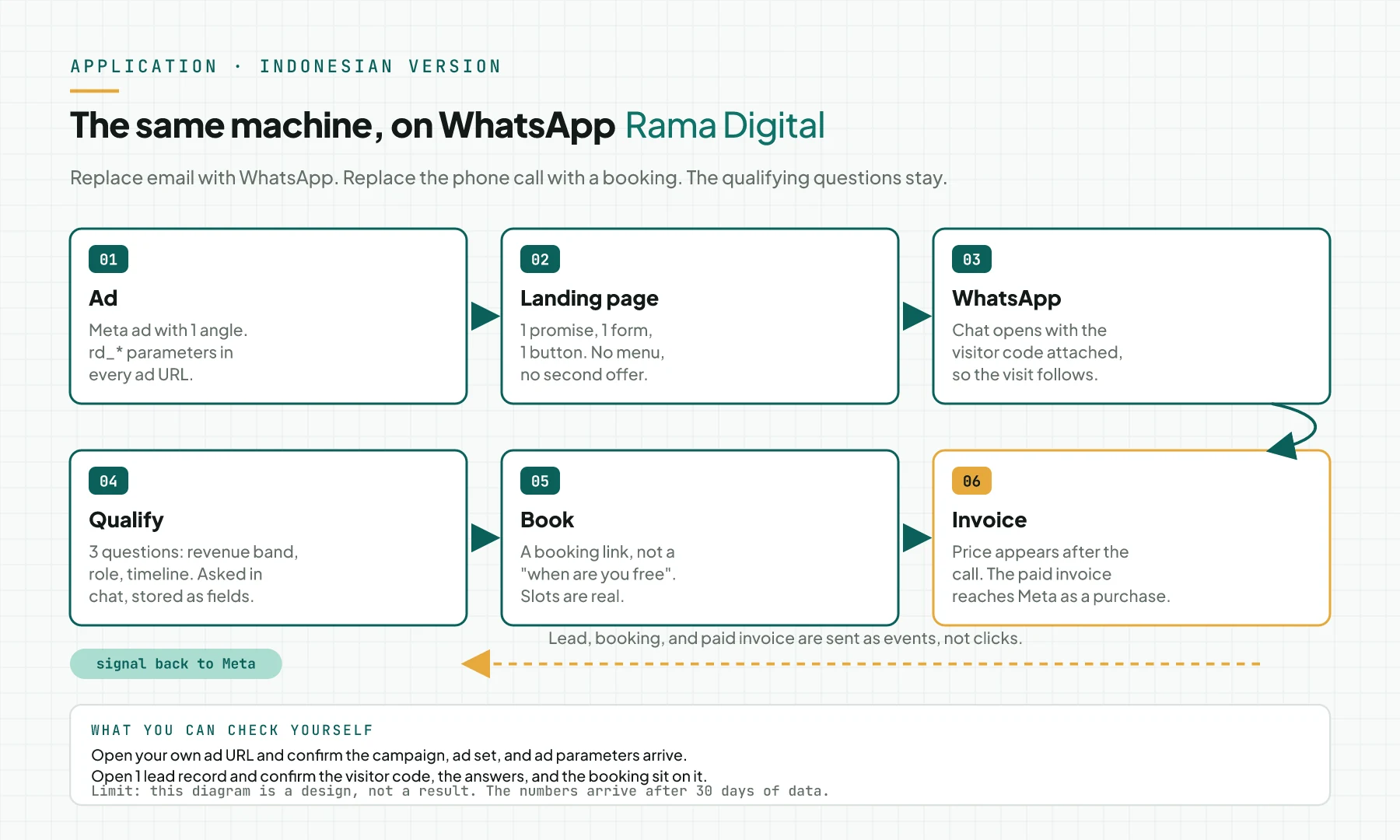
Put campaign parameters on every ad URL, then confirm that the visitor code reaches the chat. How to check it: open 1 lead record and confirm the visitor code, the qualifying answers, and the booking sit on the same record. The technical detail sits in our guide to CTWA ad tracking.
Worked example: 1 simulated week for an architecture practice
The example below uses dummy data, not customer data. The business is a residential architecture practice with an average project value of Rp180,000,000.
| Day | What runs | What the system records | What becomes visible |
|---|---|---|---|
| Monday | 3 ads for 1 message angle, 1 landing pageLanding pageThe page an ad points to. It carries 1 offer and 1 action, with no menu pulling the visitor elsewhere.What is a landing page? | Visitor code, campaign id, ad id | 40 clicks, 9 chats |
| Tuesday | 3 qualifying questions in the chat | Budget band, location, build start target | 9 chats become 4 matching leads |
| Wednesday | Send a booking link to 4 leads | The chosen slot sits on the lead record | 2 bookings, 2 no answer |
| Thursday | A 30 minute call, price opens on the call | Call notes and objections | 1 request for a formal quotation |
| Friday | Send the quotation and a deposit invoice | Quotation status and invoice status | 1 invoice sent, not yet paid |
| Saturday | Turn off 2 ads with a low impression band | The reason for the change and its date | 1 ad left for the next week |
| Sunday | Write 3 new ads for the same angle | Creative version and publish date | The next weekly loop is ready |
The numbers in the table are an illustration, not a promise. What you should copy is the shape of the record: every row names what ran, what was stored, and what became visible.
Checklist before you change your funnel
- Open your competitor Ad Library page and save a screenshot of the result count. Owner: business owner. Evidence: 1 dated image.
- Group the competitor ads into at most 5 message angles. Owner: ads lead. Evidence: an angle table.
- Open every destination page and count the required fields. Owner: ads lead. Evidence: an offer and filter table.
- Write 3 qualifying questions for your own offer. Owner: business owner. Evidence: an approved chat script.
- Install a booking link, then test 1 booking from a phone. Owner: admin. Evidence: 1 test booking, cancelled after the check.
- Confirm the visitor code travels from the ad to the lead record. Owner: tracking lead. Evidence: 1 complete lead record.
- Name 1 person who answers chats on the same working day. Owner: business owner. Evidence: a written duty roster.
- Stop criterion: if 30 days pass with 0 bookings, stop adding ads. Repair the offer and the qualifying questions first. Owner: business owner.
The layer nobody advertises: where the money actually sits
The useful question is not "what do they sell". The useful question is "which product do they never advertise". On the Ad Library page we read, not 1 ad sold a book or a free course, although the site menu lists 4 courses and 1 books page.
That same menu holds a section called Partner With Us, and it carries 3 links: an application page, ACQ Ventures, and ACQ Real Estate. The application page opens by stating that they scale companies, then asks for data through a staged form. Source: the About the Firm page and the partner application page, opened on 19 September 2026.
ACQ Ventures states its own focus: early stage capital, from pre-seed to Series A, for technology startups that serve small and mid sized businesses. The page also states that its portfolio companies gain from the association with the Acquisition.com brand and with the clients of their advisory practice. Source: the ACQ Ventures page, read on 19 September 2026.
That sentence closes the loop. The audience bought through ads is not only a pool of workshop buyers. The audience itself becomes an asset they offer to portfolio companies.
| Rung | Content | Advertised? | Its job |
|---|---|---|---|
| 1 | Free content: books, podcast, 4 courses in the Education menu | No, on the page we read | Build awareness through organic reach |
| 2 | 5 Scaling Frameworks | Yes, hundreds of ads | Collect an email and qualifying answers |
| 3 | The Scaling Roadmap as a quiz | Yes | Collect data in stages at low friction |
| 4 | A fit call behind a form | Yes, through 3 message angles | Filter owners against the threshold |
| 5 | The 2 day workshop in Las Vegas | Not directly, price only on the call | Earn revenue and filter further |
| Behind the ladder | Advisory practice, ACQ Ventures, ACQ Real Estate | No | Place capital and use the audience as an asset |
This is why that free form asks for a revenue band, an ownership status, an industry, and a street address. Those fields are excessive for sending 5 files. Those fields fit deal flow sorting.
The lesson for your business: decide first which layer pays the bills. If that layer sits at the back, the front product may break even or even lose money, as long as the data flows to the back. If there is no back layer, the front product must earn from day 1, and a ladder this long becomes a cost.
What you should not copy
The Hormozi context differs from a mid sized business in Indonesia. The table below separates the parts that transfer from the parts that do not.
| Machine part | Shape on acquisition.com | Advice for an Indonesian business |
|---|---|---|
| Ad volume | Hundreds of live ads in 1 country | Start with 3 to 6 ads per angle, then add after you have data |
| Lead container | Email and phone number | WhatsApp, because replies arrive faster and readers are used to it |
| Social proof | Dozens of Google reviews with names and industries | Use real reviews that can be checked, even if there are few |
| Portfolio numbers | Large claims with no stated method | Do not copy this. Publish numbers whose source you can show |
| Revenue threshold | 1 million dollars a year | Use a threshold that fits your market, and print it openly |
Rama Digital recommendation: copy the order and the qualifying questions, do not copy the claimed numbers. This recommendation holds when your offer closes in a conversation and its value can pay for 1 call. For a low value offer that closes in a cart, a ladder this long adds friction without adding money. A comparison of other funnel shapes sits in our guide to qualifying B2B inquiries.
If you sell a course or a class, the closest shape is an application funnel. We cover that shape in the course application funnel for Meta Ads.
Consent: the part that hurts most if you copy it raw
Under the submit button, the lead magnet page carries 1 consent paragraph. It states that by giving the data, the reader agrees to contact by phone, text, or email, including through automated dialing systems and AI, even when the number sits on a state or national Do Not Call list. The same paragraph states that they do not sell personal information. Source: the fivescalingframeworks page, read on 19 September 2026.
That paragraph is written for United States rules. Copying it onto an Indonesian page is a mistake, because the legal basis differs and the terms mean nothing to a reader here.
In Indonesia, personal data protection is governed by Law Number 27 of 2022. The law treats consent as one basis for processing, and requires the purpose of the processing to be given to the data subject. Source: Law No. 27 of 2022 on Personal Data Protection at JDIH BPK.
The partner application page uses a fuller version of that consent. It names partners as parties who may also make contact, names artificial voice calls and automated texts, then adds 2 important sentences: the reader may withdraw consent at any time, and consent is not a condition of any purchase. Source: the partner application page, read on 19 September 2026.
Those 2 extra sentences are the part worth copying, not the channel list. A right to withdraw, and a split between consent and purchase, match the principles that apply in Indonesia.
Rama Digital recommendation: write the consent in plain language, name the purpose, and separate marketing consent from service consent. Store the consent time and the version of the text the reader saw. This recommendation applies to every form, chat, and booking link you publish.
For the audit habits that keep this evidence in order, read the owner audit and access checklist for Meta Ads.
Frequently asked questions
Does the Meta Ad Library show ad spend? No. For an ordinary commercial ad, the Ad Library shows the creative, the dates, the platforms, and sometimes an impression band. Cost, audience, and sales results are not shown.
Why does the Ad Library result count change within 1 day? The number is an estimate, and ads are created and stopped all the time. Use its order of magnitude, not a difference of a few units.
Must a lead magnet ask for a lot of data? No. Ask for as much as you genuinely use to qualify, then ask the rest after the person replies. A staged quiz loses fewer people than a long form.
Do I need to lock the calendar behind a form? Lock it when 1 call costs your team more than 30 minutes. If your offer is cheap and fast, that gate throws away good leads.
How many ads are reasonable for a small business? Start with 3 to 6 ads for 1 angle, then add after 30 days of data. A small budget split across dozens of ads leaves every ad short of data.
May I write "limited seats" with no number? No. Scarcity only works when the reader can count it, such as a date, a quota, or a seat count that changes. A claim with no number breaks trust when the reader returns next week.
Next step
The limit of this article is clear: we read public pages and transparency data, so we do not know their cost, their audience, or their sales result. What you can use is the order, the qualifying questions, and the method to check it yourself.
If you want us to build the offer ladder, the landing page, and the tracking for your business, choose the Digital Marketing Setup service. It covers campaign setup, destination pages, and measurement. If you only want a second read of a funnel that already runs, book a 30 minute initial consultation and bring your ad links.
Sources
- Meta Ad Library: the Alex Hormozi page, United States and Active ads filters
- Meta Ad Library: the ad with Library ID 1797221671291334
- Meta Transparency Center: Meta Ad Library tools
- Meta for Developers: the ads_archive endpoint reference
- acquisition.com: the home page
- acquisition.com: the Scaling Workshop page
- acquisition.com: the 5 Scaling Frameworks page
- acquisition.com: the Scaling Roadmap page
- acquisition.com: the About the Firm page
- acquisition.com: the partner application page
- ACQ Ventures: the home page
- ACQ Real Estate: the home page
- JDIH BPK: Law No. 27 of 2022 on Personal Data Protection