No new tax starts on 9 November 2026. The SPP-TDLN system has collected VAT on foreign digital services since 25 September 2026 through 6 banks and e-wallets, and the VAT rate does not change (DGT, SPP-TDLN notice).
The 9 November date came from a statement by the chair of the Kadin Indonesia advisory board on 29 October 2026. On 7 November 2026, the DGT said that fund transfers and remittances are not VAT objects by default (detikFinance, 7 November 2026).
SPP-TDLN (Sistem Pemungutan Pajak atas Transaksi Digital Luar Negeri) is the Indonesian system that collects VAT on foreign digital goods and services in the payment lane. A bank or payment institution that the DGT appoints as an issuer collects, pays, and reports that VAT. The legal basis is Perpres 68/2025 and PMK 49/2026 (DGT, 2 November 2026).
What actually starts on 9 November 2026?
According to the DGT, no new rule starts on 9 November 2026. This table compares the claims in circulation with the official statements.
| Claim in circulation | Official fact | Source |
|---|---|---|
| A digital tax starts on 9 November 2026 | SPP-TDLN has applied since 25 September 2026 | DGT, SPP-TDLN notice |
| Bank transfers get VAT | Fund transfers and remittances are not VAT objects by default | DGT through detikFinance, 7 November 2026 |
| This is a new tax | SPP-TDLN is not a new tax and does not change the VAT rate | DGT, SPP-TDLN notice |
| All banks and fintechs collect now | There are 6 official issuers. Other candidates are still in a stabilization period. | DGT through detikFinance, 7 November 2026 |
| Netflix and Spotify get VAT 2 times | A purchase that PMSE already taxed does not get VAT again | IKPI, 30 September 2026 |
So 9 November is not an official start date. The number of issuers is what changes. The DGT gave candidate issuers until November 2026.
How is VAT taken from your payment?
VAT is taken when you pay, before the money reaches the foreign vendor. The DGT notice says the vendor must include Indonesian VAT in the price, then the issuer collects that VAT and sends the remainder to the vendor.
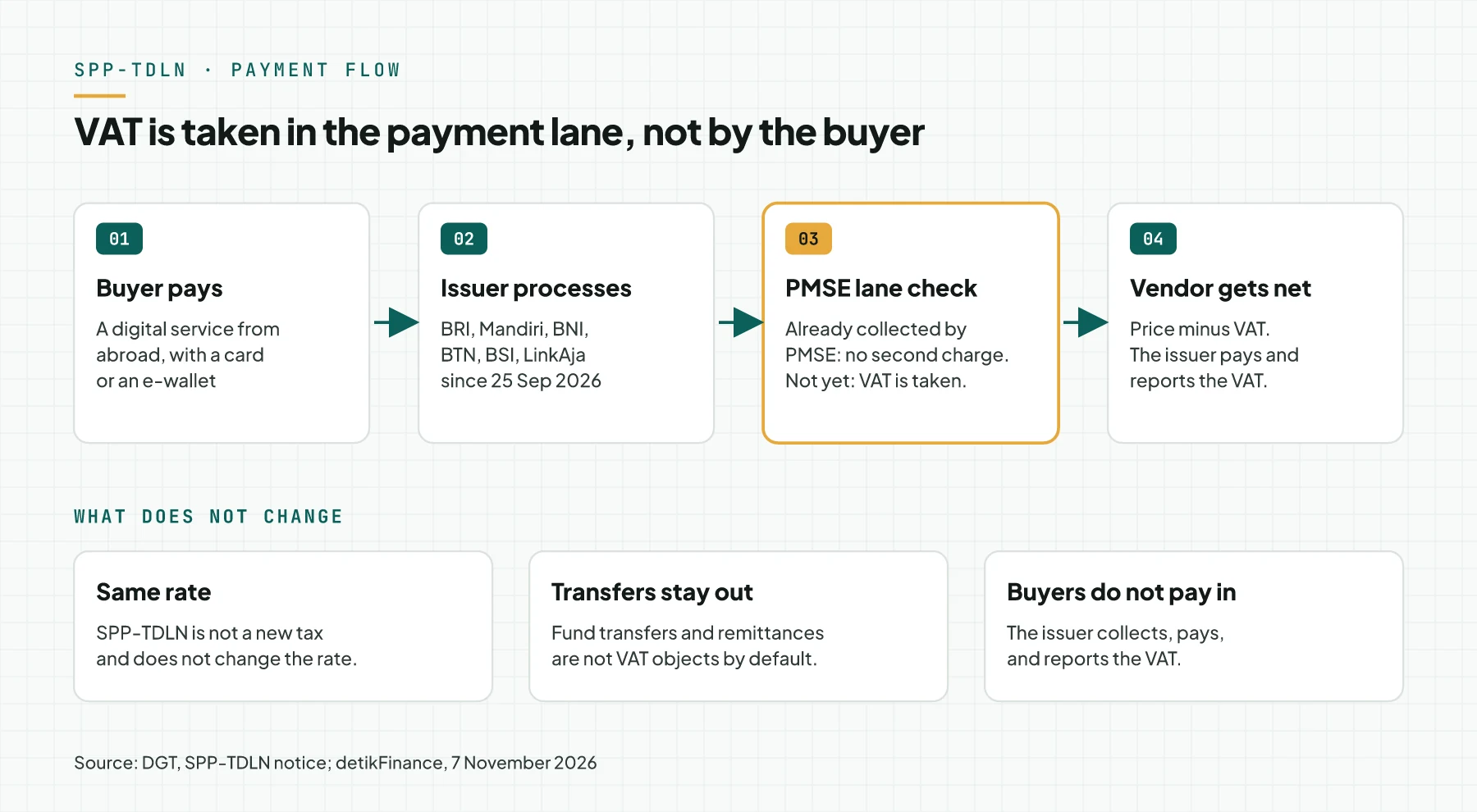
- You pay for a foreign digital service with a card or an e-wallet.
- The issuer processes the payment. Since 25 September 2026, the official issuers are BRI, Mandiri, BNI, BTN, BSI, and LinkAja.
- The system checks whether the PMSE lane already taxed the purchase.
- If not, the issuer collects VAT. The vendor gets the price minus VAT.
- The issuer pays and reports the VAT. You do not pay it in yourself.
From those 6 issuers, the DGT recorded 5.5 million transactions with a potential value of Rp10 trillion from 25 September to 11 October 2026, calculated at an 11% VAT rate (CNBC Indonesia, 15 October 2026). The DGT still calls these numbers stabilization-period data.
Which subscriptions use the PMSE lane and which use SPP-TDLN?
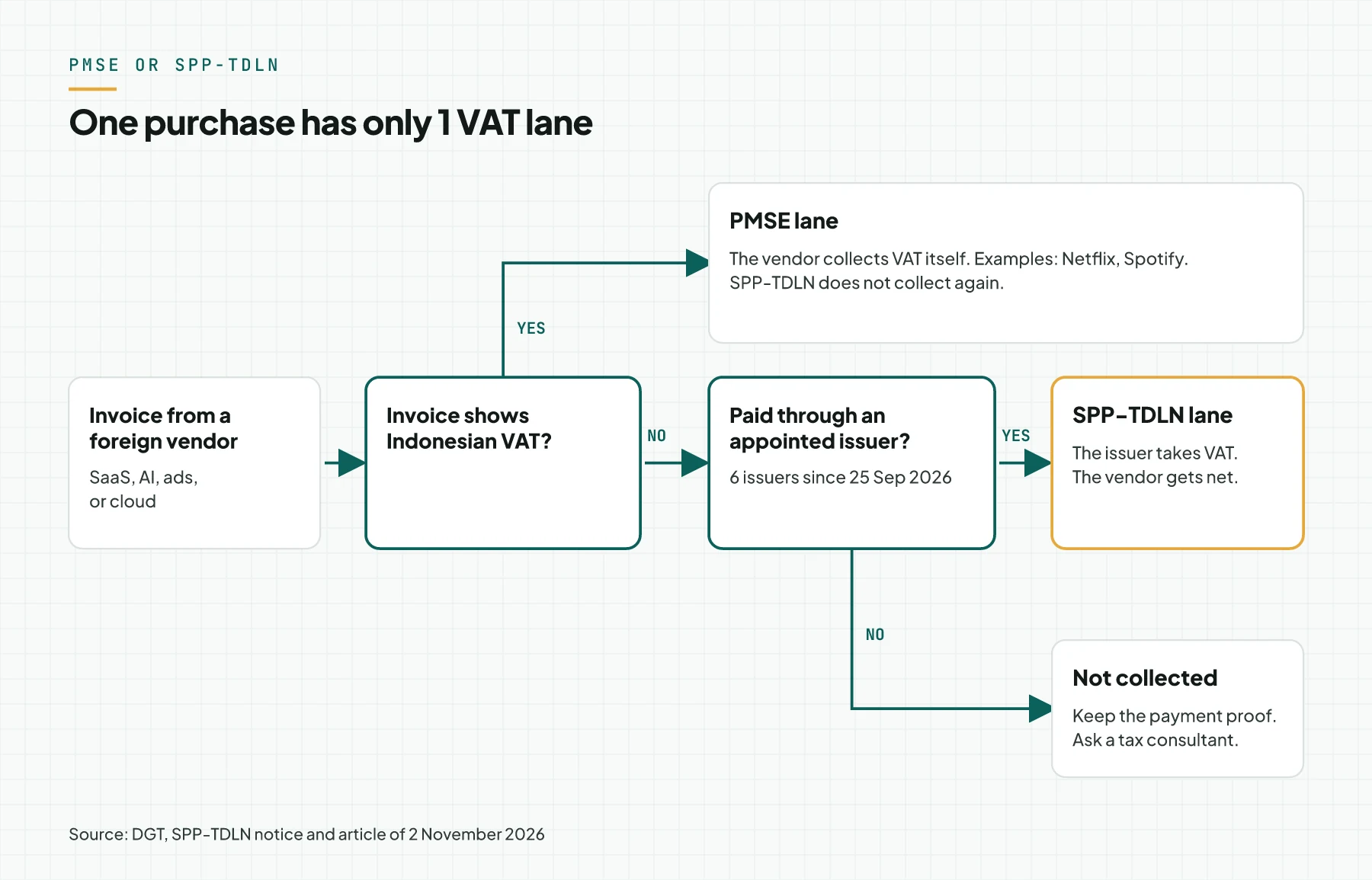
Each purchase uses only 1 VAT lane, so you must know the lane of each bill. In the PMSE lane, a foreign vendor that the DGT appointed collects VAT itself and shows it on the invoice.
| Bill condition | VAT lane | What you do |
|---|---|---|
| The invoice shows Indonesian VAT | PMSE, the vendor collects | Keep the invoice. SPP-TDLN does not collect again. |
| No VAT on the invoice, paid with a card or e-wallet from the 6 issuers | SPP-TDLN, the issuer collects | Compare the statement amount with the invoice. |
| No VAT on the invoice, paid with another method | Not collected through these 2 lanes | Keep the payment proof. Ask a tax consultant. |
IKPI wrote that VAT on Netflix through Spotify still goes through PMSE (IKPI, 30 September 2026). For other vendors, the invoice is the fastest proof. Find a line for Indonesian PPN or VAT on the latest invoice.
What is the impact on your team's tool and ad costs?
The price you pay does not rise by default, but small vendors can raise their prices. The cause is that the DGT says the price already includes VAT, so the vendor gets a smaller amount.
The example below uses the 11% rate from the DGT data above. The official calculation basis is in PMK 49/2026, so treat these numbers as an illustration.
| Scenario | You pay | VAT | Vendor gets |
|---|---|---|---|
| Same price, VAT inside the price | Rp1,110,000 | Rp110,000 | Rp1,000,000 |
| Vendor wants to keep Rp1,110,000 | Rp1,232,100 | Rp122,100 | Rp1,110,000 |
For the budget, use this upper-limit formula: total monthly non-PMSE bills multiplied by 11%. A team with Rp5,000,000 of non-PMSE bills each month needs a reserve of up to Rp550,000 each month, if all vendors raise prices in full.
For AI cost per job, also use how to calculate AI cost per task. That formula shows which tools hurt the most if their prices rise.
Check your foreign tool bills in 7 steps
Our estimate is 1 hour for 10 to 20 subscriptions. Do the check once now, then repeat it at the start of each month.
- Pull a list of all foreign subscriptions and ad accounts from the last 3 months of bank statements.
- Open the latest invoice from each vendor. Find a line for Indonesian PPN or VAT.
- Record the payment method of each vendor. Mark cards or e-wallets from BRI, Mandiri, BNI, BTN, BSI, and LinkAja.
- Compare the statement amount with the invoice amount for bills since 25 September 2026.
- Keep invoices and statements in 1 folder for each month. The DGT tells taxpayers to keep transaction proof.
- If your business is a VAT-registered entrepreneur (PKP), ask a tax consultant before you pay VAT on foreign services yourself. This step prevents a double VAT payment.
- Watch the official DGT channels. The DGT targets 30 banks and fintechs, including Mastercard and Visa, as issuers.
If this recap takes admin time each month, you can automate the statement pull and the invoice match. See AI business process automation.
How does a small team record the VAT lane of each vendor?
Use 1 vendor table with 1 owner, because foreign bills often spread across more than 1 card. These columns are enough for budget decisions and for a talk with a tax consultant.
| Column | Content | Purpose |
|---|---|---|
| Vendor | Service name and the entity name on the invoice | Find the VAT line |
| Payment method | Card or e-wallet, and the bank name | Find the SPP-TDLN lane |
| VAT on invoice | Yes or no | Find the PMSE lane |
| October and November amounts | Numbers from the statement | Measure a price rise |
| Proof | Link to the invoice and statement folder | Material for the tax consultant |
Our operational conclusion: do not change the budget because of the 9 November news. Change the budget only for non-PMSE vendors whose statement amounts rise.
If you plan an internal finance system, see AI-native ERP development.
Which sources did we use?
- DGT, official SPP-TDLN notice, FAQ, and PMK 49/2026
- DGT, press release SP-22/2026, 1 October 2026
- DGT, SPP-TDLN article, 2 November 2026
- detikFinance, DGT statement, 7 November 2026
- CNBC Indonesia, target of 30 issuers, 15 October 2026
- IKPI, VAT on Netflix through Spotify via PMSE, 30 September 2026
Questions and answers
Do bank transfers abroad get VAT from 9 November 2026?
Not by default. The DGT says fund transfers and remittances are not VAT objects by default. SPP-TDLN collects VAT only on foreign digital purchases that meet the VAT object criteria.
Do Netflix or Spotify subscriptions get VAT 2 times?
No. A purchase that PMSE already taxed does not get VAT again through SPP-TDLN. IKPI wrote that Netflix through Spotify still go through PMSE.
Must I pay the VAT in myself?
For consumers, no. The issuer collects, pays, and reports the VAT through SPP-TDLN. A VAT-registered business must ask a tax consultant before it pays VAT on foreign services itself.
Which banks and e-wallets collect VAT through SPP-TDLN now?
On 7 November 2026 there were 6 issuers: BRI, Mandiri, BNI, BTN, BSI, and LinkAja. The DGT will announce new issuers on its official channels after the preparation stages end.
Will foreign tool subscription prices rise?
Prices can rise at vendors that do not collect VAT through PMSE. Those vendors get a smaller amount, so they can raise prices by up to 11% to keep their net income.