Direct answer: choose Google Ads when you need leads this month, and choose SEOSEOThe work of making your page easy to find and easy to choose in search results, without paying for ads.Open the glossary when you need leads that still arrive next year. For a budget of Rp 10,000,000 per month, Rama Digital recommends a split by business stage: 70% ads and 30% SEO for a new product, 50% and 50% when demand already exists, then 30% ads and 70% SEO in a crowded market. Ads stop bringing clicks on the day you stop paying, and SEO pages stay visible after that. So the question is not which 1 channel to pick, but which split fits your stage now.
Main condition: this answer holds when people already search for your product on Google, your pages can be indexed, and you can hold the budget for 6 months. A minimum 6-month SEO contract is the Indonesian market standard. Source: Dipstrategy: SEO service prices in Indonesia 2026. Limit: this article promises no ranking and uses no data from your account. The 70/30, 50/50, and 30/70 splits are a starting point, not a measurement. A product that Google Ads policy restricts needs a different route.
Rama Digital checked market prices and AI impact data on 16 September 2026. We read Optimaise for per-task prices, Dipstrategy for monthly prices, Doit.co.id for SEO timing, then Ahrefs and Contently for the AI OverviewsAIOThe AI answer summary above search results. It answers part of the question before anybody presses a link.Open the glossary impact. Every example in this article uses a dummy-data simulation, not customer data.
The problem: 1 budget, 2 channels that ask for the same money
Business owners ask the same question every month: the budget is Rp 10,000,000, should it go to SEO or to ads? The question feels like a binary choice. The same money indeed cannot be spent twice.
A second problem appears when ads pause. Traffic stops on the same day, and the team suspects a technical fault. It is not a fault: ads rent attention, they do not own it.
A third problem is the vocabulary. SEM covers paid search ads, while SEO is the part of the same results page that carries no click price. A reader who is new to both terms can first read what an SEO service is and what the work covers. That page is the pillar of this cluster and points to 11 other articles.
How the 2 channels work: 6 properties that separate them
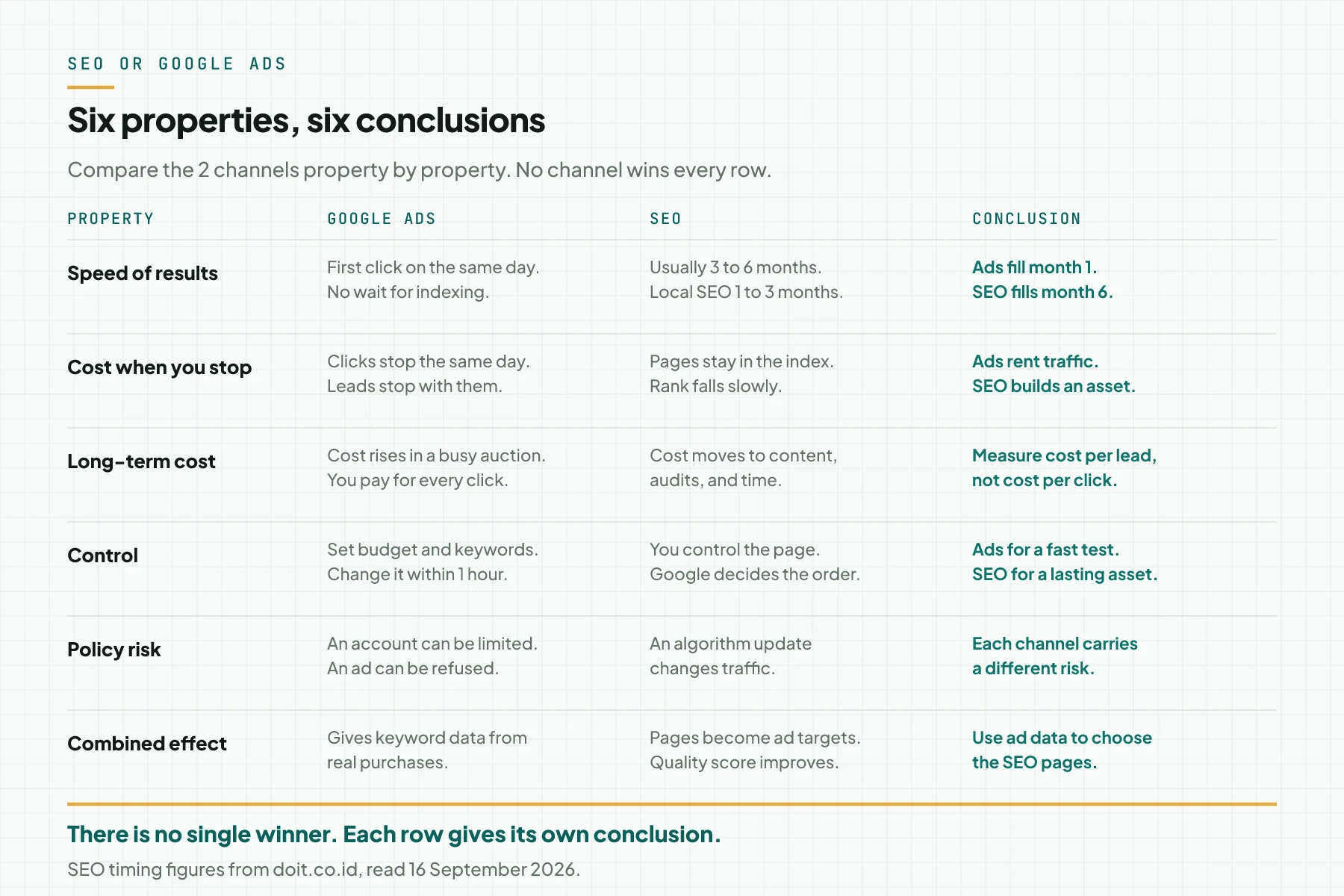
Compare the 2 channels on properties, not on taste. Each property gives its own conclusion, and no channel wins every property.
1. Speed of results
Google Ads delivers the first click on the day the account and the ad are approved. SEO needs time because Google must crawl, index, and judge the page first.
SEO results usually show in 3 to 6 months. Competitive keywords need 6 to 12 months, and local SEO needs 1 to 3 months. Source: Doit.co.id: how long SEO results take. For the month-by-month detail, read the article on SEO timing expectations.
2. Cost when you stop
Ads stop bringing clicks on the day you stop paying, and paid leads stop with them. SEO pages stay in the index and keep receiving clicks after the work stops.
This answers the question "if I stop ads, does SEO help". The answer is yes, but only when the pages were built before the ads stopped. Organic traffic falls gradually, not immediately.
3. Long-term cost per click
The ad click price follows an auction. The more sellers bid on the same keyword, the more the same click costs.
SEO cost moves into work: audits, keyword research, content, technical SEO, and backlinks. The Indonesian market price for each task appears in the price table below. Rama Digital recommendation: compare cost per lead, not cost per clickCPCThe average cost of 1 ad click. Divide the ad spend by the number of clicks.Open the glossary.
4. Control
You set the daily budget, the keywords, the locations, and the ad schedule, then change them within 1 hour. In SEO you control the page, the structure, and the content, while Google decides the order of results.
Fast control sits with ads. Control over an asset sits with SEO. Both help, but at different times.
5. Policy risk
An ad account can be limited and 1 ad can be refused, so paid traffic disappears within 1 day. In SEO, risk comes from algorithm updates and from techniques that break the guidelines.
An SEO price under Rp 1,000,000 per month with a page 1 promise signals black hat risk. Source: Dipstrategy: fair price standards for SEO services. If you still weigh an in-house team against an agency, read the article on the SEO team structure decision.
6. Combined effect
Ad data shows which keywords truly produce a purchase, not only a search. Use that list to pick the next SEO pages.
In the other direction, a mature SEO page becomes an ad landing pageLanding pageThe page an ad points to. It carries 1 offer and 1 action, with no menu pulling the visitor elsewhere.What is a landing page? with tighter relevance. The 2 channels feed each other, so splitting them into 2 separate reports removes this effect.
AI Overviews change the value of 1 organic click
AI Overviews move part of the answer onto the results page. Organic CTRCTRClicks divided by impressions, as a percentage. CTR shows how often people press the ad or the search result they saw.Open the glossary falls 34% to 61% when an AI Overview appears. Source: Ahrefs: AI Overviews reduce clicks.
On queries with AI Overviews, zero-click reaches 80% to 83%. Google referral traffic to publishers fell 38% against the year before. Source: Contently: the AI Overview traffic impact.
Those numbers do not mean SEO stopped working. A brand that AI Overviews cite receives 35% more organic clicks. Source: Contently. So the SEO target moves: not only the ranking, but also the citation inside the AI answer. Our conclusion: 1 organic click now costs more to win, so recalculate the budget split every 3 months.
Comparison table of the 6 properties
The table below holds the section above in 1 screen. Read the conclusion column first when you need a fast decision.
| Property | Google Ads | SEO | Conclusion |
|---|---|---|---|
| Speed of results | First click on the same day | 3 to 6 months; local SEO 1 to 3 months | Ads fill month 1, SEO fills month 6 |
| Cost when you stop | Clicks and leads stop the same day | Pages stay visible, rank falls slowly | Ads rent traffic, SEO builds an asset |
| Long-term cost | Rises in a busy auction, pay per click | Moves into content, audits, and time | Measure cost per lead, not cost per click |
| Control | Budget, keywords, and schedule change within 1 hour | You control the page, Google decides the order | Ads for a fast test, SEO for a lasting asset |
| Policy risk | An account can be limited, an ad can be refused | Algorithm updates and black hat techniques | Each channel carries a different risk |
| Combined effect | Gives keyword data from real purchases | A mature page becomes an ad target | Use ad data to pick the SEO pages |
What to prepare before you split the budget
- Google Ads access with a role that can read cost reports.
- Google Search Console access on your domain property.
- Admin access to the website to change 1 test page.
- 1 lead definition that sales and marketing both accept.
- 1 editable monthly budget sheet with a date on it.
- 1 test identity to check the form and the lead record.
Step 1: Decide your business stage
The stage sets the budget split. Answer these 3 questions honestly before you touch the numbers.
First, do people already search for your product by its category name? Open Google Ads, the Keyword Planner menu, then check the search volume for your category. A volume near zero puts you in the new product stage.
Second, how many sellers bid on the same keywords? Check the competition column in the same tool. High competition signals a crowded market.
Third, do you have a service or product page that can be indexed today? If not, SEO has no material to work on, so the ad share grows in the first month. How to check: open Search Console, the URL Inspection menu, then enter that page URL.
Step 2: Split Rp 10,000,000 by stage
Use the starting split below. These numbers are a Rama Digital recommendation for a budget of Rp 10,000,000 per month, not a measurement of your account.
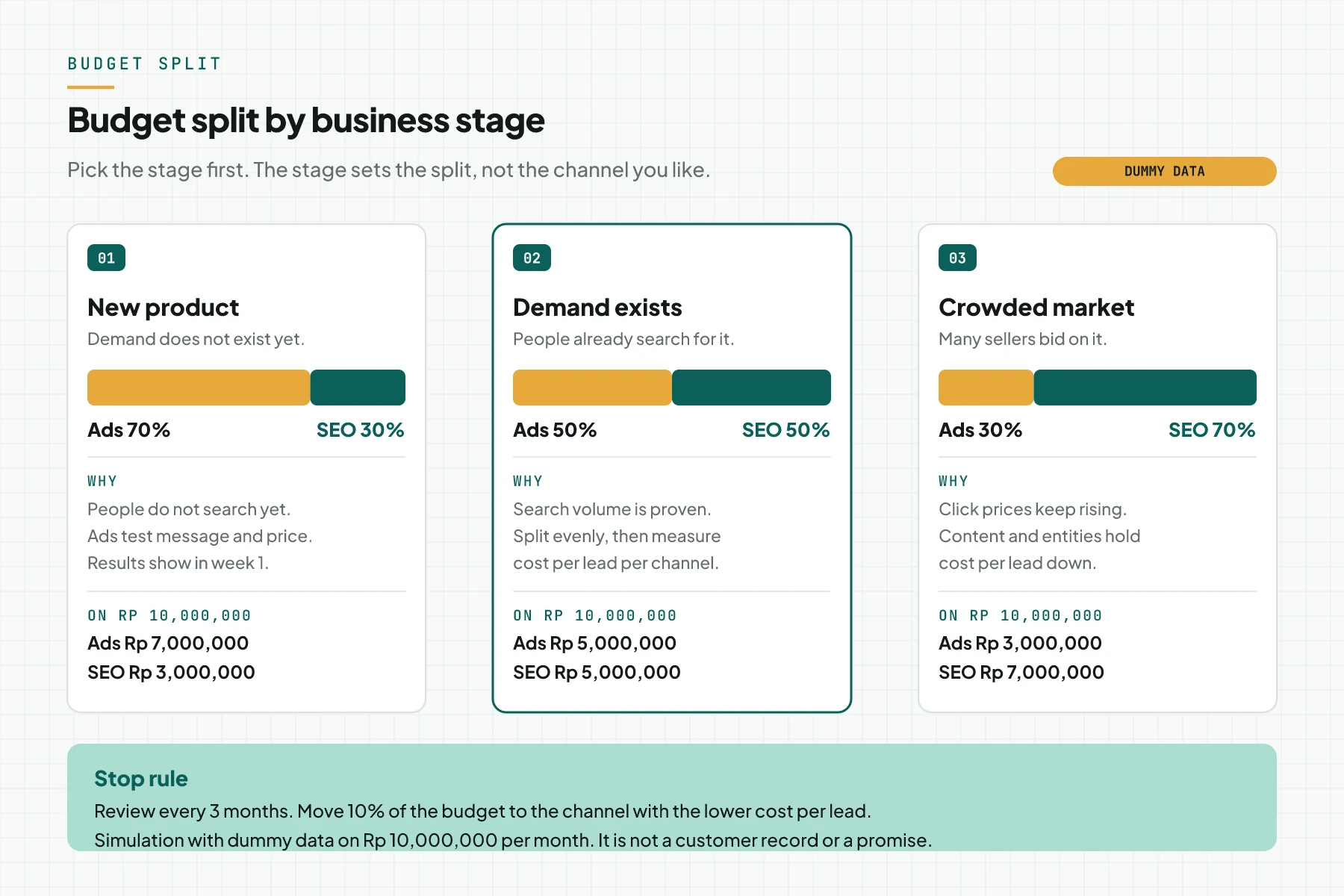
The new product stage uses 70% ads and 30% SEO. People do not search for your category yet, so ads test the message and the price faster. The SEO share pays for an audit and 1 core page.
The demand exists stage uses 50% and 50%. Search volume is proven, so both channels can run together while you measure the cost per lead of each.
The crowded market stage uses 30% ads and 70% SEO. Click prices keep rising in a full auction, and content plus entity strength hold the cost per lead down.
Step 3: Measure cost per lead, then move 10%
The starting split is only a start. The real decision comes from your own numbers after 3 months.
Calculate the ad cost per lead: 1 month of ad spend divided by the leads from ads. Calculate the organic cost per lead: 1 month of SEO spend divided by the leads from unpaid search.
At every 3-month review, move 10% of the budget to the channel with the lower cost per lead. Move 10%, not 50%, so 1 weak month does not erase a quarter of work.
A 6-month simulation with dummy data
The example below uses dummy data. The numbers belong to no customer, and they promise no result. The purpose is to show how to read your own decision table.
| Month | Ad and SEO share | Ad and organic leads | Ad and organic cost per lead |
|---|---|---|---|
| Month 1 | Rp 7,000,000 and Rp 3,000,000 | 14 and 0 | Rp 500,000 and not yet measurable |
| Month 2 | Rp 7,000,000 and Rp 3,000,000 | 15 and 1 | Rp 467,000 and Rp 3,000,000 |
| Month 3 | Rp 7,000,000 and Rp 3,000,000 | 15 and 3 | Rp 467,000 and Rp 1,000,000 |
| Month 4 | Rp 6,000,000 and Rp 4,000,000 | 13 and 6 | Rp 462,000 and Rp 667,000 |
| Month 5 | Rp 6,000,000 and Rp 4,000,000 | 13 and 9 | Rp 462,000 and Rp 444,000 |
| Month 6 | Rp 6,000,000 and Rp 4,000,000 | 12 and 13 | Rp 500,000 and Rp 308,000 |
Read the rows like this. In month 3 the organic cost per lead is still twice the ad cost, so the first review moves only 10% of the budget.
In month 5 the 2 numbers meet. In month 6 organic leads pass ad leads, and the second review moves another 10%. The observable output: total leads rise from 14 to 25 with no budget increase.
Checklist before you change the budget
- Write your business stage in 1 sentence. Owner: the business owner. Evidence: a dated stage note.
- Take the cost per lead for the last 90 days from the ad account. Owner: the ads manager. Evidence: the exported report.
- Take the clicks and organic leads for the last 28 days from Search Console. Owner: the web manager. Evidence: the 28-day report.
- Set the starting split by stage. Owner: the business owner. Evidence: 1 dated budget sheet.
- Pick the 10 landing pages that ads and SEO share. Owner: the content writer. Evidence: the URL list.
- Track 20 prompts on AI engines every month. Owner: the SEO team. Evidence: the monthly tracking report.
- Compare the cost per lead of both channels in month 3, then move 10% of the budget. Owner: the business owner. Evidence: the review table.
- Stop criterion: stop moving budget when the cost per lead of both channels changes less than 10% across 2 consecutive reviews. Owner: the business owner. Evidence: 2 review reports.
Indonesian SEO market prices on 16 September 2026
The figures below help you judge a quotation. We read every price on 16 September 2026, and a price can change after that date.
| Cost item | Market range | Source |
|---|---|---|
| One-off SEO audit | Rp 500,000 to Rp 3,000,000 | Optimaise |
| Keyword research | Rp 500,000 to Rp 2,000,000 | Optimaise |
| Content per article | Rp 300,000 to Rp 1,500,000 | Optimaise |
| Backlinks per month | Rp 500,000 to more than Rp 5,000,000 | Optimaise |
| Technical SEO per project | Rp 1,000,000 to more than Rp 5,000,000 | Optimaise |
| Monthly SEO for a small business | Rp 2,000,000 to Rp 8,000,000 | Dipstrategy |
| Monthly SEO for a mid-size business | Rp 8,000,000 to Rp 20,000,000 | Dipstrategy |
| Monthly SEO for an enterprise | Rp 20,000,000 to Rp 50,000,000 and above | Dipstrategy |
AI visibility work carries a separate price. In Indonesia, cmlabs starts its GEOGEOThe work of preparing a page so an AI answer engine quotes it correctly, not only a classic search engine.Open the glossary service at Rp 15,000,000 per month, and global GEO agencies charge USD 4,000 to USD 10,000 per month. Source: Gen-Optima: GEO agencies in Indonesia 2026. At Rp 16,300 per USD, that global range equals Rp 65,200,000 to Rp 163,000,000 per month.
Mid-tier AEO and GEO retainers run from USD 2,000 to USD 8,000 per month. Source: The Digital Elevator: AEO and GEO pricing guide. The 2026 GEO cost breakdown sits in WebFX: generative engine optimization cost.
AI visibility tools add a fixed cost. Semrush AI Visibility Toolkit charges USD 99 per month for 1 domain, Profound charges USD 99 to USD 399 per month, and Peec AI charges EUR 89 to EUR 199 per month. Source: Ryze: AI visibility tool pricing compared 2026.
The Rama Digital monthly SEO service uses the prices below. The promotion runs 40% under the normal price, and the monthly contract runs at least 6 months with a month 3 review and a right to stop.
| Package | Promo price per month | Normal price per month | Work hours per month |
|---|---|---|---|
| Pantau | Rp 1,080,000 | Rp 1,800,000 | 1 |
| Rawat | Rp 3,540,000 | Rp 5,900,000 | 8 |
| Tumbuh | Rp 7,080,000 | Rp 11,800,000 | 18 |
| Perluas | Rp 14,280,000 | Rp 23,800,000 | 36 |
The Rawat package holds a monthly crawl, up to 5 priority fixes, tracking of 20 prompts on 2 AI engines, a 28-day Search Console report, and 1 updated page. The Tumbuh package adds tracking of 50 prompts on 4 AI engines, 2 new articles, 3 updated pages, an analysis of 2 competitors, and 1 session of 60 minutes.
If you do not know the state of your pages yet, the Pindai package costs Rp 2,520,000 from a normal price of Rp 4,200,000 and finishes in 3 working days. The Pindai fee is credited in full to the Audit package or the Audit and Repair package when you continue within 30 days.
Frequently asked questions
Is SEO or Google Ads better for my business? Choose ads when you need leads this month. Choose SEO when you need leads that keep arriving after the budget drops. Your business stage sets the split, not team preference.
My budget is Rp 10,000,000 per month, should it go to SEO or ads? Split it by stage: 70% ads for a new product, 50% and 50% when demand already exists, then 30% ads in a crowded market. Review those numbers every 3 months.
If I stop ads, my traffic disappears. Does SEO help? Yes, when the pages were built before the ads stopped. An indexed page keeps receiving clicks, and the fall runs gradually.
What is the difference between SEO and SEM? SEM covers paid search ads. SEO is the part of the same results page that carries no click price. Both use keywords, but they use a different payment method.
How long must I wait for SEO results? Results usually show in 3 to 6 months. Competitive keywords need 6 to 12 months, and local SEO needs 1 to 3 months. Source: Doit.co.id.
Do AI Overviews make SEO useless? No. Organic CTR does fall 34% to 61%, but a brand that AI Overviews cite receives 35% more organic clicks. The target moves to the citation, it does not disappear.
Next step
The limit that still applies: the splits in this article are a starting point, and your own numbers make the decision. Rama Digital sells a process and a measurement, not a ranking promise.
If you want the SEO share delivered with fixed work hours and a monthly report, see the Monthly SEO and AI Visibility Service packages. If you want to discuss your stage and the split first, book a 30-minute consultation.
Sources
- Optimaise: SEO service prices per task
- Dipstrategy: SEO service prices in Indonesia 2026
- Doit.co.id: how long SEO results take
- Ahrefs: AI Overviews reduce organic clicks
- Contently: the AI Overview traffic impact
- Gen-Optima: GEO agencies in Indonesia 2026
- The Digital Elevator: AEO and GEO pricing guide
- WebFX: generative engine optimization cost
- Ryze: AI visibility tool pricing compared 2026