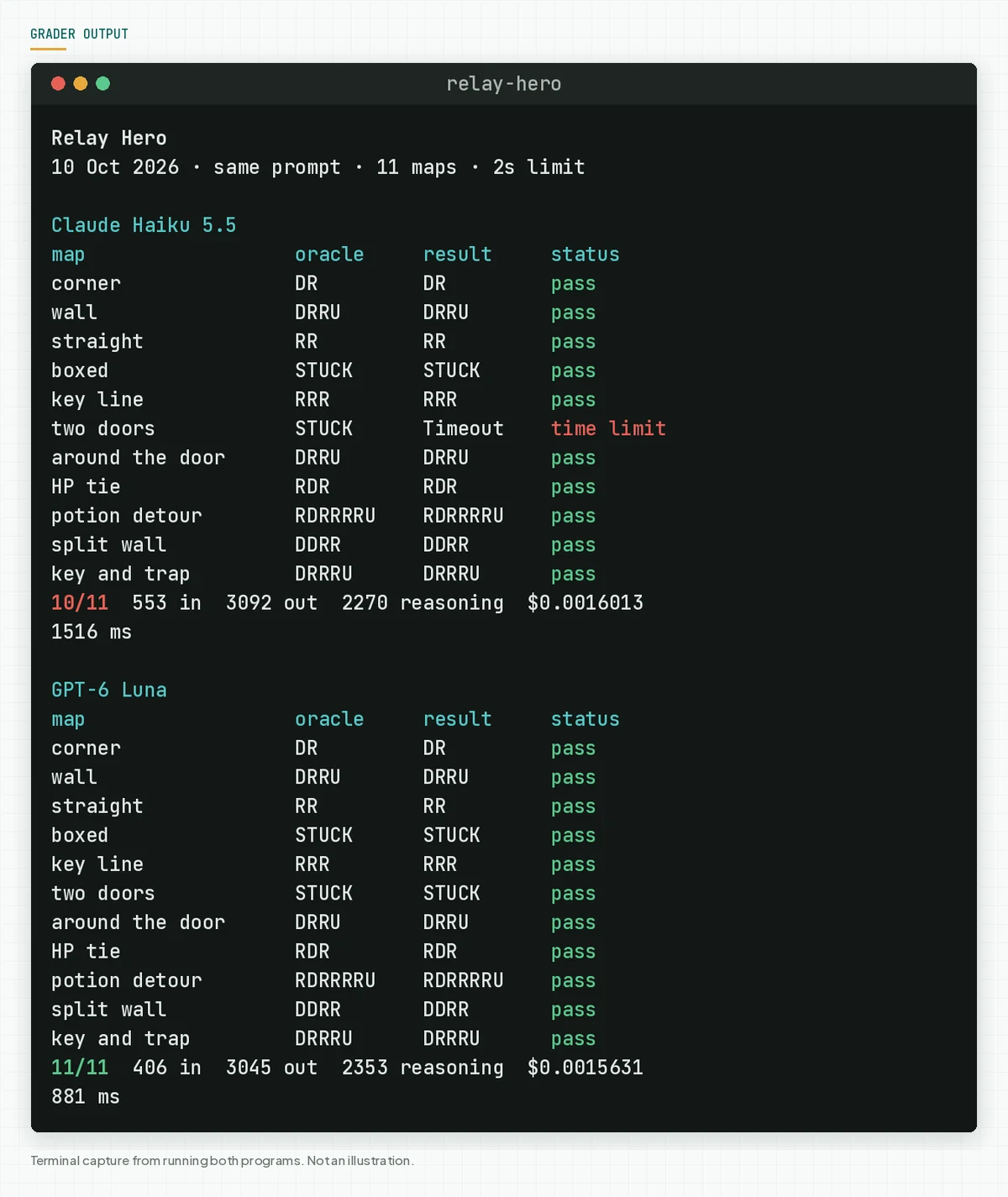
Direct answer: On one identical coding prompt, the GPT-6 Luna program passed 11 of 11 maps. The ClaudeClaude ProThe paid subscription for the Claude AI assistant from Anthropic. It unlocks connectors to outside tools.Open the glossary Haiku 5.5 program passed 10 of 11. The missed map has no route, and the Haiku 5.5 program did not return within 2 seconds.
Main condition: These figures come from 1 call per model on 10 October 2026, through OpenRouter, at effort medium. The list price is the same: $0.10 per million input tokens and $0.50 per million output tokens. This call cost $0.0015631 for Luna and $0.0016013 for Haiku 5.5.
Limit: This is not a leaderboard. the Haiku 5.5 and GPT-6 Luna price comparison reports 108 calls on 6 short business tasks. There, both models passed 54 of 54, and the Haiku 5.5 bill was 1.9x to 3.3x the Luna bill. This coding prompt does not repeat that ratio.
The picture below is the grader terminal, not a drawn chart. Both programs ran on the same 11 maps.
The Relay Hero challenge
We named this test Relay Hero. The model writes 1 Python function, plan(dungeon). The function returns the hero's path on a grid, or STUCK when no path exists.
The prompt is in English. Both models received the same text. There was no system message, no tool, and no repair turn.
The rules in the prompt:
- The grid is a rectangle. Rows are split by newlines. Every row has the same length.
Sis the start.Gis the goal. There is one of each.#is a wall. The hero cannot enter it..is floor.tis a trap and costs 3 HP. The move is illegal if HP would become 0 or less.pis a potion. The first visit sets HP tomin(20, HP + 5). A later visit changes nothing.kis a key. The first visit adds 1 key. A later visit adds none.dis a door. Entering it spends 1 key. Entering with 0 keys is illegal.- The hero starts with 10 HP and 0 keys. A move is only
U,D,L, orR. - Choose the shortest path. On a length tie, choose the highest HP on
G. On a further tie, choose the lexicographically smallest string. - If no path exists, return
STUCK. The function must return within 2 seconds on a grid up to 8 by 8.
The prompt includes 2 examples. The corner S. / .G answers DR. The wall S#G / ... answers DRRU. The other 9 maps were not in the prompt.
We wrote the oracle before the model calls. The oracle has a path finder and a separate step checker. We replayed every non-STUCK answer cell by cell. We also rejected any shorter path than the oracle answer.
How the calls were set
Both requests used POST https://openrouter.ai/api/v1/chat/completions. The max_tokens cap was 16,000. The field reasoning.effort was medium. Provider fallback was off. data_collection was deny.
| Item | Claude Haiku 5.5 | GPT-6 Luna |
|---|---|---|
| OpenRouter slug | anthropic/claude-haiku-5.5 | openai/gpt-6-luna |
| Vendor model ID | claude-haiku-5-5 | gpt-6-luna |
| Provider that answered | Anthropic | OpenAI |
| Status and finish | HTTP 200, stop | HTTP 200, stop |
| Time to the full body | 1,516 ms | 881 ms |
The client clock starts when the request is sent and stops when the body arrives. The figure includes the network. It is 1 sample, not a latency test.
finish: stop means the 16,000 token cap did not cut the answer. The Haiku 5.5 miss happened when the program ran, not when the model wrote it.
We read the list price from Anthropic pricing, Haiku 5.5 model overview, Claude Haiku 5.5 announcement, GPT-6 Luna model page, and GPT-6 Sol and Luna announcement. For prompts up to 100,000 tokens, Haiku 5.5 costs $0.10 input and $0.50 output per million tokens. Above 100,000 tokens, Haiku 5.5 costs $0.50 and $2.50. Luna uses $0.10 and $0.50 up to 272,000 input tokens. This test prompt sits far below both lines.
Tokens and the bill
OpenRouter returned usage. Reasoning tokens sit inside output tokens. We checked the list-price formula. It matched usage.cost to the last digit.
Haiku 5.5: 553 / 1,000,000 x $0.10 + 3,092 / 1,000,000 x $0.50 = $0.0016013.
GPT-6 Luna: 406 / 1,000,000 x $0.10 + 3,045 / 1,000,000 x $0.50 = $0.0015631.
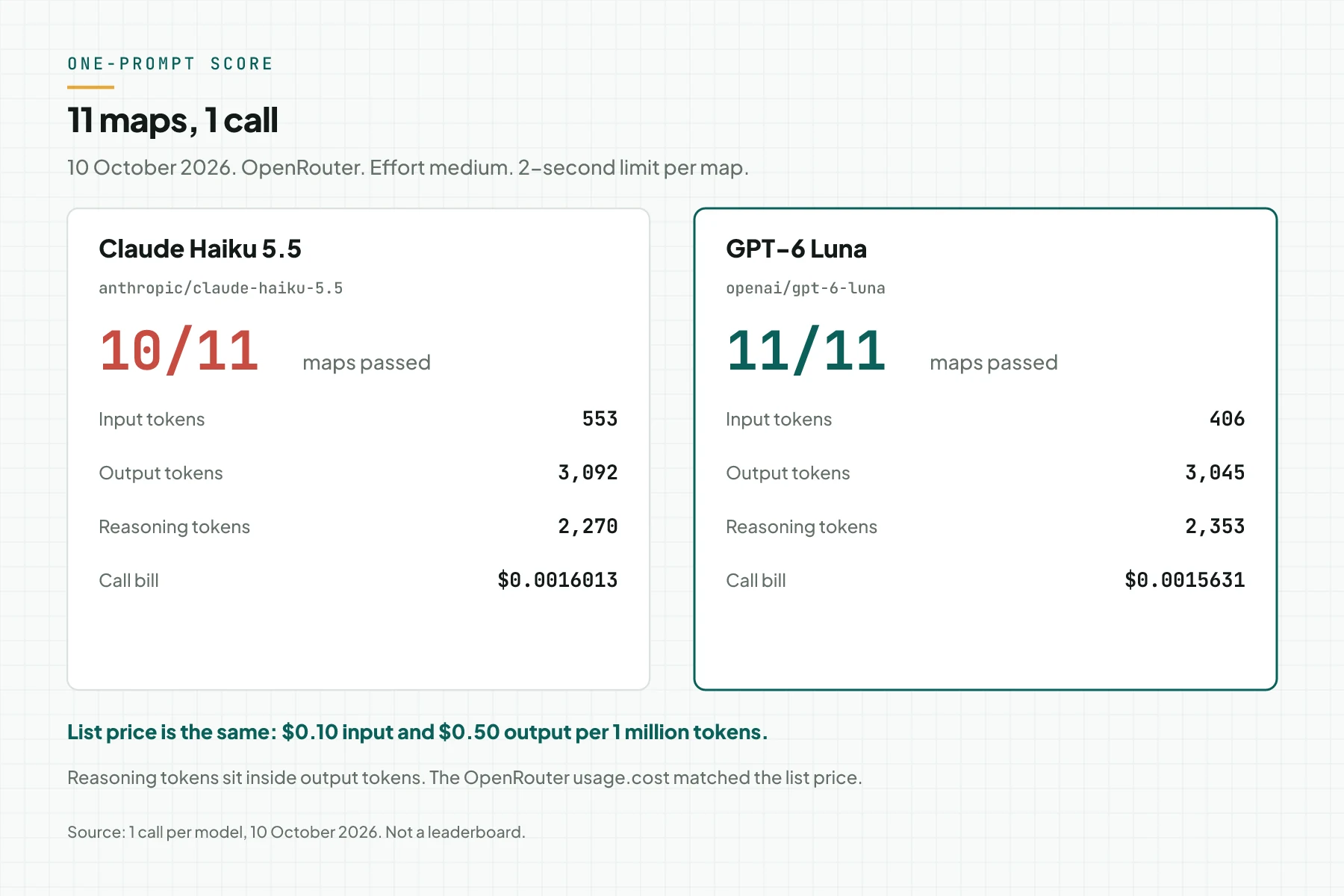
The prompt text was the same. The token counters were not. Haiku 5.5 counted 553 input tokens. Luna counted 406. The gap is 147 tokens, or 36% more on Haiku 5.5, for the same characters.
Output tokens were close: 3,092 versus 3,045. Reasoning tokens were 2,270 versus 2,353. Reasoning was 2,270 of Haiku 5.5's 3,092 output tokens, and 2,353 of Luna's 3,045. The rest, the visible code, was 822 versus 692 tokens.
On the JISDOR rate for 9 October 2026, 1 US dollar was Rp17.884. The test fell on a Saturday, so the rate is Friday's rate. One Haiku 5.5 call was Rp28,64. One Luna call was Rp27,95.
One thousand calls of the same prompt cost $1.6013000 for Haiku 5.5 and $1.5631000 for Luna. In rupiah, that is Rp28.637,65 and Rp27.954,48. The gap for 1,000 calls is $0.0382000, or Rp683,17.
The price per token does not pick a winner on this prompt. The bill gap is small. The score gap is 1 map. how to calculate API cost shows the same formula for other models. the GPT-6 Luna specification stores Luna's context limit.
The 11 map scores
The grader ran the function in a separate process. Each map had a 2-second limit. The answer had to match the oracle string, not merely reach G.
| Map | In the prompt | Oracle | Haiku 5.5 | GPT-6 Luna |
|---|---|---|---|---|
| corner | Yes | DR | Pass | Pass |
| wall | Yes | DRRU | Pass | Pass |
| straight | No | RR | Pass | Pass |
| boxed | No | STUCK | Pass | Pass |
| key line | No | RRR | Pass | Pass |
| two doors | No | STUCK | Time limit | Pass |
| around the door | No | DRRU | Pass | Pass |
| HP tie | No | RDR | Pass | Pass |
| potion detour | No | RDRRRRU | Pass | Pass |
| split wall | No | DDRR | Pass | Pass |
| key and trap | No | DRRRU | Pass | Pass |
Both programs passed the 2 maps from the prompt. Both also passed the 3 maps that test a tie: around the door (DRRU), the HP tie (RDR), and the center wall (DDRR). Both passed the potion map (RDRRRRU). Both programs can search when a route exists.
The two-door map is the only split. The grid is SkddG. It has 1 key and 2 doors. The first door spends the key. The second door cannot be entered. No other route reaches G. The oracle returns STUCK.
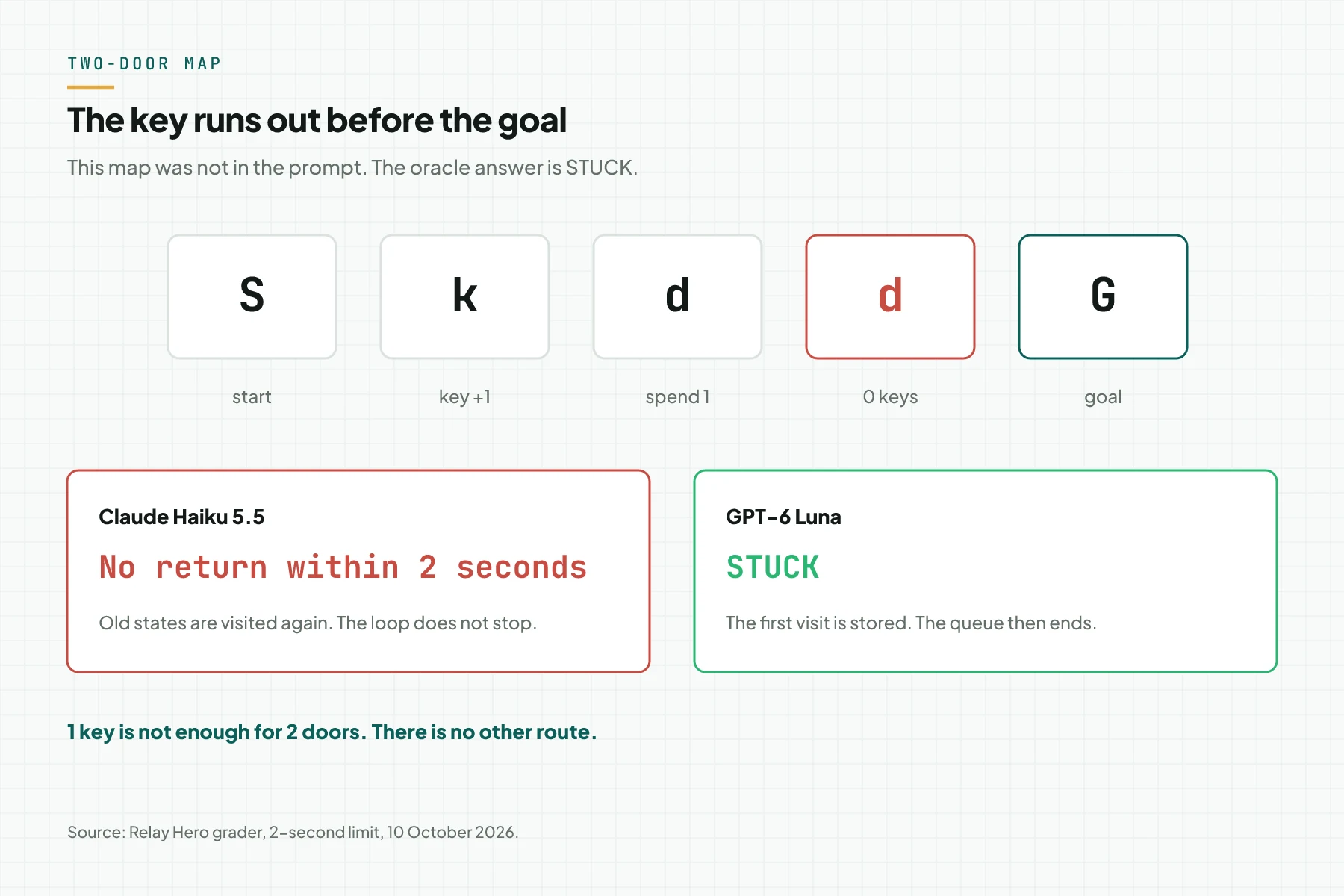
The Luna program stores the first visit to each state. A state holds the position, HP, key count, and the potions or keys already taken. A known state is skipped. When the queue ends, the function returns STUCK.
The Haiku 5.5 program stores the shortest path in the current step layer, including the lexicographically smallest path. It does not store states from earlier layers. On a map with no route, every layer still has moves. The loop never meets a stop condition. The grader cut the process at 2 seconds and recorded a time limit.
That miss is in the code, not in the luck of 1 sample. The other maps do not trigger the loop, because the goal is found and the function returns. A map with no goal gives the function no reason to return.
What this run does not decide
Do not move a production agentAI agentAn AI program that performs work steps by itself, for example reading a message, drafting a reply, and recording the result.Open the glossary only because Luna won these 11 maps. Do not drop Haiku 5.5 only because of 1 loop. Your task can reverse the result.
The 9 October 2026 test still stands for the short tasks that article measured. There, Haiku 5.5 wrote more tokens. On this coding prompt, the output counts were close. Two tasks, two ratios. Count your own task.
This test does not measure computer use, a repair turn with tools, or a document above 100,000 tokens. It also does not measure high or max effort. We sent only medium.
The times 881 ms and 1,516 ms are 1 sample of network plus generation. Do not use that gap as a latency promise.
Both programs passed the maps that have a route, including the maps where the tie rule changes the string. The measured weakness is stopping when no route exists. A coding agent needs that: the program must return, not walk forever.
Checklist before you lock a model
The owner is the person who picks the model for the agent. Keep the usage object and the grader log. Stop when the cost per passed task is a cost you accept, or when the program does not return inside the time limit.
- Save the prompt text and the model slug. Do not summarize the prompt after the call.
- Pin the provider. Turn fallback off, so the tokens do not move to another model.
- Send the same effort value. Record that value next to the score.
- Record input tokens, output tokens, reasoning tokens, and
usage.cost. - Score the program on maps that were not in the prompt.
- Put a time limit on each map. A loop with no end must fail.
- Read the code when 1 map fails. Do not stop at the score.
- Repeat the test on your production task before you move the agent.
Next step
The limits above still apply. One prompt does not pick a model for a whole operation. Open the AI Workflow Audit when your agent task is not mapped yet, then measure the cost per passed task on that set. the Haiku 5.5 and GPT-6 Luna price comparison remains the reference for short business tasks.
Sources
- Claude Haiku 5.5 announcement. Read 10 October 2026. Released 7 October 2026, with the price for prompts up to 100,000 tokens.
- Anthropic pricing and Haiku 5.5 model overview. Read 10 October 2026. The $0.10 / $0.50 price, and the price above 100,000 tokens.
- GPT-6 Luna model page and GPT-6 Sol and Luna announcement. Read 10 October 2026. The $0.10 / $0.50 price and the 272,000 token line.
- anthropic/claude-haiku-5.5 and openai/gpt-6-luna. The call route on 10 October 2026. The providers that answered were Anthropic and OpenAI.
- JISDOR. Rate on 9 October 2026: Rp17.884 per 1 US dollar.
- Rama Digital test, 10 October 2026. One prompt, one call per model, 11 maps, 2-second limit. The bill is the OpenRouter
usage.cost.